Moving Up Maslow’s Pyramid with Kirsten Dirksen

Since 2006, Kirsten Dirksen and her husband have been producing *faircompanies, a web video series that has evolved to become the world’s most comprehensive archive of compact homes and the people who made and live in them (among other things). Virtually every significant small space–from our own LifeEdited apartment to Nakagin Capsule Tower to many, many others you never heard of, but should have–has been lovingly chronicled by Dirksen.

As her profession dictates, Dirksen’s focus has her looking at others, but we thought it was time to turn the focus on her, finding out more about her and *faircompanies..

David Friedlander: Tell us a little bit about yourself.

Kirsten Dirksen: I live in Fontainebleau, France (40 miles south of Paris). We just moved from Barcelona this fall.

I don’t really have a job title. I used to work in television, then I met my husband in Barcelona and started commuting there between freelance TV jobs in NYC. Once we had kids I began to do more freelance work from Spain, but now I just make videos for our website and youtube channel.

DF: How did *faircompanies begin?

KD: Back in 2006, my husband, Nicolás Boullosa, had the idea to start a website that was a type of 21st-century Whole Earth Catalog. While it has evolved into something a bit different, “access to tools” is still the logline for *faircompanies.

With my videos I try to focus on great stories: people who are building unique homes, creating new vehicles, reinventing gardening, etc. Again echoing Stewart Brand (founder of the Whole Earth Catalog), I believe in the power of basic tools and skills–and the technologies available to us today (e.g. 3D printing, aeroponics, Arduino)–to shape our environments in a way unthinkable a few generations ago. As Brand wrote back in 1968 “we are as gods and might as well get good at it”. (For a taste of all this, I put together a compilation video of some of my stories here).

DF: What is your intention behind making the videos?

KD: I want to explore stories in the way I wanted to film and edit them, but often couldn’t while working for broadcast media. I make videos to examine how other people live. The camera gives me an excuse to ask questions.

What attracts me most to people who have minimized their lives (their possessions, the size of their home, etc) is the shift in focus. Here are people who have decided not to focus on stuff and so that leaves the more interesting topics, namely, my personal favorite: anything related to philosophy of life.

DF: What is or are the favorite videos you’ve produced and why?

KD: I don’t have a favorite video. I feel that each video builds on the others and they’re all part of this trip I’m on of discovery. That journey involves:

DF: Anything else we should know?

KD: I want to be sure to point out that I’m very aware of how easy it is to oversimplify all this. I don’t think a tiny house, or a tiny wardrobe, makes anyone happier, but it might open up more paths toward fulfillment. If you think about it within the framework of Maslow’s hierarchy of needs, those who have chosen to make their physical needs small, and easier to achieve, can move on to working on self-actualization.

Returning to Stewart Brand’s ideas about the incredible access to information we all have at this moment in history, I try to tell stories to help remind people about the great power we all have at our fingertips. I think the Internet has also made it dangerously easy for us to identify with mass movements and, at times, to fall victim to victimhood. I hope my videos inspire people to recognize the great power we all have, even if it’s just to make small, but often significant, changes in our lives.

So You’re a Minimalist. Now What?

Minimalism and tiny house living have really taken off as mainstream topics in the last several years. Marie Kondo’s book “The Life-Changing Magic of Tidying Up: The Japanese Art of Decluttering and Organizing” has become a cultural sensation and multi-year best seller. Our CEO Graham Hill’s NY Times Op-ed about living with less was one of that publication’s most read articles in 2013. And consider the numerous TV shows about tiny houses: Tiny House Nation, Tiny House Hunters, Tiny House Demolition and so forth. More than fascination with small spaces, people seem to be longing for the simplification needed to live in such small spaces. But here’s the thing about minimal living: after you’ve pared down and organized your stuff, after you’ve moved into an appropriately sized space, after you have become a minimalist in theory and practice, minimalism as a topic can start to seem a bit dull. Here’s why.

Minimalism can be described in two ways: negatively and positively. The negative description is that minimalism is a life free of unnecessary stuff. A minimalist doesn’t get rid of that 10 year old iPod rotting away in a closet, nor does she move out of that big house with a formal living room she never uses because these are the things minimalists do. She gets rid of these things because, at the end of the day, these things aren’t needed, and when lives are filled with lots of unnecessary things, it tends to distract us from the necessary ones.

This leads to the positive description of minimalism: it’s a life filled with the necessary. In its highest state, minimalism is about living a life where every possession, every square foot occupied, every activity, every everything is used and practiced with intention and appreciation.

Those new to minimalism tend to focus on the negative. They realize how burdened their lives were by useless stuff–stuff that occupies physical and mental space, stuff that costs money and time, stuff whose removal creates instantaneous liberation. It’s like someone who lost 150 lbs and marvels at how great it is to move faster and freer. 

But after a while, the novelty wears off. He might start asking, “What does this weight loss allow me to do?” Maybe he decides he wants to run or go rock climbing. 

Similarly, after the initial unnecessary stuff removal process, the minimalist will probably ask, “What is important? What can I do now that I am free of unimportant stuff…things that I couldn’t before?” And the answer isn’t, in all probability, downsize and get rid of stuff.

As our friends The Minimalists say, minimalism is a tool. It’s a means, not an end. Which is why Joshua and Ryan (the guys behind The Minimalists) focus a ton of energy on things like writing novels, writing workshops and film production. Another prominent minimalist blogger, Joshua Becker, recently launched the Hope Effect, a nonprofit dedicated to revolutionizing orphan care. While spreading the gospel of minimalism is something important in and of itself for these men, just as, or more important, is that minimalism has enabled them to pay more attention to other, non-minimalist-related stuff.

At a certain point, you can only downsize and declutter so much before it becomes fetishistic, before it distracts you from your life more than it enables you to focus on it. And when that point arrives, it’s up to you to define what important stuff you want your life to be about–is it your work, art, family, etc?

What has living with less allowed you to do? Let us know in our comment section.

It’s the Little Things That Make A Difference

Unless you’re living in some self-sustaining, off-grid detached house, the fact is that multifamily, multi-storey housing in dense, urban settings–ones that are walkable and have access to public transit–are going to be your best bet for green, low impact living. But here’s the deal: most Americans don’t live in this type of housing–single family homes make up 70% of the American housing stock, and while people may be migrating back into the cities, the vast majority of them can or will not move for various reasons. Which leaves the question: how can we make the single family housing–and the sprawl that tends to come along with it–greener?

A reader tipped us off to the east bay town of Albany, California, which, like its neighbor to the south, Berkeley, has become increasingly hospitable to accessory dwelling units (ADU’s), both as a way to increase density as well as creating an “aging in place” strategy; ADUs can let older, emptied nest adults inhabit small dwellings behind the big homes that they might have once used for their full houses. We found this nice example in Albany on Tiny House Listing of how one family, through the addition of an ADU, turned a fairly typical single family house into a mini compound that housed three generations.

While ADUs are often used to house older generations, this particular one, at least initially, was used to house younger ones. The house owner of 30 years, Judy, invited her daugher and her daughter’s partner and child to come back and live at home. Rather than shacking up in the main house, they built a simple, 442 sq ft L-shaped home where a detached garage and patio once stood.

judys-garden-cottage-1 Judy worked with New Avenue Homes to construct the home (they seem to do a lot of ADUs). Tiny House Listing said this about its construction:

The family considered sustainability and stylishness during design development. They opted for reclaimed and recycled materials, non-toxic paints, solar panels, a large bay window, stained cedar siding, bamboo flooring, and an exposed wood ceiling. The structure is L-shaped and sits in a far corner of their backyard. A garden and walkway connects the main home to the cottage. Construction took around 6 months.

For reasons not explained, the home is now used as a rental investment property, though Judy plans to move in when she retires in a few years, presumably to have a low fuss home with a large rental property helping to keep living expenses very low.

judys-garden-cottage-13

While inserting compact, multi storey housing in the millions of underutilized lots of American single family housing would be ideal, there’s pretty much no way that’s going to happen…at least any time soon. In the meantime, ADUs offer an elegant, livable way of increasing density in areas that might seem like they are immune to density. While Albany might not epitomize the American suburb (it’s near a BART station), Judy’s example shows how this can look, which, with its little pathway and garden, looks pretty good to us.

LifeEdited’s Top Posts of 2015

As the year draws nigh and vacations loom, we thought we’d look at 2015’s most trafficked posts published this year (“Build Your Own Murphy Bed for $275,” published shortly after this blog started in 2012, was and continues to be our all time most trafficked post). Without further ado, here they are:

5. Vogue Magazine Features Story of Couple Giving Up Their Stuff

Coming in at number five is this post about Prerna and Parag Gupta, a couple of techies who sold all their stuff to travel the world. Aside from the inherent ballsiness of the couple’s story was the fact that it was featured in Vogue–a magazine that’s not normally associated with minimal living.

4. The 600 Square Foot Family

The fourth most trafficked post was about the Muzereks, a Vancouver family who decided a small condo in a walkable area was a better fit for their values than big place in the burbs.

3. 2 Bedrooms, 4 Kids, 1 Mom, Lots of Ideas

buitoni

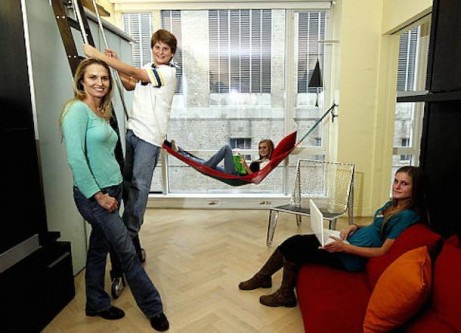
Keeping on the theme of urban families, this post took a look at Kip Longinotti-Buitoni, a single mom who left the burbs and set up camp for her four kids in a relatively small Manhattan condo, helped greatly by an array of transforming furniture. 

2. The Rise of the Minimalist Millionaire

This short post showed off the Airstream trailer that Zappos.com founder Tony Hsieh calls home. We think it falls along the line of the mainstream-ification of minimalism…something we think is a very good thing.

1. Paris Hilton Discovers Minimalism, Moves into Tiny House

This post about the alleged conversion of conspicuous consumption’s poster child proves that nothing gets traffic like celebrities…and humor.

Honorable Mentions

Frankly, the above list surprises us a little bit, but Google analytics doesn’t lie. Based on Facebook likes, you guys thought these posts were pretty interesting as well. 

3. Growing Old Together and in Style

This post about the “Cheesecake Cohousing Consortium” shows that small, communal living isn’t just about Millennials living in the middle of the city.

2. A Very Big Idea in Tiny House Living

simply-home

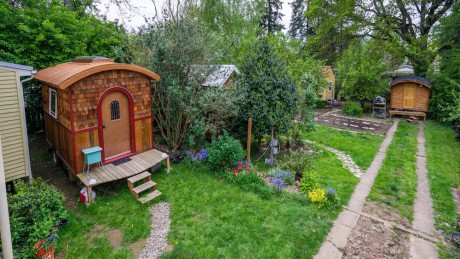
This story about a single family home with four tiny houses set up in its backyard is one of our favorites. It shows how density and community can be made inside America’s single family home-centric infrastructure.

1. The Rise of the Minimalist Celebrity

dan-norris

Alright, out titles aren’t that original sometimes, but this post about major league baseballer Daniel Norris seemed to strike a chord with readers. If you don’t recall, Norris intentionally chose to live simply out of his old VW bus, eschewing the bling that so often accompanies twenty-somethings with a few million dollars burning holes in their pockets.

If You Let Them Build It, They Are Much More Likely to Come

The world is abuzz about tiny houses. They are the architectural antidote to all that ails the modern American home: they are small, affordable energy misers whose tiny confines prohibit the accumulation of extra stuff. But tiny houses have a fatal flaw: they are illegal for permanent habitation in most cities. The few cities where tiny houses number more than a half dozen (Portland, Olympia and, um…did we say Portland?) are cities that have relaxed their zoning, usually designating them as Accessory Dwelling Units (ADU, aka “Granny Flat”), which are basically houses set up behind other, larger houses. But the Colorado city of Walsenburg (don’t worry, this author–a longtime Coloradan–has never heard of it either) is creating a plan that might someday soon serve as a precedent on how tiny houses can turn from architectural plaything to viable housing solution.

The plan, helmed by Sprout Tiny Homes, is to create a subdivision made entirely of tiny houses. Rod Stambaugh, founder of Sprout, convinced the Walsenburg city council to remove their restriction of building smaller than 600 sq ft. Rather than riding on trailer beds, these houses will have foundations and be connected to the grid–a good thing for people who might not be keen on composting toilets. But the houses themselves will be pretty damn small: the 32 units will range from 262 to 672 sq ft. There will also be a community center and outdoor movie theater. Stambaugh told Outside Magazine that he expects them to sell for $60,000 to $130,000.

Walsenburg is a former coal mining town of 3K that has seen better days. The tiny house subdivision is meant as a way of providing affordable housing and revitalizing the economy. As Lloyd Alter notes in Treehugger, that revitalization will be greatly abetted by what could by the US’s largest cannabis growing facility, which is going up on the outskirts of town. In fact, it wouldn’t be surprising if the main intent for the tiny house subdivision is to provide housing for workers at the the facility.

While company housing for pot growers might not do wonders for changing stereotypes about the type of people who gravitate toward tiny houses, the end result could be the same: showing that tiny houses can be a viable, safe, affordable housing solution. Stambaugh has plans to do another development in nearby Salida, Colorado and would eventually like to bring tiny houses to more prosperous mountain towns, such as Vail, where there’s a major shortage of affordable housing.

The Only Thing You Need to Get Rid of When Moving into a Small Space

As micro housing has gained popularity in the last several years, a number of similarly titled articles have been published. The general wording is, “Could You Live in Only ___ [200, 300, 400] Square Feet ?” Inherent in this question is a world of assumptions about what is normal and livable. In the US, what is normal and livable is, for the most part, huge. The average new single family home in 2014 was north of 2600 sq ft. So when homes fall significantly short of normal people seem to think it poses an existential threat: “could you LIVE?”

IMG_2106 (1024x683)

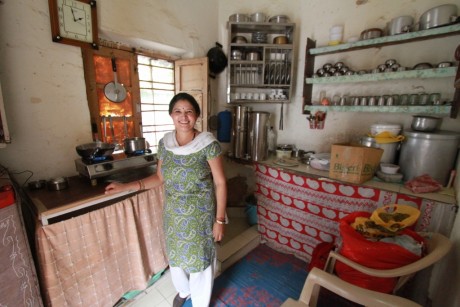
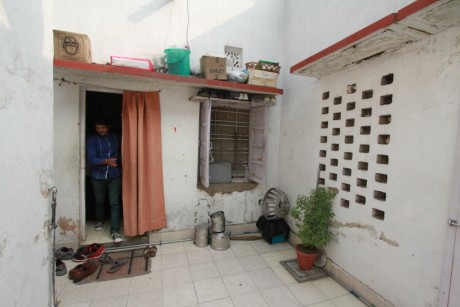
One of our favorite bloggers Johnny Sanphillippo recently visited a “normal” home in New Dehli, India. He approximates it was around 200 sq ft, shared by a family of four. No, the children were not newborns. They look like teenagers. The space consisted of two rooms–a kitchen and a bed-living-dining room. The toilet, sink and bathing areas were in an exterior courtyard and shared with neighbors.

IMG_2123 (1024x683)

What allows this family to share such a tiny space? Transforming furniture? Nope, not unless you consider a bed that doubles as a table transforming. Sophisticated tech and design? Not unless you count a TV and a place to put your shoes outside the house as sophisticated.

There is one big thing that makes this tiny place work. It’s something Americans accumulate with profound alacrity and prevents them from living in more modest spaces. It’s the one thing, that if discarded, can make the smallest of dwellings work.

That one thing is expectation. If we expect a lot, we need a lot. If we expect less–or, better yet, free ourselves from expectations–we need less. And while it’s somewhat true that certain spaces are too small for some peoples’ needs, for the most part people fit themselves into spaces as much as spaces fit people.

If you don’t think our expectations determine our capacity to be happy in a space, consider the last 70 years of American architecture. Circa 1950, the average American household contained 3.37 people and lived in a home around 1000 sq ft. Americans expected 337 sq ft per person. Today, those numbers are 2.54 people in 2600 sq ft.–three times more space per capita than 70 years ago. These fluctuations also demonstrate how elastic and divorced from actual needs expectations are. Johnny says it well:

I know families where three or four people live in a five bedroom house with a two car garage and a swimming pool. Yet they feel oppressed by the fact that they don’t have enough space. The kitchen needs to be remodeled. The bathrooms are outdated….We all get distracted from real needs and confuse them with superficial desires.

It’s important to understand how normal this Indian family is in a global context. As Johnny explains, this family is middle class. Globally, there may be people who have more, but there are just as many who have less. The way these people live–neither too secure nor too precarious–is the way a great deal of the world’s 7B+ people live. Westerners are wont to lose perspective about how materially abundant our world is, and start thinking a third car garage is a right rather than a specious luxury. 

You might think India an extreme example, but almost every country in the world has a very different–much smaller than the US–definition of what constitutes a normal home. The average new home in the UK is a little less than 800 sq ft–i.e. less than ¼ that of the average new home in the US. In Denmark it’s 1679 sq ft–that’s almost 1K sq ft less than the US, or four average Hong Kong homes worth of space (236 sq ft). In fact, there are only two countries that are remotely comparable in terms of US housing sizes. Unsurprisingly, they are Australia and Canada, two colonies established because of their vast tracts of virgin land and where much of the infrastructure growth has come about in the age of the automobile.

The point isn’t that there is a right or wrong size–though, let’s face it, most American homes are too damn big. The point is when thinking about how much space we really need to live, it’s often expectations, not physics or needs, that stand in the way of making a real reduction.

The Internet of Homes

It’s not news to say that tech is affecting nearly every facet of our existences: how we consume and deliver information, how we communicate, how we get around, how we use and share goods and on and on. The term “internet of things” goes even further, speaking to how one day everything in our lives will someday be tech-enabled and connected to the intelligence of the web via sensors, learning how we live, responding to our commands, collecting and delivering data, all in the name of making our lives more comfortable and efficient. The Intel corporation recently released their Smart Tiny House to serve as vision of how our homes might fit into this equation. The 210 sq ft home is packed with a variety of systems meant to both improve the quality of life for residents, but also tap into the greater intelligence of cloud systems.

intel-smart-tiny-house-10

Tech greets you at the door with their True Key system, a fingerprint and facial recognition based security system that lets you in the door as well as providing security for all the home’s systems. Most of the house can be controlled via a tablet or voice command. Lights can be dimmed and colors changed. Shades can be drawn. Some appliances can be turned on and off. There are leak sensors placed in trouble spots (under sinks, near showers, etc) that will notify you if there’s a leak. You can find the alert on the tablet and even book a plumber all in one fell swoop. I suspect the idea is to bring this type of system to every aspect of the house: a sensor will tell you if your roof springs a leak, if your dishwasher breaks, etc. At this point, Intel is dealing with leaks.

Intel is trying to position themselves as the brain of the smart home. They say this:

Intel creates the processors and other computing technology that serve as the brain powering a myriad of devices. Increasingly, as the home moves from connected to smart, this technology will enable a new breed of consumer electronic devices – everyday things such as lightbulbs, thermostats, smoke detectors, electrical outlets and cameras – to become connected and smart. These tiny brains inside “things” throughout the home will compute and produce data at the device level for real-time intelligence. Intel-based gateways connect the home’s smart devices, providing advanced analytics and storage, allowing the home, people and devices to work together in an intuitive, intelligent fashion. Cloud connectivity, advanced device management and built-in security will connect consumers to a variety of new services, features and cost savings.

It’s still early days for this type of tech and there are several different connectivity “smart home” protocols. But a colleague of mine noted that in the early days of telephones, there were hundreds of rival telephone companies and little interoperability. Eventually, things get sorted out. Intel is trying to address some of these interoperability issues. They have created their “Smart Home Development Acceleration Platform,” and claim they were able to enable interoperability with between three distinct lighting solutions: Philips Hue, Cree and Osram. This augers well for creating interoperability for scores of systems: wearables connecting to HVAC systems connecting to mobile devices and so on.

intel-smart-tiny-house-4

Frankly, the benefits of the tech on display in the Intel’s tiny house are underwhelming. But again, the house represent a start. They say in a press release, “The home is an experimental showcase that will evolve over the next 12 to 18 months as Intel explores the opportunities, experiences and tensions of creating a smart home.”

One thing that is definitely cool is that Intel chose a tiny house as the vessel for the house of the future. The motivation may have had more to do with the relative ease of working with a small space versus a large one. But tech is also making it possible to live with less in numerous ways such as the digitization of physical media and giving us access to shared goods. If you are really trying to make your home “smart,” few things are as smart as small: downsizing has the ability to reduce our spatial and carbon footprints, simplify our lives and save a buck or two.

Via Gizmag

5 Ways to Get Email Monkey Off Back and Put Him in a Cage

A recent article in Business Insider tells the tale of brothers John and Bert Jacobs, founders of the $100M “Life Is Good” t-shirt company. The brothers felt like they were being completely devoured by email. They write in their book “Life is Good,” “The time we spent daily just shoveling out our email inboxes was daunting. And we were going to bed at night feeling guilty and inadequate because we couldn’t get ahead. The more emails we sent out, the more flowed back in.” In a radical move, the two men ditched email…sorta. They actually delegated all of their email correspondences to other people in their organization. This act allowed them to step up their creative game and focus on high level business decisions rather than getting bogged down in putting out many small fires.

So I know what you’re thinking, because it’s what I’m thinking too: “Awesome! Two CEOs give their underlings all of their annoying, distracting emails. Good for them! I bet life is good. But I do not have any underlings. I am the underling and I can’t deal with my own email. Thanks for sharing.”

While most of us are likely not CEOs, the Jacobs’ experience can still be instructive. And though we might not be able to outsource our email responsibilities, we can, in all probability, find ways to liberate ourselves from asphyxiation by email (and for many of us, texts as well). Here are a five strategies that don’t include auto-responders: 

  1. Stop checking your email the first thing in the morning! For most of us, the morning is the best time to map out our day (if we don’t do it the day before). By checking email first thing in the morning, we start our days in reactive mode, playing whack-a-mole with our myriad responsibilities. By delaying our initial email check, we have space to create our day and decide how we want it to go. Don’t worry, all the fires in our inboxes will still be smouldering when we’re done planning. But chances are, the house will not burn down if we give ourselves 15-30 minutes to figure out what we want to do with the day first.
  2. Things can wait. I learned this concept from Tim Ferriss, who says there are few real emergencies, so we should create certain times to deal with email (aka “batching” email). Think about it. Most of us check our email all the time because we believe something important might be in one of the emails. But is this true? While many emails present things that need to be handled, often those things can be handled in their right time, which, in all probability, is not when the email comes in. Let’s say we’re writing something–a blog post, for example–and our boss asks us to send him a file. Unless that boss is boarding a plane in five minutes, he can, in all probability, wait. No one is going to die. Deals won’t fall through. It is probably a better idea to finish what we’re doing then send the file when ready. Studies actually show that multitasking makes us less productive and stupider. That’s right, when we bounce from thing to thing–writing a proposal to emailing to paying bills and so forth–we bring fewer IQ points to each one of those tasks than we would if we did each one from beginning to end.
  3. Slow the hell down. Have you ever emailed with someone who always responds to emails immediately? Or, worse yet, are you that person? Then one day, that person delays. One minute, two minutes, two hours…nothing. What the hell? Did I do something wrong? Here’s the deal: nothing’s wrong. She probably getting something to eat or do one of the million other things people do in the course of their day. The real problem is setting up an expectation of instantaneous responses. Along the lines of points #1 and #2, sometimes it’s not the right time to respond. It’s okay to respond when it works unless it’s an emergency…and it’s almost never an emergency.
  4. Turn off push notifications on your phone. This is one I don’t practice, but boy does it make sense. Those insidious banners, rings and buzzes on our phone are begging to take us out of the moment and task at hand. Screw em. They can wait. What we’re doing–even if we’re doing nothing–is probably more important.
  5. Create safe spaces from email and texts. At the dinner table, during weekends, in bed–create places and times when you cannot be reached any way other than phone. It’s vital we ensure our days include times when we cannot be reached. I don’t know about you, but anyone who would relay important information has my phone number. So if someone important really needs to relay important information, he or she will call.

If you have other strategies, please share in comments section (i.e. don’t email me ;-).

A Kinder, Greener New York City

Living in New York City can be many things: exciting, dynamic, culturally rich, god awfully expensive. But one thing it is not for most people is natural: unless you live directly on a park, your everyday exposure to nature might be limited to a handful of sidewalk trees, used as much for canine territorial outposts as natural beautifiers. But if the Green Line by Perkins Eastman Architects goes through, connecting with nature in one of the most concrete-laden lands in the world might get a lot easier. The Green Line would create a green corridor along Broadway, connecting Union Square in the south to Central Park in the north. Including the area of the park, this would effectively create a five mile green corridor from 14th to 110th streets.

greenline-2

Beside the obvious benefits of adding a natural retreat right through the center of Manhattan, the Green Line would offer many other benefits. By absorbing water, the grass would clean local waterways and stormproof the city. Gizmodo speculates that the removal of cars might actually aid in the flow of traffic as it proved to have done when NYC closed off Times Square to automotive traffic. And having several miles of protected bike/pedestrian friendly thoroughfare would surely reduce traffic fatalities.

The Green Line would also connect and expand a number of existing natural outposts and pedestrian malls such as Madison Square Park, Herald Square and Times Square. And unlike the elevated High Line which is on the far west side of Manhattan, the Green Line would be on street level running straight through the middle of the city, making it very likely to be enjoyed by people other than tourists (I love the High Line, but it belongs far more to the tourists than it does New Yorkers).

It is often argued that large cities hold the key to a sustainable future for humankind–they are denser, leading to smaller homes with reduced energy needs and far greener transportation systems. But other research suggests that people who spend time in nature are happier than those who do not. The Green Line and other projects like it, might enable people to have their city and nature too. We hope it gets the greenlight.

This Ad Campaign Hits Nail on Head About NYC’s Cramped Apartments

There’s been a lot of recent hype about New York City’s Carmel Place (aka “My Micro”). Rightfully so. It is the city’s first purpose built micro-apartment building after all. But if you have ever lived in or visited a typical NYC apartment, you know New Yorkers are no strangers to micro living. The big deal about Carmel Place is that people can live comfortably and without making socially-debilitating sacrifices to live there. The fact is that NYC’s 400 sq ft building requirement–the one they lifted for Carmel Place–has only been around since 1987. And since much of the city’s housing was made well before that year, there is 100 or so years of architecture that doesn’t give a crap about your fancy zoning laws. Tiny apartments are as New York as thin crust pizza by the slice. 

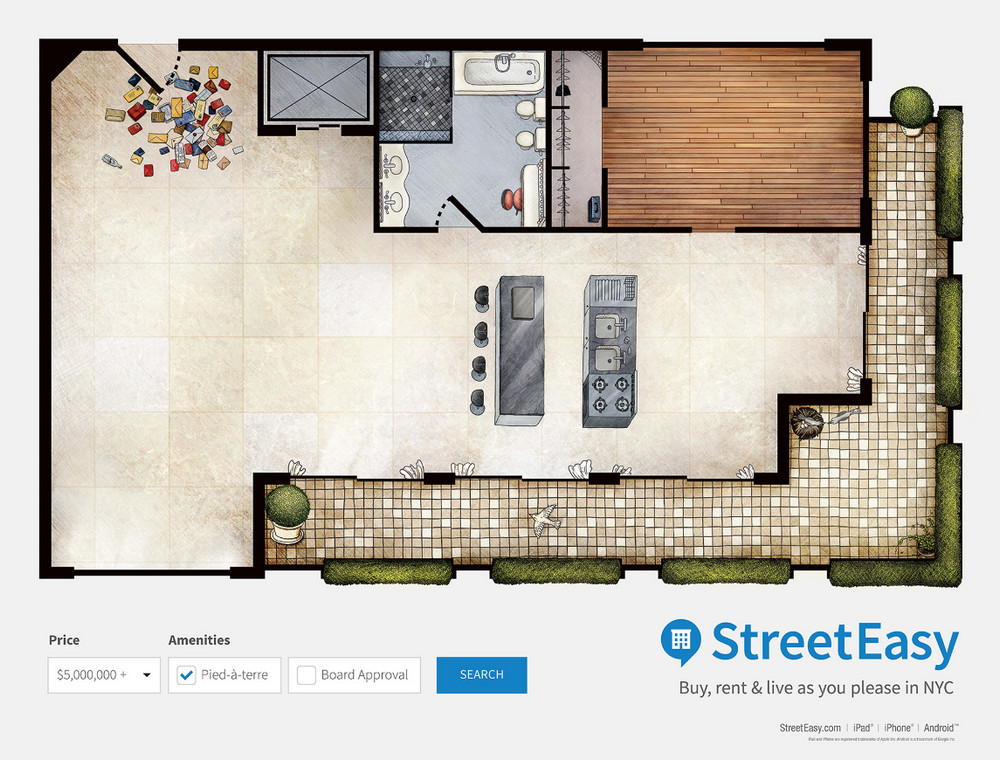
This last spring the real estate website StreetEasy launched it’s “Live As You Please” ad campaign that celebrates the contortions New Yorkers have long made to stay in a city that’s long on thrills and short on square footage. Each picture represents a different demographic, matched with a specific search criteria on the bottom of the ad. There’s the empty $5M pied a terre or the one bedroom that barely fits a bed (a housing type I can guarantee exists from personal existence). But perhaps the most poignant ad says “Sure your window faces a brick wall, but behind that wall is New York City.” You can have the most awesome home in the world, but if you don’t love where you live, it don’t mean a thing.