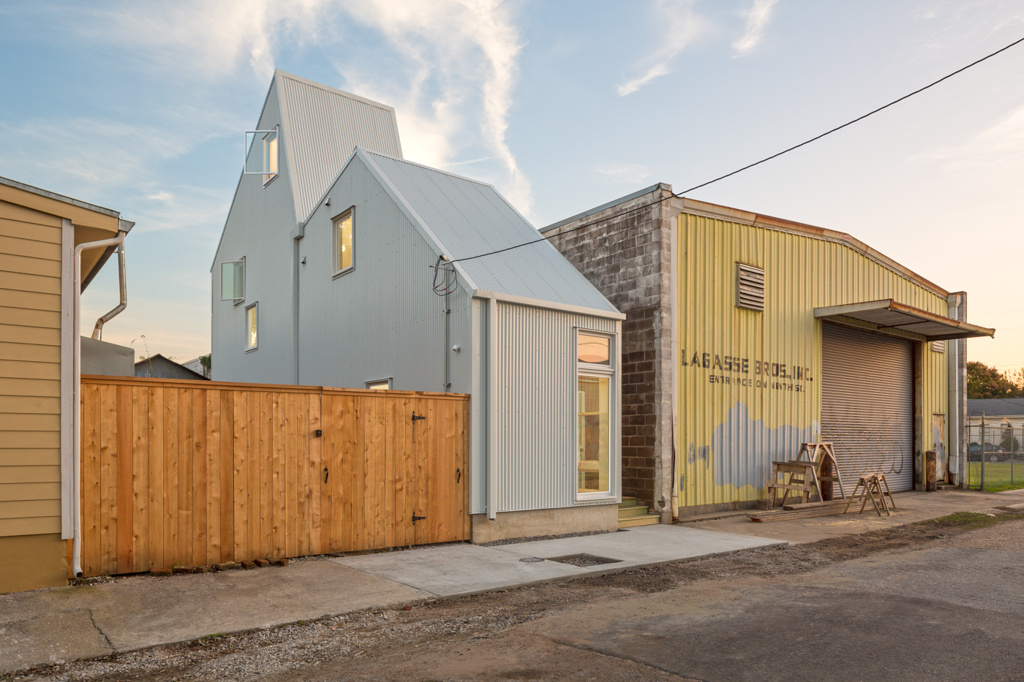
The New Starter Home

Somewhere between now and 1950 (or thereabouts) something went wrong with American housing. Back then, car-fueled sprawl hadn’t yet driven people so far from city centers. At 983 sq ft, the average home was just about right sized for the average household size of 3.54 people (277 sq ft/person). Architect Jonathan Tate told Fast CO.Design said this is what went wrong:

Houses morphed from a consumer good into an investment commodity, which in turn led to developers building cookie-cutter starter homes based on what they deemed to be the most likely to appreciate in value. Houses became more expensive to purchase and maintain, their sizes ballooned, and they were increasingly located in areas far removed from established neighborhoods since it was less expensive to buy greenfield land.

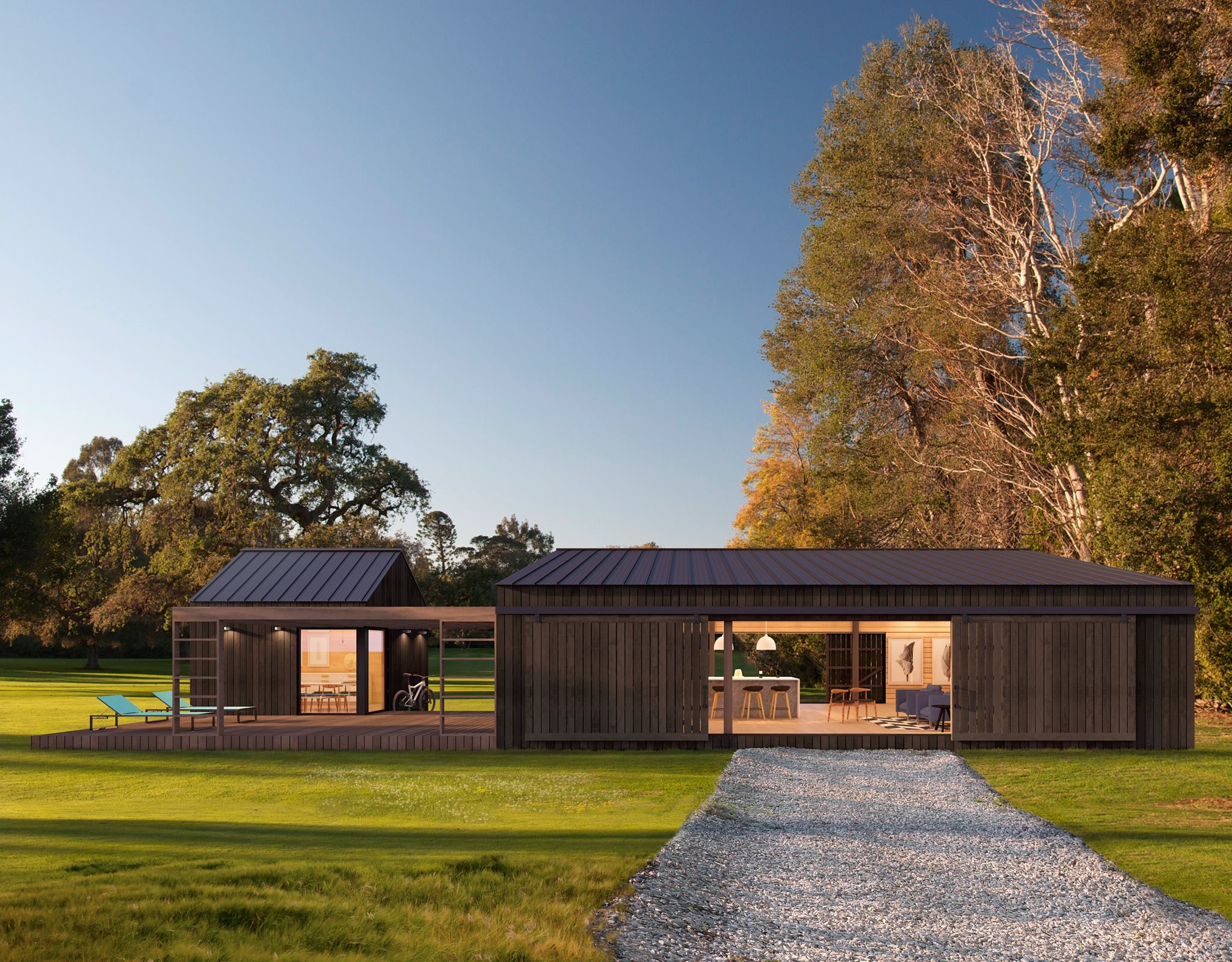
This morph made homes prohibitively expensive to large swaths of the population, evidenced by a 48 year low in homeownership rates in 2015. Tate and developer Charles Rutledge recently launched the Starter Home* project as a response to the commodification of homes, designing and developing housing around how people live.
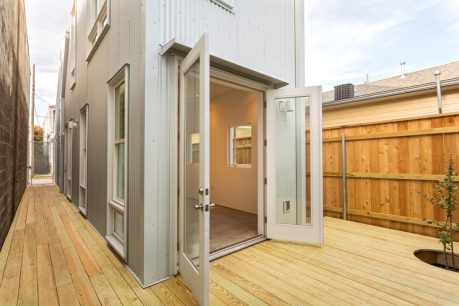
starter-home-back

The first Starter Home* recently went up in New Orleans. It’s 975 sq ft, but its actual footprint is only 473 sq ft. Even with setbacks and some outdoor space, it can fit onto a very small 16.5’ x 55’ lot. The compact proportions make the house ideal for urban infill development, using lots that might not support conventional homes. This has the benefit of allowing the developer to purchase centrally located land at a discount, which in turn creates a lower purchase price. The first starter home cost $339K, which is about $35K more than the average New Orleans listing. Tate believeshe can drive that price down with scale. Tate has 15-20 projects in the pipeline and is planning on making Oakland, CA the next stop for the Starter Home*.  

The basic tenets of the Starter Home* are great: reduce the size and price of single family homes; bring more housing into our city centers; bring sanity back to American housing. With the average new single family home size hovering around 2700 sq ft, we need this now more than ever. 

For more information and images head over to CO.Design

Legalize Tiny

In December we posted about Walsenburg, Colorado, a tiny town that created a building ordinance to allow for the construction of a tiny house subdivision. As we’ve long noted, zoning is the biggest hurdle for tiny houses taking off as a widespread housing option. While most tiny houses are designed as permanent dwellings, they are treated as RVs in the eyes of building code; this classification means that the houses can’t be parked in a residential area indefinitely. While the Walsenburg news represented a step in a great direction, the fact that it was done in a town of 3000 people made it a bit easier to dismiss. But when a city of a half million people does effectively the same thing, it might harder to ignore. Fresno, California–the half million person city in question–recently passed an ordinance specifically permitting tiny house on wheels (THOW) as permanent dwellings.

The move is pretty unprecedented. “We are the first city in the nation to actually write into its development code authorization for ‘tiny homes,’ ” the city’s mayor Ashley Swearingen said. While tiny houses have cropped up in various places around the country, their existence was shoehorned into existing code, typically regulations concerning accessory dwelling units (ADUs). Making code that treats THOWs as a distinct housing typology might go a long way to legitimizing tiny houses across the country.

What’s also notable about the ordinance is its lack of restrictions. Here are the main criterion a Fresno tiny house must meet as pulled from the Tiny House Association of America:

  1. Is licensed and registered with the California Department of Motor Vehicles and meets ANSI 119.2 or 119.5 requirements;
  2. Is towable by a bumper hitch, frame-towing hitch, or fifth-wheel connection. Cannot (and is designed not to) move under its own power. When sited on a parcel per requirements of this Code, the wheels and undercarriage shall be skirted;
  3. Is no larger than allowed by California State Law for movement on public highways;
  4. Has at least 100 square feet of first floor interior living space;
  5. Is a detached self-contained unit which includes basic functional areas that support normal daily routines such as cooking, sleeping, and toiletry; and
  6. Is designed and built to look like a conventional building structure.

Aside from point #1, which Lloyd Alter at Treehugger says might cut out a number of DIY-built homes, the rules allow for real deal tiny houses–i.e. really small and self-contained. And unlike most of the California counties that permit tiny houses currently, Fresno does not restrict their use to caregivers. The tiny houses can be used by homeowners for their personal use or as rental property.

One thing that does not seem to be a part of this code is building only a tiny house or tiny houses on a lot of land (the tiny houses must share a lot with an existing home). That said, there is no shortage of single family homes that can play host to tiny houses. In fact, adding density to the existing, sprawled out single family housing infrastructure is probably the greatest promise for tiny houses movement.

All in all, this is great news and we look forward to continued deregulation of tiny houses and other innovative forms of housing that are aligned with how we live today.

Image via California Tiny House

Single Family Housing that Makes Sense

There was a time when American single family homes weren’t so absurdly large. In 1950, the average household had 3.83 people and the average new single family home was 983 sq ft, making for a pretty reasonable 291 sq ft per person. Compare that to 2014, when the average household had 2.54 people and the average new single family home was 2,690 sq ft, or 1059 sq ft per person. That’s a 360% increase in per capita housing size. Yikes! What’s worse is this continual embiggening of the American home has dwindled the options of modestly sized homes for those who want them. We frequently get notes from people who want to downsize, but say they are forced into homes larger than they want because there’s virtually nothing available in their area. A real estate startup out of San Antonio, TX called Rising Barn is trying to remedy this lack of options, offering prefabricated, stylish, affordable and reasonably sized single family homes.

risingbarn

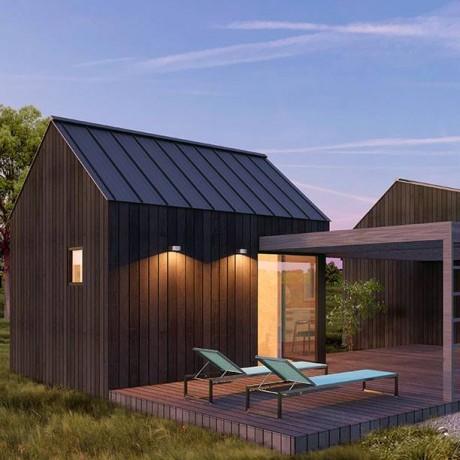
Rising Barn offers five “kits” with two categories of structures: cabins and domos. The cabins come in two sizes, large and medium. The large is a two bedroom unit with 720 sq ft of usable square feet (above), and the medium is a studio with half the area of the large; unlike the large, it doesn’t have a full bath or kitchen, so it’s designed for “work/live” use. The three domos are multipurpose rooms ranging from 80-160 sq ft and can be used in conjunction with cabins or as additions to existing homes.

risingbarn-domo

Rising Barn wants to make the whole process simple and affordable. Here’s an explanation of the ordering process from their site:

Once you do [select a kit], our barn kits will be delivered to your land in 2-6 weeks. If you prefer to hire a crew, we are happy to assist you in choosing the right one in your area. If you reside in Texas, you can contract a Rising Barn team leader or use our turn key service. You can build it with a few friends within in a week, work alongside Rising Barn team leaders, use our turnkey service, or we can help you find a local crew to assist.

According to the San Antonio Business Journal, unit pricing ranges from $120-200, which includes material and labor. If you go the DIY route, that cost drops to $90 to $105 per square foot. So a 720 sq ft cabin built by contractors would run, on the top end, $144K; even factoring in land costs, permitting and other sundry expenses, this seems like pretty competitive pricing.

Sure, there are cheaper prefab options, but I doubt they look half as nice as Rising Barn’s or are made half as well. And the ones that do look and are built this nice typically run in the multiple hundreds of thousands of dollars just for the structure. If you must live in a single family home, Rising Barn looks like a solid option. 

The Only Thing You Need to Get Rid of When Moving into a Small Space

As micro housing has gained popularity in the last several years, a number of similarly titled articles have been published. The general wording is, “Could You Live in Only ___ [200, 300, 400] Square Feet ?” Inherent in this question is a world of assumptions about what is normal and livable. In the US, what is normal and livable is, for the most part, huge. The average new single family home in 2014 was north of 2600 sq ft. So when homes fall significantly short of normal people seem to think it poses an existential threat: “could you LIVE?”

IMG_2106 (1024x683)

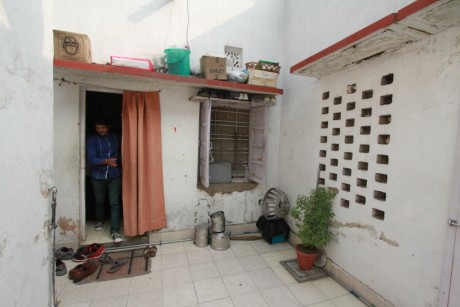
One of our favorite bloggers Johnny Sanphillippo recently visited a “normal” home in New Dehli, India. He approximates it was around 200 sq ft, shared by a family of four. No, the children were not newborns. They look like teenagers. The space consisted of two rooms–a kitchen and a bed-living-dining room. The toilet, sink and bathing areas were in an exterior courtyard and shared with neighbors.

IMG_2123 (1024x683)

What allows this family to share such a tiny space? Transforming furniture? Nope, not unless you consider a bed that doubles as a table transforming. Sophisticated tech and design? Not unless you count a TV and a place to put your shoes outside the house as sophisticated.

There is one big thing that makes this tiny place work. It’s something Americans accumulate with profound alacrity and prevents them from living in more modest spaces. It’s the one thing, that if discarded, can make the smallest of dwellings work.

That one thing is expectation. If we expect a lot, we need a lot. If we expect less–or, better yet, free ourselves from expectations–we need less. And while it’s somewhat true that certain spaces are too small for some peoples’ needs, for the most part people fit themselves into spaces as much as spaces fit people.

If you don’t think our expectations determine our capacity to be happy in a space, consider the last 70 years of American architecture. Circa 1950, the average American household contained 3.37 people and lived in a home around 1000 sq ft. Americans expected 337 sq ft per person. Today, those numbers are 2.54 people in 2600 sq ft.–three times more space per capita than 70 years ago. These fluctuations also demonstrate how elastic and divorced from actual needs expectations are. Johnny says it well:

I know families where three or four people live in a five bedroom house with a two car garage and a swimming pool. Yet they feel oppressed by the fact that they don’t have enough space. The kitchen needs to be remodeled. The bathrooms are outdated….We all get distracted from real needs and confuse them with superficial desires.

It’s important to understand how normal this Indian family is in a global context. As Johnny explains, this family is middle class. Globally, there may be people who have more, but there are just as many who have less. The way these people live–neither too secure nor too precarious–is the way a great deal of the world’s 7B+ people live. Westerners are wont to lose perspective about how materially abundant our world is, and start thinking a third car garage is a right rather than a specious luxury. 

You might think India an extreme example, but almost every country in the world has a very different–much smaller than the US–definition of what constitutes a normal home. The average new home in the UK is a little less than 800 sq ft–i.e. less than ¼ that of the average new home in the US. In Denmark it’s 1679 sq ft–that’s almost 1K sq ft less than the US, or four average Hong Kong homes worth of space (236 sq ft). In fact, there are only two countries that are remotely comparable in terms of US housing sizes. Unsurprisingly, they are Australia and Canada, two colonies established because of their vast tracts of virgin land and where much of the infrastructure growth has come about in the age of the automobile.

The point isn’t that there is a right or wrong size–though, let’s face it, most American homes are too damn big. The point is when thinking about how much space we really need to live, it’s often expectations, not physics or needs, that stand in the way of making a real reduction.

Data Driven Architecture

One of this site’s most popular posts to date is “Residential Behavioral Architecture 101.” The reason, I believe, is how it shows the gulf between how our homes are used and how they are designed, not from a speculative or conjectural perspective, but from a data and fact-driven one. In the post is a map showing how one particular family moves through their house and how they use only a fraction of the available floor area (a map that the researchers of the study that made it believe is representative of many homes). The map helps remove the political and dogmatic notes that often enter the downsizing conversation and make it wholly practical. We should consider downsizing our very large homes because we usually don’t use most of our available space.

I recently did a guest post for the website Medium, entitled “Design Driven Architecture.” In it, I bring up the map (pulled from the illuminating “Life At Home in the 21st Century”), once again making the argument that much of the floor area of large homes goes unused. But I go a few steps further in showing how home design is often out of step with data–a gap that undermines personal and global interests. I point to a growing body of research that shows how our big homes are:

  • Housing stuff we rarely use.
  • Pushing us further from city centers, making our commutes increasingly long. And numerous studies show how we hate commuting.
  • Completely out of step with demographic trends toward smaller households for all ages and particularly for older adults.
  • Helping push our already precarious environmental situation further toward the brink.

After all that, we present what we see as ways forward with a bunch of pretty pictures. Read the full post here and let us know what you think.

Suburban neighborhood image via Shutterstock

What is Your Home’s Power/Weight Ratio?

If you’re a car-nut, you know the importance of a car’s power-to-weight ratio. You know that a car with 300 hp and weighs 6K lbs will accelerate slower than a car with 150 hp and weighs 1500 lbs because each horsepower in the former car must drive 20 lbs, whereas each of the latter car’s horses must propel 10 lbs (adjusting for things like aerodynamics of course). Improving power-to-weight ratios is why the best marathoners stay rail thin and people buy carbon fiber spoke nipples for their bicycle wheels. Lowering weight is often the easiest strategy for gaining effective power.

But power-to-weight can be applied to things other than locomotion. Take architecture. To illustrate, consider these two scenarios:

  • HOUSE A is a four bedroom house with 3K sq ft of floor area occupied by a family of four. Of the 3K sq ft, 1200 sq ft are actively used. Monthly housing expenses total $4000 (mortgage, taxes, utilities, maintenance, etc). Monthly cleaning time, which includes yard care, equals 15 hrs. Monthly transportation expenses, which includes two requisite cars, equal $1500. Combined commute times equal 2.5 hrs/day, which includes work, school drop-offs and regular trips.
  • HOUSE B is a three bedroom townhouse with 1500 sq ft of floor area, also occupied by a family of four. Of the 1500 sq ft, 1000 sq ft are actively used. Monthly housing expenses total $3500. Monthly cleaning time equals 6 hrs (yard maintenance is handled by condo association). Because of close proximity to amenities and public transport the family only needs one car. Monthly transportation expenses equal $1000. Because one adult works from home in a bedroom that converts to an office and kids live near school, combined commute times equal one hr/day.

In both cases, power is represented by size, which is like the action potential of a space. House A’s size affords four bedrooms, which means you can sleep four to eight people–maybe more–all at once. It affords a dedicated living, dining and family rooms, which allows you to entertain up to 75 people. It affords four bathrooms, allowing up to four people to go to the loo at the same time. Usable power in House A equals 750 sq ft/person; 375 sq ft/person in House B. Used power–how people actually use the space–is 300 sq ft/person and 250 sq ft/person, respectively.

“Weight” are the things–bills, maintenance, commutes, natural resources used, etc–that allow you to use the power. For the sake of this argument, let’s say that each dollar represents three minutes of time ($20/hr). House A’s weight equals $7300/month and B’s $5220, or 365 and 261 hours.

Therefore, the power to weight ratio of House A is 3000 sq ft/$7300 or $2.43/sq ft per month; in terms of used space, that number is $6.08. House B is 1500 sq ft/$5220 or $3.48/sq ft per month, and $5.22 for used space. In terms of time, House A is 7:03 and 18:00 mins/sq per month (usable/used) and House B is 10:20 and 15:66 mins/sq ft per month.

In both cars and architecture, increasing power increases weight. All things being equal, a V8 engine is going to weigh more than a V4 (not to mention requiring more fuel). All things being equal, a big home will cost more time and money to maintain, require longer commutes, use more natural resources, etc, than a smaller one.

When thinking about what features you want from your home–number of bedrooms, size, location–you must consider the weight that power entails.

This is not an argument to move into a tiny house, which have tiny “weights”–bills, cleaning schedules, etc. You can have minimum power requirements. At a certain point, you can only go so small before utility is undermined or negated altogether–before you can’t fit your children in the house, before you don’t have enough horsepower to move your car. But in our excess-erring culture, few of us get anywhere near those minimum values.

The importance of design can’t be understated in terms of assessing power. A couple weeks ago I met Scott Specht, one of the architects behind the Manhattan Mini Loft. The amazing little apartment, with its high ceilings, smart layout and choice of furniture felt much larger than its small footprint would have suggested. Specht said that he puts less focus on square footage than how space is arranged, how furniture and lighting are used and many other factors, all of which determine a space’s overall usability or, for the sake of this article, its power.

I am guilty of using a house’s square footage as a primary way of understanding its capabilities. A number is an easy thing to affix your mind to. But you can’t judge a house by its number. Whether talking about a 5K sq ft McMansion or 200 sq ft tiny house, raw power (i.e. square footage) must necessarily be related to its weight–usable space, the financial, time and even environmental costs required to maintain a home, etc–in order to understand its real performance.

Housing an Aging Population

By 2030, it is estimated that there will be 33M more seniors (65+) than there are today. A majority of these seniors-to-be are currently living in big homes in the suburbs. These are homes that require physical capabilities to maintain, financial wherewithal to afford and cars to access–all things that are difficult as one’s physical and financial resources diminish, as they tend to do when we get older. The mismatch of existing housing stock and an emergent aging population (and all that goes along with that) is the subject of a recent report by Harvard and the AARP called, “Housing America’s Older Adults—Meeting the Needs of an Aging Population.”

The exhaustive report details current population demographics and where things are heading in the realm of housing. While we cannot summarize the whole report, here are a few of its key findings:

  • Today, 47% of households under the age of 50 are couples with children under 18 at home or single parents, a share which falls to 9% of households in their late 50s and continues to drop among older age groups.
  • The increase in single-person households is the most dramatic change in household type after age 50–about 1/4 of households in their 50s consist of a single person, a share which rises to 1/3 of those in their 60s, 2/5 households in their 70s, and 3/5 aged 80 and over.
  • Most older adults own single-family homes, including over 2/3 of those aged 50-64, nearly three-quarters of those aged 65-79, and three-fifths of those aged 80 and over.
  • Mobility rates continue to decline among those in their 60s and beyond, with a small increase around age 85. In 2011, 60% of households aged 80 and older and 47% of those aged 65-79 had lived in the same residence for 20 or more years.
  • In 2012, 1/3 of adults aged 50 and over—nearly 20 million households—were cost-burdened, meaning they paid over 30% of their income for housing.
  • Even though most older adults drive, 61% limited their driving to certain hours of the day, and around 21% stated that they frequently or occasionally miss out on activities they like to do because of driving limitations.

To summarize the above points, there is a rapidly growing population of older adults who today live with their kids in the suburbs in single-family homes. These same folks will be empty-nesters in the near future, leaving them with big, mostly empty homes. The likelihood of them downsizing and moving to more accessible housing based on current trends is low–at least before age 80. A high number of seniors today are cost-burdened by their homes, a trend that’s expected to continue given the increasing rates of housing and non-housing debt. Driving becomes a big issue as people get older, making car-dependent living problematic for older adults.

Not to get all bleak about it, but the report suggests a possible future with large populations of older adults stranded in the suburbs, living in needlessly-large, unsafe homes they cannot afford or maintain. The public and personal ramifications could be huge. The report says, older adults will “sacrifice spending on other necessities including food, undermining their health and well-being”; older adults will be isolated from friends and family; and “disconnects between housing programs and the health care system put many older adults with disabilities or long-term care needs at risk of premature institutionalization.”

One might assume that the large homes now occupied by future seniors will eventually be occupied by the Millennial generation, who in 10-20 years will presumably have children, careers and will want more space. Emily Badger of the Washington Post questions whether this will be the case. If current trends among Millennials continue, where centralized urban living is prized above space in the suburbs, the Millennials might end up hogging the centrally-located, amenity-rich housing, driving housing costs higher than most seniors can afford, leaving them to fend for themselves in the burbs.

We won’t suggest that we have an easy answer for this most difficult topic, but we will suggest that micro and other compact housing is one logical direction. Smaller spaces are far easier to maintain than large ones. They are often less expensive. They are often more conducive to social living as they are typically part of multifamily structures. And they are more likely to be centrally-located, obviating the need for car ownership.

The micro-housing conversation is almost invariably linked to young, single people: the ones who just got out of college and need an affordable, centrally located home; the ones who might be living with their parents and need a starter home before shacking up with a nice guy or girl; ones who work and play so much that they just need a place to sleep in between their exciting job at that startup during the day and fashion openings at night. What the Harvard/AARP report suggests is that micro-housing might be just as–or more–relevant to our growing aged populations as it is to young folks. Now it’s a matter of legislators and real estate developers to see this pressing need.

Seniors image via Shutterstock

Should There Be Housing Size Minimums?

Last week, Seattle’s City Council was discussing micro-housing regulation–a discussion that’s been going on for a while. About a year ago, we looked at a proposal that sought to define a micro-apartment as a dwelling smaller than 285 sq ft; it had to have its own bathroom and a communal kitchen for every eight units along with a few other criteria. The discussion last week furthered this conversation, stating that eight micro-dwellings (effectively efficiency apartments), each with their own bathroom and kitchenette and one shared kitchen, would constitute one micro “unit”. There could be multiple units in a building.

One big unresolved issue for the council is dwelling size. One proposal promoted by Mike O’Brien, the city council’s land-use committee chairman, is that the average minimum size of all of the micro-housing units in a building be 220 sq ft; this number being in line with a number of other major cities like San Francisco’s minimum required area. Specifying that a buildings units’ average minimum–versus overall average–is a safeguard against developers putting one or two big units so they can build a bunch of tiny units.

The other proposal, came from council-member Nick Licata, who said “I don’t want to have the market determine the availability and affordability of units to the extent that we end up putting people in chicken coops.” He suggested an amendment to the 220 sq ft proposal, which would allow for units as small as 180 sq ft. The number was based on the fact that he knew people who live comfortably in apartments that size. It is also a number that is consistent with other parts of the city’s building code.

Whether Seattle lands on 220, 180 or 90 sq ft, there seems to be a bigger question on the table. Should cities even have minimum size requirements for dwellings?  If someone wants to live in a closet–and presumably pay a proportionately low rent–shouldn’t that be an option he or she should be able to exercise?

This is hardly a suggestion to abolish building regulation. Whether 8K or 80 sq ft, any dwelling should adhere to certain safety and livability standards. People shouldn’t live in chicken coops or cages. But if they want to live in a well-ventilated, sunny space with proper egress–one that happens to be the size of a chicken coop–who are government officials to say that they can’t?

One big problem in Seattle is the neighborhoods the micro-apartment building are moving into. Unlike places like San Francisco, many of Seattle’s micro-apartment buildings are being built in medium density neighborhoods with single-family houses with longtime–and vocal–residents who aren’t keen on micro-apartment dwellers (younger, more transient) and their impact on parking. Many of these folks think the city needs to be stricter about micro-housing regulation.

On the other hand, Seattle is unique in that its government has been overall quite supportive of micro-housing. The current proposals being discussed are a function of that. The city is trying to add the micro-housing typology into its architectural canon through these regulations. And why not? Micro-housing provides market-based, affordable housing for the city’s growing single populations (40% of residents in 2011 according to the Seattle Times).

The city’s advocacy is no doubt helped along by the fact that developers seem to be making money building micro-housing. Hell, there’s even a lobbying group called Smart Growth Seattle. In many ways, the controversy is arising from the parity of the two sides: entrenched and vocal Seattleites opposing micro-housing (or at least trying to curb its rate of expansion) versus flush and connected developers, who are providing a popular type of housing.

This issue reminds us of Felice Cohen’s 90 sq ft apartment. Because of its size, Cohen was able to afford a neighborhood and lifestyle she couldn’t have had she lived a larger apartment. She proudly showed the tiny space off to Fair Companies. When the video went viral, her landlord got busted because it was an illegal sublet. She was evicted shortly thereafter. When we last saw her, she did an awkward tour of her new 500 sq ft digs, whose space she hardly knew what to do with. Cohen’s first apartment, so far as we could see, was small, but not dangerous. Assuming a space is safe, who’s to say that someplace is too small to live in?

What do you think? Should the government regulate housing size? Or, assuming housing is safe and livable, should the market and citizens decide? Let us know what you think in our comments section.

Via Crosscut.com

Residential Behavioral Architecture 101

The above image was taken from an article in a Wall Street Journal article about the book “Life at Home in the 21st Century.” The UCLA group responsible for the book followed 32 middle class Los Angeles families around their homes, tracking their every move to see how people actually live nowadays. This image shows “the location of each parent and child on the first floor of the house of ‘Family 11’ every 10 minutes over two weekday afternoons and evenings.” In other words, primetime for their waking hours at home.

The activity on this floor, which measures around roughly 1000 sq ft, is concentrated almost exclusively in three rooms: The dining, kitchen and family rooms; the latter room’s activity focused around the TV and computer. We estimate that around 400 or so square feet of those 1000 are actually used with any regularity.

Family 11’s house is very typical in size, if a bit smaller than the average new home, which was 2,662 in 2013. For comparison’s sake, in 1950 that same number was 983 sq ft and there were, on average, about one extra occupants in each of those smaller homes as well.

While we don’t want to assert that there exists a correct house size for everyone, if this case study is indicative of how many/most American households use there homes, it begs a couple questions: Why are American homes so big? And what would homes look like if designed around how most people behave? It wouldn’t be hard to imagine that this Family 11 could easily live in half the space they currently occupy.

An article in the NY Times from a couple years ago called “The Big Shrink” illustrates how our homes might look if based on behavior, not convention. The Kelly’s, a family with two adolescent children who were profiled in the story, traded in their 3200 for a 1200 sq ft home (Pictured above. Built in 1954 incidentally). Like Family 11’s home, the formal living and dining rooms were barely used, less one family member, as Greg Kelly explains: “We had a dining room and a formal living room—that was where the dog lay on the couch, that was his room.”

We’ve often argued that micro-apartments make complete sense based on the way the majority of single people live. Our question to readers is, “How would you design a home if based on your behavior, not architectural convention…for singles, couples, families, etc.?” Let us know what you think in our comments section.

[Note: this post was originally published on December 14, 2012. A few updates have been made.]

Kelly home image credit: Ryann Ford for The New York Times

Lots and Lots of Problems

Big houses are the minimalist/tiny-living advocate’s whipping boy for many of the world’s ills. Few things are as easy (or big) of a target as a big houses; they take up too much land leading to sprawl, they use too many resources to build and maintain and they have too much storage space for the accumulation for extraneous stuff.

But there’s nothing inherently wrong with big houses. Okay, they take more to clean, and sure the potential for accumulating more stuff than one needs increases, and yes, all things being equal they use more resources to make and maintain (though both of those things can be mitigated significantly with best practices). But, at least to a great extent, a big house can be competitive with a small one in terms of efficiency and resource use.

How can that be, you ask?

As we’ve seen with household size (the number of people living in a home or “dwelling unit”), other factors contribute greatly to housing efficiency. For example, ten 200 sq ft tiny houses with one-person living in each house will probably be a lot less efficient than one 4K sq ft multifamily home with a ten people. Even though they have half the floorspace, the tiny houses, unlike the multifamily home, would each require their own thermal envelopes, plumbing and HVAC systems and so forth. Most importantly, the tiny houses would each have their own lots, swelling the size of the land necessary to accommodate them.

In addition to house and household size, lot size is a critical figure in understanding a house’s overall efficiency.

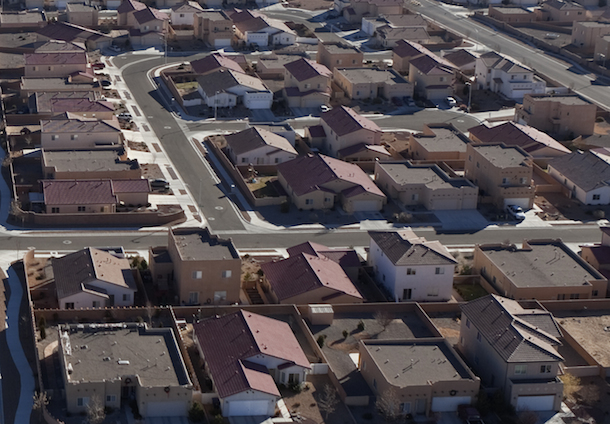
The average lot size for a new single-family home sold in the US in 2013 was .35 acres or 15,456 sq ft. Combine this with an average household size of 2.54 people and you have the average single-family-home-dwelling American occupying over 6K sq ft of land. [NB: the Census doesn’t distinguish household size between single-family and multifamily homes, so actual household size for single-family homes might be slightly higher]. If we reduced the size of our lots, even if housing size didn’t change or even increased, it could significantly reduce sprawl and improve housing efficiency.

In understanding how lot size affects sprawl, it’s important to understand a lot’s allowable floor area ration or FAR. The FAR is the ratio of gross floor area in relationship to lot size. A 4K sq ft building on a 1K sq ft lot will have a FAR of 4, or conversely a 1K sq ft building on a 4K sq ft lot will have a FAR of .25 and so forth. Typically, FAR is a big deal in cities, where developers want to squeeze every bit of use from a lot’s area.

But FAR has many suburban implications. Consider this: if the average new home in the US is 2,662 sq ft and occupies a 15,456 sq ft lot, it has a FAR of .17. In other words, it uses 17% of the lot it’s built on. But this doesn’t tell the full picture. 17% use of a lot’s area assumes a one story structure. If those 2,662 sq ft are evenly divided between two floors, a home might only take up 8.5% of its lot’s area. The rest of the lot is yard space, driveways, garages (which are sometimes not included in gross floor space), etc. When everyone gets their own mansion, plopped on a big lot, connected to other mansions by wide-laned roads and highways, interspersed with shopping centers with huge parking lots, it leads to more driving, more encroachment on nature, more sprawl.

But again, big houses aren’t the problem. If a big house has a high FAR–either a single family home occupying a small lot or a large home in a multifamily building–it can rival or beat many small homes with low FARs in terms of efficient use of land and location efficiency. Consider that a 200 sq ft tiny house on a bucolic one acre lot would have a FAR of .004, contributing more to sprawl than a McMansion. In achieving efficient housing, smaller house size might be necessary, but it’s far from sufficient.

All of this is to say that efficient housing should not be oversimplified. A big house in the right context can be a great thing. A tiny house in the wrong one can be an energy-gobbling, sprawl-creating terror. The ideal is a hybrid of modest house and lot size, where the area that is consumed is area that is used.

Large Back Yard image via Shutterstock