A Village in a Tower

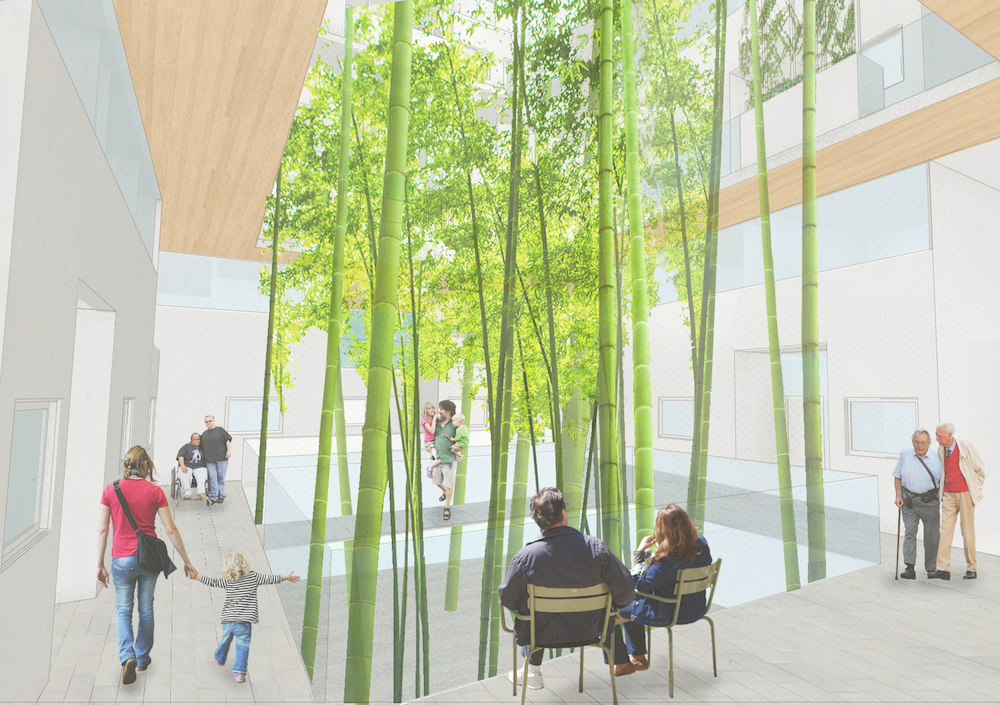
Bamboo plants in inside courtyard

Image above by Rachel Kao.

While Europeans are no strangers to communal, urban living, evidenced by things like Baugruppen, the phenomenon is still pretty rare in North America. Cohousing, the most established form or communal living this side of the pond, tends to be located in the burbs. In these communities, several single family houses band together to create a cohesive community with regular shared activities and spaces. There are some urban exceptions such as Durham Central Park Coho. But developing a building like Durham Coho is a time and resource intensive affair. Now a group out of Vancouver calling themselves “Our Urban Village” has come up with a clever middle ground approach to creating communal living in the city. Rather than developing their own building, they’re seeking to graft their community onto an existing development.

The group calls their concept “”co-housing lite”. Rather than originating the development, the group would commit to buying several units at market value (~C$700/sq ft at the moment) of an in-progress condo building. This influx of cash would give the developer investment capital as well as cost savings down the road as pre-sale and marketing expenses would be minimized. In return, the developer would build common spaces such as shared dining and guest rooms for the community. While these added features might seem like a big hit for the developer, co-founding member James Chamberlain told the Globe and Mail that developers see the expense as fairly small relative to the overall costs of developing the large buildings their interested in.
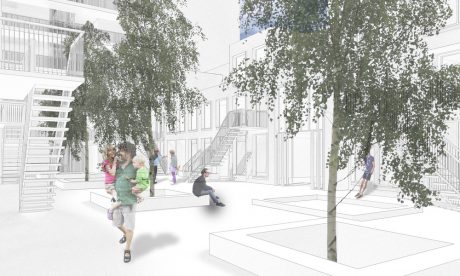
Morgan_McDonagh_Social Street

The community is being smart with design of those common spaces. Another member, Kathy Sayers, wrote that OUV “will be working with a German architect and Resource Furniture to design our common space to make 1200 square feet work for our 20-30 families instead of the average 2000-2500 square feet.” That same architect, Inge Roecker, is an associate professor at the University of British Columbia and gave her students the task of concepting the community. Ultimately, we suspect, the look of the spaces will be largely dictated by the building’s preexisting architecture. 

The group is presently courting a number of Vancouver developers. Because of their unconventional approach, Chamberlain said the ideal developer will be one with a “social conscience”.

The community wants to be multigenerational and their current membership of nine represents several demographics including singles and couples with and without kids. They’re shooting for 15-30 households total for the community. Before you become a member, OUV has a three month getting-to-know-you period to weed out people who might not be into the sometimes involved nature of cohousing. When that period is over, members pay a C$500 membership fee and are responsible for paying for their units.

While designing a building from scratch to facilitate a shared living experience is perhaps ideal, many people with jobs don’t have the time to commit to such an undertaking. Co-housing lite provides people interested in this way of life, ones who don’t want to live in single family housing, a way to create their community without the burden of being amateur real estate developers.

If you’re interested in learning more or becoming part of OUV, check out their website.

The Problem(s) with Tiny Houses

At LifeEdited, we love tiny houses! They are like architectural and existential reduction sauce. Every space and object that isn’t utterly essential, that isn’t something you absolutely need, is boiled away. They are great examples of how humans can live simpler, lower impact lives. Yet tiny houses have some big problems, ones that are often overlooked amidst the hype, and it’s not just their lack of legality.

The biggest problem with tiny houses stems from density, or lack thereof. At their core, tiny houses are small single family homes. As Kriston Capps wrote in CityLab a couple years ago, tiny house enthusiasts “are confirming the status quo, if shrinking it a little.” All single family homes, huge or tiny, require their own lot and almost invariably take up more space than multistory, multifamily housing. Individual lots lead to reduced density which leads to greater land use and increased transportation needs (aka sprawl). To build density, the best strategy is often to build up rather than out.

Here’s an absurd example to demonstrate this point. One57 is a building in Manhattan often called “The Billionaires Building.” It is the epitome of excess. One of its penthouses fetched over $100M and the average per square foot purchase cost is about $6K. But the building’s 94 units and 75 stories (some of those units are as big as 11K sq ft) sit on a 23,808 sq ft lot. This means that each unit takes up 253 sq ft of ground space…oh, and there’s a 210 room hotel on its lower floors.

Now compare that to a normal tiny house on wheels. An average tiny house is about 200 square feet. Add a very modest 10 ft of setback on each side and you’ll need a 1K sq ft lot. Just to be generous, we’ll say that a car can fit within that lot, but realistically you’ll need additional room for parking. 1K ft is still considerably smaller than the average single family house lot which is 15,456 sq ft, but quite a bit more than the humble One57.

Speaking of cars, whenever you see a tiny house out in the country, you have to wonder: how do residents get to and from their houses? How do they get their food? In most instances, they drive there. And as we know, transportation is one of the (if not the) biggest factor in increasing a home’s carbon footprint. Meanwhile, the residents of One57 can walk to get everything they need and are spitting distance from several major subway lines (One57 residents are more likely to spit on the subway riders than ride the subway, but that’s a separate point).

Then there are access issues. We ran across an article singing the praises of tiny houses as retirement homes. While a nice idea, most tiny house designs are a poor fit for seniors. Sleeping lofts are difficult and hazardous to access. And try fitting a walker into a tiny house bathroom. And single family housing tends to be more isolated, which is not ideal for seniors. Meanwhile, One57 has commodious bed and bathrooms and lounges and spas where you can discuss with the hassles related to the Panama Papers with your peers.   

Of course there are many asterisks to the above arguments.

  • One57 is only dense because it bought the air rights of surrounding buildings, thereby reducing the housing density of nearby buildings. And to suggest that someone living in One57 has a smaller carbon footprint than someone living in a tiny house (no matter the location) is patently absurd. A better comparison would be someone living in a normal-sized 5-10 story multifamily building in a walkable location.
  • If you live fully or partially off grid and grow much of your own food and don’t drive much or at all–a not too uncommon scenario for tiny house dwellers–you can significantly reduce your environmental impact. The non-consumer-fueled lifestyles of most tiny house dwellers should also be factored in (though you could live this way in an apartment as well). 
  • There are many tiny houses that are being clustered as communities or being used as ADUs in low density areas, making those areas more efficient.
  • And while tiny houses might not be great for most seniors, they’re fine and dandy for millions of other people.

The main point is that a home’s impact cannot be assessed without considering its context, and in general the context that’s going to make a home lower impact is locating it in a central location. And the way to build more units centrally is building modest (they need not be tiny) multistory, multifamily housing. Condos and apartments might not be as photogenic as tiny houses, but they get the job done. 

The last point, lest you think we’re hating too much on tiny houses, is that it’s not an either/or situation. As Shaunacy Ferro eloquently put it in FastCo.Design:

Just because micro-units are badly needed in urban areas doesn’t mean small-scale dwellings should be restricted to tiny apartments in big cities. New zoning laws in Portland, Oregon, encouraging the construction of granny flats is still adding density and creating more affordable housing options, albeit not to the same extent as San Francisco’s 300-square-foot units. Nor are micro-houses on large plots of land without benefit. Precious though a beautifully designed tiny house in the midst of the wilderness may look, it’s a better environmental choice than building a McMansion. Shrinking the status quo isn’t that bad of an idea.

Well That’s One Way of Adding Density

The skyscraper is without a doubt the most effective way of adding density to any patch of land.  And eVolo’s Magazine’s Skyscraper Competition is an exploration of innovative designs around this structure, creating “dynamic and adaptive vertical community.” Unlike every other entry, the winner, dubbed “New York Horizon” by Yitan Sun and Jianshi Wu, took an entirely different approach to scraping the sky. Rather than building up, they dug down deep below the surface of Manhattan. Their design calls for the excavation of Central Park. The walls of the hole are lined with housing and other public and private spaces, all of which enjoy unobstructed views of the new Central Park.  

Here are some more details from the designers:

The 1000-feet tall, 100-feet deep mega structure provides a total floor area of 7 square miles, which is about 80 times greater than the Empire State Building. Wrapping all four sides of the new Central Park. This system breaks the traditional perception of large-scale skyscrapers without taking valuable ground area of Manhattan….The soil removed from the original park is relocated to various neighborhoods, which will be demolished and moved into the new structure.

The idea is nothing if not novel and we’re afraid to ask too many questions…like how they would relocate several thousand obstinate upper west siders ? Or the mirrored glass that covers the mega structure? It’s meant to “reach beyond physical boundaries, creating an illusion of infinity….[where] a New Horizon is born.” But it seems like it might reflect all the sun’s light directly into the park, making Death Valley seem like the North Pole.

new-york-horizon-perch

But again, these questions are probably academic. It’s a very interesting idea and rifling through the runner ups, New York Horizon creates far less visual interference than conventional skyscrapers.

Via Curbed

The Oracle of Awesome, Affordable, Urban Living

There’s an ideal we promote on this site about the perfect edited life. Here’s how it goes: live in compact apartment without much stuff in walkable, culturally vibrant city. Work and friends are just a quick walk/bike/subway ride away. Because your home is smaller, you don’t accumulate a bunch of useless stuff and there’s less to take care of, allowing you to pay attention to relationships and experiences. This way of life is greener and more fulfilling than living in a big suburban home on a cul du sac. But here’s the rub: the cities we tend to associate with walkability and vibrant cultural scenes–NYC, SF, Boston, Toronto, Vancouver and a handful of others–are, for a variety of reasons, batshit expensive. The simple, edited life becomes difficult to achieve for many because they must struggle to just get by, even if they’re living in the tiniest of apartments with nary an extraneous personal possession. This grinding way of life can make people question whether the edited life in these cities even exists. But before you ditch your walking shoes for an SUV and your apartment for a McMansion, you should consult Johnny Sanphillippo.

Sanphillippo describes himself as a housekeeper, gardener and handyman by trade, but he is more of an oracle. For the last few decades, Sanphillippo has seen where things are going in terms of lifestyle and real estate trends before they happen. Despite the fact that he’s hardly made more than $20K a year for much of his life, Sanphillippo has been able to purchase homes in San Fran’s Mission District (as part of a group), Sonoma and Hawaii. When he purchased these places, they weren’t the real estate golden children they are now (with the possible exception of Hawaii). Sanphillippo saw their good bones of these places–whether it was culture or walkability or lovely weather–and invested accordingly. This prescience is why Sanphillippo latest real estate investment in Cincinnati is so interesting.

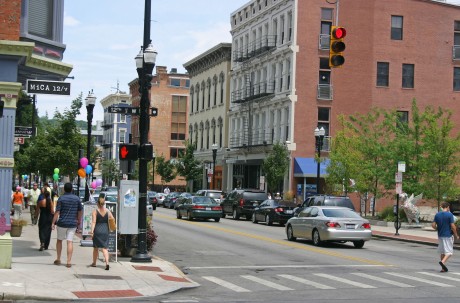
over-the-rhine

“I think of the big cities like New York and San Francisco being like a balloon,” he told me. “When you squeeze one part of the balloon, another part bulges. So if a bunch of people grab at the middle of New York or Toronto or San Francisco, it’ll push other people to edge. The problem right now is that everyone is trying to grab hold of every part of the balloon and a lot of people are seeing that they just can’t make it work.”

But he says this squeeze is not the case in second and third tier cities like Cincinnati, Pittsburgh, Louisville, KY, Philly and others that are not the darlings of the monied few. Despite their lack of glitz and glamor, he believes that these cities are very livable and attractive and that many people are realizing this. Because they were developed before the car, they offer walkable streets lined with solid, beautiful old architectural. Most importantly, their real estate values are approachable for people making normal salaries.

“If you want to stay in the New York area and want something a little bigger and more affordable than what you can get in the city, you’ll probably end up in some split level ranch house in Long Island far from everything.” Alternatively you could live in one of these second or third tier cities, which offer many of the benefits of a New York at a fraction of the price. He says that many people who initially bristled at the idea of living in a place like Cincinnati begin to see its merits after some analysis–they see the walkability, safety, affordability and human scale. “Sure, you might not have access to same super fabulous jobs as New York, but let’s face it, most people have normal jobs,” he says.

The changes in today’s workforce is one reason why these and other cities are becoming more economically viable. Many of today’s workers just need a strong wifi signal and access to a major airport to conduct business, leaving them free to live where they want. He also cautions that the super fabulous jobs in New York and San Fran–and their attendant extreme housing costs–might not always be there. If there are crashes (or adjustments) in the financial and/or tech industries respectively, the solidity of those cities’ economy might be quickly dissolved.

streetcar-suburbs

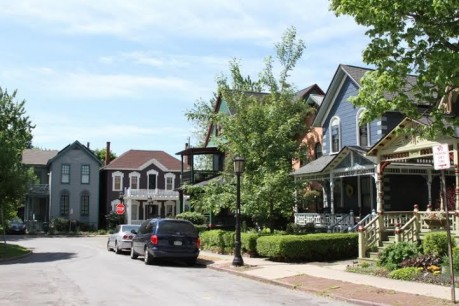
Sanphillippo presents options aside from the city centers. There are “streetcar suburbs”–areas developed between 1890-1940 that might lack the higher density of living in a city center, yet still offer compact, convenient living. He said you might not be able walk everywhere or live without a car in these places, but you might be able to go from four cars for a family to one.

He also said that people can “retrofit suburbs,” creating pockets of density in suburban enclaves, ideally with groups of other like minded folks. He says this is easiest to do in suburbs developed in 50s and 60s when car ownership was not a given for every adult. In fact, most of Sanphillippo’s top picks for places to live are inversely related to car-dependency. He said this retrofit process is not an overnight process. “It took 60 plus years to get to car dependency and it could take another 60 years to get to something else.”

If you’re looking for great places to live–or simply a fascinating blog–Check out Sanphillippo’s Granola Shotgun, where he tours the country looking for what’s next, taking pictures, talking to locals and presenting myriad options for living an affordable, urban life.

image via Urbancincy

Where’s the Best Place in North America to Live an Edited Life?

An article in Curbed yesterday gave a construction update of My Micro NY, the celebrated winner of the adAPT NYC micro-apartment pilot program competition that will be ready this summer. Make no mistake, My Micro is a significant step in the right direction for giving more housing options to New Yorkers. It also might be providing evidence for why the city should lift its absurd 400 sq ft building code minimum size requirement. But as I mentioned a couple months ago, My Micro has a total of 55 units–22 of which will be set aside for formerly homeless Veterans and low-and middle-income families (I imagine it’s gonna be a tight fit for the families). The rest of the 260-360 sq ft, unfurnished units will be market rate, which in NYC means $2-3K rent–a lot of dough for a tiny apartment. The fact is its immediate impact in providing affordable housing for New Yorkers is, charitably speaking, insignificant.

The problem isn’t the My Micro developers or architects or the micro-apartment concept–it’s the city itself. The average price of a studio in Manhattan is around $2500. Want to save money in Brooklyn? Fuggedaboutit. You’ll pay $2100. And both of these numbers factor in many outer-borough neighborhoods, where prices are considerably cheaper than average. The more central, walkable neighborhoods frequently exceed these averages by large sums. To illustrate how out of control NYC housing has become, an affordable housing development in Williamsburg, Brooklyn had a lottery for its 38 available units. 70,000 application were received.

The reason I bring up New York is because in many ways it should be the ideal city to live an edited life. It is one of the most experience and relationship-rich cities in the world–who needs stuff with all these interesting folks and culture around? There are countless public spaces to augment small personal spaces. It is one of the most walkable cities in the world. It has a peerless public transit system and an increasingly awesome network of bike lanes. But in reality, it can be a brutal place to exist (an Onion article explains it well). If you have to work 60 hours a week just to afford a place to live, it’s tough to live a sane, edited life.

Lest I unfairly single New York out, it should be said that many of the most walkable, culturally diverse cities in North America have become, or are quickly becoming, out of reach to all but a select few. New York, San Francisco and Vancouver are the most obvious places where this is happening, but other cities like Boston, DC, Seattle and Toronto are seeing similar housing costs explosions.

Many proponents of space travel believe that we have a better chance of colonizing Mars than we do repairing earth. In much the same way, might it be easier to evacuate the New Yorks and San Franciscos than it is to expect things to get better?

Obviously, the aforementioned cities aren’t the end all be all in terms of places to live. Walkscore.com published an interesting list last year of affordable, walkable cities. The list errs on the chilly side, with Buffalo, Rochester and Chicago making up three of the four top spots. But the 12 cities do give some not-so-obvious suggestions for interesting place to set up camp. In fact, Buffalo was the subject of a recent Gothamist article called “Millennials are Moving to Buffalo and Living Like Kings,” giving further credence to Walkscore’s number one designation.

But we thought we’d reach out to our readers to ask them where they think the best place to live an edited life is. Here are the general characteristics that this place might possess:

  • Easy to live without a car. Walkable, bikeable, public-transportable. Few things save money and simplify life like ditching the car, but in many places, that’s just not feasible.
  • Stable economy. Places with decent job prospects.
  • Affordable. This does not mean cheap. It means that the housing costs are relatively low in relationship to median incomes. Detroit might have dirt cheap housing, but median household income is half the national’s.
  • Rich public life. Parks, events, street life. The things that make a city great.
  • Bonus points: decent weather (no endless subzero winters nor sweltering summers) and resilient (ideally places not in the middle of an epic drought, not being ravaged by forest fires or lava flows, etc).

What do you think? If you were to create an edited life, where would be the ideal place you’d do it? Is it where you live? Why? Is it someplace else? Why? Let us know your thoughts in our comments section.

Image credit Bokstaz / Shutterstock.com

The Slow Death of the Walkable City

As a bit of an urban planning enthusiast, I’ve often wondered how cities that predate widespread car-ownership can be so car-dependent nowadays. For example, I am from Chicago, a city that was booming well before the Model T hit the assembly line. Yet today, there are large swaths of the city that are, for all intents and purposes, inaccessible without a car or a ton of patience for public transit.

The fact is most cities that predate ubiquitous car-ownership were far more walk/bike/public-transit friendly than they are now. Their cityscapes were characterized by dense housing on small lots connected by narrow streets. People walked, biked, rode horses or took streetcars to get where they were going. Without cars, people had to live close to their work, stores, etc.

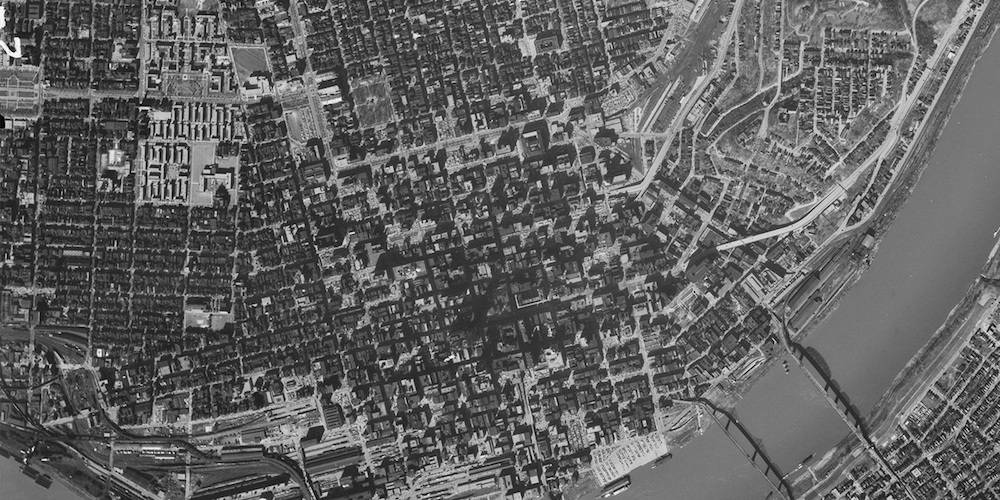
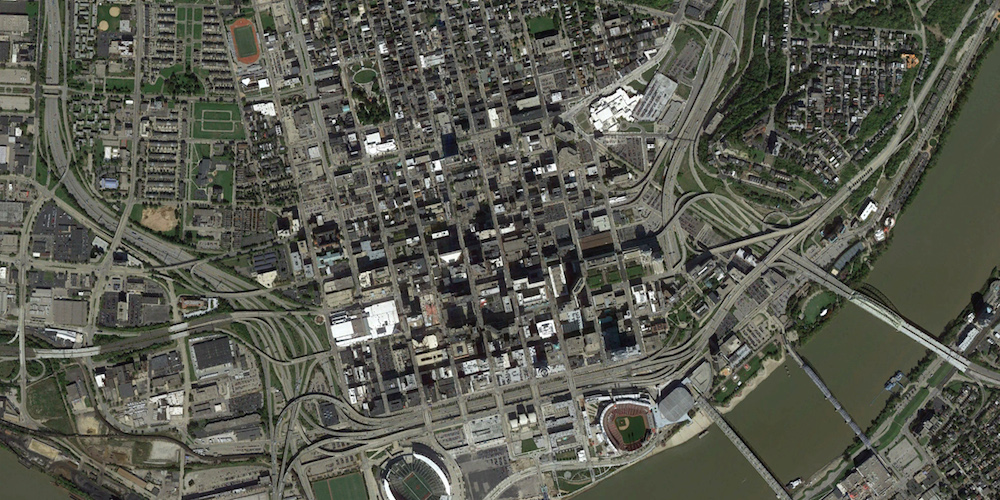
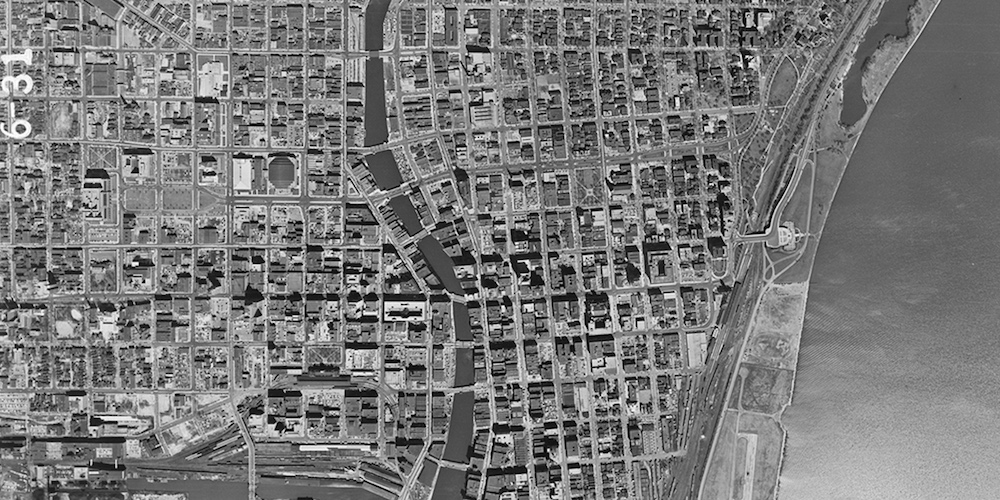
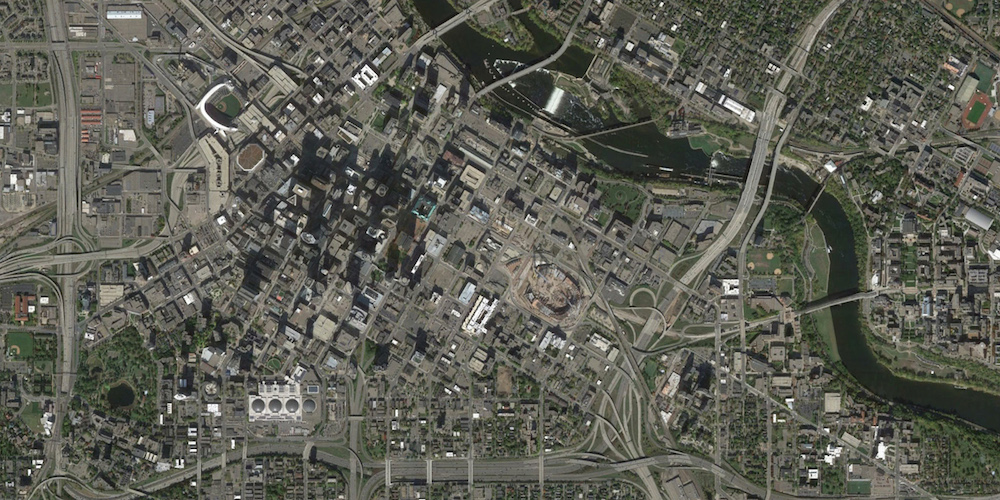
In the mid 20th century, much of this density was lost to make way for the car, a fact illustrated so well by these maps published by the University of Oklahoma’s Shane Hampton. He writes of the contrasting views:

60 years has made a big difference in the urban form of American cities. The most rapid change occurred during the mid-century urban renewal period that cleared large tracts of urban land for new highways, parking, and public facilities or housing projects. Fine-grained networks of streets and buildings on small lots were replaced with superblocks and megastructures. While the period did make way for impressive new projects in many cities, many of the scars are still unhealed.

Indeed, the pictures show cities eviscerated by highways. Semi-occupied lots fill the spaces where tightly packed housing once stood. Wide arterial roads replace narrow streets. It is a picture of sprawl.

What’s interesting is that many of the cities featured have experienced economic decline in the last 60 years. On the other hand, cities like San Francisco, Boston and New York City that did not undergo such profound transformations (not that people didn’t try), have remained economically vital.

As with many things, the answers to present and future problems can often be found in the past. The older pictures show that we know what to do, how to build and how to make cities vibrant, walkable and sustainable. If we can build that type of cities once, we can do it again…at least one can hope.

See more interactive maps on the University of Oklahoma’s Institute for Quality Communities website

Hat tip to Lloyd

Why Living in New York and San Fran is Affordable

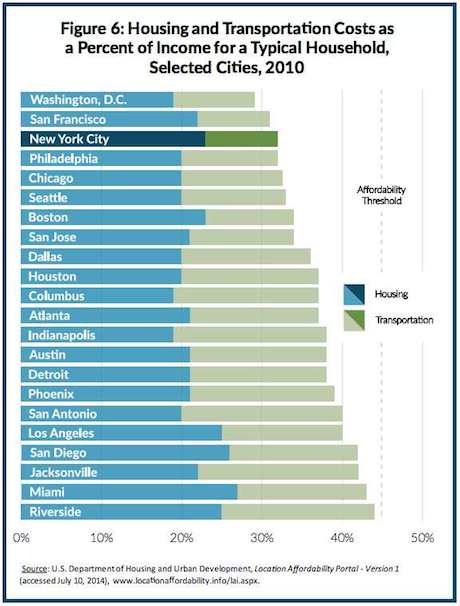
It’s fair to say that New York City and San Francisco are the darlings of dense, walkable urban living in the US. It’s also fair to say that rents and house prices in those cities are bat-sh#t crazy expensive; median rents in those two cities exceed $2200/month according to Trulia (and we know this is a very low figure). But assessing the true cost of living in a particular city is not something that can be achieved with housing costs alone. Incomes for the region, cost of living and, importantly, transportation costs have a big hand in determining how much it really costs to live somewhere. Calculating these manyfold considerations is exactly what the Department of Housing and Urban Development’s (HUD) Location Affordability Index does for you.

The Index has a national map that allows the public, businesses and government to access realtime data about the combined costs of living in an area relative to average incomes. For example, a single professional in Soho NYC annually pays $22K on rent and $5300 on transportation, but because he or she makes almost $90K annually, the percentage of his or her income of the living expenses (28%) make it more affordable then suburban Westchester County (42%), where, despite its lower rents, is less affordable due to increased transportation costs and lower incomes.

The map gets pretty detailed, allowing you to zoom in on very small regional zones. For example, the Index provides data for almost every block of the small neighborhood in Brooklyn where I live. The Index has a variety of filters, allowing you to see the expenses as they relate to renting your home, owning or combined. I also gives you the ability to search depending on your marital status and income bracket: moderate income family, working single, single-parent-family, etc.

housing-transporation

Interestingly, the Index showed Washington DC, San Francisco and New York City as the most affordable major US cities, besting places like Houston, Indianapolis and Phoenix.

Needless to say, the Index uses fairly broad data (e.g. I know few people in Soho who pay less than $2K/month for rent), but it is pretty informative. One of the prime reasons people move out of cities is housing costs. For a one bedroom in San Francisco, you might be able to buy a four bedroom house in Sacramento. But as the Index shows, you can’t look at housing expenses in a bubble.

via Vox

Love Manhattan? Then You’ll Love Yujiapu

Ah the dream of creating a perfect city–include the best, leave the rest and all you have is perfect living conditions. History is dotted with success stories: Brasilia, Arcosanti, Celebration, Florida–places that testify that making a great place to live is really a matter of connecting dots and constructing a few buildings.

Aforementioned examples notwithstanding, it’s actually tough to make a city from scratch (who’d a’thunk?). Most successful cities get that way because: 1. they are blessed with great geography (NYC, Singapore, Hong Kong, etc); 2. they evolve over time, adapting to their populations’ and eras’ particular needs; and 3. their evolution has created cultural and aesthetic diversity that makes them resilient and interesting.

But don’t let the difficulty of city-building make you think people ain’t gonna try to do it. They do and they are.

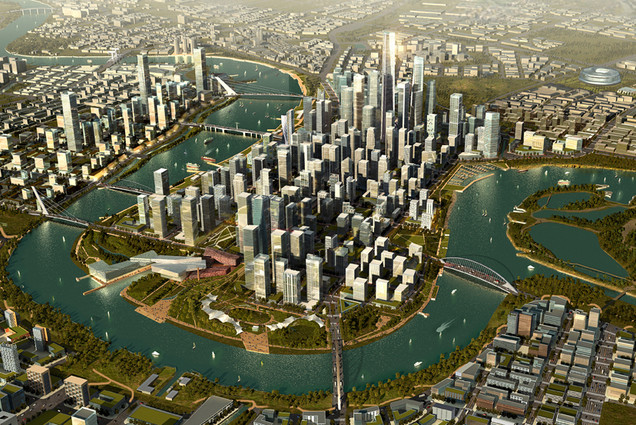
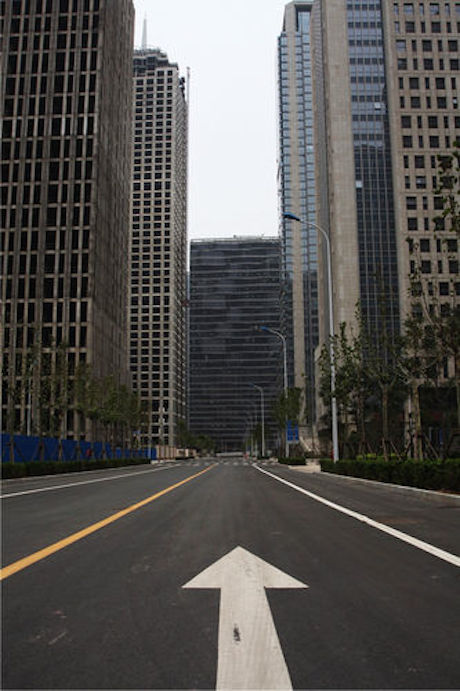
Yujiapu Financial District is one such example. It’s a city being built from scratch in China. It is being made in the likeness of Manhattan, replete with its own Rockefeller Center and One World Trade Center knockoffs. It even has a couple big NYC real estate heavyweights like Tishman Speyer and Rose Rock Group helping construction along. Located about 2.5 hours southeast of Beijing and built on a marshy former fishing village, the city is meant as a high-density haven of global finance, littered with skyscrapers placed along gridded streets…just like Manhattan.

yujiapu-street

Unlike Manhattan, a city whose modern incarnation started with a small Dutch Settlement 400 years ago, Yujiapu began construction in 2008. Yujiapu’s first building opened two years later and completion is expected for 2019. Also unlike Manhattan, who boasts a population of about 1.7M people, Yujiapu is virtually deserted. And the chances of changing that and replicating Manhattan’s hustle and bustle aren’t looking good.

The city was conceived in the heyday of China’s economic boom. In particular, Yujiapu is near to Tianjin, China’s fourth largest city, whose economy seemed unstoppable ten years ago. But as China and Tianjin’s economy slowed (the latter experiencing a 7% decrease in economic growth in last four years alone), new construction, fueled by hopes of ceaseless economic growth and massive amounts of debt, no longer had occupants. Now buildings like the Country Garden Phoenix Hotel (pictured below), designed to be Asia’s largest, sit fallow along Yujiapu’s untravelled streets.

yujiapu-hotel

We at LifeEdited love our cities. We love walking and biking everywhere. We love the serendipitous encounters that seems to happen all the time along city streets. But making a great city, so far as we can tell, is not a paint-by-numbers proposition. It’s a mutual evolution of planning, place and population. Though it would seem to lack most of those things, we wish Yujiapu well–mostly because that’s a lot of resources for something that might not be used.

Via Bloomberg News and Vagabond Journey

The Housing-Transit Connection

A recent report by the American Public Transportation Association found that public transit use in 2013 was the highest its been since 1956; 10.7 billion trips to be precise. They also reported that “public transit ridership is up 37.2 percent, outpacing population growth, which is up 20.3 percent.”

These are heartening numbers, likely reflecting an overall trend toward urban living, where public transit is far easier to use than sub-and-ex-urban areas. Between 2000-2010, there was a 12% increase in urban growth across the country according the US Census; 3% higher than non-urban areas. There were 2.3M new city dwellers from 2012 to 2013 alone.

Why is this important and what does it have to do with small-space living? It’s important because there is an inextricable link between the type of house we choose to live in, its size, location, access to transportation and our carbon footprint.

As a rule, single family houses are more resource intensive. Their individuated thermal envelopes require more heating, cooling and materials than multifamily dwellings which share walls. More importantly, single family houses have their own lots (the average lot size of a new home in 2013 was 1/3 acre), which pushes them further and further afield, requiring more driving, more gas, more infrastructure to support those cars, etc. Given that 35-40% of the country’s energy needs are from petroleum–the bulk of which goes to cars–living in a house that is not car dependent can significantly reduce your carbon footprint.

It’s also important to note that there are fewer people occupying these houses due to a shrinking household size, a trend which, if it continues, could mean more houses for the same population, meaning more sprawl.

energy_use_impact2

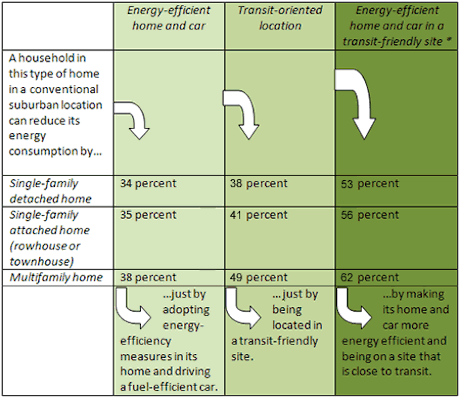
An EPA study published a few years ago called “Location Efficiency and Housing Type” explored this topic in great detail. What they found was that making your single-family house more efficient makes a difference. They found that an energy efficient housee and car can cut your footprint by 34% over a conventional, single-family suburban one. But they found that living in an energy efficient multifamily house with access to public transport–even if you keep your car–can reduce your carbon footprint by 62%. It’s also important to note that multifamily housing units are typically smaller than single-family houses.

The good news is that APTA’s report suggests America is slowly moving toward a multifamily, public-transit-centric housing bias. We say “slowly” because new single family houses are, on average, still pretty damn big. In 2012, the average new single family home was 2505 sq ft–just shy of the 2007 high of 2521, right before the housing bubble burst. One big asterisks is that there were fewer single family housing starts–1.04M in 2007 and 535K in 2012 (though there has been a steady increase in single family starts since a major dip in 2008-9).

That said, 5+ dwelling unit multi-family building starts are up as well to 293K in 2012 from their 97K low in 2009, which, coupled with increased public transit use and the overall trend away from car ownership, bodes well for a less-car-dependent, centralized American population with a smaller carbon footprint.

Long story short, putting all lifestyle benefits aside, if you want to reduce your carbon footprint, there are few things that are more effective than downsizing, centralizing and moving into a multifamily housing situation.

Via Treehugger

Fast Moving Traffic image via Shutterstock 

Tabula-Rasaburg

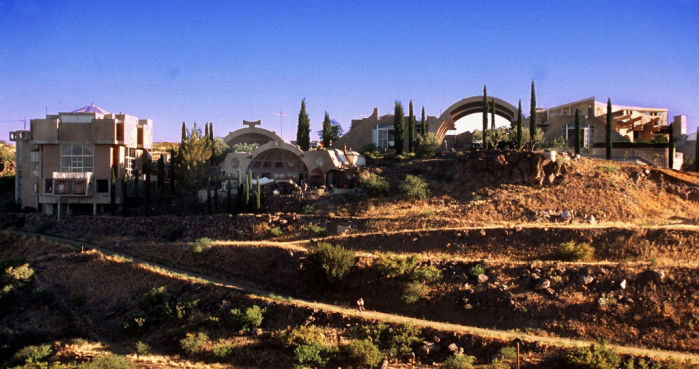
Many, if not most major cities have been around for some time. NYC dates from the 17th Century, San Francisco from the 19th, London from the Roman Empire. As such, these and other cities are burdened with the unwanted inheritances of past lives: ancient and crumbling architecture, archaic street grids, sprawled-out and mass-transit-proof city plans and so on. Arcosanti, an urban experiment built on the tabula rasa of the Arizona desert, was to be a city without a past–a city that would succeed because it was guided and designed by principles, not ghosts.

arcosanti-panorama

Arcosanti first broke ground in 1955 in a location 70 miles north of Phoenix. The project was the brainchild of Italian-American architect Paolo Soleri. It was meant to be a living embodiment of the concept he called arcology, the meeting of architecture and ecology. The city sought to adhere to design principles that would perfectly alloy the best of the city (density, social living), country (access to nature) and sustainable living (resource conservation). Here is an example of the “proximity” principle from the Arcosanti site:

Arcosanti’s design provides an efficient and lively urban environment by physically connecting a mix of activities such as living, working, learning and leisure. In this way efficient and equitable access to most of the city’s amenities and are available within minutes. Although life in such a setting will be intense and exciting, at times it could be taxing on individuals. For this reason, Arcosanti also features immediate access to open space and nature, to provide opportunities to decompress.

Other principles include things like urban scale, less consumption and elegant frugality (full list here).

Arcosanti_vaults

The town occupies a space of 25 acres and has 13 buildings, most of which were built between 1955 and 1974. The architecture, which was to embody the principles and bring people together, is littered with common spaces that look like a Roman forum as interpreted by the set designer of Battlestar Galactica (the one from the 70s).

Over the course of its life, there have been anywhere from 50 to 150 people living there at one time, fluctuations attributable to student populations who have used the town as a research site.

The town was intended to eventually house and support 5K people. That intention, for a multitude of reasons, was never fulfilled. Some of those reasons, like a spartan, toilsome daily routine, and a cement building composition that baked in the sun and froze in the winter, were specific to Arcosanti. Others were characteristic of many total cities (e.g. Brasilia), where the autocracy of principles and a singular, exclusionary vision left little room for the cultural and formal flexibility that makes successful cities succeed.

Today, the town’s main “industry” is handmade bells. As of a couple years ago, there were 56 full-time residents. Arcosanti still hosts students and tourists (you can book one of their rooms through their website). But notions of Arcosanti as a model for the future have mostly evaporated like water in the desert (who knew making a city could be so hard?). All that said, we love a good experiment and think Arcosanti was, and to some extent isa bold one worth knowing about…if not living in.