11 Steps for Choosing the Right Roommate

The fact is many of us can’t afford to live alone–at least not in places we want to live. Roommates hold the promise of cost and space efficient living; they may even be a way of making new friends. They also hold the possibility of living in some pretty crappy situations: living with slobs, deadbeats, Chatty Cathies, etc. These situations can make us dread going to the one place that’s supposed to our refuge.

While there are a number of professional roommate-matching services, the vast majority of us DIY it on Craigslist or reaching out to our personal networks. Whether you are looking for someone to move in with you, or are looking to move in with one or more people, a little bit of planning and forethought go a long way. Here are a ten tips we suggest for creating a happy, functioning roommate situation:

  1. Think ahead. If there’s one factor that leads to more horrible living situations than any other, it’s haste. You find yourself needing a place to live yesterday, and suddenly you are rationalizing living with the guy who can’t stop talking about his pet boa constrictor. And while many good people find themselves on their ass needing a place to live ASAP, as a rule, people who plan ahead, seeking out their roommates a month or two in advance, are also the kind of people who pay their bills on time and are considerate to the people they live with.
  2. Get habituated. Find out how your prospective roommate(s) live. Do they watch a lot of TV? Stay home all the time? Never home? Like hanging out? Like being alone? Work all of the time? Like loud music? Hates loud music? Vegan? Partiers? And so on. Get as much information as possible before you move in together. No one will be a perfect match, but honestly ask yourself if, on balance, these habits are things you can live with.
  3. Pay attention to the details. Looking for a potential roommate is like dating–only more intimate. Don’t dismiss the red flags. Look and listen for tip-offs for how the other party lives. If you’re at their place, are there dirty dishes in the sink? Excessive beer cans in the trash? More than one game counsel attached to the TV? Did the prospective roommate bring up his/her jealous ex more than three times during your interview? Maybe these things are coincidences, but probably not. If you notice more than a couple red flags, chances are these things will get worse with time and exposure.
  4. Come clean. Few things can be as contentious as cleaning habits, as everyone has a different idea of what constitutes clean. Do you expect your house to be spotless and tidy all of the time? Are you okay with a little clutter? Are you a slob? There is no right way of living, but it’s important people’s habits are similar. If you’re trying to assess how clean someone is in an interview, ask about his/her cleaning habits. If she says “it’s not a big deal,” she is probably pretty messy. If he suggests a regular cleaning schedule or splitting the cost of a housecleaner (a very good idea), he is probably a neatnik. People can have different politics and tastes and live felicitously together, but if you have mismatched cleaning habits, forget about it.
  5. Money talks. Besides dirty dishes, money matters can strain an otherwise happy roommate situation. Get with your prospective roommate about every bill, the portion expected to pay and estimated monthly amounts. Get reasonable assurance that all parties have the ability to pay for said bills (employed roommates tend to be preferred). This is a good time to bring up food costs. Some roommates are okay with sharing food and food costs, but many are not. Get clear how you want to handle that.
  6. Friends are good…sometimes. Just because your good friend needs someone to live with, it doesn’t mean it should be you. Many friendships have been destroyed after living together. Treat your friend as you would anyone else–honestly evaluating whether he/she would be compatible with your lifestyle.
  7. Do a background check. This might seem a bit cold, but the fact is unless you’ve known someone for a while, their history can be quite iffy. Running a credit report or criminal background check can help ensure you’re not moving in with an unsavory character. If someone objects, particularly to a credit check, you might ask yourself why.
  8. Find a space that works. Apartments where autonomy is possible–e.g. large bedrooms to retreat into–tend to work best in roommate situations. This is not always possible or needed–many roommates are never home and having a ton of space is irrelevant. Just try to find a space that works with your respective lifestyles.
  9. Determine how the place is decorated. This is usually pretty straightforward; the person with the apartment to move into will usually provide furnishing. If you are particular about your décor, let it be known up front.
  10. The finer points. If you’re moving into an unknown space, think of all possible things that can go wrong: Roaches and bedbugs (particularly in big cities), neighbor and street noise, superintendent responsiveness, any back bills…whatever you can think of, ask.
  11. Sign on the dotted line. When you’ve found someone you think you can live with, put as many of the terms in writing (there are many standard forms available online). Informality and vagueness never pay.

What would you add to this list? Let us know in our comments section.

Smell Up Your Home for Lower Stress

A body of evidence has shown that interacting with nature reduces stress and increases our ability to pay attention. Research is now showing that smelling nature “lowers our blood pressure dramatically and increases anti-cancer molecules in our bloodstreams” according to a recent Atlantic Cities article.

Immunologist Qing Li at Tokyo’s Nippon Medical School suspected the positive physiological effects of being in nature weren’t only visual–i.e. looking at a forest or creek or whatever–but olfactory. For the last eight years, he’s been studying phytoncides, the natural aerosols emitted by plants, to see if and how they benefit humans.

To test his theory, he stuck subjects in a hotel room (probably the most unnatural environment imaginable); one group had cypress aromatherapy and the other without. The group with “experienced significant drops in stress hormones and boosted immune cell activity,” according to the Atlantic. Li helped found a Japanese group to further research in the forest medicine field, and a few years ago the International Society of Nature and Forest Medicine (INFOM) was founded.

What does this all have to do with living an edited life? Well many of the living situations we talk about on this site are urban. And while city life has many benefits–culture, great transportation, walking, etc.–it can also be pretty assaultive on our senses. While nothing replaces time in nature, a few small steps such as adding an essential oil diffuser with cypress or lavender oil (we suspect Febreeze and Glade Plugins won’t produce the same benefits) to your home might make a huge difference in offsetting some of the stressors inherent in city life.

Image Credit: Shutterstock.com

Via Atlantic Cities

Hong Kong’s Micro Madness

We’re big proponents of high-density urban living but there comes a point where small-footprint, efficient housing starts looking a whole lot like storage units for humans. Few places fit that bill like Hong Kong, which boasts the second highest density of any sub 1M person nation in the world.

Some pictures by photographer Benny Lam taken for the Society for Community Organization show the more unseemly side Hong Kong’s high density. The shots are part of a campaign meant to bring awareness to the shockingly cramped conditions many Hong Kong residents live in.

The shots bring to mind a series of photos from photographer Michael Wolf, who looked at many different facets of Hong Kong density–from squeezed interiors to seemingly unending high-rising apartment exteriors. Check out his website to see the full series.

We recently read an NRDC interview with our good friend and Treehugger managing editor Lloyd Alter, where he shared some of his thoughts on the limits of density. While there has been a recent battle-cry of “denser-is-better” that axiom can be a bit facile, as he explains:

Environmental writers and thinkers are piling on, all of them claiming that we need to fill our cities with 40 story buildings. A renowned architect can design a building that is essentially a pile of radiator fins but call it green because it packs 750 apartments on a third of an acre, saying that the most important thing we can do for the environment is live in compact cities with mass transit.

I am convinced that they are wrong, that there is a “goldilocks density” that is high enough to support a vibrant, walkable community, but not so high that you can’t walk up to your apartment when the power goes out, that needs expensive infrastructure like subways and huge underground parking garages. Dense enough to build a sense of community, but not so dense as to have everyone slip into anonymity.

We’re not intimate enough with Hong Kong to say whether their density is problematic (though a video we posted a while back seems to indicate that people in Hong Kong seem to think it’s a problem), but we can’t help think that these Hong Kong homes bear out Alter’s contention that greater density ain’t always so great.

Incidentally, Singapore is the both the densest and unhappiest nation in the world. While that’s far from proof that hyper-dense living causes unhappiness, anecdotally it might bolster the contention that maximizing density doesn’t maximize greater living.

Survey Shows Real Costs of City Life

In our quest to find the best place to live an edited life in the US, we came across this chart from The Atlantic. It shows what percentage of income is spent on housing and transportation by the middle class for every major metropolitan in the United States.

While this chart does not provide a definitive answer to our question (and of course there is no “one” answer), it does provide some useful data.

First, it looks at the middle for income; defined as people making 50-100% of median income for that city. And rather than looking at raw housing costs, it looks at housing costs as percentage of that income. So even though the average rent in the city of San Francisco is $3226, most San Franciscans use 33% of their income for housing; combine that figure with one of the lowest transportation costs in the country and San Francisco looks quite competitive in terms of affordability. Same story with New York City: High incomes in proportion to high housing costs combined with low transportation costs equal reasonable overall expenses.

Washington DC ranked the most affordable in this survey. The nation’s capital has relatively high housing costs, but also high relative incomes and very low transport costs.

On the other end of the spectrum are cities in Florida and California (San Fran excepted). Their low incomes relative to housing and high transport costs made them not-so-affordable places to live.

Unfortunately for all of the cities surveyed, the overall costs of housing and transport relative to income has gone up, as indicated in the graph at top.

via The Atlantic

Man Goes Into Deep End in Quest to Edit Life

Each week we are profiling real people who are editing their lives for more freedom and happiness. This week we hear from Mike, who is giving up his spacious Bath, England flat to live out his dream, living aboard a 42 ft “Gentleman Cruiser” motorboat, while creating a simpler, more financially sane life.

Tell us about yourself.

My name is Mike. I’m 52. I work as an IT consultant, part time film extra (you can see me briefly in Harry Potter and The Order of the Phoenix) and occasional performance artist (Captain Teapot, I took part in a project on the empty plinth in Trafalgar Square in 2009). I’m single and currently living in the UK in the Georgian city of Bath.

What makes your life an ‘edited’ one?

My life is becoming an edited one due to my imminent move from a large apartment in Bath, ceiling heights nearly 12 ft, living room and bedrooms are both 18 ft x 14 ft, built in the late 1700’s. I’m moving to London and I’ll be living on a motorboat that is only 42 ft x 12 ft with a ceiling height of 6 ft. There is no room for freestanding furniture, but there is some built in furniture, a table and 3 bunks and of course a shower and galley kitchen.

living rooms now and later

How long have you been living this way, and do see yourself continuing to live this way?

I’ve been living in houses and apartments all of my life. I’ve never lived on a boat before, but have sailed a little. I see my move to the boat as a long term one, perhaps a permanent one. It was motivated by a long held dream of a life afloat and by the fact that property prices in the UK are too high.

What are the biggest advantages of living this way?

Advantages are more money and time, as most of my work in the past has been in central London I’ll be able commute using public transport and on good days I’ll be able to walk to work.

What are the biggest challenges?

The biggest challenges are the reduced space, plumbing aboard a boat is not as straightforward as it is in an apartment, water has to be pumped aboard. Also I’ll probably have to move the boat on a regular basis, residential moorings in London are difficult to find so I’ll have to relocate every few months for a while until I can find one..

Do you think you could maintain this lifestyle with a family?

It could be done with a family, but I’d need a bigger boat.

What is the number one suggestion you’d give to someone looking edit their lives?

Look carefully at what you think you need. If its been sitting in a box out of sight for years, you don’t need it. I had many items that belonged to my youngest brother who died several years ago, a castle and soldiers I bought him for Christmas when he was 8 years old, and some of his personal items. I was keeping them for sentimental reasons but realised that he wasn’t in them. He’s in my heart, in me and always will be. The things are ultimately not important and now someone else can enjoy them. Items that belonged to him I gave to local charity shops and I had a home sale that enabled me to sell most of the furniture and other items I’ve accumulated over the years and a poster for the film ‘Charade’ has gone to an auction in London.

What item(s) have made your lifestyle easier?

A computer has made a big difference, CD’s, DVD’s and even books are no longer neccessary now that they can be stored on a laptop that fits into a small bag. Also the fact that I’m currently single has helped. I’m the only one that I have to consider, it wouldn’t be quite so easy with a partner or family.

Do you have any design or architectural suggestions derived from your lifestyle?

A boat is made for a purpose, size is limited and there’s a purity to it that I like, also there is a little romance about life on a boat. I intend to do a little work to her and will have good quality fabrics etc on board and I can do that because the boat is small. I’ve lived in many different places over the years but could never afford to decorate them properly, corners were cut and the sheer size of the places meant that decorating was almost a never ending task. With the boat I can decorate easily and afford to do it well.

Anything else?

If your looking for boats for sale in the UK www.apolloduck.com. For information about moorings www.bwml.co.uk.

Opinion: Where is the Best Place to Live an Edited Life in the US?

We are great advocates of cities: They’re walkable, bikeable and have public transport for easy mobility; the average city dweller uses approximately 14% less carbon than his non-urban counterpart according to the Brooking’s Institute study; their density facilitates easy interchange of resources and vibrant cultural lives.

But to use “city” as an abstract term might not be helpful if you are looking to move somewhere where you can best live an edited life–i.e. living a life with more money, health and happiness with less space, stuff and energy. The question becomes, which city supports that life best?

We talk a lot about New York City and San Francisco, as they both are very dense, have extensive public transport systems and have vibrant cultural lives. But consider the average rent in the New York metropolitan area is $2687. San Francisco is even more at $3226.

Perhaps you want to take economist Jed Kolko’s advice and buy a home, which he claims will save around 30% in living expenses. Well consider that the median home price in Manhattan is $1.14M. Want to slum it up in a borough like Brooklyn? Median price is $582K (the borough was recently deemed the second most expensive place to live in the US behind Manhattan). San Francisco is no slouch at $705K. That’s a lot money to fork over to save money! And buying small doesn’t necessarily save you a ton. Studio rents in both cities frequently exceed $2K. If you’re a family, expect to pay $3500+ rent or $800K for even a modest apartment.

Of course, with these prices come increased economic opportunities, but there’s a paradox: There are more jobs where you can make more money, but, in most cases, you work more, with less time to enjoy the benefits of the city.

There are middle-ground cities like Chicago, Boston, Philly, Seattle and Denver that enjoy more manageable living expenses along with decent economic situations, but they also tend to be less walkable and have less developed public transport.

Then there is Main Street USA. Many claim that small business and technology will allow people to work remotely will make them the “cities” of the future. But for the most part, this is still speculative. Most jobs are still in denser areas and these areas are usually quite car-dependent.

We realize this is not a simple question. The “right” answer might depend on living situations (single, couple, family), career situations, family connections, etc.

Imperfect as the answers may be, we’d love your opinion. Do you live–or have you lived–in a place you think facilitates the edited life–a place you think allows you to do the most with the least?

Please leave us your thoughts in our comment section below. Thanks!

The Bicycle is the Official Vehicle of the Edited Life

We know there are many parts of the world where driving is extremely impractical, and we are not here to begrudge the multitudes for whom that is a reality. But make no mistake about it, no mode of transportation gets you around more effectively, efficiently and with minimal overhead than bicyling.

Consider the passenger mile per gallon of various modes of transport as a function of caloric energy expended over distance:

Nothing beside subways comes even close to a bicycle’s efficiency. But not everyone has a subway system in their area. And, as recent events are showing, even those who have great subway systems can be left at the mercy of repairs.

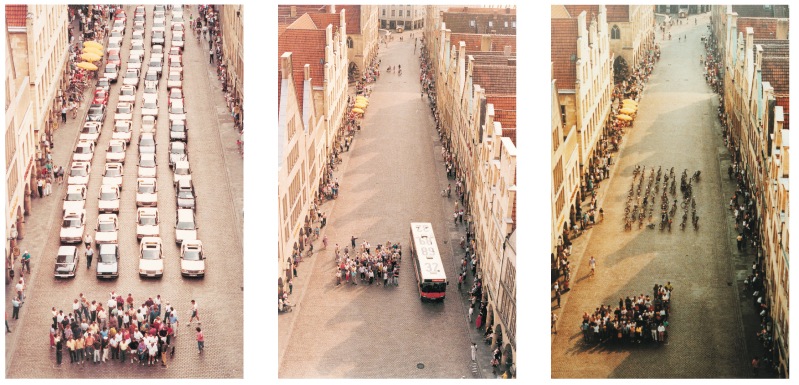
Then consider the sheer area consumed by bikes versus other modes of transport. The picture at top shows 50 people and 50 cars at left, 50 people and a bus in the center and 50 people standing by 50 bicycles at right. It’s a great illustration how cars make cities more crowded and cast suburbs further afield.

Biking may even reduce your personal area as a 150 lb bicycle commuters riding at 12-14 mph for 30 minutes burns 297 calories during his or her commute.

And even though walking takes the minimal volume prize, the 250% increase of efficiency compared to a slight increase in volume make bicycling a no-brainer for commutes longer than a mile.

Other benefits of ditching your car for a bike include avoiding costly car registration, repairs, insurance and fuel. An added bonus is that traffic becomes a thing of the past. Ridding yourself of managing these annoying details makes life simpler and happier.

So maybe you are considering commuting to work or doing more errands on your bike, but something is stopping you. Here are a few suggestions to help you get started:

  1. Get a bike you will ride. Some people think the Salvation Army is a bike shop. It’s not. Consider how much you will save by driving less, go to an actual bike shop, find something that fits your body and riding style and invest accordingly.
  2. Get some bike friendly clothes. We talk about Outlier a lot here, but there are many other commuter-friendly clothes out there such as Betabrand and even Levi’s that work too. It’s best to have clothes that are both durable and permit movement necessary to pedal.
  3. Get full fenders. Unless you live in the desert, you will deal with rain at some point. Few things are as gross as dealing with road grime all over your clothes after a light shower. Nothing helps avoid that like a set of wraparound fenders. Clip-on versions will work in some cases, but often leave you unprotected. When buying a new bike, make sure the frame is compatible with fenders.
  4. Learn how to take care of your bike. Get regular tuneups. Have a good floor pump. Get some decent chain lube (i.e. not WD40). Learn how to fix a flat (it’s not that hard). Many people avoid riding because they are afraid something will go wrong–it might! Learn how to deal with the situation rather than avoid it.
  5. Be flexible. Riding three out of five days is better than not riding at all. If there’s a blizzard, it’s okay to take public transport or drive. Going from two cars to one makes a big difference too. The key is just start riding!

Graph statistics by James Strickland, 2009

Loosecubes and the On-Demand, Go-Anywhere Office

Loosecubes is a network made up of companies and individuals that swap and use desk space. We’d call it the Airbnb of offices, but we’re getting a little tired of comparing things to Airbnb.

You join the network either as a host or individual. Hosts are typically organizations that provide desk space; members of that organization can access desk space of the other network members–in other words, the whole company can tap into the network. Individuals can access the network and book desk space whenever they want. According to their site, Loosecubes got some solid funding and consequently, joining the network is totally free.

All members are required to connect their Loosecube profiles with their Facebook and LinkedIn accounts to avoid unseemly characters. There is a $50K protection policy for hosts against theft, and hosts can decide the level of guest access to their office. Hosts can impose a maximum number of days a guest can work at the space to avoid office squatters.

Wifi and a comfortable place to sit are what’s provided, which for many of today’s professionals is all you need. If you need a printer or conference room, you have to work that out with the host.

The network is huge with locations in most every major, and many not-so-major, cities in the world. If you’re on the road, all you need to do is book a desk in the city you’re visiting, meet with the host and start working.

Beyond the practical aspect of having a free, temporary office in most any city in the world, Loosecubes has the potential to transform offices from static, closed spaces into coworking spaces, filled with a stream of new faces and ideas. Likewise, it promotes getting maximum use of existing resources; office spaces that would otherwise be vacant are filled by people who need a place to work. This might be bad news for many coffee-shops, but it’s good news for today’s light-traveling professional.

Have you used Loosecubes? What was your experience? Let us know.

Get Your Masters in Walkonomics

No form of transportation is more edited that walking. Tires are your shoes. Parking is your chair. Fuel is dinner.

We’ve looked at Walkscore.com in the past. The site is a great resource for assessing a neighborhood’s walkability, showing proximity to various pedestrian-friendly amenities like restaurants and public transport. What the site might not convey is a comprehensive picture of what that walk would look like. Is the walk a stroll in the park or an advance toward enemy trenches?

A new site called Walkonomics tries to fill in these gaps in knowledge. Rather than relying on statistical information, Walkonomics crowd-sources information about particular streets. It looks for information like “road safety,” pavement and “fear of crime,” as well as intangible but important qualities like “fun and relaxing” and “smart [the site makers are English] and beautiful.”

The site reminds us of Waze, which crowd-sources traffic data and gives you corresponding directions. Walkonomics is not nearly as robust as Waze, nor does it appear to have a mobile app, which would be indispensable for this type of information–helping you to decide on-the-spot whether to walk down that dark street or not.

The site is pretty beta and mostly covers major urban areas like London, San Fran and NYC. Even the latter city, arguably the most walkable in the US, has huge gaps in information. That said, users can take it upon themselves to enter data about their particular streets and beef up Walkonomic’s data.

Windy City Goes Micro with FLATS Chicago

Chicago adds its name to the growing list of cities that are building large-scale micro-unit developments with FLATS Chicago. The project is quite an undertaking. The development company, Cedar Street Co, has acquired seven buildings, representing 1200 apartments that will be converted into luxury apartments in the city’s rough-and-tumble Uptown and Edgewater neighborhoods.

Unit size will average around 350 square feet and be as small as 275. Amenities will include things like free wifi, washer/dryers in each unit, bike-shares, common spaces, rooftop pools and sports clubs. Projected rents range from $800 a month for a studio to at least $1,400 a month for a two-bedroom.

Rendering of Interior of FLATS Chicago

Jay Michael, one of Cedar Street’s partners, told Time Out Chicago that he wants to “sell singles on what he calls ‘FLATS life’: Common spaces are ‘an extension of your space’ where you can meet neighbors or entertain friends,” and that they are “targeting recent college grads who are ready to live alone,” who “for the same rent they’d pay for their half of a two-bedroom condo…can live solo at FLATS.”

Sounds good to us.

But there’s a catch: the buildings in question are dilapidated SRO’s, many of which, until recently, were occupied by impoverished residents. Though the developers want to make their units financially “approachable” to the existing tenants, the rents will likely be out of reach for most, and construction will inevitably displace them, even if that displacement is only for the length of the renovation.

While not obliged to do so, Cedar Street is working with transition coordinator Sherri Kranz to find housing for old tenants, many of whom have been in the apartments for more than 10 years. In one building alone, Wilson Tower, she’s working to find 60 people new homes–a challenge for people accustomed to paying as little as $475/month rent. She’s turning to city housing and nonprofits, though it sounds like sometimes the best she can do is get people on waiting lists. [Note: the SRO’s in question are not the “supportive housing” we talked about the other day, but rather privately held buildings.]

It’s the perennial gentrification conundrum. On one side are the under-served populations the buildings house. However, these building are, in Kranz’s words, “slums”–ones that in short time will be closed due to disrepair, making them a not-so-sustainable housing solution.

On the other side, the FLATS apartments will presumably serve large populations of city-dwellers, young and old alike, who are priced out of traditional apartments in more expensive neighborhoods.

Granted, there’s a big difference between having to get a roommate and being homeless, but it doesn’t negate the need for this type of clean, smart and affordable apartment.

Do you have any thoughts on these competing interests? Have you seen them successfully reconciled? Let us know in our comments section.

via Time Out Chicago