Japan, with its one-room-mansions and Kyosho Jutaku homes, gets a lot of attention for small space living, but England deserves recognition as one of the small-space-living world capitals. The country is packed–the densest in Europe in fact.
According to The Guardian England has no minimum space standards! While this doesn’t create a lot room for storage, it does leave room for innovation…or, as The Guardian suggests, developers looking to pulp every dollar from every square foot.
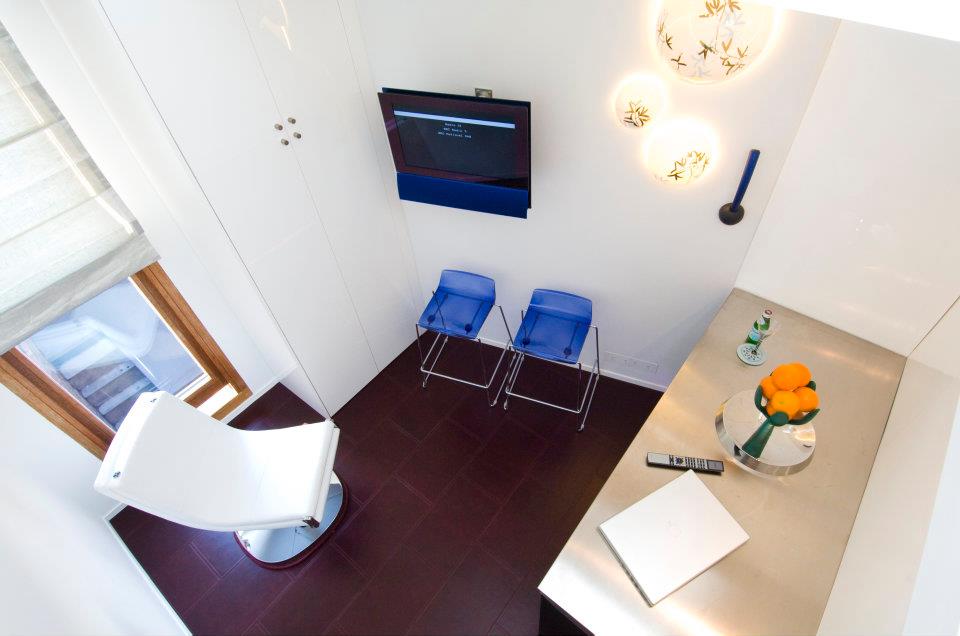
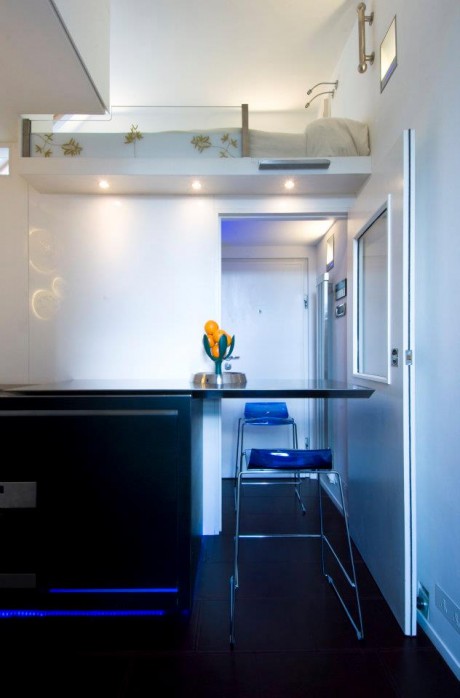
Like the fellow London Yo Home! flat we looked at last week, we think the LuxPod falls in the innovative category. The experimental space was built in 2008. According to LuxPod’s website, it’s 11 sq m/118 sq ft, which is by no means the smallest space we’ve seen, but it’s pretty damn small. It was initially used as a vacation property. It is not clear what it’s being used for now (we’re looking into it).
It’s really an impressive little space. The finishes are top notch. There are a number of cool features like a retracting countertop that creates a dining bar. There’s a cool “wet” bathroom. All of the appliances and furniture look high end. The layout–as far as a 118 sq ft spaces go–is great.
The important thing to note about micro apartments like these is they are not intended for everyone. For example, when this author moved to New York City 11 years ago, 118 sq ft of my own would have been palatial. As there was nothing like this available, I had to share an illegally divided apartment with 4 other people. Two of the bedrooms had no windows.
There is a worldwide market for small spaces. Many people, like my younger self, want a clean space for themselves in major cities and beyond. Now it’s a matter of making them available, livable and affordable for the people who need them.
In the 70’s and 80’s, single room occupancy (SRO) housing became synonymous with drugs, crime, totalitarian architecture and poor building quality. While the circumstances that lead people to SRO’s are still less than ideal (many are for the homeless population or very low income residents), a few architects are looking at what the buildings look like and what it means to live in them, designing innovative and supportive spaces for the populations they house.
Many SRO’s like the ones featured here enjoy a pass on restrictive building codes, allowing smaller unit sizes and larger communal areas than their conventional residential counterparts. Perhaps these developments presaged the upcoming micro-unit movement we’ve been talking so much about.
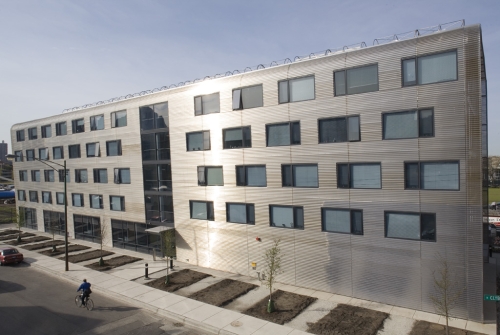
Harold and Margot Schiff Residence, Chicago IL
photo by Doug Snower
This building (also known as Near North Apartments or Mercy SRO) was designed by Murphy/Jahn Architecture, famous for O’Hare’s United terminal and Bangkok’s Suvarnabhumi Airport among many other large, notable projects. Charles Hoch, professor of urban planning at the University of Illinois told the NY Times that the design is a “stigma-smasher.”
The 96-unit building, built in 2007, borrows on “the cachet of Mr. Jahn to send a message to the larger society and that message is that homeless people have value, they have a role to play in society,” according to Hoch.
It is LEED silver certified, has solar panels and wind turbines that generate 15% of the buildings power and a grey-water recycling system (the first of its kind in Chicago). The ground floor features a large community space and the four top floors feature bright and airy units whose average size is 300 sq ft. Many of them feature views of downtown Chicago.
Bronx Park East, Bronx, NY
Before adAPT NYC, there was this SRO development by Jonathan Kirschenfeld, whose firm has done several similar sustainable “supportive housing” developments. The building, built in 2009, features triple-height street-side windows and 68 well-lit units with kitchenettes and private bathrooms. Units measure 285 sq ft, as supportive housing bypasses residential code that New York City spaces be 400 sq ft and up.
The development features a courtyard with a garden, a gymnasium and a double-height-windowed common room. Mr Kirschenfeld sees these kinds of spaces as integral to the intention of the space as he remarked to the NY Times: “Isn’t the idea here to improve mental health? Isn’t good architecture part of that?”
Another interesting aspect of Bronx East is its footprint, which utilizes an irregular lot.
Both of these developments show that innovation can come from unlikely sources and that good architecture and design need not be the domain of the rich.
If you know of similar innovative supportive housing, let us know.
Last week, 33 development teams submitted to adAPT NYC–the Bloomberg-administration-supported competition seeking the best 275-300 sq ft/unit apartment building proposal [full disclosure: LifeEdited was on one of the teams]. According to the Wall Street Journal, this is three times the number of entrants similar competitions draw.
“The City’s adAPT NYC competition has ignited a global interest and conversation about how high-density urban centers can right-size their housing stock to fit changing demographics,” according to Mathew Wambua, commissioner of the housing preservation department.
Good news, right?
Well, not according to everyone.
This last Tuesday, a few thousand miles away in San Francisco, the South of Market Community Action Network (Somcan) took to the steps of City Hall to protest a proposed change in housing code that would permit dwellings as small as 150 sq ft.
Perhaps because of its proximity to Japan, San Francisco has been at the vanguard of small building in the US for some time. Unlike NYC, who demands new apartments have a minimum of 400 sq ft of living space (adAPT NYC is receiving a waiver on that), San Francisco already allows new spaces to be built as small as 220 sq ft. The Cubix SF, which has units as small as 230 sq ft, has been around for several years. An upcoming project by SmartSpace at 38 Harriet St in the SoMa neighborhood will feature 4 stories of 300 sq ft units.
What Somcan is protesting is the city’s ostensible shifting focus from family-friendly affordable housing to housing for affluent, childless singles and couples. This is taken from Somcan’s Facebook page:
SF has yet to meet its SF Housing Element plan of prioritizing affordable family housing units and yet creating housing for the new techies in the neighborhood seems to be first on the agenda. With less families in San Francisco means less family-friendly city and less funds for our public schools. It will be competing with the minimal land that the City has which can be use for REAL affordable housing. This type of development could possibly be catastrophic to our neighborhood, displacing low-income families, singles and existing residents
They might have a point: mico-units are not family friendly. They are primarily for singles and couples without children. The construction of micro-units could be construed as an elevation of their needs over those of families. And while there are no protests (yet), the same could be said of adAPT NYC.
What complicates Somcan’s argument is:
Market demand. Singles and couples need affordable housing too. SF micro-units will start around $1300/month, far lower than the $2300 median price for a studio in that neighborhood.
Smart design actually makes these spaces more livable than comparable, larger spaces.
As cities grow denser, a fundamental shift in living spaces will have to be made. NYC, for example, expects nearly 1M new residents by 2030. The city says 85% of the housing stock for those people is already built, so redistribution of current spaces and new types of buildings will be essential to accommodating these people–whether they are singles, couples or families.
It’s a tough situation. Indeed, many cities like San Francisco and NYC are becoming prohibitively expensive for families. Yet singles and couples need affordable places to live.
Then again, maybe 150 sq ft is just too damn small (though the Japanese would have room to spare). Maybe really small legal micro-units would make cities the near-exclusive domain of singles, driving out all but the richest families. And maybe these dinky digs would open the gates to exploitation–already a problem in space-strapped places like Hong Kong, Singapore and London. Perhaps there is such a thing as too small.
We’re obviously more in the pro-micro-unit camp. We think they portend a fundamental, and positive, shift in the way people live in the city and even beyond. We also believe they can be scaled up for any type of household. But we’d love to hear what you think? Are micro-units providing affordable, smart and efficient housing for tomorrow’s urban dweller? Or are they displacing families and existing tenants in favor or “new techies”? Let us know your thoughts.
Clarification: San Francisco’s current code allows 220 sq living spaces, with 70 sq ft additional for kitchen and bathroom (290 sq ft total). A proposed change in code would allow for 150 sq ft living space with 70 sq ft additional for kitchen and bathroom (220 sq ft total).
The England-based Yo! Company is a branding and investment firm that brings Japanese-tinged enterprises to Western territories. Among its holdings are Yo! Sushi, a conveyor belt Kaiten sushi bar in London and Yotel, a Japanese-style hotel with compact-rooms that has locations in London, Amsterdam and New York City.
Now Yo! Co founder Simon Woodroffe is bringing his Japanglo magic to the home market with the Yo! Home. The 800 sq ft London concept home aims to take us out the “agricultural, primitive age” he believes we live in now and into the future–a time when people will ask “do you remember when they had one space and it couldn’t change around?”
The Yo! Home changes around alright. There is a bed that descends from the ceiling and covers up a huge lounge area. There is a dining area that pops up from the floor; the same floor that hides a wine wine cellar. The kitchen hides completely. The guest room has a large sliding door that opens up to increase the area of the main room.
The space relies on a fair amount of automation, some of which broke down during his tour with Channel 4 News (above). To be fair, this is a prototype and breakdowns are to be expected. We do wonder about the long-term implications of an automated home. What happens if you’re really tired and can’t get you bed down?
Woodroffe spent £200K on the Yo! Home (~$325K US), which actually doesn’t seem like a lot seeing as how elaborate the space is. He thinks it’ll initially be for moneyed clients, but believes the technology and designs will eventually trickle down to the greater public.
Our hats are off to Woodroffe and his bold enterprise. Architectural thinking often gets fossilized because structures are imbued with a sense of permanency–so architects and designers avoid risky designs like these; ones that might look weird a few years from now. Concepts like Yo! Home loosen the noose of conventional thinking. They are invaluable idea-generators even if some of its features don’t make the final draft of the home of the future.
What do you think? Is this home the future or a curiosity–something that’ll look weird and overwrought 5 years from now? Let us know what you’re thinking.
In his youth, my father’s primary mode of cross-country transport was hitchhiking. A thumb and a clean shave were the currency for a ticket anywhere.
A few well-publicized stories about rides gone wrong, the introduction of cheaper, more reliable cars for the masses and some states banning the practice more-or-less killed hitchhiking in America.
San Francisco-based Zimride has a 21st Century answer for this once-loved, now-maligned institution. On their site, people post where they are going, how many seats they have and how much money they want for those seats. Potential riders opt into the ride, which the driver accepts or not. Riders buy a seat and drivers receive the money via PayPal. A sample fare is $35 to get from LA to Vegas; this is not too much more than gas share for a similar ride. While it doesn’t seem to be the primary motivation, drivers can make a little money if they pack their cars.
There are connections to Facebook and profiles of drivers and riders in order to weed out sketchy chauffeurs and passengers alike. Motor-vehicle and criminal records are checked for all drivers.
Zimride’s other features include an iPhone and Android app for booking on the go, and a large university and corporate network, which is focused more on commuting. Midwesterners might be waiting a while for a ride as most of the rides are on one or the other coast.
Zimride has also launched a beta version of an app called Lyft, which searches for nearby non-professional drivers who are willing to give you a ride. As this is system is of somewhat specious legality, riders are expected to “donate” 80% of what they’d pay for a comparable cab ride. If they don’t honor that, drivers can flag riders as a deadbeat. A Techcrunch article reported there are about 100 drivers in San Francisco using Lyft, so it might be a while before you use it.
The average commuter car carries a measly 1.1 passengers according to a 2009 DOT study. Cars everywhere are begging to be filled, but unfortunately informal hitchhiking has acquired too much baggage over the years. And though Zimride doesn’t have that devil-may-care spontaneity of old-school hitchhiking, it does fill cars, giving people lifts to places they need to go for not too much money.
You have long layover or delayed flight. You’re super spent and want to sleep. You:
Knock your head back, causing drool to run down your face and irreparable neck damage.
Take a nap on the floor–the same floor trodden by thousands of dirty soles, from thousands of lands.
If there is no raised arm rest, you stretch out on some heavily canted airport seats, simultaneously getting marginal sleep and ensuring the growth of the chiropractic industry.
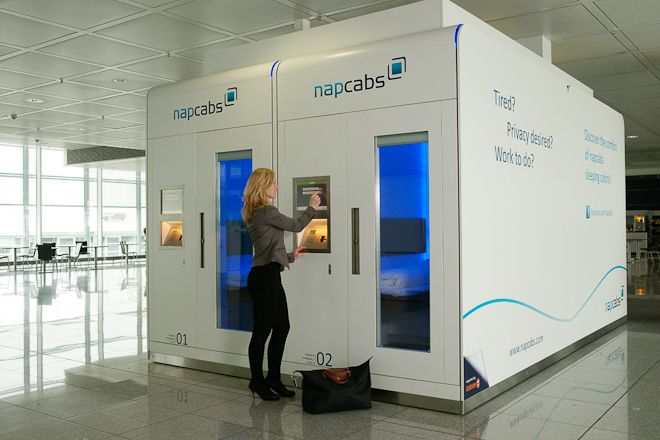
A few upstarts from around the world are tackling this issue of airport sleep deprivation with small sleeping cubes. While they haven’t exactly taken over the world (the 3 here are only in one airport each), they offer minimal sleeping quarters for the beleaguered traveler.
Napcabs (pictured above) is a German-based company with one outlet in the Munich airport (it had 2, but one is being serviced). It features a bed, soundproof walls, wifi, a multimedia screen with flight information and “anti-jetlag” lighting. Bedding is changed by an on-call cleaning staff.
At anywhere from 10-15€/hour, with a minimum 30€ charge, it’s not cheap, though consider if you’re flying overnight, this is a fraction of a hotel room’s cost.
Sleepbox is in the Moscow airport and has very similar features as Napcabs. The one edge Sleepbox has is that it features 2 beds, not 1. According to Wikipedia, they charge $15USD/hour.
Wikipedia also said there are concerns about bed-bugs. Unlike Napcabs, Sleepbox does not explicitly say how linens are dealt with. I am hardly a germophobe, but this seems like a major oversight. A post in Treehugger.com indicates that they originally wanted to use an automated linen changing system, but instead opted for traditional linen. We imagine/hope they have some sanitary setup.
Sleepbox is smartly trying to position itself as a space maximizer for hostels. While airports are a great application, I could imagine these units as replacements for real hotels and hostels, particularly for people who just need a place to sleep.
Snoozecube has 10 sleeping cubes set up in the Dubai airport. The company is from New Zealand, evidenced by the big fern leaf, similar to that of the All Black Rubgy team, emblazoned on their cubes and bedding. Like the others, they cost $16USD, are soundproof, offer wifi and connections to flight info. Their look is not quite as posh as the other 2, but the fact that they are clustered together in Dubai makes them like a makeshift hotel, which seems to make sense as you can have a standing staff and some isolation from the rest of the airport (something I think would be nice even if the cubes are soundproof).
High priced, hourly sleep cubes in airports might not be everyone’s bag. But similar to the Japanese sleeping pods we looked at a while back, these firms are showing an alternative to hotel rooms that feature more–and cost more–than most travelers would prefer.
Have you ever used any of these, or similar, sleeping boxes? What was your experience? We’d love to hear from you.
In this short piece from CCTV, we see the interior of Genevieve Shuler’s 105 Sq Ft NYC apartment. Shuler pays $800 for the packed-to-the-gills West Village mico-unit. She has lived there for 8 years and apparently feels there’s more than enough space for her, evidenced by the fact she has a roommate: her cat Ruby.
The tour was part of CCTV’s coverage of the adAPT NYC competition. The segment included Senior Policy Analyst of the Citizen’s Housing and Planning Council (CHPCNY) Sarah Watson. Spearheaded by executive director Jerilyn Perine, CHPCNY was one of the main initiators of the adAPT NYC competition and is the city’s biggest advocate for small-space policy reform.
One of the biggest hurdles facing building small is policy reform. As the segment indicated, the smallest you can build in NYC is currently 400 sq ft. As we see with Shuler and many others, a person can live quite comfortably in far less space. Similarly, no more than 3 unrelated persons can occupy the same space legally (though this author can attest that that policy is seldom enforced). Tenant advocacy is very important but, as is the case in New York, policy is often out of step with tenant needs and advancements in building design.
While Shuler shows that people can–if necessary–live happily in super tiny apartments, we think the best is yet to come in small living; where micro units will be designed from the ground floor to optimize the living experience. San Francisco’s SmartSpace is a great example of that. Before that happens, policy reform will have to take place in many regions. The adAPt NYC competition and CHPCNY are making that look like a likely reality.
We talk a lot about living a life focused less on stuff and space and more on relationships and other things that truly make us happy. The epoch in most of our lives that best embodies that way of life is our college dorm days: days when rooms were small, the conversations were nocturnal and hopelessly interesting, when meeting people and making (and even retaining) friends was easy.
Fast forward a few years. The time spent wiling away hours is spent at work or recovering from work. The once-open hallways, resplendent in conversational possibility are replaced with lawns or vacant hallways in apartment buildings. Neighbors go unknown for years. College friends move to Portland, OR. All of a sudden, we find ourselves with few friends and having a hard time meeting new ones.
As external conditions change, it becomes tougher to meet the three conditions that sociologists since the 1950s have considered crucial to making close friends: proximity; repeated, unplanned interactions; and a setting that encourages people to let their guard down and confide in each other, said Rebecca G. Adams, a professor of sociology and gerontology at the University of North Carolina at Greensboro. This is why so many people meet their lifelong friends in college, she added.
There are other issues. As we get older, we tend to focus on emotional quality of relationships, versus quantity and novelty. That’s great, but what often happens–because of a move, divorce, new job, child, etc.–is the circumstances that foster deepening existing relationships evaporate. In other words, we find ourselves living away from the people we want to go deep with. Many adults find themselves isolated and with few resources to make new friends.
The Times article leaves off on a not-so-optimistic note, though it does point to a big part of the answer for ending isolation: get over yourself and get out. Isolated adults must try new things and meet new people if they want to connect.
They point to a guy who, after a recent move to New York City found himself so lonely that he’d walk his cat in Central Park to initiate conversations. To deal with his isolation, he started a site called The New York Social Network that hooks fellow social New Yorkers around activities. Activity-based social networks are distinct from networks like Facebook, who provide social narrative more than social directives.
Apartment Therapy suggests a few other, non-romantic online resources for meeting friends:
Girlfriend Network is a pretty self-explanatory site. It hooks up women looking to connect as friends.
Companion Tree connects people looking for friends. Connections are based on your specified interests.
Meetup.com is the granddaddy–and probably still the most robust–activity-based social networking.
We would add, Front Porch Forum, which we’ve covered in the past. There is also Nextdoor.com. Both of which connect people based on proximity–still one of the most effective bases of connection.
Google and Yahoo groups are good too as they tend to coalescence real networks.
Take caution though: none of these resources will work if you don’t use them. Meeting people takes effort and a little bit of humility–the willingness to admit we want companionship and taking actions aligned with that desire.
Are you older than 30 and have successfully made and kept new friends? We’d love to hear what you did in our comments section.
According to the US Census Bureau, the average American moves 11.7 times in his or her lifetime. As the average life expectancy of that same citizen is 78.2 years, most Americans will move every 6.68 years.
It is perhaps this peripatetic lifestyle and an ever-accelerating pace of life that leads many of us to live those 7 or so years without getting to know our neighbors. We don’t know their names and we don’t rely on them–i.e. the original collaborative consumption.
A website called Front Porch Forum is making getting to know your neighbors just a little easier. The site is like the front porch or town square where people voice their needs, opinions, services–pretty much anything. Your particular forum is determined by your street address and unlike a community site like Craigslist, it is not anonymous. There are real names of real people who live really near you. Unlike Yahoo or Google Groups, you don’t need any special interests–just an address.
One of the site’s FAQ’s is “Has it really come to this? Using computers to talk to people next door?” The answer, they believe, is yes. Here’s what they claim:
In one rural town, we found that half the community had subscribed to FPF after one year and, remarkably, 66 percent had posted….In another study in Burlington, Vt., where half of the city subscribes to FPF, 90 percent reported that their local civic engagement had increased due to this online service.
Their site includes a sample of posts–things like “Found watch – yours?” and “Audubon summer day camp scholarships available.” The kind of casual stuff you’d chat with a neighbor about. Though we cannot attest to it personally, we imagine this online interaction would serve as a catalyst for face-to-face communication.
The site’s newsletter are sponsored with ads. If you’re an idealist, this might strike you as a corrupting force. If you’re a capitalist, this might strike you as practical. The fact is sites like these take time and money; they can either be beholden to volunteers, donors or corporate sponsors.
There is one serious rub to FPF: it is almost exclusively in Vermont (there are couple communities in NY and NH). They are actively looking to expand, but right now that is not the case.
If you are interested in creating a FPF in your area, drop them a line. If you have used FPF, we’d love to hear your experience.
We’re big fans of Zipcar and similar services. They allow people who don’t need a car full time to have on-demand access to cars when they need them, for as much or as little time as necessary.
A site called RelayRides is trying to get in on that action. Rather than dealing with a corporation however, RelayRides allows peer-to-peer car rentals–sorta like an Airbnb for the automotive world. RelayRides takes people’s slumbering cars and puts them to work as well as making some cash for the owners.
Car owners set their cars price and availability and renters book the cars online. Owners review the request before their car is booked. Protection comes in the form a $1M insurance policy for both owners and renters; 24 roadside assistance comes with the package. Riders are screened to make sure Thelma and Louise don’t rent your convertible.
In terms of money, owners get 60% of the reservation fee. Yep, that’s right–40% go to RelayRide (a hot topic on their comment board). Cars seem to rent for around $7-50/hr, with majority for around $15. Renters cover gas charges.
We wish RelayRides the best, but wonder about their value proposition. Their prices are higher than Zipcar whose prices start at $9/hr in NYC (lower in other regions); oh yeah, this includes gas. RelayRides reservations are not instantaneous and in some cases both parties have to arrange a key exchange (“select” cars can be opened with a cellphone). Zipcar members have a card that allows them to open the door for any reserved car. To be fair, there is a yearly registration fee for Zipcar ($60 in NYC).
I am quite familiar with using Zipcar. I’ve used it for several years, and excepting a few late returns and last-minute reservations switches, I’ve been quite happy with the service.
Have you used RelayRides? What was your experience? Would you recommend it? Are there other similar services we should be looking at? Let us know.