Airbnb: Changing How and Where People Stay When Away

Several of the LifeEdited team are based in large cities like New York and Seattle, and unfortunately we are cursed with those great city’s myopic worldviews. There are certain things we deal with that we assume everyone deals with, like $2K/month studio apartments, locating reliable public restrooms and knowing cheap places to stay for guests when your place is too small.

For that latter topic, the last few years have seen a revolution in guest accommodation with Airbnb. The company calls itself a “community marketplace for people to list, discover, and book unique accommodations around the world.”

The company, founded in 2008 in San Francisco, lets you book rooms in peoples’ homes in 26K cities and 192 countries, often paying a fraction of what you would in a hotel. Conversely, you can rent out your space to earn some extra money.

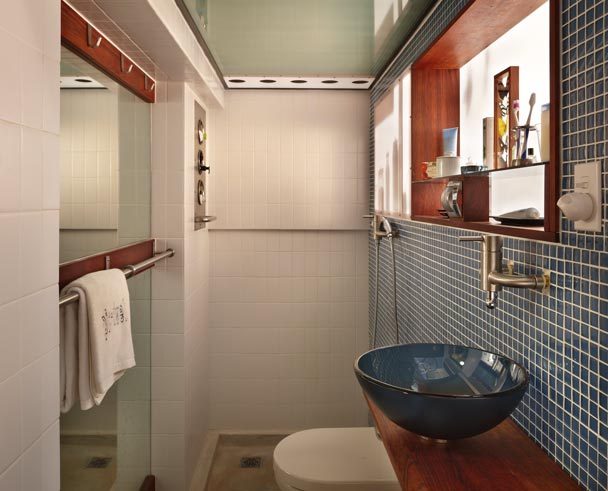
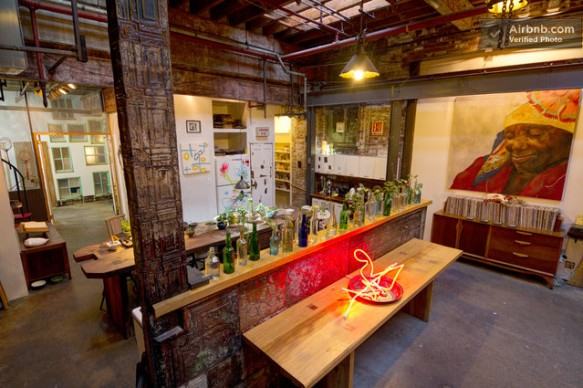
Beyond the savings, you can book spaces far more interesting that standard hotel fair–like a cave house in Granada Spain for $63/night (above) or a houseboat in Paris for $125/night. Funny enough, you can rent the 1 Sq Meter Home we covered the other day for $12/night in Berlin. On a more conventional note, you can rent rooms in places like New York City–where average hotel rooms are in excess of $300/night–for less than $100/night.

Airbnb makes money by charging hosts a 3% processing fee and guests a 6-12% service fee (more expensive stays have a lower fee)–nominal expenses compared to a hotel’s overhead charges. Their website provides reviews of hosts and their accommodations, as well as profiles of guests to protect hosts. There are numerous safety measures in place, such as $1M coverage for theft or vandalism for hosts. Their system also allows you to network with your friends, so you can exchange information about various stays from people you know.

Airbnb does require a couple extra hoops to jump through over a conventional hotel, like waiting 24 hours to confirm a reservation and you often have to coordinate a key exchange, so it might not put the hotel industry out of business just yet. That said, it creates a far more affordable, interesting and intimate way to house yourself when you’re away from home.

269 Sq Ft Apartment with Hiding Tub and Very Cool Chairs

Fair Companies recently released this video of architect Valentina Maini’s 269 sq ft (25 sq m) Barcelona apartment. The tiny space enjoys the benefits of big windows and a terrace–the latter feature was closed off when Maini moved in.

The most obvious wow-factor feature is a bench whose sliding top reveals a bathtub. Other cool things include high-quality, re-purposed sliding cabinets built into her loft-bed and a dining table on casters that slides in and out to create different room configurations.

A less wow-inducing, but nevertheless great feature is her use of Tatami chairs. The Japanese chairs typically sit on the floor, but Maini places them on top of the tub/bench, thereby creating more traditional seating while retaining storage underneath (or in this case a bathtub).

We could envision placing Tatami chairs on any crate or box; this would create flexible, standard-height seating while utilizing all the volume under the seat. You would enjoy the added benefits of being able to easily move the Tatami chairs around or store them away should you want to free up some space.

We found a number of Tatami chairs available online via Ebay, Amazon and Google Shopping.

via Treehugger

The Media’s Small Home Split Personality

First they ignore you, then they laugh at you, then they fight you, then you win.

Mahatma Gandhi

The world’s spotlight has shown brightly on small living since NYC Mayor Bloomberg announced the adAPT NYC program last week. Articles have been featured in nearly every major newspaper around the world. Suddenly, small living is a big topic.

But what is the nature of the discourse? It seems to oscillate between ridicule to legimacy. Just check out the NY Times, who featured a satirical editorial about micro units called “Microhome, Sweet Home.” Here are a couple passages:

Please keep your coat on. One of Gerald’s friends brought a hat, so unfortunately space is a bit tight in the closet.

And

I had a dream I was in my own coffin last night, but it wasn’t a nightmare so much as a fantasy about the legroom.

In the next breath, they’re publishing a decorating guide to small apartments. Which is it guys?

The Times isn’t the only one. While many publications did straight reporting, the Wall Street Journal called the adAPT units “Lilliputian.” Other publications are asking if anyone would live in such a small space?

This question of whether people can live in such small spaces assumes no on is living in such small spaces. The fact of the matter is small is not new, nor is it unusual. It’s just new to the US. Many–pretty much all–developed countries are, and have been, living in spaces a fraction of the size Americans occupy (can’t say “use”) for years.

Average Floor Space of Newly Built Homes

As the Gandhi quote alludes to, most deviations from the status quo endure several stages of resistance: ignorance, ridicule, active resistance and finally surrender. Perhaps the most important thing is that smaller, smarter living is being talked about and addressed in public policy in tangible ways.

What do you think about this shift? Will compact living remain a novelty in the US forever or can you see a time when compact living will be the standard? We’d love your thoughts.

Info graphic via Apartment Therapy

Image credit: AP/Edward Reed

LifeEdited on ABC World News in adAPT NYC Roundup

[If you are having trouble viewing video on this site, visit ABC World News homepage]

Check out the LifeEdited apartment in this ABC World News feature about small New York City living spaces. The story is related to Mayor Bloomberg’s adAPT NYC design competition, which is looking for great 275-300 sq ft apartment designs to better house NYC’s 1 and 2 person households.

Perhaps, as the feature suggests, the LifeEdited apartment will factor into the winning design. We’ll keep you posted!

10K Public Bikes Coming to NYC in July

In July, New York City will add its name to the many cities that have public bicycle programs. The Citi Bike program will feature 10K bikes in 600 docking stations around the city, making it the largest such program in the US (the name comes from Citibank, who gave $41M in sponsorship money).

You can either rent bikes by the day, week or sign up for a yearly membership; prices are $10, $25 and $95 respectively. With the yearly, you receive unlimited sub-45 minute rides with nominal charges when that time is exceeded.

Programs like this have been going on for years across the US and the world. Paris has 20K public bikes, London 9K, Montreal 5K, Washington DC 1500 and Hangzhou, China has a whopping 60K+.

Public bikes are ideal for city-dwellers who need to get somewhere quick. The bikes’ upright position and grease-less configuration make them business-attire compatible. They also cover the spaces not covered by public transport. Most importantly, they make biking more accessible and acceptable to larger swaths of the population. They are, as Treehugger puts it, “cycling’s gateway drug”–once you start, you can’t stop.

Do you or have you used a public bike? What was your experience. Let us know.

Via Bloomberg and Treehugger

What Does a 182 sq ft Triplex Look Like?

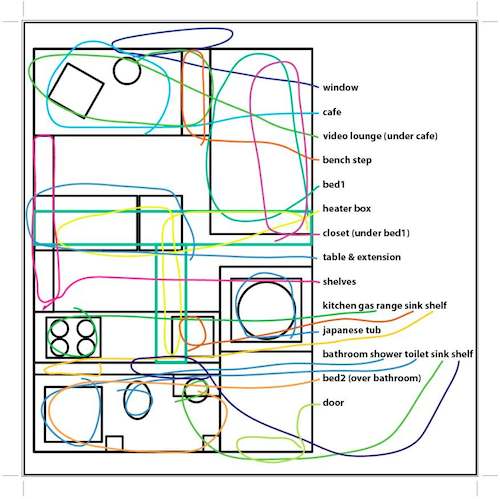
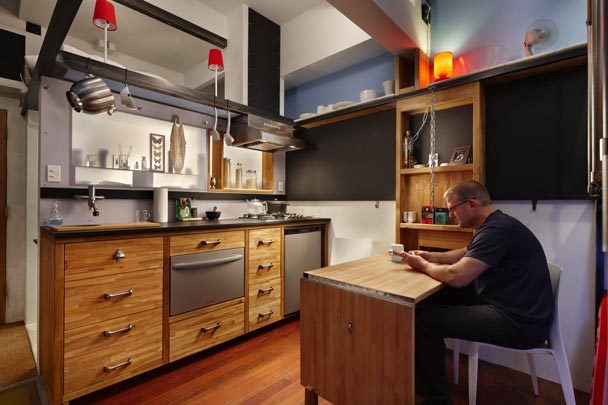
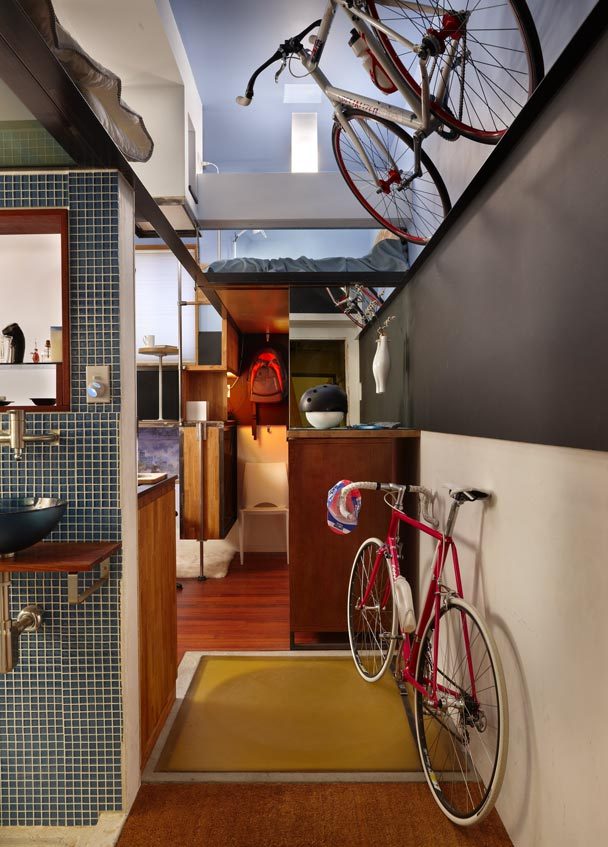
Steve Sauer is serious about efficiency. His 182 sq ft Seattle apartment has virtually no unused spaces and zero redundancies.

Fittingly, Sauer is an interior designer for Boeing and a holder of a Masters in whole-systems design. The genesis of began after he started looking for storage space for his stuff. When he found an available space in a coop building, he realized that with proper design, it could house him and his stuff.

He made a list criteria like being “quick to clean and have” and provide “room for current needs only.” Every decision had to be intentional. He claims that each product represents 10-100 hrs of internet research. What he couldn’t buy he made.

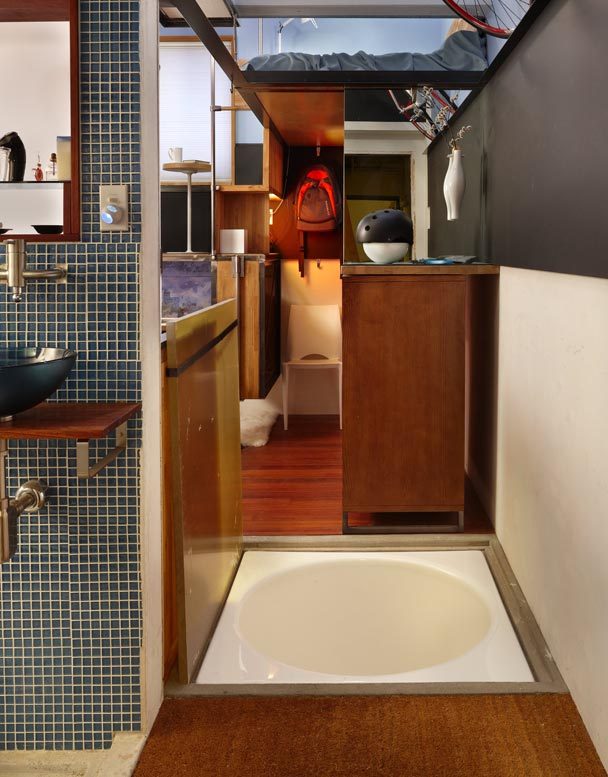
The result, which he duddbed “Pico Dwelling” (pico is 1/trillionth) is an amazingly efficient space featuring two sleeping areas, 3 levels, a recessed and covered Japanese soaking tub, a video lounge, a cafe and many other amenities.

Another intention Sauer had for the space was to “compress my home to squirt me back out to the community.” In other words, the space was so small, he’d have to engage his community. That said, he has had up to 10 guests in the space at a time.

image credit Benjamin Benschneider/Seattle Times

Via Seattle Times and Oixio.com

Prototype Apartment Pushes the Small Envelope

Yesterday, we asked “how small is too small” for a home? This is not necessarily a simple question to answer. Not all small is created equally. 420 sq ft can be airy and intelligent or dark and dumb depending on its design. For proof, look at the LifeEdited apartment before and after its conversion.

But assuming you design a space optimally, how small can you go? A San Francisco-based firm called SmartSpace is trying to answer this question.

They built a prototype starting with 160 sq ft of living space, which is the minimum legal size for a dwelling in California.

The space, dubbed SmartSpace 1.0, is a lab for what works and what doesn’t in such a tight space. An MIT student served as its guinea pig, living in it for 3 weeks to solicit feedback. Here are a few lessons learned about this ultra-compact home in particular, and, one can infer, small living in general:

  • The Euro-bath “wet” shower (no divided shower) doesn’t jibe with the American audiences–too much mess and water. V2.0 will have separate shower.
  • V1.0’s cute round sink couldn’t handle real-world pasta pots. V2.0 will have larger rectangular sink.
  • They found the portable induction cooktop drawer “too clever by half” and will be keeping it on top in v2.0. Incidentally, they use the same model as LifeEdited apartment.
  • Keep appliances out of site.
  • Air movement is essential even if it’s not heating or cooling. A ceiling fan is installed in v1.0.
  • Ceilings should be at least 9′ to create sense of space.
  • Width of unit should be at least 10′. V2.0 will be 11′ wide.
  • Finishes and materials should be high quality. Detail is much more evident when there are no gaps.
  • Built-in items are preferred to standalone. A lack of cohesion can be overlooked in big spaces, but in tiny ones uniformity and order work best.

To maximize utility, SmartSpace added clever touches like its “Smart Bench,” which is a table on a hydraulic lift. When raised, it acts as a banquette and table; when lowered it is a bench or, with the addition of a pad, a guest bed.

So does this intelligent prototype prove that 160 sq ft is the minimum amount of sq ft a person needs?

Not at all. The answer is there is no answer. Living spaces, like people, have different needs for their lives and homes. SmartSpace is particularly geared toward singles in San Francisco–a city that has many out-of-house diversions that compensate for small quarters.

What this shows is that the amount of space we need can be seriously reduced with an open mind and smart design.

via Fair Companies

Okay, It Is Possible to Have Too Little Space

We’ve looked at some pretty small spaces like Felice Cohen’s 90 sq ft NYC apartment or Japan’s wan rūmu manshons. But these places feel palatial compared to the 16 sq ft “King’s Cube”.

“King’s Cube” is a “luxury” Hong Kong apartment that features “western-style, wood-like flooring” and “space utilization [that] is as high as 100%.” Incredible!

The video is actually a parody made by MFA student Joe Yiu to bring light to Hong Kong’s criminally small living spaces. Hong Kong is one of the densest and most expensive cities in the world. In order to house its population cheaply, apartment buildings like the one shown in the video are divided and divided again until an apartment is nothing but a bed. And as bad as the “reference” apartment is, when the host reveals the real King’s Cube apartment–which is the same size but lacking a window or any decor aside from a few wire hangers–you realize it could get indescribably worse.

While we’re obviously advocates for small-space living, putting candles in a roach motel does not equal luxury. And while it’s possible to live in what is effectively a human cubby hole, it doesn’t mean it’s a good idea. Obviously, there are many political and economic considerations in places like Hong Kong that go beyond the scope of this post, but it raises the question how small is too small?

Via MNN

Parisian Apartment Presents Micro Luxury Living

We’ve looked at some pretty small apartments in the past, and while it can be inspiring to see folks occupying such a small footprint, it’s not always an aesthetic treat. Wired Magazine recently looked at a Parisian apartment that is both compact and comely.

Thibaut Ménard’s 130 sq ft Montparnasse apartment is micro-luxury at its best. Architects Marc Baillargeon and  Julie Nabucet built the space–once a master bedroom in a Haussmann multi-story building–with the detail normally reserved for larger, luxury units. They also included a number of innovative small-space solutions like a staircase storage unit that rolls away to create more space; a sliding bed that, when pulled out halfway, serves as a couch; and a split-level layout that stores the bed and gives the space more dimension.

Oftentimes, tiny spaces are associated with worst-case-scenarios; the story goes that someone was so down on his/her luck that he/she had to move into a 130 sq ft apartment. Ménard’s apartment and many others are presenting small living as an active choice, where spaces are optimally designed, not cobbled together with whatever is lying around.

If you know of other tiny homes with big design, let us know.

Images and story via Wired

Kyoto Hotel Offers Travelers Posh Pods

Japan always seems to be one step ahead of the rest of the world in space-saving living. Case in point is a capsule hotel in Kyoto called 9 Hours. The name is based on the idea of 1 hr to shower, 7 hrs to sleep and 1 hr to rest.

While capsule hotels have been around for a while in Japan, they have been more focused on function than form. 9 Hours’ super sleek interior and ample amenities give a luxury feel to what is essentially sleeping in a cubby.

The developers express that they are not interested in replacing full-size hotels–merely providing an alternative for people who may literally need a place to sleep and nothing more.

The video asks if the US and Europe are ready for this style of hotel. We suspect it’ll come down to cost. If a space is 20% the size and 20-30% the cost of a standard hotel room, it will create a compelling argument for booking a pod. Ultra-sleek environs like 9 Hours will make the decision to go with a capsule easier as well.

What do you think? Have you stayed in a capsule hotel? What was your experience. Would you? If not, why not?

via Monocle