The Untethered Life

Dan Timmerman is an American. He makes his living professionally racing cyclocross. If the combination of those two statements doesn’t impress you, you probably don’t know much about cyclocross. The sport is like steeplechase on a bike, and though popular in Europe, it is still pretty niche this side of the pond. The reason Timmerman can make his living like this is not because of the millions he makes clearing hurdles on his Ridley cross rig. He does it because he and his wife have reduced their living expenses to such an extent that they can do what they damn well please.

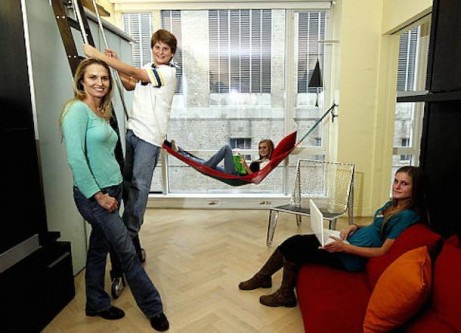
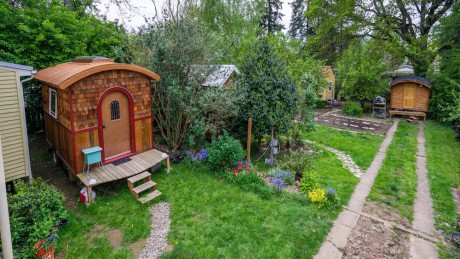
Five years ago, the couple bought a cabin on a 10-acre property in rural New York. The cabin is owned outright, so housing costs are negligible. It’s off-grid, relying on solar power, which is stored in batteries when the sun’s not out. Heat and cooking fuel come from chopped wood. Water comes from a well. Poop is composted. They raise chickens, grow veggies and Dan does some hunting, though he says most of their food comes from the grocery store. They have cellphones, which double as their internet connection for their laptops. Paying for the cell phone bill is their only real “bill.”

Beside the profoundly low overhead, their setup allows them to be immersed in nature–one of the main motivations for moving there. “”We have direct access to nature—it’s right there…We’re connected to it every day, not just sitting there observing it,” Timmerman said (full interview on video above).

There are some downsides to their setup, namely that they are pretty remote, which forces them to drive quite a bit. His wife Sam drives 18 miles to Ithaca to work and the nearest town is eight miles away. But Dan says they have a community in the woods, and even though they talk about moving further in, the advantages of having freedom to do what they want and being so close to nature outweigh the disadvantages.

H/T Tim F!

Via Business Insider and DirtWireTV
The $7000 Tiny House

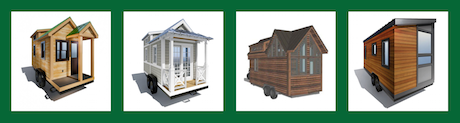
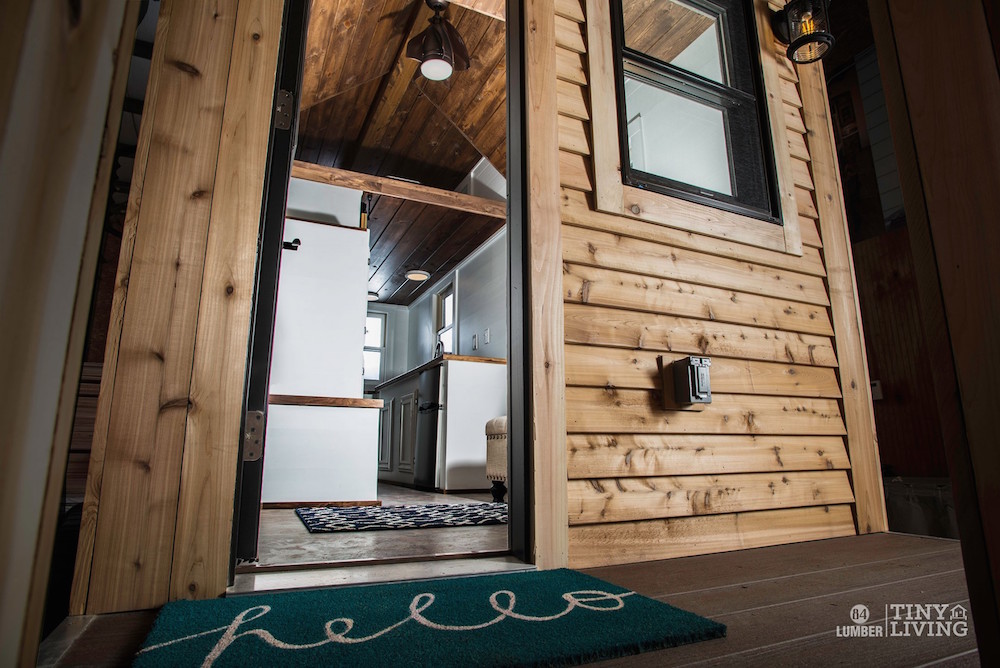
In a resounding sign that tiny living has hit the mainstream, 84 Lumber, one America’s largest building material suppliers, is rolling out (pun intended) a line of sub 200 sq ft trailer mounted tiny houses. The line, appropriately named “Tiny Living,” includes four models, varying somewhat in size and aesthetics from traditional to modern, and have prices starting at a mere $7K.

Screen Shot 2016-03-09 at 11.42.46 AM

Now before you whip out your credit card, know that the $7K model is mostly a DIY affair that only includes blueprints, materials list (i.e. not the materials themselves) and a trailer with subfloor ready to build upon. Up from there is the “Semi-DIY Package” that starts at $19,884 and has a “shelled in” house mounted on a trailer along with windows, a door, a shower and blueprints and a material list for finishing the home. Their move-in ready models start at $49,884 and include a trailer, composting toilet, Energy Star-certified appliances and LED lighting. (NB: it looks like only one model, the Roving, is available to order at present).

84lumber-roving

The pricing is pretty in line with most existing tiny house companies. For example, Tumbleweed Tiny Houses offer their own semi-DIY models (dubbed Barn Raisers) that start around $15K; their move in ready models start around $58K.

The models while stylish, are not especially revolutionary in terms of design. The big deal here is that a large company is treating tiny houses as a legitimate thing, something probably helped along by zoning legislation loosening up in a number of municipalities around the country. 84 Lumber’s national network and 8-10 week turnaround will surely make it easier for people that want to go tiny to do so.

Via Curbed

Legalize Tiny

In December we posted about Walsenburg, Colorado, a tiny town that created a building ordinance to allow for the construction of a tiny house subdivision. As we’ve long noted, zoning is the biggest hurdle for tiny houses taking off as a widespread housing option. While most tiny houses are designed as permanent dwellings, they are treated as RVs in the eyes of building code; this classification means that the houses can’t be parked in a residential area indefinitely. While the Walsenburg news represented a step in a great direction, the fact that it was done in a town of 3000 people made it a bit easier to dismiss. But when a city of a half million people does effectively the same thing, it might harder to ignore. Fresno, California–the half million person city in question–recently passed an ordinance specifically permitting tiny house on wheels (THOW) as permanent dwellings.

The move is pretty unprecedented. “We are the first city in the nation to actually write into its development code authorization for ‘tiny homes,’ ” the city’s mayor Ashley Swearingen said. While tiny houses have cropped up in various places around the country, their existence was shoehorned into existing code, typically regulations concerning accessory dwelling units (ADUs). Making code that treats THOWs as a distinct housing typology might go a long way to legitimizing tiny houses across the country.

What’s also notable about the ordinance is its lack of restrictions. Here are the main criterion a Fresno tiny house must meet as pulled from the Tiny House Association of America:

  1. Is licensed and registered with the California Department of Motor Vehicles and meets ANSI 119.2 or 119.5 requirements;
  2. Is towable by a bumper hitch, frame-towing hitch, or fifth-wheel connection. Cannot (and is designed not to) move under its own power. When sited on a parcel per requirements of this Code, the wheels and undercarriage shall be skirted;
  3. Is no larger than allowed by California State Law for movement on public highways;
  4. Has at least 100 square feet of first floor interior living space;
  5. Is a detached self-contained unit which includes basic functional areas that support normal daily routines such as cooking, sleeping, and toiletry; and
  6. Is designed and built to look like a conventional building structure.

Aside from point #1, which Lloyd Alter at Treehugger says might cut out a number of DIY-built homes, the rules allow for real deal tiny houses–i.e. really small and self-contained. And unlike most of the California counties that permit tiny houses currently, Fresno does not restrict their use to caregivers. The tiny houses can be used by homeowners for their personal use or as rental property.

One thing that does not seem to be a part of this code is building only a tiny house or tiny houses on a lot of land (the tiny houses must share a lot with an existing home). That said, there is no shortage of single family homes that can play host to tiny houses. In fact, adding density to the existing, sprawled out single family housing infrastructure is probably the greatest promise for tiny houses movement.

All in all, this is great news and we look forward to continued deregulation of tiny houses and other innovative forms of housing that are aligned with how we live today.

Image via California Tiny House

A Tiny House that Doesn’t Look Like it Belongs in 1890s Kansas

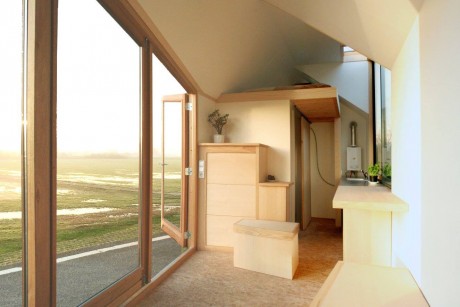
Call us a bit jaded, but after a while many tiny houses start to look alike: tiny gable-roofed structures with eaves and a porch, lots of rustic wood, a loft bed, composting toilet. This is all fine, good and functional, but it can also feel somewhat generic and leave those whose tastes lean modern a little wanting. We ran across this tiny house on Treehugger by a Dutch outfit that calls themselves Woonpioniers. Yes, their “Porta Palace”, as they call it, is still made of wood and has a gabled roof (albeit an asymmetrical one), loft bed and composting toilet, but its sleek and clean design give it an overall effect that is very removed from Laura Ingalls and her houses on prairies.

woonpioniers-living

The first distinguishing trait are windows: two huge ones on either side, one of which contains a big door, making the transition from in and outdoors somewhat fuzzy. While giving it a dramatic look and tons of light, it would also pose some serious privacy issues if the Porta Palace were placed in a group setting.

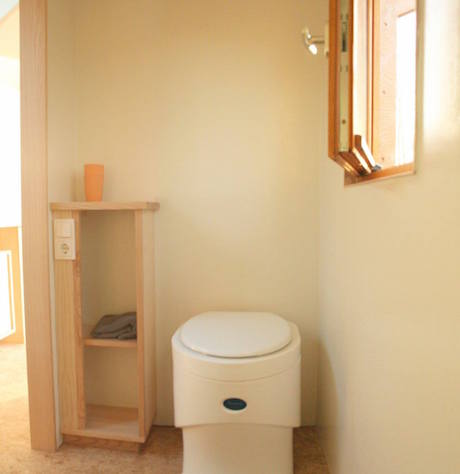
There’s not much to the space that can’t be seen: there’s a living room with integrated sofa that faces out one of the large windows; there’s a sleeping loft that’s accessed via stairs that are also storage boxes; that loft sits above a bathroom where the requisite composting toilet resides; and there’s a small (I guess that goes without saying) galley kitchen. Everything has a unified aesthetic, making it look like a pleasant place to hang out.

woonpioniers-toilet

The project seems to be an experiment in low cost, low impact living (Woon means “living,” not wood as I initially assumed) and one its architects, Jelte Glas, will conducting that experiment upon itself, living in it full time. As much as anything, the Porta Palace shows the infinite forms tiny housing can take. See more on Treehugger and the Woonpioneers website.

Moving Up Maslow’s Pyramid with Kirsten Dirksen

Since 2006, Kirsten Dirksen and her husband have been producing *faircompanies, a web video series that has evolved to become the world’s most comprehensive archive of compact homes and the people who made and live in them (among other things). Virtually every significant small space–from our own LifeEdited apartment to Nakagin Capsule Tower to many, many others you never heard of, but should have–has been lovingly chronicled by Dirksen.

As her profession dictates, Dirksen’s focus has her looking at others, but we thought it was time to turn the focus on her, finding out more about her and *faircompanies..

David Friedlander: Tell us a little bit about yourself.

Kirsten Dirksen: I live in Fontainebleau, France (40 miles south of Paris). We just moved from Barcelona this fall.

I don’t really have a job title. I used to work in television, then I met my husband in Barcelona and started commuting there between freelance TV jobs in NYC. Once we had kids I began to do more freelance work from Spain, but now I just make videos for our website and youtube channel.

DF: How did *faircompanies begin?

KD: Back in 2006, my husband, Nicolás Boullosa, had the idea to start a website that was a type of 21st-century Whole Earth Catalog. While it has evolved into something a bit different, “access to tools” is still the logline for *faircompanies.

With my videos I try to focus on great stories: people who are building unique homes, creating new vehicles, reinventing gardening, etc. Again echoing Stewart Brand (founder of the Whole Earth Catalog), I believe in the power of basic tools and skills–and the technologies available to us today (e.g. 3D printing, aeroponics, Arduino)–to shape our environments in a way unthinkable a few generations ago. As Brand wrote back in 1968 “we are as gods and might as well get good at it”. (For a taste of all this, I put together a compilation video of some of my stories here).

DF: What is your intention behind making the videos?

KD: I want to explore stories in the way I wanted to film and edit them, but often couldn’t while working for broadcast media. I make videos to examine how other people live. The camera gives me an excuse to ask questions.

What attracts me most to people who have minimized their lives (their possessions, the size of their home, etc) is the shift in focus. Here are people who have decided not to focus on stuff and so that leaves the more interesting topics, namely, my personal favorite: anything related to philosophy of life.

DF: What is or are the favorite videos you’ve produced and why?

KD: I don’t have a favorite video. I feel that each video builds on the others and they’re all part of this trip I’m on of discovery. That journey involves:

DF: Anything else we should know?

KD: I want to be sure to point out that I’m very aware of how easy it is to oversimplify all this. I don’t think a tiny house, or a tiny wardrobe, makes anyone happier, but it might open up more paths toward fulfillment. If you think about it within the framework of Maslow’s hierarchy of needs, those who have chosen to make their physical needs small, and easier to achieve, can move on to working on self-actualization.

Returning to Stewart Brand’s ideas about the incredible access to information we all have at this moment in history, I try to tell stories to help remind people about the great power we all have at our fingertips. I think the Internet has also made it dangerously easy for us to identify with mass movements and, at times, to fall victim to victimhood. I hope my videos inspire people to recognize the great power we all have, even if it’s just to make small, but often significant, changes in our lives.

LifeEdited’s Top Posts of 2015

As the year draws nigh and vacations loom, we thought we’d look at 2015’s most trafficked posts published this year (“Build Your Own Murphy Bed for $275,” published shortly after this blog started in 2012, was and continues to be our all time most trafficked post). Without further ado, here they are:

5. Vogue Magazine Features Story of Couple Giving Up Their Stuff

Coming in at number five is this post about Prerna and Parag Gupta, a couple of techies who sold all their stuff to travel the world. Aside from the inherent ballsiness of the couple’s story was the fact that it was featured in Vogue–a magazine that’s not normally associated with minimal living.

4. The 600 Square Foot Family

The fourth most trafficked post was about the Muzereks, a Vancouver family who decided a small condo in a walkable area was a better fit for their values than big place in the burbs.

3. 2 Bedrooms, 4 Kids, 1 Mom, Lots of Ideas

buitoni

Keeping on the theme of urban families, this post took a look at Kip Longinotti-Buitoni, a single mom who left the burbs and set up camp for her four kids in a relatively small Manhattan condo, helped greatly by an array of transforming furniture. 

2. The Rise of the Minimalist Millionaire

This short post showed off the Airstream trailer that Zappos.com founder Tony Hsieh calls home. We think it falls along the line of the mainstream-ification of minimalism…something we think is a very good thing.

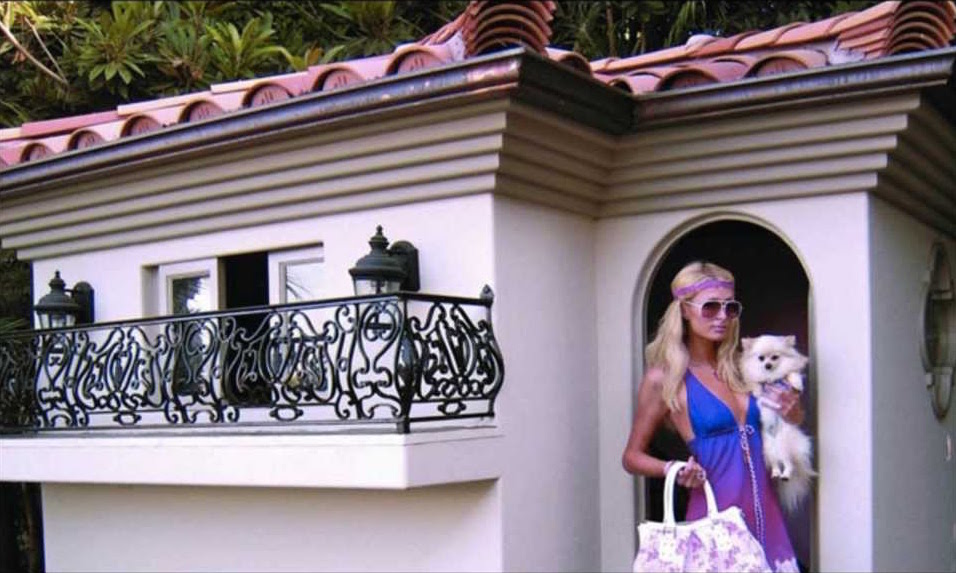
1. Paris Hilton Discovers Minimalism, Moves into Tiny House

This post about the alleged conversion of conspicuous consumption’s poster child proves that nothing gets traffic like celebrities…and humor.

Honorable Mentions

Frankly, the above list surprises us a little bit, but Google analytics doesn’t lie. Based on Facebook likes, you guys thought these posts were pretty interesting as well. 

3. Growing Old Together and in Style

This post about the “Cheesecake Cohousing Consortium” shows that small, communal living isn’t just about Millennials living in the middle of the city.

2. A Very Big Idea in Tiny House Living

simply-home

This story about a single family home with four tiny houses set up in its backyard is one of our favorites. It shows how density and community can be made inside America’s single family home-centric infrastructure.

1. The Rise of the Minimalist Celebrity

dan-norris

Alright, out titles aren’t that original sometimes, but this post about major league baseballer Daniel Norris seemed to strike a chord with readers. If you don’t recall, Norris intentionally chose to live simply out of his old VW bus, eschewing the bling that so often accompanies twenty-somethings with a few million dollars burning holes in their pockets.

If You Let Them Build It, They Are Much More Likely to Come

The world is abuzz about tiny houses. They are the architectural antidote to all that ails the modern American home: they are small, affordable energy misers whose tiny confines prohibit the accumulation of extra stuff. But tiny houses have a fatal flaw: they are illegal for permanent habitation in most cities. The few cities where tiny houses number more than a half dozen (Portland, Olympia and, um…did we say Portland?) are cities that have relaxed their zoning, usually designating them as Accessory Dwelling Units (ADU, aka “Granny Flat”), which are basically houses set up behind other, larger houses. But the Colorado city of Walsenburg (don’t worry, this author–a longtime Coloradan–has never heard of it either) is creating a plan that might someday soon serve as a precedent on how tiny houses can turn from architectural plaything to viable housing solution.

The plan, helmed by Sprout Tiny Homes, is to create a subdivision made entirely of tiny houses. Rod Stambaugh, founder of Sprout, convinced the Walsenburg city council to remove their restriction of building smaller than 600 sq ft. Rather than riding on trailer beds, these houses will have foundations and be connected to the grid–a good thing for people who might not be keen on composting toilets. But the houses themselves will be pretty damn small: the 32 units will range from 262 to 672 sq ft. There will also be a community center and outdoor movie theater. Stambaugh told Outside Magazine that he expects them to sell for $60,000 to $130,000.

Walsenburg is a former coal mining town of 3K that has seen better days. The tiny house subdivision is meant as a way of providing affordable housing and revitalizing the economy. As Lloyd Alter notes in Treehugger, that revitalization will be greatly abetted by what could by the US’s largest cannabis growing facility, which is going up on the outskirts of town. In fact, it wouldn’t be surprising if the main intent for the tiny house subdivision is to provide housing for workers at the the facility.

While company housing for pot growers might not do wonders for changing stereotypes about the type of people who gravitate toward tiny houses, the end result could be the same: showing that tiny houses can be a viable, safe, affordable housing solution. Stambaugh has plans to do another development in nearby Salida, Colorado and would eventually like to bring tiny houses to more prosperous mountain towns, such as Vail, where there’s a major shortage of affordable housing.

The Internet of Homes

It’s not news to say that tech is affecting nearly every facet of our existences: how we consume and deliver information, how we communicate, how we get around, how we use and share goods and on and on. The term “internet of things” goes even further, speaking to how one day everything in our lives will someday be tech-enabled and connected to the intelligence of the web via sensors, learning how we live, responding to our commands, collecting and delivering data, all in the name of making our lives more comfortable and efficient. The Intel corporation recently released their Smart Tiny House to serve as vision of how our homes might fit into this equation. The 210 sq ft home is packed with a variety of systems meant to both improve the quality of life for residents, but also tap into the greater intelligence of cloud systems.

intel-smart-tiny-house-10

Tech greets you at the door with their True Key system, a fingerprint and facial recognition based security system that lets you in the door as well as providing security for all the home’s systems. Most of the house can be controlled via a tablet or voice command. Lights can be dimmed and colors changed. Shades can be drawn. Some appliances can be turned on and off. There are leak sensors placed in trouble spots (under sinks, near showers, etc) that will notify you if there’s a leak. You can find the alert on the tablet and even book a plumber all in one fell swoop. I suspect the idea is to bring this type of system to every aspect of the house: a sensor will tell you if your roof springs a leak, if your dishwasher breaks, etc. At this point, Intel is dealing with leaks.

Intel is trying to position themselves as the brain of the smart home. They say this:

Intel creates the processors and other computing technology that serve as the brain powering a myriad of devices. Increasingly, as the home moves from connected to smart, this technology will enable a new breed of consumer electronic devices – everyday things such as lightbulbs, thermostats, smoke detectors, electrical outlets and cameras – to become connected and smart. These tiny brains inside “things” throughout the home will compute and produce data at the device level for real-time intelligence. Intel-based gateways connect the home’s smart devices, providing advanced analytics and storage, allowing the home, people and devices to work together in an intuitive, intelligent fashion. Cloud connectivity, advanced device management and built-in security will connect consumers to a variety of new services, features and cost savings.

It’s still early days for this type of tech and there are several different connectivity “smart home” protocols. But a colleague of mine noted that in the early days of telephones, there were hundreds of rival telephone companies and little interoperability. Eventually, things get sorted out. Intel is trying to address some of these interoperability issues. They have created their “Smart Home Development Acceleration Platform,” and claim they were able to enable interoperability with between three distinct lighting solutions: Philips Hue, Cree and Osram. This augers well for creating interoperability for scores of systems: wearables connecting to HVAC systems connecting to mobile devices and so on.

intel-smart-tiny-house-4

Frankly, the benefits of the tech on display in the Intel’s tiny house are underwhelming. But again, the house represent a start. They say in a press release, “The home is an experimental showcase that will evolve over the next 12 to 18 months as Intel explores the opportunities, experiences and tensions of creating a smart home.”

One thing that is definitely cool is that Intel chose a tiny house as the vessel for the house of the future. The motivation may have had more to do with the relative ease of working with a small space versus a large one. But tech is also making it possible to live with less in numerous ways such as the digitization of physical media and giving us access to shared goods. If you are really trying to make your home “smart,” few things are as smart as small: downsizing has the ability to reduce our spatial and carbon footprints, simplify our lives and save a buck or two.

Via Gizmag

Micro Goes Even More Mainstream

When LifeEdited began several years ago, the micro housing conversation was happening but primarily in small pockets–the odd tiny house in northern California, Gary Chang’s transforming Hong Kong apartment and so. But in the last few years, spurred by things like the adAPT NYC competition and, we like to think, our own efforts, the micro-housing movement has grown considerably and become far more mainstream. Its growth is further evidenced by this short feature by Katie Couric on her Yahoo News program. The feature includes LifeEdited CEO Graham Hill in the LifeEdited apartment as well as other projects we’ve covered recently such as Jeff Wilson in his Kasita prototype apartment in Austin TX and NYC’s Carmel Place micro-apartment building.

Ultimately, we hope mainstream media features like this have a normalizing effect on micro housing–that one day living in well designed, safe and liveable homes that happen to be 200 or 400 square feet will not be newsworthy. They’ll be normal.

Low Impact, High Times in the Woods

Individual tiny cabins out in the woods are nifty and all, but the architectural form’s real potential lies in community formation. Magic happens when you throw a bunch of tiny structures and people in a cluster to share resources, meals, skills and lives. This kind of magic has been happening at a 55-acre woodland preserve in upstate New York named Beaver Brook for the last five years. The property was purchased by tech entrepreneur Zach Klein for $280K as a place to commune with nature and friends. The Beaver Brook land came equipped with an amazing off grid cabin, designed by its previous owner, Scott Newkirk. Klein had more than a passing interest in small cabins, having started the appropriately named Cabin Porn blog, the web’s leading repository for gorgeous little cabins set in equally gorgeous natural settings (also a book).

beaverbrook-newkirk

In the ensuing years, Beaver Brook has become an ongoing community and retreat (Klein, incidentally, has since moved to San Francisco). There are now additional cabins on the property, including a space-aged looking one by fellow Brookers Grace Kapin and Brian Jacobs and a bunkhouse built around the frame of a 19th Century barn. There are 20 regular “residents,” including five kids, who either pay a monthly fee for the bunkhouse or camping on the land, $150 and $75, respectively; these folks also help out with regular maintenance of the land doing things like path maintenance, according to the NY Times. Beaver Brook has guest stays, hosts weeklong building workshops and artist residencies as well.

beaverbrook-sauna beaverbrook-bunkhouse

Similar to my post about the need for more small, inexpensive vacation homes, Beaver Brook presents an earthy, low impact, low cost way people can supplement their oft-harried urban lives with an immersion in slow, natural living. 

Images via Beaver Brook