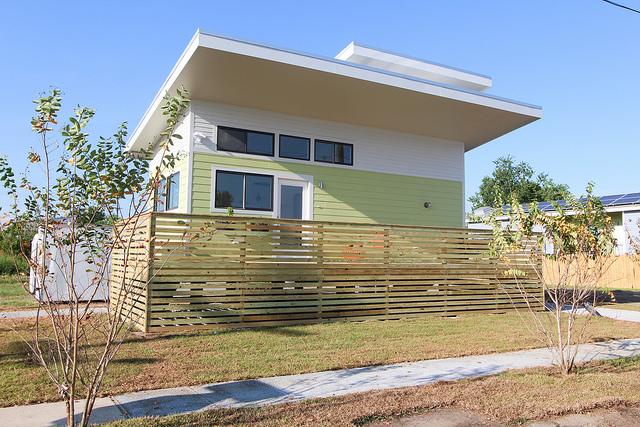
The Make it Right foundation was founded in 2007 by Brad Pitt as an architectural response to the devastation wrought by Hurricane Katrina. Rather than merely replicating the homes destroyed by the storm, MIR set out to build affordable housing that incorporated sophisticated and resilient architecture and sustainable building practices, making their structures both LEED Platinum certified as well as using many Cradle to Cradle materials. They didn’t just want to replace–they wanted to upgrade. Recently, MIR dabbled in tiny houses, building a smartly designed 430 sq ft home in New Orleans.
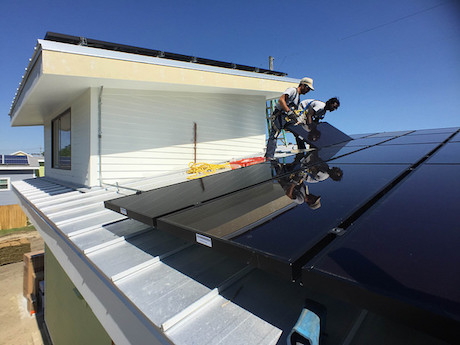
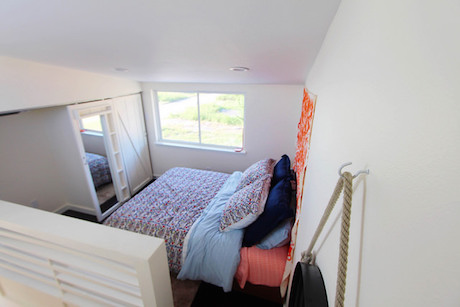
Working with the TV Show Tiny House Nation, MIR designed and built the home in a mere 21 days. The simple little house includes a full kitchen, a living area, sleeping loft and a washer/dryer. The place has a number of features to improve efficiency such a solar array that delivers all of the home’s power, a mini-split HVAC system, an abundance of high performance Marvin fiberglass windows and doors and insulation made of discarded American Eagle jeans. They used a number of C2C products as well such as Shaw Floors engineered flooring and Eco by Cosentino stone in the kitchen (same stuff we used in the LifeEdited Apartment incidentally). The understated interior was designed by Nomita Joshi Gupta of Spruce NOLA, all made with sustainable wood and natural fibers and dyes.
While MIR doesn’t mention the cost of the construction on their site, the organization’s raison d’être is building sustainable, affordable housing and we suspect this house is no different. Because building small means fewer materials to source, often you can upgrade on materials and design without breaking the bank, achieving the mostly unheard of combination of low price and high quality.
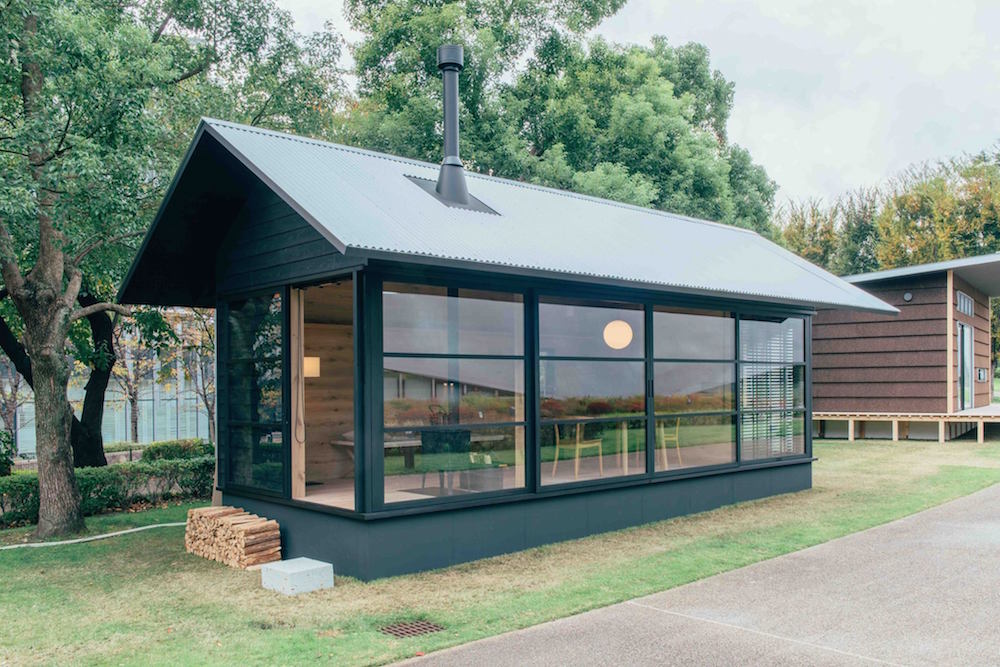
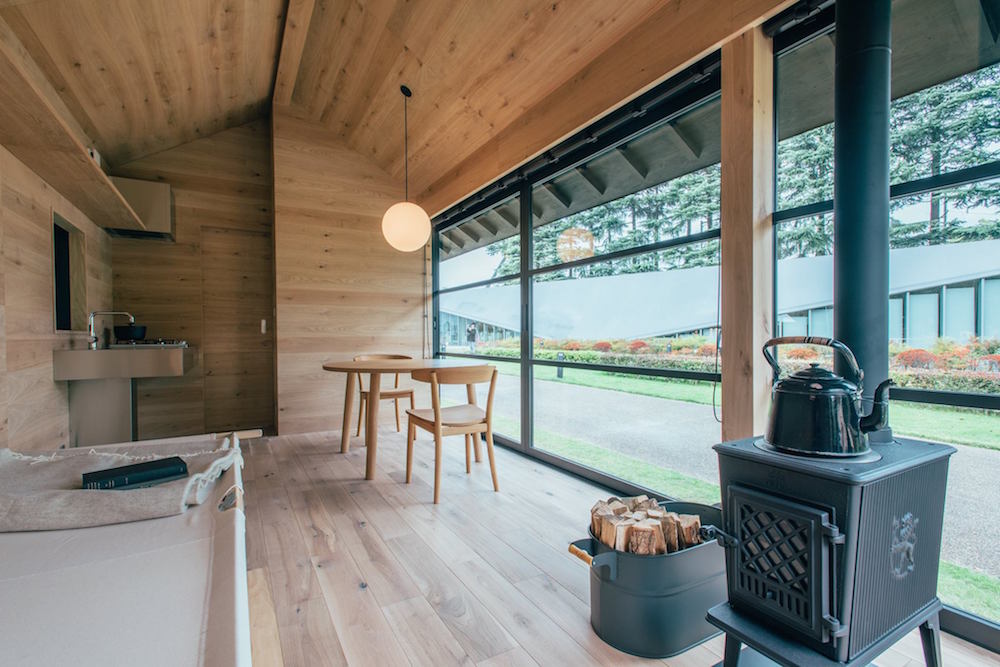
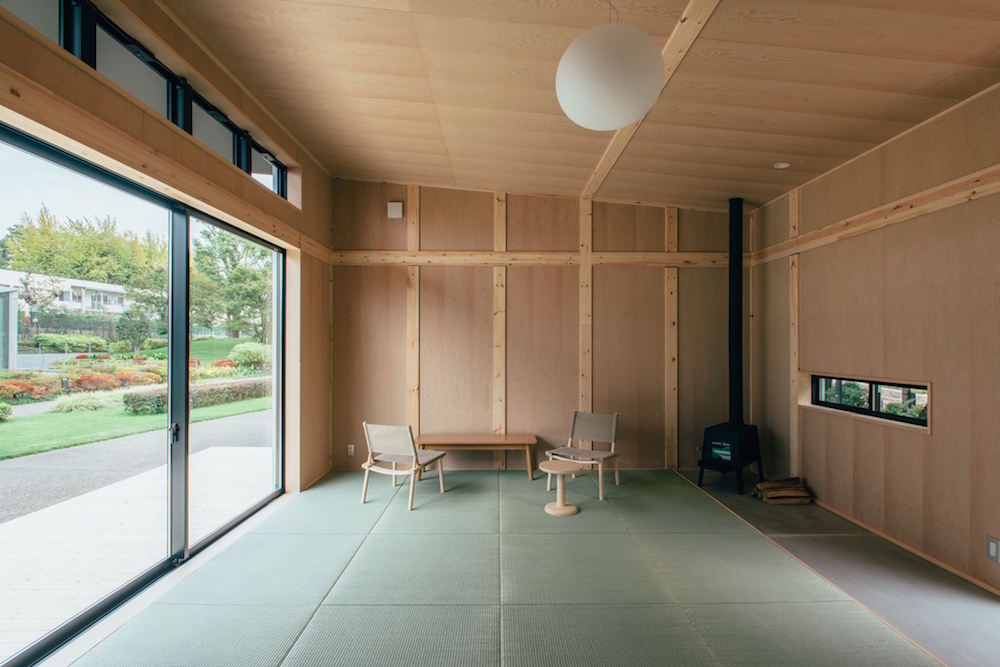
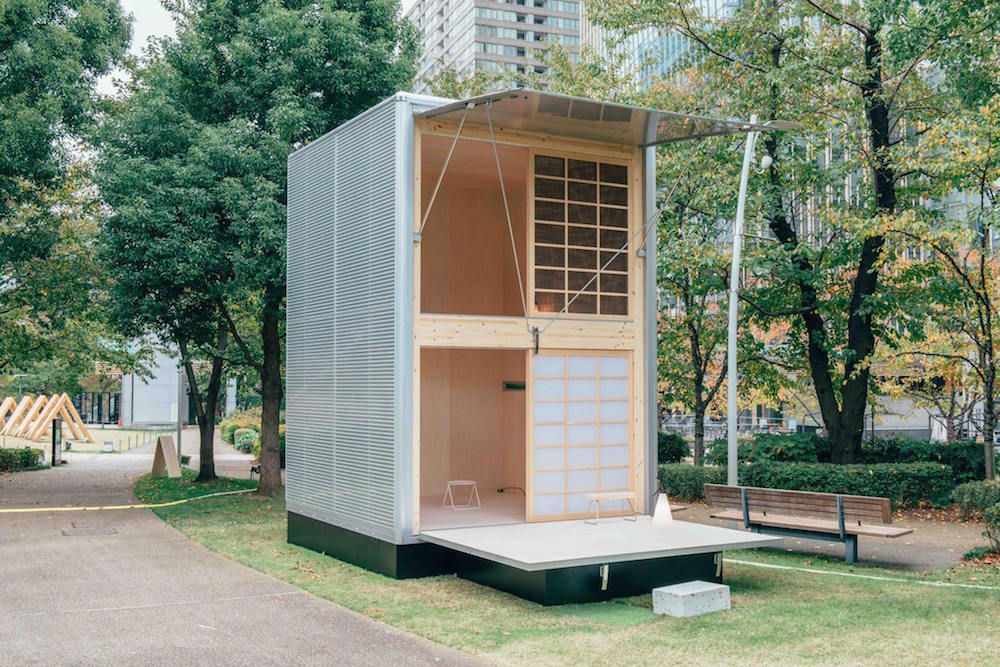
Japanese retailer MUJI’s bread and butter is simple, neutral colored, no-frills household products, furniture and the occasional piece of clothing. As part of the “Tokyo Midtown DESIGN TOUCH” event, the company is dabbling in house design, showing off three tiny houses–MUJI Huts–that embody the brand’s stark but elegant aesthetic. The size and the lack of decor aren’t a function of laziness, but the company’s exploration into “what it means to live a more sustainable lifestyle through minimalism,” according to Inhabitat.
The three prefabricated MUJI Huts were designed in partnership with leading designers Naoto Fukasawa, Jasper Morrison, and Konstantin Grcic, each of whom built their huts around a central material: wood, cork and aluminum, respectively.
The idea behind the concept is to create an easily-moved tiny house that can be set up in nature, giving harried city folks a tiny retreat to breathe. But I hope the sophistication of these designs bleed into the collective thinking of tiny house design worldwide. Too often–but not always–it seems like tiny house designers assume people want a mini Victorian home. What the MUJI Huts show is that tiny architecture and design can be every bit as sophisticated as the conventional stuff.
Happy Friday! Sit back, relax, grab a bowl of cereal and watch this Fair Companies video of Dan Price and his Hobbit hole home. Be prepared to feel like your life is a wasteful, complicated mess. It’s fairly tough to get much lower impact than Dan. He lives in a tiny subterranean Shire-like structure that is almost wholly constructed of reclaimed materials. He pays $200 a year for the land his house sits on (or, rather, under) and his annual expenses total $5K. He gets most of his water from a spring. His feces are composted in a toilet he made 25 years ago. He uses the tiniest bit of electricity. His diet consists mostly of raw fruits and veggies and cereal. He has very few possessions. Almost everything in his life has been edited–a word Price, once a professional photographer, uses liberally–down to the most essential. Despite his radical level of editing, Price sees himself as a pretty normal guy, albeit one who has and consumes very little stuff.
The video is really worth the full 34 minute viewing time. It’s the chronicle of a man who has consistently chosen to live according to his own rules (His lifestyle is no flash in the pan. Before the Hobbit hole, he lived in a tent, teepee and tiny house). And while he considers himself a normal guy, he alludes to how his lifestyle is partly the function of being a bit of a hermit–that more human contact would put him under more scrutiny, making it more difficult to do his own thing, which he seems to enjoy quite a bit.
Even if you don’t want to live like Price, to know this level of minimalism is not only possible, but being carried out, might help inspire whatever bit of modest editing you might be having difficulty incorporating into your life.
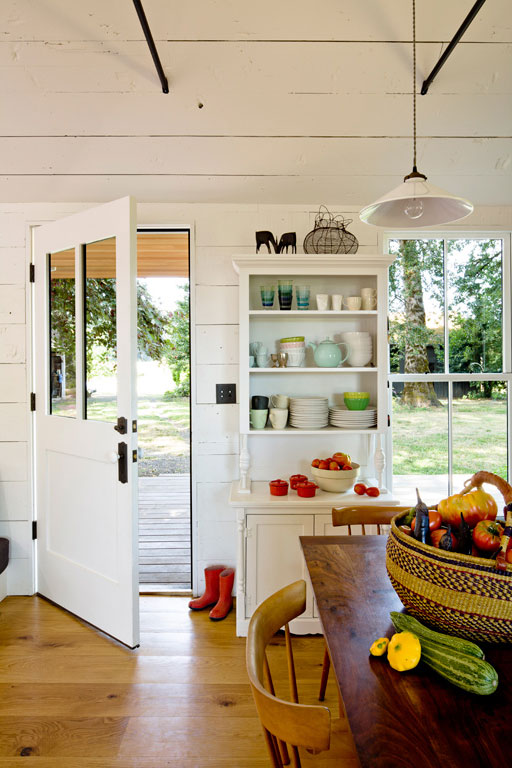
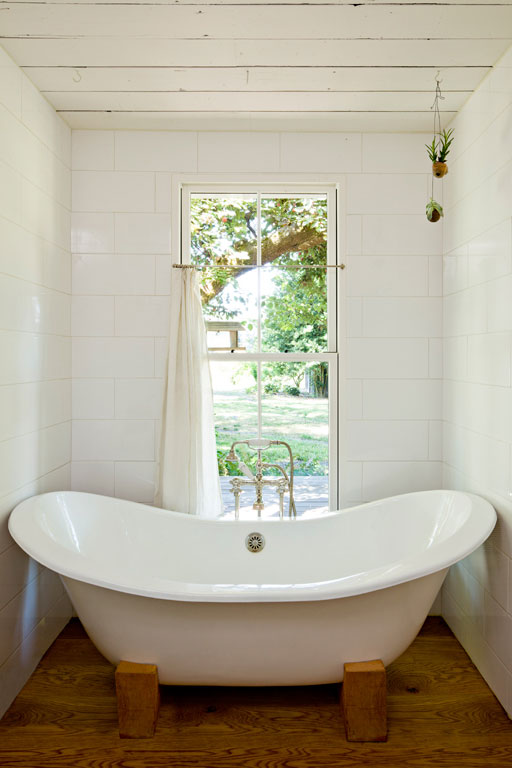
While it’s a nice idea to think a family could live in a sub 300 sq ft tiny house, the reality is that at a certain point you have to concede you can only downsize so much before quality of life is seriously compromised. That said, there are many options between tiny house and McMansion. Interior designer Jessica Helgerson’s home is a great example of one such option. At 540 sq ft it’s small, but not microscopic. And its thoughtful layout and great material choices make it seem like a great place to live and raise a family.
Located right outside Portland, OR, the house is an exercise in creative reuse. Nearly all of the materials used were reclaimed. And the structure itself has seen many lives. From Helgerson’s website:
It was first built in the early 1940s as part of Vanport Village; a quickly erected development built to house shipyard workers. When Vanport Village flooded in 1948 this particular little house was floated down the river to Sauvie Island, where it became the goose-check station. Years later it was remodeled to become a rental house.
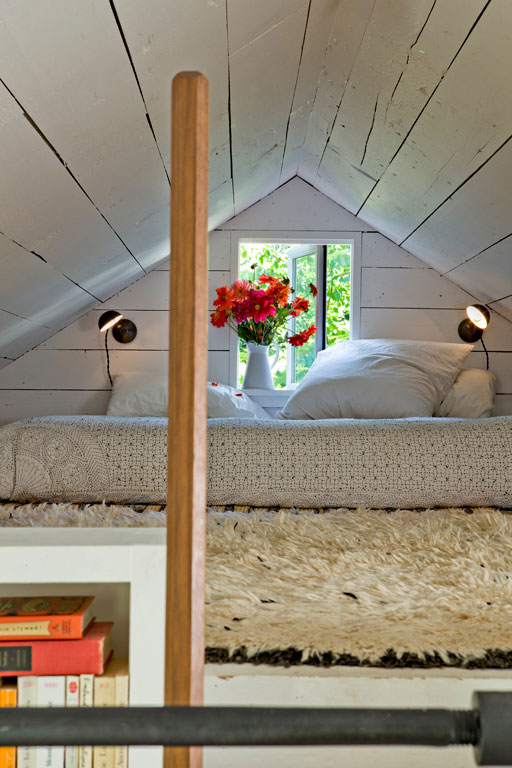
The house centers around a great room, which has the kitchen, a dining area and lounge area with two custom built sofas that double as guest beds and have storage in their bases. The house’s one bedroom is occupied by the kids, who have built in bunk beds. Both the kids’ room and bathroom have low ceilings to accommodate an overhead loft where the parents sleep.
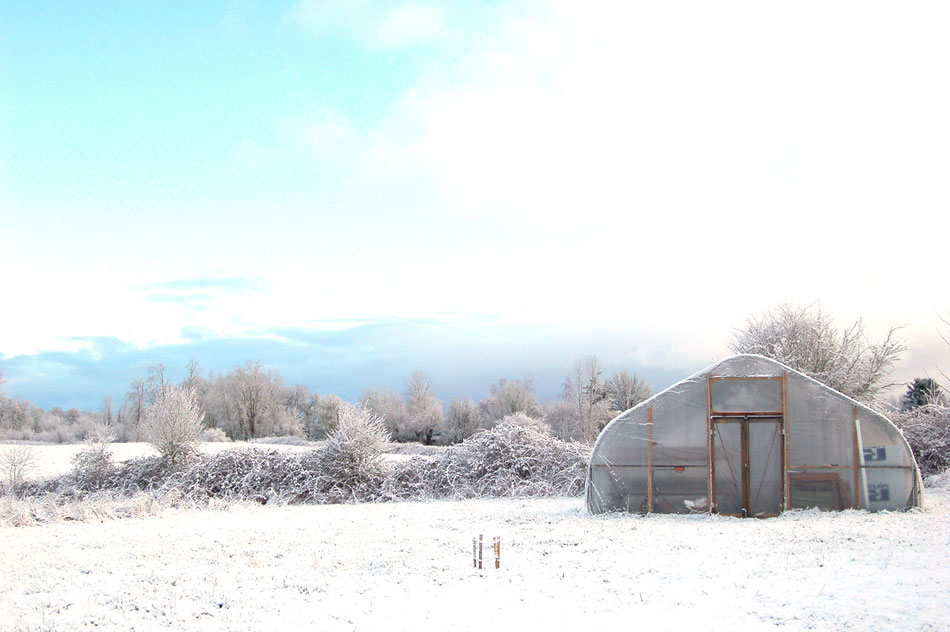
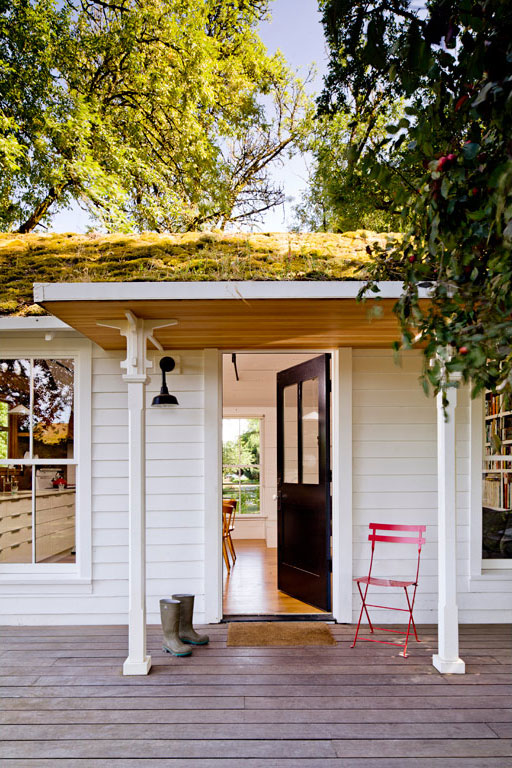
Outside, Helgerson and her husband installed a lush green roof and they are also trying their hands at food self-sufficiency with a large outdoor garden as well as a 1200 sq ft greenhouse on the property.
With its space efficient design and cohesive, but unfussy, furniture and material choices, Helgerson’s house is a great example how, with a bit of thought and consideration, a little space can go a long way.
There’s a subject in many of the posts I write about that is present but not always called out by name. The subject is money. Time and again, we read stories about people editing their lives, not just because they want to create a smaller carbon footprint and have less to clean and manage. These are very valid reasons, but let’s face it, most people downsize and simplify because it’s cheaper. When life is cheaper, when the base of Maslow’s hierarchy of needs is satisfied, people are less concerned about making money, leaving them time to think about loftier pursuits than paying the bills. Canadian Ben Hayward is an awesome example of such a downsizer. For the last year, Ben has been living frugally out of his “Hobbit Mobile” traveling around Europe, training and competing to pursue his dream of being an Olympic kayaker.
Before his current journey, Ben was already an accomplished athlete. He’s ranked Canada’s #1 solo whitewater kayaker; he’s occupied a spot on the national team for the last nine years; and he’s amassed 47 gold medals in national games. Yet he wanted to go even further and compete in the 2016 Olympics in Rio. In order to be better prepared, he realized he had to go live in Europe where the best training opportunities existed.
While the Canadian government offers a small stipend to their team members, it wasn’t enough to pay for the myriad expenses that come along with training and traveling–hotels, food, race entry, coaches, etc. Most people in his position accept that they will go into debt to pursue their dreams–something Ben told me he was willing to accept as well if it came down to it.
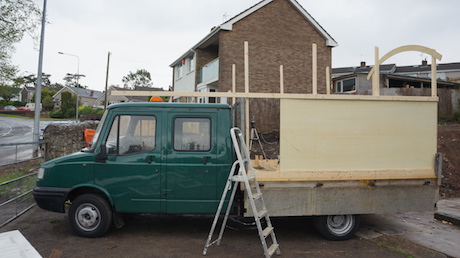
But Ben had another solution. As if his resume weren’t impressive enough for his 25 years, Ben is one year away from completing his architectural undergraduate degree. In thinking about how he could live cheaply in Europe, he conceived an idea to build his own traveling home that could also exploit his architectural chops. With the help of friend Adam, he conceived the Hobbit Mobile, a tiny house on wheels, which would allow him to live simply and frugally while he traveled and trained all across Europe.
Rather than spending his entire $5K nest egg on the van, Ben decided to crowdfund the construction of the Hobbit Mobile. In his “Van Starter” campaign, Ben managed to raise $16K, paying for the van’s entire construction (you can still contribute to his pursuits).
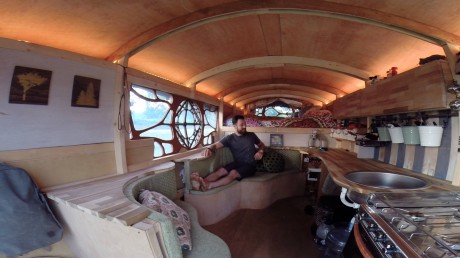
The van is built on a durable commercial vehicle frame and has what Ben called “Wallace and Gromit” (and Shire) style to it. There’s a lounge area, a lofted bed and a kitchen to prepare the 5-6K calories of food he consumes in a given day. With passenger space for six and room for 11 boats (gear is stashed inside the boats), he’s been the occasional taxi and/or hotel for his teammates. The house has solar arrays for power and there’s a copper cauldron for storing water, which also has a heating element at its base for generating hot water. Ben uses the bathrooms that are present at all of the training facilities where he camps.
All of this not only allows him to keep expenses minimal, but it simplifies his life. He said that because he knows where he’s going to eat and sleep, the van affords him a lot of mental space that his teammates who are constantly making room and board arrangements might not enjoy.
Ben told me there are numerous other benefits of living in the van. “In a normal house, it’s so easy to plug stuff into a wall and pay later,” he told me. “It’s been really cool to be self-sufficient and be connected with power useage, prioritizing what I need to use power for.” He also says that he loves spending so much time outside. “Living in a small space makes you go outdoors, which I believe is better for the human psyche. Living in a conventional house, it’s so easy to spend most of your life trapped inside.”
Because his overhead is so low, Ben can make ends meet with his stipend and a few sponsorships. He has strung together some impressive results recently, entering the finals at the World Cup in Spain last week and earning a bronze medal at the Pan-Am Games a month ago. But he’s mostly focused on training for the World Championships, an Olympic qualifying event, that goes down in about a month.
“From an external view, it seems like a poor lifestyle,” he says of the rather spartan way he lives. “But the quality of my life is very high,” he assured me. Though not everyone would choose to live as he does, he believes the downsized, minimal way of life is hardly limited to single, male, Olympic caliber kayakers. By paring down to the necessities, keeping expenses low, spending lots of time outdoors, the life that you would dream of living might not be as far out of reach as we think.
Tiny houses are, to borrow a hopefully soon-to-be-retired expression, trending. I believe this trendingness is attributable to their role as the architectural embodiment of our collective exhaustion with too much physical, financial and psychic overhead. They provide just what a single person or couple need and nary a thing more. But there are few legal places to park them outside Portland, leaving many folks who would live in a tiny house unable to do so. In order to become a real movement, tiny houses and the folks that love them need to consolidate power. There needs to be a visible groundswell of support, showing legislators that tiny homes are more than some backyard dalliance with simple living. The Tiny House Jamboree this weekend (August 7-9, 2015), in Colorado Springs might just help create that groundswell.
The Jamboree looks to be the worlds’ largest tiny house gathering to date. Jay Shafer, Deek Diedricksen and most all of the biggest names in tiny living will be in attendance. There will be a ton of builders, vendors and other tiny house related exhibitors, making it the perfect venue for folks looking to take the tiny plunge. The event’s organizers are expecting a huge turnout to the free event. I emailed Marcus Alvarado, one of the event’s head coordinators a few questions to find out more about the event.
DF: What the are the intentions and goals behind the jamboree?
MA: The 2015 National Tiny House Jamboree aims to bring together the community of tiny house builders and sustainable-living enthusiasts in celebration of the ever-growing Tiny House Movement. EcoCabins’ Marketing Director, Coles Whalen, puts it best by saying, “The movement is rooted in sort of a counter-cultural idea: smaller environmental footprint, tighter-knit communities, a debt-free lifestyle”. This movement means so much, to so many different people, from so many different backgrounds, it’s a simply a melting-pot that aims to flip the script on what a normal US dwelling should look like. We hope to bring this vision to the largest celebration this community has ever seen!
DF: How many people do you expect to attend and where are most of them coming from?
MA: As of today [August 1], we are upwards of 9,000 registrants from all 50 states and 14 countries! Most of the registrants are coming from Colorado, Texas, California, New Mexico and Kansas. Outside of the US, Canada has the most registrants with Australia and Germany tied for the second most.
DF: What do you see as the highlights of the jamboree?
MA: That’s hard to say when we have been jamming the “Jam” with all tons of special happenings! We have an all-star group of speakers that are set to present at the Jamboree including: Andrew Morrison, Jay Shafer, Derek “Deek” Diedricksen, Zack Giffen from Tiny House Nation, and a whole lot of others you wouldn’t want to miss! We will have drawings routinely handing-out giveaways from our 30+ vendors, a Mini Chapel for couples to renew their vows, a gypsy wagon stage auction, live music, along with a presentations from Sketchup and IKEA. To top it all off, We also will be screening “Small is Beautiful: A Tiny House Documentary” at a local movie theater. And did I mention we are going to have builders from all around the nation exhibiting? We’re excited!
DF: Anything else you would like to tell our readers about the event?
MA: We are aiming to make this event to be the “Sturgis” of the tiny house movement with a fun-packed jamboree that goes against the grain of conventional celebrations. We also offered “Open-Camping” to 50 lucky attendees for free! However, when everything is said and done, we have worked incredibly hard to make this event significant enough for this community to take and call their own. See ya all there!
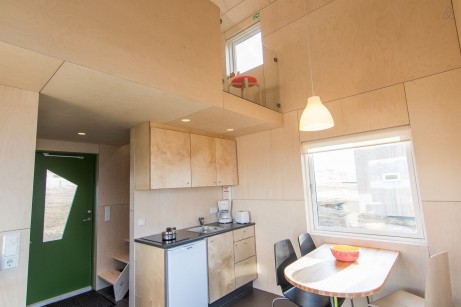
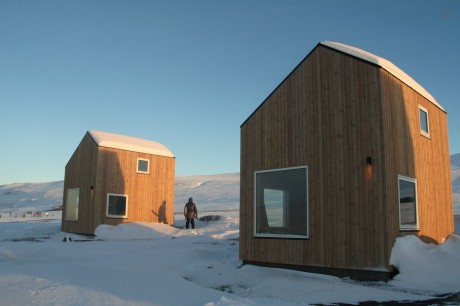
A reader sent me this Airbnb listing featuring three identical tiny cabins available to rent out. Located in the roaring metropolis of Sunnuhlíð, Iceland, these tiny houses look like the perfect place to read, use as a launching pad for sheep shearing tours, and staring out into the distance.
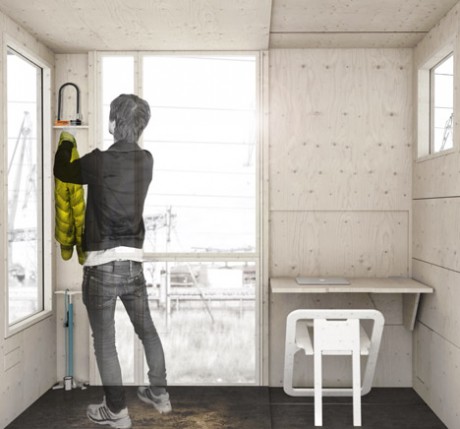
I’ve covered more than my fair share of compact, mobile homes. More often than not, the mobility is expressed on pavement, whether the home is affixed to a bicycle, a truck chassis or being towed around by an automobile. Very rarely–as in never–have I featured homes that move on old shipyard railway tracks. But that’s exactly what I’m doing today with the aptly named “Small House on Tracks” project by Polish architecture students Tomasz Zablotny and Paweł Maszota.
SMoT (my acronym, not theirs) is actually not meant as a universal housing solution, but rather a site-specific one for the Gdańsk Shipyard, a decaying industrial center that the project’s creators want to help revitalize into an artist colony.
The “houses” are actually expandable housing units, each fulfilling a different role. The units only measures 5’ W x 6.5 L x 8’ H, all the easier for moving on a truck bed or storing when not needed. They are filled with flat packing furniture that folds into the wall.
Zablotny told Dezeen that they are not necessarily meant for full time residency, but rather to provide “comfortable space[s] for artists, interns, workers or simply those to whom the unique atmosphere of the site would appeal.”
I’m not exactly sure how SMoT would have appeal beyond temporary housing in old, disused industrial complexes–of which there are a few, particularly in Europe and the US, which are no longer manufacturing powerhouses. But I’m a sucker for housing that can be expanded and contracted according to the needs of the day.
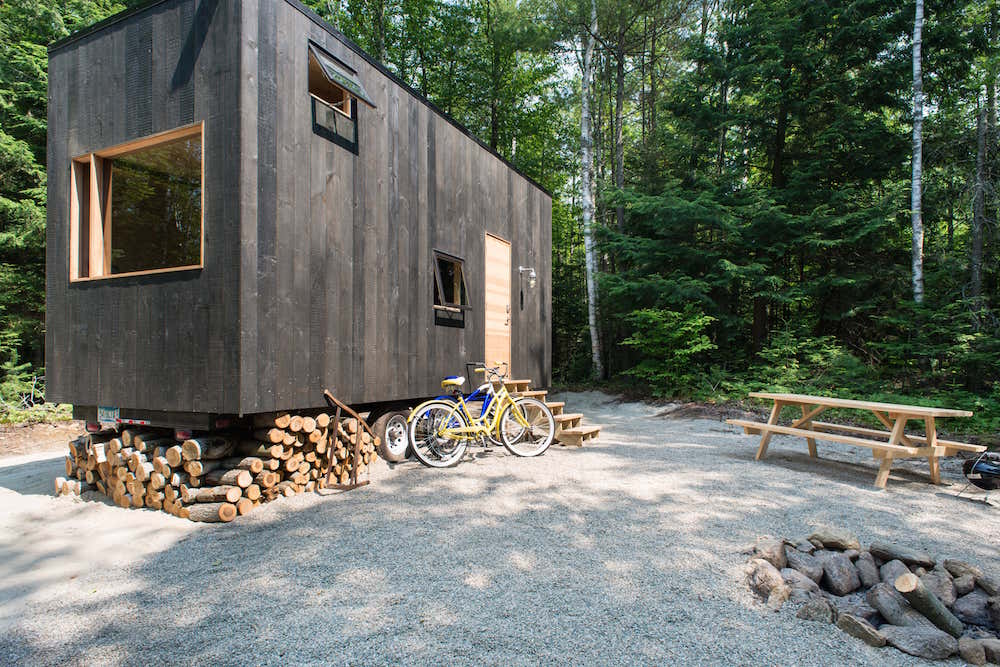
As I brought up a few weeks ago, there is a real need for more small, inexpensive vacation homes, ideally ones that are easily accessed by city-dwellers. City life can be a real grind. Without some sort of retreat, it can be unsustainable. Well the gods have heard my plea. Actually–as is more often the case–a group of Harvard grads heard my plea (but aren’t they the same thing anyway?). Headed by MBA student Jon Staff and Law School student Peter Davis, Getaway House provides an attractive, affordable, off grid tiny house for “folks looking to escape the digital grind and test-drive tiny house living.”
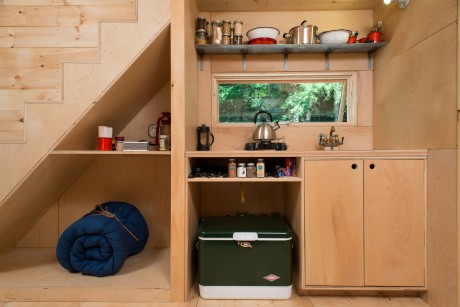
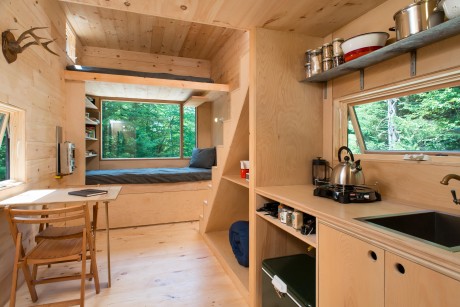
There is currently one completed Getaway House that is available to book by the night. It is dubbed “Ovida” and is located within two hour driving distance from Boston. The place was designed by a group of Harvard Design School grads. This elite-institution provenance shows through in its design. Both its modern interior and exterior are clad with attractive rough cut pine. The interior features built in furniture such as a table that doubles as a window cover and two built-in beds, giving the place capacity to sleep four. All electricity is solar, the toilet is composting and water is handled via a 110 gallon water tank that is refilled via the host house the tiny house shares its land with. Bookings also include fresh linens and available “provisions”–a sort of backwoods mini bar with things like coffee, trail mix, pasta, etc (these cost extra). Ovida is available for a reasonable $99/night for double occupancy.
Another Getaway House, dubbed “Lorraine” will be available mid-August and they are already taking reservations. A third house is due out in early September. Staff and Davis raised a bunch of money to build the houses with the goal of making them into a replicable model, providing both affordable, sustainable urban retreats and income generator for property host.
Getaway House is actually the first initiative of a project called Millennial Housing Lab, which, somewhat along the lines of what I wrote about yesterday, is trying to develop and realize “fresh housing ideas for a new generation,” focusing “on all sides of the housing experience: architecture, neighborhood design, financing, regulation and community-building.” As I’ve mentioned time and again, for all the hype surrounding tiny houses, micro-apartments, micro-suites and other creative forms of housing, market and regulatory forces often stand at odds with bringing these things into being. While Getaway House is ultimately a tiny vacation cabin, it is also another small step in making tiny, low impact housing a viable housing option for more people.
Man built most nobly when limitations were at their greatest.
Frank Lloyd Wright
You’d think that if we had access to boundless resources for our architecture, we would build the most amazing structures, incorporating the highest tech, the best quality, the utmost in efficiency and so forth. But such is not usually the case. More often unlimited resources give birth to McMansions and $100M Park Avenue duplexes–structures that hardly indicate the advancement of architectural thought, much less human evolution. The trouble is when you have no limits to external resources, you typically don’t need to rely on internal ones. In other words, excess tends to breed creative laziness. On the other hand, limited resources and the imposition of other constraints often spurs creativity. It’s a much trickier proposition to fulfill on objectives, not with anything you can imagine, but with whatever is available, which might not be much. This paradox is why we features so many interesting projects geared toward homeless populations. In these projects, limited budgets and spaces are not barriers to ingenious design, but the reasons they exist.
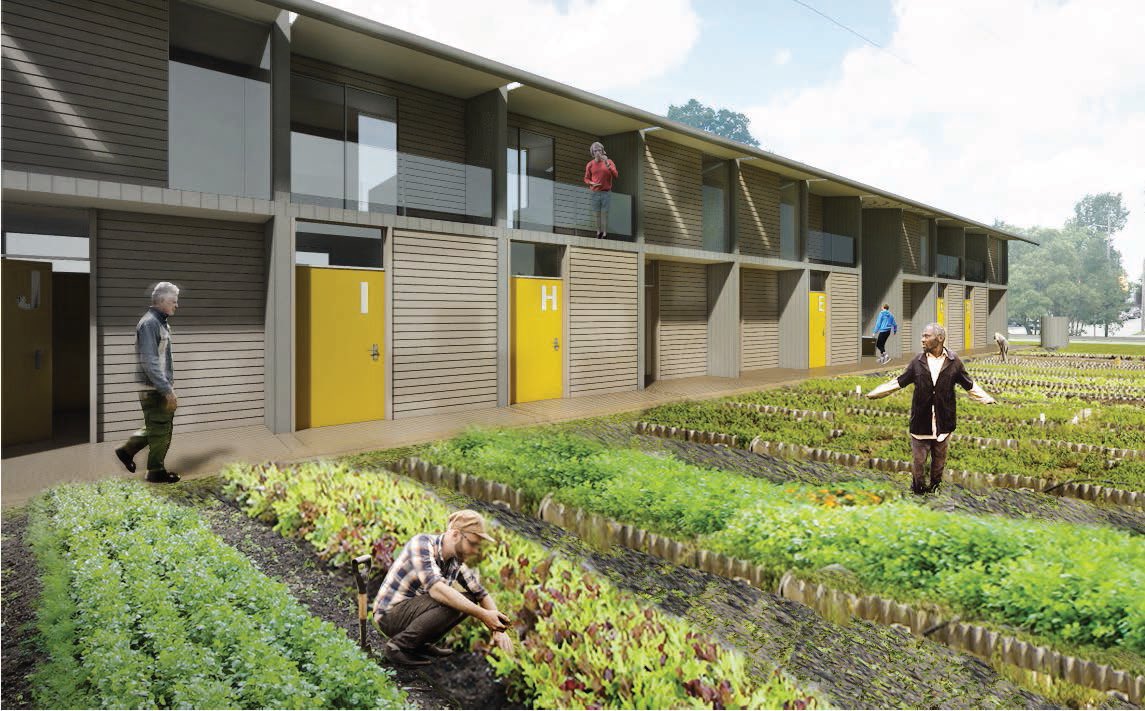
This phenomenon was demonstrated in spades with the Tiny Home Community Competition, launched by the AIA North Carolina Activate14 committee and the Raleigh/Wake Partnership to End and Prevent Homelessness. The competition sought out the best designs for a tiny house community built on a small parcel of donated land on the outskirts of Raleigh. The winning design, when built, will serve some of NC’s 11K+ homeless citizens. From the competition website:
Tiny home communities cannot eliminate poverty or homelessness, but they can create a more lively, caring, and diverse city. The goal is to generate innovative micro-housing communities that can repair and enliven our social fabric and help people transition out of homelessness.
The entrants were to meet a number of criteria such as affordability, the inclusion of a community center and garden, modular and prefabricated construction, a design that includes natural ecology and sustainable lifestyles and a design that can use leftover city land “as a resource for mending social and urban fabric.”
Winners were announced a couple weeks ago. Rather than a grand prize winner, entries were given awards based on specific merits. Merit categories were prefab construction, community engagement, affordability, aesthetic and community.
It’s worth checking out the competition winner’s page, as judges gave pointed praise and criticism for each design. Citizen Engagement Merit Award winners Heather Ferrell, Hiroshi Kaneko and Shane Gibbon’s design showed “true grit in a good sense of relationship with the neighborhood,” but while the judges liked “the concept of having the residents build it themselves,” their “experience shows that in reality it costs more to have coaches come in to teach how to build.” Affordability Merit Award winner Jeffrey Pinheiro and Derek Zero’s design “was simple, restrained, portable, well insulated with SIP, and had a very good site plan,” but some judges thought it might be “too cubicle-like to seem attractive to the residents,” and “there were a lot of questions about how to fold down a queen-sized bed without stepping outside of the unit.” Aesthetic Merit Award winners Gonzalo Carbajo, Inanc Eray, Pinar Guvenc and Marco Mattia Cristofori’s design “was the most architectural and formally organized project in the competition, and the units had great clarity,” however “the two story units increase cost and decreases accessibility.”
Despite some of the critiques–which are par for the course for such a competition–the winners showed a ton of great ideas, especially considering the lot they are to be built on occupies a mere .32 acres and units were conceived to be constructed quickly and affordably. Moreover, they are are proof positive, at least to this author’s mind, that fewer things spur innovative thinking like the imposition of constraints. Download the winner board pdf to see more details on all of the project.