A Compact and Communal Approach to Housing the Homeless

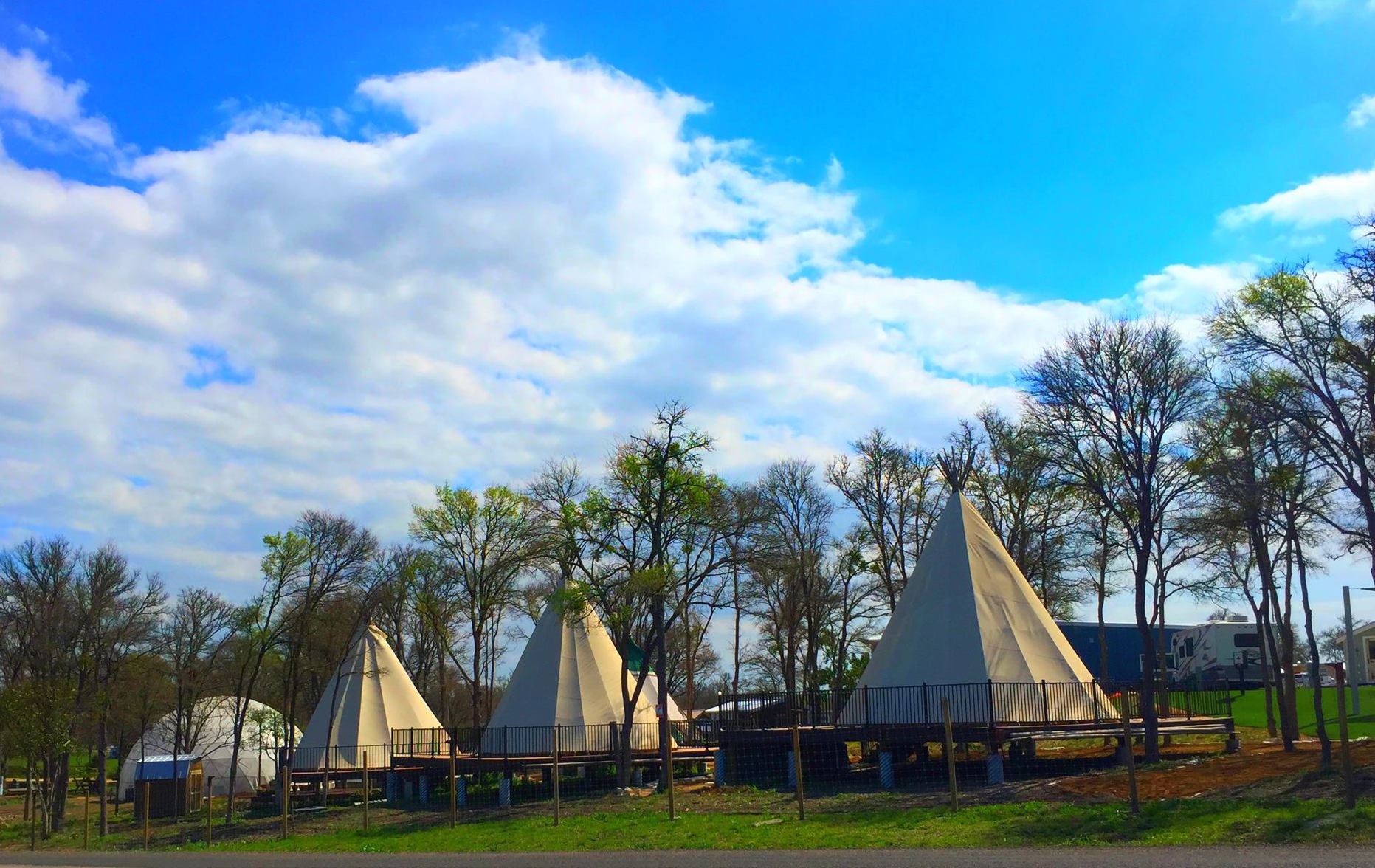
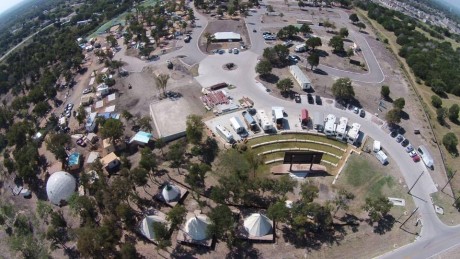
As we’ve seen here before, some of the most interesting and innovative projects involving small housing revolves around addressing the needs of the homeless. We can add Austin Texas’ based Mobile Loaves and Fishes and their “Community First! Village” to those innovative projects. When it is fully built out next year, the village will house “200 residents living in a retrofitted RV, microhome or canvas-sided cottage” according to CNN Money.
mlf-over

The community was initially conceived by its CEO Alan Graham who called the community a “RV park on steroids.” Everything on the 27 acre property is designed to foster a sense of community. From CNN:

It’s a village not only in name, but in function. The homes are essentially just bedrooms. The residents share everything else, from state of the art communal kitchens to laundry and bathroom facilities. There’s a dog park, volunteer nurses, a market, gardens, chickens and goats, a fish farm and an art gallery. The property even has an outdoor movie theater and a bed and breakfast.

Unlike some homeless communities, CFV does not require sobriety to live there. The only three community rules are that “residents must pay rent, obey the law and follow community rules.” As you may have deduced from their name, MLF is a Christian organization, though no religious affiliation is needed to live in the community.

Rents will range from $220 to $380 a month. Community members will have the opportunity to make some money from onsite “microbusinesses” such as the movie theater and the bed and breakfast, which will be open to the public. Internal sources of income are a good idea since the property is on the outskirts of Austin.

The Porch With A Home #tinyhome. Isn’t it just adorable?! And you should see the inside… ??

A photo posted by Mobile Loaves & Fishes (@mobileloaves) on

From what we can see, many of the existing housing structures are pretty interesting architecturally.

The “Housing First” model of combatting homelessness has gained a great deal of traction in the last several years. The belief–borne out in a number of places–is that when people have housing, they can better deal with the issues that might have lead to their situations. This is contrary to the model of expelling those issues before providing housing. CFV goes a bit further. As Graham put it, “Housing will never solve homelessness but community will.

Are RVs a Good Solution to Affordable Urban Housing?

We’re ever on the lookout for creative ways of making cities denser and more affordable. One way of doing that is filling up unused land gaps with housing. And one super simple form of housing that can do that are RVs. They’re small so can fit in the most miniscule parcel of land. And because they’re mobile, they can be inserted and removed on a moment’s notice, making them ideal for land that might be in transition. We’ve looked at how a couple New Yorkers live in their RVs, and recently the real estate site Zillow did a profile of Ellen Sims, an RVer living in Seattle.

Following the simultaneous departure of her two housemates in 2014, Sims pondered her options for an affordable alternative to traditional apartment shares. She decided to move into the RV, putting down $2K for a good sized Coachmen Freelander. She pays $540 in car payments, insurance and propane; all told, she figures it’s ⅓ to ¼ the cost of living in a normal apartment. She enjoys the RVs low cost, the autonomy it affords her and the imposed simplicity. She alludes to some of the less pleasant aspects, such as safety and finding good level ground to park upon.

We wrote a couple weeks ago about Seattle being a bastion of affordability. “Affordability” there referred to salaries being in line with the cost of living. While the city’s tech boom has beefed up many Seattleites’ salaries, many have not been so fortunate. Homelessness has increased a fairly shocking 19% in the last year alone and RVs have become a common solution to avoiding shelters and living exposed on the streets. Most of the 175-200 people who are living out of their vehicles in Seattle probably don’t have Sims’ sweet ride or relative good cheer about the situation.

Seattle’s mayor Ed Murray is now proposing the creation of two parking lots specifically for people living out of their cars and RVs. These lots will have waste management and other amenities.

Despite the unfortunate circumstances that drive (pun intended) many–though not all–to take up residence in RVs, it does present an interesting question about formalizing RV habitation in urban (and other) areas. While safety and sanitation concerns do exist, making RV living legal would go a long way to ameliorating these issues. The fact is many people who are not in danger of being homeless still want to spend less on housing or have greater flexibility as to where and how they want to live. By recognizing RVs as a valid form of housing and creating some infrastructure to support it–or allowing private parties to do so–we could possibly make strides in making our cities denser and more affordable.

Via Geekwire and Zillow

Competition Uses Tight Resources to Squeeze Out Big Designs

Man built most nobly when limitations were at their greatest.

Frank Lloyd Wright

You’d think that if we had access to boundless resources for our architecture, we would build the most amazing structures, incorporating the highest tech, the best quality, the utmost in efficiency and so forth. But such is not usually the case. More often unlimited resources give birth to McMansions and $100M Park Avenue duplexes–structures that hardly indicate the advancement of architectural thought, much less human evolution. The trouble is when you have no limits to external resources, you typically don’t need to rely on internal ones. In other words, excess tends to breed creative laziness. On the other hand, limited resources and the imposition of other constraints often spurs creativity. It’s a much trickier proposition to fulfill on objectives, not with anything you can imagine, but with whatever is available, which might not be much. This paradox is why we features so many interesting projects geared toward homeless populations. In these projects, limited budgets and spaces are not barriers to ingenious design, but the reasons they exist.

This phenomenon was demonstrated in spades with the Tiny Home Community Competition, launched by the AIA North Carolina Activate14 committee and the Raleigh/Wake Partnership to End and Prevent Homelessness. The competition sought out the best designs for a tiny house community built on a small parcel of donated land on the outskirts of Raleigh. The winning design, when built, will serve some of NC’s 11K+ homeless citizens. From the competition website:

Tiny home communities cannot eliminate poverty or homelessness, but they can create a more lively, caring, and diverse city. The goal is to generate innovative micro-housing communities that can repair and enliven our social fabric and help people transition out of homelessness.

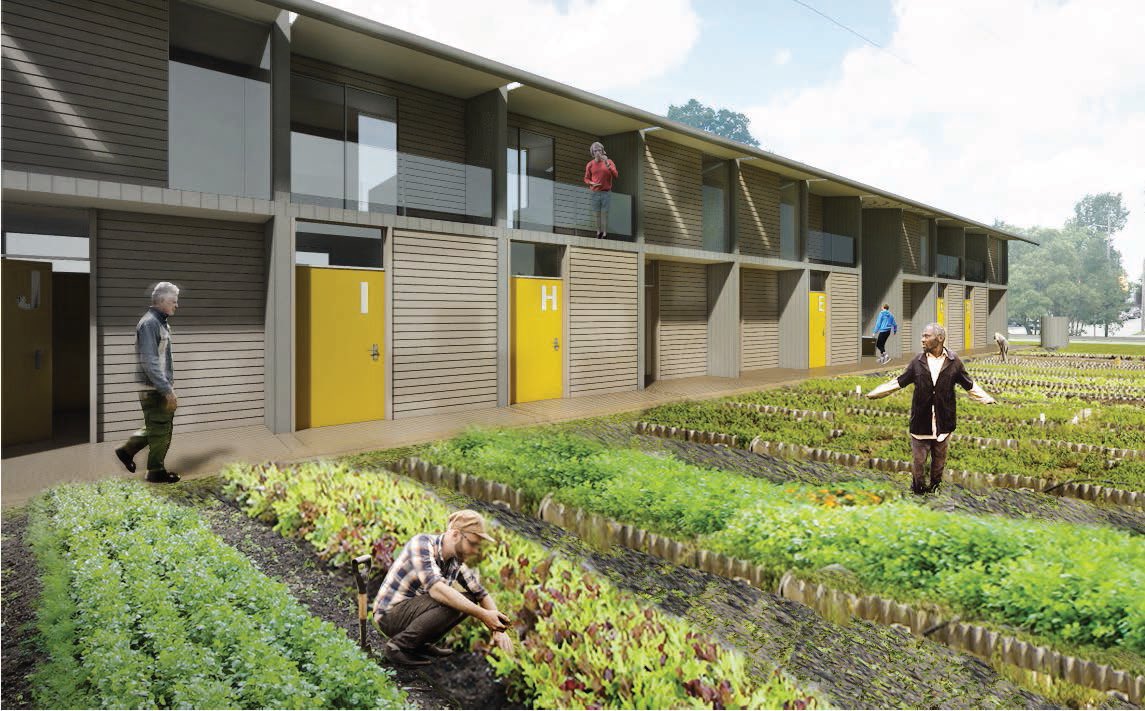
The entrants were to meet a number of criteria such as affordability, the inclusion of a community center and garden, modular and prefabricated construction, a design that includes natural ecology and sustainable lifestyles and a design that can use leftover city land “as a resource for mending social and urban fabric.”

Winners were announced a couple weeks ago. Rather than a grand prize winner, entries were given awards based on specific merits. Merit categories were prefab construction, community engagement, affordability, aesthetic and community.

It’s worth checking out the competition winner’s page, as judges gave pointed praise and criticism for each design. Citizen Engagement Merit Award winners Heather Ferrell, Hiroshi Kaneko and Shane Gibbon’s design showed “true grit in a good sense of relationship with the neighborhood,” but while the judges liked “the concept of having the residents build it themselves,” their “experience shows that in reality it costs more to have coaches come in to teach how to build.” Affordability Merit Award winner Jeffrey Pinheiro and Derek Zero’s design “was simple, restrained, portable, well insulated with SIP, and had a very good site plan,” but some judges thought it might be “too cubicle-like to seem attractive to the residents,” and “there were a lot of questions about how to fold down a queen-sized bed without stepping outside of the unit.” Aesthetic Merit Award winners Gonzalo Carbajo, Inanc Eray, Pinar Guvenc and Marco Mattia Cristofori’s design “was the most architectural and formally organized project in the competition, and the units had great clarity,” however “the two story units increase cost and decreases accessibility.”

Despite some of the critiques–which are par for the course for such a competition–the winners showed a ton of great ideas, especially considering the lot they are to be built on occupies a mere .32 acres and units were conceived to be constructed quickly and affordably. Moreover, they are are proof positive, at least to this author’s mind, that fewer things spur innovative thinking like the imposition of constraints. Download the winner board pdf to see more details on all of the project.

H/T to Pinar Guvenc

Living Well in the Margins

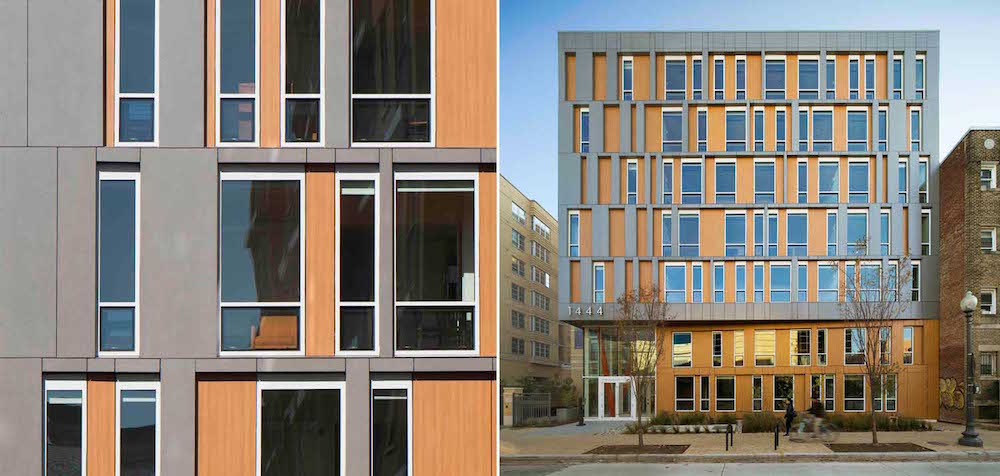
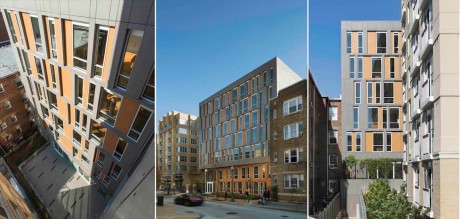
In most any area, it’s generally best to look to the margins, not the center, for innovative thinking. Small space architecture is no different. Conventional architecture is too often big and boring, victim of zoning restrictions and/or design driven by the interests of developers rather than residents. One place to find consistently interesting “marginal” architecture is supportive housing–a type of government-funded housing for populations that need, ahem, extra support. Supportive housing usually enjoys less restrictive building code restrictions than conventional housing and because it’s not for sale, it is not necessarily bound to imitate what everyone else is doing in the market, often resulting in innovative, community-centric, compact architecture. La Casa Permanent Supportive Housing in Washington DC is a great example of such a beast. It’s an attractive, smartly-designed apartment building that happens to be supportive housing serving homeless men.

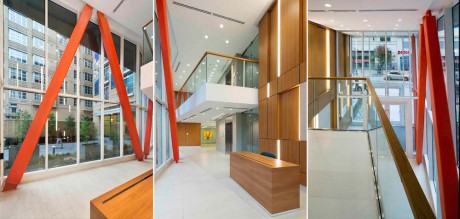
The seven story La Casa was jointly designed by LEO A DALY and Studio Twenty Seven Architecture for the DC Department of Human Services. According to LAD’s website, they were challenged “to create a ‘home’ rather than an institution, and to ‘meet or exceed’ the quality of the adjacent market-rate apartments.” With bright, clean and smart interiors, their challenge appears to have been met.

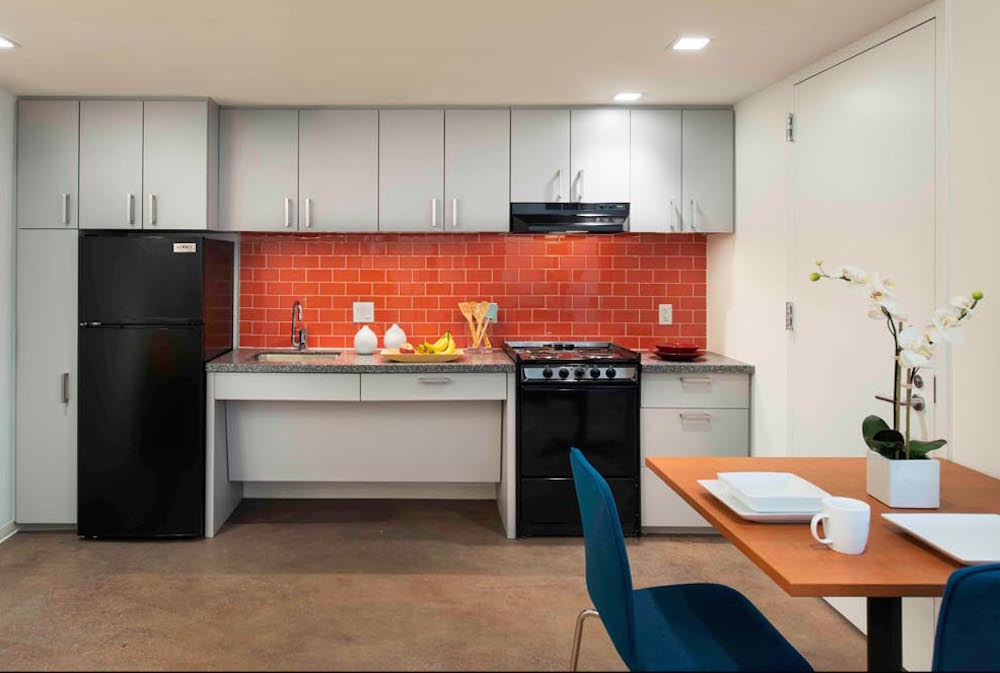
The building will house 40 chronically homeless men, all of whom will have their own furnished efficiency apartments with kitchens and bathrooms. The units are designed to create a sense of home and permanency, rather than serving as a stopover in some institution in a never ending cycle of homelessness. It will employ the “housing first” service model. Whereas many supportive housing communities require sobriety or other conditions for eligibility, housing first has no such conditions, acting under the belief that when housing and counseling services are in place, it can provide the security and dignity that will act as gateways for an improved life.

La-Casa-4-Desktop

Even the design was meant to be rehabilitative. Jim Spearman, La Casa’s project architect at Studio Twenty Seven Architecture, said “From the exterior, large and individualized windows on the façade identify particular spaces to which occupants can point and exclaim, ‘That is where I live!’”

La-Casa-12-Desktop

Beside the efficiency apartments, there is a welcoming lobby on the ground floor, support offices and a mail area. There is also a community room on the second floor that opens onto an outdoor terrace. “A green roof contributes to the design’s LEED-Gold certification,” according to LAD, and “Security is provided by a combination of security officers, remotely monitored cameras, and secured door access.”

La Casa recently won the American Institute of Architects (AIA) 2015 Housing Award in the Specialized Housing category. The project is great because it’s not just a nice place for someone accustomed to living on the streets–it’s a great place for anyone to live.

Images via Studio Twentyseven Architecture

Small Houses, Medium-Sized People, Big Ambitions

Project H Design is a Bay-Area nonprofit that empowers kids through design and building. For the last seven years, over 600 kids ages 9-17 have participated in their programs, which according to their website “teach rigorous design iteration, tinkering, applied arts and sciences, and vocational building skills to give young people the creative, technical, and leadership tools necessary to make positive, long-lasting change in their lives and their communities.” For the 2014-15 school year, their program is focused on tiny house design and construction.

A group of 70 high school and 150 middle school students have been looking at the tiny housing type with a number of inquiries in mind, namely: How is housing influenced by social and economic context? How does affordable access to housing empower communities or families? How does the design of a home uplift and inspire positive change in a person’s life?

project-h-doghouse

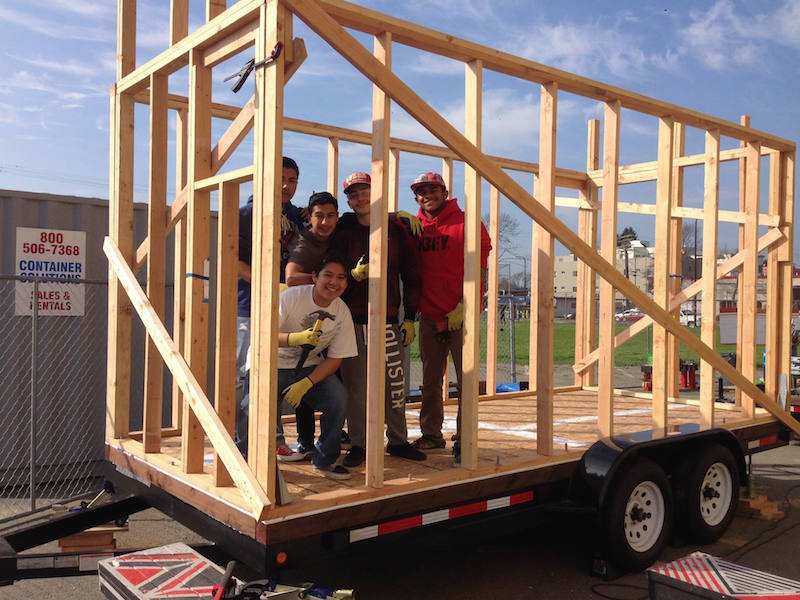
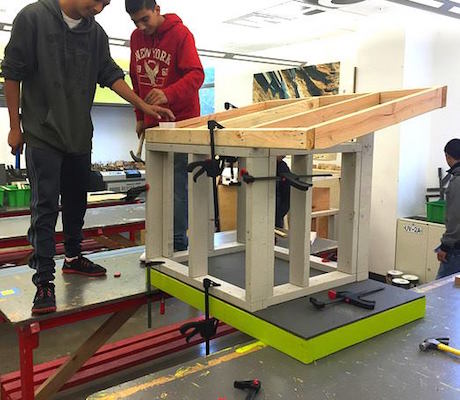
In answering these questions and creating tangible, built answers, Project H created a program with different units. They start with the most basic aspects of designing and building like drawing and modeling skills. Each unit builds on the next, expanding the students’ skills; they look at tiny house precedents for design inspiration, draft and make cardboard models of different tiny house designs, conduct critiques of the students’ various designs and even build a mockup tiny dog house (pictured above) before they begin construction of two full-sized tiny houses.

project-h-built

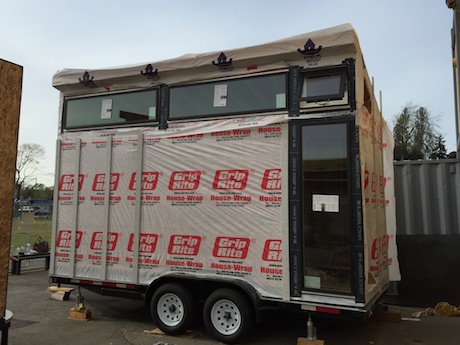
The two houses are identically designed, each measuring 7’ x 16’ and trailer mounted. Currently, the houses are pretty far along, having been framed and insulated in the last couple months. The students’ current unit is sourcing siding from used palettes. They expect the houses to be complete by June. Project H provides regular updates and images on their tiny house project page.

One of the houses is already set to be donated to Opportunity Village, a tiny house colony for would-be homeless populations in Eugene, OR (Bay Area code prohibits tiny house living) and the second will be auctioned off to raise money for Project H.

There’s something very heartening to see these kids developing a deeper connection with their built environments–that housing is not something that magically appears or comes about without consideration about how it fits into a greater scheme of things.

Is Portland Getting Ready for a Tiny House Revolution?

Necessity, as the saying goes, is the mother of invention. The necessity in Portland–not to mention many other places–is housing the homeless and other economically marginalized citizens. The invention is the formation of low-cost tiny house communities throughout the city to house them. Ok, perhaps they didn’t “invent” the idea per se–we’ve seen it before with Quixote Village in Olympia, WA–but doing it on the scale Portland is thinking is novel.

The conversation about creating low cost tiny house communities has been building for a while now. For the last several months, a nonprofit initiative called Micro Housing Concepts has been trying to find a home for its tiny house communities, which calls for 192 sq ft tiny houses manufactured by a company called TECHDWELL. According to TECHDWELL’s website, the houses can be built in two to four days and assembled with basic hand tools and little to no construction background. They can be made of reused and recyclable materials and upgraded with features like composting toilets and PV cells.

Michael Withey, founder of MCW, has developed a plan where 25 of the TECHDWELL tiny houses could be built on about half an acre, with each unit costing $15,000 to $35,000, sums that include land costs. He contrasts this with the Bud Clark Commons, a recent low income housing development built in Portland, which had a per unit cost of $253K.

Monthly rents at the tiny house communities would only be $250 to $350, making them affordable, Withey believes, for people making $7,000 and $21,000 per year. Withey told us that half the rents collected will go back into the micro community for maintenance and improvements while the other half would fund the next community, making them not only self sustainable, but self replicating as well.

Withey told Willamette Week that the communities are “not necessarily a homeless project,” but “a homeless prevention project,” saving people who earn small incomes from hitting the streets; though their very modest rents would likely make them accessible to homeless populations as well. Renters would not be required to furnish income verification, though they would undergo background checks and the community members, like those at Quixote Village, would have to abide by agreed upon rules.

The big news is not necessarily architectural or even economic, but legislative–this latter factor is typically the biggest hurdle to building tiny. Portland mayor Charlie Hales is reportedly “infatuated” with the idea, and his director of strategic initiatives, Josh Alpert, told the Oregonian that it’s not a matter of if the communities will happen, but when. City representatives say they are putting the project “on the front burner” and there are plans to ask TriMet, Portland Public Schools and Multnomah County to share their surplus land inventories for possible sites for the communities. The mayor’s office has also organized a task force to investigate the legal and zoning challenges of making the micro-communities a reality, according to the Oregonian.

The communities would help some of the more than 2K known homeless Portlanders, but Withey sees the them expanding to include all types of demographics, telling the Oregonian that there could be veteran, family, single mother and senior communities as well–not to mention people who might want a simple, affordable home. With their low cost, quick startup times (Alpert hopes the first micro-community can be in place by as soon as February 2015) and supportive government, it’s easy to think that the tiny house communities could quickly proliferate. We’ll keep you posted as this story unfolds and check out Micro Community Concept’s Facebook page for more regular updates.

Check Out These Scrappy Little Homes for the Homeless

“One man gathers what another man spills.”

Grateful Dead

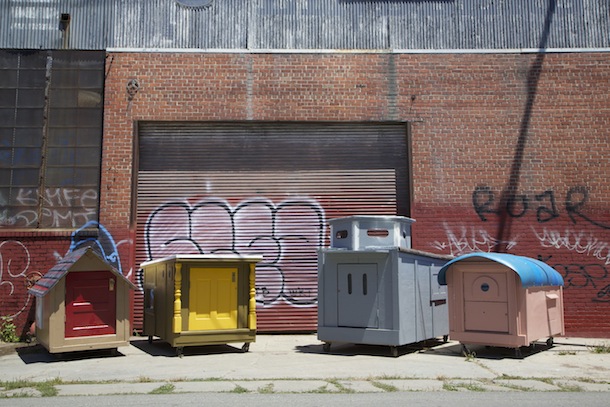
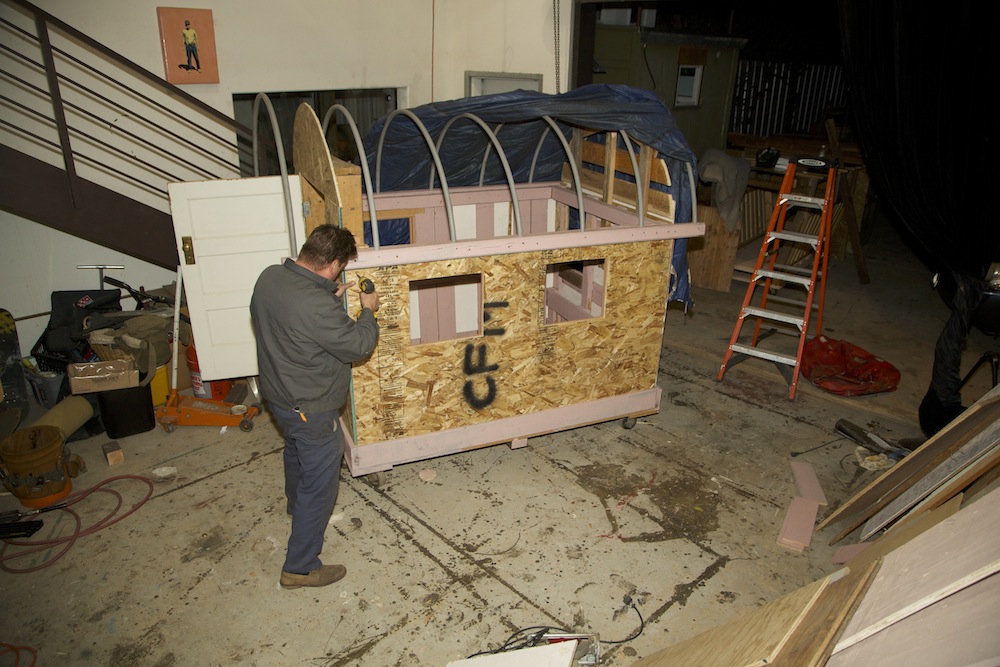
Sculptor Gregory Kloehn wanted to do more than make art that sat in rich folks’ homes. He wanted to make useful stuff–made from unused stuff. He started a few years ago making houses from used shipping containers, both his own home and then for others. And then one day a homeless couple stopped by his studio asking for a tarp. He had been working on a small structure about the size of a sofa that had a “kitchen,” water tank and small receptacle for waste. He gave this tiniest of houses to the couple, which led him to building nine more, all of which he has done free of charge.

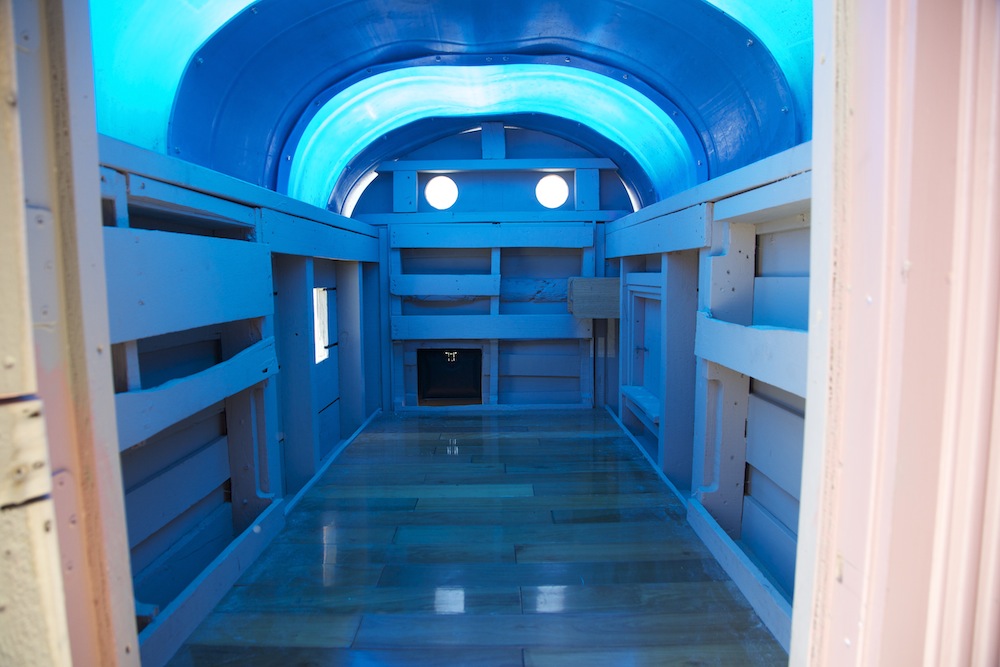
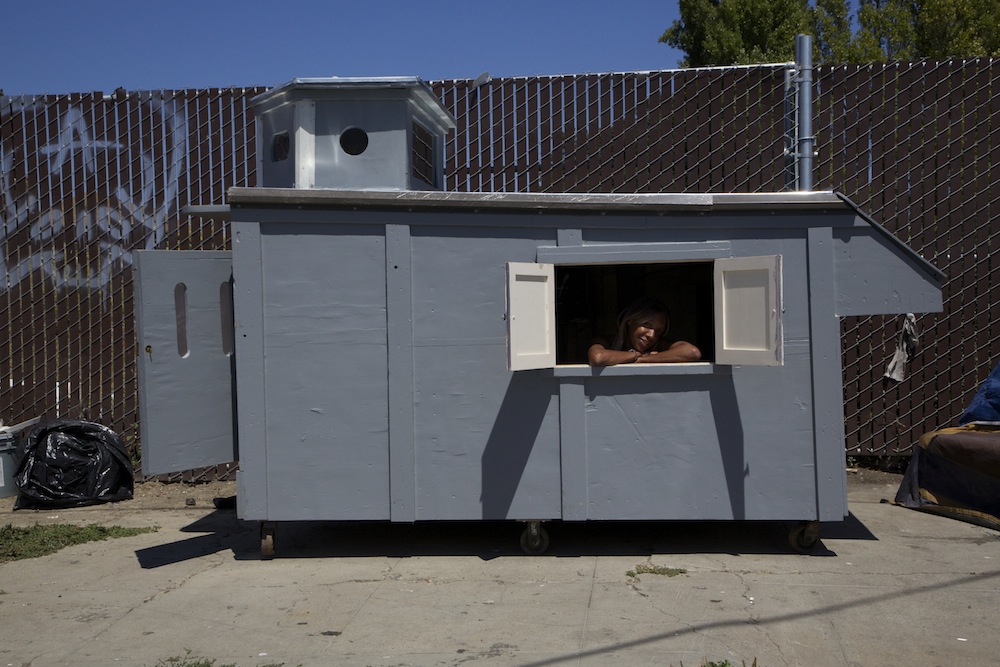
Like the first house, they are all tiny–little more than a covered bed in most cases. He constructs them largely out of illegally dumped trash found in the industrial section of west Oakland, CA where Kloehn lives much of the year. Their foundations are usually made from old shipping pallets, which are attached to casters for easy porting.

The houses, though tiny, represent a significant improvement to the status quo, where options typically include sleeping on the street or in dangerous homeless shelters. Not all of them have faired well: the first home was firebombed, one was stolen and another was sold for $80 to be used as a doghouse.

Kloehn does have a larger purpose for the homes. He has started the Homeless Homes Project, which through the use of scrapped materials, “strive[s] to diminish money’s influence over the building process.” He is looking for both donations and materials. He held workshops this last spring where homeless populations can build their own structures.

Via Oakland Tribune

Tiny House Village Provides Big Life

If you build it, they will come..eventually. Such is the case with the perpetually displaced tiny house building typology. The popular demi-homes have a habit of falling on the wrong side of the law and habitability. They often find themselves getting moved around town because they can’t be stationed anywhere for too long, or remaining unoccupied because they fail to be considered legal housing. A new tiny house development in Olympia, Washington may have hit the nail on the head for how to use tiny houses in an ongoing, legal and logical fashion.

Quixote Village, as the development is called, is a permanent tiny house village that evolved from Camp Quixote, a floating homeless camp founded in 2007–a camp  that moved over 20 times since its founding, hopping from various faith community lands until they exceeded city ordinance time limits for campouts.

The village is made up of 30 residents from the camp, who occupy 30, 144 sq ft tiny houses, spread over 2.1 acres. The village includes a community center with laundry, communal kitchen, living and dining spaces as well as a community garden.

Each house cost $19,000, which includes materials and labor at commercial rates. The total project cost $3.05M. The project was funded and guided by a nonprofit called Panza, which is made up of the various Olympia faith organizations that supported Camp Quixote throughout its history.

Quixote Village got so much support largely because of its longevity and cohesiveness. It is self-governing and abides by two code of conduct–one established by Panza and another by itself.

quixote-community

The village planning was a collaboration between a committee and architect Garner Miller. Residents had input as well as a NY Times article reports:

The residents lobbied for a horseshoe layout rather than clusters of cottages, in order to minimize cliques. And they traded interior area for sitting porches. The social space lies outside the cottage. Or as Mr. Johnson put it, ‘If I don’t want to see anybody, I don’t have to.”

This community oriented planning reminds us of Pocket Neighborhoods, which feature homes with large porches that face a community-shared commons.

Half of the residents report zero income, and the average annual income of the villagers that do report one is $3100, most of which comes from day labor, pensions and social security. Villager are expected to give 30% of whatever income they do produce. We assume the shortfall is made up by Panza.

It might be a stretch to say we envy the Quixote Villager’s situation, but we think their setup–with its minimal, community designed housing–makes far more sense than most residential housing. And it may go to show that modest means often produce solutions that make far more sense than ones that well from unlimited means.

Via NY Times 

Park Your Life in These Repurposed Garages

A design by architectural firm Levitt Bernstein that converts unused garages on London housing developments into popup homes was the winner of the Building Trust International’s HOME competition, which sought to provide “residents most at risk in developed cities with a safe place to live.”

The Levitt Bernstein units are part of a larger project they call HAWSE (Homes through Apprenticeships With Skills for Employment). The homes provide shelter for their occupants as well as trade skills as they are involved with the assembly of the unit. The house provides low cost housing (£11/week) for a year or two before the occupant moves on to other developments and the structure is demolished. We’re not sure why they wouldn’t remain as ongoing housing, though it likely has to do the fact they’re using someone else’s property.

The units are a mere 118 sq ft and feature their own bedroom, bathroom and living/dining area. We particularly like the wall-through sink between the bathroom and kitchenette. Each fifth garage will have a communal laundry, additional kitchen equipment and a dining area.

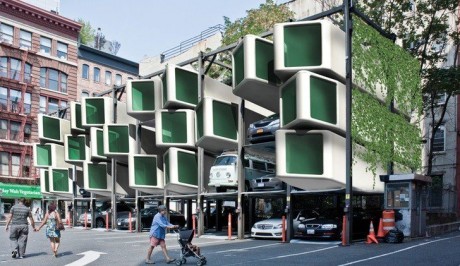
HAWSE is meant to use under-used spaces in expensive, high density areas, in this case East London. We’ve seen other garage-cum-homes with the same mission intended for New York City, but this one seems much more thought out. The other designs, particularly the upLIFT design (below), proposed using highly used, revenue-generating parking spaces as housing for the homeless, which seems like a tough sell. Focusing on using under-used spaces like HAWSE makes a lot more sense.

Uplift-concept

There was some controversy (possibly manufactured) reported in the London Evening Standard. An architect called pop-up housing “morally bankrupt” and not addressing the causes of homelessness. We think it’s a pretty great idea and a creative way to make increasingly expensive cities accessible to diverse populations.

What do you think? Is this smart design or a bandaid on larger social and economic woes?