The Unbearable Lightness of Being Average

“You are not special. You’re not a beautiful and unique snowflake. You’re the same decaying organic matter as everything else. We’re all part of the same compost heap. We’re all singing, all dancing crap of the world.”

Chuck Palahniuk

Have you had a time when you felt content with your life? A time when you had enough money in the bank, a body fit enough to get you through the day and a reasonably long life, a job that was interesting enough, a partner comely enough, friends interesting enough, a house big enough and a car fast enough. Nothing needed to change….until…you found out someone had a lot more money than you, was fitter and more attractive than you, had a much cooler job, had a much hotter partner, had far more interesting friends, had a much bigger (or perhaps for our readers, smaller) house and had a super fast car (ultra-efficient, no less). All of a sudden, you were discontented. Maybe you didn’t put state it as such, but deep down you felt deeply, profoundly average. But if we are to believe writer Mark Manson, average is not grounds for despair. In his brilliant essay “In Defense of Average,” he lays out a compelling argument for how we can be both average and extraordinary.

bellcurve

Manson starts with the cold, hard, somewhat obvious truth: statistically speaking, the vast majority of us are going to be average. He uses the bell curve to illustrate this point, stating that in any domain there are small populations of extremes: the high performers at one extreme–the Michael Jordans of basketball, the Warren Buffetts of finance–and low performers at the other extreme–the Mickey Roonies of basketball (I’m assuming), the 50 Cents of finance. In the middle is you and me–the great, average masses. Sure, we might be above average performers in some domains, and below in others, but for the most part, we populate the wide middle section of the curve, hitting neither high nor low in many, or perhaps any, domain.

This averageness can be grounds for despair, lamenting how we can’t live up to the performance of the high performers–a population that is, by its very definition, tiny (funny how we rarely rejoice that we aren’t the low performers). Or it can be a liberating realization, one that inspires us to accept statistical truths, that we may never be ungodly rich, dropdead gorgeous, hyper-intelligent, ultra-fit or extraordinary in almost any domain we desire to excel in. It’s not a personal thing. It’s just the law of averages. But it is a place we can learn to be happy and fulfilled.

Manson explains that the expectation of high performance is to some extent a recent phenomenon, one exacerbated by the internet. He writes:

Therefore the only [online information]…that break through and catch our attention are the truly exceptional pieces of information. The 99.999th percentile….All day, every day, we are flooded with the truly extraordinary. The best of the best. The worst of the worst. The greatest physical feats. The funniest jokes. The most upsetting news. The scariest threats. Non-stop.

Through repeated exposure, this becomes our expectation of ourselves. As Manson puts it, “exceptional” has become the new normal. But exceptional is exceptional–it’s the thing that happens to few, rarely. Meanwhile, most of life is average for many, often. Even many people who are extraordinary in one arena are horribly average or below average in others–juxtapose Tiger Woods’ golf prowess with his relationship skills.

Not only that, but the online highlight footage doesn’t even accurately portray high performers. Manson writes, “We are not exposed to those years of practice. Or those hours of drab and failed footage. We’re merely exposed to each person’s absolute finest moment–possibly in their entire lives.” Not featured are the clips showing the states that precede high performance: low and average performance (Ira Glass did a wonderful talk on this topic). Manson explains that the mindset of high performers is not even necessarily fueled by expectations of high performance. He writes:

The people who become truly exceptional at something do so not because they believe they’re exceptional. On the contrary, they become amazing because they are obsessed with improvement. And that obsession with improvement stems from an unerring belief that they are, in fact, not that great at all. That they are mediocre. That they are average. And that they can be so much better.

And herein Manson explains the key to living an extraordinary, average life: “Mediocrity [a proxy for being average], as a goal, sucks. But mediocrity, as a result, is OK.” Do your best, let go of results.

Manson’s thesis is very relevant in the context of this blog. So many of the issues we write about concern our collective obsession with being exceptional. We build houses larger than we need, lust after and buy more stuff than we need, do as many activities as we can, consume as much information as we can, travel to as many countries as we can and perhaps even try to be as ultra-minimal as we can–often fueled by the desire, conscious or not, of differentiating ourselves and proving ourselves more than average. But life might be a lot easier if we stopped trying to differentiate ourselves from our fellow humans, if we embraced the average (after all, it is a state that rivals death and taxes in terms of its inevitability). The choice is ours. Life is short.

Go here to read Manson’s full essay.

Photo credit: Lewis Tse Pui Lung / Shutterstock.com

Bleeding Edge Furniture Technology

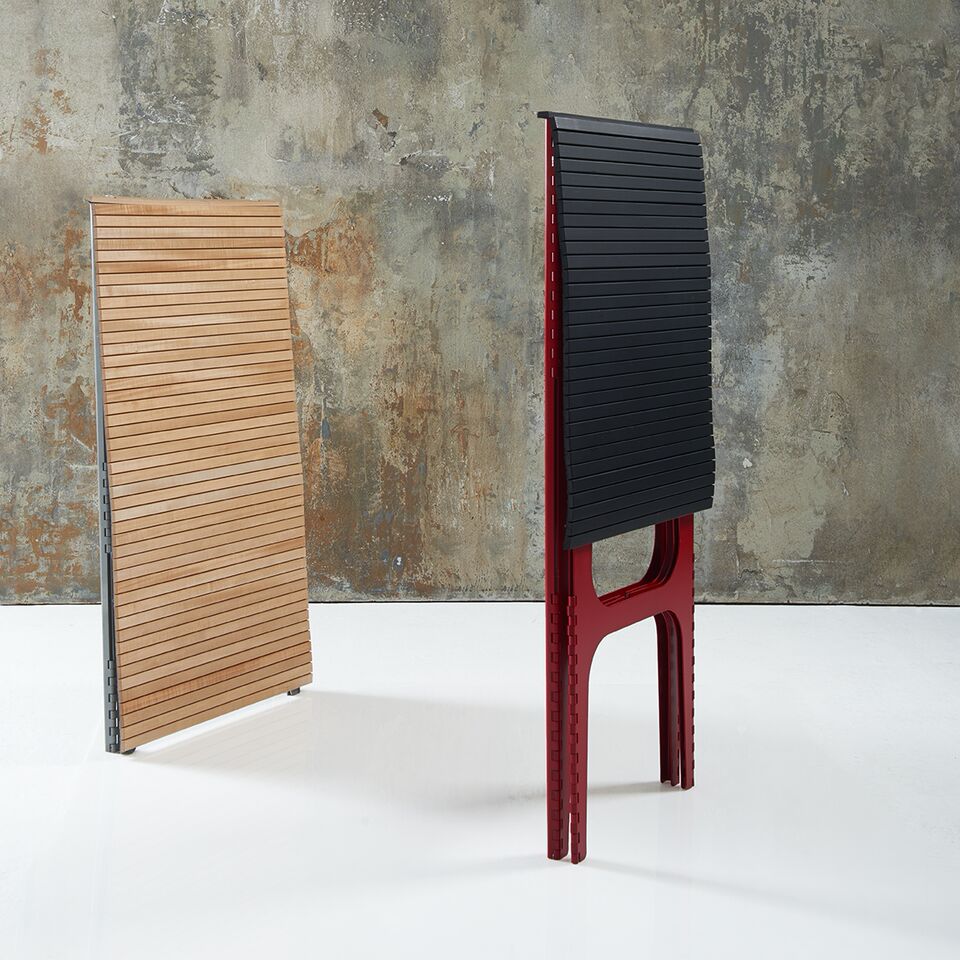
While there’s a certain novelty about space-saving, transforming furniture–dining rooms that tuck into floors, automated, disappearing bedrooms and so on–its impact on architecture can be real and profound. It might double or triple the utility of a given room, leading to diminished real estate needs, leading to less sprawl, leading to less driving, less waste, smaller carbon footprints and a shot of mitigating the profound damage humans have done to the planet (sorry, but it’s true). It’s an impact big enough to warrant big brains and focus, which is exactly what furniture upstart RockPaperRobot is all about. RPR was founded and is run by Jessica Banks, who holds a PhD in robotics from MIT, a pedigree that shows up in RPR’s new Ollie line of transforming furniture.

Previously, RPR had focused mostly on designing and producing high end furniture that, through creative engineering, appeared to defy the laws of physics–tables that seemed to levitate or rest on a pinhead. These pieces also defied most people’s furniture budgets. While they continue to produce these premium products, Banks wanted to make furniture that was more accessible functionally and financially to more people, which is how Ollie was born.

“We saw a number of trends such as urbanization and the desire to live life with less stuff and more experiences,” Banks told me about the Ollie line’s inspiration. She also saw how the phenomenon of FOMO [fear of missing out] could apply to the objects in our lives. “Most furniture is like, “If I buy this, I can’t do this,’” she said. For example, if I have this full-sized dining table, I can’t have open space to do yoga. “We asked ‘Why should furniture prevent us from doing what we want to do?’”

The Ollie line includes a table, stool and chair, all of which effortlessly transforms from full-sized furniture into super slim storing proportions, giving rooms double and triple functionality. The furniture is both lightweight and sturdy (a rare combination I’ve found). Aesthetically, I would call it industrial chic. The customizable slats are easily swapped to match a room’s decorative needs.

Beside the obvious residential applications, Banks told me that they have been discussing using the furniture in commercial spaces in order to optimize for traffic patterns. For example, a coffee shop with a ton of foot traffic in the morning could deploy Ollie tables in the middle of the day for loitering freelancers (the author knows of which he speaks).

I asked Banks if her robotics training helped in designing the collection. “Definitely,” she replied. “The tables are more like a transmission than tables. They’re highly engineered with 60 moving parts and 300 total parts. We had to make everything work together and calculate for forces.”

RPR is currently readying the tables and chairs ready for production and says they will be taking orders in three months for the chairs and six for the tables (they will also do custom manufactured pieces anytime you want).

The Tiny House ‘Sturgis’ Coming to Colorado this Weekend

Tiny houses are, to borrow a hopefully soon-to-be-retired expression, trending. I believe this trendingness is attributable to their role as the architectural embodiment of our collective exhaustion with too much physical, financial and psychic overhead. They provide just what a single person or couple need and nary a thing more. But there are few legal places to park them outside Portland, leaving many folks who would live in a tiny house unable to do so. In order to become a real movement, tiny houses and the folks that love them need to consolidate power. There needs to be a visible groundswell of support, showing legislators that tiny homes are more than some backyard dalliance with simple living. The Tiny House Jamboree this weekend (August 7-9, 2015), in Colorado Springs might just help create that groundswell.

The Jamboree looks to be the worlds’ largest tiny house gathering to date. Jay Shafer, Deek Diedricksen and most all of the biggest names in tiny living will be in attendance. There will be a ton of builders, vendors and other tiny house related exhibitors, making it the perfect venue for folks looking to take the tiny plunge. The event’s organizers are expecting a huge turnout to the free event. I emailed Marcus Alvarado, one of the event’s head coordinators a few questions to find out more about the event.

DF: What the are the intentions and goals behind the jamboree?

MA: The 2015 National Tiny House Jamboree aims to bring together the community of tiny house builders and sustainable-living enthusiasts in celebration of the ever-growing Tiny House Movement. EcoCabins’ Marketing Director, Coles Whalen, puts it best by saying, “The movement is rooted in sort of a counter-cultural idea: smaller environmental footprint, tighter-knit communities, a debt-free lifestyle”. This movement means so much, to so many different people, from so many different backgrounds, it’s a simply a melting-pot that aims to flip the script on what a normal US dwelling should look like. We hope to bring this vision to the largest celebration this community has ever seen!

DF: How many people do you expect to attend and where are most of them coming from?

MA: As of today [August 1], we are upwards of 9,000 registrants from all 50 states and 14 countries! Most of the registrants are coming from Colorado, Texas, California, New Mexico and Kansas. Outside of the US, Canada has the most registrants with Australia and Germany tied for the second most.

DF: What do you see as the highlights of the jamboree?

MA: That’s hard to say when we have been jamming the “Jam” with all tons of special happenings! We have an all-star group of speakers that are set to present at the Jamboree including: Andrew Morrison, Jay Shafer, Derek “Deek” Diedricksen, Zack Giffen from Tiny House Nation, and a whole lot of others you wouldn’t want to miss! We will have drawings routinely handing-out giveaways from our 30+ vendors, a Mini Chapel for couples to renew their vows, a gypsy wagon stage auction, live music, along with a presentations from Sketchup and IKEA. To top it all off, We also will be screening “Small is Beautiful: A Tiny House Documentary” at a local movie theater. And did I mention we are going to have builders from all around the nation exhibiting? We’re excited!

DF: Anything else you would like to tell our readers about the event?

MA: We are aiming to make this event to be the “Sturgis” of the tiny house movement with a fun-packed jamboree that goes against the grain of conventional celebrations. We also offered “Open-Camping” to 50 lucky attendees for free! However, when everything is said and done, we have worked incredibly hard to make this event significant enough for this community to take and call their own. See ya all there!

Visit their website for more information.

Man Doesn’t Like Working, Is Well, Has Swagger

There’s something fairly epic about the life of Benedict, aka Ultra Romance, a tattooed, muscle-bound, bushy-beard-wearing, bike-touring, not-so-fond-of-working, foraged-food-eating, $10-a-day-living nomad. A recent article in Business Insider called attention to his adventures and I think you’ll be glad they did. While his lifestyle might not be for everyone, it is testimony that life can be as much a choice as a prescription.

ultraromance-beach

Since leaving college 15 years ago, the 35 year-old hasn’t spent more than six months in any one locale. He splits his year working and relaxing. Six months are spent as a commercial or charter fisherman. The other six are spent going where he pleases aboard his touring bike (he seems to be a big fan of Grant Petersen’s Rivendell Bicycle Works). He definitely falls into the “work to live” category, seeing it as a means to support his ultralight, adventure-and-relaxation packed lifestyle. He told Business Insider, “We have this preconceived notion of what success is in the modern world…[but] I’m not ashamed that I don’t like to work. It’s just very unnatural.” He says that in hunter-gatherer days, people worked a fraction of the hours they do today (BI pegs it at around 47 hours a week), and that most of their time was devoted to leisure.

ultraromance-forage

He says that he has his expenses down to a mere $10 a day. This is supported by the fact that he spends most every night camping out, claiming that he spent only 15 nights indoors in the last year. In terms of food, he supplements his simple diet with a healthy dose of foraged greens and berries. When he’s near the coast he eats seaweed and crabs.

It’s easy to dismiss someone like Benedict as an outlying kook–someone whose extreme lifestyle can only work in the most particular circumstances (i.e. single, healthy, male). But this dismissal would miss an important point. The fact is there are people choosing their lives all around us–they are single women, families of five, older folks and many other situations. What they all have in common is that they have chosen to have less overhead, requiring less money and work in order to support a life of richer experiences, deeper relationships and more leisure.

Read more about Benedict in Business Insider and check out his amazing Instagram feed.

HT to Tim F

Anyone Up for a Trip to Iceland?

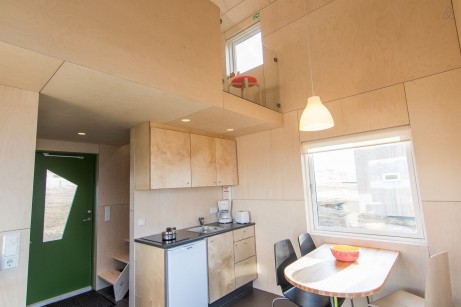
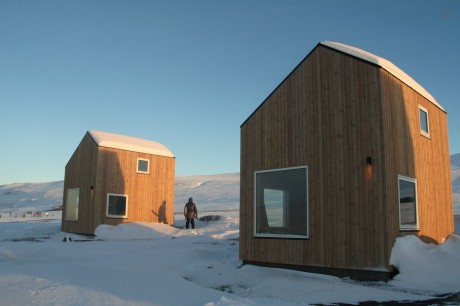
A reader sent me this Airbnb listing featuring three identical tiny cabins available to rent out. Located in the roaring metropolis of Sunnuhlíð, Iceland, these tiny houses look like the perfect place to read, use as a launching pad for sheep shearing tours, and staring out into the distance.

icelandiceland-livingiceland-loft iceland-snow

HT to Sunnuva

The Chicago Bungalow

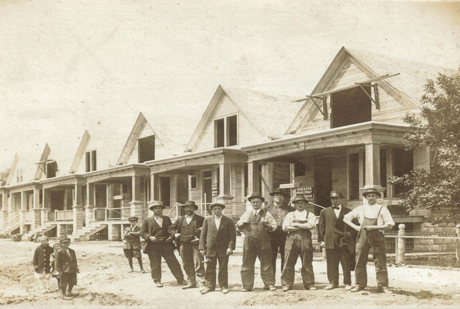
In the early part of the 20th Century, the United States experienced a surge of housing demand from upwardly mobile first and second generation immigrants. Fueled by incomes that exceeded their previous subsistence levels, these people were after something more comfortable than their previous cramped urban quarters. At this point in history, cars hadn’t quite hit saturation levels (in 1930 there were 2 : 10 cars/people versus 8 : 10 today). As such, these new, comfortable homes had to be densely laid out so people could get to work via bus and streetcars. One supply solution to this demand came in the form of the Chicago Bungalow–a modest, solidly-built, densely laid out single family house that spread throughout the midwestern city’s borders.

bungalow-interior

Between 1910-1940, 80K bungalows were constructed in Chicago. According to the Historic Chicago Bungalow Society, these homes had several distinguishing features such as having:

  • One and one half stories
  • Brick faces with stone trim
  • Low-pitched roof with overhang
  • Rectangular shape: narrow at the front and rear ends, longer on the sides
  • Generous windows
  • Full basement
  • Offset front entrance, or side entrance

Measuring roughly 1200 sq ft, the family-focused Chicago Bungalows were fairly uniform in dimension, yet they had aesthetic variations such as differing brick color and unique decorative windows that gave each unit its own personal character.

gladstone

Because they sat on long, narrow 125’ x 25’ lots, which included small yards, aforementioned populations were able to stay relatively close to city and industrial centers. Incidentally, my mother, whose father worked in the railyards, grew up in a southside bungalow along with my uncle and grandmother (before they were known as such).

bungalow-historic

In contrast to today’s single family home, whose girth has grown beyond 2600 sq ft for the average new single family home, the Chicago Bungalow was (and still is) an exercise in modesty, practicality, quality craftsmanship and solid urban planning. As I’ve said many times before, the past often holds the key to the future.

Images via Historic Chicago Bungalow Society

Whose Life Are You Living?

Are there things that concern you more than your time?

Jack Johnson

This site often features things like cool design, architecture and demographic trends–novel, interesting things, but ultimately things that hint at important things. At our heart, LifeEdited is about an existential query. Beneath the cool designs and analysis is the fundamental question: “What will we focus on during the life we have?” We want to ask whether we are going to focus on stuff we find important–relationships, experiences, health, contributing something unique to the world? Or are we going to focus on stuff that might not be so important–jobs just kept to pay for a house that’s bigger than we need, time spent doing excessive cleaning, reading inane top ten lists on the internet and so forth (you can make your own lists). If we find ourselves spending more time in the latter category than the former, might we be able to edit some of the unimportant stuff out of the narrative of our lives?

A few months ago I wrote about unMonastery, an activist collective that uses disused real estate to provide free lodging; they want to give people the ability to pursue endeavors free from economic concern. As I mentioned back then, the question “what would you do if money was no object?” can be a threatening one for many of us. We might not even deign to answer it lest it create too much dissonance between the answer and how we are currently living. But just because the question is not asked doesn’t mean there’s not an answer. The answer is there if we take the time to ask and answer.

Today, take three minutes to watch this video by writer and philosopher Alan Watts. In plain language, he describes the absurdity of living a life in pursuit of money and the expectations others have of you. Moreover, how this way of life can set forth patterns of behavior for generations to come.

I don’t think the implication of Watts’ statements is that course correction is a simple or easy thing. Merely that living a life that is not aligned with who we are and what we find important is not a path to living a happy, meaningful life.

Get Your Life on Track

I’ve covered more than my fair share of compact, mobile homes. More often than not, the mobility is expressed on pavement, whether the home is affixed to a bicycle, a truck chassis or being towed around by an automobile. Very rarely–as in never–have I featured homes that move on old shipyard railway tracks. But that’s exactly what I’m doing today with the aptly named “Small House on Tracks” project by Polish architecture students Tomasz Zablotny and Paweł Maszota.

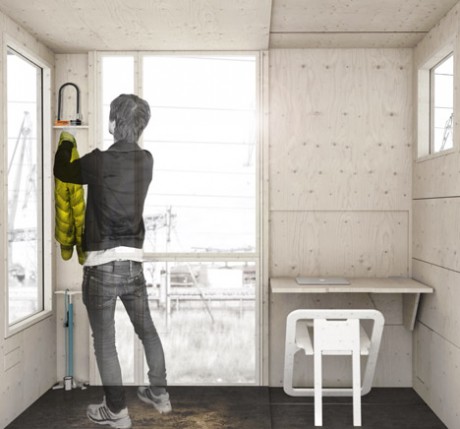
Small-House-on-Tracks_Tomasz-Zablotny-kitchen Small-House-on-Tracks_Tomasz-Zablotny-office

SMoT (my acronym, not theirs) is actually not meant as a universal housing solution, but rather a site-specific one for the Gdańsk Shipyard, a decaying industrial center that the project’s creators want to help revitalize into an artist colony.

Small-House-on-Tracks_Tomasz-Zablotny-bathroom

The “houses” are actually expandable housing units, each fulfilling a different role. The units only measures 5’ W x 6.5 L x 8’ H, all the easier for moving on a truck bed or storing when not needed. They are filled with flat packing furniture that folds into the wall.

Zablotny told Dezeen that they are not necessarily meant for full time residency, but rather to provide “comfortable space[s] for artists, interns, workers or simply those to whom the unique atmosphere of the site would appeal.”

I’m not exactly sure how SMoT would have appeal beyond temporary housing in old, disused industrial complexes–of which there are a few, particularly in Europe and the US, which are no longer manufacturing powerhouses. But I’m a sucker for housing that can be expanded and contracted according to the needs of the day.

See and read more on Dezeen

New Startup Offers Rent-a-Tiny-House

As I brought up a few weeks ago, there is a real need for more small, inexpensive vacation homes, ideally ones that are easily accessed by city-dwellers. City life can be a real grind. Without some sort of retreat, it can be unsustainable. Well the gods have heard my plea. Actually–as is more often the case–a group of Harvard grads heard my plea (but aren’t they the same thing anyway?). Headed by MBA student Jon Staff and Law School student Peter Davis, Getaway House provides an attractive, affordable, off grid tiny house for “folks looking to escape the digital grind and test-drive tiny house living.”

KATARAM_Kitchen

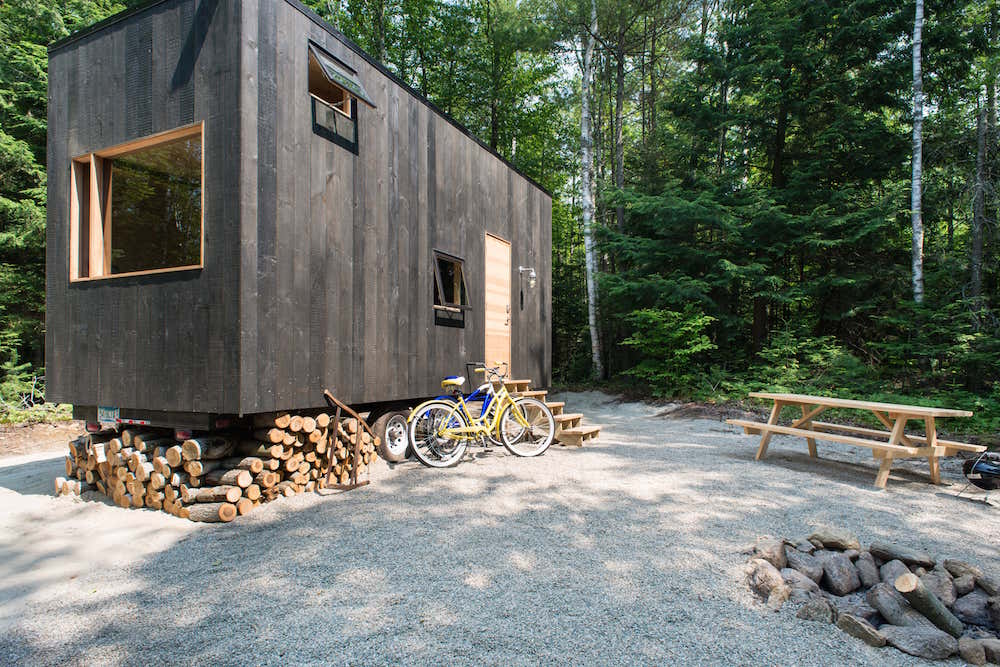
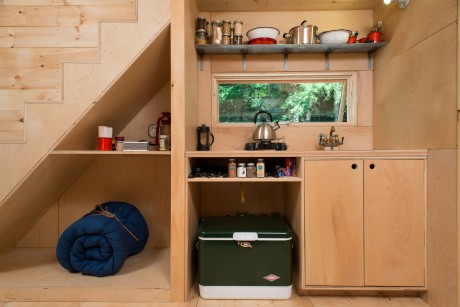
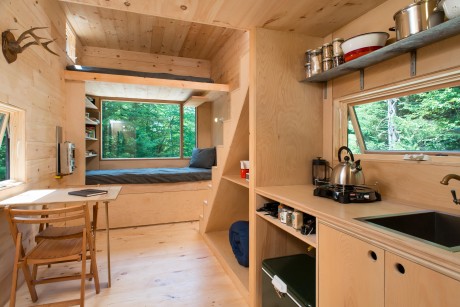
There is currently one completed Getaway House that is available to book by the night. It is dubbed “Ovida” and is located within two hour driving distance from Boston. The place was designed by a group of Harvard Design School grads. This elite-institution provenance shows through in its design. Both its modern interior and exterior are clad with attractive rough cut pine. The interior features built in furniture such as a table that doubles as a window cover and two built-in beds, giving the place capacity to sleep four. All electricity is solar, the toilet is composting and water is handled via a 110 gallon water tank that is refilled via the host house the tiny house shares its land with. Bookings also include fresh linens and available “provisions”–a sort of backwoods mini bar with things like coffee, trail mix, pasta, etc (these cost extra). Ovida is available for a reasonable $99/night for double occupancy.

KATARAM_Inside

Another Getaway House, dubbed “Lorraine” will be available mid-August and they are already taking reservations. A third house is due out in early September. Staff and Davis raised a bunch of money to build the houses with the goal of making them into a replicable model, providing both affordable, sustainable urban retreats and income generator for property host.

Getaway House is actually the first initiative of a project called Millennial Housing Lab, which, somewhat along the lines of what I wrote about yesterday, is trying to develop and realize “fresh housing ideas for a new generation,” focusing “on all sides of the housing experience: architecture, neighborhood design, financing, regulation and community-building.” As I’ve mentioned time and again, for all the hype surrounding tiny houses, micro-apartments, micro-suites and other creative forms of housing, market and regulatory forces often stand at odds with bringing these things into being. While Getaway House is ultimately a tiny vacation cabin, it is also another small step in making tiny, low impact housing a viable housing option for more people.

Millennials, Micros and Why Hannah Horvath Probably Couldn’t Afford to live in Brooklyn

If you watch the HBO series “Girls”, you know who Hannah Horvath is. If you don’t watch it, Hannah is an underemployed writer and substitute teacher living in one of Brooklyn’s hippest neighborhoods. Her life is filled with all sorts of interesting (albeit melodramatic) experiences and friends. She eschews cars for a bike. She wears weird clothes and is covered with tattoos. Because of her underemployment, urban leaning, experience loving, bike riding lifestyle, the character is held up in the media as the archetypal urban Millennial. Yet she is a mythical creature. In reality, Hannah would be cast out to Rochester or Indianapolis or some other city whose cost of living is in line with her income. Even with parental support or a roommate’s or Adam’s money, it’s unlikely she could afford the decent-sized two bedroom apartment she keeps throughout the series.

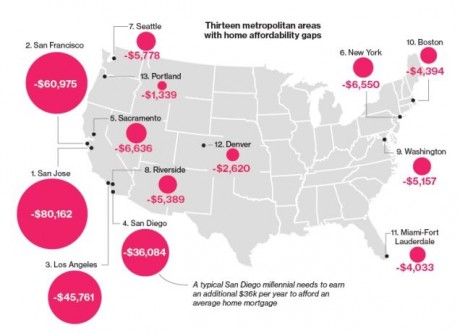
On this site and many others, people have been quick to define Millennial preferences, which fall along the lines of Hannah’s. They like cities, Instagram and experiences; they dislike suburbs, cars and stuff. Some of these stereotypes might hold a lick of truth, but they miss cold, hard economic realities. Through a combination of astronomical rents and stagnant wage growth in many professions, many–if not most–Millennials are being priced out of today’s major cities. A recent Bloomberg story highlights this well, showing that 13 of the US’s major cities are profoundly out of reach for the average Millennial. For example, the average San Franciscan Millennial would need to pull in an extra $60K a year to afford the city’s average home mortgage. Of course there are rentals, but that scene is just as bad. The city’s median rent is $4,225 month.

millennials-housing

So if they’re not living in Greenpoint or the Mission, where are they living?

Sometimes I am guilty of creating a polarity, where people either choose to live in the city center or far afield in the suburbs. But this is not an accurate polarity. There are many stops between city center and cul du sac, and a recent article in Gizmodo by Alissa Walker describes some these stops, particularly as they relate to Millennial migratory patterns.

Walker reports two major trends. First, is the urbanization of the suburbs. She says that Millennials are “looking for amenities like walkability and public transit,” but according to an Urban Land Institute study, they are more concerned about “relationships and having the time to enjoy those relationships, which doesn’t necessarily mean working long hours to pay the rent in a big city.” They want the benefits of the city, but they are not necessarily committed to living in one.

As such, Millennials are creating what one writer called Urban Burbs. Walker writes:

Millennials might not be staying in the urban cores, but rather, they’re helping to remake the urban-like enclaves that allow easy access to the city when they want it. These places where millennials are choosing to live still have the qualities of downtowns—dense housing, transit connections, walkability, good food, great bars—without the high prices of downtowns.

She points to a couple examples in suburban Chicago (my birthplace for what it’s worth), where smaller, amenity rich rental apartments are cropping up in places that have been traditionally the strongholds of mortgaged single family home suburban living.

The other trend Walker writes about is the revitalization of smaller, affordable cities like San Antonio and Milwaukee. This is a trend I’ve noticed in the micro world and reflected in my post about how micro apartment buildings are sprouting up in smaller cities. I get Google alerts for micro-apartment news and for every alert about a micro apartment building going up in New York and San Francisco, there are ten going up in smaller places like Des Moines, Kalamazoo and Buffalo.

A Bloomberg article entitled “Micro-Apartments Are Coming to the Midwest” apparently sees what I see. While cities like Columbus and Omaha might not be space starved like NYC, Millennials, looking for an apartment are willing to forsake size for a good location and low price. This consumer desire is abetted by developers who can charge more per square foot (though this is not a perfect formula as sometimes micros can cost more to build on a per square foot basis). This passage from the article to my mind sums it up:

In that light, the shift toward smaller apartments can be seen as simple economics: Smaller apartments are more profitable for developers to build and more affordable for tenants to rent. “I could paint a cooler picture about value of design, efficiency, and all of that,” says Alexander Grgurich, a development analyst at Nelson Construction & Development, which converted a century-old office building in Des Moines into 425-square-foot apartments in 2013. “For us, it’s about getting a higher price per square foot while offering a lower absolute rent to the renter.”

The same appeal of offering an attractive, albeit small $2000 micro apartment in Boston versus a $2750 conventional studio is equally recognized when the price delta is $750 versus $1000 in a city like St Louis.

[divider]

I moved to New York when I was roughly Hannah’s age. I paid around $650/month to share an illegally subdivided Williamsburg duplex with four other people. It seemed outrageous at the time because I had just been paying a few bucks more for my own one bedroom in Colorado. But I suspect most Millennials moving to the city now would kill for a deal like mine.

On the one hand, I feel a certain pity for all the young people who cannot feasibly live in these exciting global cities (and I’m sure there are many not-so-young folks getting priced out as well). On the other hand, I’m a little envious. Particularly in some of the smaller cities Walker mentions, there seems to be vital cultural movements afoot. Arts and small businesses are flourishing. Young people are riding their bikes everywhere because they have the time to do so. They are doing many things they couldn’t if they were scrambling to make rent payments. Millennials, whether living in a low cost micro apartment or shared house or somewhere in between, are creating edited lives by virtue of will, not history and infrastructure.

Image credit: HBO, CRAIG BLANKENHORN