These NFL Players Tackle People, Conspicuous Consumption

Forget what you think you know about NFL players and their glitzy lifestyles with mountains of bling, big houses and fast cars. There is a new breed of player, one who is an exemplar of restraint, modesty and frugality…well, if you base the character of the league on two of its roughly 1700 members. Like the story I reported on a few months back about Daniel Norris–the rookie Baseball phenom who chooses to spend much of the year living very minimally in a VW bus–there are a couple (perhaps outlying) NFL players who are showing another, more sensible way of handling fame and fortune.

The first is John Urschel, a 6’3”, 308 lb offensive lineman who signed a $2.3M rookie deal with the Baltimore Ravens. If Urschel’s name sounds familiar and you’re not an NFL fan, it might be because he co-authored the well-known paper, “A Cascadic Multigrid Algorithm for Computing the Fiedler Vector of Graph Laplacians.” You see besides being a talented player, Urschel is a gifted mathematician with bachelor and master’s degrees from Penn State. This faculty with numbers might be something that gives him a leg up in devising a sensible financial plan.

john-urshel-car

When other players happen upon their newfound wealth, they tend to gravitate toward extravagance. Not Urschel. Rather than blowing all his cash, he’s living on $25K a year. Rather than getting his own pimp crib, he got a roommate. Rather than buying a car with eight cylinders or more, he got a profoundly practical Nissan Versa hatchback–a used one no less.  

Ryan Broyles

Like Urschel, Ryan Broyles is living la vida modesta. In 2012, the Detroit Lions wide receiver signed a contract for $3.6M over four years (NB: I realize wide receivers don’t tend to tackle). Rather than being a prompt for shopping sprees, Broyles put himself and wife on a $60K annual budget. Rather than decking out his house with fancy furniture, he made his own. Rather than buying Maseratis, he and his wife bought Mazdas.

Ryan-broyles

Like Urschel, Broyles seems to grasp the tenuous nature of life in the NFL, where injury or team cuts can strike at any moment. In fact, Broyles has the majority of his money in investments, retirement savings and securing [his] post-football monetary future,” according to ESPN. While one could consider these players restraint as self-interest, few players–as Broyles well knows–exercise such restraint. Many a fortune has evaporated as quickly as it came into existence.

I like to think that these guys as well as Norris, Zappos.com’s Tony Hsieh and Paris Hilton (well, maybe not her) are showing a new type of celebrity–one that celebrates responsible consumption, folks who buy what they need, not everything they want.

Future and Past Experience Small Architectural Collision

I’ve long expressed my enthusiasm for clever renovations of old spaces. The fact is that even though new buildings might seem like the future, most of the architectural future was built in the last 150 years. In other words, many of the buildings we see today will be there tomorrow. So it makes sense to devote intellectual, material and financial resources toward incorporating future-based thinking into old spaces. The Darlinghurst Apartment in NSW Australia by Architect Brad Swartz is a nice example of such an allocation of resources. It takes a tiny, old space and injects it with a cutting edge design, making it ready for infinity and beyond.

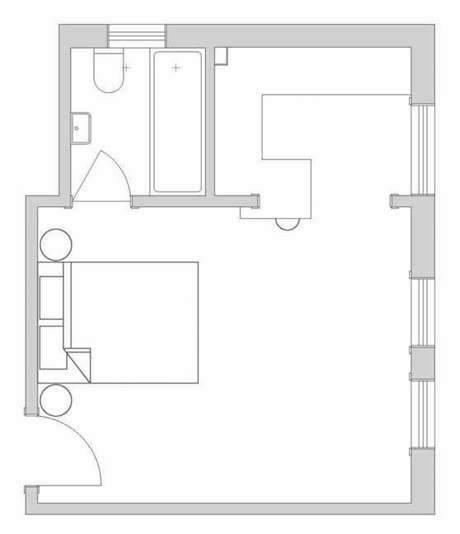
The 290 sq ft space was intended to be suitable for a single person or couple. The original layout had a bed in the main room and the kitchen in an adjoining nook. Swartz reversed these positions, placing the bed in the nook and leaving the main room open for a sofa, dining table and kitchenette. 

 darlinghurst-apartment-original-floorplan

darlinghurst-apartment-new-floorplan

Dividing the sleeping nook and main area is a bank of cabinets with sliding doors that either conceal the cabinetry or close up the bed and bath rooms. A door opens on the cabinets to reveal a small desk. 

The decor is a minimalist’s dream, with a sofa, table and a few stools being the only non-built in elements of the space. Though there are additional cabinets in the bedroom, the sum total storage is not hoarder-friendly. There is a wine cabinet, making it strangely oenophile-friendly.

See and read more on Archdaily

HT to Steve S.

Breakdowns, Adventure Guaranteed

About a year ago, I wrote about Foster Huntington, a twenty-something who ditched his corporate design career to become a full time van-dwelling nomad. Inspired by Tupac Shakur’s Thug Life tattoo, Huntington created the Instagram hashtag #vanlife–a small act that inspired a movement of light-living, full and part time vandwellers (there are almost 300K Instagram pics with the hashtag).

The Atlantic made this great little documentary that provides a deeper look at the #vanlife subculture. While the doc catches up with Huntington (stationed in his bitchin treehouse), it spends most of the time interviewing Ryan Sellmeyer, aka @poseidonsbeard. Sellmeyer, his wife Christina and their two small children spend months on the road, rendezvousing with folks they meet through the Instagram hashtag #vanagonlife–a subset of the #vanlife community who drive (mostly vintage) VW Vanagons, a vehicle where regular mechanical failure is pretty much assured. Rather than an unfortunate side effect of an otherwise awesome vehicle, the breakdowns seem to be the primary appeal of the vehicle, ensuring none-too-rushed journeys and the ingenuity and camaraderie that are necessary to address said breakdowns.

Sellmeyer and Huntington’s lifestyles are nice counterpoints to the prevailing trends of bigger, faster, more efficient. These folks seem to value languor and connection for connection’s sake. It’s also a nice case where technology facilitates real connection and deeper experiences rather than inhibiting them. Do yourself a favor and spend the 12:34 minutes and watch the documentary.

This Contraption Saves Counter Space, Dish Towels, Time and Maybe Even Lives

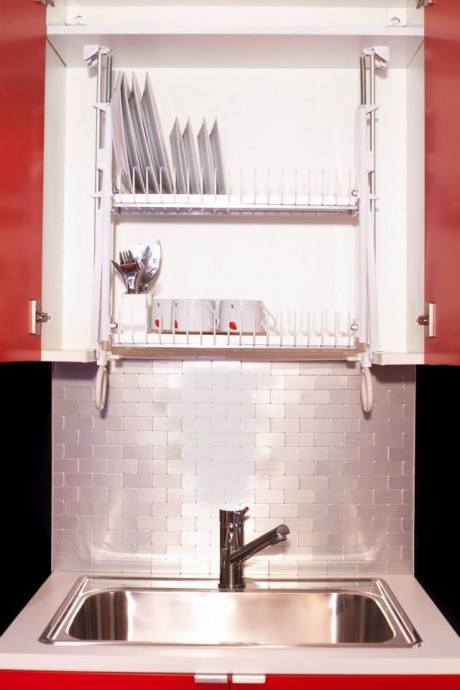
One of this site’s first very posts featured a dish drying rack that sat above the sink. The rack served as both drying rack and dish storage, eliminating the need for counter hogging conventional drying racks. It’s such a profoundly logical design, it’s a wonder why it’s not a standard feature on all kitchens. And if it weren’t for the corrupting influence of the industrial-drying-rack complex, it surely would be. But one rebellious company called Drip Dry is fighting the powers that be, making some nifty, cabinet ready drying rack kits, hopefully auguring the demise of the tyrannical reign of counter-based drying racks. (NB: In writing this post, I found out that these type of drying racks are pretty common in Europe and beyond).

The Drip Dry Classic (DDC) is constructed of antimicrobial plastic and can be installed into most any framed or frameless cabinets with minimal fuss. The whole assembly slides up and down along stanchions for easier access to dishes. The whole assembly runs a very reasonable $119.

drip-dry-rack-up

A representative told me that they are also planning a version with stainless steel frame and a slightly different mechanism, where the top rack will pivot forward and down. She told me it will be available in about four months. In the meanwhile, she assured me the DDC, which was originally conceived in Israel, is plenty durable and she has seen models that have lasted for 50+ years.

Ben Franklin wrote, “Do not squander time for that is the stuff life is made of.” And really, who wants to squander their time, and by extension their lives, drying and moving dishes around? Find out more info at Drip Dry’s website.

Via Livinginashoebox.com

Can Tech Combat Tech Addiction?

There is a new software system called Phylter developed by a group of scientists at Tufts University. Phylter is meant as an accompaniment to wearable tech, which poses the risk of non-stop notifications of texts, emails, twitter updates and the like. The software uses functional near-infrared spectroscopy to monitor brain activity, which detects whether you’re deep in thought. The system restricts notifications accordingly–if you’re deep in thought, it’ll cut off notifications; if you’re not deep in thought, it’ll send away. As said in New Scientist, you could use the excuse, “SORRY I missed your call. My brain said I was busy.”

It’s a nifty and logical idea, one that is meant to fight the scourge of multitasking. PSFK reported that a study found multitaskers “reported twice the anxiety, committed twice the number of errors, and required up to 25% longer time on a primary task when interruptions arrived during rather than in-between tasks.” As has been said, “Multitasking is the act of screwing up multiple things at once.”

But will Phylter work toward stopping our technology-aided multitasking tailspins? Speaking more broadly, can any technology effectively limit our use of technology?

My experience is no. I have tried to block out sites or web access using the Self Control and Freedom apps. I have tried RescueTime, which monitors web activity, thereby cultivating awareness of my multitasking ways. All of these systems yield the same initial enthusiasm and burst of focus, followed by a cessation of use and/or ignorance of results.

To me, using these apps feel like going on a diet where I’m always resisting the urge to do things that compromise my health and happiness. But if there’s a bag of chips in the house during my diet, I tend to eat them. Likewise, if I want to be distracted and there’s the means to do it, I am going to.

In general, the best way for me to avoid technology is by not having it–either leaving it at home (which, frankly, usually happens by accident), being fully engaged at some event or being out of cell/wifi range. The other method–the one that works most consistently and is most feasible given my professional tech dependence–is not starting down the multitasking path at the beginning of the day. Just as it’s easier for me to eat no chips than it is to eat one, it’s easier for me to never indulge multitasking than it is to reign it in.

But that’s just me. What do you think? Can certain technologies effectively combat the multitasking that other technologies often incite? Have they for you? Let us know in our comments section.

Do You Buy Stuff to Feel Accomplished?

I spend a good deal of time outside and since it’s typically sunny in New York (it really is), I usually wear sunglasses. And when not in the sun, my sunglasses are either on my head or hanging from the collar of my shirt–perfect locations for either of my two boys to grab and throw onto the ground (don’t suggest a strap. I tried one and they either strangled me with it or tore the glasses off the strap, sending it to the ground all the same). My lenses are fairly scratched up right now–not horrible, but they need to be replaced sooner than later.

This morning I was looking at my to-do list feeling a little overwhelmed. There were long-term projects where I felt stuck. There were several tasks that require phone calls or lining up other people or putting together materials before I can even begin to check them off the list. But then I saw it: “buy lenses.” Stop everything. I could accomplish that!

I once went to workshop that taught me how to use the Franklin Planner. One of the most basic tools of the planner is prioritization. Tasks are assigned one of three values: A, which is urgent and important (think deadline tomorrow and putting out fires); B, which is not urgent but important (think working on that novel that doesn’t have a publisher yet); and C, which is not urgent or important (think rewatching the Godfather Trilogy). There are nuances inside these assignations and some include “Urgent but not important,” but that’s general overview.

In the context of my life, buying lenses was a solid C. They’re scratched, but I can see quite well out of them. Yet I felt the impulse to put the purchase ahead of many A’s and B’s.

The reason I, and many of us, prioritize shopping might be neurochemical. Studies have shown that shopping–impulse shopping in particular–releases dopamine, a neurotransmitter associated with feelings of pleasure and satisfaction released when we experience something new, exciting or challenging. In other words, our brains might use purchases as a proxy for real accomplishment. Why climb a mountain or help a friend when we can buy some NOS high flange Campagnolo Nuevo Record track hubs? And unlike those difficult-to-accomplish things, shopping requires little skill or preparation. All we need is money…or credit.

The trouble is the sense of accomplishment doesn’t last. When the dopamine wears off, we want to re-up, which is how compulsive shopping is perpetuated.

Now I shouldn’t oversimplify the topic. Most readers of this blog are not likely to be compulsive shoppers. And not all purchases are made at the behest of neurochemical impulsive desires. Or if they are, they are alloyed with genuine need. Sometimes we just need to buy stuff and it might happen to feel good–neurochemically that is–to buy this needed stuff. I felt pretty good after we bought our apartment–a purchase that was the antithesis of impulsive.

But even the most ardent minimalist can find him or herself obsessing about a purchase–whether it’s the perfect pair of shoes or a composting toilet. In those moments, it might be good to remember that we could be in the throes of our physiology. It might be time to step back and remember that rich, meaningful lives are seldom defined by purchases made (and no, I don’t think Imelda Marcos counts). They’re defined by the relationships we tend, the contributions we make, the experiences we have–things that might not be acquired with one-click shopping, but things have a far more enduring impact on creating lasting happiness.

August_0802 / Shutterstock.com

It’s All About the Benjamin

There’s a subject in many of the posts I write about that is present but not always called out by name. The subject is money. Time and again, we read stories about people editing their lives, not just because they want to create a smaller carbon footprint and have less to clean and manage. These are very valid reasons, but let’s face it, most people downsize and simplify because it’s cheaper. When life is cheaper, when the base of Maslow’s hierarchy of needs is satisfied, people are less concerned about making money, leaving them time to think about loftier pursuits than paying the bills. Canadian Ben Hayward is an awesome example of such a downsizer. For the last year, Ben has been living frugally out of his “Hobbit Mobile” traveling around Europe, training and competing to pursue his dream of being an Olympic kayaker.    

Before his current journey, Ben was already an accomplished athlete. He’s ranked Canada’s #1 solo whitewater kayaker; he’s occupied a spot on the national team for the last nine years; and he’s amassed 47 gold medals in national games. Yet he wanted to go even further and compete in the 2016 Olympics in Rio. In order to be better prepared, he realized he had to go live in Europe where the best training opportunities existed.

While the Canadian government offers a small stipend to their team members, it wasn’t enough to pay for the myriad expenses that come along with training and traveling–hotels, food, race entry, coaches, etc. Most people in his position accept that they will go into debt to pursue their dreams–something Ben told me he was willing to accept as well if it came down to it.

DSC04632

But Ben had another solution. As if his resume weren’t impressive enough for his 25 years, Ben is one year away from completing his architectural undergraduate degree. In thinking about how he could live cheaply in Europe, he conceived an idea to build his own traveling home that could also exploit his architectural chops. With the help of friend Adam, he conceived the Hobbit Mobile, a tiny house on wheels, which would allow him to live simply and frugally while he traveled and trained all across Europe.

Rather than spending his entire $5K nest egg on the van, Ben decided to crowdfund the construction of the Hobbit Mobile. In his “Van Starter” campaign, Ben managed to raise $16K, paying for the van’s entire construction (you can still contribute to his pursuits).

IMG_6030

The van is built on a durable commercial vehicle frame and has what Ben called “Wallace and Gromit” (and Shire) style to it. There’s a lounge area, a lofted bed and a kitchen to prepare the 5-6K calories of food he consumes in a given day. With passenger space for six and room for 11 boats (gear is stashed inside the boats), he’s been the occasional taxi and/or hotel for his teammates. The house has solar arrays for power and there’s a copper cauldron for storing water, which also has a heating element at its base for generating hot water. Ben uses the bathrooms that are present at all of the training facilities where he camps.

ben-hayward-interior-2

All of this not only allows him to keep expenses minimal, but it simplifies his life. He said that because he knows where he’s going to eat and sleep, the van affords him a lot of mental space that his teammates who are constantly making room and board arrangements might not enjoy.

Ben told me there are numerous other benefits of living in the van. “In a normal house, it’s so easy to plug stuff into a wall and pay later,” he told me. “It’s been really cool to be self-sufficient and be connected with power useage, prioritizing what I need to use power for.” He also says that he loves spending so much time outside. “Living in a small space makes you go outdoors, which I believe is better for the human psyche. Living in a conventional house, it’s so easy to spend most of your life trapped inside.”

Because his overhead is so low, Ben can make ends meet with his stipend and a few sponsorships. He has strung together some impressive results recently, entering the finals at the World Cup in Spain last week and earning a bronze medal at the Pan-Am Games a month ago. But he’s mostly focused on training for the World Championships, an Olympic qualifying event, that goes down in about a month.

“From an external view, it seems like a poor lifestyle,” he says of the rather spartan way he lives. “But the quality of my life is very high,” he assured me. Though not everyone would choose to live as he does, he believes the downsized, minimal way of life is hardly limited to single, male, Olympic caliber kayakers. By paring down to the necessities, keeping expenses low, spending lots of time outdoors, the life that you would dream of living might not be as far out of reach as we think.

Keep up with Ben on his website and Instagram.

To Fix or to Replace?

If most of us are ashamed of shabby clothes and shoddy furniture let us be more ashamed of shabby ideas and shoddy philosophies….It would be a sad situation if the wrapper were better than the meat wrapped inside it.

–Albert Einstein

For the last several months, I have had a small crack on my two year old iPhone 5’s glass. Following an unexpected trip to the floor (glass side down) a few weeks ago, the small crack became a full on shatter. A couple days ago, the shattered pieces started falling out, leaving me with small glass shards swimming around my pocket. I went to the local mobile store to get it fixed. The clerk told me that a screen replacement would cost $75. I asked how much a new phone would cost. He said given that I was eligible for an upgrade, a 5S would cost $99 and a 6 would be $199. He also said he’d give $30 trade in value for the old phone. In other words, the 5S, which represents an upgrade from my first gen 5 would cost $5 less than getting my old phone’s screen replaced.

Now let me back up: aside from my screen and some issues with its battery life (issues that could always be handled with a modicum of foresight), I have no problems with my phone. It still occurs to me as a technological marvel. Even though it’s only 16 GB, I haven’t had any particular issues with storage. It has some superficial scuff marks on its aluminum, but these do not impact the performance whatsoever.

I weighed the pros and cons of replacement and fixing:

  • Pro replacement: cheaper by a few bucks; better battery according to sales dude; shinier, newer, thus inflating self esteem and esteem from people who care about having shinier, newer stuff.
  • Con replacement: I’d have to re-up my two year contract and use my once-every-two-year upgrade upgrading a perfectly good phone; I would be sending another perfectly usable phone to an early death, adding to the already-monumental amount of e-waste created we as a society produce.
  • Pro fix: not having to commit to two year contract; not using upgrade; not sending phone to premature death and creating unnecessary e-waste; not feeding into a culture of incessant upgrading and idealization of the new and unused.  
  • Con fix: not having latest and greatest (though the 5S, which is probably what I’d get, is no longer the latest or greatest).

Given these considerations, I am fixing the screen. The money is negligible. A better battery would be nice, but not nice enough to outweigh the other reasons not to upgrade. More than anything, doing a premature upgrade, to me, means submitting to the spurious logic of planned obsolescence and throwaway culture.

One of the concepts I have helped promote on this site is that we fill our lives with only the stuff we love and cherish. Sometimes this concept is misconstrued as living in some Dieter Ramsian ideal, where the few things that are left in our possession are immaculate. All furniture is clean and modern, all clothes fit perfectly and are plain and stain-free, all electronics are up-to-date. But this is an unrealistic, and often harmful, ideal. It’s one that can result in a “minimalist” sending as much stuff to the landfill as anyone else–not to mention depleting his or her bank account unnecessarily.

Rivendell Bicycle Works Grant Petersen coined the term “beausage”–a mashup of the words beautiful and useage. While he applies it to cool, often custom bikes, the term can apply to everything we possess. These are items we care for and maintain the best we can, but that also undergo the inevitable effects of age and use. If we can see things this way, we can see how an edited life can include the used, beat up and even outdated.

Tour Yesterday’s Future Architecture Right Now

I’ve long expressed my affection for the Nakagin Capsule Tower. The 1972-built residential tower, located in the Ginza district of Tokyo, was a daring expression of the Metabolism architectural movement. Each tiny, prefabricated unit was self-contained, fully furnished and affixed to a central spine. The units were meant to be easily attached and detached from the spine for upgrades and reconfigurations. Unfortunately, the building was fraught with design and engineering problems–constant leaks, poor circulation in the units and so forth. And today, the building lies semi-derelict, ever in danger of feeling the crush of a demolition ball.

Fortunate for us, Kirsten Dirksen from Fair Companies got into the tower before it’s gone forever. Guided by Masato Abe (who, incidentally, rents out capsule units on Airbnb. Dirksen actually stayed there with her husband and three girls), she gets an in depth look at the building and its amazing level of detail. Abe also gives a nice explanation of how its creators thought it would be used.

There’s been a recent resurgence of multi story, prefabricated urban skyscrapers (some micro), but their level of design daring pales in comparison to Nakagin (many, like Brooklyn’s B2, have been similarly fraught with engineering hiccups). And while the Capsule Tower was far from an unbridled success, I hope it will continue to inform the shape of urban architecture for years to come.

Via Fair Companies

Data Driven Living

One of this site’s all time most popular posts is entitled “Residential Behavioral Architectural 101.” In it, we show that many families use a small fraction of their home’s usable area, leading to the question, “How would you design a home if based on your behavior, not architectural convention?” The implication being that we would, in all probability, design a lot smaller than the supersized norm.

But what if we allowed data to inform, not just how we design our homes, but how we design our lives? How would we live if we let data be our guiding force, rather the forces of: A. This is the way I’ve always done it, B. This is the way my parents/family have always done it, C. This is the way everyone else is doing it, or D. Some other non-data-related rationale?

Now let me be quick to say I’m not talking about controversial things like whether you should be a Believers or a non-believer, a Republican or Democrat or even whether you should live in a city or in the burbs. I’m talking about basic stuff. Stuff where there’s a hefty body of data to suggest that yes, this is something you should do frequently, because it will improve your life in tangible ways (feeling better, happier, living longer, etc).

If you’re anything like me, you probably do a lot of stuff that flies in the face of data. I do things that I know–both intellectually and experientially–that make me feel like crap. These behaviors are often rationalized by excuses such as:

  1. I’m going to do it this once because I had a hard day.
  2. It’s okay. I should go easy on myself.
  3. Screw it, live a little.

Of course, all of the above excuses are BS. Let me illustrate why. First, staying up late watching TV, cutting into my sleep is why I had a hard day–not the remedy for it. Second, getting regular exercise will make me stronger and give me more energy thus making things easier, while avoiding it gives me less energy, thus making my life harder. And third, “live a little?”–as if gobbling that piece of cake, setting in motion a massive sugar high, then low, is somehow the hallmark of a life well lived. Actually, it might be the hallmark of living a little, but what if I want to live a lot? Wouldn’t I care for my body in a way that reflected that?

A few days ago I asked myself these question and made a list of behaviors–either things to include or exclude–that are pretty incontrovertible in terms of their efficacy to improve life. I determined to incorporate these things into my life every day for a week, even if it was just in small doses. Here’s most of the list (follow links for more about the data):

On a practical level this looks like using an app to do 5-15 minute intense workouts at home, meditating 3-5 minutes once a day and choosing the kale salad over a bacon, egg and cheese sandwich at the cafe I work from. Baby steps. Perhaps the biggest benefit is a tingle of integrity–taking some comfort that I’m not knowingly doing things that undermine my health and well being.

My favorite quote about editing one’s life is still from 17th Century mathematician Blaise Pascal. He said, “I would have written a shorter letter, but I did not have the time” (or “Je n’ai fait celle-ci plus longue que parce que je n’ai pas eu le loisir de la faire plus courte”). Getting to the essence of something, whether it’s a letter or a life, is often a process of attrition, removing all that is not totally necessary. If you are wondering which things are removable, it’s important to check in with yourself, but there’s no harm in checking in with the researchers either.

Image via Shutterstock