Living La Vida Mínimo

America is number one….in terms of using too much space, buying too much stuff and using too many natural resources. But halfway across the world another sprawled-out, car-loving, former English colony gives us Yankees a run for our money in terms of maximalist living. As we’ve seen before, Australia has the world’s biggest homes and, unsurprisingly, they have their own issues with consuming too much. And now they are issuing their own revolt…against unchecked, consumer-crazed living (in fact, this month is “Buy Nothing New Month“). This short video points to a growing (or is it contracting?) minimalist movement in the land down under.

The video centers mostly on Brooke McAlary, who runs the minimalist blog slowyourhome.com. She expresses why she chose to become a minimalist and its myriad benefits. We also get a peek into her particularly suburban interpretation of minimal living. Brooke lives with her husband and two children in a not-so-small home. She has a yard and even a storage shed. But the house is sparsely, albeit tastefully, decorated, and their lives–at least in her telling–are free from many of the associated woes hyper-consumer living, leaving them more time for each other and more money for travel and other great experiences.

The video also interviews The Minimalists (aka Joshua Fields Millburn and Ryan Nicodemus) and Australians Mark Adam Douglass and his wife Jess. They all talk about their motivation to live more meaningfully and how living simpler lives with less stuff supports that. In a word, Millburn puts the movement best, saying “Love people, use things, because the opposite never works.”

Thanks for the tips Chelsea!

Via SBS

Small, Stylish Home Takes Over Garage

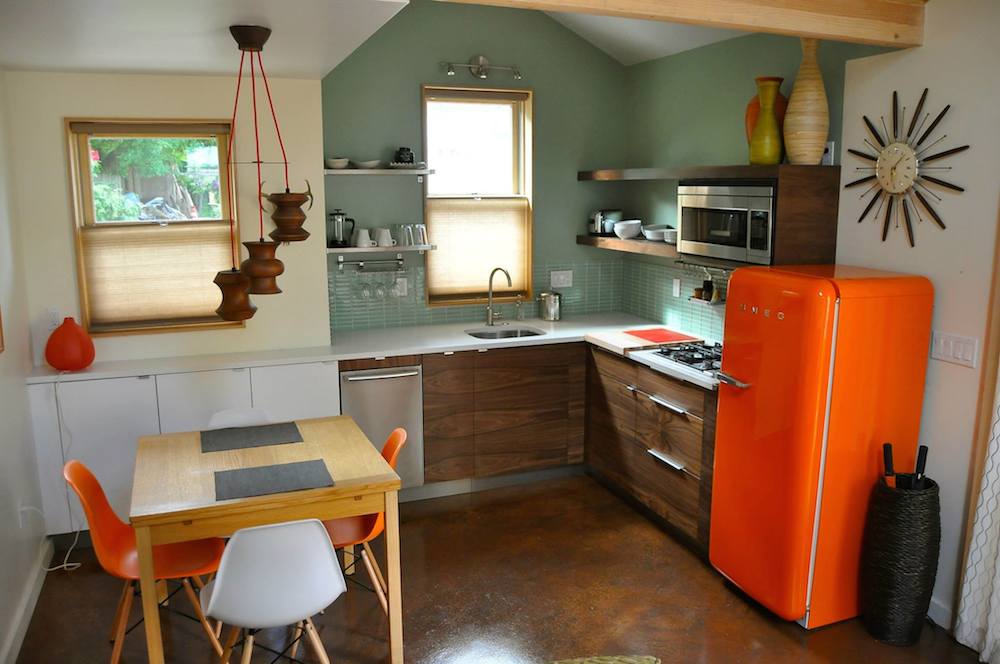
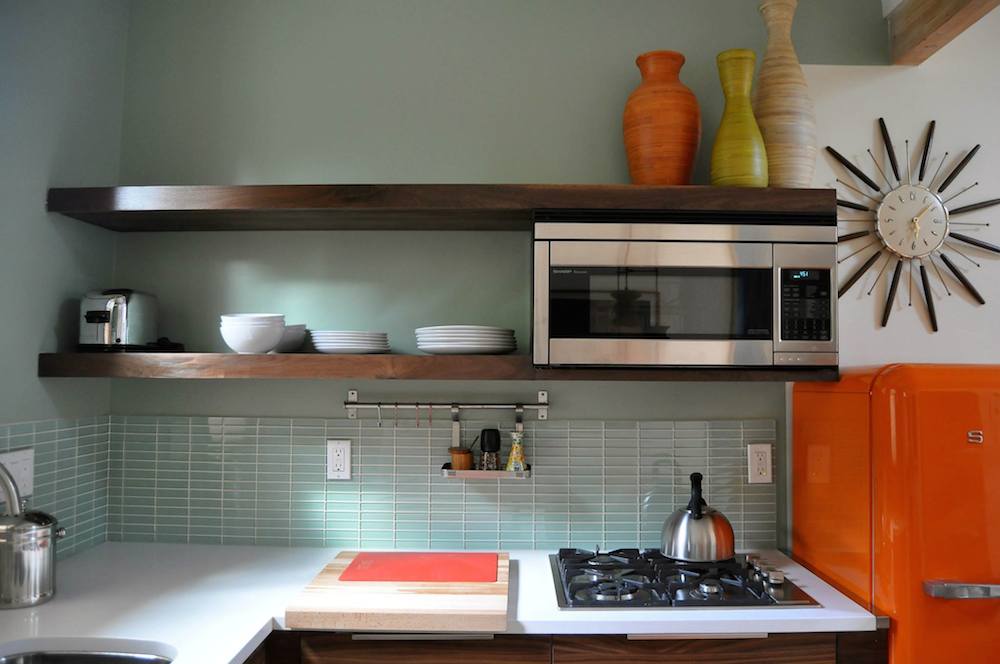
We’ve expressed our love of the accessory dwelling unit (ADU) in the past. To us, they represent a great solution for adding density to more spread-out, car-intensive, suburban areas–a vitally important conversation in the micro-housing world. We ran across this little Portland ADU on Tiny House Talk, which to us demonstrates how nice these little places can be. The 508 sq ft home, dubbed PDX Eco Cottage (not to be confused with the workout routine) began its life as a garage. With the help of Jack Barnes Architect, owner Susan Moray converted the space into a very stylish, usable, sustainable home.

The house features a full kitchen, bathroom and separate bedroom. It achieved an Earth Advantage Platinum certification, a point system that evaluates a home’s indoor air quality, responsible use of natural resources, land protection and low water usage. The whole project cost $110K plus quite a bit of Susan’s labor, according to Jack Barnes. While not necessarily cheap, it’s less expensive than comparable quality homes in the area (the cheapest thing we could find was $444K, though it was much larger).

Susan built the home using Portland’s new short term rental permit for ADUs and you can stay at the place as a vacation rental. She told us that she built the cottage with the idea of living there when she’s older, with her daughter living in the front house where she currently resides. The home seems more than adequate for full time residency and we hope places like this start punctuating suburban landscapes, providing sensible housing in otherwise underutilized spaces.

Via Tiny House Talk

Residential Behavioral Architecture 101

The above image was taken from an article in a Wall Street Journal article about the book “Life at Home in the 21st Century.” The UCLA group responsible for the book followed 32 middle class Los Angeles families around their homes, tracking their every move to see how people actually live nowadays. This image shows “the location of each parent and child on the first floor of the house of ‘Family 11’ every 10 minutes over two weekday afternoons and evenings.” In other words, primetime for their waking hours at home.

The activity on this floor, which measures around roughly 1000 sq ft, is concentrated almost exclusively in three rooms: The dining, kitchen and family rooms; the latter room’s activity focused around the TV and computer. We estimate that around 400 or so square feet of those 1000 are actually used with any regularity.

Family 11’s house is very typical in size, if a bit smaller than the average new home, which was 2,662 in 2013. For comparison’s sake, in 1950 that same number was 983 sq ft and there were, on average, about one extra occupants in each of those smaller homes as well.

While we don’t want to assert that there exists a correct house size for everyone, if this case study is indicative of how many/most American households use there homes, it begs a couple questions: Why are American homes so big? And what would homes look like if designed around how most people behave? It wouldn’t be hard to imagine that this Family 11 could easily live in half the space they currently occupy.

An article in the NY Times from a couple years ago called “The Big Shrink” illustrates how our homes might look if based on behavior, not convention. The Kelly’s, a family with two adolescent children who were profiled in the story, traded in their 3200 for a 1200 sq ft home (Pictured above. Built in 1954 incidentally). Like Family 11’s home, the formal living and dining rooms were barely used, less one family member, as Greg Kelly explains: “We had a dining room and a formal living room—that was where the dog lay on the couch, that was his room.”

We’ve often argued that micro-apartments make complete sense based on the way the majority of single people live. Our question to readers is, “How would you design a home if based on your behavior, not architectural convention…for singles, couples, families, etc.?” Let us know what you think in our comments section.

[Note: this post was originally published on December 14, 2012. A few updates have been made.]

Kelly home image credit: Ryann Ford for The New York Times

Photographer Captures Poetry and Perils of Sprawl

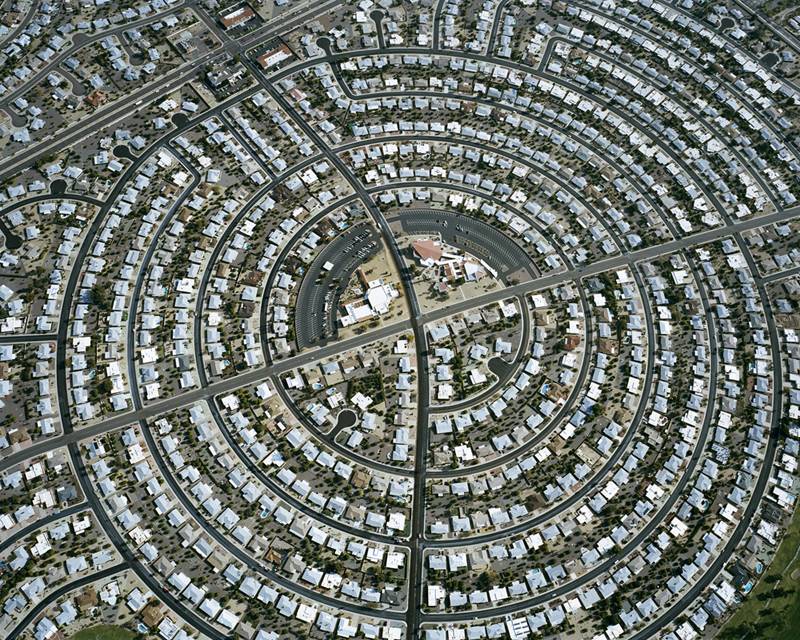
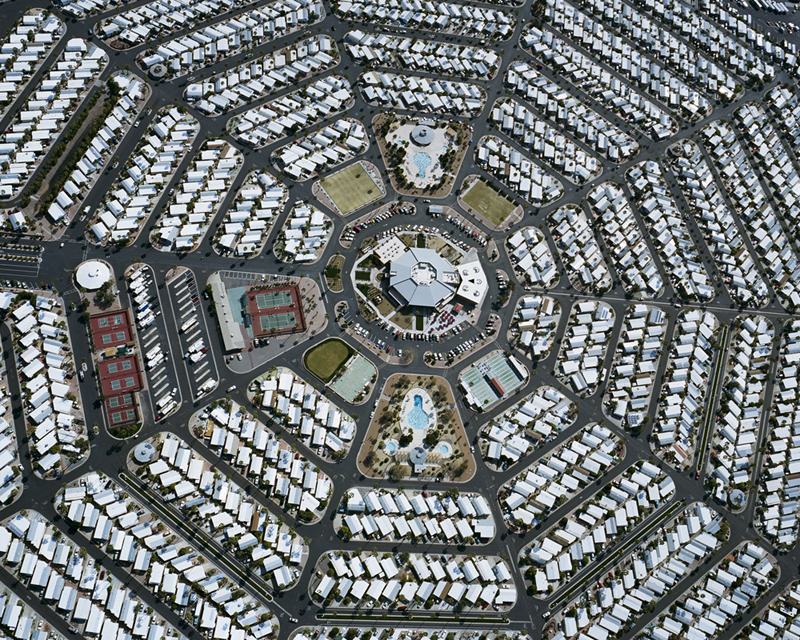
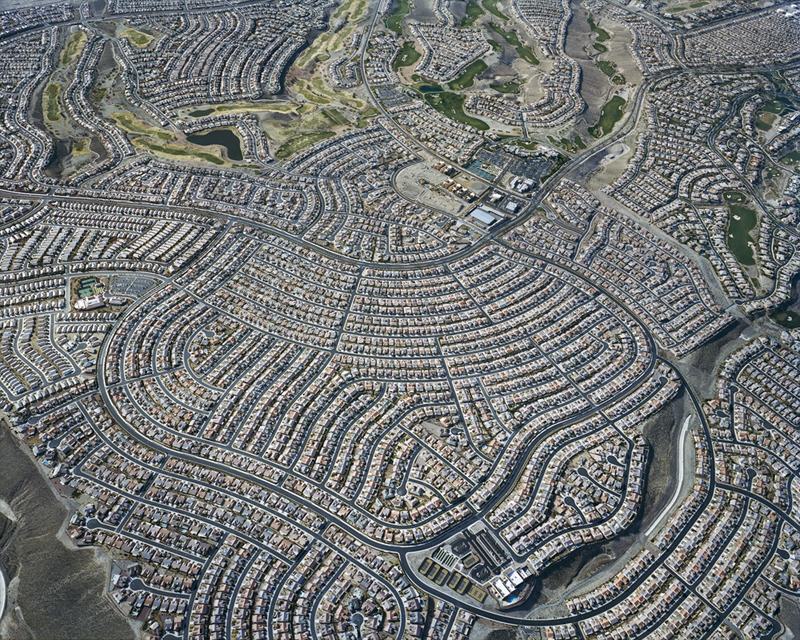
Few things provide context for a place like an aerial view. When we only see what’s in our immediate field of vision on the ground, it’s tough to understand how we fit into the world around us. Gaining this larger perspective is what photographer Christoph Gielen achieves with “Ciphers,” a collection of shots showing suburban sprawl as seen from above. His examples, which are as varied as prisons and retirement communities, show an undeniable visual poetry to the patterned layouts of the homes.

Gielen also brings to attention the environmental impact sprawl, which is almost entirely dependent on cars to access. He writes on his site:

The goal of this work is to connect art with environmental politics and to trigger a discussion about contemporary building trends by looking closely at the ramifications of sprawl – to ask: what is sustainable planning? – particularly at this point in time, when a growing need for new housing is prevalent across the globe.

The images mostly speak for themselves, but one of the things not explicit is location: most of the developments Gielen chooses are former marshes of Florida or deserts of Arizona, Nevada and California–places that, in their natural states, are barely inhabitable are now blanketed with homes.

Sprawl is the byproduct of the notion that there was and always will be unlimited resources–unlimited gasoline to drive us further and further from city centers, unlimited money and materials to keep building and maintaining ever-growing homes, unlimited water to make prairie grasses grow in the desert. In our process of rethinking these misbegotten notions, people like Gielen provide visual demonstrations of where we’re at so that we might determine where we’re heading.

via Treehugger

9 Ways to Edit Your Life in the Suburbs

It has been rightly pointed out that we at LifeEdited have a heavy urban bias. We sing the praises of compact apartments nestled in vibrant streets where we all frolick, ahem, walk or bike to world class restaurants, charming cafes and green markets; where cars are only used for the rare road trips to bucolic countrysides; where the reusable shopping-bag denizens create a fraction of the carbon footprint of the national norm.

But sometimes we miss the point. Many, many people live in the suburbs–roughly 2/3 of Americans. Many of them happily. They like their lawns, cars and streets that aren’t punctuated by the sound of sirens every five minutes. They don’t mind doing yard work, thank you very much. They accept and occasionally enjoy their commutes to work. And yet, many of these folks (of which you might consider yourself one) want to simplify their lives. They want to have more time, money and peace of mind. They want to reduce the amount of stuff they have and their carbon footprints. They just don’t want to move to the city.

A while back we wrote a popular post entitled “The New American Dream Home,” which profiled the Kawabatas, a family of four living in a not-so-small suburban home. The post was popular, we believe, because it presented a middle ground between extreme minimalist urbanism and unchecked suburban profligacy.

For the record, if you’re going to move, even within the burbs, we suggest finding a house that errs on the smaller side of the national norm and is close to the stuff you do–work, shopping, etc. But given that most of us aren’t going to move any time soon, or not based of some bloggers suggestion, we thought we’d offer a list of things you can do–some simple, some more involved–to create an edited home whilst living in the burbs.

  1. Get rid of stuff. As the old saying goes, nature abhors a vacuum, and given that suburban homes tend to be on the larger side, resisting the urge to fill your rooms with stuff can be difficult. But living with too much stuff is also difficult. There’s more stuff to buy, maintain, dust, organize, clean and toss. And while ultra-austere environments might not be everyone’s cup of tea, most of us appreciate a clear space more than we suspect. We suggest getting rid of stuff you don’t need, use or want, whether it’s housewares, furniture, clothes or paperwork. Edit ruthlessly. Just because you have the space doesn’t mean you have to fill it.
  2. Organize. With a bigger house, the tendency for out-of-sight-out-of-mind increases. Work on going through all of your home’s spaces, getting rid of stuff wherever possible, then organizing. Sort through storage areas, digitize paperwork and photos, make sure everything has a proper place. On the other side is the mental liberation that comes when we know what we have and where it’s at.
  3. Consider going natural. One of the larger time-sinks of having a single-family home is routine lawn care and landscaping. There are many types of beautiful grasses, shrubs and other plant life that need no or minimal upkeep. Look into what those things are for your particular climate and consider them as an alternative to the standard suburban mowed lawn and trimmed hedge aesthetic.
  4. Think before you drive. It’s sort of an inescapable truth that most suburbs truly depend on the car. Distances between destinations are generally too long for a walk and even a bike in many cases. That said, more and more municipalities are adding bike lanes and paths as well as public transport. While these forms of transit might lack the lightning speed of hopping in your car, there are many ancillary benefits like getting exercise, saving money and cutting your carbon footprint. Consider upgrading your commuter bike and riding that ten mile trip to work. Use the time waiting and riding the bus to catch up on reading.
  5. Telecommute whenever possible. The average American spends 50 minutes a day on his or her commute. And many people report that their commutes are the low-points of their days. If you have a flexible work situation, regain that time and sanity and consider making a request to work from home, even if only for one day a week.
  6. Close off a room. I know, this might sound weird, but the fact is many of us have spaces in our homes we simply don’t use enough to justify their upkeep–cleaning, heating and cooling. Consider making the room off limits–shutting the vents, covering the windows, etc–until you have a use for it.
  7. Get a lodger. This falls a bit outside the suburban norm, but fitting more people into a space cuts down on sprawl, can spread expenses and, assuming you have reasonably good interpersonal skills, might even make your home a more interesting place to live. Don’t want a stranger–consider having a family member moving in. Don’t want a family member–consider a stranger.
  8. Look into an Accessory Dwelling Unit (ADU). This one is a bit of a radical proposition, but depending on zoning where you live, you might be able to add an additional home to your existing home’s lot. Throw a tiny house in your back yard and rent out your main house–or vice versa.
  9. Use and love your space. Probably the biggest shame of the big American house is that it doesn’t get used enough. There is no “right size” for a home. If a space is frequently used and enjoyed, then it’s probably the right size. Host parties, BBQ’s, movie nights and other community activities. Size is an asset when it’s used.

Do you live an edited life if the suburbs? What would you add to this list? Let us know in our comments section.

Arial view of housing subdivision image via Shutterstock

Sprawl Messed Up

Forgive us if we seem like anti-sprawl-ites, but evidence keeps mounting that sprawl is neither planet nor people friendly. A study commissioned by Smart Growth America called “Measuring Sprawl and its Impact” looked at 221 metropolitan areas and 994 counties in the United States. The study sought to find out if there were connections between sprawl and social issues. Here’s what University of Utah professor Reid Ewing and doctoral research assistant Shima Hamidi–the study’s main authors–found out:

Several quality of life factors improve as [sprawl] index scores rise. Individuals in compact, connected metro areas have greater economic mobility. Individuals in these areas spend less on the combined cost of housing and transportation, and have greater options for the type of transportation to take. In addition, individuals in compact, connected metro areas tend to live longer, safer, healthier lives than their peers in metro areas with sprawl. Obesity is less prevalent in compact counties, and fatal car crashes are less common.

More specifically:

  • Traffic accidents were slightly more frequent in compact areas, but there were twice as many fatal accidents in sprawling areas.
  • Residents in sprawling cities spent more on combined transportation and housing expenses than compact cities, 52.1% and 51.1%, respectively.
  • Compact city dwellers had a longer life expectancy: 78.4 years versus sprawlers 77.7 years. Moreover, “For every doubling in an index score, life expectancy increases by about four percent. For the average American with a life expectancy of 78 years, this translates into a three-year difference in life expectancy between people in a less compact versus a more compact county.”
  • The average sprawling man was two pounds heavier than the compact one.
  • In terms of economic mobility, “For every 10 percent increase in an [sprawl] index score, there is a 4.1 percent increase in the probability that a child born to a family in the bottom quintile of the national income distribution reaches the top quintile of the national income distribution by age 30…For example, the probability of an individual in the Baton Rouge, LA area (index score: 55.6) moving from the bottom income quintile to top quintile is 7.2 percent. In the Madison, WI area (index score: 136.7) that probability is 10.2 percent.”

The aforementioned sprawl index is a scale based on “four primary factors—residential and employment density; neighborhood mix of homes, jobs and services; strength of activity centers and downtowns; and accessibility of the street network,” according to the study. An index score of 100 represents the national average. Anything above 100 was considered compact and below, sprawl.

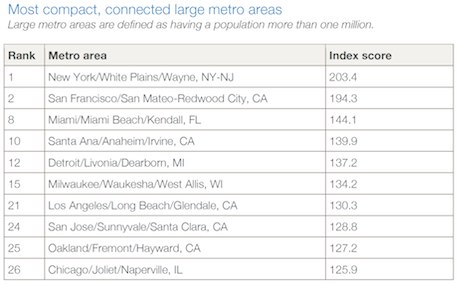
Predictably, with a score of 203.4, NYC was the most compact large metro area. Predictably as well, with a score of 76.7, Houston ranked as the most sprawling large metro area; in fact, eight of the ten most sprawling large cities were in the south (technically, the other two cities rounding out the bottom ten–Riverside-San Bernardino/Ontario, CA and Prescott, AZ–are southern cities).

most-compact-citiesmost-sprawling-cities

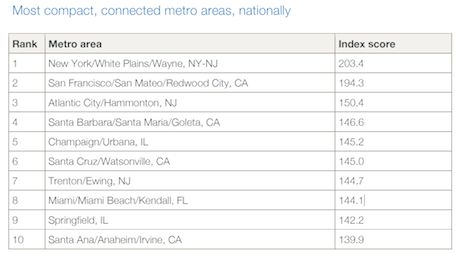
There was a pretty big drop off from second ranked San Francisco at 194.3 to third ranked Miami, at 144.1. These scores hint at how sprawl still pervades most American metro areas. Despite many indicators pointing to a more compact, urban America, there was a 1.4% increase in sprawl between 2000-2010. With few exceptions, it would seem as though we have a long road ahead of us before we offset years of urban planning predicated on cars (no pun intended).

most-compact-cities-all

Secondly, the names of cities that ranked below NYC and San Francisco–irrespective of size–were not who we thought they’d be: Atlantic City, Santa Barbara, Champaign/Urbana and Santa Cruz bested places like Boston, Chicago and Los Angeles. Of course, this is macro-data and cannot account for specific comparisons, e.g. living and working in the Loop of Chicago will be less sprawling than living on the edges of town in Santa Cruz (the study could not get data at those discreet levels and notes as such). Nonetheless, it shows there are still compact, walkable, economically viable cities outside the ones we typically think of.

We’re not shy about expressing our belief that much of the world (and the US in particular) would be better off living a little closer, a little smaller and driving a lot less. At least in a general way, the SGA quantifies some of the social and public health benefits of this sort of living.

Via Wall Street Journal

The Housing-Transit Connection

A recent report by the American Public Transportation Association found that public transit use in 2013 was the highest its been since 1956; 10.7 billion trips to be precise. They also reported that “public transit ridership is up 37.2 percent, outpacing population growth, which is up 20.3 percent.”

These are heartening numbers, likely reflecting an overall trend toward urban living, where public transit is far easier to use than sub-and-ex-urban areas. Between 2000-2010, there was a 12% increase in urban growth across the country according the US Census; 3% higher than non-urban areas. There were 2.3M new city dwellers from 2012 to 2013 alone.

Why is this important and what does it have to do with small-space living? It’s important because there is an inextricable link between the type of house we choose to live in, its size, location, access to transportation and our carbon footprint.

As a rule, single family houses are more resource intensive. Their individuated thermal envelopes require more heating, cooling and materials than multifamily dwellings which share walls. More importantly, single family houses have their own lots (the average lot size of a new home in 2013 was 1/3 acre), which pushes them further and further afield, requiring more driving, more gas, more infrastructure to support those cars, etc. Given that 35-40% of the country’s energy needs are from petroleum–the bulk of which goes to cars–living in a house that is not car dependent can significantly reduce your carbon footprint.

It’s also important to note that there are fewer people occupying these houses due to a shrinking household size, a trend which, if it continues, could mean more houses for the same population, meaning more sprawl.
energy_use_impact2

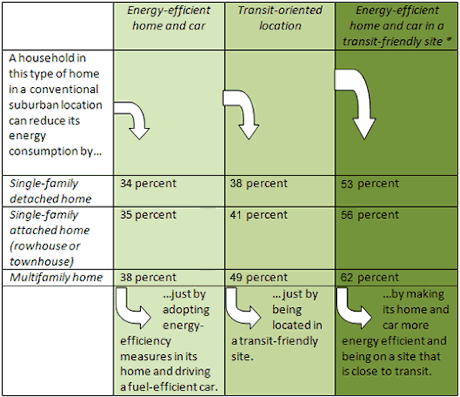
An EPA study published a few years ago called “Location Efficiency and Housing Type” explored this topic in great detail. What they found was that making your single-family house more efficient makes a difference. They found that an energy efficient housee and car can cut your footprint by 34% over a conventional, single-family suburban one. But they found that living in an energy efficient multifamily house with access to public transport–even if you keep your car–can reduce your carbon footprint by 62%. It’s also important to note that multifamily housing units are typically smaller than single-family houses.

The good news is that APTA’s report suggests America is slowly moving toward a multifamily, public-transit-centric housing bias. We say “slowly” because new single family houses are, on average, still pretty damn big. In 2012, the average new single family home was 2505 sq ft–just shy of the 2007 high of 2521, right before the housing bubble burst. One big asterisks is that there were fewer single family housing starts–1.04M in 2007 and 535K in 2012 (though there has been a steady increase in single family starts since a major dip in 2008-9).

That said, 5+ dwelling unit multi-family building starts are up as well to 293K in 2012 from their 97K low in 2009, which, coupled with increased public transit use and the overall trend away from car ownership, bodes well for a less-car-dependent, centralized American population with a smaller carbon footprint.

Long story short, putting all lifestyle benefits aside, if you want to reduce your carbon footprint, there are few things that are more effective than downsizing, centralizing and moving into a multifamily housing situation.

Via Treehugger

Fast Moving Traffic image via Shutterstock 

Seattle’s Urban Boom

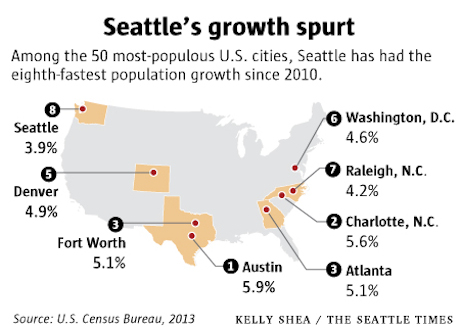
Forget NYC and San Francisco as the American leaders in smart urban growth. Seattle is where it’s at. The two former cities–with their tight geographies and urban grids conducive to walking, public transport and compact, efficient living–have always packed people in. But Seattle’s growth was more emblematic of many American cities, where, throughout the 20th Century, suburban sprawl reigned supreme. For 100 years, the suburbs of King County outpaced the growth of the city of Seattle (which, incidentally, is the King County seat). A trend that appears to be changing.

The first sign was in 2010, when the city of Seattle matched King County suburban growth. Then between 2011-2012 Seattle grew at a rate 25% faster than King County.

seattle-growth

Some attribute this trend to the aftermath of the housing bust–young people couldn’t “graduate” to the burbs like their parents did in the past. But the trend is hardly limited to Seattle. From DC to Denver to Atlanta, people are choosing city living–a choice that may be more than sloppy seconds to the suburbs.

fyiguy-popgrowth-map-2

The Seattle Times speculates about the possible motivations behind this movement:

We might be witnessing a major demographic shift, with younger people rejecting a culture of sprawl and car-dependency associated with suburbs, and instead choosing the lifestyle offered by dense, walkable cities…Signs of Seattle’s success are not difficult to spot. Everywhere you look there seems to be a new apartment building under construction. As reported in The Seattle Times, more apartments were opened in 2013 than in any of the previous 20 years.

Seattle bears this out. Least we forget, the city is perhaps the epicenter of the micro-apartment movement (often to the chagrin of many Seattleites). These tiny apartment forgo large interiors and parking spaces for central locations and affordability. As of last year, there were at least 47 micro-apartment buildings throughout the city; these developments are unique in that they Seattle convert low-to-medium density neighborhoods into higher density ones.

Of course Seattle’s growth can’t be solely attributed to micro-housing. It does show Seattle’s regulatory willingness to centralize populations–something that can’t necessarily be said for NYC, for example, a city that still has a 400 sq ft minimum size for new apartments.

The city of Seattle has 7,402 people per square mile. Compared to NYC and San Francisco–27,550 and 17,620 people per sq mile respectively–that number is not earth shattering. But NYC and San Fran both enjoy significant geographical constraints as well as infrastructures that were developed well before the car came into widespread use. For them, dense, walkable, easily traversed cityscapes are natural. Seattle, whose infrastructure grew up to a greater extent around the car, was more susceptible decentralization, making recent developments all the more impressive. It shows that a city’s growth need not be dictated by nature–that how a city nurtures development plays a critical role in smart growth and more livable cities.

Via Seattle Times

Misery, Apparently, Does Not Love Company

Thinking of moving to the burbs or the country? Want a little more room to spread out and raise the kids? Want to feel safer and more secure than you do on the city’s mean streets? Well, you might want to think again. A growing body of research suggests that moving away from the city may be a move fraught with peril and insecurity. Here are some of the possible threats of moving out of town:

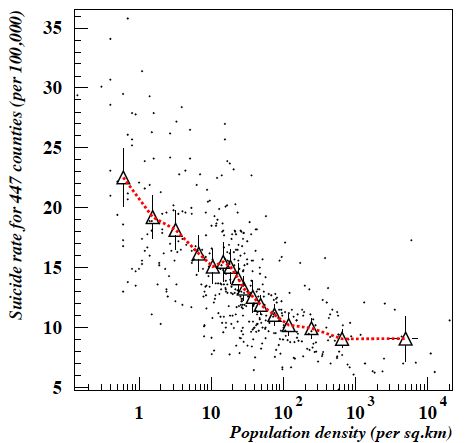
Suicide. A paper by Cornell researchers has found a strong correlation between low density and suicide, particularly for people aged 15-19 as the below chart suggests.

suicide-sprawl

This correlation holds true almost everywhere around the world. Countries such as France, Canada and Japan showed a similar connection between suicide rates and density.

Though there is no definitive explanation for why this is the case, an article in Atlantic Cities speculates that the reason is akin to the biological phenomenon called apoptosis, where cells “isolated from the group begin to self-destruct.”

Death. Many people’s notion of the city is forever associated with Charles Bronson riding the 1 Train at midnight. If we just escape to the bucolic burbs or countryside, where people trade their switchblades for hedge-clippers, we will be safe. Not so says a study by researchers from the University of Pennsylvania and the Children’s Hospital of Philadelphia.

polulation-densitydensity-violent-death

While certain urban environs have significantly higher homicide-related death rates than the national average, the overall likelihood of non-illness-related death are considerably higher outside the city, as another Atlantic Cities article reports:

That risk [of dying from urban homicide] is far outweighed by the fact that you’re about twice as likely to die in a car crash in rural America than you are in the most urban counties. Nationwide, the rate of “unintentional-injury death” – car crashes, drownings, falls, machinery accidents and the like – is about 15 times the rate of homicide death. Add together all the ways in which you might die prematurely by intentional or unintentional injury (as opposed to illness), and your risk of death is actually about 22 percent higher in the most rural counties in America than in the most urban ones.

Upward mobility. A NY Times editorial by Paul Krugman called “Stranded by Sprawl” suggests a third threat of moving to the outskirts: Unemployment and lack of opportunity.

Citing a new study by the Equality of Opportunity Project, Krugman points at Atlanta, a city he refers to as the “Sultan of Sprawl.”

Though Atlanta has recently experienced an enormous population growth suggestive of an economic boom, its citizens’ likelihood of upward mobility is the same as Detroit, a city whose economic woes have made it the epitome of urban decay. Krugman asks:

So what’s the matter with Atlanta? A new study suggests that the city may just be too spread out, so that job opportunities are literally out of reach for people stranded in the wrong neighborhoods. Sprawl may be killing Horatio Alger.

In other words, what good is opportunity if you can’t get to it?

[divider]

Needless to say, this is not a topic for over-simplification. Not all suburbs or cities are created alike and there is surely a lot of noise in all of these studies.

And we won’t suggest that people only move out of the city to find a better life. Many people are moving to the outskirts because the city centers have become prohibitively expensive.

But there are many who still see the suburbs as havens of safety and security. For them, these studies should provide plenty of food for thought. Maybe it’s safety and opportunity–not misery as always thought–that love company. 

Average Family House image via Shutterstock

Sprawl, Huh! What is it Good For?

Last week we gave a micro view of the embiggened American home. Today, thanks to Google and the US Geological Survey’s Landsat images, we see the macro view. The GIF’s below, made by Texas architect Samuel Aston Williams, show the Houston, Dallas/Fort Worth, Chicago, NYC, San Francisco and Los Angeles metro areas as they grow from 1984-2012. The ever-sprawling burbs look like spilled milk over once-green hinterlands.

Of course the images don’t tell the full picture, e.g. how the increase in sprawl relates to overall US population or how these spread out cities might be the product of an increasingly urban country (in other words, the increased size of one area might translate to a major decrease in another, more remote locale). Nonetheless, these images, coupled with consistent data showing the ballooning American home size, paint a picture of a country that might need a serious edit.

click on image to enlarge

via The Atlantic Cities