A Suburb that Puts People First

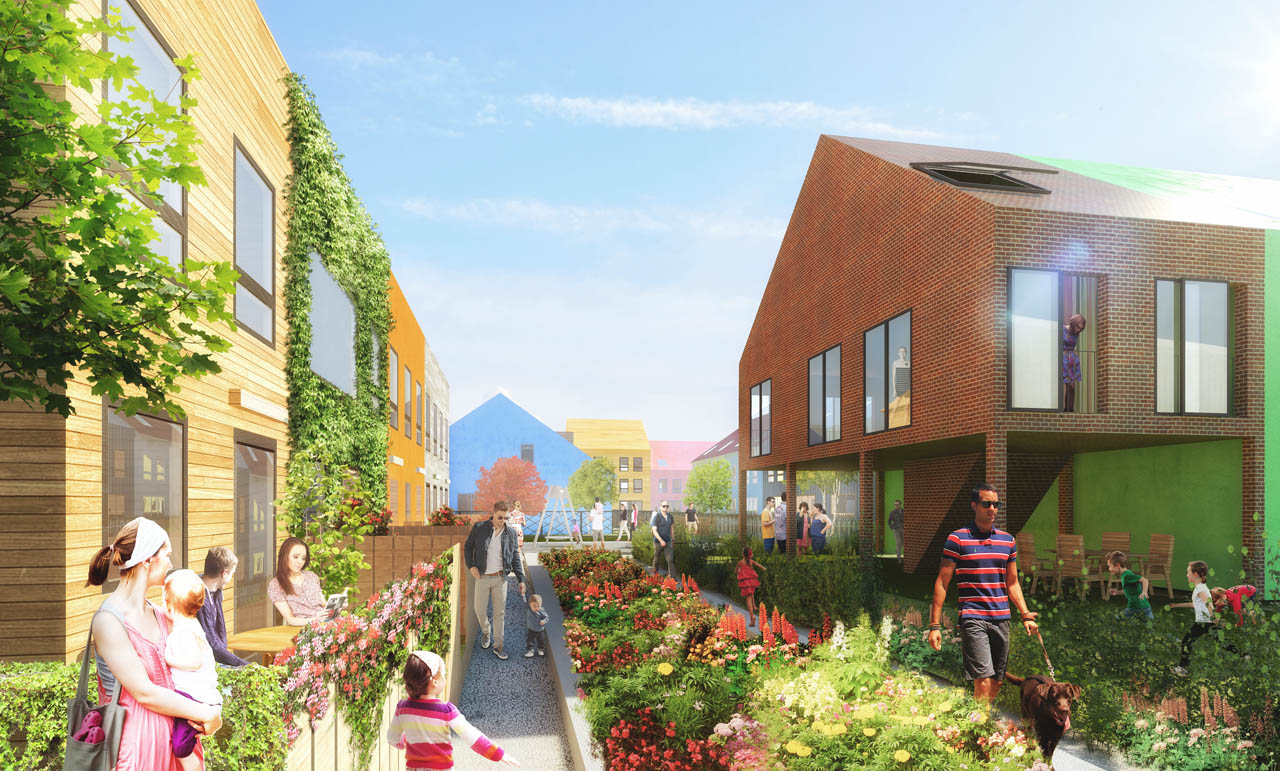
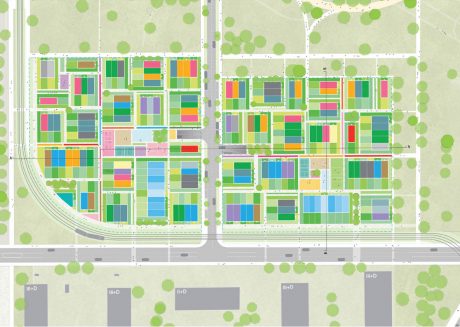
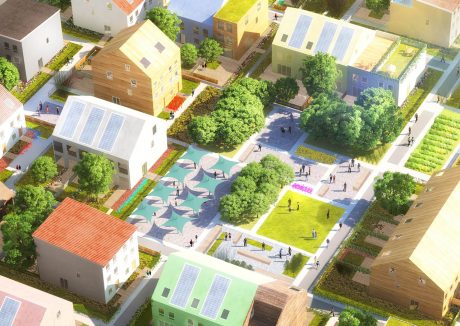
One of the biggest demerits of suburban living is how they can have an isolating effect on people who live in them. When most suburbanites leave home, they enter a car that’s usually in an enclosed garage where you often drive to another garage at work or the store or wherever. In cities where garages are less common, you leave your home and you’re thrust into contact with your fellow human. We’ve looked at Pocket Communities before, which are communities of single family houses where the front door faces a commons area, fostering a more social living environment. And we just ran across this new suburban development in Mannheim, Germany that puts the humans first in its design. The development, which has many of the hallmarks of suburbia like single family homes and yards, has two notable things missing: cars and parking.

mvrdv-grid

Johannes Pilz, one of the architects behind the project told FastCo.Exist:

By getting rid of the cars, you then open up the streets, whether it’s for children to come out and play with each other, or to encourage residents to sit outside their house, chat with one another, or go for a stroll…By getting rid of the [pavement] barrier between households, you then increase interactions between neighbors, and the community then starts to bond.

The lead developer, MVRDV, specializes in affordable housing. The development is designed to avoid gentrification by creating a diversity of housing types as well as taking a modular approach to construction. Residents will be given a catalog of houses to choose from of various sizes, heights, etc. Instead of each house representing a custom design, many are reconfigurations of basic building blocks, streamlining design and construction processes and cutting costs.

MVRDV-housing-types

The development, which will be built on an old US Army barrack, is also next to a tram stop, so people who commute into the city could live car free if they so chose. There will be underground parking available however, for residents who want a car and for emergency vehicle access.

MVRDV-Courtyard

Some of the promises of suburban life are safety and community, but because many suburban developments design more around cars than people, those ends are often not achieved. The design of this development shows what can happen when people come first, and  we think it looks pretty great.

Via FastCo.Exist

The New Starter Home

Somewhere between now and 1950 (or thereabouts) something went wrong with American housing. Back then, car-fueled sprawl hadn’t yet driven people so far from city centers. At 983 sq ft, the average home was just about right sized for the average household size of 3.54 people (277 sq ft/person). Architect Jonathan Tate told Fast CO.Design said this is what went wrong:

Houses morphed from a consumer good into an investment commodity, which in turn led to developers building cookie-cutter starter homes based on what they deemed to be the most likely to appreciate in value. Houses became more expensive to purchase and maintain, their sizes ballooned, and they were increasingly located in areas far removed from established neighborhoods since it was less expensive to buy greenfield land.

This morph made homes prohibitively expensive to large swaths of the population, evidenced by a 48 year low in homeownership rates in 2015. Tate and developer Charles Rutledge recently launched the Starter Home* project as a response to the commodification of homes, designing and developing housing around how people live.

starter-home-back

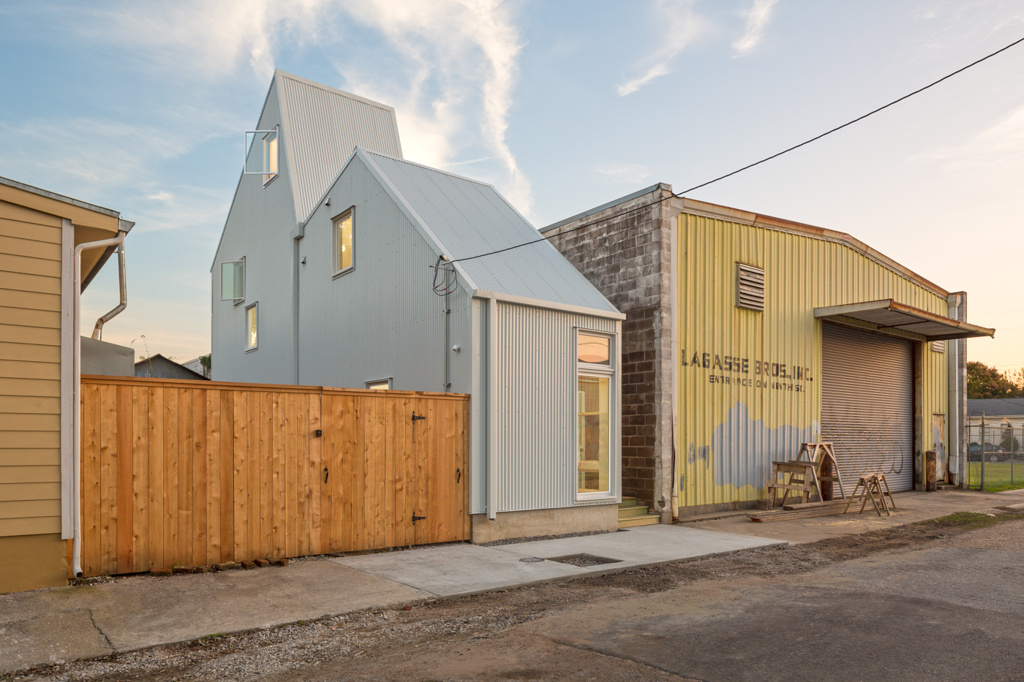
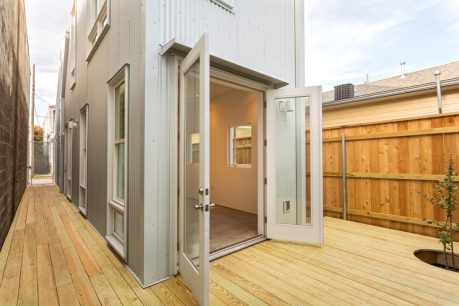
The first Starter Home* recently went up in New Orleans. It’s 975 sq ft, but its actual footprint is only 473 sq ft. Even with setbacks and some outdoor space, it can fit onto a very small 16.5’ x 55’ lot. The compact proportions make the house ideal for urban infill development, using lots that might not support conventional homes. This has the benefit of allowing the developer to purchase centrally located land at a discount, which in turn creates a lower purchase price. The first starter home cost $339K, which is about $35K more than the average New Orleans listing. Tate believeshe can drive that price down with scale. Tate has 15-20 projects in the pipeline and is planning on making Oakland, CA the next stop for the Starter Home*.  

The basic tenets of the Starter Home* are great: reduce the size and price of single family homes; bring more housing into our city centers; bring sanity back to American housing. With the average new single family home size hovering around 2700 sq ft, we need this now more than ever. 

For more information and images head over to CO.Design

We Wish All Suburban Developments Looked Like This

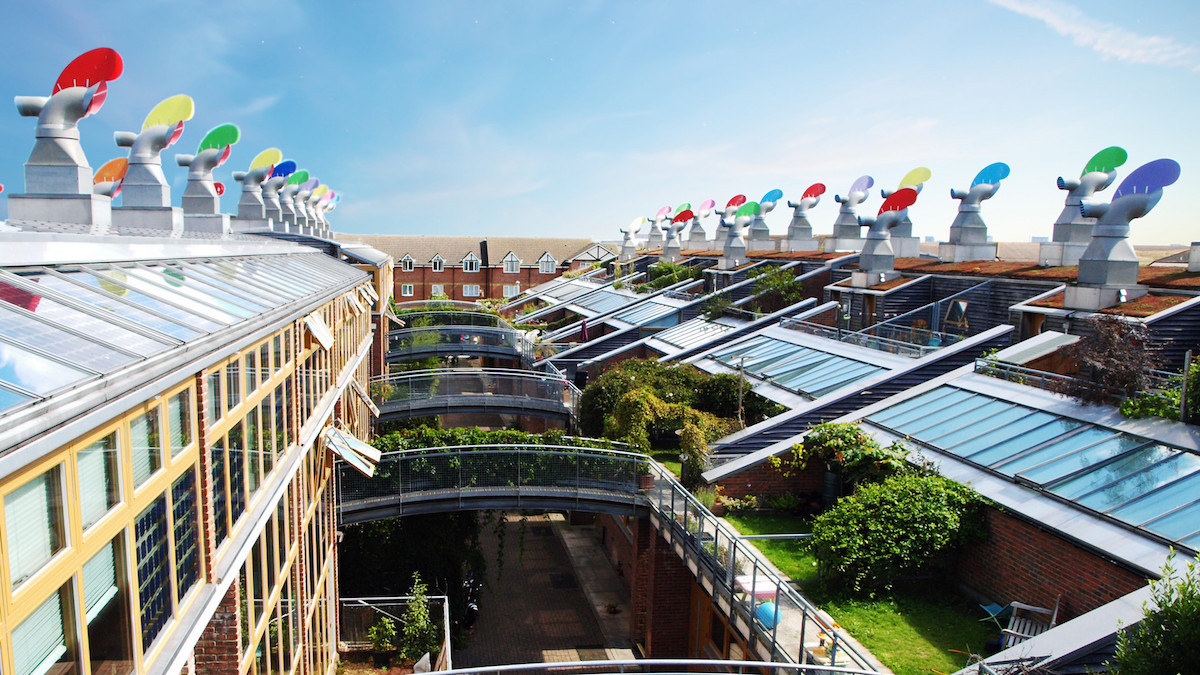
We’ve long extolled the virtues of high density, urban living. By keeping things close, you can walk or bike most places, which is better for both physical and planetary health. Density leads to more social interaction, easier distribution of goods and foods. And so on. But we also understand why people are drawn to the suburbs. It’s nice to have a little more personal space and maybe even a yard. In 2002, architectural and development firm ZED Factory completed their BedZED, a unique housing development that fuses the best of urban living with suburban comfort.

The word zed, for those unfamiliar with anglo-numerical nomenclature, means zero. In this case, BedZED, located in Wallington, a commuter suburb located 10 miles outside central London, is the “UK’s largest mixed use, carbon-neutral development.” It achieves this zero-ness through solar power and a “biomass combined heat and power plant, an onsite sewage treatment and rainwater recycling system,” according to ZED Factory’s website. Many of the building materials were reclaimed or sourced within 50 miles of the site to keep embodied energy low.

One of the more remarkable aspects of the development is its diversity housing types and uses. According to ZED’s website, “BedZED comprises 82 affordable dwellings in a mixture of flats, maisonettes and townhouses, and approximately 2500 m2 of workspace/office, and is built on a brownfield site [repurposed industrial site].” In addition to housing diversity, there is demographic diversity, with one third “social rent [subsidized low income], one third shared ownership [coop] and one third private for sale”–a structure that promotes a variety of people at different stages in their lives. Residents share the complex with ground floor businesses, whose spaces can be easily configured to accommodate large or small businesses.

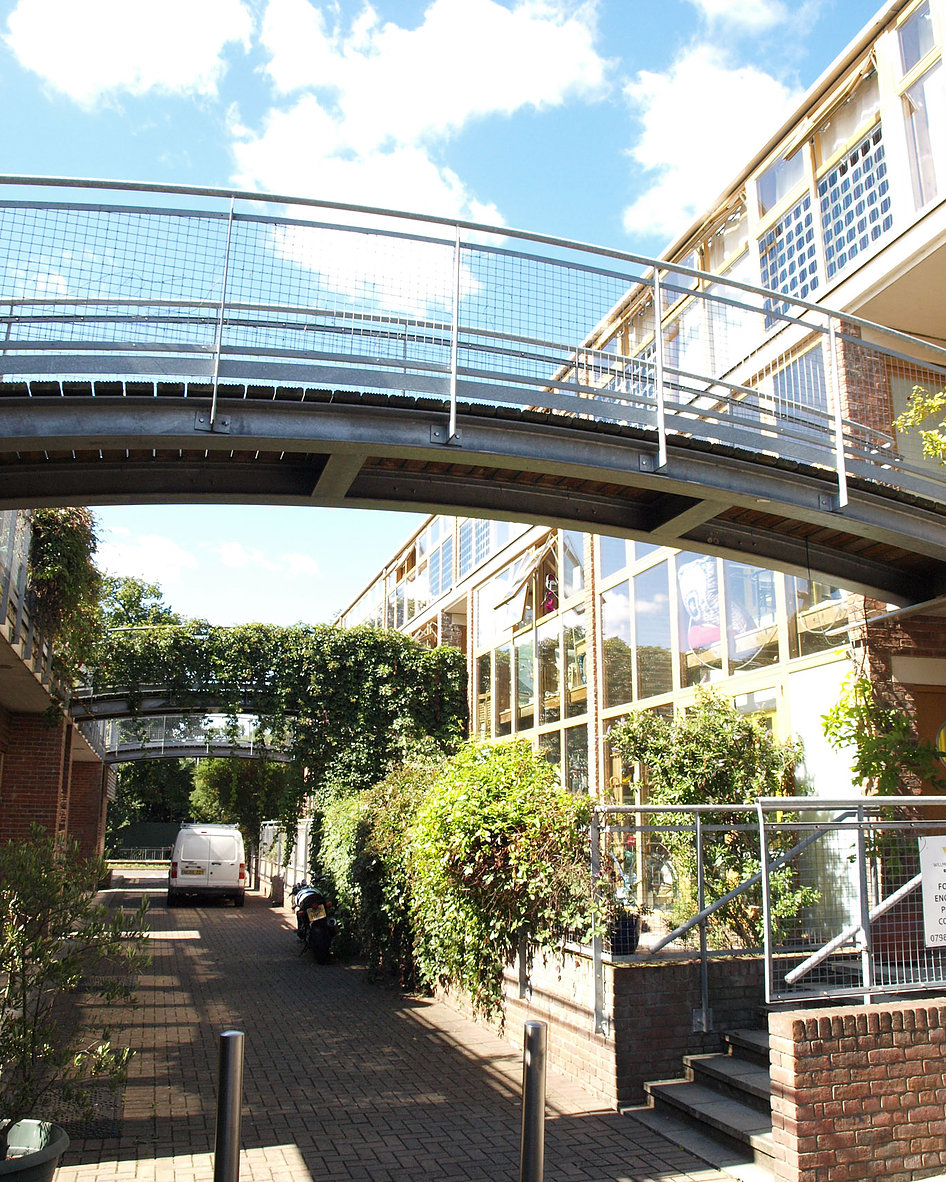
Putting aside its considerable eco and urban planning cred, the place looks great. Units are bathed in light (as much as they can be in the UK) and the interiors enjoy an industrial chic look carried over from the building’s previous life. Small, verdant walkways and wend their way through the complex and almost every unit having its own terrace or garden. If this is the suburbs, we want in! 

Image via ZED Factory

Rethinking the American Dream Home

Whether manufactured or the reflection of a genuine desire, the American dream has long been a process of settling down with your family in your own single family house (ideally with white picket fence). To some extent, there is a shift away from this dream. One obvious reason is that many people are delaying or avoiding coupling up and having kids. 27% of all Americans live alone–a percentage that has continually increased over the years–suggesting there’s a movement away from nuclear family households and the single family homes they inhabit. Even for those who do have families, there seems to be a shift around the dream of homeownership, a shift that went into overdrive following the housing crisis in 2007. People are questioning whether owning a house means they’ve “arrived” in the world. How can carrying mountains of mortgage debt forcing homeowners to choose work based on whether it can pay the bills be a dream? How can managing and maintaining stuff and space homeowners seldom use be a dream? How can hour plus commutes to homes in lifeless cul du sacs be a dream? It’s not a stretch to say we need to rethink our dreams when they’re so out of sync with reality. This new dream is what real estate startup Acre is all about.

Acre’s mission “is to preserve the beauty and balance of of the environment, connect our homes to it, and give homeowners the freedom to enjoy it more fully.” Husband and wife founders Andrew and Jennifer Dicksen want to create “innovative, attainable, high-quality homes that are better for people and the planet,” according to their website. The way they do this is through easy to ship and assemble homes that are net zero, creating both reduced construction and operating expenses as well as minimal environmental impact.

On top of being more efficient than status quo housing, Acre wants to challenge the large house as status symbol. Not only does the size impact the efficiency of the home, but it often leads to homeowners serving their homes (cleaning, maintaining, paying for, etc) versus the other way around. Acre explains in their promotional video that the status that comes from owning one of their homes is that the owner shows off his or her intelligent, intentional existence (a more enlightened form of status seeking we suppose).

They are offering three sizes: small, medium and large, ranging from 1200-1800 sq ft and two to four bedrooms. The houses arrive in a shipping container, and once the foundations are set, take three months to construct. While homeowners must take care of buying the land and laying the foundation, Acre’s pricing includes the rest: from delivery in the continental US, construction costs, all materials and finishes, solar power systems, appliances and so on.

Speaking of pricing, the small house runs $400K, medium is $450K and the large is $500K–prices that will surely increase with land costs and foundation work. The prices, considering the homes’ quality and features, are not too surprising. Yet these prices are considerably higher than the median price of a single family home in America, which is about $226K, raising a thorny question: which would go further toward simplifying life, buying and improving a less expensive, lower quality home or going for something like Acre’s homes, which in the long run, might be a better investment?

Acre also doesn’t address the thing that can totally thwart a home’s attempts at being energy efficient, which is its location. These are still single family homes, which are ultimately best suited for suburban (read: driving intensive) living. Almost anyway you cut it, single family housing in the burbs is going to be less efficient than multi family housing in transit friendly locations

Those questions aside, we appreciate what Acre is trying to do, how they are trying to make a substantive change to how homes are designed and built and how they are making us think about how we relate to our homes financially, environmentally and psychologically. If you’re interested in an Acre, head over to their website

HT Jared J.

Legalize Tiny

In December we posted about Walsenburg, Colorado, a tiny town that created a building ordinance to allow for the construction of a tiny house subdivision. As we’ve long noted, zoning is the biggest hurdle for tiny houses taking off as a widespread housing option. While most tiny houses are designed as permanent dwellings, they are treated as RVs in the eyes of building code; this classification means that the houses can’t be parked in a residential area indefinitely. While the Walsenburg news represented a step in a great direction, the fact that it was done in a town of 3000 people made it a bit easier to dismiss. But when a city of a half million people does effectively the same thing, it might harder to ignore. Fresno, California–the half million person city in question–recently passed an ordinance specifically permitting tiny house on wheels (THOW) as permanent dwellings.

The move is pretty unprecedented. “We are the first city in the nation to actually write into its development code authorization for ‘tiny homes,’ ” the city’s mayor Ashley Swearingen said. While tiny houses have cropped up in various places around the country, their existence was shoehorned into existing code, typically regulations concerning accessory dwelling units (ADUs). Making code that treats THOWs as a distinct housing typology might go a long way to legitimizing tiny houses across the country.

What’s also notable about the ordinance is its lack of restrictions. Here are the main criterion a Fresno tiny house must meet as pulled from the Tiny House Association of America:

  1. Is licensed and registered with the California Department of Motor Vehicles and meets ANSI 119.2 or 119.5 requirements;
  2. Is towable by a bumper hitch, frame-towing hitch, or fifth-wheel connection. Cannot (and is designed not to) move under its own power. When sited on a parcel per requirements of this Code, the wheels and undercarriage shall be skirted;
  3. Is no larger than allowed by California State Law for movement on public highways;
  4. Has at least 100 square feet of first floor interior living space;
  5. Is a detached self-contained unit which includes basic functional areas that support normal daily routines such as cooking, sleeping, and toiletry; and
  6. Is designed and built to look like a conventional building structure.

Aside from point #1, which Lloyd Alter at Treehugger says might cut out a number of DIY-built homes, the rules allow for real deal tiny houses–i.e. really small and self-contained. And unlike most of the California counties that permit tiny houses currently, Fresno does not restrict their use to caregivers. The tiny houses can be used by homeowners for their personal use or as rental property.

One thing that does not seem to be a part of this code is building only a tiny house or tiny houses on a lot of land (the tiny houses must share a lot with an existing home). That said, there is no shortage of single family homes that can play host to tiny houses. In fact, adding density to the existing, sprawled out single family housing infrastructure is probably the greatest promise for tiny houses movement.

All in all, this is great news and we look forward to continued deregulation of tiny houses and other innovative forms of housing that are aligned with how we live today.

Image via California Tiny House

Single Family Housing that Makes Sense

There was a time when American single family homes weren’t so absurdly large. In 1950, the average household had 3.83 people and the average new single family home was 983 sq ft, making for a pretty reasonable 291 sq ft per person. Compare that to 2014, when the average household had 2.54 people and the average new single family home was 2,690 sq ft, or 1059 sq ft per person. That’s a 360% increase in per capita housing size. Yikes! What’s worse is this continual embiggening of the American home has dwindled the options of modestly sized homes for those who want them. We frequently get notes from people who want to downsize, but say they are forced into homes larger than they want because there’s virtually nothing available in their area. A real estate startup out of San Antonio, TX called Rising Barn is trying to remedy this lack of options, offering prefabricated, stylish, affordable and reasonably sized single family homes.

risingbarn

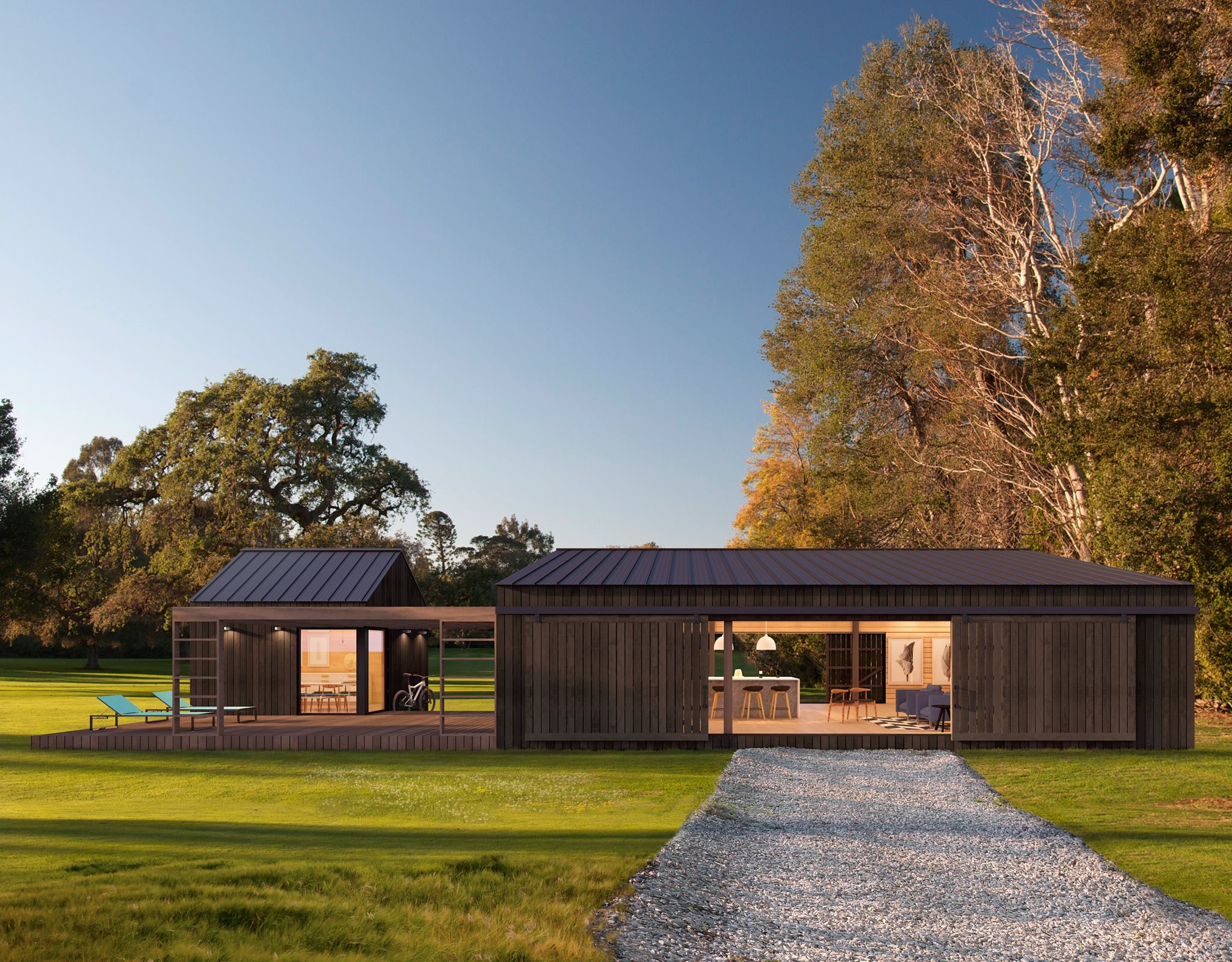
Rising Barn offers five “kits” with two categories of structures: cabins and domos. The cabins come in two sizes, large and medium. The large is a two bedroom unit with 720 sq ft of usable square feet (above), and the medium is a studio with half the area of the large; unlike the large, it doesn’t have a full bath or kitchen, so it’s designed for “work/live” use. The three domos are multipurpose rooms ranging from 80-160 sq ft and can be used in conjunction with cabins or as additions to existing homes.

risingbarn-domo

Rising Barn wants to make the whole process simple and affordable. Here’s an explanation of the ordering process from their site:

Once you do [select a kit], our barn kits will be delivered to your land in 2-6 weeks. If you prefer to hire a crew, we are happy to assist you in choosing the right one in your area. If you reside in Texas, you can contract a Rising Barn team leader or use our turn key service. You can build it with a few friends within in a week, work alongside Rising Barn team leaders, use our turnkey service, or we can help you find a local crew to assist.

According to the San Antonio Business Journal, unit pricing ranges from $120-200, which includes material and labor. If you go the DIY route, that cost drops to $90 to $105 per square foot. So a 720 sq ft cabin built by contractors would run, on the top end, $144K; even factoring in land costs, permitting and other sundry expenses, this seems like pretty competitive pricing.

Sure, there are cheaper prefab options, but I doubt they look half as nice as Rising Barn’s or are made half as well. And the ones that do look and are built this nice typically run in the multiple hundreds of thousands of dollars just for the structure. If you must live in a single family home, Rising Barn looks like a solid option. 

The Oracle of Awesome, Affordable, Urban Living

There’s an ideal we promote on this site about the perfect edited life. Here’s how it goes: live in compact apartment without much stuff in walkable, culturally vibrant city. Work and friends are just a quick walk/bike/subway ride away. Because your home is smaller, you don’t accumulate a bunch of useless stuff and there’s less to take care of, allowing you to pay attention to relationships and experiences. This way of life is greener and more fulfilling than living in a big suburban home on a cul du sac. But here’s the rub: the cities we tend to associate with walkability and vibrant cultural scenes–NYC, SF, Boston, Toronto, Vancouver and a handful of others–are, for a variety of reasons, batshit expensive. The simple, edited life becomes difficult to achieve for many because they must struggle to just get by, even if they’re living in the tiniest of apartments with nary an extraneous personal possession. This grinding way of life can make people question whether the edited life in these cities even exists. But before you ditch your walking shoes for an SUV and your apartment for a McMansion, you should consult Johnny Sanphillippo.

Sanphillippo describes himself as a housekeeper, gardener and handyman by trade, but he is more of an oracle. For the last few decades, Sanphillippo has seen where things are going in terms of lifestyle and real estate trends before they happen. Despite the fact that he’s hardly made more than $20K a year for much of his life, Sanphillippo has been able to purchase homes in San Fran’s Mission District (as part of a group), Sonoma and Hawaii. When he purchased these places, they weren’t the real estate golden children they are now (with the possible exception of Hawaii). Sanphillippo saw their good bones of these places–whether it was culture or walkability or lovely weather–and invested accordingly. This prescience is why Sanphillippo latest real estate investment in Cincinnati is so interesting.
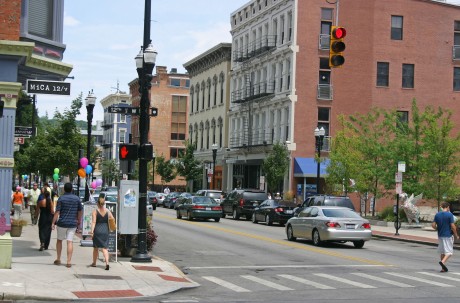
over-the-rhine

“I think of the big cities like New York and San Francisco being like a balloon,” he told me. “When you squeeze one part of the balloon, another part bulges. So if a bunch of people grab at the middle of New York or Toronto or San Francisco, it’ll push other people to edge. The problem right now is that everyone is trying to grab hold of every part of the balloon and a lot of people are seeing that they just can’t make it work.”

But he says this squeeze is not the case in second and third tier cities like Cincinnati, Pittsburgh, Louisville, KY, Philly and others that are not the darlings of the monied few. Despite their lack of glitz and glamor, he believes that these cities are very livable and attractive and that many people are realizing this. Because they were developed before the car, they offer walkable streets lined with solid, beautiful old architectural. Most importantly, their real estate values are approachable for people making normal salaries.

“If you want to stay in the New York area and want something a little bigger and more affordable than what you can get in the city, you’ll probably end up in some split level ranch house in Long Island far from everything.” Alternatively you could live in one of these second or third tier cities, which offer many of the benefits of a New York at a fraction of the price. He says that many people who initially bristled at the idea of living in a place like Cincinnati begin to see its merits after some analysis–they see the walkability, safety, affordability and human scale. “Sure, you might not have access to same super fabulous jobs as New York, but let’s face it, most people have normal jobs,” he says.

The changes in today’s workforce is one reason why these and other cities are becoming more economically viable. Many of today’s workers just need a strong wifi signal and access to a major airport to conduct business, leaving them free to live where they want. He also cautions that the super fabulous jobs in New York and San Fran–and their attendant extreme housing costs–might not always be there. If there are crashes (or adjustments) in the financial and/or tech industries respectively, the solidity of those cities’ economy might be quickly dissolved.
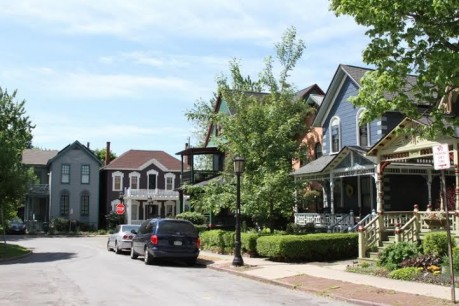
streetcar-suburbs

Sanphillippo presents options aside from the city centers. There are “streetcar suburbs”–areas developed between 1890-1940 that might lack the higher density of living in a city center, yet still offer compact, convenient living. He said you might not be able walk everywhere or live without a car in these places, but you might be able to go from four cars for a family to one.

He also said that people can “retrofit suburbs,” creating pockets of density in suburban enclaves, ideally with groups of other like minded folks. He says this is easiest to do in suburbs developed in 50s and 60s when car ownership was not a given for every adult. In fact, most of Sanphillippo’s top picks for places to live are inversely related to car-dependency. He said this retrofit process is not an overnight process. “It took 60 plus years to get to car dependency and it could take another 60 years to get to something else.”

If you’re looking for great places to live–or simply a fascinating blog–Check out Sanphillippo’s Granola Shotgun, where he tours the country looking for what’s next, taking pictures, talking to locals and presenting myriad options for living an affordable, urban life.

image via Urbancincy

The Neighborhood within the Neighborhood

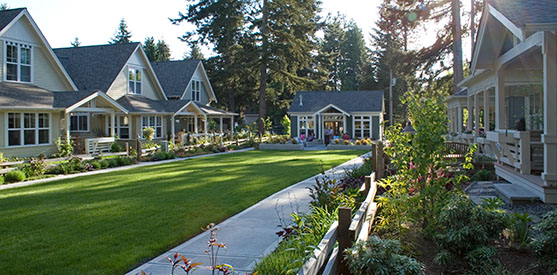
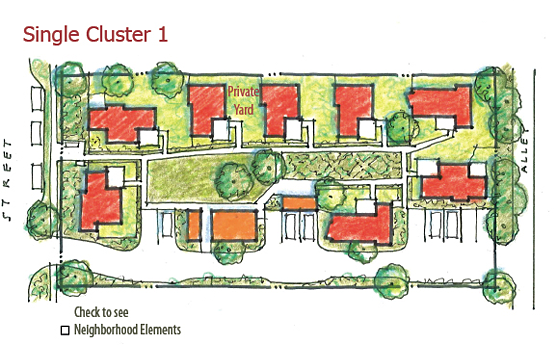
Pocket neighborhoods prove that an edited home can take on many shapes and sizes and be located most anywhere. The term, coined by architect Ross Chapin, refers to clusters of houses that share common, car-free outdoor areas like gardens, joined backyards and even alleyways. The idea is to design the conditions that promote tight-knit communities–where neighbors look out for one another, where children can play safely, where it’s not a big deal to ask someone to walk your dog or borrow a cup of sugar.

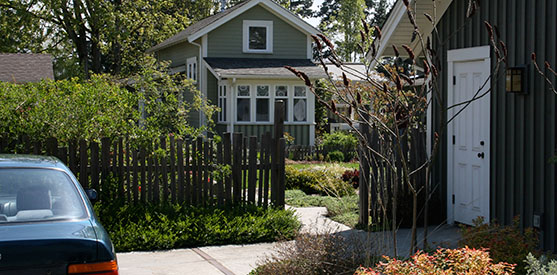
In a smart move, pocket neighborhoods are designed to promote community but also have enough autonomy and privacy for members to do their own thing. One particular design flourish that supports this is the orientation of the houses. By nesting the houses–i.e. the ‘open’ part of one house like its entrance faces the ‘closed’ part of another like its side or back–separation is created without a big yard. Strategic use of low fences and perennials create further barriers for the tightly spaced houses.

Pocket neighborhood houses need not be new and they can be any style, as indicated on PN’s website:

Residences in a pocket neighborhood can be any style — Craftsman Cottage, Contemporary, Spanish Mission, Screaming Solar or Modern Modular. They can be detached single-family houses, attached townhouses, or clusters of urban apartments. The key idea is that a limited number of nearby neighbors gather around a shared commons that they all care for. There are a number of design principles that make pocket neighborhoods successful, but style is not one of them.

Those design principles include a cap on the number of houses in the neighborhood (12 max, but multiple clusters can be joined by walkways), no cars or traffic in the commons, no parking in front of the houses and the active rooms like porches should face the common spaces.

While there are a number of pocket neighborhoods with larger houses, Ross Chapin Architects (RCA) seems to promote “cottage style houses” as the optimal house-style for the neighborhoods. The PN site explains why:

If houses are too large, residents tend to spend all their time indoors. With slightly snug houses, the porch, gardens and shared common buildings get used more, which fosters connection among neighbors. As well, a house that is ‘not so big’ is more likely to be fully lived in and cared for.

These cottages are less than 1000 sq ft and include design elements like large windows and built-in cabinetry that make the space feel larger and use every square inch of space to its fullest capacity. This layout of multiple small homes clustered together reminds us of the upcoming Napoleon Complex by Four Lights.

So far RCA has helped build 14 pocket neighborhoods in the northwest. They take pains to say they are an architecture firm, not a developer, and that there are numerous zoning issues that make establishing a pocket neighborhood difficult in certain areas. They have resources for developers and a book if you’re interested in establishing a pocket community of your own.

We see the pocket neighborhood as a great option for establishing a strong community while using minimal resources and being adaptable to environments ranging from urban to rural.

Do you have firsthand experience with pocket neighborhoods or similar communities? If so, let us know your thoughts in our comments section.

images via Pocket neighborhoods

This post was originally published May 20, 2013 and has been updated slightly. 

The House Behind House

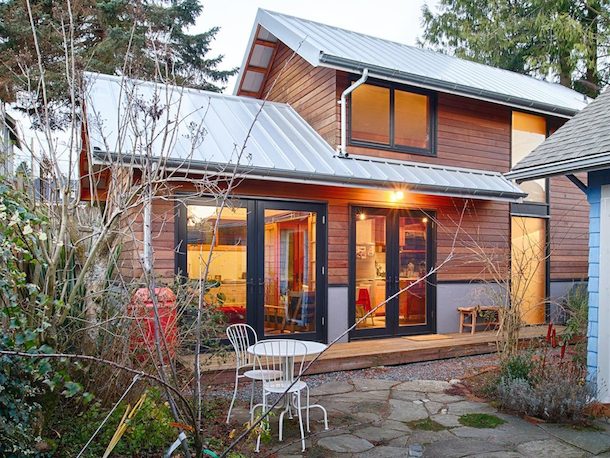
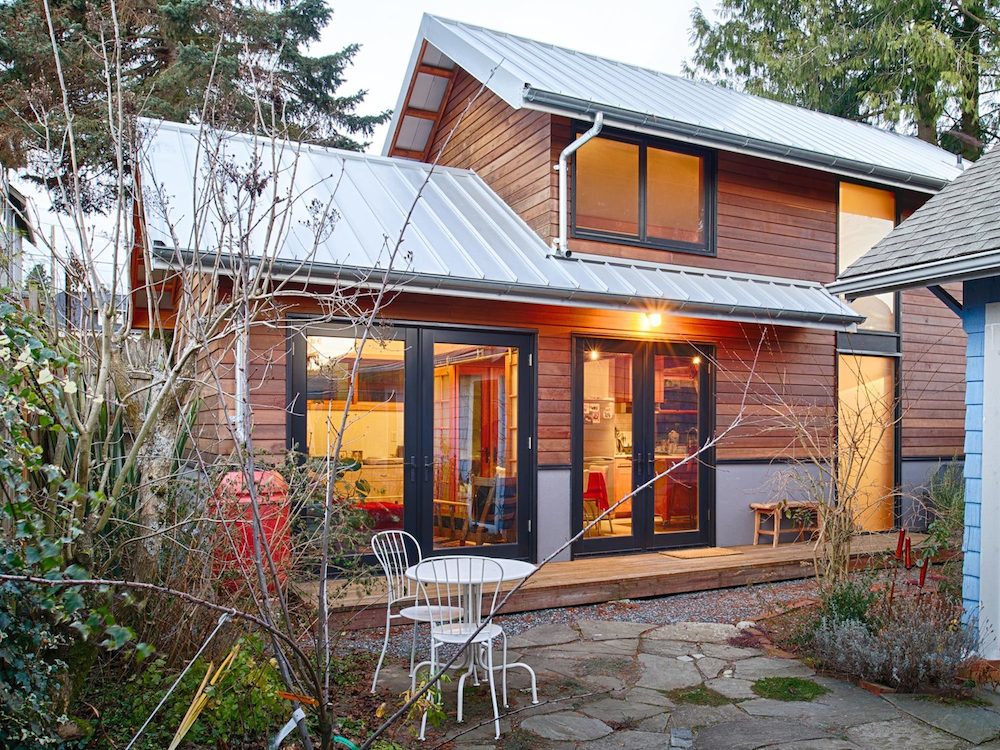
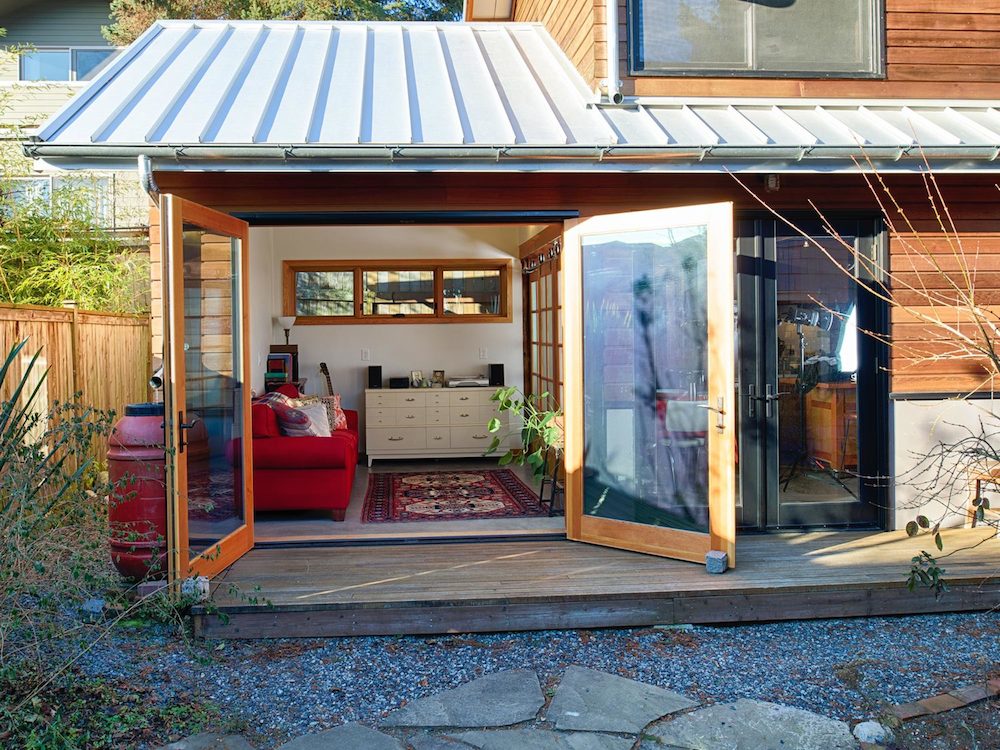
We love ADUs. They have the power to do the near-impossible: pack more housing into suburban and other low-density areas that were not designed to be dense. And given that they’re typically wedged into a backyard, they err on the compact and efficient side of design. And we love this particular 550 sq ft Seattle ADU by Cast Architecture.

The house was built in the backyard of client Kate Lichtenstein. Tim Hammer, the architect who designed the project, is a bit of an expert in designing small spaces, having spent 18 months studying high-density housing in Kobe, Japan as well as living in 550-square-foot fisherman’s shack in Ballard, WA himself. Informed by these experiences, Hammer created a space that feels light and spacious, despite the tiny footprint.

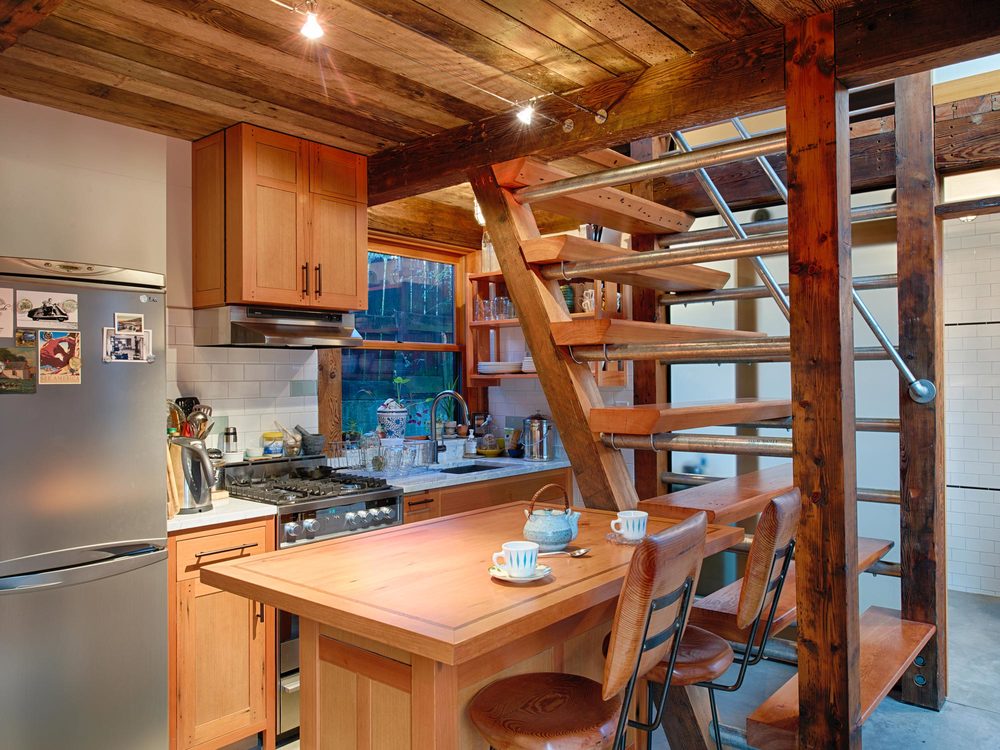
The house has great eco cred, enjoying a 5-star Built Green designation. It uses a ton of salvaged materials including stairs made of an old bowling lane. It also features LED lighting, a super-efficient boiler heater, low-VOC paints and caulks and radiant floors of fly-ash concrete (a by-product of burning coal for energy) and an exterior envelope with two inches of rigid insulation and wall cavities filled with an additional 5 ½ inches of cotton insulation from recycled blue jeans.

Lichtenstein built the place after the City of Seattle started allowing ADU construction on single-family lots in 2010. We hope more municipalities take Seattle’s lead by permitting these innovative little homes to sprout up in backyards everywhere.

Via Seattle Magazine

Toronto’s Tiny Town

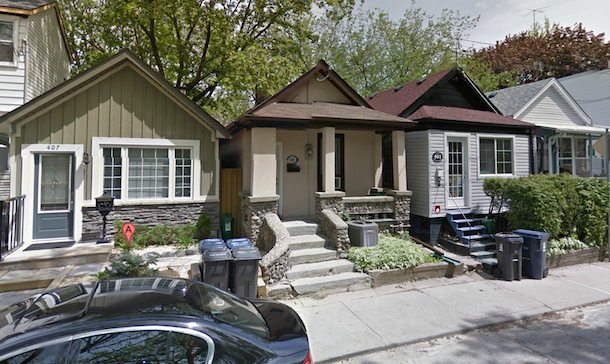
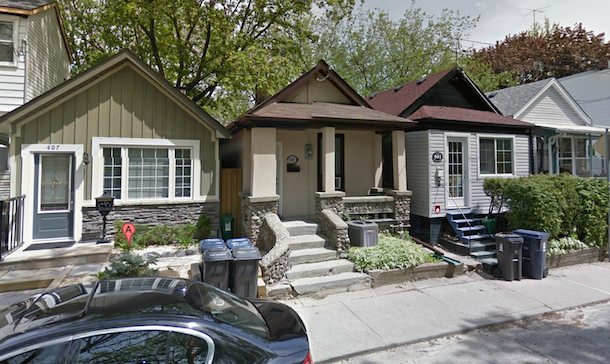
One of the biggest barriers for the proliferation of smart, compact single-family housing is zoning. Many municipalities require certain lot sizes, FARs (floor area ratios) and setbacks (distance from house to road) for homes to be deemed suitable for occupancy. One neighborhood in Toronto sidesteps many of these issues, leading to a cluster of small and/or interesting homes and achieving high density in an otherwise, quasi-suburban part of town.

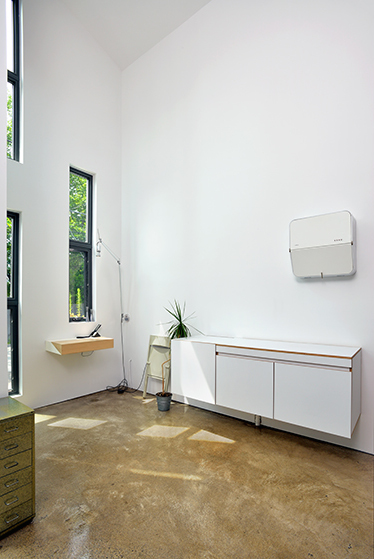
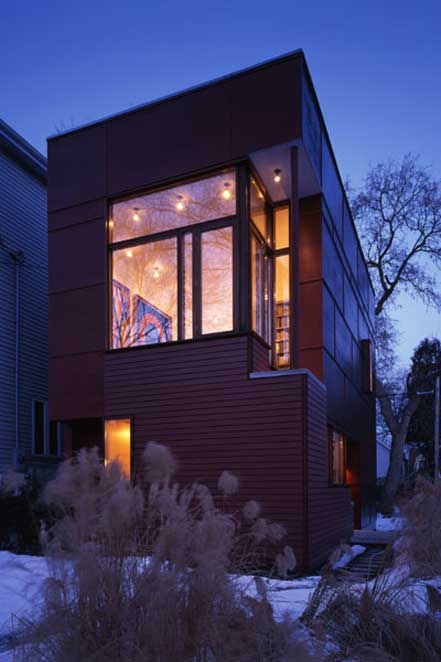
The neighborhood, deemed “Tiny Town” is centered around Craven Road. Linebox Studio, whose “Mini home” is a modern addition to the mostly historic area, explains how the neighborhood came to be:

First developed as worker housing in the 1880s the street was then a vacant railway corridor, it is now characterized by a series of 10’ wide lots with homes between 300 and 500 square feet in size.  There is a long continuous fence along its west side where it once bordered farmland and separated the wealthy from the poor. In 1909 the city began to gentrify this underprivileged community which resulted in a growing number of stable residents in the area. Since that time, the houses along Craven Road have wavered between the unlawful and decrepit to the quirky and endearing.

The current state of the neighborhood seems to be blend of artistic and crack-addled (Craven St, at various points in history, has been called Crackhead Alley and Alcoholics Row). But the former seems to be displacing the latter as Toronto’s property values ascend, something made clear by the Mini home as well as another architecturally interesting 1100 sq ft work/live space by Shim-Sutcliffe Architects (pics above).

What the neighborhood shows is that people will use the space that’s available. And, as Linebox and Shim-Sutcliffe show, creativity often flourishes when that space is limited.