The High Cost of the Guest Room

Pulling data from the US Census, Finder.com found there are 9.4% more bedrooms in the U.S. than people: 357M bedrooms but only 323.4M people–a 33.6 million bedroom surplus. This figure, they note, is probably very conservative because it assumes one person per bedroom and many couples share a bedroom.

This surplus is not just a waste of good mattresses, but money. They suggest putting those spare rooms to use. Rent them, Airbnb them, do something other than letting them sit as big dust traps. They estimate that renting all of these rooms for a mere $100 week would yield $174B. But that figure is super conservative too: “Americans in bigger cities could get significantly more than the national average. For example, Phoenix residents can get $338 a week ($17,576 a year), while people in Nashville, Tenn., can rake in $572 a room per week to the tune of nearly $30,000 a year.”

We might also suggest that developers and architects start channelling their energies toward smaller–or at least more flexible–spaces. And for people looking for a new home to start purchasing/renting/demanding smaller homes, armed with the knowledge of the real costs of keeping a room (or rooms) on standby.

Via CNBC

Rethinking the American Dream Home

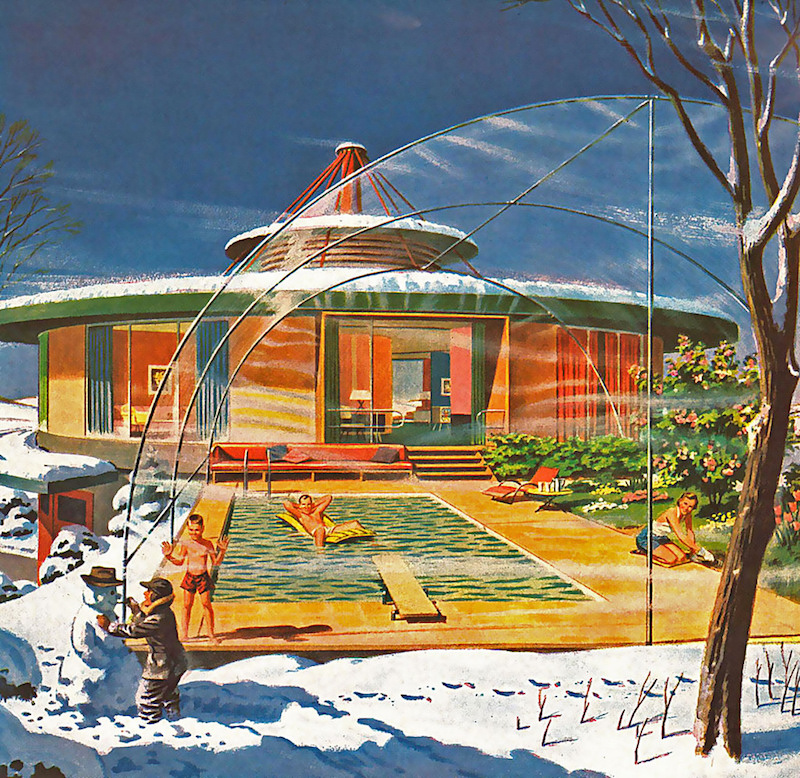
Whether manufactured or the reflection of a genuine desire, the American dream has long been a process of settling down with your family in your own single family house (ideally with white picket fence). To some extent, there is a shift away from this dream. One obvious reason is that many people are delaying or avoiding coupling up and having kids. 27% of all Americans live alone–a percentage that has continually increased over the years–suggesting there’s a movement away from nuclear family households and the single family homes they inhabit. Even for those who do have families, there seems to be a shift around the dream of homeownership, a shift that went into overdrive following the housing crisis in 2007. People are questioning whether owning a house means they’ve “arrived” in the world. How can carrying mountains of mortgage debt forcing homeowners to choose work based on whether it can pay the bills be a dream? How can managing and maintaining stuff and space homeowners seldom use be a dream? How can hour plus commutes to homes in lifeless cul du sacs be a dream? It’s not a stretch to say we need to rethink our dreams when they’re so out of sync with reality. This new dream is what real estate startup Acre is all about.

Acre’s mission “is to preserve the beauty and balance of of the environment, connect our homes to it, and give homeowners the freedom to enjoy it more fully.” Husband and wife founders Andrew and Jennifer Dicksen want to create “innovative, attainable, high-quality homes that are better for people and the planet,” according to their website. The way they do this is through easy to ship and assemble homes that are net zero, creating both reduced construction and operating expenses as well as minimal environmental impact.

On top of being more efficient than status quo housing, Acre wants to challenge the large house as status symbol. Not only does the size impact the efficiency of the home, but it often leads to homeowners serving their homes (cleaning, maintaining, paying for, etc) versus the other way around. Acre explains in their promotional video that the status that comes from owning one of their homes is that the owner shows off his or her intelligent, intentional existence (a more enlightened form of status seeking we suppose).

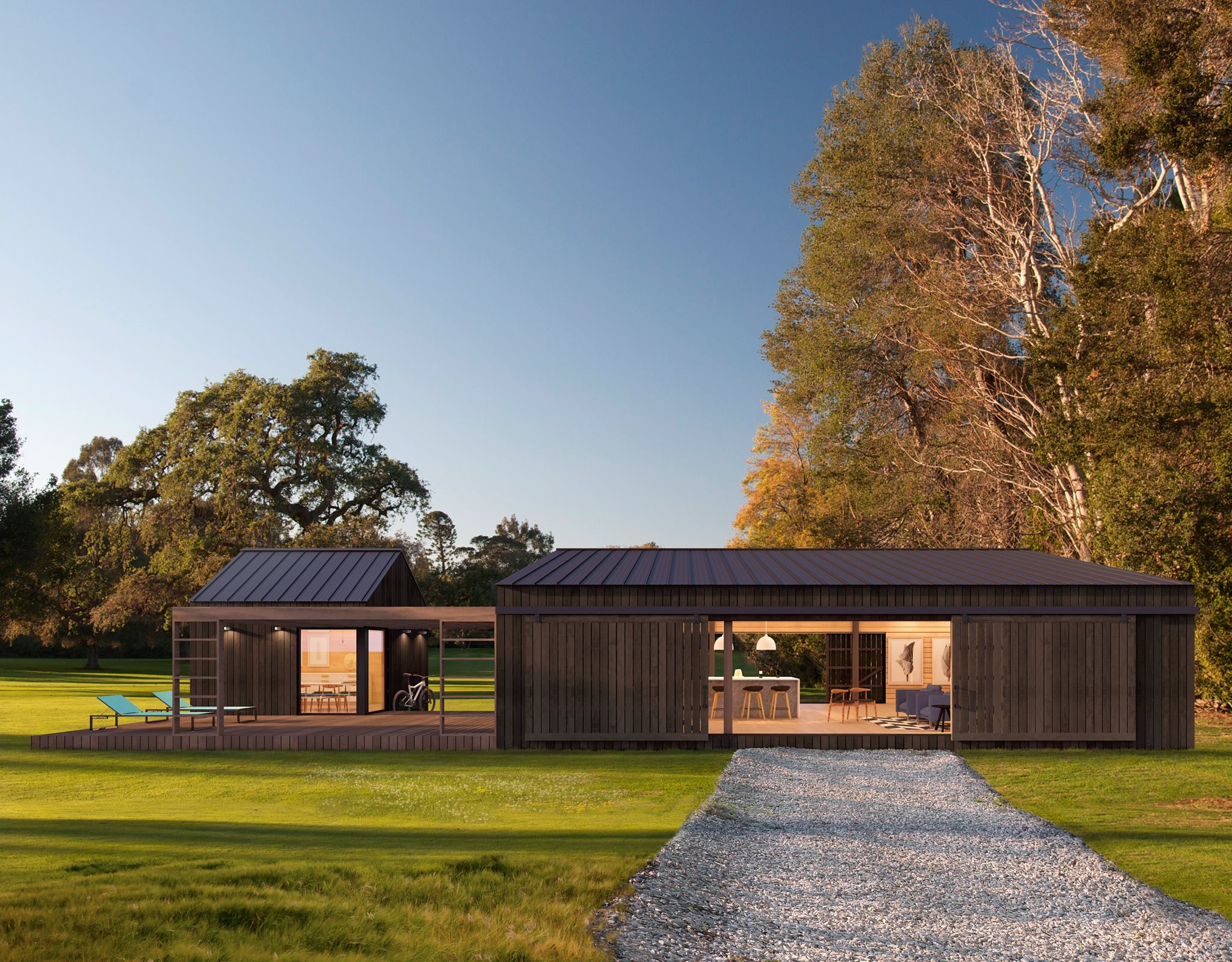
They are offering three sizes: small, medium and large, ranging from 1200-1800 sq ft and two to four bedrooms. The houses arrive in a shipping container, and once the foundations are set, take three months to construct. While homeowners must take care of buying the land and laying the foundation, Acre’s pricing includes the rest: from delivery in the continental US, construction costs, all materials and finishes, solar power systems, appliances and so on.

Speaking of pricing, the small house runs $400K, medium is $450K and the large is $500K–prices that will surely increase with land costs and foundation work. The prices, considering the homes’ quality and features, are not too surprising. Yet these prices are considerably higher than the median price of a single family home in America, which is about $226K, raising a thorny question: which would go further toward simplifying life, buying and improving a less expensive, lower quality home or going for something like Acre’s homes, which in the long run, might be a better investment?

Acre also doesn’t address the thing that can totally thwart a home’s attempts at being energy efficient, which is its location. These are still single family homes, which are ultimately best suited for suburban (read: driving intensive) living. Almost anyway you cut it, single family housing in the burbs is going to be less efficient than multi family housing in transit friendly locations

Those questions aside, we appreciate what Acre is trying to do, how they are trying to make a substantive change to how homes are designed and built and how they are making us think about how we relate to our homes financially, environmentally and psychologically. If you’re interested in an Acre, head over to their website

HT Jared J.

Single Family Housing that Makes Sense

There was a time when American single family homes weren’t so absurdly large. In 1950, the average household had 3.83 people and the average new single family home was 983 sq ft, making for a pretty reasonable 291 sq ft per person. Compare that to 2014, when the average household had 2.54 people and the average new single family home was 2,690 sq ft, or 1059 sq ft per person. That’s a 360% increase in per capita housing size. Yikes! What’s worse is this continual embiggening of the American home has dwindled the options of modestly sized homes for those who want them. We frequently get notes from people who want to downsize, but say they are forced into homes larger than they want because there’s virtually nothing available in their area. A real estate startup out of San Antonio, TX called Rising Barn is trying to remedy this lack of options, offering prefabricated, stylish, affordable and reasonably sized single family homes.

risingbarn

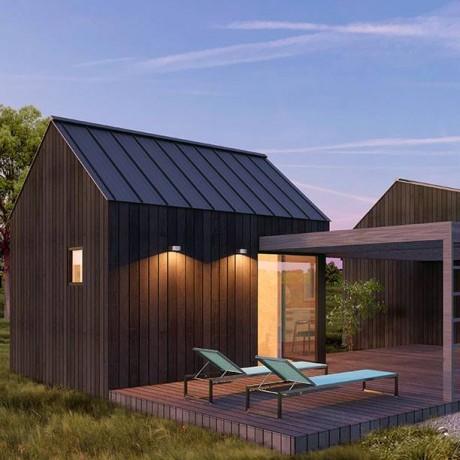
Rising Barn offers five “kits” with two categories of structures: cabins and domos. The cabins come in two sizes, large and medium. The large is a two bedroom unit with 720 sq ft of usable square feet (above), and the medium is a studio with half the area of the large; unlike the large, it doesn’t have a full bath or kitchen, so it’s designed for “work/live” use. The three domos are multipurpose rooms ranging from 80-160 sq ft and can be used in conjunction with cabins or as additions to existing homes.

risingbarn-domo

Rising Barn wants to make the whole process simple and affordable. Here’s an explanation of the ordering process from their site:

Once you do [select a kit], our barn kits will be delivered to your land in 2-6 weeks. If you prefer to hire a crew, we are happy to assist you in choosing the right one in your area. If you reside in Texas, you can contract a Rising Barn team leader or use our turn key service. You can build it with a few friends within in a week, work alongside Rising Barn team leaders, use our turnkey service, or we can help you find a local crew to assist.

According to the San Antonio Business Journal, unit pricing ranges from $120-200, which includes material and labor. If you go the DIY route, that cost drops to $90 to $105 per square foot. So a 720 sq ft cabin built by contractors would run, on the top end, $144K; even factoring in land costs, permitting and other sundry expenses, this seems like pretty competitive pricing.

Sure, there are cheaper prefab options, but I doubt they look half as nice as Rising Barn’s or are made half as well. And the ones that do look and are built this nice typically run in the multiple hundreds of thousands of dollars just for the structure. If you must live in a single family home, Rising Barn looks like a solid option. 

Millennials, Micros and Why Hannah Horvath Probably Couldn’t Afford to live in Brooklyn

If you watch the HBO series “Girls”, you know who Hannah Horvath is. If you don’t watch it, Hannah is an underemployed writer and substitute teacher living in one of Brooklyn’s hippest neighborhoods. Her life is filled with all sorts of interesting (albeit melodramatic) experiences and friends. She eschews cars for a bike. She wears weird clothes and is covered with tattoos. Because of her underemployment, urban leaning, experience loving, bike riding lifestyle, the character is held up in the media as the archetypal urban Millennial. Yet she is a mythical creature. In reality, Hannah would be cast out to Rochester or Indianapolis or some other city whose cost of living is in line with her income. Even with parental support or a roommate’s or Adam’s money, it’s unlikely she could afford the decent-sized two bedroom apartment she keeps throughout the series.

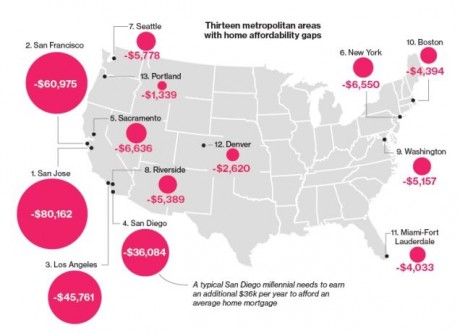
On this site and many others, people have been quick to define Millennial preferences, which fall along the lines of Hannah’s. They like cities, Instagram and experiences; they dislike suburbs, cars and stuff. Some of these stereotypes might hold a lick of truth, but they miss cold, hard economic realities. Through a combination of astronomical rents and stagnant wage growth in many professions, many–if not most–Millennials are being priced out of today’s major cities. A recent Bloomberg story highlights this well, showing that 13 of the US’s major cities are profoundly out of reach for the average Millennial. For example, the average San Franciscan Millennial would need to pull in an extra $60K a year to afford the city’s average home mortgage. Of course there are rentals, but that scene is just as bad. The city’s median rent is $4,225 month.

millennials-housing

So if they’re not living in Greenpoint or the Mission, where are they living?

Sometimes I am guilty of creating a polarity, where people either choose to live in the city center or far afield in the suburbs. But this is not an accurate polarity. There are many stops between city center and cul du sac, and a recent article in Gizmodo by Alissa Walker describes some these stops, particularly as they relate to Millennial migratory patterns.

Walker reports two major trends. First, is the urbanization of the suburbs. She says that Millennials are “looking for amenities like walkability and public transit,” but according to an Urban Land Institute study, they are more concerned about “relationships and having the time to enjoy those relationships, which doesn’t necessarily mean working long hours to pay the rent in a big city.” They want the benefits of the city, but they are not necessarily committed to living in one.

As such, Millennials are creating what one writer called Urban Burbs. Walker writes:

Millennials might not be staying in the urban cores, but rather, they’re helping to remake the urban-like enclaves that allow easy access to the city when they want it. These places where millennials are choosing to live still have the qualities of downtowns—dense housing, transit connections, walkability, good food, great bars—without the high prices of downtowns.

She points to a couple examples in suburban Chicago (my birthplace for what it’s worth), where smaller, amenity rich rental apartments are cropping up in places that have been traditionally the strongholds of mortgaged single family home suburban living.

The other trend Walker writes about is the revitalization of smaller, affordable cities like San Antonio and Milwaukee. This is a trend I’ve noticed in the micro world and reflected in my post about how micro apartment buildings are sprouting up in smaller cities. I get Google alerts for micro-apartment news and for every alert about a micro apartment building going up in New York and San Francisco, there are ten going up in smaller places like Des Moines, Kalamazoo and Buffalo.

A Bloomberg article entitled “Micro-Apartments Are Coming to the Midwest” apparently sees what I see. While cities like Columbus and Omaha might not be space starved like NYC, Millennials, looking for an apartment are willing to forsake size for a good location and low price. This consumer desire is abetted by developers who can charge more per square foot (though this is not a perfect formula as sometimes micros can cost more to build on a per square foot basis). This passage from the article to my mind sums it up:

In that light, the shift toward smaller apartments can be seen as simple economics: Smaller apartments are more profitable for developers to build and more affordable for tenants to rent. “I could paint a cooler picture about value of design, efficiency, and all of that,” says Alexander Grgurich, a development analyst at Nelson Construction & Development, which converted a century-old office building in Des Moines into 425-square-foot apartments in 2013. “For us, it’s about getting a higher price per square foot while offering a lower absolute rent to the renter.”

The same appeal of offering an attractive, albeit small $2000 micro apartment in Boston versus a $2750 conventional studio is equally recognized when the price delta is $750 versus $1000 in a city like St Louis.

[divider]

I moved to New York when I was roughly Hannah’s age. I paid around $650/month to share an illegally subdivided Williamsburg duplex with four other people. It seemed outrageous at the time because I had just been paying a few bucks more for my own one bedroom in Colorado. But I suspect most Millennials moving to the city now would kill for a deal like mine.

On the one hand, I feel a certain pity for all the young people who cannot feasibly live in these exciting global cities (and I’m sure there are many not-so-young folks getting priced out as well). On the other hand, I’m a little envious. Particularly in some of the smaller cities Walker mentions, there seems to be vital cultural movements afoot. Arts and small businesses are flourishing. Young people are riding their bikes everywhere because they have the time to do so. They are doing many things they couldn’t if they were scrambling to make rent payments. Millennials, whether living in a low cost micro apartment or shared house or somewhere in between, are creating edited lives by virtue of will, not history and infrastructure.

Image credit: HBO, CRAIG BLANKENHORN

What is the Future of Home?

We–well Graham, our founder–often gets asked to present on the subject of LifeEdited, doing more with less and the like. And we–well I, David your trusty blogger–am often charged with researching and helping to organize these presentations. Graham spoke at last week’s Visioneering conference held by X-Prize (my research being the main culprit behind the site’s mostly offline status the last couple weeks). If you’re not familiar with X-Prize, it’s an organization that offers up a bunch of money to fund big solutions to grand challenges. Visioneering is a brainstorming session to consider and prioritize what the next X-Prize challenge will be. Graham spoke on the “future of home” and was charged with throwing out a grand challenge around the topic.

In researching this topic, one thing became really clear to me: the future of housing is a really big deal, perhaps the biggest individual deal there is in terms of addressing our biggest problem. What is that biggest problem, you ask? In my opinion, it’s climate change, aka global warming.

Consider the following:

  • 13 of the 15 hottest years on record have all occurred since 2000.
  • Arctic sea ice is melting at a rate of 12% a year and some believe it might all be gone as soon as 2030.
  • The atmospheric concentration of CO2 just passed 400 ppm, which is already 50 ppm north of what is considered an acceptable concentration for maintaining a stable climate situation. Going at our current our current average emission rate of 1.92 ppm, we will hit 450 ppm by 2042, which might trigger temperature increases of anywhere 2-5 degrees centigrade. This might (i.e. likely) set off a bunch of events like massive glacial melting, triggering sea level rises and the release of ungodly amounts of methane from said glaciers accelerating warming even more. We can look forward to horrible, ongoing droughts in some places (we’re looking at you California) and monsoon like conditions in others. Famine, mass-extinctions of flora and fauna, climate refugeeism, resource conflicts, plagues of invasive species and lots of other fun stuff if things keep going as is.
  • Experts believe that if we are to stand any chance of stabilizing the climate, we need to return to 50% of 2010 global CO2 emissions…and do it yesterday. But for all the resolutions and imperatives to curb global CO2 emissions, there seems scant evidence that it will happen. According to recent National Oceanic and Atmospheric Association (NOAA) findings, “the average growth rate of carbon dioxide concentration in the atmosphere from 2012 to 2014 was 2.25 ppm per year, the highest ever recorded over three consecutive years.” Ever. Recorded.

How does all of this relate to housing? Well many believe that housing and related mobility accounts for anywhere from 40-70% of our CO2 emissions. If there were one place to focus our energies in reducing our carbon emissions, housing would be a great candidate (or we could just screw it all and go to Mars…either way).

Of course stemming housing-related emissions is not a one-size-fits all proposition. Much of the global population growth in the 21st Century is expected to happen in the urban areas of the developing world; it’ll be tough to anticipate how this growth will go down exactly and its impact on the environment. What we do know here and now is that the developed world (and the US in particular) has a totally outsized carbon footprint relative to its population–a footprint that’s largely responsible for our current quagmire and one that will prove geo-cidal if it were to continue.

visioneer

One interesting study I found used a Swiss village as a proxy for how emissions were affected by housing typologies. What it found was that a small percentage of houses created a disproportionate amount of emissions. Large homes located away from the village center–21% of the houses studied–created more than 50% of the emissions due to heating, cooling and transportation requirements.

In the global housing context, the United States is that 21% that creates a disproportionately large carbon footprint. We are the second biggest overall global producers of CO2, despite being a distant third in terms of population. The second most populated country, India, has four times the population of the US and a per capita carbon footprint 1/10 ours. China, the most populated country, has the largest total carbon footprint, but a per capita footprint that is about 1/3 ours, and a healthy chunk of that comes from manufacturing our–and the rest of the world’s–stuff.

So if there is going to be a future of home–or a future of anything–it seems pretty clear that we Americans, and to various extents the rest of the developed world, must reduce the carbon footprint of our homes. The US released 6.7M metric tons of CO2 into the atmosphere in 2013. Halving our housing related emissions (at 70%, roughly 2.3M tons) might not be the end of the story, but could be a good beginning, especially if it were to influence housing in other parts of the world. So the challenge, as we phrased it, was this:

Our grand challenge in the next 5 years is to design and bring into being attractive, cost-effective homes that bring together existing and future technologies and that will compel the developed world to live in them thereby drastically reducing their footprints and inspiring the rest of the world to go this way instead of the suburban McMansion and highway route.The challenge is also for the emerging economies to develop their version of this…a low cost, compelling way of living that is healthy and safe yet attractive enough to compete with the desire for the “Cribs” lifestyle.

A grand challenge indeed. And fortunately for us, we were not charged with providing a specific solution to the challenge. We did present a number of technologies that are addressing the challenge–from transforming architecture to thermostatic smart sensors to 3D architecture and much more. Most followed the LifeEdited ethic of downsizing, doing more with less but better, employing technology to improve efficiency and so on (note: the X Prize is not into policy-making, so these were technological, not political, solutions).

The topic and my findings were pretty overwhelming. As a species, we face a huge challenge. And we the inhabitants of the “developed” world have a huge responsibility. Our big-house dwelling, car-dependent, consumer-obsessed lifestyle will almost certainly lead the planet to environmental catastrophe if continued. If we want to stand a chance, something must change. What will that change be, I’m not sure.

What do you think? What do you think is the future of home? What technological solutions would you employ to drastically reduce our housing-related carbon footprints? Let us know in our comments section.

Why Are Millennials Living at Home?

Maybe it’s access to stocked fridges or the premium cable channels–whatever the reason, Millennials (roughly those born between 1983-1996) are shacking up with their folks at unprecedented rates. The above infographic from Good Magazine shows that in the US there were 21.6 million people–7% of overall population and 36% of Millennials—living with their folks in 2012; a 4% increase over just five years prior. The US is not alone. According to StatCan, 59.3% of 20-29 year old Canadians were living with their folks or one folk in 2011. Compare that to 11% in 1981!

Truth is Millennials aren’t staying at home because they’re watching Game of Thrones with tubs of Neapolitan ice cream. The reasons are economics and lifestyle choices. The days of graduating college into a verdant field of employment opportunity are, at least for the time being, over. 2/3 of all American graduates are leaving college with an average of $26K student loan debt. Then there’s low employment rates, which for Millennials stands around 15%–twice the national average. Of the live-at-home American Millennials, 45% reported being unemployed. The other 55% are not necessarily flush; real wages have consistently fallen for Millennials–a problem most acute with their cohort.

Then fewer Millennials are marrying. Only 20% of 18-29 years olds are married; compared to 59% in 1960 for that same group. Tellingly, 44% of Millennials think the institution obsolete according to Pew Research. Moving out to live with your partner just doesn’t have the urgency it might have once had.

What does this have to do with small space living?

We have read many comment boards for stories about micro-apartments, with the frequent comparisons to jail cells and cages. But what often gets missed amidst the fast-flying vitriol are demographic realities and changing lifestyles. Many people–and not just Millennials–don’t want to spend all their money on housing, either by choice or economic necessity; they might not want to marry; and their ideal living situation is more likely to be in the city than suburbs, particularly for Millennials.

There has been a big kerfuffle about micro-housing in the Pacific Northwest, but there has been less talk about why they’re so popular. There’s a huge demand for low-cost, centrally located housing, and having a rumpus room big enough for a ping-pong table is far less important than proximity to work and other amenities. While we can’t prove it, we suspect many of the micro-apartment dwellers are people who might otherwise be living at home. Moreover, as Derek Thompson of The Atlantic stated (perhaps a little optimistically), we are living in an era of cheap food and consumer goods relative to income.  Now it’s the time for housing prices to follow suit.

Of course there are many other factors contributing to the Millennial “failure to launch,” as many have put it. A stagnant economy, questionable returns on higher education, income inequality, a shrinking middle class and so forth. But in a certain way, reducing one of the biggest life expenses–housing and, to some extent, transportation–you can give more mobility for people who may never enjoy the salad days their folks did. And no, many Millennials might not be able afford a 1500 sq ft home for themselves (too often the only choice), which forces them to stay at home. But even with a modest income, they might be able to afford a great 350 sq ft apartment in the middle of the city, one that allows them to live car free and gives them access to the things that they find important.

Land Down Under is Over in Terms of Housing Size

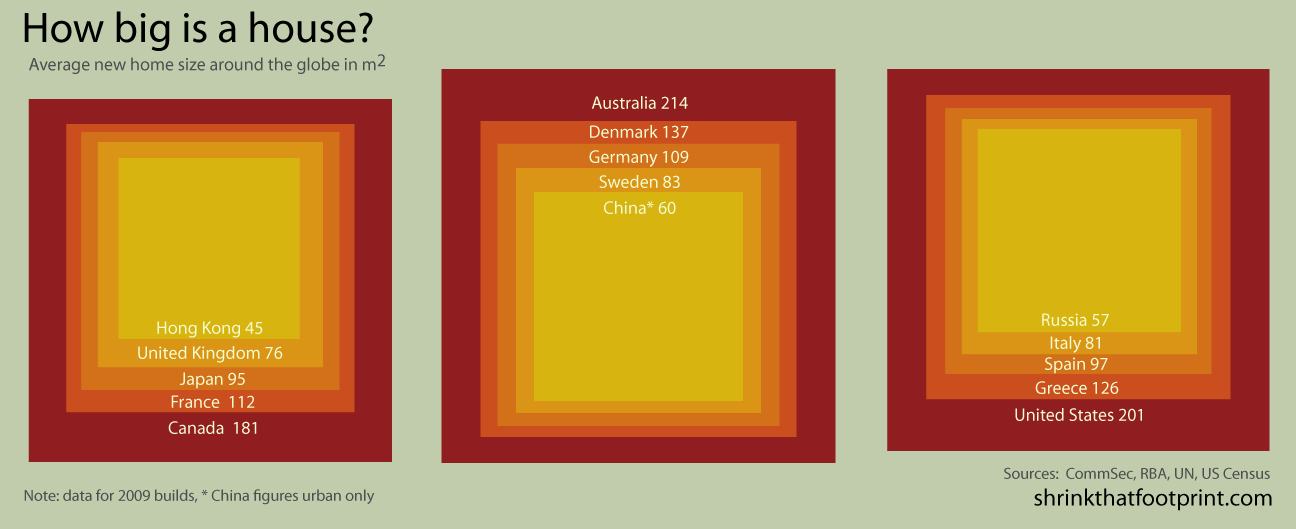
These infographics from Shrink That Footprint show the average new house sizes across the world in 2009. Despite the American penchant to do everything a little bit bigger, it’s the Australians who claim the prize for world’s largest homes.

Without getting too pseudo-scholarly about the situation, the three countries with the biggest homes (Australia, US and Canada) began as British colonies a few hundred years ago. Unlike their motherland, all were fairly unbound geographically (no pesky oceans every 20 miles). A good portion their infrastructures were created after the widespread availability of cars. All of these factors surely contributed to the overgrown housing statistics we see here.

per-capita-square-footage-around-the-world

The other infographic concerns per capita space use, which divides housing size by household number (most developed nations average around 2.5 people per household). These figures are predictably correlated with overall housing size. Again, Australia wins the dubious prize for most space per person.

per-capita-electricity-use

We fished around Shrink That Footprint and found another infographic showing per capita residential electricity use. Interestingly, Australia is a lowly fourth place in this heat (behind France, whose homes are 90% smaller!). Canada makes a from-the-behind dash to the front; with its harsher-than-most winters and big homes, it is often crowned the world’s energy gulping king (there is no explanation as to why Australia’s numbers wouldn’t be commensurately higher due to inordinate use of AC, particularly for its large homes).

What’s not shown in the graphics are trends. For example, China, whose energy consumption is a fraction of countries like the US and Canada, has seen a 600% increase in electricity over the last 20 years. New homes in the US are almost as big as ever. And household sizes are shrinking in Europe (albeit by a small amount), which means per capita housing size is increasing there.

The good news is…we’re not sure what the good news is. Housing sizes are bigger than ever and energy consumption continues to increase across the globe (except for the countries in most dire need). One thing to extract is that housing size is not correlated with quality of life; for example, Denmark and Sweden, who both enjoy high standards of living have smaller homes than the Big Three. But then again, their infrastructures–smaller cities with high quality public transport–support those smaller homes (not the case with the Big Three).

What do you think? What can you deduce from these figures? Is there a silver lining or will the world continue to consume until it bursts? Let us know your thoughts in our comments section.

You’re Getting Older, Where Will You Live?

So often, the spotlight on micro-apartment residents shines brightest on the young. Recent college grads, twenty-something Bay Area startup employees and other unencumbered types are the people we imagine will live in 300 sq ft, Murphy-bed-equipped micro-apartments. But this assumption might be out of step with demographic realities. Empty-nested-baby boomers are retiring en masse and micro-apartments might be a perfect fit for their housing needs.

To illustrate what the US housing market will have to contend with demographically, here are a few stats from a US and World Report article:

  • The age-65-and-older population grew 18 percent between 2000 and 2011 to 41.4 million senior citizens.
  • The median income for people age 65 and older was $27,707 for males and $15,362 for females in 2011.
  • 81 percent of seniors reside in metropolitan areas.
  • The average life expectancy for people turning age 65 is an additional 20.4 years for women and 17.8 years for men.
  • The US Census Bureau projects that by 2040, there will be twice as many Seniors as there are today, with 28 million of them aged at least 80 years old.

In other words, there are more seniors, living longer, with less money, primarily living in and around urban areas. The trend toward building bigger houses, with their huge lawns to mow, interiors to clean and mortgages to pay seems profoundly incompatible with our growing senior ranks.

Not only do larger homes make less sense in terms of convenience and economics, their isolating effects may even have a deleterious impact on senior health. According to the Yale Medical Group, social seniors showed reduced risks of cardiovascular problems, some cancers, osteoporosis, rheumatoid arthritis and Alzheimers. Conversely, antisocial seniors had higher blood pressure and greater risk of death (we thought the risk was the same for everyone).

Retirement communities provide one answer for housing seniors. There has been an increase in “age-restricted” (typically with a minimum age of 50) multifamily housing units recently: In 2012, 225K units were started versus 92K started four years ago. But with 18.5% of the over-65 population still working in 2012, and with many seniors enjoying robust health for many years past 60, the designation of retirement versus non-retirement is getting fuzzier by the day.

Another solution is the “Naturally Occurring Retirement Community” (NORC), which provide a transitional housing model. According to Wikipedia, a NORC is a:

Community that was not originally designed for seniors, but that has a large proportion of residents who are older adults (at least 60 years old). These communities are not created to meet the needs of seniors living independently in their homes, but rather evolve naturally, as adult residents age in place.

NORCs are cropping up all over the US. In NYC, the birthplace of the NORC, there are 27, all of which are Robert Moses-era “towers-in-the park” style apartment high-rises. Other NORCs take form in suburban developments and even rural areas.

What’s great about the NORC is that they use existing buildings and tenants. And unlike retirement homes, young and old live alongside one another. What’s less great is that they’re not purpose built. Some NORCs, because they were built around a full family, are not necessarily the best arrangements for the needs of seniors–people for whom smaller, more manageable spaces are a big plus.

In Seattle, where the micro-apartment controversy continues to brew, there have been reports that seniors are opting for the tiny digs because of their convenience and small price tags. Piggybacking on this trend, we would contend that micro-apartments and other varieties of compact living are perfectly suited for senior populations: They’re easier to manage, generally cost less to rent, buy and operate, they lend themselves to social living, they are typically urban and have applicability to non-senior demographics.

What do you think about this topic? Are you a senior who has discovered a great housing solution? Or are you faced with the scarcity of smart housing? Let us know your thoughts in our comments section.

Senior Woman Image via Shutterstock.com

4 Reasons Why Less is More for Planet Earth

Happy Earth Day! We don’t talk about our beautiful host planet that much around here. Not because we don’t care. We do. Not because the “less, but better” lifestyle doesn’t have benefits for the planet. It does. But we think those benefits stand on their own legs. In other words, the environmental benefits are the happy byproduct of a simpler, better-designed life–not the reason to live it.

All that said, some reputable sources claim that our glorious planet has been pretty battered in the last couple hundred years and that we might want to consider changing the manner in which we live on it…like yesterday.

In consideration of these considerations, we put together a few compelling reasons why living a life with less stuff and space makes a lot of sense for the planet.

Less stuff = smaller carbon footprint

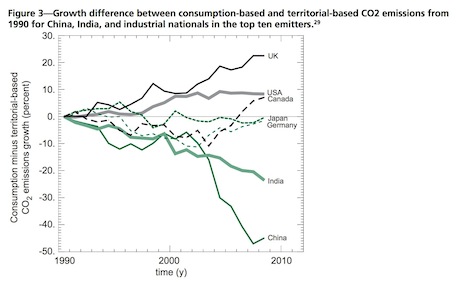
A recent article in Guardian UK made this point abundantly clear. Between 1990-2008, the UK boasted that it reduced its carbon emissions by an impressive 19% within its borders. The trouble was that when their carbon emissions were measured based on consumption, which includes the emissions of producing imported goods, their carbon emissions increased a whopping 20% over that same period. The US clocked an 8% increase. This lower rate is nothing to brag about–in that same period we increased our intra-border emissions by 17% for a 25% increase overall.
Carbon-emissions-terrestrial-consumption

China has blunted the impact of our carbon production. It’s estimated that 45% of China’s carbon emissions, which are the world’s greatest overall, are attributable to the production of exported goods. If we take away carbon emissions for exported goods, China’s carbon footprint has been steadily decreasing in the last 20 years.

Long story short: Fewer exports and less stuff = less carbon and greenhouse gases no matter where you are.

Are you dense?

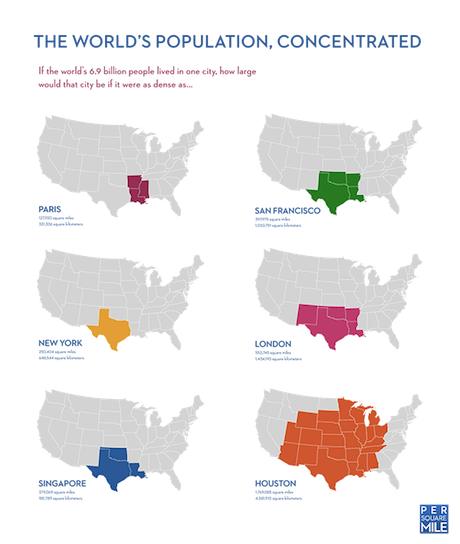
We’ve looked at this topic before with Per Square Mile’s infographics. Basically, if the planet’s 7 billion people enjoyed New York City levels of housing density, we could all live in an area the size of Texas. If those 7 billion were to be housed as densely as Texans–specifically Houston, Texans–the amount of area would occupy most of the continental US.
per-square-foot

We are quick to say this is not the whole story: How we consume plays a significant part in our area footprint. We might live in a 300 sq ft home, but our consumer behavior might require a square mile’s worth of resources–a square mile that is most likely in China (see above).

But density does matter. If everyone lived in larger homes on bigger lots, requiring more sprawl, more driving on more highways, it would create a bigger environmental impact and almost certainly encroach on nature.

As counterintuitive as it sounds, a life in the heart of the city, with its walkability and access to public transport,  might be the greenest thing you can do.

As economist Ed Glaeser put it, “The next time you want to fight for nature, leave [Thoreau’s] Walden Pond alone and start pushing for denser development.”

Big homes use more resources to build

According to the EPA, home construction, remodeling and demolition projects are responsible for a staggering 25-30% of the nation’s annual municipal solid waste. If the world were to start building small–both new construction and remodeling–there would still be a lot of waste, but here’s the thing: Building big homes creates a disproportionate amount of waste compared to smaller homes. In other words, a 2K square foot home doesn’t necessarily create twice as much waste as a 1K square foot home, as Greenbiz explained a few years ago:

The U.S. National Association of Home Builders (NAHB) estimates the materials used in building a 2,082-square-foot (193-m2) single-family house to include 13,837 board-feet of framing lumber, 11,550 square feet (1,073 m2) of sheathing, and 16.92 tons (15,350 kg) of concrete. One would expect that, relative to material use, there would be an economy of scale as house size increased…but that is not necessarily the case…because larger houses tend to have taller ceilings and more features, larger houses may actually consume proportionally more materials….a new 5,000-square-foot house will consume three times as much material as the 2,082-square-foot house NAHB has modeled, even though its square footage is only 2.4 times as large.

It’s not a major mental leap to say that if the size of homes were to decrease, the amount of waste and resources needed for construction would decrease in turn. Creative division of existing spaces would decrease that waste more still.

Big homes use more energy to maintain

It’s pretty common sense, but when you have a bigger home, not only do you need more building materials to make it, you more energy to maintain it.
energy-information-administration

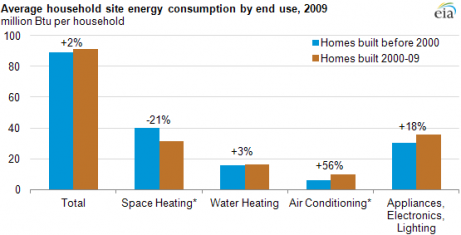
A study done by the Energy Information Administration found that homes made after 2000 use 2% more energy than pre-2000 ones. This tiny increase doesn’t tell the whole story though. These newer homes are considerably more efficient than the older ones, but because they are 30% bigger, all of those gains have been negated.

Those efficiency measures applied to smaller new homes and older homes could make a significant dent in our national energy consumption.

Can the American Dream be Rented?

For many years, the American Dream has centered around home ownership. The logic follows that you buy a home, lay roots and live in your biggest investment, which, more often than not, appreciates in value.

In the last few years, this dream has become a nightmare. The mortgage crisis created a class of defaulters, and the ensuing recession made down payments and financing near-impossibilities for most. Moreover, our mobile job market made the tether of a home more of a liability than asset.

According to a Wall Street Journal article by Daniel Gross called “Renting Prosperity,” these factors have triggered a shift away from the ownership ideal. He says:

In the American mind, renting has long symbolized striving—striving, that is, well short of achieving. But as we climb our way out of the Great Recession, it seems something has changed. Americans are getting over the idea of owning the American dream; increasingly, they’re OK with renting it.

The facts bolster his argument: home ownership is down, while rentership rises; and multi-unit buildings–most of which are used for rentals–have increased in production over the last few years while single units are declining.

He also explains that for many, the idea of ownership is mostly that: an idea. The reality is that people simply rent from the banks, whose “rent” comes in the form of interest and fees. This begs the question, if there is little, no or negative cost benefit to owning, why do it?

We’re big fans of rental/sharing services such as Zipcar and Rent-the-Runway. They allow you to use products by the hour, rather than paying a hefty and often unnecessary retainer fee. The author Gross points to these services as indicators of a changing attitude to rentership–that people increasingly care more about using than owning. The question is whether this a good system for housing, which for most is something they want to have all the time.

Like cloud computing, where all data is stored online and accessed when needed, could our world be moving away from the model of all-the-time ownership to on-demand access? On the one hand, this could lead to fewer people laying roots and improving their communities. On the other hand, it could lead to smarter rental homes and renters–the Strand East planned community is a good example of that.

What do you think? Do you think we should be living in the cloud or on the ground?

via Wall Street Journal