Have We Reached ‘Peak Stuff’?

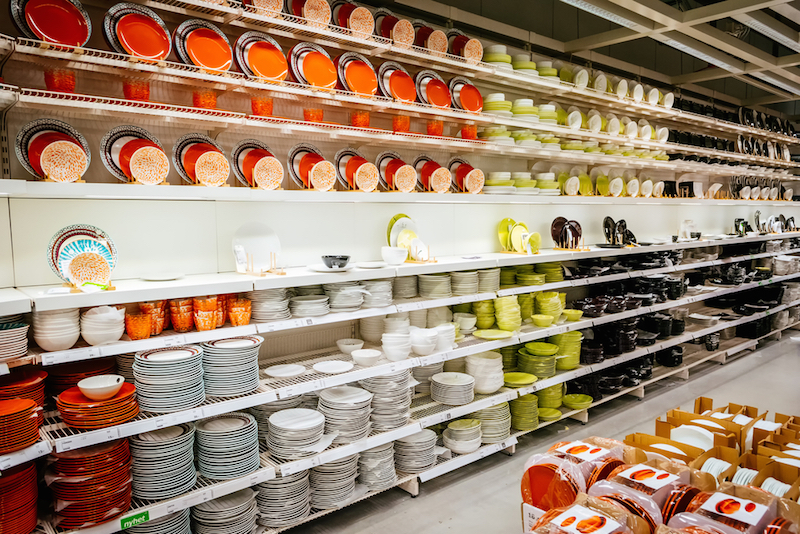
Make no mistake about it, the world still abounds with tons of stuff, but if we were to believe some, we might be approaching a state of “peak stuff”–a state where we have capped out our appetite for extraneous candle holders and handheld blenders. Ironically, one of the exponents of peak stuff is IKEA’s Chief Sustainability Officer Steve Howard, who, the other day, was on NPR talking about this theory. He thinks that the “total material impact of society in the West…[has] probably just about peaked.” He explains:

If you look at things like oil–well, actually, oil sales have peaked in the U.S. and Western Europe. Beef sales have pretty much peaked. Sugar sales have pretty much peaked. You can see trends in things like cars where young people, they’re getting their driving licenses either later or not getting them at all. This trend’s very broad across society….and we’re [IKEA] not immune from the trade. Obviously, you know, there are still people who don’t have–who have very limited means who would like significantly more stuff. But broadly, you saw a tremendous expansion in consumption and people’s livelihoods through the 20th century. And the use of stuff is plateauing out.

This is not the first time IKEA has addressed matters of reduced consumption. Their 2025 kitchen concept envisioned a future with far less food and space than the present. But the implications of peak stuff on the retail behemoth are unclear. Asked if IKEA–easily the single largest purveyor of stuff–would scale back its operations in the west and ramp them up in developing nations, Howard said, “We still want to meet more customers and to make ourselves much more accessible, so we’ll actually expand in the U.S. and still in most markets in Europe.”

His stance is that if there is going to be stuff, that that stuff be from IKEA, which has launched programs to promote reuse and responsible disposal in a number of its European outlets. He said that people want to reuse, recycle and generally make their stuff last as long as possible, but they often lack the channels to do so.  

We hope Howard’s theory is correct as the planet–and some might say the human psyche–is buckling under the weight of our obsession with accumulating stuff.

There are many indicators that we have reached peak stuff: minimalist sites like ours, the media’s obsession with tiny houses and so forth. But we realize as well as anyone that ours are minority views. That said, these things might be suggestive of what writer William Gibson once wrote, “The future is already here–it’s just not evenly distributed.”

What do you think? Have we reached peak stuff or is this a clever turn of phrase that will have little, if any, market impact?

Image credit: nomadFra / Shutterstock.com

It’s Okay to Buy Stuff, but Please Don’t Buy the Hype

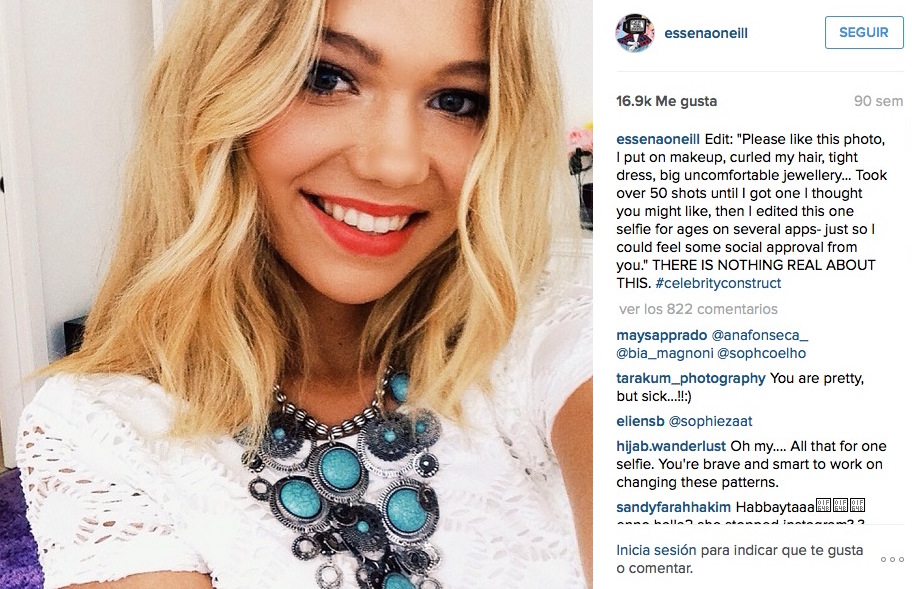
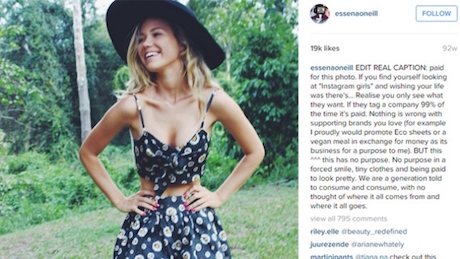
One of today’s most powerful advertising mediums is Instagram. Companies give tons of free products and pay handsome sums to have their products featured in highly trafficked Instagram account feeds. Until a few days ago, 19 year old Australian Essena O’Neil was a coveted Instagram model. Brands would give her stuff and pay her to show off their wares to her 600K Instagram followers. But then something happened. She took down nearly all of her Instagram pics, leaving a few with captions describing the true story behind the picture. Captions included, “I didn’t pay for the [pictured] dress, took countless photos trying to look hot for Instagram, the formal made me feel incredibly alone,” and, “Took over 50 shots until I got one I thought you might like, then I edited this one selfie for ages on several apps–just so I could feel some social approval from you.”

oneil2

O’Neil has since removed virtually all trace of her social media life. She deleted her Instagram, Tumblr, Youtube and Snapchat accounts. She made several impassioned videos describing how miserable she was trying to live up to the ideal she was supposed to embody. She also started a new site called “Let’s be Gamechangers” meant to combat the malevolent influence of social media striving. There are a few other agenda items as well:

I wish to create a platform that acts to spread new age messages of conscious living, addition [sic] to technology, conversations on transparency online, minimise the celebrity culture, promote veganism, plant based nutrition, environmental awareness, social issues, gender equality, controversial art.

While some say the whole thing is a calculated stunt to get attention, I think it has the authentic messiness of a 19 year old who truly lost it and wants to affect change. To her detractors, she wrote, “This is about me feeling the need to constantly perfect and edit my life online…I’ve had these feelings about social media for ages and struggled with coming to grips with them.”

[divider]

One of the biggest drivers of consumerism is advertising. Companies want to forge an association between the highly edited, staged ideals shown in ads and the products they’re selling. Happy, smiling people drink Coca Cola. Sexy, desired guys wear Axe Body Spray. But 9 times out of 10, there is zero causal relationship between the ideal shown and product sold. Coke will not make you happy. No amount of Axe Body Spray will make a guy attractive.

When I was researching this post, I ran across a video for an advertising advocacy group that envisioned a world without advertising and ad-fueled “information.” There would be no ads in Times Square. No posters on bus stops. No Instagram feeds. The producers were clearly trying to make it look like a bleak world–one without color, options and entertainment. But my main thought was, “Boy, that would be nice.” You could see buildings unmolested by billboards. Our cityscapes would be unmarred by ugly ads. People might look up from their phones and pay attention to the environment around them. 

None of this is to say advertising as an entity should be banished. There are many useful products out there, and the companies that make those products need people to know their products exist for sale. But when advertisers imply that their humble products will lead to amazing things, it’s good to call them out and cry bollocks, which is exactly what O’Neil did.

Screenshot via Petapixel

Combating Consumerism with Kids

Today’s post was written by mother and minimalist Jen Adams.

I have 13 children. That’s not a typo–thirteen. 5 adopted, 4 biological and 4 “step”–although don’t tell them that. Our kids range in age from 5 to 23 years old. We still have 10 at home–seven in high school, two in middle school and the last in kindergarten. It. Is. Awesome. And challenging.  We live in a 1700 sq ft home with four bedrooms and two bathrooms. The bedrooms are shared–four boys in one, three girls each in the other two and my partner and I in the last. The bathrooms are always shared. We began the process of intense minimalism in February 2015 when, as parents, we couldn’t take the clutter anymore. One of the biggest foes of minimalism, especially for impressionable younger people, is the influence of consumerism.

Regardless of your income or your priorities, consumerism an issue parents have to face, and particularly so if you’re trying to maintain a minimalist home. No matter how often you succumb to “the gimmes,” someone or something will always be peddling more. Commercials on TV, ads on the internet, friends who own more “stuff,” the ability for social media to track what you look for and like–it’s never ending. Want to be thinner? Faster? Stronger? Better looking? Have more energy? Look better? There seems to be a product that will fix whatever problem you might have.

But for us, resisting the urge to give in to consumerism wasn’t just about having less stuff and saving money (those are important). We wanted to about teach our kids values. I wanted them to learn:

  • That instant gratification isn’t all its cracked up to be
  • That stuff won’t make you happy
  • That you can’t get everything you want
  • That you have to work for what you want
  • That you should prioritize what’s of value and be willing to earn it

My kids are older now and I thought I’d ask them how our journey into minimalism is going–if any of these lessons have stuck. I spoke to six of them, asking them what it’s been like growing up wearing hand me downs, shopping at thrift store, having me bake their birthday cakes at home, making all their Halloween costumes and Christmas pajamas and being regularly told no when they asked for things they had to have. Here’s what they said:

gabi

Gabi–15 years old: “It sucks being told no sometimes when you want something, but it taught me I don’t have to get everything I want. I like the homemade Halloween costumes and birthday cakes from scratch because it means more and there are memories. Hand me downs are pretty cute clothes. Thrift stores means stuff that’s expensive is cheap and we can get it, so it’s pretty cool. I don’t mind getting rid of things because I don’t use things so my mom minimizing doesn’t bother me. Our house isn’t crowded like it was before we minimized and that feels better. “

alana

Alana–17 years old:  “[Sighs] I never did get that pillow pet I wanted” [She then proceeded to sing the commercial–be thankful I didn’t take a video.] “It taught me that having a few sentimental things is more important than having a lot of things. It’s more meaningful. It was frustrating not getting things when I was younger because other kids had stuff that I didn’t and it seemed like it was cool. I felt like I never got any of the cool toys. Now I’m really glad. I’m not an entitled, stuck up snob and I learned to be more creative.”

taylor

Taylor–16 years old: “It was nice because I didn’t have that privileged mindset that I’ll have everything I want. I learned how to work for things and earn them. Homemade Halloween costumes, Christmas pj’s and birthday cakes. It meant a lot that my mom took the time to do that stuff.”

olivia

Olivia–19 years old: “It was just how I was raised. If you don’t know any different you don’t realize there is anything different. Homemade birthday cakes are always better than store bought anything. Mom made things so there was good stuff in it and we were allowed to lick the bowl which always made it better, plus we got to pick the cake we wanted from pictures. We still had a lot. I never felt like I didn’t have enough. The only thing I remember wanting to do and being told no was wearing a belly shirt. I was really mad. It was a green, waffle material. That kind of sucked. The want vs need thing–I make a list of what I need first and then things I want.  So I learned to know the difference between wants and necessities. That’s great for planning ahead and not splurging on things I don’t actually need.”

kezia

Kezia–13 years old:  “I don’t like being told no. Mainly because I’m one of those people that want everything. It taught me that I didn’t need things just because I wanted them.  I didn’t mind hand me downs or going to the thrift store because the clothes were cute. The one thing I don’t like is that they aren’t always ‘in’ and fashionable but I learned to make them fashionable. I like the homemade costumes so we could make them and no one else had them. I liked the homemade cakes because they were made with love. One of the biggest things is that we learned to help each other because we did things together. It brought us closer together.”

ashlea

Ashlea–15 years old:  “It sucked at the time, but looking at how other families are who have spoiled kids, [has] made me appreciate less consumerism as I got older. I didn’t like getting hand me downs but I learned I’d rather have a few nicer things than a lot of things.”

[divider]

The bottom line is who the hell cares how you’re raising your kids. People–even strangers–like to offer advice on parenting, but we all parent in dynamically differing ways. You must do what works for you. For us, living with less stuff, not buying everything the TV tells us to, buying used when we can, making stuff ourselves and so on, works. While our kids might not always be happy when we tell them that they can’t have what they want, as they’ve gotten older, they seem to appreciate that we are doing it because it works for the family. And if I do say, in spite of not getting everything they want–or because they don’t get everything they want–they’re doing pretty okay. 

Read more about from Jen and her family’s adventures at Mom’s Running It

REI Is Making Black Friday a Bit Brighter

There is no single day that better represents the scourge of compulsive, compulsory consumption than Black Friday–historically the biggest shopping day of the year. The day compels many to camp out in front of stores in frigid temperatures to nab limited time offers on retail goods; it sends workers to work extra long hours that would otherwise be spent partaking in post-thanksgiving revelry; and it brings out some pretty nasty human behavior: in the last decade, seven people have died and 98 have been injured in Black Friday related shopping incidents. These are not people shopping for life-saving serums–these are people pursuing deals on flatscreen TVs and remote control cars for their kids. Well, outdoor retailer REI is taking a stand against this insanity. Its #Optoutside campaign will close all 143 REI stores on this most lucrative shopping day.

Not only will REI stores be closed, but the company will give its employees a paid day off to spend outside. REI president and CEO Jerry Stritzke says this about the campaign:

For 76 years, our co-op has been dedicated to one thing and one thing only: a life outdoors…We believe that being outside makes our lives better. And Black Friday is the perfect time to remind ourselves of this essential truth…We’re a different kind of company—and while the rest of the world is fighting it out in the aisles, we’ll be spending our day a little differently. We’re choosing to opt outside, and want you to come with us.

The cynic in me wants to say it’s just a big PR stunt to get them attention (I’m writing about it, aren’t I?), but the other part of me thinks it’s pretty cool. While the prevailing retail culture is still very much set up to encourage consumption at all cost, there are signs of a new culture emerging. Whether it’s Patagonia, Outlier, Zady or REI, we are starting to see companies that consider their social and environmental impacts. They are creating a new way to buy the stuff we actually need. This new way might require a little bigger initial investment and it might not be as convenient (you’ll have to wait until November 28th to shop at REI…or shop online), but it might make us a bit more conscious and careful of how and why we consume.

HT Sarah L

Keeping Up with the New, Improved Joneses

Many, if not most, of our habits are influenced–if not outright dictated–by a desire to keep up with our peers. We choose the homes we do, we consume the stuff we do, we have the careers we do and make many other choices in response to how others in our worlds are living. This is the underlying notion behind the expression “keeping up with the Joneses.” If Mr Jones gets a new luxury sedan, we are far more likely to try and keep up–or one-up–his purchase with our own sedan. But what if the Joneses were folks who used a meager amounts of energy? What if they lived in modest, super-efficient homes and used few newly-made products? What if the Joneses were exemplars of responsible, sensible and sustainable living? That’s exactly what The New Joneses project is about.

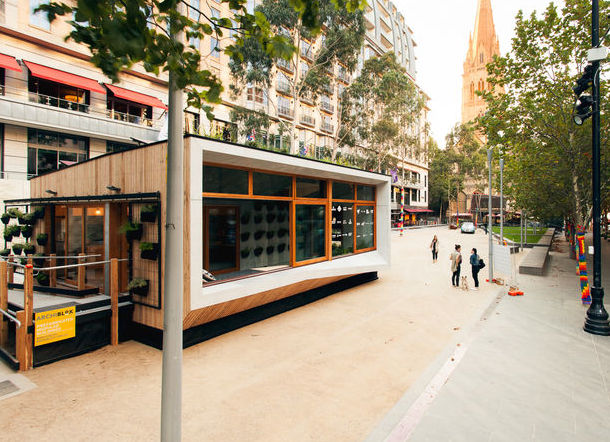
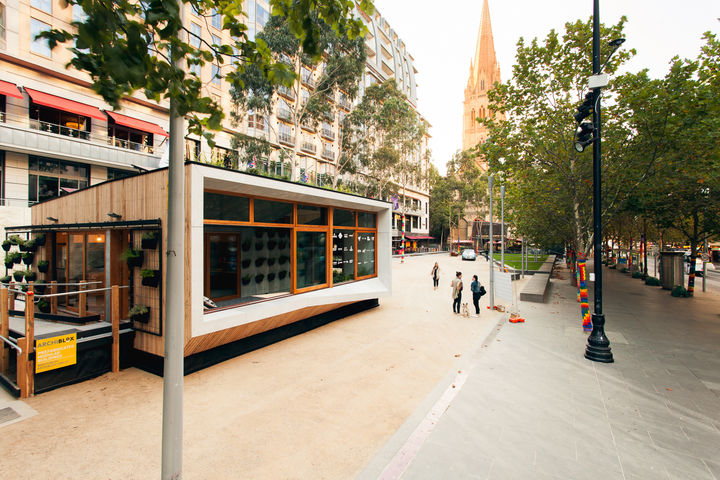
TNJ is essentially a showcase of ideas of how people can reduce their consumption and live more sustainably. The centerpieces of the project are mockup homes set up in public spaces in Melbourne, Australia. There have been three demo homes in the last few years, used for press ops, promoting various non and for profit companies to showcase their services and stuff.

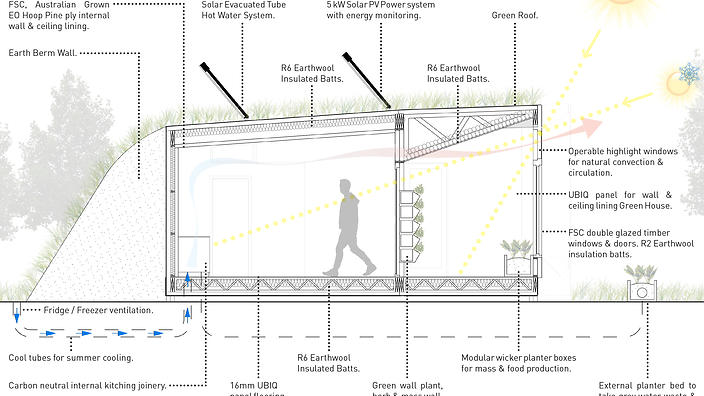
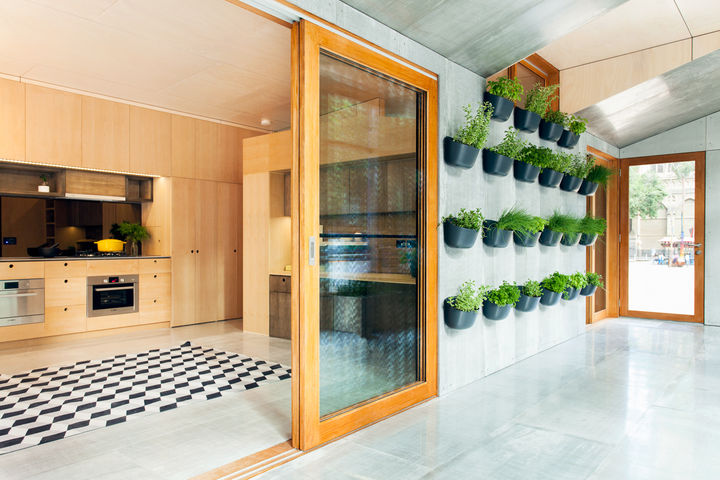
Their latest demo house is quite badass. It was designed by Archiblox Architecture. It has prefab construction and is “carbon positive,” meaning it produces more energy than it needs to run. Through the use of passive solar design, grey water and water catchment systems, PV power, green walls and roof and many other energy-saving features, the house is extremely energy efficient. According to Archiblox, over its lifespan, the building will emit 1,016 (tCO2e) tons less greenhouse gases than a standard home of similar size and function–the equivalent to taking 267 cars off the road, or planting more than 6,095 native trees.

At 828 sq ft, it’s not all that compact, particularly considering it’s a one-bedroom, but it’s not crazy large either, considering Australia boasts the largest average-sized home in the world. The layout is probably also designed to help large groups of people move through the space.

I think the best part of the project is its name. It’s a perfectly natural human tendency to want the things our peers have. But that tendency can be easily co-opted by the interests of entities–be they the interests of real estate developers peddling McMansions or some retailer selling a bunch of crap you don’t need–in ways that neither promote health nor happiness. In other words, if keeping up with the Joneses is a fairly intrinsic human behavior, we might as well choose Joneses that have our, and the planet’s, best interests in mind.

If you’re in Australia, the demo house will be on display in Melbourne’s City Square through Feb 15. Check the TNJ website for more info.

How to Know if You Should Buy Something

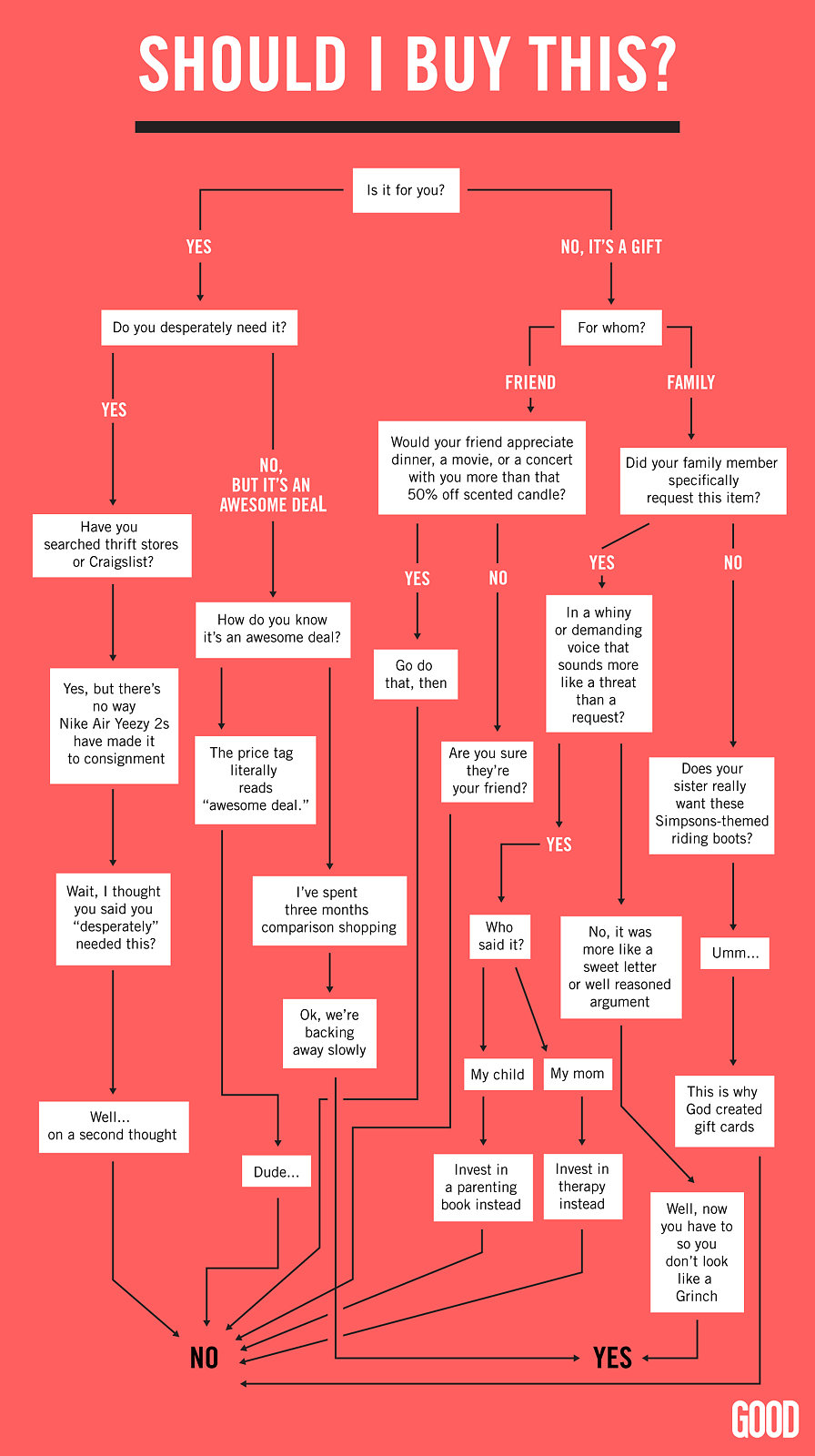
The good folks over at GOOD Magazine made this handy flowchart that provides various questions to ask oneself before buying something. It’s decidedly more polished and complex than the one we did a couple years ago–though that’s probably the point. Answering the Byzantine circuit of questions will compel most people to scrap their purchase decision–a good idea much of the time.

What the chart does is flip consumer mindset on its head. Rather than idealizing and assuming that we need certain stuff, it creates many hurdles for stuff to clear before it justifies its inclusion in our lives.

Via GOOD Magazine

The New Materialism

Many of us have a very conflicted relationship with our stuff. On the one hand, we want a lot less of it and think the world in general could use a major ‘edit’ in order to save planet and collective sanity alike. On the other hand, we appreciate the good stuff. We like using it, the things we can do with it or the memories it holds. We might even say it makes our lives better. Sometimes, it’s hard to articulate and reconcile these seemingly contradictory perspectives–something that a website/movement called “New Materialism” attempts to do. As the name implies, NM does not eschew material goods. Rather, it tries to forge a deeper connection with the stuff we have and invite into our lives.

The easiest way of thinking about the NM orientation to stuff is like a loving relationship. If our stuff was something we loved, would we throw it away carelessly? Would we stick it in storage lockers? Wouldn’t we try to spend as much time with it as possible? Wouldn’t we care for it as much as possible because we value its life? They write:

Far from eschewing materialism, a deeper understanding of humankind’s place in a living world of materials suggests the need and opportunity for a different kind of love affair with ‘stuff’ – a long-term relationship of appreciation, slow pleasures, care and respect. That invites re-writing the relationship manual for the objects we use. Far from suggesting abstinence and austerity, embracing a new materialism could have profoundly positive effects on our own well-being, that of the communities we live in and the Earth we are part of.

At the center of NM is its manifesto, which sets forth a set of ideals by which we can orient our relationship to stuff.

  1. Liking ‘stuff’ is okay, healthy even-–we can learn to love and find pleasure in the material world
  2. Wherever practical and possible develop lasting relationships with things by having and making nothing that is designed to last less than 10 years
  3. Get to know things – before you acquire something, find out at least 3 things about it
  4. Love stuff – mend, maintain and re-use things until it is no longer possible, then recycle them
  5. Get active – only acquire something new if you are also learning a new, useful skill
  6. Share – look at all your things, think about what your friends might need or could benefit from, and share at least one thing a week

Also, in a nod to 18th Century political activism, NM has its own heady pamphlet, which outlines the history of materialism for the last couple hundred years and the future as they see it–a model that is characterized by “more active production, making, adapting, mending, sharing and all the ‘re-s’ such as: re-use, recycle, re-love, re-purpose…[which will provide] far more potential for novelty and pleasure,” than our current throwaway culture.

The manifesto is well written and researched and definitely worth a read. And while UK focused, the content and resources are useful to almost any region of the world.

Few things highlight the need for a new relationship to materialism like the holidays. At every turn, we are encouraged to participate and subscribe to the model of new + more = better–a model that drives many of us into debt and overwhelm and the planet into tailspin. New Materialism offers one possible way forward, which is characterized by connection, appreciation and care for the things we use and possess.

Moving Up and Beyond Maslow’s Pyramid

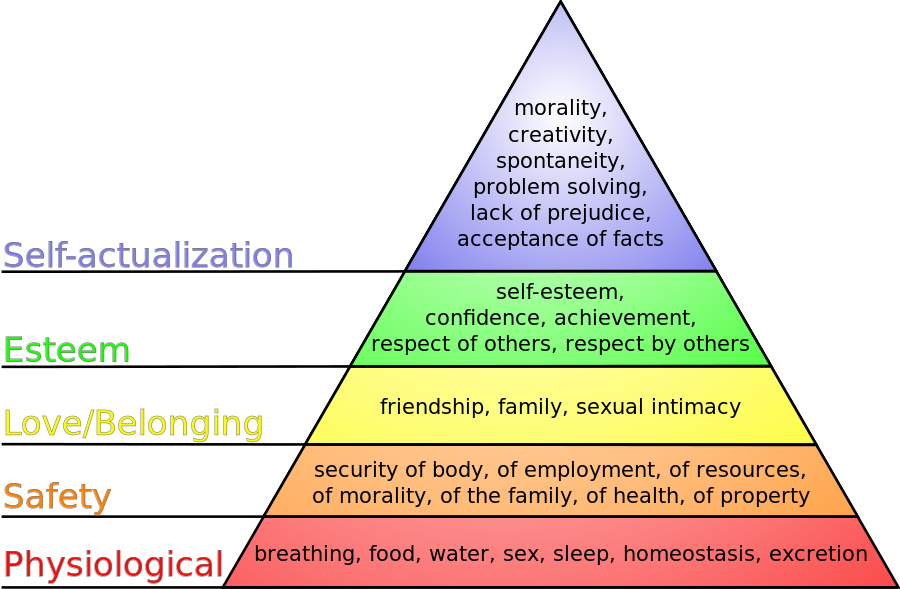
In his 1943 paper “A Theory of Human Motivation,” American psychologist Abraham Maslow outlined a hierarchal structure for what motivates human behavior. Though many have greatly expanded his theory, it has remained popular because of its intuitive logic. Here’s how how he framed human motivation:

  1. Most important is physiological needs: food, water, protection from the elements.
  2. Second most important need is safety: once we feel somewhat confident that we will eat and sleep undisturbed for the day, we make sure that we can do the same thing tomorrow, ensuring the safety of resources, food, employment, etc.
  3. Third most important need is belonging and loving.
  4. Fourth most important need is esteem; this can either be what Maslow called “lower” esteem, which is gaining esteem through external means or “higher” esteem which is internally generated.
  5. The top of the pyramid is the need for self-actualization, which encompasses the human capacity to live to his or her fullest potential and have higher purpose.

Within Maslow’s theory, if a lower need is not satisfied, it’s tough to think about a higher one. If we can’t secure clean drinking water (physiology), we’re probably not going to be thinking about artistic expression (self-actualization), and so on.

In many ways, our consumer culture–and the marketing that drives it–uses Maslow’s theory to get people to buy stuff they don’t necessarily need. Noted evolutionary psychologist Gad Saad said this in his 2007 book “The Evolutionary Bases of Consumption” about the intersection of Maslow, consumer behavior and marketing:

A perusal through leading consumer behavior textbooks reveals that the most ubiquitous theory to address this issue is Maslow’s hierarchy of needs….Consumer motives are mapped onto one of the five hierarchical levels, as are the consumer products and services that cater to those needs. By joining the American military, one is addressing one’s self-actualization needs (i.e., “Be all that you can be”). Similarly, by engaging in conspicuous consumption of fashion items, one is meeting his or her belongingness and possibly esteem needs.

But Saad explains that Maslow was a bit facile in his logic. Saad believes that some of our higher needs can seem just as important as lower ones from an evolutionary psychological perspective:

Maslow’s hierarchy assumes a strict hierarchical ordering of needs, goals, and motives. In other words, the theory proposes that higher level needs are pursued, only after lower level ones have been met. Van Kempen (2003, see pp. 165–167) proposes that this could not be a veridical theory because it cannot explain why the poor spend money on status products when they are deprived of their most basic needs. An evolutionary account recognizes that seeking status is a Darwinian drive that can at times be as important and primordial as many of the other first-level needs identified by Maslow.

In other words, bracketed inside Maslow’s logic, people driven by aspirational marketing will ignore their lower needs to secure their higher needs. E.g. someone might miss a rent payment (safety) to pay for a handbag that will earn her the esteem of her peers.

Whether inside of Maslow’s easy-to-digest, albeit flawed pyramidal structure, or Saad’s more nuanced Darwinian model, it’s fairly easy to see that we are often prodded to buy stuff–whether it’s a tube of toothpaste or a luxury car–because of a promise that these things will satisfy some very basic, perhaps primordial, need.

But do these things work? Has anyone ever said they met the love of her life because of a particular brand of toothpastes? Has anyone ever said (truthfully) that his esteem was permanently elevated because of a new car?

What if we stripped away the marketing double-speak and saw stuff for what it was? What if toothpaste was just something to clean our teeth, not something that would help us find true love? What if a luxury car was just something to get us comfortably and quickly from point A to B, not something that proves we made it in the world? What if stuff was just stuff, sometimes useful for living, but rarely–if ever–a tool for satisfying our highest needs? How would we live if this were the case? What would we wear? What would we drive? What would we live without?

Swedish Students Show You All Their Stuff

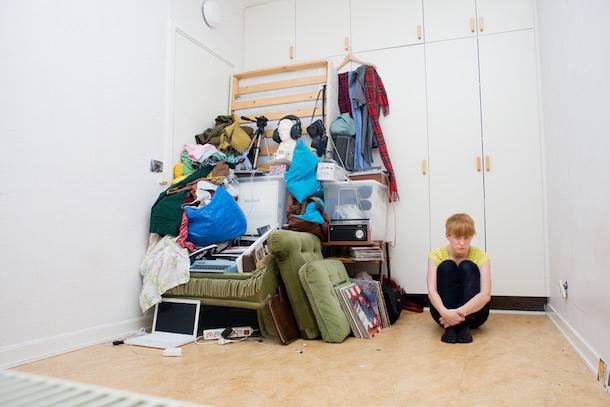
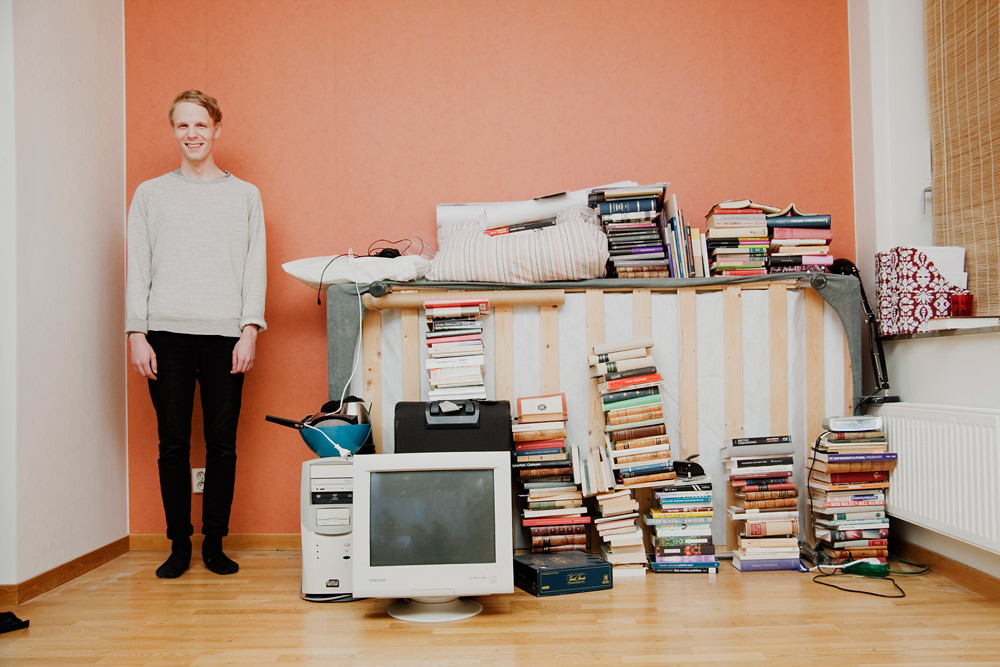
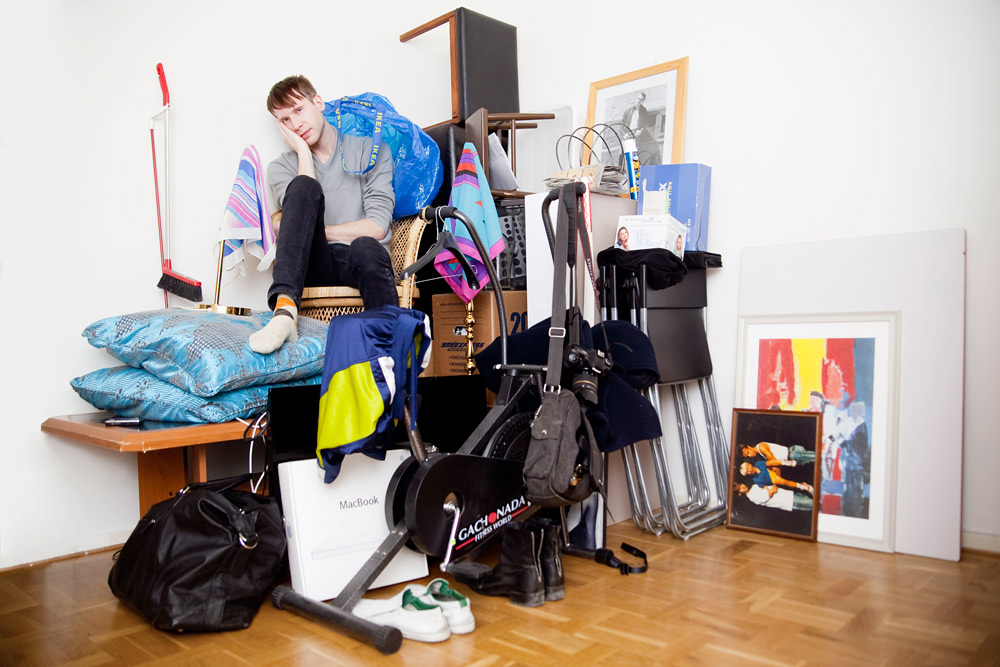
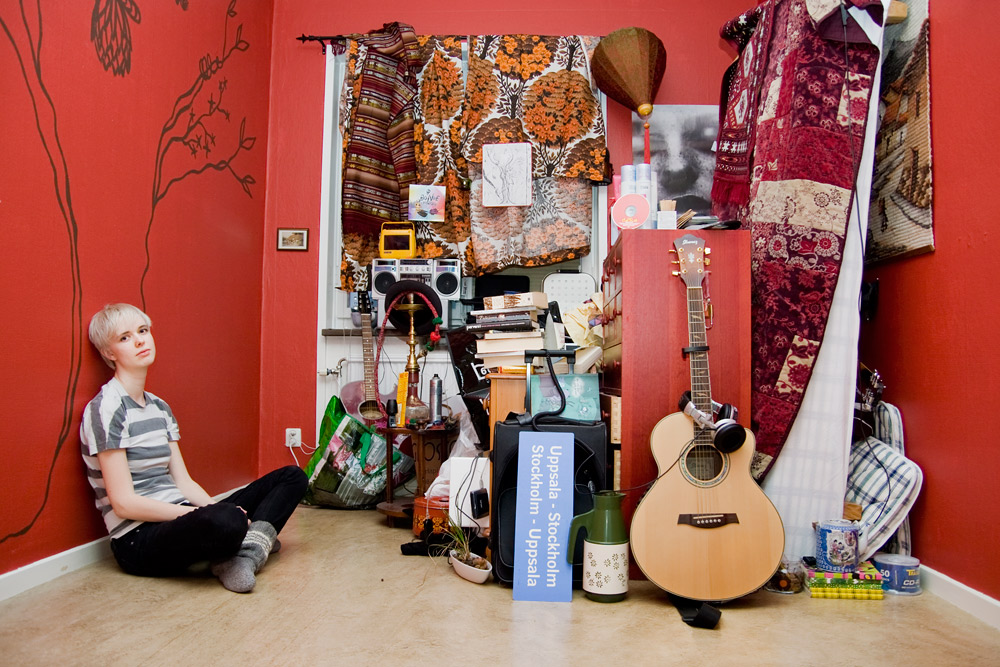
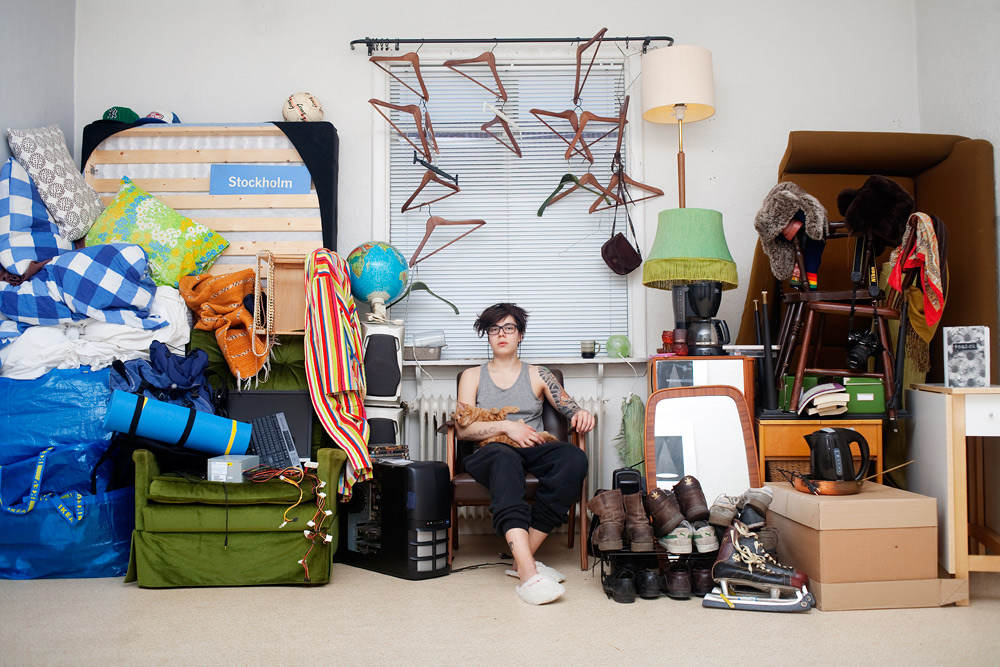
Except if you live in the smallest of homes, most our stuff gets dispersed and concealed by space. We don’t get the full scope of how much stuff we have until it’s all together in a small area, e.g. in a moving truck. Rather than waiting for a move, Swedish photographer Sannah Kvist decided to snap some shots of students with all of their worldly possessions.

The 2009 photo essay is called “All I Own.” Like the photo essays “Child’s Play” or “Family Stuff” we looked at a while back, each subject has his or her own priorities, reflected in their various possessions. Some are bibliophiles, others musicians, others photographers. All in all, none of the piles strikes us as that big.

Because all the subjects were born in the 80s and are students, it might be easy to distance ourselves from their modest collections of stuff. But upon further examination, their piles are collections of practical, mostly essential items, giving a testament to how little most of us really need to live.

via Inhabitat

My Genes Made Me Keep It

From the perspective of evolutionary psychology, there’s a certain logic to being materialistic. In the olden days, folks couldn’t just run to Target and pick up a hypo-allergenic full-sized duvet. You had a few shots a year to hunt and skin that buffalo, otherwise you’d freeze the rest of the year. Accumulating more than we need and keeping those accumulated objects to ourselves, thereby providing for lean times, makes intuitive sense. In other words, we might be hardwired to accumulate. The only difference is that now our objects of accumulation do not stand between life and death.

This logic might not be true however. A recent study suggests that people living closer to subsistence levels might be less inclined to accumulate. The study in question sought to test something called the “endowment effect”–the overvaluing of the personal objects. Psychologist Tom Wallsten at the University of Maryland told NPR the effect is similar to the man who won’t drop the price of his house even though it’s not selling for months. He needs to sell it, but because he values it more than others think it’s worth, he holds onto it. NPR science correspondent Shankar Vedantamit, said that the effect dictates that it “feels worse to lose something than it feels good to gain something.” We would say it’s also like people who do not rid themselves of stuff they do not use because they are “too valuable” to get rid of, despite the expense and headache associated to holding onto them.

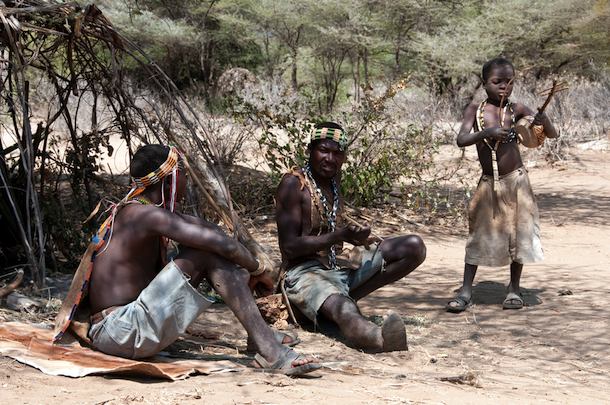
Coren Apicella, a researcher at the University of Pennsylvania, realized that the endowment effect was mostly proved by testing the behavior of college students–a demographic whose cultural biases might blare out any meaningful information about innate dispositions toward accumulating stuff. She observed the patterns of the Hadza people of northern Tanzania, some of whom were nomadic hunter-gatherers living at subsistence levels; other Hazdas observed lived in villages with market economies.

What she found was that the nomadic Hadza, people with virtually no possessions, rather than being highly acquisitive, were very easily induced to give up their stuff. Apicella explains why:

If you think about, you know, you’re a hunter-gatherer, you’re living a hunter-gatherer life, one possible reason why it doesn’t hurt as much to give things up is that you’re constantly having to give things up all the time. People are asking them for–from you, you know, demanding them from you, demanding that you share. Things come and go in hunter-gatherer life. You don’t even own that much to begin with.

Vedantam expanded to say that in a nomadic society, it is essential to give things up because the person you give to might have something valuable tomorrow to give to you.

Meanwhile, the village-dwelling Hazda who bought stuff from markets were more acquisitive than their nomadic relatives. Vedantam said of the villagers that they “were more like us [Westerners presumably]. They fell in love with their possessions because modern economies allow people room to be selfish.”

Same genes, different cultures, different attachments to stuff.

Sometimes changing the patterns of consumer behavior seems nearly impossible. Not only are we up against a behemoth economic system whose mission is to compel us to buy more stuff than we need, we are up against the culture that has sprouted around this system–a culture that accepts hyper-consumerism as the way thing are and will be. The Hazda example might be a glimmer of hope, suggesting that while we are battling marketers, bankers, politicians and even our friends and neighbors, we are not battling our biologies.

Via NPR

image credit:  Matej Hudovernik / Shutterstock.com