Extreme Risk of Stuffocation

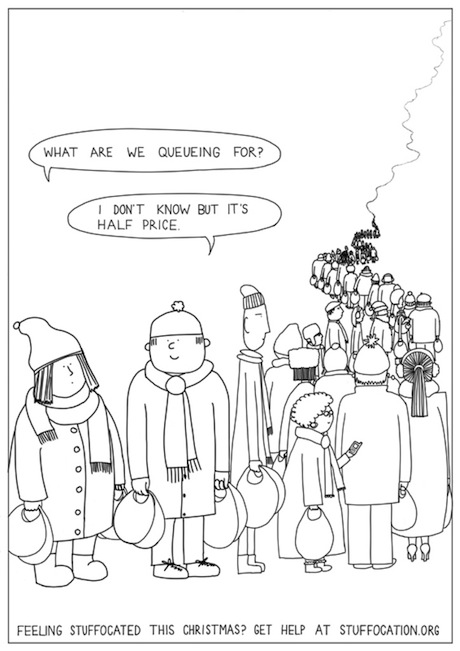
Forgive us if we’ve been harping on about the experience versus stuff subject. Tis that time of year. Every scene of our lives seems set to the drunk-on-eggnog caroling of marketeers, urging us to get more stuff. And we talk about it so much because we believe it’s one of the most important topics of our times. This tightly wound knot, where retail value has become inseparable with emotional value, must be undone–for the sake of our planet, wallets, closets and lives. Anyway….

This leads us to James Wallman, a British trend forecaster who has defined and named this global material and existential crisis. He calls it “Stuffocation”–an apt name for the asphyxiating quality our addiction with stuff has produced in our planet and lives. He has penned a book of the same name, and in this short talk at the Royal Society of Arts, he outlines some of its concepts (note: the actual talk is the first 20 mins or so of video).

stuffocation

He touches on the now-familiar ecological and psychological problems that stem from stuffocation. But he also provides solutions. Rather than dissolving the world economy and moving to primitive, agrarian societies, Wallman suggests the movement from materialist to experientialist values. He envisions and predicts a new economy that supports the experience of living great lives, not the accumulation of the symbols we’ve been trained to believe denote them. To give an idea of what an experientialist economy would look like, he challenges the RSA audience to spend the same amount of money they would normally spend on stuff on experiences. E.g. take that money you’d spend on a Rolex and go on a vacation.

The book is already available in the UK. It’s US release is January 20, 2014 (full review coming soon). In the meantime, watch Wallman’s talk, check out his website and let us know what you think.

Honor Your Holey Relics

If most of us are ashamed of shabby clothes and shoddy furniture let us be more ashamed of shabby ideas and shoddy philosophies….It would be a sad situation if the wrapper were better than the meat wrapped inside it.” ― Albert Einstein

If we were to think the world dressed like TV characters, we might think everyone wears freshly-pressed, perpetually clean clothes. But TV-reality and real-reality seldom intersect. Real-reality is fraught with stains, scuffs, holes, worn-out soles and all varieties of wear. Patagonia, the folks who brought us Common Threads, not only recognizes the reality of wear, they celebrate it. They have produced a movie (below) and launched a website called Worn Wear. Here’s how they describe it:

Worn Wear is an exploration of quality – in the things we own and the lives we live. This short film takes you to an off-the-grid surf camp in Baja, Mexico; a family’s maple syrup harvest in Contoocook, New Hampshire; an organic farm in Ojai, California; and into the lives of a champion skier, a National Geographic photographer, and a legendary alpinist. It also features exclusive interviews with Patagonia founder Yvon Chouinard.

Released as an antidote to the Black Friday and Cyber Monday shopping frenzy, Worn Wear is an invitation to celebrate the stuff you already own.

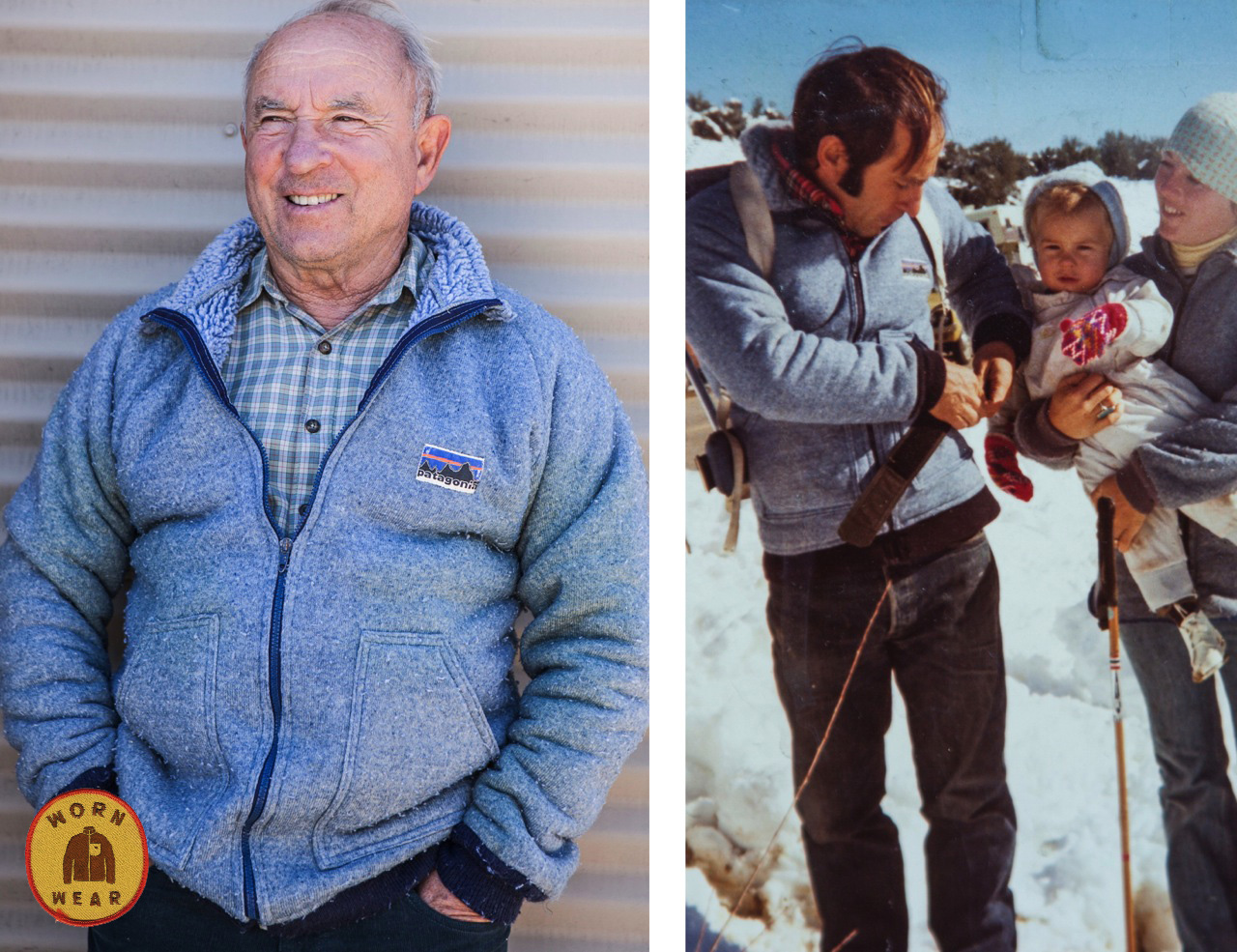
Their website features a dozen or so folks sporting Patagonia clothes, along with short stories about how the clothes were worn over the course of their lifetimes. The pictures are not of the latest Patagonia clothes, but old, torn and tattered ones. One picture of Patagonia founder Yvon Chouinard has him rocking a vintage, pilled-up fleece in the present day–couple with him wearing the same jacket 30 or so years earlier.

While you’re out not shopping this Friday, November 29th, Patagonia stores across the US will be celebrating Worn Wear (day?), with movie screenings, repair clinics, food and beer. See list of event locations here.

To the cynical eye, Worn Wear might seem like a clever way to lure people into a Patagonia store. This may be true to a small extent, but Patagonia really does seem to be earnest about creating a new breed of capitalism. With numerous programs like Common Threads, Worn Wear, and Footprint Chronicles (a site that allows people to follow the lifecycle of Patagonia garments) as well as a policy of donating 1% of all sales and 10% of all profits to environmental causes–the company seems serious about only selling the good stuff you need, and making that stuff last as long as possible.

The Perfect Friday Night Date Movie

Prep the popcorn and get ready for some hardcore entertainment. “Consumed,” a recently-released movie by Journeyman Pictures (not affiliated with the Journeyman featured on this blog recently), is sure to be this summer’s blockbuster hit.

Or not.

Unlike most (or any) blockbusters, Consumed is a thought-provoking documentary that tries to unearth the root causes of pathological consumerism. Through narration and interviews with consumer and psychology experts, Consumed drives home the point that consumption and the marketing that fuels it is the byproduct of misplaced evolutionary imperatives. The psychological emphasis is what really separates Consumed from other movies on the topic like The Story of Stuff, which focus primarily on the environmental and human rights impact of consumerism.

True to its subject, the bulk of the movie is a real downer, with some experts saying we as a species are hardwired to consume until we run out of things to consume (see Easter Island).

But there are sunnier perspectives expressed in the film; chiefly that our unsustainable consumer culture is but a drop in the bucket of human evolution; that for millions of years we have lived in a state of equilibrium with the earth and this last 70 years or so will be a temporary “what-the-hell-were-we-thinking” period of species maturation (our words, not theirs).

Whether the future holds a consumer heaven or hell remains to be seen. Either way, something’s gotta change. Hopefully, movies like Consumed will move the conversation forward, expressing both the self-evident perils of the present as well as the potential for a future not characterized by mindless and lethal consumer behavior. Give it a watch.

Via Treehugger

World’s Least Edited Building Opens in China

What has 18,000,000 square feet of floor area, an artificial beach and a Gap clothing store? If you answered, the New Century Global Center in Chengdu, China–now the biggest building in the world as measured by floor space–you’d be correct.

The building’s interior can swallow 20 Sydney Opera Houses or three Pentagons. It will feature offices, conference rooms, a university complex, hotels, an IMAX movie theater, a “Mediterranean village”, a pirate ship (very important), a skating rink, aforementioned 54K sq ft beach and a 4.3M sq ft shopping mall.

Buildings like the Global Center seem to demonstrate the Chinese’s knack for going too far. Some might even argue they take sustainable building too far. But for all of the finger pointing, the fact remains that the Chinese per capita carbon footprint is a fraction of that of most western nations. In 2009, Americans produced 17.2 metric tons of CO2 per capita; for China, that same figure was 5.3 metric tons (a figure that is admittedly on the rise).

Moreover, as a Guardian article by George Monbiot pointed out a few months ago, many “developed” nations’ emission reductions are only possible with overseas emission increases. He took the example of the UK, who boasted a 19% carbon emission drop between 1990 and 2008, as measured within its borders. When emissions were measured to include consumption behavior and the embodied emissions therein, the UK posted a 20% increase–a fact that has a big role in the increasing carbon emissions within China’s borders.

What does this all have to do with the price of tea…we mean, the size of a mall in China? It’s a reminder that in our increasingly connected world the excesses of one country often go lockstep with another. And as distasteful as we might find what is, for intents and purposes a gargantuan shopping mall located halfway around the world, it’s also a reminder that we take responsibility for how we consume at home.

Images: Exhibition and Travel Group

A Shop That Sells Stuff Worth Buying

At LifeEdited, we have a funny relationship to stuff. On the one hand, we tend to think there’s too much of it, and that most of it is poorly designed and hardly worth buying or owning for any considerable period of time. On the other hand, we love when stuff is done right; when it’s made to last; when it’s designed to extract as much function with using as little space as possible; when it’s sourced responsibly; when its manufacturer seems to be genuinely motivated by offering a great product–not simply some piece of junk to overload your closet and increase their bottom line. This fickle relationship with stuff is why we’re so excited by a web-store called IPPINKA.

pack-away-kettle-1-350x350

IPPINKA (pronounced ee-pink-eh) has one of the highest concentrations of useful, well-thought-out and designed products of most any store we’ve seen. Much like LifeEdited, the shop has a paradoxical relationship with stuff. The Dieter-Rams-inspired company describe their ethos like this:

IPPINKA wants you to consume less. We want to help you choose products that will serve you for a long time, instead of constantly buying similar products to replace each other.

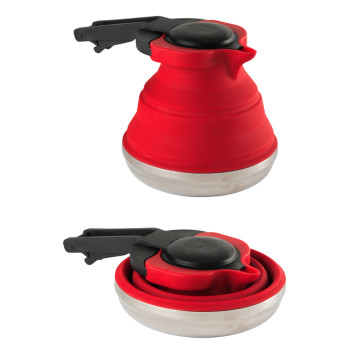
Based on the stuff they carry, we believe them. We recently picked up a few products for the LifeEdited Apartment including a collapsible latex kettle (above), reusable, biodegradable Abeego food wraps (replaces plastic wrap) and a pour spout that acts as instant strainer for any pot.

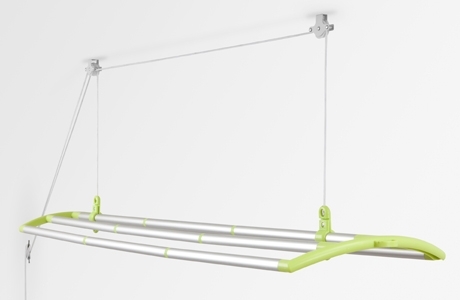
Other objects we’ve coveted are the thin Japanese KONTEX towels, some gorgeous Lithuanian linens, a ceiling mounted drying rack and a clever tea mug that allows you to steep whole leaves without a separate strainer. I say “coveted” as IPPINKA stocks limited quantities and if you don’t buy something when you see it, it might be gone the next day. It’s sort of like a daily menu for products.

The site also gives its visitors the opportunity to vote on upcoming products to gauge whether they’re worth carrying or not.

To us, IPPINKA represents an ideal form of consumerism. Rather than urging its customers to spend as much as possible on stuff useful or not, IPPINKA humbly offers up their products saying, more or less, “If you must buy something, it should probably be this.” Check out more at www.ippinka.com.

[Full disclosure: the author received a complimentary set of the Abeego food wraps from IPPINKA…but that was it.]

This Hamster Should Win Nobel Prize in Economics

The Impossible Hamster is one of the most articulate treatises on economic growth and resource depletion we’ve ever seen.

At LifeEdited, we try to stay happily apolitical. We think living a less, but better way of life has self-evident benefits. Our lives are simpler, less expensive, more manageable and so on.

But there are global benefits as well. Not to over-simplify a complicated topic, but if every member of the world’s population started lining up his and her consumer behavior with actual needs and priorities, we might start a course-correction from the current trajectory of economic and environmental meltdown. The model of never-ending growth of consumption–whether that takes the form of consumer goods or housing or natural resources–will, in all probability, lead to a situation as dangerous as a 9 billion ton hamster.

Let’s Talk About Stuff Baby

Yesterday LifeEdited founder Graham Hill had an op-ed published in the NY Times. The autobiographical essay entitled “Living with Less. A Lot Less” tracked  his progression from late-20s, flush-with-dot-com-cash, consumer extraordinaire to minimalist exponent. He writes:

My success and the things it bought quickly changed from novel to normal. Soon I was numb to it all. The new Nokia phone didn’t excite me or satisfy me. It didn’t take long before I started to wonder why my theoretically upgraded life didn’t feel any better and why I felt more anxious than before.

At present, the article sits atop the NY Times most emailed and most read lists. Like the TED Talk Graham gave almost exactly two years ago–a talk that has received over 1.7M views to date–the message of living more with less is clearly on peoples’ minds.

Rather than transcribing Hill’s piece, we dug through the comments, highlighting and commenting on some of the major themes.

Desertwaterlily writes:

My son, daughter-in-law and their baby live in Brooklyn in a 700 sq. foot condo. It’s very crowded and not functional. They know it can be made functional but they don’t (as yet) have the money or resources to do anything. I agree with you about living close to the bone, but it takes more than wishing to move walls, build new working kitchens, electrical, shelving, etc. Sometimes it takes money to live a “simpler” life.

Desertwaterlily check out 8 Tips for Editing Your Life that Work for Any Budget. While it’s true moving walls cost money, there are a ton of things to simplify your life that require little or none.

Sonja writes:

I’m 82 and live on and with the barest of necessities, for the less I have, the better I feel. I regularly go through my small house wondering what else I can get rid of. Minimalism is soothing, aesthetically appealing. I sometimes fantasize about living in a cell like a monk – a cot, a table, and a window.

Knowing what I know now, if I had my life to live over, at the age of 18, instead of sitting around devising plans for a cluttered life, I would put a knapsack on my back and with my dog I would leave the house and just start walking.

Thanks Sonja for showing that this is not just a young man’s game.

MJones writes:

Most of the people responding to this article appear to have no children….I think it’s hard to live in small places with other people – children and adults – without separate sleeping rooms for them. Old people snore. Children are distracted by adult activities and truly need their own space to develop fully in western culture. A baby can sleep in the corner, but as they get older and play sports or pursue their own interests, they need space for their stuff and friends.

And Larry L also writes:

I noticed that the author does NOT have children and is NOT married. His life choice is highly unlikely to be replicated under different circumstances.

The “you-don’t-have-kids” argument comes up a lot. Neither Graham, nor anyone at LifeEdited suggest that everyone should live in 420 sq ft. Nor do we suggest the needs of a single person are the same as a family’s. Living with less might look like having ten toys instead of fifty or living in 1200 sq ft instead of 2500. And yes, this is written by someone with children.

MGM writes:

Great. If the one percenters stop buying lots of stuff and stop building lots of big homes where will that leave the rest of us? Our economy is fueled by overconsumption. The middle class cannot do it by themselves!

We’re not sure if MGM was being serious, but this argument does occur to many as a potential problem. First, we’d respond by saying that if we destroy our environment, there will be big problems for every class. And because domestic manufacturing is almost extinct, most consumer dollars flow to top heavy corporations and overseas producers; this situation has been thwarting the American middle class for decades now. What if Americans started buying less stuff they could keep for much longer at fair market value? What if our stuff was made by skilled, well paid workers (foreign or domestic)? We don’t want to overstate our economic chops, but we think it’s fair to say the current system is patently unsustainable and we are due for another model.

imadeamesss

That’s a nice article and all but I still want the Omega single auger juicer. It is a thing that I want.

Please, keep your juicer. No one is saying get rid of all your stuff. But what if we cared about everything as much as imadeamess cares about his/her juicer?

Sam93

I believe your insights resonate only with people who have money and who are capable of owning stuff. You have come a full circle with consumption and then simplification. You are still financially capable to accumulate stuff. Thus, it is no longer a thrill for you. For people who are working hard, owning stuff(e.g house, car, etc) is an indication that they have arrived at a certain stage to acquire what they wish. It is not always easy when one couldn’t afford something other people discard regularly.

Sam93 brings up a very good point. In many articles that focus on Graham, he is often charged with “easy-for-you-to-say”–that most people don’t choose less, but are forced into it.

There are certainly many people who cannot afford even basic items and no one is trying to minimize their plight. However, as Graham tried to convey, the stuff issue–as well as the inflated home one–affects those with even very small incomes. Big box stores and 99 cent stores and cheap housing, fueled by easy credit, have made torrents of stuff and space available to almost any income level.

What Sam93 says about stuff-as-status is astute. We live in a culture where consumer goods are used to demarcate success–even if they undermine our happiness and wealth. Whether the mainstream will every “choose” less–rather than being forced into it–remains to be seen, but we’re optimistic!

en D

I realized how little meaning “stuff” has when our house was on fire and my husband and I were frantically trying to save the lives of our pets. I realized later that neither of us had stopped to try to rescue a single thing: not jewelry, not computers, not even money itself. Only life mattered. That was over 15 years ago, but the message remains as vivid to me as it did that day.

Well said!

Image via Shutterstock.com

Comments via New York Times

The Tao of Fight Club

tyler-durden-owing

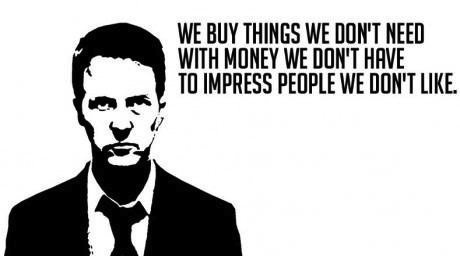
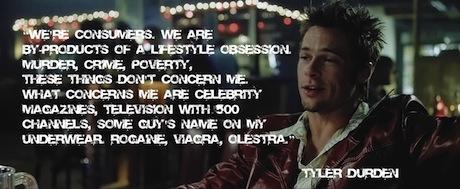
We at LifeEdited are staunchly nonviolent, but a recent viewing of, and subsequent reminder from our friends over at Unstash, revealed the many pearls of wisdom dispensed between bloody brawls in the movie Fight Club. The 1999 flick starring Brad Pitt, Edward Norton and Helena Bonham Carter, based on the Chuck Palahniuk (pronounced Paul-uh-nick, if you were ever wondering) novel of the same name, is a commentary on society’s obsession with a consumer lifestyle we can never quite attain–and the subsequent liberation through, well, fighting (it’s way more nuanced than it sounds).

Please note: The following quotes–most deliberately taken out of context–are not our endorsement of any or all ideas expressed in Fight Club.

Tyler Durden: You’re not your job. You’re not how much money you have in the bank. You’re not the car you drive. You’re not the contents of your wallet. You’re not your [expletive] khakis. You’re the all-singing, all-dancing crap of the world.

fight-club-things-we-dont-need

Narrator: You buy furniture. You tell yourself, this is the last sofa I will ever need in my life. Buy the sofa, then for a couple years you’re satisfied that no matter what goes wrong, at least you’ve got your sofa issue handled. Then the right set of dishes. Then the perfect bed. The drapes. The rug. Then you’re trapped in your lovely nest, and the things you used to own, now they own you.

[divider]

Tyler Durden: Reject the basic assumptions of civilization, especially the importance of material possessions.

tyler-durden-lifestyle

Narrator: Tyler, I’m grateful to you; for everything that you’ve done for me. But this is too much. I don’t want this.

Tyler: What do you want? Wanna go back to the [expletive] job, [expletive] condo world, watching sitcoms? [Expletive] you, I won’t do it.

[divider]

Marla Singer: I got this dress at a thrift store for one dollar.

Narrator: It was worth every penny.

Marla Singer: It’s a bridesmaid’s dress. Someone loved it intensely for one day, and then tossed it. Like a Christmas tree. So special. Then, bam, it’s on the side of the road.

Clear Hurdles to Sharing with Yerdle

Yerdle is a new website and mobile platform that allows easy sharing and giving of common items. The idea is very simple: We want or need stuff, the people we know have the stuff we want or need, often unused. Yerdle enables you to get that stuff either to borrow or keep. That’s about it.

Yerdle is connected to your Facebook account. You and your friends post pics of the stuff you’re willing to give away or lend. You can post what you’re looking for and peruse offerings from other yerdle members on their site, Facebook timeline or iPhone.

Yerdle has an impressive team behind it and a lofty mission:

Co-founded by Adam Werbach, former President of the Sierra Club and Founder of Saatchi & Saatchi S, Andy Ruben, former Chief Sustainability Officer and head of Global Strategy at Walmart, and Carl Tashian from the founding team of Zipcar, yerdle was created to offer a sharing marketplace that provides an easy way to reduce consumer waste associated with buying items new. With Americans throwing away an astounding 31 million tons of plastic each year, packaging for new gifts over the holidays will clutter even the neatest home. yerdle’s mission is to reduce 20% of the things people buy through sharing, collectively protecting precious ecological resources.

We asked Adam Werbach a few questions about yerdle specifically and sharing systems in general–about how to get started and how sharing can compete with cheap consumer goods.

LE: What makes yerdle different from other sharing sites out there?

AW: Before supercenters and Amazon.com, the obvious place to get something you needed was from a friend or a neighbor. Need a shovel? Ask a neighbor. Kids need new shoes? Check with the cousins. In the last hundred years though, retail has become hyper-efficient, and it has become easier to buy something new than to borrow it or find it from a friend. Our goal with yerdle is to flip that on it’s head, and to make it easier and more fun to get things from your friends. Here’s how it works, you connect yerdle with your Facebook account and snap a few pictures with your iPhone of items you might be willing to share. Have a baby stroller you don’t need any more? Or an extra thermarest? Yerdle allows you to post items to either give or loan to your friends. The average person who logs on finds about 300 free items from their friends that are immediately available to them.

LE: How do you think technology is changing the face of sharing?

AW: Although sharing has been around forever, we’ve never really applied the advances of software to the sharing economy. The thing that you’re thinking of buying right now is probably sitting unused, and perhaps unwanted, in a friend’s closet or garage. The goal of yerdle is to float that information up to you when you’re considering a new purchase.

LE: How can yerdle compete with an abundance of cheap consumer goods–when it often seems easier to buy something from amazon that it does to browse through a site?

AW: The great thing about sharing is that it saves you money, it builds community and it saves natural resources. That’s a hard set of benefits to beat. Our challenge is to grow the community of folks who are willing to check in with their friends before they give something to Goodwill or buy something on Amazon. It’s not right for everything, but chances are you can save about 25% of the money you’re spending now on durable goods.

LE: What’s the best way to get started if you’re not actively sharing or if there is little sharing going on in your region?

AW: The best way to get started is to take a few photos of items that you are ready to part with. Put them up on yerdle and share them with your friends. You’ll be amazed at how quickly people start talking about what you’re doing. We’ve found that people are as interested in the social relationships as they are in getting something physical. It’s a good excuse to connect with old friends and to help folks.

Kick Your Stuff to the Krrb

Selling stuff can be a pain. Most us use one of several channels: Word-of-mouth, yard/stoop sales, Craigslist or eBay. Word-of-mouth is okay for stuff we want to dump, but many us have issues selling stuff to friends, particularly if we want to make money. Yard/stoop sales are a pain in the butt (dragging your stuff in and out, weather, etc) and they hit a limited audience, most of whom want to pay pennies on the dollar. Craigslist has great outreach, but often buyers are super-bargain shoppers and then there are scammers galore. EBay, for most of us, is a intimidating bazaar filled with cutthroat dealmakers.

A site called Krrb provides an answer for the non-professionals and small local businesses to sell their stuff easily. The site describes themselves this way:

Krrb (pronounced ‘curb’) is a hyperlocal, curiously global classifieds made just for you. A most epic scavenger hunt at your fingertips where you can thrift, scavenge, rummage and discover local treasures – in your neck of the woods or over yonder.

With over 24K users in 1130 cities, it beats word-of-mouth and yard/stoop sales; you can also keep stuff posted as long as you want. Unlike Craigslist, there are thumbnail pics of objects to see what you might want to buy. Also, everyone on the site must become a member, which is a great scammer-deterrent. Unlike eBay, there is no bidding; members can civilly negotiate prices if they so choose, but none of that last-second-outbidding that turns so many folks off of eBay.

Other features include a mobile app that shows Krrb objects in your area, a digest of stuff for sale in your area and Krrb Meetups (only in Brooklyn and Paris right now). Posting works on credit system. One post is one credit. Credits cost anywhere from $.50-1.00 (depending on volume you buy) and there are numerous ways of earning free credits (you get 10 free just for signing up). Visit their site to sell your stuff or buy some preowned holiday gifts.