Why Most Americans are Crappy Sharers

Winston Churchill was famously quoted as saying, “You can always count on Americans to do the right thing–after they’ve tried everything else.” While there’s some debate about the exact phrasing and context of this statement, it does have a ring of truth. We have a history of righting nasty wrongs a little later than most. Hopefully the adoption of the so-called sharing economy–something that promises to save a significant amount of natural resources and money–will be another example of such a late bloom. In a report called “The Sharing Economy: Where We Go From Here” advertising giant Leo Barnett dissected the Nielsen Global Survey of Share Communities to find out American perspectives on sharing. What they found was that most Americans are pretty ignorant of what the sharing economy is and would probably not be inclined to participate in it even if they did know.

The Nielsen study went pretty deep into how receptive people around the globe were to sharing and the sharing economy, asking such intimate questions as how likely people were willing to swap pillows with their mothers. What they found was that most global citizens were open to sharing, particularly in many Asian, Middle Eastern and African nations, where sharing is a longstanding practice. But when LB teased apart the 4500 Americans surveyed, they found a population not so keen on participating in the sharing economy. Here are some of the report’s findings:

  • 3 out of 4 Americans said they hadn’t even heard of the terms “sharing economy,” “conscious consumption” or “mesh economy.”
  • Only 1/3 of Americans were familiar with brands like Airbnb and TaskRabbit.
  • 47% said they considered safety and hygiene an issue that would prevent them from sharing.
  • 43% said they have an emotional attachment to owning that would stop them from sharing.
  • 30% said that adapting to others’ schedules, following their rules and letting go of spontaneity would stop them from sharing.
  • 27% said they enjoyed the U.S. consumer culture and the sharing economy, for some, undermined free market capitalism.
  • 52% of those surveyed agreed with the statement, “I think most people would rather own than share, if they can afford to.”

While these findings are far from the death knell for the sharing economy, taken collectively, they present a formidable obstacle for it to take hold in the US.

Some of this resistance to the sharing economy is surely cultural: America is a country founded on the rugged individual, someone who doesn’t need your stuff to get by, thank you very much. But a large part is economic: people don’t avail themselves of sharing technology because it’s still very cheap to own. It’s cheap to order a power drill off of Amazon with one click. It’s cheap to own big homes to store all of your privately owned objects. And until the economics favor sharing people will continue to own their own stuff. For example, Airbnb and Zipcar have managed to gain some economic traction because they save people money over their conventional alternatives, particularly in large cities where hotel rates and car ownership is very expensive.

It’s hard for this author to not be a bit pessimistic about what it’ll take to get Americans to share in a more widespread manner. In my opinion, many people will either need to make a lot less money or the cost of goods must increase dramatically before people start taking sharing seriously.

What do you think? Can people change their behavior–sharing, for example–without dire circumstances forcing them to do so? Let us know in our comments section.

Hat tip to Wehatetowast.com Via Tripple Pundit

Uncle Sam image via Shutterstock

UberPool Makes it Easy to Pimp Your Ride

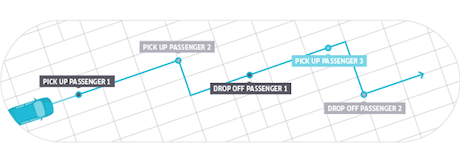
The world’s roads are littered with people driving the same way–people leaving when you’re leaving, from where you’re leaving, going to where you’re going (or, if not exactly same locale, at least getting on and off somewhere along points on the way). But until now there was no way of connecting those people–likely why 78% of American commuters end up driving alone. UberPool–a division of Uber–is trying to change that, connecting people who are going the same way. From their website:

With UberPool, you share a ride—and split the cost [of an UberX car-service ride]—with another person who just happens to be requesting a ride along a similar route. The beauty, though, is that you still get Uber-style on-demand convenience and reliability: just push the button like before and get a car in five minutes. When we find a match, we notify you of your co-rider’s first name.

Uber says an UberPool car would achieve 36.4 person trips per day (the number of people carried in a car multiplied by the number of trips that car makes in a given day) versus the average private car that only has 4.8. This high volume will theoretically make the service so cheap that it can realistically replace car ownership, halving the price of their UberX service, which they say is already 40% less than a traditional taxi. They think that UberPool’s convenience and thrift will make it compelling enough to eventually remove 1M cars off the road.

uber_NYC_infographic-02

The program has been rolled out in beta in Paris, San Francisco and New York City. A Newsweek article reports that some drivers are having trouble using the service and there are complaints about the service cutting into profits for the drivers. Uber has expressed that there are still many kinks in the system–which is why it’s in beta, duh–but that UberPool will ultimately benefit drivers as the service, by virtue of its convenience and low cost, will create ever-increasing volume of people looking for rides, keeping drivers busier than they are now. Like all new ideas, there is bound to be a ramp up period.

It’s pretty clear that we have more resources than we need, but sometimes distributing those resources to people who want them, when they want them can be difficult to say the least. UberPool is a great example of how tech can help us make the most of what we got. We wish the project the best of luck.

Helsinki Attempts to Create a Seamless Transit Web

Last year we looked at DriveNow, an innovative program set up by BMW that would connect you with whatever form of transit made sense given your location. The system, accessed via a smartphone app, could, for example, direct you from a shared bike to the train to a DriveNow BMW car parked at the train station. The system holds the promise of a swift and efficient connection of transit options, none of which requires personal ownership of any vehicle.

One issue with DriveNow program is that focuses on automobile travel (albeit BMW wants those automobiles to be their electric i-Series). It’s also possible that if the system were governed by BMW, there might be some conflict of interest between public and private interests. What if the most effective way of traveling has nothing to do with BMW? What if something like DriveNow was an open and neutral platform, almost like a public utility? That’s exactly what Helsinki Finland is trying to do. Their “mobility-on-demand” system would be a comprehensive transit system that would seamlessly (and neutrally) link you to the most efficient mode of transit available.

Helsinki’s program was devised by transportation engineer Sonja Heikkilä and would allow users to enter a pickup and drop off location. You could enter in preferences and the system would map out your journey, even factoring in things like weather in order to devise an optimal plan.

Another key part of the system would be how payment is given. Currently, people pay for their transit to whichever system they’re using. For example, they pay the Helsinki Region Transport when they take public transit. The “transit-on-demand” program would centralize payment, buying transit wholesale from the various providers. People could choose various payment options; they could pay by the kilometer or have unlimited use, with each having a different pricing structures depending on frequency of use.

The city is launching a test run with a small group of people at the end of this year. If all goes well, Helsinki hopes to have this program up and running by 2025.

Helsinki’s Kutsuplus system sets a precedent that this could work. Kutsuplus is a geo-locational minibus service that creates its routes based on realtime demand–sort of like a mix of a public bus and taxi cab, with a price that’s square in the middle of the two.

Heikkilä told the Helsinki Times that this program is not merely representative of innovation and efficiency, but the fact that “a car is no longer a status symbol for young people.” In other words, people, particularly young ones, are just as interested in pimping their planets as they are their rides.

Image credit: Slava2009 / Shutterstock.com

Via The Guardian

Luxury Micro-Apartments Come to DC, Transportation Included

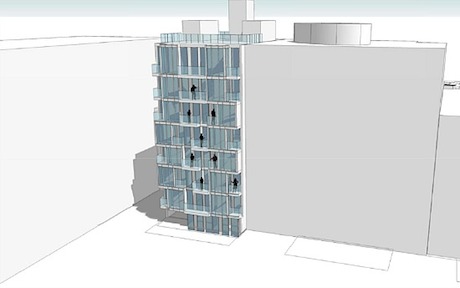
A new micro-apartment building will be going up on the 1400 block of Church St NW in Washington DC. It will have 37 units ranging from 265 to 490 sq ft, according to Brook Rose who, along with Gregg Busch is developing the project. Rose’s specialty is luxury development and he sees the Church St apartments as consistent with that. “We are going to try to make these luxury micro apartments,” Rose told us. The rental apartments will feature floor to ceiling windows and high end finishes. The smallest units, where there is an imperative to have all the furniture work perfectly with the space, will be semi or fully furnished, using transforming furniture by the company Inova. Rents will likely start around $2K.

church_back

The building is a testament to the fact that Washington DC, a city that up until recently had been pretty ambivalent about micro-housing, is changing its tune, as evidenced by the likely micro-apartment development of the Patterson Mansion as well as this one.  But the city’s approval of the Church St building was far from a slam-dunk, having been held up by the Board of Zoning Adjustment (BZA) for a year because of issues around parking.

As we’ve seen here before, one of the primary sticking points for adding density to an area–something that micro-apartments tend to do–is parking. Most residential building requires a certain number parking spots per unit; these can be satisfied by on or off-street parking. Areas that have robust public transportation and walkable streets like San Francisco can often sidestep those requirements or provide minimal parking. But for most parts of the country, it can be a real barrier for development as it was for the Church St building.

Certain members of the BZA were not receptive to the idea of a building without parking, even though Rose was sure there were many “carless urban dwellers” who were “willing to trade space [and their cars] for lifestyle,” particularly in the building’s neighborhood which is along the 14th street corridor, a walkable area with tons of amenities. Rose calls the area “DC’s Soho.” One gesture Rose and Busch made to prove they were serious about creating a carless building was offer car and bike sharing memberships to residents for the duration of their leases (nb: residents would still pay for their use of the car).

The building eventually received the BZA’s narrow approval last month. The developers agreed to provide four parking spaces: two for residents to use for move in/move out and for guests and the other two will be for dedicated for car sharing cars.

But the city made a stipulation that residents could not apply for parkings permit that would allow them to park legally on neighborhood streets. This prohibition will be written into the leases and the developers will periodically check with the DMV to see if any tenants are violating the agreement. In other words, if you live here you cannot have a car.

Of course residents can elect to park in a private garage, but the arrangement seems like a prescient one. For most of the last 60 years, architecture has been bound to parking. Perhaps the Church St development augers a future where architecture and urban planning are designed as much around people as they are cars.

Cutting the Housing-Car Umbilical Cord

Whether you’re aware of it or not, most homes–or to be more precise, “dwelling units”–require parking. Meeting these requirements is not a big deal in low density suburbs with their copious amounts of space for driveways and garages. But it’s a big issue in high and medium density areas, where real estate developers might only be able to build as big as available parking spots permit. These requirements can put residents looking for affordable housing in a pinch. Making housing density low in desirable areas dwindles housing stock, driving housing prices higher. Alternately, developers must create off-street parking to satisfy requirements; the expense of those parking spaces trickles down to residents.

“The single biggest impediment to main street development, lower cost housing and midrise development is the parking requirement,” architect and Treehugger.com’s managing editor Lloyd Alter told us. “A parking spot costs a fortune to build and needs a big enough site to get all the ramps in,” he adds.

Portland, Oregon is one city that’s very familiar with this issue. More specifically, Portland’s recent crop of micro-apartments have created a situation where residential population density is outpacing available parking spaces, at least as that proportion relates to conventional dwelling unit to car ratios. Development has continued because of zoning loopholes, but like Seattle, existing residents have been up in arms; they are taking to the streets because those streets might have fewer parking spaces.

Some are proposing to cap the number of parking permits issued to micro-apartment buildings. According to the Portland Tribune who interviewed several Portland developers, this idea would solve the city’s parking woes. Alter agrees, “Limiting the number of parking permits is a perfectly reasonable strategy; The NIMBYs [not in my backyard] get to keep their spots, the NEWBEs know in advance that they don’t want to live here [Portland] and own a car without spending more money on some distant garage.”

On the surface, this solution might not seem like such a big deal. Many buildings have fewer parking spaces than dwellings. But these tend to be in high density places like San Francisco and NYC that have robust public transit systems. This is a bigger deal in a medium density city like Portland where 72% of residents still own cars. Implicit in the idea of a parking cap for micro-apartments is that how we live and how a neighborhood performs can be affected be housing type–by adding density and removing cars, micro-apartments might shift a neighborhood from being mostly low-density and car-centric, to higher-density and bike/walk/car-share/bike-share reliant.

But all of this requires new thinking on the part of regulators.

“I think that the extra density that comes with micro-apartments absolutely has to be accompanied by a revised concept about parking requirements,” Sarah Watson, Deputy Director of Citizen’s Housing and Planning Council (CHPC), a NYC housing advocacy group and think-tank, told us. She also said that “public transportation has to support those residents” or there should be “well-managed options for car sharing as part of the projects.”

Patrick Kennedy has been dealing with this issue for decades. He is the Bay Area developer behind SmartSpace as well as an upcoming, 160-unit micro-apartment building in the Mission district. “I think it is a fair compromise,” he says of giving up parking for high density, convenient living. “I did one development that had 6 parking spaces for 35 units and it didn’t cause any problems,” he told us.

Granted, most of Kennedy’s development were in places like Berkeley, which have a density twice that of Portland. But he sees the trend that Watson alluded to. “We’re moving in this direction [away from requisite parking]. In the age of Uber and bike-sharing, living without a car just isn’t that big of a sacrifice.”

Alter sees this shift away from car dependence and more reliance on alternative transportation strategies. “Fewer and fewer people who live downtown own cars. They don’t need them in their daily routines and Zip cars and car 2go are available when they do.”

He points to a new building in his Toronto hometown as a prime example of this trend. “They just built and sold a 300 unit condo without a single parking spot, in a part of town with no permit parking. They threw in 5 Zip car parking spaces and a bike locker. This is the future of development downtown.”

Watson noted something that goes beyond no permits. “I heard recently that a new micro-apartment building in DC that makes residents sign as part of their lease that they will not have a car…taking the idea even further!”

We’ve said it once and we’ll say it again: cars and the sprawl they support have costs. There are social costs, huge environmental costs, even costs to our economic wellbeing. Historically, these costs have been hidden by entitlement–that having a big home, car and the infrastructure to support these things are inalienable rights. But as we as a culture shift our ideals from space, stuff and privacy to convenience, mobility and connection, we realize we no longer want to foot the bill for these costs. It is our hope that regulators will make it easier to shift to this new way of living, removing parking regulations where and when they don’t make sense.

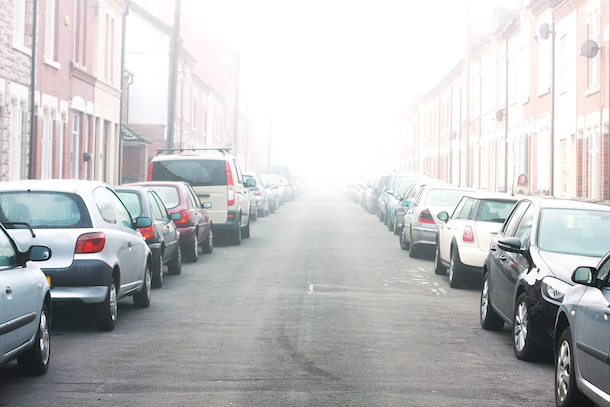
Misty street with parked cars image via Shutterstock

Why Your Next Car Might be My Next Car Too

Last week, Google Ventures invested $258M in the car service Uber raising the company’s value to $3.5B. If you don’t know Uber, you probably will soon. While the company’s bread and butter is an app that allows on-demand black car reservations from existing limo companies, they have also recently introduced UberX, which allows you to book a Prius limo in several major cities. For the future, they plan to move into non-taxi ride-sharing, cutting into services like Lyft, and some speculate that they might start their own fleet of taxis. TechCrunch waxed about the possibility of an Uber fleet of driverless vehicles supplied by Google.

Uber’s growth, as well as that of other car-sharing programs, would not be so interesting if not seen in light of a major shift in behavior and attitudes toward driving, cars and where people want to live. In short, people are moving to the city, driving less and caring less about cars.

Consider the following from a US PIRG (Public Interest Research Group) report:

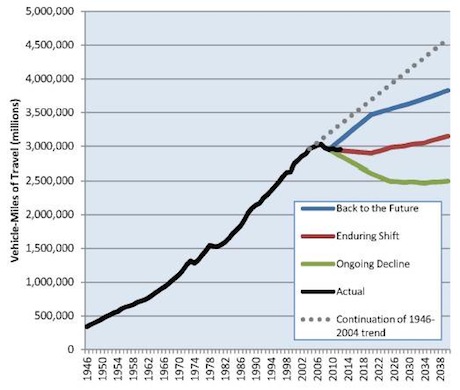
  • Americans drove more miles nearly every year between the end of World War II and 2004.
  • Americans drive no more miles in total today than we did in 2004 and no more per person than we did in 1996.
  • Americans took nearly 10 percent more trips via public transportation in 2011 than we did in 2005. The nation also saw increases in commuting by bike and on foot.
  • Young people aged 16 to 34 drove 23 percent fewer miles on average in 2009 than they did in 2001—a greater decline in driving than any other age group. The severe economic recession was likely responsible for some of the decline, but not all.
  • Millennials are more likely to want to live in urban and walkable neighborhoods and are more open to non-driving forms of transportation than older Americans. They are also the first generation to fully embrace mobile Internet-connected technologies, which are rapidly spawning new transportation options and shifting the way young Americans relate to one another, creating new avenues for living connected, vibrant lives that are less reliant on driving.

Further data supports this trend away from car use and ownership, such as the fact that kids are waiting longer to get their drivers license, and a study conducted by Zipcar found that most Millennials would sooner give up their car than their smartphone. The trend of less driving is expected to grow.

vehicle-miles-traveled

There are detractors who say that the dip in car ownership is a momentary blip before the economy improves and Millennials start having babies, but we think there’s more to it.

Following WWII, excess industrial capacity in America allowed cheap cars to flourish. In that same time fuel, excepting the OPEC blip in the 70s, was cheap and plentiful. The environmental impact of emissions was an abstraction. This low cost of ownership and operation and the perceived benign global impact of cars gave people permission to take more than they needed–more power, capacity, seating, etc (if you don’t believe this, go to Europe–or virtually anywhere else on earth–where most cars are significantly smaller). The car, invented as a tool, became a totem.

But today, the rising costs of car ownership and fuel, cultural shifts toward more centralized, urban living and technological means to access to cars without owning might be pushing the car back to its utilitarian roots. Cars may soon be seen as something to move us from point A to B, not something to move us ahead in life.

What do you think? Do you think car sharing can truly replace individual car ownership? Are we really giving up our cars or is this shift a momentary blip in automotive history?

Image credit: ChameleonsEye / Shutterstock.com

Would You Pay $400/Month for All of Your Transportation Needs

The Downtown Project is an ambitious project going up in Las Vegas’ old downtown area. Helmed by Tony Hsieh and the Zappos corporation–for whom the area will serve as their new corporate campus–the area is being designed to embody the ideal urban conditions to produce a global innovation capital to rival Silicon Valley. They are carefully condensing housing to be 100 people per acre–perfect for serendipitous encounters that spark innovation. They are providing a large startup fund to attract the best minds from around the globe. And now they are adding a transportation scheme that may point to how we get around in the future.

For about $400 a month, Project 100 will provide on demand transportation, matching subscribers with several different transportation alternatives depending on their needs in the moment. From Project 100’s website:

Project 100 is the code name for a complete transportation system designed to let you get rid of your car and be more connected to your neighborhood. It includes on-demand cars with drivers, shared cars you can drive yourself, bikesharing, shuttle buses and more. The experience is simple: open an app so we know where you are and tell us what zone you want to travel to. With that information we’ll give you a set of options, for example, 1 – Be picked up by a driver in a Tesla in 3 minutes, 2 – Drive yourself in a low range electric vehicle that’s 0.2 miles away, 3 – Grab a bike that’s 0.1 miles away or 4 – Hop on the party bus that will be near you in 4 minutes.

Similar to the architectural idea of using transforming spaces to provide space when you need it and not when you don’t, Project 100 wants to match your transportation need with transportation conveyance to optimize efficiency. For example, if you need to cruise on the highway, use one of their Tesla 100s; if you need to go a mile, use a bikeshare bike; if you need to barhop, use a shuttle; and so on.

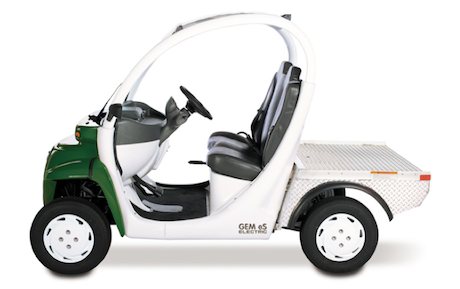
One of those transportation alternatives they allude to are “low range electric vehicles” such as the Polaris GEM (pictured below)–a tiny EV that handles quick trips to the grocery store more efficiently than the Tesla.

polaris-gem

The project has some technical challenges. They need to create an infrastructure for charging the EVs; they will provide a hub for vehicle storage and charging, but the nature of the system would make leaving the cars anywhere the ideal. There is also the substantial technology necessary to distribute vehicles so everyone in the system has what they need 100% of the time. The project wants people to get rid of their cars, and in order to do so they need a system that rivals–or perhaps bests–the convenience of traditional car ownership.

All these challenges included, we applaud The Downtown Project and Project 100. It’s an earnest effort at curbing the inefficiencies inherent in America’s current transportation landscape, where large SUVs are routinely used to pick up a half-dozen cupcakes because that’s the one vehicle its owner has immediate access to.

The limited range of the Downtown Project provides a nice laboratory to work out the inevitable kinks–as well as a forward-thinking, forgiving constituency. And $400 for all your transportation needs (insurance, fuel, etc are included), while more money than biking around the city, is pretty comparable in terms of cost to car ownership, and the system has a number of benefits car ownership does not.

via CNET

6 Future Blue Chip Companies in the Sharing Economy

A recent article in Forbes called “Airbnb And The Unstoppable Rise Of The Share Economy” gives a great overview of the nascent sharing economy. It tells stories of people like Frederic Larson, who brings in $3K/month renting his home to Airbnb and his Prius through Lyft, or Dylan Rogers, who makes $1K/month renting his BMW out and plans to buy a couple extra cars to make his own micro-rental car fleet. It explains how more and more average people are making and saving dough through resource sharing.

The article is a worthwhile read as it gives a balanced look at the opportunities–the millennials growing receptivity to renting and sharing versus ownership, a southbound economy–and challenges–getting people to share low-cost goods, restrictive commercial regulations–facing the sharing economy

The article also turned us on to a number of sites we didn’t know about. Stahlwarts like Zipcar, Zimride, Neighborgoods and Taskrabbit appeared in the article, but so too did some newer, more specialized sites. Here are a few of them:

  • Parking Panda is a peer-to-peer parking garage. Rent out your vacant parking spot as you would your unused room for Airbnb. PP also allows booking standard garage parking, using their mobile app.
  • Dog Vacay is like Airbnb for dogs. Give your dog to “one of thousands of vetted and insured dog lovers” when you leave town (or need a reprieve from your pooch) for “cage-free” boarding starting at $15/night.
  • EXEC is an on-demand cleaning and errand running service with a lovely web interface. An added bonus is that they use all organic cleaning products.
  • Liquid is a peer-to-peer bike rental service. Rent a bike for $20/day or let your bike out for some extra cash (note: the site is down for the winter).
  • Fon is an international peer-to-peer wifi network with over seven million Fon Spots (aka hot spots). Private wifi providers can make money off people accessing their signal.
  • Zaarly allows you to sell your homemade cookies and other shippable custom goods.

Most of the services seem to have a Left-Coast bias, though ones like Fon and Zaarly have national appeal. And of course, as the article mentions, Airbnb started in San Francisco and can now be found in Peoria, Il. You gotta start somewhere.

Do you have more sharing sites we should be looking at? Let us know in our comments section.

Image via Shutterstock.com

Fit Your Next Car into Your Phone

DriveNow is a car-sharing program launched by BMW and European car rental company Sixt that allows you to locate and rent the nearest car within a given city’s limits via its website or mobile app. What sets DriveNow apart from other car-share services is you don’t need a reservation and you can park and leave the car anywhere you want rather than returning it to a home garage. You could rent a car for 20 mins to drive to work, end your rental, stay at work for eight hours, and rent another DriveNow car to go home.

This flexibility contrasts to services like ZipCar, which require you to make a reservation for a set amount of time and return your car to a specific garage (penalties fees are applied if you don’t return the car by the end of your period).

The service is BMW’s attempt to future-proof itself from the changing nature of car usage and ownership. With car ownership decreasing and urban-living on the increase, having a car that does 150 mph on the autobahn and is parked in your suburban garage will become increasingly irrelevant. Tomorrow’s driver will need a car that can handle 25 mph around town and be easily parked.

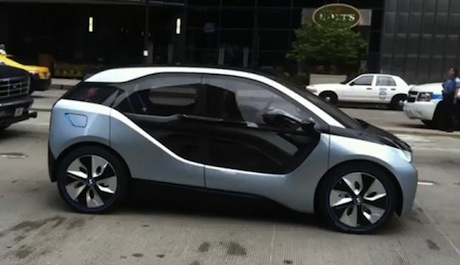
bmw-i3

DriveNow is also connected with BMW’s upcoming i3 electric vehicle (pictured above), which is the company’s first EV geared specifically to city living. In the future, DriveNow will be connected to charging stations around a city for low-emission temporary urban transit.

Here’s the rub: DriveNow is almost exclusively in Germany, with locations in Munich, Berlin, Dusseldorf and Cologne. Currently, their fleets are internal combustion engines, which enables the flexibility of returns (i.e. you can park on the street rather than finding a charging station). Rates are €29 cents/minute for driving and €10 cents/min for parking. These rates include parking and gas; fuel levels are visible when you book your car. DriveNow also includes on their maps proximity to bike share stations.

They have one US location in the Bay Area, whose fleet is made up of BMW’s ActiveE, an all electric version of their 1 Series car. Because of the need to charge, you need to return the cars to one of the designated garages, though not necessarily the one where you picked the car up. All stations are located near BART stations. Rates are $12 for the first half hour then $.32 each additional minute and $90 for the day. There is a one time $39 registration fee.

Ideally, a service like DriveNow would be brand-agnostic–i.e. not attached to a particular carmaker. But we find the idea of on-demand, restriction-free car sharing pretty exciting. Imagine being able to rent any car parked on the street whenever you want. While the per drive expense is surely much greater than car ownership, the lack of overhead and flexibility seems well worth it. And with bigger fleets and costs spread out over more members, the per drive cost would likely go down while available cars increase.

via Metropolis Magazine