9 Ways to Edit Your Life in the Suburbs

It has been rightly pointed out that we at LifeEdited have a heavy urban bias. We sing the praises of compact apartments nestled in vibrant streets where we all frolick, ahem, walk or bike to world class restaurants, charming cafes and green markets; where cars are only used for the rare road trips to bucolic countrysides; where the reusable shopping-bag denizens create a fraction of the carbon footprint of the national norm.

But sometimes we miss the point. Many, many people live in the suburbs–roughly 2/3 of Americans. Many of them happily. They like their lawns, cars and streets that aren’t punctuated by the sound of sirens every five minutes. They don’t mind doing yard work, thank you very much. They accept and occasionally enjoy their commutes to work. And yet, many of these folks (of which you might consider yourself one) want to simplify their lives. They want to have more time, money and peace of mind. They want to reduce the amount of stuff they have and their carbon footprints. They just don’t want to move to the city.

A while back we wrote a popular post entitled “The New American Dream Home,” which profiled the Kawabatas, a family of four living in a not-so-small suburban home. The post was popular, we believe, because it presented a middle ground between extreme minimalist urbanism and unchecked suburban profligacy.

For the record, if you’re going to move, even within the burbs, we suggest finding a house that errs on the smaller side of the national norm and is close to the stuff you do–work, shopping, etc. But given that most of us aren’t going to move any time soon, or not based of some bloggers suggestion, we thought we’d offer a list of things you can do–some simple, some more involved–to create an edited home whilst living in the burbs.

  1. Get rid of stuff. As the old saying goes, nature abhors a vacuum, and given that suburban homes tend to be on the larger side, resisting the urge to fill your rooms with stuff can be difficult. But living with too much stuff is also difficult. There’s more stuff to buy, maintain, dust, organize, clean and toss. And while ultra-austere environments might not be everyone’s cup of tea, most of us appreciate a clear space more than we suspect. We suggest getting rid of stuff you don’t need, use or want, whether it’s housewares, furniture, clothes or paperwork. Edit ruthlessly. Just because you have the space doesn’t mean you have to fill it.
  2. Organize. With a bigger house, the tendency for out-of-sight-out-of-mind increases. Work on going through all of your home’s spaces, getting rid of stuff wherever possible, then organizing. Sort through storage areas, digitize paperwork and photos, make sure everything has a proper place. On the other side is the mental liberation that comes when we know what we have and where it’s at.
  3. Consider going natural. One of the larger time-sinks of having a single-family home is routine lawn care and landscaping. There are many types of beautiful grasses, shrubs and other plant life that need no or minimal upkeep. Look into what those things are for your particular climate and consider them as an alternative to the standard suburban mowed lawn and trimmed hedge aesthetic.
  4. Think before you drive. It’s sort of an inescapable truth that most suburbs truly depend on the car. Distances between destinations are generally too long for a walk and even a bike in many cases. That said, more and more municipalities are adding bike lanes and paths as well as public transport. While these forms of transit might lack the lightning speed of hopping in your car, there are many ancillary benefits like getting exercise, saving money and cutting your carbon footprint. Consider upgrading your commuter bike and riding that ten mile trip to work. Use the time waiting and riding the bus to catch up on reading.
  5. Telecommute whenever possible. The average American spends 50 minutes a day on his or her commute. And many people report that their commutes are the low-points of their days. If you have a flexible work situation, regain that time and sanity and consider making a request to work from home, even if only for one day a week.
  6. Close off a room. I know, this might sound weird, but the fact is many of us have spaces in our homes we simply don’t use enough to justify their upkeep–cleaning, heating and cooling. Consider making the room off limits–shutting the vents, covering the windows, etc–until you have a use for it.
  7. Get a lodger. This falls a bit outside the suburban norm, but fitting more people into a space cuts down on sprawl, can spread expenses and, assuming you have reasonably good interpersonal skills, might even make your home a more interesting place to live. Don’t want a stranger–consider having a family member moving in. Don’t want a family member–consider a stranger.
  8. Look into an Accessory Dwelling Unit (ADU). This one is a bit of a radical proposition, but depending on zoning where you live, you might be able to add an additional home to your existing home’s lot. Throw a tiny house in your back yard and rent out your main house–or vice versa.
  9. Use and love your space. Probably the biggest shame of the big American house is that it doesn’t get used enough. There is no “right size” for a home. If a space is frequently used and enjoyed, then it’s probably the right size. Host parties, BBQ’s, movie nights and other community activities. Size is an asset when it’s used.

Do you live an edited life if the suburbs? What would you add to this list? Let us know in our comments section.

Arial view of housing subdivision image via Shutterstock

How to Create a Healthy Relationship with Technology

Aside from publishing this site and our real estate arm, one of the chief things LifeEdited does is spread the less is more gospel at various conferences. This last weekend we–specifically Graham Hill with my assistance–presented at the Revitalize Conference organized by the good folks over at Mind, Body, Green. The name of our talk was “Signs You Have an Unhealthy Relationship With Technology.” While there’s undoubtably a crisis of excess affecting consumer goods and architecture, those things are well-matched by the attention crisis. We live in a world where people are glued to glowing LCD screens for many of their waking hours–some of those hours are used to good effect, many are not. The talk was an investigation into this relationship between humans and personal technology as well as a brainstorming session for possible ways through some of the more problematic aspects of that relationship.

We touched on the marvels technology has wrought (mostly portable and information tech–smartphones, tablets and to some extent computers). It has given us the ability to access vast amounts of information instantaneously; the ability to fit tens-of-millions of songs or books in our pockets; the ability for unprecedented levels of connectivity, which has changed the face of social activism a la Arab Spring, the Occupy movement and others.

But in line with the talk’s title, we spent a good deal of time elucidating some of the more problematic aspects of technology use. A bunch of this we covered a few weeks ago with the post “Distracted, Dangerous and Dumb: Why it Might Be Time to Check Our Cellphone Use,” which explained how our technophilia is making us bad students, thinkers, friends, lovers, community members and parents. Expanding on that, here are few more things we found about the deleterious effects of our overuse of technology:

  1. Portable tech is making us really, really, horrendously awful drivers. This can’t be overstated. According to the National Highway Traffic Safety Administration (NHTSA), sending or receiving a text takes a driver’s eyes from the road for an average of 4.6 seconds, the equivalent–when traveling at 55 mph–of driving the length of an entire football field while blindfolded. They say driving and texting is six times more dangerous than driving while intoxicated.
  2. It’s even making us bad walkers. Experts say distracted walking results in more injuries per mile than distracted driving. Reports of injuries to distracted walkers treated at ERs have more than quadrupled in the past seven years and are almost certainly underreported. There has been a spike in pedestrians killed and injured in traffic accidents in that time as well (though there is no reliable data on how many were distracted by electronics).
  3. It’s making us nervous nellies. Americans check their phones, on average, 150/day according to study conducted by Nokia.
  4. Our technophilia is crap for the environment. The average American generates 65 lbs of e-waste every year–a yellow labrador’s weight in electronic waste–much of which does not get recycled.
  5. It might be bad for our health. The International Agency for Research on Cancer (IARC), an agency of the World Health Organization, downgraded radiation from mobile phones from a category 3, which means “no conclusive evidence” of causing cancer, to category 2b–a “possible human carcinogen”–a designation shared with diesel exhaust, chloroform, jet fuel, lead and DDT.

When we got all the nasty stuff out of the way, we started seeking solutions. We explained that technology is not bad any more than a chef’s knife is bad–it can be wielded by Mario Batali or Norman Bates for very different purposes.

The thing that became evident is that in many ways technology use is in its infancy. For most of humankind, we have had incremental introductions of technology. In Europe, the lowly table fork took about 700 years between its first notable appearance and widespread adoption. Smartphones have been around for about ten years, yet 56% of Americans already have them–a number that’s only expected to increase. We haven’t had time as a culture to develop rules and etiquette around their usage. So we proposed a few strategies that might start fostering a happy, healthy, balanced relationship with technology:

  1. Regularly going tech free. This is an obvious, though seldom followed, suggestion. We suggested not only turning off your phone, but actually getting away from it–charge it away from your bed at night, keep it off the dining table, etc. Stay away from tech an hour before sleep and upon awakening. Also, we suggested taking a tech sabbath once a week or more. We also suggested going analog for certain things; sure, it’s pretty awesome that smartphones can do so much, but if checking the time on our phones sets us off on four hour Facebook binges, maybe it’s time to get a wristwatch. Likewise, we might play Scrabble rather than Angry Birds, talking to someone face to face instead of chatting online. Sometimes the old ways are the best ways.
  2. Build your defenses. All of us have moments of weakness. If we’re straight about that, we can effectively defend ourselves from common dangers technology poses to our wellbeing. We suggested batching emails, calls and texts, choosing a time or two a day when we knock out all of our correspondences, rather than having a distracting drip feed of correspondences throughout the day. We suggested disabling push notifications–those (generally) useless reminders that come up on our smartphones telling us that Joe thought the new episode of Orange is the New Black was interesting. We suggested using the Airplane mode on our phones liberally. Most of us non-surgeons have few true emergencies. It’s okay to be offline for a while.
  3. Honor yourself and others. When we check our phones incessantly, what we are communicating to the world, in the words of Renny Gleeson, is that “you are not as important as anything that could come to me through this device.” When he said “you,” he meant the people we spend time with, but this could also mean ourselves. By continually checking our phones, we are communicating that our phones and whatever bits of information they transmit take priority over the present moment–whether that present moment is spent alone or with others. If we value our lives, if we value our friendships, if we value our surroundings, we suggested that we might all start acting that way, honoring these things with our “payment” of attention and putting the damn phone down. We suggested getting reacquainted with the art of being “in-between”–those gaps between activities that used to be filled with no activity but are now filled with information. It’s been said that 75% of Americans report using their phones on the toilet. We suggested practicing going tech-free waiting in line, sitting in a cab or taking a poop. Lastly, we suggested leading by example. If we want our kids to be less tech-addicted, if we want our friends to pay better attention, we must do it first.

We also pointed out that these are not fantasitc goals. There are many people living with no or minimal technology, some notable like Jim Jarmusch, Warren Buffett, Louis CK and Alain de Bottom. The latter figure announced to his 443K Twitter followers that they should delete their Twitter accounts. Our closing thought was the reasoning de Botton gave to the Washington Post about his newfound relationship with Twitter. It’s a sentiment we think is applicable to most tech use. He said:

Twitter is of course a wonderful thing, but it is also the most appalling distraction ever invented. It sounds so harmless…[but] It denies us that precious non-specific time in which you can daydream, unpack your anxieties and have a conversation with your deeper self.

…We need long train journeys on which we have no wireless signal and nothing to read, where our carriage is mostly empty, where the views are expansive and where the only sounds are those made by the wheels as they click against the rails. We need plane journeys when we have a window seat and nothing else to focus on for two or three hours but the tops of clouds and our own thoughts.

We need relief from the Twitter-fueled impression that we are living in an age of unparalleled importance, with our wars, our debts, our riots, our missing children, our after-premiere parties, our IPOs and our rogue missiles. We need, on occasion, to be able to go to a quieter place, where that particular conference and this particular epidemic, that new phone and this shocking wildfire, will lose a little of their power to affect us – and where even the most intractable problems will seem to dissolve against a backdrop of the stars above us. FULL TEXT HERE

We couldn’t agree more.

7 Ways to Improve Your Small Space with Feng Shui

An NPR story last week told the tale of Lisa Dutton. Her home had been languishing on the market for 30 months with only low-ball offers coming in. The Chino Hills, CA resident was frustrated. She said, “I thought, ‘Wow, my house is beautiful. What’s wrong? Why is someone just walking right out the door?” The reason, she came to find, was the place had bad qi–a Chinese term for energy. To fix this energetic issue, Dutton hired a feng shui expert and in short time had an offer nearly $100K more than her pre-feng shui-ed listing period.

Feng shui is an ancient Chinese philosophy that seeks to harmonize the human experience with our surrounding environment; it’s like UI design for reality. To some, feng shui might seem like soft science, but another way to see it (at least its more mundane aspects) is a codification of those intuitive and intangible elements that make a place feel great or horrible. When dealing with a small space, where there is no room for bad mojo, correcting qi disorders can make all of the difference in making the place a sanctuary or a rattrap.

The feng shui philosophy has been developing over the last 6K years give or take, so we won’t try to give an expert guide to incorporating its principles into your home (there are many consultants if your home has a serious qi deficiency). Furthermore, every house is different in its makeup, and much of feng shui depends on orientation to the sun and poles. That said, we can give a few simple, easy-to-implement suggestions to making your small space–or any space really–feel and flow better:

  1. Make an inviting entranceway. Logically, the entranceway is the gateway for both your body and qi into a home. Keep your entranceway clean, uncluttered and inviting. Paint your door if it’s in bad shape, put some plants and a clean door mat out front. Make an entranceway appropriate for a place you want to enter. The same goes for the interior aspect of the entranceway, which is where energy flows back out. Don’t block it with tons of coats or your gnome collection.
  2. Keep thing flowing. One of the main ideas is that energy should peacefully move through your home. Furniture placed in the middle of your home’s main arteries can clog those arteries leading to a constricted environment. Rodika Tchi says this on About.com about keeping a room’s flow: “Basically, as you stand at the entrance to your living room, visualize energy as water flowing into the room. Would the stream of water flow freely and smoothly? Would it get stuck in many areas of your living room? Will it rush right out the big window or another door aligned with the living room door.” These are important questions as there can be a tendency to cram too much stuff into small spaces. Err on the side of less to keep a space open. Often it’s better to sacrifice some function for flow.
  3. Remove “dangerous” furniture. Feng shui expert Erica Sofrina says, “Anything that you bump your head on, stub your toe or bruise your shins on is unsafe. The message to the reptilian brain is that home is not a safe place to be. Replace sharp-edged furniture with those that have rounded edges and remove from sight anything that is–or even looks like a weapon.”
  4. Clear clutter. You might have rationalized that a messy desk–or table or dresser or countertop–is the hallmark of genius, but feng shui philosophy would say otherwise. Feng shui dictates that we have connections with every physical object in our homes; when those objects are superfluous or represent things not dealt with, they can make our homes stagnant and overwhelming. Clear old clutter away ASAP and continually clear surfaces to keep things flowing smooth.
  5. Balance the elements. Traditional Chinese philosophy holds that there are five essential elements: fire, metal, earth, wood and water. Each element has a corresponding color or hue, e.g. red is passion, blue is relaxation, brown is grounding and so on. Try to not lean too heavily on one color, but rather try to create an elemental balance in your home to have balance in your life. Balance can also apply to décor; more “active” rooms like an office can have more going on than “passive” rooms like the bedroom.
  6. Use mirrors to your advantage. Well-placed mirrors can help transmit the flow of energy. Place them in dining areas to increase the enjoyment of meals or near dark areas to bring light and energy to that space. But don’t put mirrors directly in front of a door, which repels entering energy or near areas where you don’t want to increase something’s quality, e.g. a toilet.
  7. Bring in nature. Evolutionarily speaking, humans are very accustomed to living away from nature. Place greenery around your home accordingly.

Water and elements image via Shutterstock

Via NPR 

Parkinson’s Law and 3 Ways to Work Less and Get More Done

Australia: 20. Sweden: 38. Canada: 15. Norway: 26. Switzerland: 32. Germany: 25.  The countries are those ranked as having the world’s highest standards of living. The numbers are minimum number of paid leave days employers are legally obliged to give their employees in those countries (note the numbers can far exceed those listed).

Then there’s the United States: bupkis. American employers are not required to give their employees any paid time off. To be fair, 10 days is pretty standard for employees of most big companies. But check this out: a survey by Glassdoor found that 51% of Americans who had paid leave didn’t take it. That’s right, their companies told them to take off, gave em’ some loot to have fun, and these folks said, “No thanks, I got work to do.”

The survey also found that only 25% of employees took all of their paid leave, and that 61% of those who took vacation leave said they worked during those vacations.

This inability to not work might be linked with the American belief that working more means more success and happiness, another study found (a belief celebrated in the above Cadillac commercial). With a belief like this, vacationing and taking time off are stressful events. The Glassdoor survey found that 28% of people feared a vacation would cause them to fall behind at their jobs. 17% feared losing their jobs.

However, the link between working more and more success and happiness is not strong in most other nations. For a good reason: it’s not true. John de Graaf, who runs an organization called Take Back Your Time, told CNN, “There is simply no evidence that working people to death gives you a competitive advantage.” He points to the World Economic Forum Global Competitive Index, where all but two of the top ten economies have workforces with requisite and substantial paid leave (the US and Singapore being the exceptions. And some say Singaporeans are some of the most miserable folks on earth).

Overworking and Parkinson’s Law

This American overworking phenomenon–one that, like obesity and Walmart, will probably travel the world–might have something to do with a “law” set forth by a Brit named C. Northcote Parkinson. Parkinson said that “work expands so as to fill the time available for its completion.” In other words, there will never be enough time to do your work if you have no limits for the amount of time you work. For many Americans, work time is primarily limited, not be vacations, hobbies, leisure, family, etc, but by the interruptions of routine bodily functions.

Okay, perhaps it’s not that bad, but it is bad. Americans have trained themselves to fill their prescribed or self-imposed work-time vacuum in order to satisfy their (um, our) drive for success and happiness. The issue isn’t that this strategy is making us economically successful (the US is #4 on the WEF Competitive Index, though you could argue about the distribution of this success), it’s that our strategy has no positive correlation with success–as evidenced by the fact that many of the most economically powerful nations enjoy ample paid leave. And there certainly isn’t a positive correlation with happiness. According to the JWT Anxiety Index, Americans are more anxious than these other countries who have mandatory paid leave. This is not to say that overworking is the specific cause of the anxiety, but the level of anxiety should call into question the notion that more work = more success = more happiness.

What does this mean to Joe and Jane Six Pack? We have a few suggestions for anyone looking to escape the “don’t have enough time/gotta work more to be more successful” hamster wheel:

  1. Look how inefficiencies might be bloating our punchcard. Remember that the average American spends 4 hrs 15 mins watching TV and 2 hrs 38 mins on his cellphone or tablet per day. Many of us probably waste many hours a day on things that have nothing to do with work, but because we do them while working, it somehow satisfies our desire to fill the work-time slot. For example, 5 hrs work + 2 hrs Facebook + 1 hr fantasy football = 8 hr workday. What if we just did the 5 hrs of work and then went for a run or hung out with our kids?
  2. Impose limits on how long you can work. As any college student with three days to finish a ten page paper will attest, short timetables tend to put things in motion faster than indefinitely long ones. Consider that the addition of leisure time or some other non-work event–one that might make you more than a worker bee–may well drive you to get work done quicker and more efficiently than the addition of time.
  3. Don’t be afraid to work less. Consider that more time is not what you need to be more successful, and that less time may do the trick and leave time to play. We understand there is a deeply entrenched culture of overworking to contend with, but when we focus on quality of work, rather than quantity of time, performance and contribution rather than duration, we may even win over colleagues. Of course, this might not translate to every profession–e.g. a babysitter is paid for her time–but there are many professions where this is quite applicable.

3 Tips for Transitioning Your Aspirations

As a child, few things got me more excited than cars. In particular, I loved European sports cars: Porsches, Ferraris, Lamborghinis, Lotuses and the like. I subscribed to magazines, bought books and memorized specs. Though I had a very vague idea of what a dual overhead cam was, I knew that an AMG Hammer had em.

My car-lust continued unabated until one day I learned about something called global warming. I learned that things humans did and consumed were imperiling the planet’s ability to sustain life. I learned that seemingly benign, everyday things like aerosol cans, refrigerator freon and styrofoam were in fact evil, earth-harming, animal-habitat-destroying substances–things I should stop using immediately.

But it got worse. I learned that those beloved, V8-powered, petroleum-parched cars I loved so much were one of the biggest emitters of greenhouse gasses. The things I aspired to have were destroying the planet.

My situation was far from unique. Many of the popular objects and activities held up as signifiers of success were revealed as net harmers to the planet and the people who live here. Turns out that sparkling jewelry is manufactured by slave labor. Dye runoff from our favorite fashion company’s factory contaminates Bangladeshi groundwater. That fancy designer house in the woods creates sprawl and consumes far more resources than that drab coop in the city. Even the jets that take us to exotic ports of call are acidifying the ocean.

And therein lies one of the bigger challenges of making significant life changes: letting go of aspirations, desires and ideals that no longer align with where we want to take our lives.

These things can be pretty hardwired. For years, we have associated particular stuff with success and happiness, even when these associations are purely a construct of an advertising campaign. A Louis Vuitton handbag (a real one) means you’ve made it. But the more we learn, the more we realize that popular belief doesn’t make something true. As Anthony De Mello put it:

There is only one cause of unhappiness: the false beliefs you have in your head, beliefs so widespread, so commonly held, that it never occurs to you to question them.

Letting go of these associations–in the interest of personal and global welfare–often requires replacement. A sports car is replaced by a hot bike. A big mansion with a tiny house. Carrie Bradshaw with Courtney Carver. But we caution to say that these things–though an improvement–can become more refined versions of the old, politically incorrect stuff we used to aspire to have.

If your old aspirational models are bringing you down, here are a few suggestions that might help replace and/or let them go:

  1. Find new influencers. Generally speaking, we learned what was aspiration-worthy via TV and other traditional media. I wanted a Ferrari Testarossa because Sonny Crockett had one. These influences can be subtle and surprisingly powerful. Find sources of media–like this one ;-)–and friends that speak your new language and share your new values. Our thoughts are a function of our conversations. Make sure those conversations are the right ones for who you want to be. Quarantine yourself from the old conversations if necessary.
  2. Go local for inspiration. It’s easy to desire things from afar. It’s easy to want to live like or have something someone in a TV commercial or fashion ad has; worlds where all problems are edited or photoshopped out. Aspiring to have or be something or someone you are intimate with–with which you are familiar with all its, his or her problems–is a different matter. When we truly know something, we can better determine if we want that for ourselves.
  3. Start with the end goal. When I lusted after cars, I was seeking power–something most boys feel lacking. The problem is fast cars make you fast, not powerful. Remember Be > Do > Have. Start paying attention to the things that produce the desired state, whether it’s power, simplicity, happiness, etc. Investigate and try things for yourself. Don’t take someone else’s word for what will produce these things–and certainly not someone who’s trying to sell you something. Start doing those things more often.

Sergio Gutierrez Getino / Shutterstock.com

Maybe We Should Eat Less

We often write about the merits of living in smaller spaces with less stuff, but when pressed we admit these things have never been clinically proven to extend life. Eating less food, on the other hand, may. The life-extending benefits of a calorie restricted diet have been known for years; laboratory mice lifespans have been increased by as much as 40% as a result of a calorie restricted diet. Now another study suggests that humans too might benefit from taking one less trip up to the buffet.

A University of Wisconsin study that spanned 25 years took 76 Rhesus monkeys and observed their wellbeing as it related to the amount they ate. One group, the control, ate a diet designed to mimic the standard American diet (sometimes called SAD), which meant unlimited portions of food with lots of sugar. The other group had a similar diet, but consumed 30% fewer calories. The results were dramatic: the control monkeys had a 2.9 times higher risk of disease and a three-fold increased risk of death over the course of the study as compared to the calorie restricted group.

It should be noted that there is some controversy about how conclusive the UW study is. The National Institute of Aging conducted a similar study spanning three decades. They observed 120 Rhesus monkeys, split between a control standard diet and a calorie restricted one. But unlike UW, they found little difference between the two groups in terms of mortality rates.

The difference, many are speculating, has to do with the respective diets. UW fed their control monkeys an unlimited supply of laboratory-grade junk food from the time they were young adults (seven to 14 years old). NIA’s control monkeys were adult when the study started; they fed them whole foods in portions based on how they ate before the study. The UW monkeys were like teenagers, whose habits were not yet formed, and then were given an unlimited supply of McDonalds for 25 years. The NIA control monkeys were like adults accustomed to a lifetime of wholesome, home-cooked meals.

The two research groups are now collaborating to come to some definitive conclusions about the benefits of calorie restricted diets.

We must say that the UW study seems to correlate with the way most Americans eat, with our virtually endless supply of sugary, far-from-whole foods. Coupled with the robust evidence supporting life extension in lab mice, we suspect cutting back on the calories (i.e. eating less) is a good, if not guaranteed, way of improving our health and possibly living longer.

Of course this is easier said than done. With tasty, sugar-and-salt-rich convenience foods lurking in every aisle and cupboard, the temptation to eat more than necessary is often too great to withstand. Here are a few tactics for keeping the calorie count low:

  1. Eat less, but better. The calorie-restricted mice had the same micro-nutrients levels as their overeating, fast-dying counterparts. Nutrition matters, and just because you eat a lot, does not mean you get a lot of nutrition. Focus on eating high-quality, nutritious, whole foods. Chips, sweets and highly refined wheat products have virtually no nutritional value, yet they can take up an inordinate percentage of our daily caloric intake if consumed. Find nutritional replacements for junky food or cut it out. Sometimes the reason we overeat is not hunger, but malnourishment.
  2. Try smaller plates and portions. Sensible eating has no greater foe than the buffet. Portions keep us in check, allow us to slow down and give a sense of completion for a meal.
  3. Will power. No one likes to struggle–especially fighting the very biological urge to eat–but sometimes a little discomfort is what it takes to make a habit. Try setting a goal of eliminating nighttime snacking or some other non-nutritious, calorie-rich, “recreational” eating. You might find after a few times of stopping yourself from indulging, your capacity to do so in the future increases and you have yourself a habit.

Via NY Times and Medical News Today

Group Catering image via Shutterstock

6 Tips for Creating an Edited Kitchen

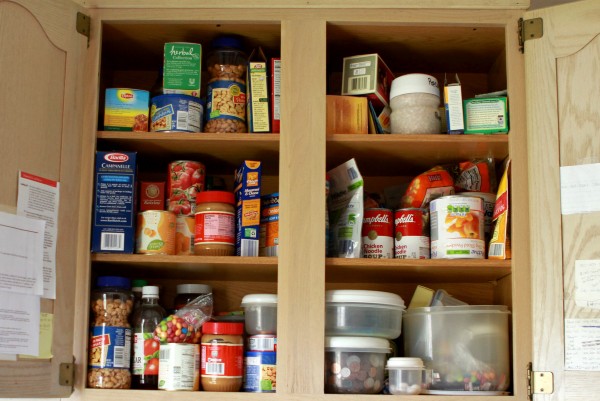
When we think about clearing out excess stuff, we tend to think about durable goods like clothes, electronics, furniture and so on. A cassette tape player we haven’t used in 15 years is an easy target for excision and reducing clutter. But there is another, more edible source of residential overcrowding: food. We might be far less likely to get rid of those 15 year old canned peaches crowding our pantries than we are the cassette player. We say to ourselves, “I might eat that someday.” But do we?

Many modern fridges, cupboards and pantries buckle under the strain of excess food stocks–food that takes up valuable household space; food that uses resources and money to produce and purchase; food that often gets tossed after a long, uneventful stay in our kitchens. Consider these food facts:

  • It’s estimated that 40% of America’s food supply ends up in the trash.
  • 10% of greenhouse emissions from developed countries is generated by the production of food that is never eaten.
  • According to the USDA, “In 2008, the amount of uneaten food in homes and restaurants was valued at roughly $390 per U.S. consumer–more than an average month’s worth of food expenditures.”
  • According to ABC news, between the years 1974 and 2004 the average American home’s kitchen doubled in size from 150 to 300 sq ft.

Cutting down on food waste can make it easier to live in a smaller space, reduce clutter in any kitchen, save money and reduce our carbon footprints. It may even improve our health. If you’re interested in editing your food stock, here are a few tips.

  1. Buy only what you need. This is a pretty obvious one, but try to buy the food and the quantities you know you’ll consume from one shopping trip to another. It’s okay to have an empty fridge before you go shopping. If feasible in your area, make more frequent, smaller shopping trips.
  2. Avoid “precious” food. How many times have you bought special cheese, meat, heirloom tomatoes–whatever–and waited to use it for a special occasion, only for that food to end up rotting? Have a plan for your food–either eat it at an appointed time or immediately. Food spoils. Make every day a special occasion.
  3. As a rule, try to purchase most food from the perimeter of the grocery store. Grocers put all of their perishables–fruits, veggies, fresh meat, dairy–on the outside of the store. Aside from their greater nutritional value, perishables have a finite amount of time you need to consume them, creating an urgency for consumption. On the other hand, food from the store’s interior can sit on their (and our) shelves for millennia–food that is often bereft of nutritional value or filled with preservatives. Real food goes bad. Eat more real food.
  4. If you’re trying to get rid of food you already have, create recipes using existing food and schedule meals. If you need to buy extra ingredients, go ahead, as long as it doesn’t add another wave of new, unused food. Not sure what to make? Try the Su Chef app. If there is food you’re sure you’ll never eat, drop it off at a local shelter.
  5. Compost wherever possible. Many local green markets and community gardens have drop off compost bins. Put food scraps in your freezer between drop offs to avoid bugs. Consider your own composter such as the NatureMill automatic composter used in the LifeEdited apartment.
  6. Don’t be afraid to toss. If something is not fit for eating, giving away or even composting, don’t be afraid to toss it. This is especially true of junk food. Some food is healthier in the trash bin. Just resolve to not buy the same stuff again.

image credit My Cooking Magazine

5 Ways to Think Less in 2014

Michelangelo is famously quoted as saying about his David statue that he made it by removing all the stone that didn’t look like David. Implicit in this remark is that underneath extraneous layers, a thing has an essential, irreducible quality. 17th Century scientist/philosopher Blaise Pascal said, “I would have written a shorter letter, but I did not have the time.” Pascal understood that editing, i.e. getting to that essential, irreducible quality (in his case, the essential message) is something that takes time and great effort.

This is a bit counterintuitive. Humans tend to be impressed with “more”–more space, money, bling, etc. But addition is the easiest math (at least in the short term); it involves throwing more distractions and stuff in our lives to avoid confronting life’s toughest questions. What would my life look like in its most essential form? What kind of company would I keep? What kind of work would I do? Where and how would I live? What would I focus on?

For 2014 we suggest continuing to ask those tough questions–to continue removing all that is not David (insert your own name to make the metaphor work). Here are five areas where we might direct our figurative chisels in the coming year.

  1. Attention. It’s been shown that the more we attempt to multitask, the less we are able to pay attention to anything. Multitasking might even make us dumber insofar as our intelligence is applied to those multiple tasks. In 2014, become a master monotasker. Practice doing one thing at a time–whether it’s work, driving, reading or talking with a friend. Keep asking ourselves, “Am I doing and paying attention to my essential task?”
  2. Space. We suspect that our readers are better than most in terms of editing their spaces, but there is almost always room to reduce. We’ve seen before that many Americans use a small percentage of their floorspace. If we’re considering a move, we might consider how much space we truly need, not just what we can afford or what other people have decided is the right amount of space for them. If we’re staying put, ask ourselves how we can make the most of the existing space and how we can remove any elements that don’t support how we live.
  3. Clothing. It’s been estimated that most people only wear 20% of the clothes in their wardrobes. An essential wardrobe would be one where 100% of our clothes are regularly worn (seasonal and specialty clothing notwithstanding). In 2014, let’s get rid of the clothes we don’t wear and don’t bring in ones that won’t be worn. Create a wardrobe where every item is our favorite.
  4. Food. For many, eating is a recreational activity more akin to zoning out in front of the TV than reading a great book. Rather than jumping on the latest fad diet, for 2014 let’s eat less, but better–healthy, fresh food that supports longterm health, not immediate gratification.
  5. Stuff. With the holidays over, it is a good time to take stock of our stuff. For 2014, we might continually ask whether we need the stuff we have. Do we use it? Does our frequency and quality of use justify its residency in our lives? If not, can we be willing to let go of it? Can we let go of the things that prevent us from living an essential life?

Image via Asier Villafranca / Shutterstock.com

4 Ways to Get Off the Misery Train

Have you ever experienced a time when you were perfectly content with your life? A time when you had a sense of wholeness about your home, job, relationships, financial situation and everything else. No, things were not perfect, but they were sufficient and alright.

Then something happened.

You went online and saw a really cool house on Pinterest you wished your’s looked like. You talked to a friend you hadn’t connected with in a while. She got a promotion, and you realized you deserved a promotion. You saw a commercial and realized how much static cling your clothes had. These things made you realized just how much your life sucked. Whatever term you affix to it–jealousy, envy, keeping up with the Joneses–few things have the capacity to rob us of satisfaction like comparing ourselves to others (also known as “social comparison”).

The phenomena works like this: we take a comprehensive understanding of our own lives (personal struggles, financial woes, etc.); we hold that up against a superficial understanding of our others’ lives (pictures, tabloids, interviews); we realize how little we have, how hard our lives are, how fat we are and so on.

Social comparisons affect both our emotional and material sense of satisfaction. We compare our emotional trials and tribulations to the self-evident ease of living others enjoy–our evidence typically being derived from pictures, People Magazine articles, Facebook status updates and the like. In fact, one study about the effects of Facebook found that “passive following [i.e. not contributing content] exacerbates envy feelings, which decrease life satisfaction.” (It should be noted that people who actively engage on Facebook, contributing content and posting on friends’ walls reported greater life satisfaction).

And nothing reminds us of our material deficiencies like brief glances at the abundance of others. We never realized how crappy our iPhone 3S was until the iPhone 5 arrived. We never realized we needed three car garages until our neighbors had one. We never realized how ill-fitting our jeans were until Miley Bieberlake showed up at the AMAs with a perfectly fitting pair.

In all cases, trouble originated from comparing our internal wellbeing and satisfaction of needs to another’s external circumstances. Few strategies are as effective as this one for making us consistently miserable.

There are things we can do:

  1. Determine what’s important to you and live accordingly. If you need a three car garage or faster phone or bigger home, get them. But if those desires are the products of comparative deficiency–i.e. we want them because someone else has them, and we perceive them to be happier because they have those things–we will forever be on the losing team. We will be chasing the next best thing, aka the “hedonic treadmill.”
  2. Get real. Nothing dispels romantic notions about how easy people have it, or how satisfied they are, like getting to know people. We’re all fighting our own battles. No car, house, amount of money, etc has ever made anyone happy. Sure, these things might get us from place to place, they might house us and pay for certain things, but they don’t make us happy. The guy or gal with the fastest car, biggest house and largest bank account is–nine times out of ten–dealing with the same boring problems you are (though it might look a little different).
  3. Shield yourself. If you know you tend to get envious looking at certain websites, magazines, TV shows or even talking to certain friends, don’t engage in those things. This is not the bliss of ignorance–it’s selective attention; it’s choosing to focus on the fullness of one’s own life rather than the supposed grandeur of others.
  4. Practice gratitude. Place focus on what you do have and what does work in your life. Nothing fends off of comparative despairing like rejoicing in our own good fortune.

Three Car Garage image via Shutterstock

The Myth of the Perfect Gift

Are you looking for the perfect gift this holiday season? Look no further. It doesn’t exist. As we reported the other day, Americans spend between 3-4% of their annual income on Christmas season gifts. The objective of this considerable allocation of funds, we might assume, is to give things to the people we love and like that will enrich their lives–things they will appreciate, use and enjoy.

The reality is something quite different. A Psychology Today article reports sobering information about the psychology of gift giving and receiving. Author Ben C Fletcher cites Professor Karen Pine’s research about festive gifts, which found that:

  • 89% of women and 79% of men pretended to like a gift they hated.
  • Half of all people had received at least one gift they hated the previous Christmas.
  • Half of all people have lied to a loved one about a gift, pretending to like it.
  • Gift receivers reported avoiding eye contact with the giver for fear of revealing how they really felt.
  • Gift receivers reported producing fake smiles using only the mouth (not the eye) muscles when pretending to like a gift.
  • Only 12% said they would tell the gift giver directly they didn’t like their gifts (“men were significantly more likely to do this than women”).
  • 1 in 5 people said receiving a gift made them feel anxious.

The reason for these pretenses and anxiety, Fletcher contends, is the maintenance of social bonds. The objective of a gift is to strengthen those bonds. If the receiver rejects the gift, it might weaken the bond–something he or she does not want to do. So people lie. They say they like things they don’t in order to maintain the relationship.

It’s not much easier for the gift giver, who is unsure whether his gift will strengthen of weaken the social bond he’s trying to maintain (not to mention possibly leveraging his finances). Pine found that a quarter of people surveyed reported that giving a gift made them anxious.

So what do we do? How do we strengthen social bonds without forking over a ton of money? How do we avoid putting our loved ones in positions where they feel like they must pretend to like something in order to maintain a relationship? Here are a few ideas:

  • Give experiences. We’ve said it before and we’ll say it again, people are far more likely to be satisfied with an experience than an object. Treat them to a play, take them out to dinner or cook dinner for them, go for a sleigh ride…whatever. Keep the focus on doing and experiencing, not having and accumulating. If you need to hand something over, give them a “One Less Gift Certificate.”
  • Give a gift certificate or money. It might lack the romance, but these gifts are sure to get used (unless the gift certificate is for an extremely inappropriate store, i.e. don’t get a Tiffany’s gift certificate to your ultra-minimalist pal.).
  • Give thoughtfully. Gift giving is an art. It often takes time, consideration and some knowledge of the gift receiver’s life. If we don’t have those things, we might want to give something with more universal appeal. If we do have those things, choose something carefully…and feel free to throw in a gift receipt and give license to use it ;-).

Upset man image via Shutterstock