The Best Way to Fold Shirts

I love folded clothes. I love how folding prevents wrinkles. I love how it optimizes space. I love how it makes it easy to see your inventory of clean clothes. But I loathe folding clothes. I find it tedious and time-consuming. In the past, I would gladly hand over $15 to have one of NYC’s ubiquitous wash-and-fold laundromats transform my dirty tangle into clean, orderly columns of ready-to-go clothes. But with an in-building washing machine and a son who tears through clothes at a breakneck speed, it’s tough to justify sending clothes out nowadays. And while my wife has less of an aversion (and more skill) to folding than I do, she’s not always available to fold, which means I often find myself folding.

Let me back up a bit, folding clothes is not uniformly difficult. I find folding pants, towels and mating socks pretty easy. It’s the dreaded shirt (any type) that is my laundro-nemesis. I learned my main technique watching a Gap employee fold a shirt I bought when I was a freshman in high school (i.e. a long time ago). It always served me and my shirts well, but it is labor intensive. The method involves laying a shirt face down, folding the sleeves toward the center, then folding the outside quarter of the shirt toward the center, then folding in half or thirds from top to bottom.

My method appears to be the correct (or at least common) way for folding a dress shirt and, to a lesser extent sweaters, which are bit more forgiving. The above video shows how it’s done. The more fastidious seem to prefer using a board in the center of the fold, which helps cinch the shirt against the board and create a standard size for the shirt.
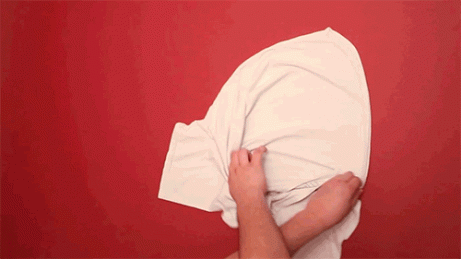
tshirt-gif-step5

This method is not an ideal way of folding a t-shirt however. Surfing the internets, there were two popular methods of folding a t-shirt. The most popular is called the pinch method or Japanese method (see above video). It’s a seemingly magic way of folding a t-shirt in about three seconds (FWIW, it’s the way Martha Stewart recommends). I gave it a shot and couldn’t quite figure it out after a couple tries, though because of its speed, I might try harder.

The other way is the ranger-roll, so-called as it’s the preferred way military personnel fold their t-shirts. It involves folding clothes in toward a six inch center channel, rolling very tightly, then closing off the roll with a crease made at the hem of the shirt. This method is super simple and has a number of advantages: It compacts the shirts as much as possible; it allows various different storing methods, e.g. you could store your shirts butt side up; and it makes t-shirts very portable as there is little way they will come unfolded accidentally. It is however relatively slow to do compared to the pinch method.

This is by no means a definitive list of correct methods. We would love to know your preferred method of folding all clothes and shirts in particular. Let us know in our comments section.

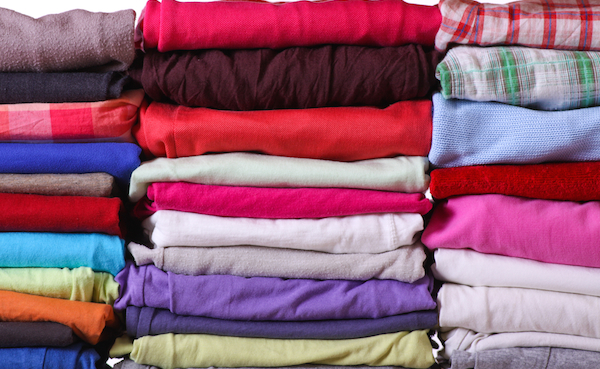
Pile of colorful clothes image via Shutterstock
Tossing X Is Easy If You Know Why

It’s hard to imagine 90 square feet reaching across the globe, but that’s what happened after I moved into that now infamous tiny Manhattan apartment. Prior to deciding whether to move into what some have called “one of the smallest apartments in the world,” I went through my list of living priorities:

  • Is the apartment located in the Upper West Side?
  • Is the rent reasonable?
  • Is it near places I frequent?
  • Will living there allow me to quit my demanding job and finish writing a book?
  • Will it satisfy my itch of wanting to experience living in NYC?

When the answers to all of the above came back a resounding “Yes!” the decision to move into that place was a no brainer. But then came the hard part: culling my possessions. These were items I’d lugged around for years never able to part with. However, now that I had found my “why”–to experience life more, write a book and not work my tail off to pay rent –I could get rid of “X” without a second glance. This included clothes, books and all my kitchen supplies except for a hot pot and toaster oven since the studio was kitchen-free.

I set my sights on living in New York City for just a year. After that I planned to move into a normal-sized apartment in the burbs.

Yet something happened inside those 90 square feet. My life got better. And bigger. And fuller. Did I really want to give that up for more closet space? With my overhead lower (no pun intended), I now had more time to write, ride my bicycle, read books, see theater, visit friends and travel. I was still working hard, but on my own schedule, and the stress was less. I also finished my book, something that had been on my To Do list for over a decade. I might have been living with less, but I had gained so much more. All because I had figured out my “why.”

After the video went viral and the landlord discovered I was subletting illegally, I was handed my walking papers. At first I was frightened. Apartments in my neighborhood, while larger, were more expensive. Would I have to get another 9-5 or move out of Manhattan? Granted it wasn’t the end of the world, but I had created a lifestyle I wasn’t so ready to give up.

felice-cohen-kitchen

My grandfather suggested I buy an apartment. Having been saving for years, I looked around. And I found. The one-bedroom was just two avenues away from the tiny residence, was in my price range, and happened to be five times larger (my kitchen pictured above). Not that I was looking for more space. People joke and ask what I do with all the extra space and the answer is simple. I fill it with family and friends.

It’s been almost three years since I moved out of that apartment, but I often think back on those years and smile. For such a minuscule space, it left an enormous impression.

Today’s post was written by Felice Cohen, a professional organizer, author, public speaker and blogger who currently lives in more than 90 square feet in New York City. Follow on Facebook and @FeliceCohen

Eliminate Stuff by Eliminating Surfaces

In addition to abhorring vacuums, nature seems to abhor clear surfaces. If you don’t believe us, make a clear surface–table, desk, countertop, or even inside a drawer or closet–and see how long it takes for it to get cluttered up with all varieties of stuff: unopened mail, brochures, dog leashes, pencil sharpeners, etc. Clear surfaces provide unstructured, hook-free, often-vertically-unlimited storage. Don’t know where to put something, cram or stack it on that table.

But because they’re so flexible and convenient, clear surfaces tend to be magnets for stuff we don’t need, use or even want. They are especially useful for holding stuff we don’t want to deal with. Why do you think people “table” issues?

RAM or Hard Drive Surface?

If you want to live in an uncluttered home, it’s best to treat your surfaces in one of two ways. One is RAM (random access memory) for your stuff. These are the open surfaces like desks, dining, kitchen and coffee tables. Like a computer’s RAM, these surfaces should store the stuff that needs to be accessed or dealt with immediately–the bill we’re about to pay, the phone we’re about to use, the cup we’re drinking from. When done with use, they will be removed.

The other type of surface is our stuff’s hard drive. Closet and desk interiors, drawers, some desk surfaces, etc. These are surfaces that are assigned specific stuff that will be accessed in an ongoing basis.

If you are looking to de-clutter and simplify your home, try removing a surface or two–one less end table, even one less dresser. Without easy places to deposit and indefinitely store stuff, we often find ourselves compelled to deal with it (or toss it on the floor).

Want to Simplify Your Life? Try a Uniform

My high school hallways were like a fashion show catwalk. With my classmates carefully scrutinizing my outfits, I made sure my clothes were up to date, that I had the right sneakers, the right cuffs on my stonewashed jeans, the right collar shape on my Gap button-downs and so forth. I carefully rotated my wardrobe to make sure there were no repeated outfits in a given week. I didn’t want anyone to think I didn’t care.

While no one ever accused me of not caring, no one cared that much either. All the anxiety, time spent assembling the right styles, laundry–all of it was for naught. I hovered through high school enjoying low-to-medium popularity, no portion of which was attributable to my clothing.

Most people just don’t care that much about what we’re wearing. In my experience, people will notice if our clothes aren’t clean, if they’re falling apart or if they are majorly out-of-date. They’ll notice if what we’re wearing is well made or fits us well. But people won’t care if the nice, clean, stylish thing we wore on Monday is the same nice, clean, stylish thing we wore on Friday.

The world is filled with a profound number of choices, but studies show that having fewer–not more–choices may be the path to greater happiness. Few places provide a greater opportunity for strategically eliminating choice than our clothing.

Rather than boring and imposed fashion, a uniform can be a great way to simplify your life and even express your style–there’s a reason Steve Jobs, one of the foremost design gurus of the last 100 years, wore the same outfit day in, day out.

With a uniform, dressing and life become much simpler and speedier, and with the right uniform, no one will accuse you of not caring.

If you are interested in creating your own uniform, here are a few tips to get you started:

  • If you don’t have a uniform, or don’t know what it would be, start with your favorite clothes as the basis of your uniform. This should be stuff that that fits you well and you feel comfortable wearing. The idea is to have a wardrobe of only your favorite clothes. If you don’t have favorite clothes or don’t don’t care about fashion, ask someone you trust to help select your uniform.
  • Try to find versatile clothing that will work for several different settings. For example my Outlier pants, a staple in my uniform, work for casual and dress occasions.
  • If you can’t make one thing work for several occasions, create separate uniforms, e.g. a work uniform and a casual uniform.
  • When you find something you like, buy multiples. Get a few colors of the same item if you’re worried about looking the same all the time (but remember no one cares).
  • Even if you don’t wear the exact same thing every day, choose high quality clothing staples like a particular skirt, pant or shirt. Choose classic cuts in muted and complementary colors that you’ll be less likely to tire of and that work well together. Ideally, every item in your wardrobe should look good together.
  • Add variety and style to your uniform by wearing accents like colorful undershirts, shoes or jewelry.

Do you have a uniform? Let us know your suggestions in our comments section below.

[This post originally appeared on this site on April 12, 2013]

4 Ways to Stop Reacting and Start Responding to Your Life

“Between stimulus and response is our greatest power—the freedom to choose.” –Stephen Covey

If you’re anything like me, Mondays tend to suck. Unlike other weekdays, which seem distinct and portioned out with manageable tasks and objectives, I look at Monday as a big glob, one that contains all the week’s tasks, objectives and expectations. Rather floating in a sea of opportunity, I feel like I’m paddling upstream in a river of unmet expectations. Monday mornings tend to be a frenzy of reactions. There is little time for reflection or creativity. I am not quite sure if my actions are the best use of my time. I flit about like an amped up gnat, trying to cross stuff off of my to-do list.

Essential to editing one’s life is time management. When we are in reaction mode, acting without evaluation, without taking the time to see if our actions are serving our greater objectives, we run the risk of wasting a good deal of time and therefore our lives.

What if we could step back and see our lives with calm and proper perspective? What if, rather than reacting to a bunch of little things, we could organize our tasks and make sure they were in alignment with our greater objectives in life? What if we could stop reacting and start responding to the various situations in our lives?

The word respond is derived from the Old French word respondre, which means ‘to answer.’ To answer denotes thought—something is asked of us, we consider it, then respond based on the present situation.

On the other hand, reactions tend to be vestiges of our pasts. We are repeating an action. The source of these actions–for many of us at least–has little to do with the present moment. It is most likely based on some previous reference point. I act this Monday much the way I did last Monday and the Monday before that (the breadcrumbs of my first action probably go back to kindergarten).

If you find yourself constantly reacting to life in ways that don’t serve your larger professional or personal goals, here are a few suggestions to get into response mode:

  1. Meditate. The most simple method is breathing meditation–either following or counting your breath for a set amount of time. What this does is make something unconscious (i.e. we breath whether we think about it or not) into something conscious. This simple act can pervade everything we do. When we are conscious of something, we can start seeing it for what it is, not just what we always thought it was, and start responding appropriately.
  2. Step away from your life. Take a walk. Exercise. Plan your day the day before. It’s really tough to see your day when you’re in the middle of it. Make time to think about how you want to live your life when you’re not being besieged by things you “have to” do.
  3. Look for different perspectives. As Einstein is quoted as saying, “Problems cannot be solved with the same mind set that created them.” Oftentimes, we react to life based on internal logic–a logic that was often formed at adolescence or earlier. We can get bogged down if we only depend on our own limited mental faculties to gain perspective. Talking to someone other than ourselves can do wonders for getting that perspective. We might start to realize that the way we see things is not necessarily the way things are, which will enable us to consider how we might respond to our present circumstances in more creative, useful ways.
  4. Put down the tech. If you’re someone (like me) who checks his or her email first thing in the morning, try something different. The problem with this behavior is that we start playing whack-a-mole with our days, thinking we’re getting necessary stuff done, when we might be giving ourselves more things to react to later, more ways in which we continue the cycle of reaction-action-reaction. Upon awakening, try to get centered, whether by meditating, drinking a cup of coffee or tea or reading something to set your day’s compass (i.e. that won’t piss you off). Don’t worry, the email will be there when you are through, but you will be better able to respond to it from a clearer place.

 Boy playing whack-a-mole image via Shutterstock

Video: Signs You Have An Unhealthy Relationship With Technology

A couple months ago, we published a post called “Signs You Have An Unhealthy Relationship with Technology.” It was written in conjunction with research for a talk LifeEdited founder Graham Hill was giving at MindBodyGreen‘s Revitalize conference. The talk is about how our super-sizing tendencies are hardly limited to design and architecture. We are living in an era of unprecedented technological stimulation, taking in overwhelming amounts of information through our phones, computers and other devices–all of which have left many of us pretty strung out. Graham outlines the problem as well as ways we might start creating a balanced relationship with technology (because it’s unlikely to be going anywhere anytime soon).

Last week, MBG released the talk in its entirety. So sit back, turn your phone on airplane mode, close all of your open browser tabs and windows (other than this one) and enjoy.

The Real Cost of Free

The other day I was walking down the street with my family, where a couple of people were handing out coupons for free premium ice cream. I like ice cream. My two year old son certainly does. I knew the retail value for this ice cream was about $6 per coupon, and here they were giving it away. It was like free money. How could I not take it? BUT, we were about to go home and feed our son; the ice cream would have likely killed his appetite and amped him up before bed. My wife and I had just finished eating dinner, and we probably didn’t need to put a dollop of sugary-frozen-cream on top of the not-super-healthy meal we had just eaten. Taking the free ice cream would have meant compromising my son’s appetite and my own and wife’s health and sanity. The ice cream might have been free, but it had costs.

Just as free food is the enemy of the health conscious, free stuff is the enemy of the minimalist. Here’s how it works: Let’s say that someone gives you a nice tent. In the years past, you borrowed a tent for the three or so times a decade you backpacked. You never needed your own. But now you have the opportunity to own one (for free!)–one whose retail value you happen to know is around $500. The tent takes on that monetary value, even though it’s a sum you did not–nor would have ever–paid. You have a hard time refusing it. If you take it, you might have a hard time getting rid of it. It’s like throwing away $500.

But do you really need it? Was it so bad borrowing a tent, even one of those with the splintered fiberglass poles? Do the advantages of ownership outweigh the hidden costs–the clutter it creates, the volume of storage it occupies? What seems like a free and benign object, when looked at as an aggregate of a larger mass of possessions, becomes a creator of chaos and clutter. As Dave Bruno so eloquently put it, “Stuff is not passive. Stuff wants your time, attention, allegiance.”

One mental hurdle with free stuff and minimal living is that minimalists, or people who are drawn to the idea, tend to prize thrift and abhor waste. This is why we don’t actively invite stuff into our lives that we won’t use or use enough in the first place. So refusing free stuff can feel like making an active choice to waste resources–even when the net effect of accepting the stuff is inconsistent with our desire to simplify our lives.

If you have a hard time refusing free stuff or getting rid of stuff you got for free, here are a few things to think about either before or after you receive that stuff:

  1. Before accepting free stuff, ask yourself “Is this something I’d buy?” Chances are if you weren’t willing to buy it (even if the sum you’d spend was small) you probably don’t need it.
  2. Assess the free stuff’s real value to you. A Lamborghini Aventador costs somewhere in the ballpark of $500K, the same amount you’d pay for a one bedroom apartment in Manhattan or a two bedroom in Seattle or mansion in Indianapolis. For many the Lamborghini would be a liability and thus be worthless. For some, living in NYC is a nightmare…and so on. Everything has a different value relative to the circumstances and values of different people–and these values are only loosely associated with the price. If the free stuff is valuable–it’s something that will likely be used and appreciated–take it, use it, appreciate it. But if free stuff is not valuable–even if it’s worth a lot to other people–don’t take it.
  3. Even if you’ll use it, that doesn’t mean it’s necessary to bring into your life. Let’s say someone offers you a free pasta maker. You use it a few times a year. You love the pasta it makes. But you love having a clutter free kitchen too, and buying fresh pasta or hand-cutting your own works too. There are many useful, lovely and practical things you don’t need. Keep this in mind when offered one of those things for free. Most times, when deliberating whether to take a free thing (or purchase something for that matter), the right answer is no.

Image via Enjoytheridetoday.com

6 Low/No Cost Ways to Create More Space in Your Small Apartment

We had the privilege of co-hosting the #ModernMonday Twitter chat yesterday with Design MilkDwell and Resource Furniture. One of the questions asked was “When renovating isn’t an option, what are some super easy, affordable tricks that make a small space feel bigger?” It’s a great question because even though many of us would love to incorporate moving walls and tons of built-in storage into our homes, the fact is most of us don’t have the budgets or even inclinations to do so.

Here are some of the tricks we and others suggested during the conversation.

  1. Get rid of stuff. Kinda self-evident, but many of us hold onto stuff we don’t use or that doesn’t justify the space it occupies. Getting rid of stuff is 100% free and, with a little extra effort, might make you a couple dollars.
  2. Clean and clear surfaces. Another obvious one, but one we might not abide by regularly enough. Few things make a small space feel smaller than cluttered surfaces and too much stuff on the floor. Clear your home’s arteries by keeping a regular cleaning schedule.
  3. Paint your place white or a very light color. Okay, we know some of you want express your colorful personalities with equally colorful walls, but the fact remains that few things make a space feel confined like dark walls. Painting your walls some variation of white can make even the smallest, darkest homes feel bigger and brighter.
  4. Get some decent lighting. The dim bulbs and Barry White soundtrack might work for creating ambiance, but they do nothing for expanding a space. If you have dim bulbs, up your wattage a little. If your home has dark zones, find ways of illuminating them.
  5. Put a mirror, mirror on your wall. Besides reflecting the light you do get in your home, mirrors of almost any size have the ability to create the illusion of more space than is really there, expanding the feel of your home.
  6. Ditch the heavy drapes. Okay, no one said this yesterday, but they should have. Drapes almost invariably make a space feel stuffy and dark.

If you can add to the list, let us know in our comments section below.

Interior image via Shutterstock

How to Start Simplifying and Downsizing Your Life Today

We regularly receive emails from readers looking for suggestions for how they can start ‘editing’ their lives. They find themselves living lives that feel chaotic. They have too much stuff. Their houses are too big. They might want to downsize their homes but the areas where they live do not have many options for compact housing. Their families are not necessarily aligned with the would-be simplifiers’ ambitions. They are having a hard time letting go of stuff and the idea of downsizing themselves. Almost invariably, they ask, “What do I do? Where do I start?”

Much to our chagrin, we are not oracles here at LifeEdited and have no special access to wisdom in regard to simplifying one’s life. We know how hard it can be to change habits that are often forged over several decades. We know letting go of stuff can be tough. We know that many places, particularly in the US, don’t have a ton of options for desirable compact homes in walkable areas outside of major cities. We know that getting family members and friends on the same page can be tough. We offer no easy answers.

That said, we do have some experience, both our own and from many others. With that experience, we have compiled a short list (the best kind) of suggestions we find to be pretty universally effective in starting the process of simplifying and downsizing lives:

  1. Don’t wait for a good time to start. At risk of sounding cliché, the time to start something is–and always will be–now. Don’t worry if the changes are tiny–maybe throwing away a pair of old sneakers you never wear–make them as soon as possible.
  2. Get rid of stuff you are very attached to, but don’t worry, it gets easy with practice. This is one of the biggest hurdles for many people. They are simply unable to give up many of the items that clutter their lives due to sentimental attachments. Perhaps it’s heirlooms or high school yearbooks or art your children made. Important, sometimes valuable things. The unfortunate fact is a certain amount of sacrifice is necessary for simplification. As it’s been said, “are you willing to give up what you have for what you want?” If you’re not willing to give up your stuff for a simpler existence, no biggie. Many people have lived great lives with tons of stuff. But if you actually want to start making changes, something–and more likely many things–will have to go. But take heart! And this we can promise, it gets easier. Once you get rid of one sentimental object and live to tell the tale, the next one is so much easier to part with. You start realizing that the value of having less is often greater than the sentimental value you placed on the dearly departed item you were clinging to. Soon you wonder why you kept the stuff for so long.
  3. Don’t wait for the right home to start downsizing. As Gandhi (or someone) said, “There is no path to simplicity. Simplicity is the path.” You can live a simplified, downsized life, even in a big home in the suburbs. If we use our environment as an excuse to getting rid of stuff and simplifying our lives, there’s a good chance we’ll never get started.
  4. Moving is the best way of getting rid of stuff. Okay, we’re totally contradicting ourselves from point #3, but nothing clears the coffers like moving. One of the ways we hold onto more stuff than we need is by creating invisibility. Out of sight, out of mind. When we move, everything comes into view, and sometimes that view ain’t so pretty. We get a taste of the shear enormity of our acquisitiveness. Moving into a smaller home works doubly well to get rid of stuff as the space’s spatial limitations will guide your excisions. Getting rid of stuff whilst moving also tends to build the habit of removing the unnecessary–to reiterate point #2, practice makes perfect.
  5. Don’t wait for the support of friends and family to start making changes. This is a simple, though often exceedingly difficult proposition for most of us. We might read this post and be excited to start getting rid of stuff or even look for a new home. We reach for the _____ that we’ve been meaning to get rid of for years. Then our significant other says, “You’re not getting rid of the ______. I love the ______.” We become crestfallen. We realize the futility of our endeavor. Like any change, there will be internal and external resistance. It’s natural. Start with your own stuff. Get rid of some of those clothes you don’t wear or bathroom products you don’t use–stuff no one can stop you from getting rid of. Lead by example. Simplicity and manageability are contagious. And if your friends and family are immune to that contagion, at least your house will be in order.

If you have successfully simplified and/or downsized your life, what has worked for you? Let us know in our comments section below.

Complicated or Simple Road Sign via Shutterstock

147 Tips to Avoid Wasting Time Online That’ll Blow Your Mind

There you are, doing something worthwhile online–researching, reading the news, connecting with people on Facebook. Then you see a link. “This kitten has a special trick that’ll leave you speechless.” You click through to a web page with a Youtube video of a kitten smoking a cigarette and doing shots of Jaegermeister. You chuckle. You try hard to return to what you were doing. You add four minutes to your life’s clock of time ill used.

We don’t want to suggest that recreational activity–online or otherwise–is intrinsically time misspent, but if we saw our lives as balance sheets divided between time spent on activity that enriches and activity that distracts, chances are much of the viral media that’s out there is basically a waste of time.

A study released last year reported that Americans aged 18-64 who use social networks spend an average of 3.2 hours per day on those networks. While there is surely a portion of that time used to good effect, there is surely another (very large) portion that is spent clicking through to sites that add almost no value to our lives. If you’re interested in having more time for the important stuff, we suggest to look out for and, whenever possible, avoid online media with these attributes:

  1. Titles that use the following adjectives: richest, hottest, best, worst. These are almost always the things that lead to a lot of head-scratching and asking, “where did the time go?” and “what did I gain from learning that?”
  2. Virtually any list exceeding 15 items. Sure, every now and again there’s a useful list that’s longer than 15 (e.g. 100 cities with highest quality of life), but more often than not, these lists are a complete waste of time. In fact, most are designed to generate pageviews. Oftentimes, each item on the list has its own discreet page. The more pages you click on, the more ads the site will expose you to, the more revenue they generate. By all means, get drawn into good content, but beware of endless, superfluous lists.
  3. Virtually anything about celebrities. Unless you’re Kanye West, there’s very little probability that the comings and goings of Kim Kardashian having any bearing on your life.
  4. Stuff about the decade you were born in. 20 Things you’ll appreciated if you were born in the…90s, 80s, 70s, etc.” Yes, like millions of others, I used to listen to Wham and cuff my jeans. This is not critical information to my wellbeing. It’s not even that interesting or funny upon reflection.
  5. Titles that say “Must see.” Think about it, does a respected and venerated journalistic outlet like the NY Times–a place that delivers impactful, high quality, dare we say “must see” content–use the words “must see”? Okay, maybe they would in today’s click-happy media landscape., but really important stuff rarely needs to convince you of its import.
  6. Titles that end with “what happens next will blow your mind.” Okay, maybe it will blow your mind, but it will not, in all probability enlarge it.
  7. Titles with “Your won’t believe…” Again, unbelievability and usefulness are not synonymous.
  8. Titles that start with “Things you didn’t know about…” You probably didn’t know about these things because they weren’t that important.

How would you increase this list? Let us know in our comments section.