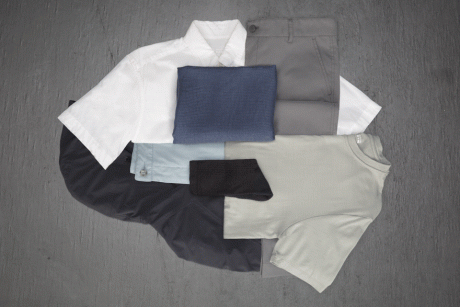
Fashion Week, Edited

If you live in New York City or are interested in fashion, you might be aware that this week is New York Fashion Week (NYFW for the cognoscenti). It’s a weeklong celebration of the fashion trends that will make your current clothes look inexplicably outdated in the not so distant future. The practice of continually refreshing and overhauling one’s fashion is, for many, one of the leading causes of accumulating way too much stuff. As I oft-quote, one expert estimates that only 20% of most wardrobes are actively worn. The rest is just filler–likely casualties of changing fashion.

Let me hazard to say that I am not a fashion basher. As much as I continually extol the virtues of having a few well-selected garments, I am pretty fussy about what those garments looks like. I am particular about the color, fit and function of my clothes. I believe fashion is one of the most practical mediums in which one can express him or herself.

But let’s face it, fashion has a super dark side. As mentioned, many people find themselves with way too many clothes, leading to stuffed closets and emptied bank accounts–all done in the name of staying au courant. And then there are the considerable environmental and human right tolls paid in order to keep our clothes cheap and plentiful (follow this innocent looking link if you are interested in knowing more about what I’m alluding to).

As with everything, less, but better wins the day. Those of us living above or below the tropics can’t very well live without clothes, but we can create wardrobes filled with necessary clothes that are worn and cherished. In honor of NYFW and looking spiffy all year long, here are a few posts from the past fashions that will help you create your edited wardrobe.

  • Project 333. Courtney Carver is like the minimalist Anna Wintour. But instead of yay or naying particular fashions, she challenges people–women and men–to put more thought into their wardrobes by selecting 33 items to wear for three months. What’s great about her approach is that it’s pared down, but no so much that you can’t achieve variety.
  • Outlier Tailored Performance. I know, I’m a bit of a fanboy, but this company is a great example of how you can sell folks (ok, mostly men) great-looking, responsibly manufactured and sourced clothes that allow you to do more with less.
  • Shapeshifting fashion. For those who might want to spice up their minimalist wardrobes, companies like MORF create clothing that allows several looks with the one garment.
  • Rent and shared clothing. If you are simply not someone who can wear the same thing too long, consider renting or swapping your clothes. It’s way friendlier to your pocketbook, the planet and will give your closets some breathing room.
  • Fall deeper in love with your existing clothes. Just like friends and family, sometimes we take great, but familiar things for granted. Patagonia’s Well Worn campaign urges us to fall back in love with the things we have. Love them, wear them, fix them if needed. Sometimes the fashion we seek is the fashion we already have.
  • Wear a uniform. Yep, I’m a broken record, because uniforms are so awesome! They’re the autopay system of fashion–select one and forget about it. There’s something so liberating about not thinking about what you have to wear on any given day.

Sam Aronov / Shutterstock.com

Large Lego-Like Blocks Can Make Anyone a Builder

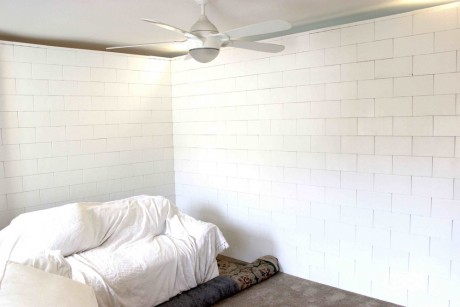
Along with thrift and above average height, my father passed down an aversion for building stuff. I’ve often pondered if my minimalist tendencies are just the offshoot of this aversion–i.e. doing without requires zero carpentry skills. But EverBlock is a building system so simple, even a DDIY (don’t do it yourself) person like me could build stuff like a champ. EverBlock “is a life-sized modular building block that allows you to build nearly anything”–a description that bypasses Lego® brand building blocks, because, well, EverBlock are just really big Lego blocks.

everblock-wall

Like Lego, EverBlock are plastic blocks that fit together, though EverBlock blocks are considerably more substantial. Details from their website:

The EverBlock™ System consists of four universal parts–a full sized 12″ block, a 6″ half-sized block, a 3″ one-quarter sized block, and a 12″ finishing cap that all interlock. Connector clips, hanging clips, and reinforcement rods are available for more structurally demanding applications and metal baseplates and feet can be used for additional stability.

This scale allows you to make some practical stuff: furniture, walls, various dividers, etc. Besides their obvious ease of construction, what’s best about them is that you can adjust them to changing spaces and needs. Need to chop your 1000 sq ft friendly sofa in half to fit into your new tiny house? Need to divide a room in your rental apartment without 2×4’s, sheetrock and paint? Need to convert your kid’s bed frame into an adult sized one? EverBlock has you covered for all of this.

everblock-tableeverblock-building

You might even be able to make a basic house using the blocks. EverBlock founder Arnon Rosan wrote me saying that the blocks are reinforceable via a channel that runs inside the blocks, accommodating a plastic or wooden dowel or rebar and making them suitable for permanent or semi-permanent structures. There are also plans to make reinforcement pins that slot inside the blocks for much more rigidly. Windows and doors can be framed out similarly to traditional construction and replacement windows can be installed by screwing the window right into the blocks using nailing strips around the perimeter. While he estimates the R-value of the stacked blocks to be around 1.5–about the same as a one inch thick plywood–this figure could be greatly improved with caulking and, of course, insulation. If you have CAD drawings, EverBlock will help you realize your design. Getting a building inspector to sign off on this structure is a conversation for another day.

The blocks come in a few different colors and can be purchased individually and in bulk. An 18 pack of the large blocks runs around $125. Rosan said that a 7.5 ft tall, 400 sq ft structure with an opening for a door and two windows requires about 1,000 blocks, or about $6,500.00 in blocks. Raw materials for a conventional building might still be cheaper, but EverBlock’s ease of use and reusability–for both furniture and construction–might create a compelling alternative for many.

A Very Bright Idea in Portable Lighting

A couple years ago, we featured a prototype lighting system made by Voltaic Systems that was installed in the LifeEdited apartment. The light featured a CNC machined aluminum body and a bright, adjustable LED bulb. Since Voltaic’s main business is portable solar charging systems, the dangling light was connected to a ceiling receptacle that was connected to battery packs stored in a cabinet. Those batteries were connected to a small array of photovoltaic panels installed right outside one of the apartment’s windows (the batteries could also charge portable devices). While making a nifty and functional light for the apartment, the lighting system was ultimately designed to be a versatile light source that could be used and charged in any conditions.

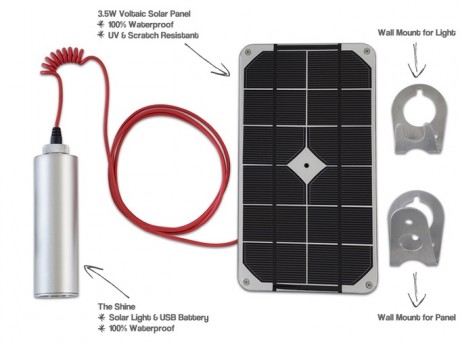
For the last few years Voltaic Systems has been tweaking and refining the design and now they have launched a Kickstarter campaign to fund production. Dubbed Shine, the new system retains an adjustable LED bulb and sleek aluminum construction. Unlike the prototype, the production unit is 100% waterproof and its battery is stored inside the shaft. The battery can be charged via USB or an 8.27” x 4.45” solar panel. The battery is good enough to power the light for 31.5 hours in low and 7.5 hour in high modes. You can also plug a smartphone into the battery and it acts as an auxiliary charger.

shine-system

The system has countless applications. It makes an amazing camping light or light for an off-grid cabin or for some spot in your home far from an outlet. But perhaps Shine’s best applications are in less ideal scenarios, such as emergencies like Hurricanes when power goes out. It can also be indispensible for the 1.3 billion people across the globe that live without access to electricity in their homes, many of whom rely on hazardous substances such as biomass to light their homes. The World Bank estimates that 780 million women and children inhale smoke which is the equivalent to smoking two packs of cigarettes every day from the smoke from these substances create when burned. Voltaic Solaire has partnered up with the nonprofit Fabretto to deliver their lights to several regions of Nicaragua who fall into this category.

Shine seems to be a hit, evidenced by the fact that it met its funding goals about a day after their campaign launched. For a pledge of $39 you get the light itself; for $66 you get the light and solar charger; and for $109 you can get the light, solar charger and Voltaic will send a system to a Nicaraguan family in need (there are other pledge amounts as well). Units are expected to ship January 2016. Even if you don’t have an altruistic bone in your body, the Shine is an awesome, perhaps indispensable item to have around. As they say in their campaign, “Useful everyday, essential one day.” Visit their Kickstarter page to pick one up or for more info.

Get More Fit with Less Time and Equipment

There are few things that can reliably improve our health and happiness like regular exercise. But for many of us, exercise occurs as a chore–a boring, time and logistic intensive affair that we might have the same level of enthusiasm we would have for an all you can eat rice cake buffet. But the fact is we can get pretty fit in very little time with little or no equipment. A few months ago, I explained how you might be working out all wrong, focusing on duration rather than intensity of exercise. High intensity interval training (HIIT) is something I’ve practiced for the last several years, however I’ve almost always done it in a gym. But with two small boys occupying much of my free time, getting over to the gym, even for an hour, has been a far more complicated affair than days past.

Rather than totally resign myself to acquiring a “dad bod,” I decided to find ways of staying fit that didn’t require a round trip to the gym. The fact is there are many great exercises that involve little or no equipment or special spaces.

In the past, I wrote about the Seven Minute Scientific Workout app. The app and workout are solid (especially if repeated), but there’s not much variation in the workout. In my search for something more comprehensive, I discovered 12 Minute Athlete, a website that offers numerous HIIT workouts via Youtube videos, a free ebook and iOS and Android apps that guide you through simple, minimal or no equipment exercises and routines. There is also a subscription based intra-app training program called “Super Athlete.”

The workouts are not all 12 minutes; some are shorter, some a little longer and some are done to time, for example the first weekend of the month 12 Minute Athlete founder Krista Stryker puts out a 100 burpee challenge, which asks people to perform 100 burpees in as little time as possible (I’ve been a bit too chicken to take the challenge just yet).

I consider myself to be a bit above average fitness and I found that many of the exercises and routines, when done with proper intensity, were pretty challenging–a good thing if you’re looking to do a lot with little time. 

I emailed a few quick questions to Krista to ask her about her site and the philosophy behind it. Here’s what she had to say. 

David Friedlander: What motivated you to start 12 Minute Athlete?

Krysta Striker: I was one of those people growing up that never really considered myself athletic. Sure, I played team sports (basketball and soccer mainly), but I never really felt I was that great at them, and the moment I went off to college I pretty much stopped doing anything active at all and turned into quite the couch potato, assuming I was destined to be a bit pudgy and weak for the rest of my life.

Towards the end of college I was feeling pretty lost and hopeless with no idea of what to do with my life, and started exercising a few times a week partly because my mom told me it would make me feel better. It worked, and I surprised myself with my strength and how quickly I went from barely being able to do a single push up to working up to more difficult exercises like pull ups and triceps dips. I liked feeling strong, and my confidence levels skyrocketed in all areas of my life, which eventually led me to study for and receive my NSCA CPT certification [personal training].

At that point, I started working out for hours a day, diligently doing my cardio, weight training and sports-specific training every day until I was overtrained, injured, and had little time in my day to do anything else. But even though I was spending so much time working out, it felt like it was never enough.

That’s when I discovered HIIT training and everything I knew about fitness and exercise was turned upside down. Not only did I get leaner and fitter in a shorter amount of time, I got stronger and more confident than ever before. Before long, I was able to do feats of exercise I never before thought possible, such as handstands, pull ups, and completing 100 burpees in nearly six minutes flat—and still have the time and energy for a hike, bike ride or long walk later in the day.

It was after my own personal successes that I created 12 Minute Athlete so I could share these incredibly effective HIIT workouts with the world and help people of all fitness levels ditch their excuses and get in shape in as little time as possible.

DF: What would you say to people (like me) who are accustomed to going gym about doing app based workouts?

KS: Going to the gym is great if you enjoy it, but not everyone has the time, so doing app-based workouts like the ones in the 12 Minute Athlete app just give people more freedom to work out anywhere. You can still work out in the gym if you wish, but you can also work out in a nearby park, your apartment, or even a tiny hotel room if that’s all you have.

DF: Many of your routines are fairly advanced. what would you say to people looking to start out who might not be quite ready for a pistol squat [see below], pull up or burpee?

krista-pistol

KS: Everyone has to start somewhere! When I first started working out I couldn’t do a single push up, let alone a pull up or a pistol squat. If you can’t do a pull up yet, try flex hangs instead, where you’re simply holding onto a pull up bar for as long as you can to build up strength (it’s harder than it sounds!). The same goes for exercises like pistols and even push ups—simply find the hardest version of the exercise you can do now that still pushes you past your normal comfort zone. The key is to work as hard as you can and modify anything you need to in order to get started.  

See more at 12 Minute Athlete

A Better Black Sock (More Interesting than it Sounds)

I can sometimes be a bit of a fanboy when it comes to Kickstarter. I’ve featured countless great projects here because I love the idea of products proving that they deserve to exist before they are manufactured, not after. As such, I get quite a few email solicitations from Kickstarter project managers asking me to write about their campaigns. But not every project is an Unbelievable Testing Laboratory shoe or GOBAG. Many of these folks are presenting products that invent solutions to problems that don’t exist, e.g. the artisanally crafted, leather six-pack holder (no joke). I’ve become pretty accustomed to ignoring most of these emails, which is exactly what I was going to do when a representative of “Oh My Sock” campaign contacted me. They are trying to fund a breathable, odor-resistant black sock. Big deal.

But then I thought again. As I’ve written about here before, I’m a fan of wearing a uniform. And while I’ve written about the more visible constituents of my personal uniform such as Outlier Tailored Performance pants and shorts, I have not written about things like socks. The fact is that even though I have a “sock uniform” my choice of socks isn’t that considered. I wear Champion brand sports socks in the spring, summer and fall (I have wool socks for the winter). I bought about three six packs of them from Target a while ago. I bought them because they’re no-show, which I like, and they come in XXL (I’m a 14), which helps keeps them from getting too stretched. Most importantly, they’re black. Unless your socks are an integral part of your color ensemble, I don’t understand buying anything other than black socks (or underwear, frankly)–white and other colored socks look old and dirty after a few wears, whereas black stays fairly fresh looking. But these socks aren’t especially soft and comfortable and despite the fact they are my size, they wear out very quickly.  

Anyway, the “Oh My Sock” sock does what I believe the best Kickstarter campaigns tend to do: it’s a simple, useful, well made and designed alternative to existing market offerings. In this case, socks. Rather than making their socks out of cotton, they’re making them out of Bamboo, which is soft as silk and will keep your feet 14% dryer than cotton and thus more odor resistant. They claim they are more durable than cotton and that most testers have had theirs for six months without any blowouts. They come in three sizes so they don’t bunch up for small feet or get too stretched out for big ones. And they’re the right color for avoiding staining and for perfectly matching up pairs post-laundry. The campaign socks are normal height, but a project representative told me they will offer other heights after the initial campaign is funded (also other colors, but I don’t think they should).

Speaking of funding, after one day of campaigning the project has met $5400 of its $7500 goal, so it looks like other folks are into the idea of a better designed sock. A pledge of $39 will get you seven pair, which is on par with a pair of middle-of-the-road dress socks. Delivery is expected for December. See their campaign page for more info. 

This Contraption Saves Counter Space, Dish Towels, Time and Maybe Even Lives

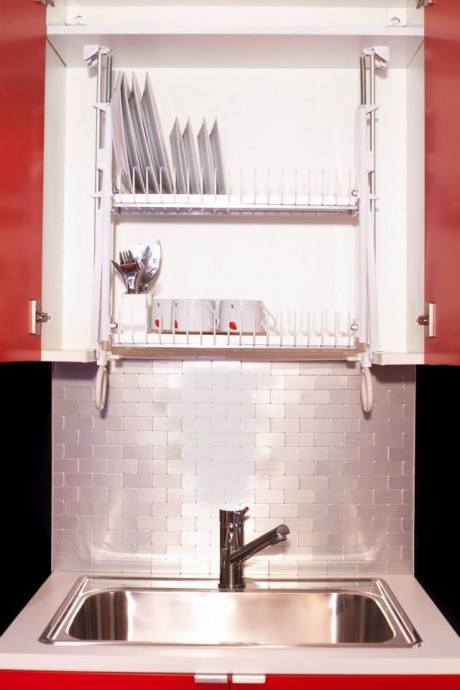
One of this site’s first very posts featured a dish drying rack that sat above the sink. The rack served as both drying rack and dish storage, eliminating the need for counter hogging conventional drying racks. It’s such a profoundly logical design, it’s a wonder why it’s not a standard feature on all kitchens. And if it weren’t for the corrupting influence of the industrial-drying-rack complex, it surely would be. But one rebellious company called Drip Dry is fighting the powers that be, making some nifty, cabinet ready drying rack kits, hopefully auguring the demise of the tyrannical reign of counter-based drying racks. (NB: In writing this post, I found out that these type of drying racks are pretty common in Europe and beyond).

The Drip Dry Classic (DDC) is constructed of antimicrobial plastic and can be installed into most any framed or frameless cabinets with minimal fuss. The whole assembly slides up and down along stanchions for easier access to dishes. The whole assembly runs a very reasonable $119.

drip-dry-rack-up

A representative told me that they are also planning a version with stainless steel frame and a slightly different mechanism, where the top rack will pivot forward and down. She told me it will be available in about four months. In the meanwhile, she assured me the DDC, which was originally conceived in Israel, is plenty durable and she has seen models that have lasted for 50+ years.

Ben Franklin wrote, “Do not squander time for that is the stuff life is made of.” And really, who wants to squander their time, and by extension their lives, drying and moving dishes around? Find out more info at Drip Dry’s website.

Via Livinginashoebox.com

To Fix or to Replace?

If most of us are ashamed of shabby clothes and shoddy furniture let us be more ashamed of shabby ideas and shoddy philosophies….It would be a sad situation if the wrapper were better than the meat wrapped inside it.

–Albert Einstein

For the last several months, I have had a small crack on my two year old iPhone 5’s glass. Following an unexpected trip to the floor (glass side down) a few weeks ago, the small crack became a full on shatter. A couple days ago, the shattered pieces started falling out, leaving me with small glass shards swimming around my pocket. I went to the local mobile store to get it fixed. The clerk told me that a screen replacement would cost $75. I asked how much a new phone would cost. He said given that I was eligible for an upgrade, a 5S would cost $99 and a 6 would be $199. He also said he’d give $30 trade in value for the old phone. In other words, the 5S, which represents an upgrade from my first gen 5 would cost $5 less than getting my old phone’s screen replaced.

Now let me back up: aside from my screen and some issues with its battery life (issues that could always be handled with a modicum of foresight), I have no problems with my phone. It still occurs to me as a technological marvel. Even though it’s only 16 GB, I haven’t had any particular issues with storage. It has some superficial scuff marks on its aluminum, but these do not impact the performance whatsoever.

I weighed the pros and cons of replacement and fixing:

  • Pro replacement: cheaper by a few bucks; better battery according to sales dude; shinier, newer, thus inflating self esteem and esteem from people who care about having shinier, newer stuff.
  • Con replacement: I’d have to re-up my two year contract and use my once-every-two-year upgrade upgrading a perfectly good phone; I would be sending another perfectly usable phone to an early death, adding to the already-monumental amount of e-waste created we as a society produce.
  • Pro fix: not having to commit to two year contract; not using upgrade; not sending phone to premature death and creating unnecessary e-waste; not feeding into a culture of incessant upgrading and idealization of the new and unused.  
  • Con fix: not having latest and greatest (though the 5S, which is probably what I’d get, is no longer the latest or greatest).

Given these considerations, I am fixing the screen. The money is negligible. A better battery would be nice, but not nice enough to outweigh the other reasons not to upgrade. More than anything, doing a premature upgrade, to me, means submitting to the spurious logic of planned obsolescence and throwaway culture.

One of the concepts I have helped promote on this site is that we fill our lives with only the stuff we love and cherish. Sometimes this concept is misconstrued as living in some Dieter Ramsian ideal, where the few things that are left in our possession are immaculate. All furniture is clean and modern, all clothes fit perfectly and are plain and stain-free, all electronics are up-to-date. But this is an unrealistic, and often harmful, ideal. It’s one that can result in a “minimalist” sending as much stuff to the landfill as anyone else–not to mention depleting his or her bank account unnecessarily.

Rivendell Bicycle Works Grant Petersen coined the term “beausage”–a mashup of the words beautiful and useage. While he applies it to cool, often custom bikes, the term can apply to everything we possess. These are items we care for and maintain the best we can, but that also undergo the inevitable effects of age and use. If we can see things this way, we can see how an edited life can include the used, beat up and even outdated.

Bleeding Edge Furniture Technology

While there’s a certain novelty about space-saving, transforming furniture–dining rooms that tuck into floors, automated, disappearing bedrooms and so on–its impact on architecture can be real and profound. It might double or triple the utility of a given room, leading to diminished real estate needs, leading to less sprawl, leading to less driving, less waste, smaller carbon footprints and a shot of mitigating the profound damage humans have done to the planet (sorry, but it’s true). It’s an impact big enough to warrant big brains and focus, which is exactly what furniture upstart RockPaperRobot is all about. RPR was founded and is run by Jessica Banks, who holds a PhD in robotics from MIT, a pedigree that shows up in RPR’s new Ollie line of transforming furniture.

Previously, RPR had focused mostly on designing and producing high end furniture that, through creative engineering, appeared to defy the laws of physics–tables that seemed to levitate or rest on a pinhead. These pieces also defied most people’s furniture budgets. While they continue to produce these premium products, Banks wanted to make furniture that was more accessible functionally and financially to more people, which is how Ollie was born.

“We saw a number of trends such as urbanization and the desire to live life with less stuff and more experiences,” Banks told me about the Ollie line’s inspiration. She also saw how the phenomenon of FOMO [fear of missing out] could apply to the objects in our lives. “Most furniture is like, “If I buy this, I can’t do this,’” she said. For example, if I have this full-sized dining table, I can’t have open space to do yoga. “We asked ‘Why should furniture prevent us from doing what we want to do?’”

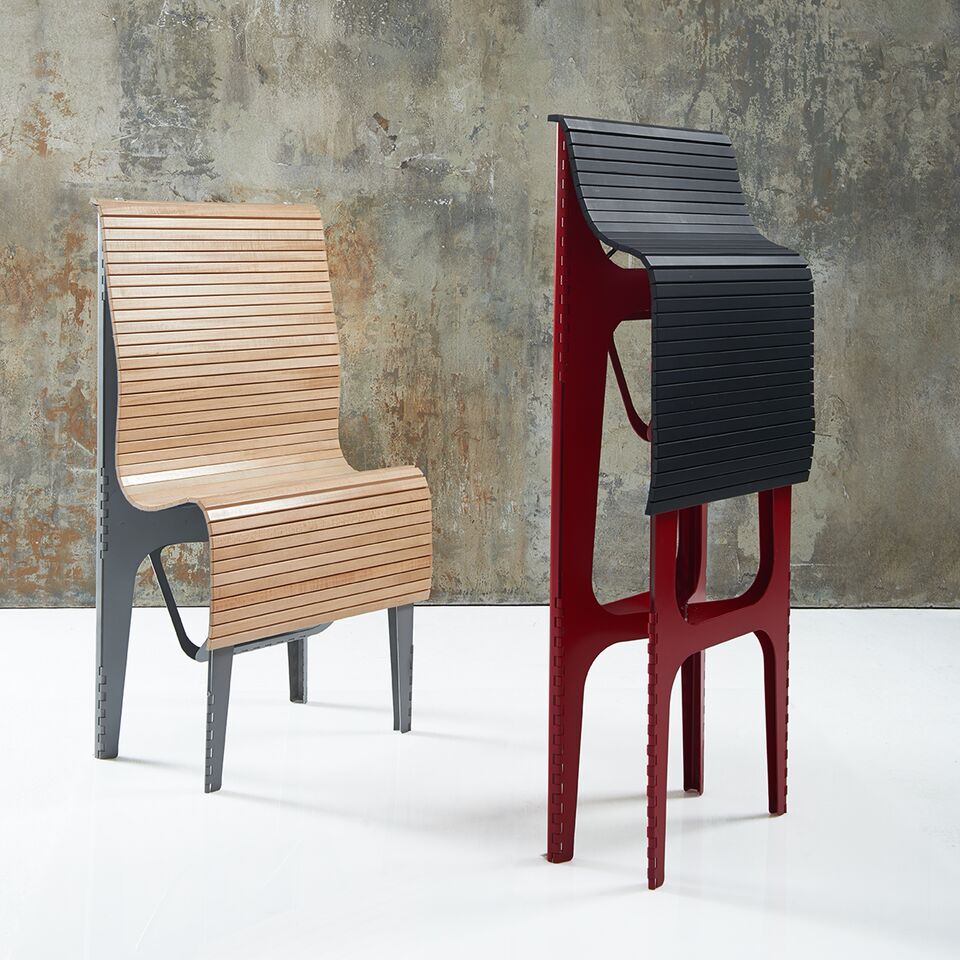
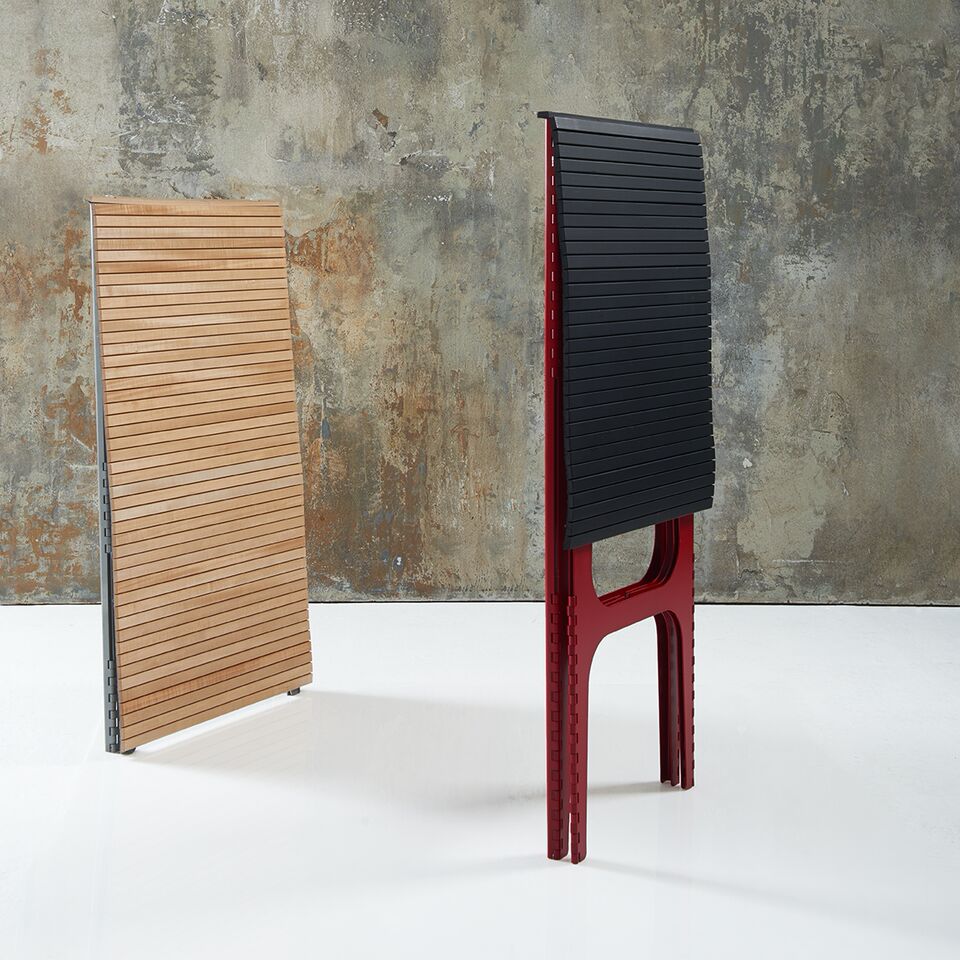
The Ollie line includes a table, stool and chair, all of which effortlessly transforms from full-sized furniture into super slim storing proportions, giving rooms double and triple functionality. The furniture is both lightweight and sturdy (a rare combination I’ve found). Aesthetically, I would call it industrial chic. The customizable slats are easily swapped to match a room’s decorative needs.

Beside the obvious residential applications, Banks told me that they have been discussing using the furniture in commercial spaces in order to optimize for traffic patterns. For example, a coffee shop with a ton of foot traffic in the morning could deploy Ollie tables in the middle of the day for loitering freelancers (the author knows of which he speaks).

I asked Banks if her robotics training helped in designing the collection. “Definitely,” she replied. “The tables are more like a transmission than tables. They’re highly engineered with 60 moving parts and 300 total parts. We had to make everything work together and calculate for forces.”

RPR is currently readying the tables and chairs ready for production and says they will be taking orders in three months for the chairs and six for the tables (they will also do custom manufactured pieces anytime you want).

Product Review: Unbelievable Testing Laboratory Ninja Kick

Emptiophobia is the fear of shopping (well, it’s the disorder I invented based on a few minutes on Latin translation sites). It’s a condition, I fear, I suffer from. After keeping this blog for a few years, I have become so shopping averse, so worried I am getting something I don’t need or worried the thing I am thinking of getting is the wrong thing, that any non-food purchases are made months, even years, after my actual need presents itself. One of those needs has been shoes. For a long time now I have been walking around on busted shoes. I was waiting to replace them with the perfect do-almost-everything shoe–a shoe, it was starting to seem, did not, nor ever would, exist.

Before I get to the review, let me bore you a little with my shoe history, because it’s relevant. Several years ago, I got into minimalist shoes and running. As many do, I started out with Vibram Five Fingers KSOs. I eventually ditched them because they provided too little protection (read: fractured metatarsal), they fell apart on me fairly quickly, they smelled awful after a couple wears and I became a little tired of explaining my shoes to strangers. Overall though, I liked having my feet free of too much support and structure, so I traded the KSOs for Merrell Trail Gloves, a more conventional looking minimalist shoe that allowed me to wear normal socks, thus avoiding the stink issue. They had bomber construction and more rubber on the soles than the KSOs, providing more foot protection and durability–a good thing for an active 185 lb guy like me. The only issue I had were the looks. When I bought my first pair of Trail Gloves, I wasn’t too crazy about the looks–too many stripes and logos. Somehow, many minimalist shoe manufacturers think their buyers want tons of design and big logos emblazoned on their uppers. At least in my case, they are mistaken. As Merrell released the Trail Gloves 2 and 3, the looks and colors became even more elaborate making them inappropriate for anything other than kicking around or the gym.

In thinking of stylish replacements, I considered Vivobarefoot, but they run wide and voluminous. When you have long, narrow, low volume feet like I do, wide, high volume shoes tend to look like gunboats attached to your legs, so those were out.

Prior to all this minimalist shoe stuff, I wore Converse All Stars. I actually love their snug fit and they have zero drop from heel to toe, somewhat mimicking minimalist shoes. I also think they look great, even wearing them with formal attire on occasion. Following the Merrell’s, I started wearing an old pair of All Stars I had sitting around (actually, they were made by a company Ethletics, an ethically made All Star knockoff that Converse has since put out of business). But then I was reminded of why I stopped wearing them. Their heels wear out in weeks. Their uppers tear after a few months. They are pretty heavy. They absorb the slightest bit of moisture. And since becoming a father of two, tying their laces has become increasingly inconvenient.

So there I was, wearing my holes-in-the-soles Converse knockoffs, looking for a minimally structured, lightweight, simply-styled, low-volume, durable, ideally slipon shoe. I had been looking for the best part of a year with no luck.

A couple years ago, I wrote about a Kickstarter project called Unbelievable Testing Laboratory. They were trying to bring to market a high tech, Tyvek uppered, super light shoe. I liked their techiness and light weight, but wasn’t hot on their styling and they weren’t offered in a 14. I hadn’t really thought about them since then. But a couple weeks ago, I got a Facebook ad for their new Ninja Kick shoe (go cookies!). It appeared to be everything I was after. They weighed 130 grams per size 11 shoe (less than ½ pound per pair), they had a minimal, no drop sole, they were simply styled, they were available in slipon and in size 14. Hell, they were even machine washable! I immediately emailed them to get a free pair to demo.

They never responded, so in a testament to how promising I thought they were, I bought them. Full retail price!

I have been wearing them now for a week and I gotta say I really like them. In my experience, buying shoes online is a dodgy proposition, so I guess I lucked out. The size 14 was true to size and because they run on the narrow side and fairly low volume, so they fit great and don’t make my feet look any more sasquatchy than they already are. They are light as hell. Their outsoles are minimal but not so minimal that you feel every dirt particle underfoot like the KSOs; the soles are also substantial enough to use with bike pedals. And the outsole’s EVA rubber hasn’t shown any appreciable wear despite near constant use. They claim their insole is anti-microbial and anti-odor so I went sockless for a few days in very hot weather and amazingly they didn’t stink up (I went back to socks to be on the safe side). In contrast to Converse’s canvas, the suede-like microfiber outsole is water repellent and seems very durable. And probably more important than it should be, their minimal design is matched by a minimal look (take note Merrell and New Balance). I would feel totally fine matching them with slacks.

ninja-line

I’m not sure if I can cite any demerits. I’ve been reluctant to work out in them as I did with all the other shoes. While laces can be annoying, they are good at gluing foot to shoe and I’m not sure if I trust the Ninja’s foot-shoe connection. The Ninja actually comes in five different styles and I could theoretically get the lace-up Franklin style for workouts. I’m actually hankering for the Chukka’s for dressier ocassions (though 14s are not available yet).

At $64 for the Kick, the price is reasonable and less than all the aforementioned shoes, less the Converse. Moreover, UTL claims the Ninja line, all of which are constructed of only eight components, uses 60% less material than conventional shoes, so there’s that.

While it might be a little premature to say, given their combination of fit, weight, durability and style, I think the UTL Ninjas will become a permanent fixture in my uniform. Go to UTL’s site for more info.

The Business of Selling Less

In 2009 I attended a conference where I struck up a conversation with two guys who had recently launched a men’s fashion label. Their names were (and are) Abe Burmeister and Tyler Clemens and their company was (and is) Outlier Tailored Performance. At the time, they were focused primarily on making great looking men’s clothes that would work well for cycling. The line consisted of a few pairs of pants and a couple shirts made of fabrics normally reserved for mountaineering gear. Unlike most dressy, fashionable clothing, their stuff was wicking, water-shedding and stain resistant. Most of their pants used four-way stretch materials, making it super easy to pedal or perform any other activity. As an added bonus, their stuff was made in New York City by people earning living wages.

I mentioned that I used to be really into cycling and that I had a cool bike. They asked me if my bike and I wanted to do some modeling in exchange for some clothes (clearly they were bootstrapping it at the time. Thankfully, they now employ real models). I have since become something of an Outlier devotee. In the six years, I have replaced most of my pants, shorts and, to a lesser extent, shirts, with Outlier stuff. Their styles are super simple, which also happens to be my style. Their stuff fits great. I take comfort knowing it is not made in sweatshops. And it is the most durable clothing I’ve ever owned. I’ll regularly wear a pair of shorts or pants for four days straight and they won’t look or feel dirty (it’s why a guy who wore one outfit for one year chose so many Outlier garments). In short, their stuff allows me to do more with less.

In the last six year, some things have changed at Outlier, others have not. They have grown as a business. When we first met, their warehouse was in their living room and their stuff was perpetually sold out. Now they have a couple large spaces in Williamsburg, Brooklyn and a good sized staff. They have expanded their offerings considerably and are no longer focused just on cycling–though their stuff still works great for cycling. But unlike many companies that achieve a modicum of success, they have not sent their manufacturing overseas. They are also now a registered B-Corporation, a type of business that must adhere to rigorous social and environmental performance standards. And they are still committed to selling less, but better clothes. It’s a mission that greets you when you open their website: “Quite simply Outlier is about owning less.”

I shot Abe a few questions to talk about Outlier and the business of selling less, but better clothing:

DF: Tell our readers a little bit about Outlier and what you stand for.

AB: We are trying to invent the future of clothing. Basically we believe that what we wear should be liberating not constraining, and that means making clothes that let you do more while owning less. To put it in more concrete terms we make things like pants that are both more durable and more comfortable yet still look great so you are happy wearing them every day. Or shirts that stay cleaner and resist odors so that you can wear them longer, wash them less and carry less stuff when you travel. A lot of it is built around the idea that what you put on in the morning shouldn’t restrict what you do with your day, you can go to work or summit a mountain in the same clothes.

DF: How has your company evolved since you first started?

AB: Well when we started we only made a single style of pant, and now we are a full fledged clothing company making various shirts, pants and outerwear so it’s been a big evolution. We’ve also got a lot broader in our focus, the very first couple garments were oriented around bike commuting, but we very quickly realized that focus was constraining and there was WAY more you could do with our goods.

DF: You write on your site, “Quite simply Outlier is about owning less.” I feel like your site used to a be a bit more atmospheric. What prompted this overt mission declaration?

AB: We’ve had our basic philosophy posted on our site for a long time and two of the core tenets are “the world does not need more design it needs less” and “one well considered object can take the place of many cheaply made ones”. We just got those two sentences combined into one shorter and sweeter one now.

outlier

DF: Some people see some contradiction between minimalism and commerce. They think, “How can you sell more to have less?” What would you say to that charge?

AB: This makes zero sense to me. We are trying to sell higher quality goods, which means that they are actually putting more into economic circulation then a bunch of low margin goods produced by subsistence level workers. In GDP terms five cheap items at a 1x cost adds the same amount as 1 quality item at a 5x cost. But that ignores the sort of multiplicative effects you get when people are paid properly and thus able to participate in the broader economy in a real way. The less time people spent on subsistence level events the more time for more creative and interesting endeavors. And this reflects all the way through the lifecycle of an object, from the workers having more free time and money all the way through to the final buyer needing to spend less time thinking about what to wear.

DF: Do you see minimalism as a fad or a real alteration in the way people consume?

AB: We don’t really think about this sort of stuff, we just focus on doing what we see as the best path. We’re not out to judge other people’s lifestyles and paths, we provide an example and opportunity for people to live a certain way, but it’s up to them to decide how they want to proceed.

DF: By conventional standards, your clothes are pretty pricey. What would you say to someone who might not want to spend the kind of money you charge for your clothes?

AB: There is a massive difference between what something costs and what sort of value it delivers. We don’t believe in compromising, we make the absolutely best possible goods we can and then we spend a huge amount of effort trying to make them as reasonably priced as we can. This means they cost a lot more than the disposable type clothing that some many companies pump out nowadays, but if you extrapolate our prices over the lifecycle of a garment you’ll find that our stuff is actually a much higher value than most of the alternatives.

DF: What’s next for Outlier?

AB: We just try to keep learning and subtly improving the world around us.

Visit Outlier’s site to see their full line.

Image by Emiliano Granado