Manhattan Soho Apartment “LifeEdited 2” (LE2) is for Sale!

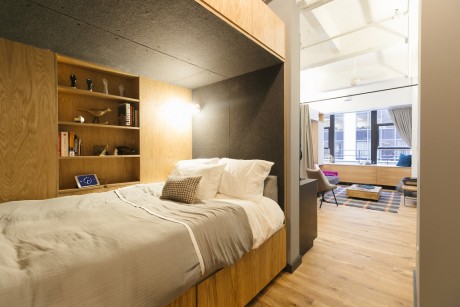
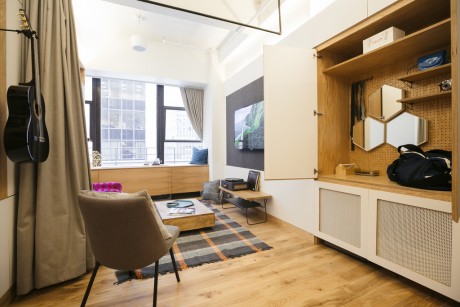
If you like our design approach, here’s your chance to own one of our apartments! We’re selling LifeEdited 2! Go ahead and visit Corcoran’s website for full details about buying our property. ​Having learned from our first crowdsourced tiny apartment LE1, our man Graham Hill downsized from 420 square feet to 350 square feet while refining its construction and also going for a more textured and luxury oriented design. He loved living in LE2  but has moved to Venice, California to focus on backyard housing and it’s time for a new owner.

Small? Yes. But don’t underestimate this apartment’s functionality, it can seat 10 for dinner, sleep 2 guests, has a huge amount of storage and even space for a terrific office. Its location couldn’t be better, it has lots of light as well as high ceilings and it’s very quiet and private. Here’s a short list of more of LE2’s amazing functions:

With a cover feature from Dwell, and numerous other accolades, this apartment speaks for itself. Its 350 sq ft footprint may sound tiny but its functionality equates to spaces more than double or even triple its size. The details on the listing can already be seen on the New York Post, Curbed and Bloomberg. See LE2 transform by clicking the video below:


Can Sustainable Sushi Become the New Wave in Seafood

In NYC’s East Village, a couple of restaurateurs are going for a new dining concept that is seeking to change how we look at seafood. Sushi restaurant, Mayanoki, headed by TJ Provenzano and David Torchiano focuses on serving locally and sustainably sourced seafood. Concepts of organic farming to farm to table dining have long made its way into the public mainstream but seeking out sustainable options when it comes to sushi have not yet come to light.

“When it comes to other cuisines, they always promote that they use local beef or chicken, except when you go to high-end omakase it’s always, ‘We flew this in from Japan’ and that’s acceptable and I don’t know why,” Torchiano in discussing the concept for Mayanoki. “Delivery chains and distribution are not up to the same standard as they are in Japan, so I think that’s what turns off a lot of the chefs here. We just feel it’s a challenge we need to take on. While we want to respect the tradition of sushi, sushi has always been about food preservation and by its nature it was sustainable.”

In addition, Mayanoki only carries local beers and wines from New York State and the only thing they still import from Japan is the sake. Monterey Bay Aquarium Seafood Watch has recognized them as the only sushi restaurant working towards sustainability.

Although it sometimes is tough for them to procure certain types of fish depending on the season and remain sustainable, their hopes of educating the public into this new type of sushi will help drive business in order take on the other major sushi restaurants in the Manhattan dining scene.

For their full write up in Eater, click here

Photo by food blogger @restaurantgroupie

Well That’s One Way of Adding Density

The skyscraper is without a doubt the most effective way of adding density to any patch of land.  And eVolo’s Magazine’s Skyscraper Competition is an exploration of innovative designs around this structure, creating “dynamic and adaptive vertical community.” Unlike every other entry, the winner, dubbed “New York Horizon” by Yitan Sun and Jianshi Wu, took an entirely different approach to scraping the sky. Rather than building up, they dug down deep below the surface of Manhattan. Their design calls for the excavation of Central Park. The walls of the hole are lined with housing and other public and private spaces, all of which enjoy unobstructed views of the new Central Park.  

Here are some more details from the designers:

The 1000-feet tall, 100-feet deep mega structure provides a total floor area of 7 square miles, which is about 80 times greater than the Empire State Building. Wrapping all four sides of the new Central Park. This system breaks the traditional perception of large-scale skyscrapers without taking valuable ground area of Manhattan….The soil removed from the original park is relocated to various neighborhoods, which will be demolished and moved into the new structure.

The idea is nothing if not novel and we’re afraid to ask too many questions…like how they would relocate several thousand obstinate upper west siders ? Or the mirrored glass that covers the mega structure? It’s meant to “reach beyond physical boundaries, creating an illusion of infinity….[where] a New Horizon is born.” But it seems like it might reflect all the sun’s light directly into the park, making Death Valley seem like the North Pole.

new-york-horizon-perch

But again, these questions are probably academic. It’s a very interesting idea and rifling through the runner ups, New York Horizon creates far less visual interference than conventional skyscrapers.

Via Curbed

The State of Small in New York City

As has been said of the largest city in the United States, if you can make it there…well, you know. And regarding micro housing, they did make it here. Once. The soon to open “My Micro” (we’re loathe to call it by its new suburban subdivision sounding name “Carmel Place”) is a comely building with smartly designed units ranging in size from 265-323 sq ft. The building is the product of former Mayor Mike Bloomberg’s adAPT NYC pilot program that gave a one-time pass on the minimum size a developer could build an apartment. But it could be that My Micro is as far as New York micro housing will go for the foreseeable future.

A pillar of current Mayor Bill de Blasio’s election campaign was bringing more affordable housing to the city. In keeping with that commitment, his administration introduced its “Housing New York” plan with a sweeping set of zoning changes that included reducing the minimum allowable square footage of an apartment from 400 to 275 sq ft. Parking lots were also part of the plan; according to Capital New York, a proposal would “eliminate the requirement for parking lots in any new senior or affordable housing developments within a half-mile of public transit and replacing existing senior housing lots—which they say are virtually empty—with more housing.”

The other day, an affordable housing advocacy group called Real Affordability for All threatened de Blasio with imminent protest if he didn’t capitulate on a number of issues including the housing size and parking lots. At present, details are still being hammered as to what the final plan will look like, but aforementioned issues are still very much up in the air. 

Unfortunately, this is not a topic that lends itself to oversimplification. 55% of New Yorkers are rent burdened, spending 30% or more of their income on housing, and 30% of those people are spending 50% or more. Those opposing the changes fear that developers will hit de Blasio’s affordability targets by making housing that is both smaller and less accessible.

It should also be noted that those opposing the changes are not young professionals or well heeled empty nesters looking to simplify their lives by getting some tricked out micro apartment in Manhattan. They are working class folks, most of whom live in Queens and the Bronx, places where transit options are far fewer than they are for someone who lives a couple blocks from Union Square. The struggles that face these New Yorkers, and concerns that developers will exploit the new zoning to build substandard housing, are legitimate. If a financially strapped family of four can save 20% on a 300 sq ft apartment versus a 600 sq ft one, they might just do that.

But we hope de Blasio and all parties involved don’t conflate the micro housing conversation with providing affordable housing for New Yorkers who need it most. The topics might be related, but they are not the same. 

The big issue is creating more housing that matches how people live. Across the boroughs, 33% of New Yorkers live alone and it’s 50% in Manhattan. There is a dire need for more housing, ideally market based, designed specifically for these populations. Building small and smart is a logical way of doing that. It has been opined that this could even free up unnecessarily large housing, now occupied by singles, for larger households.

And maybe we’re a bit too immersed in the micro mentality, but 400 sq ft, at least for singles and some couples, is huge! Many major cities like Washington DC, San Francisco and Seattle have much lower minimum building requirements (225 sq ft for the latter two). Seattle’s micro apartments, as we’ve long reported, have been wildly successful for providing affordable, market rate, transit friendly housing for (mostly) singles–albeit success met with a hefty dollop of protest.

The possible amendments in the plan might be an issue of advocacy as much as anything. Few people outside our friends at CHPC are advocating for micro housing with the passion of the affordable housing folks. While there are many charges that micro housing will benefit developers, the dearth of lobbying efforts calls this assumption into question. The New York real estate development community is a financial behemoth, yet they don’t seem to be offering a countervailing voice pushing for micro housing.

The fact is building micro housing is often more expensive than conventional development, as there are more walls, kitchens and bathrooms per square foot. And in a city where you can fetch a per square foot premium for large apartments, many developers might be a bit indifferent to the micro housing topic. If there were more advocacy, there might have been more conversation about a compromise–protecting the welfare of strapped New Yorkers and loosening restrictions on building small.  

Of course, whether the zoning laws pass or not, small living will continue in NYC, either illegally or in the form of micro-suites, which work within the constraints of existing code while achieving high housing density. But we fervently hope the measures pass. While New York has many faults, it still holds great sway in affecting national and global trends. Legalizing micro in New York would likely help advance the movement of small footprint, urban living everywhere.

GuilhermeMesquita / Shutterstock.com

Petite Apartment Packs Pivot Power

Robert Garneau is no stranger to ingenious small space design. The NYC-based architect’s Transformer Apartment, with its host of custom storage solutions and transforming elements, is one of the most publicized micro apartments in the last decade. Last year, Garneau’s new practice Architecture Workshop PC received an NY AIA Honor award for their Pivot Apartment, which takes an innovative approach to creating spatial divisions in a small NYC prewar studio.

pivot-apartment-dining

Similar to the MJE House by Spanish architects PKMN, the Pivot Apartment uses a pivoting wall to split the 400 sq ft space (yes, Garneau has a knack for descriptive naming). When the wall is closed, it creates an open space with enough room for a table with seating for ten (table collapses when not in use). When the wall is open, it reveals a wall bed and an array of cabinetry. The two cabinets skirting the bed extend out and include ample clothes storage.

pivot-apartment-livingpivot-apartment-storage

White walls, cabinets and blonde wood throughout the apartment keep the space looking bright and airy.

Photo credit: Robert Garneau

HT Robert T

The Best Worst Case Scenario Housing

Necessity, so it is said, is the the mother of invention. And few situations bring necessity to the fore like a disaster. And few disaster housing is as inventive as the NYC Emergency Housing Prototype by Garrison Architecture’s. Made in partnership with New York City’s Office of Emergency Management, the prototype was, in part designed as a response to the need for housing following events like Hurricane Sandy. The prefabricated housing complex was designed to be deployed in less than 15 hours “in the event of a catastrophic natural or manmade disaster,” according to Garrison.

While designed for emergencies, the prototype’s construction bests most permanent homes. From Garrison’s site:

With 1- and 3-bedroom configurations, every unit features a living area, bathroom, fully equipped kitchen and storage space. Units are built with completely recyclable materials, cork floors, zero formaldehyde, a double-insulated shell, and floor-to-ceiling balcony entry doors with integrated shading to lower solar-heat gain, provide larger windows, and add more habitable space. Units can be equipped with photovoltaic panels, which will not only alleviate pressure on the city grid, but also ensure the units are self-sustaining.

The units range between 480 and 813 sq ft and whole multi-story, multi-unit structure measures only 40′ x 100′, making it easy to set up in small lots.

garrison-nyc-emergency-interior

That Garrison should make such an innovative, handsome prefab structure should be no surprise. Since 1991, the firm has specialized in modular construction, citing “material efficiency, economy of scale and built-in quality control” as its inherent strengths.

For more info head over to Garrison’s website.

Photo credit: Andrew Rugge

WeLive Goes Live, Sorta

A while back we reported about WeLive, the residential arm of the coworking giant WeWork. That post gave some of the spec’s for their Crystal City project, which converted a 12 story office building outside of DC into massive complex filled with micro apartments, communal recreational and coworking spaces. Well, unbeknownst to many, WeWork was developing another project at 110 Wall Street in Manhattan’s financial district (also the site of an existing WeWork coworking space). The project will eventually house 600 folks on 20 floors. They recently announced a beta launch at the building, which will house 80 WeWork members in 45 units.

Similar to Ollie in New York, The Collective in the UK, CommonSpace in Syracuse and other such developments, WeLive (not the official name for the record) seeks to create a whole universe for its residents. The pictures released by WeWork show handsome apartments designed by ARExA Architecture, whose principal and Creative Director Darrick Borowski designed one of our favorite micro-apartments. The interior incorporates Resource Furniture space saving beds. There will be studios and one and two bedroom units. The pictured unit is a two bed studio separated by a curtain (a setup that will probably not appeal to everyone). 

Welive-second-bedroom

The private units will be supplemented by common areas on every floor. There will be social directors, who, according to Fast Company, “Will help plan Sunday-night suppers, game nights, karaoke, and fitness classes.” Additional services like wifi, cable and cleaning are also included. You could, theoretically, never have to leave the building if you so chose.

welive-dresser

The whole concept raises a somewhat thorny question: would having your coworking space share a building with your apartment be a good thing? Or might it create a somewhat insular existence, where work and and personal lives have no division, where you run into the same (somewhat homogenous) crowd day in, day out? These are somewhat academic questions–literally. What WeWork is doing is creating something akin to an academic campus, albeit with a professional twist, a model that seems to work just fine. Which is good, as WeWork sees their residential endeavors making up 21% of their revenue by 2018. 

Via Fast Company

A Kinder, Greener New York City

Living in New York City can be many things: exciting, dynamic, culturally rich, god awfully expensive. But one thing it is not for most people is natural: unless you live directly on a park, your everyday exposure to nature might be limited to a handful of sidewalk trees, used as much for canine territorial outposts as natural beautifiers. But if the Green Line by Perkins Eastman Architects goes through, connecting with nature in one of the most concrete-laden lands in the world might get a lot easier. The Green Line would create a green corridor along Broadway, connecting Union Square in the south to Central Park in the north. Including the area of the park, this would effectively create a five mile green corridor from 14th to 110th streets.

greenline-2

Beside the obvious benefits of adding a natural retreat right through the center of Manhattan, the Green Line would offer many other benefits. By absorbing water, the grass would clean local waterways and stormproof the city. Gizmodo speculates that the removal of cars might actually aid in the flow of traffic as it proved to have done when NYC closed off Times Square to automotive traffic. And having several miles of protected bike/pedestrian friendly thoroughfare would surely reduce traffic fatalities.

The Green Line would also connect and expand a number of existing natural outposts and pedestrian malls such as Madison Square Park, Herald Square and Times Square. And unlike the elevated High Line which is on the far west side of Manhattan, the Green Line would be on street level running straight through the middle of the city, making it very likely to be enjoyed by people other than tourists (I love the High Line, but it belongs far more to the tourists than it does New Yorkers).

It is often argued that large cities hold the key to a sustainable future for humankind–they are denser, leading to smaller homes with reduced energy needs and far greener transportation systems. But other research suggests that people who spend time in nature are happier than those who do not. The Green Line and other projects like it, might enable people to have their city and nature too. We hope it gets the greenlight.

This Ad Campaign Hits Nail on Head About NYC’s Cramped Apartments

There’s been a lot of recent hype about New York City’s Carmel Place (aka “My Micro”). Rightfully so. It is the city’s first purpose built micro-apartment building after all. But if you have ever lived in or visited a typical NYC apartment, you know New Yorkers are no strangers to micro living. The big deal about Carmel Place is that people can live comfortably and without making socially-debilitating sacrifices to live there. The fact is that NYC’s 400 sq ft building requirement–the one they lifted for Carmel Place–has only been around since 1987. And since much of the city’s housing was made well before that year, there is 100 or so years of architecture that doesn’t give a crap about your fancy zoning laws. Tiny apartments are as New York as thin crust pizza by the slice. 

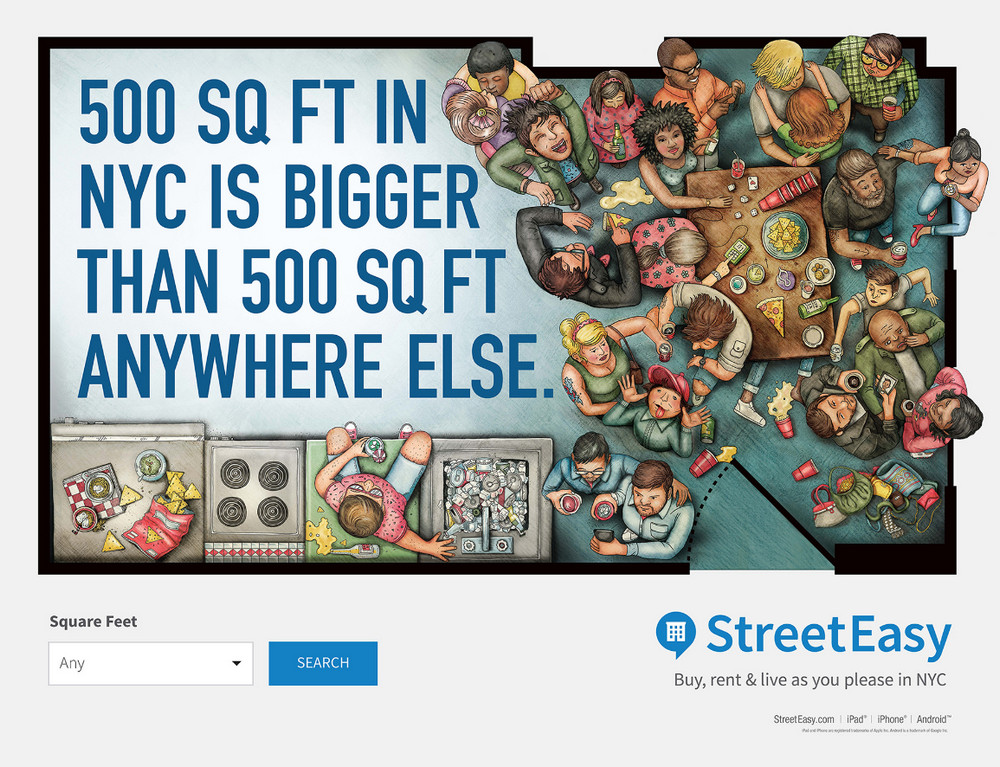
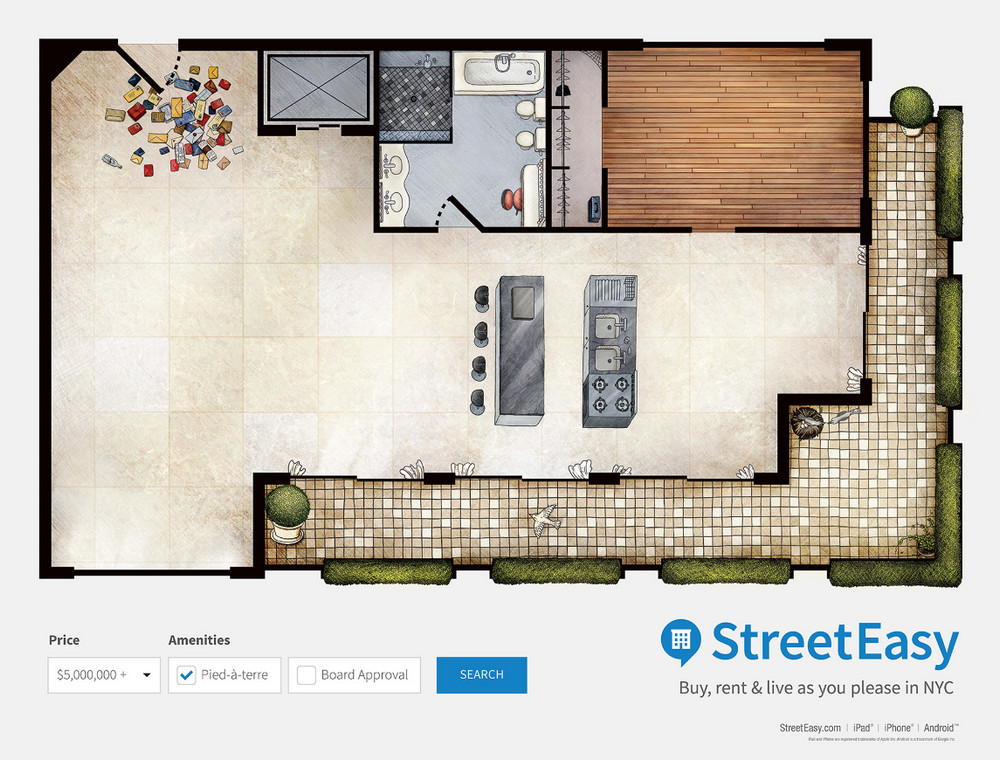
This last spring the real estate website StreetEasy launched it’s “Live As You Please” ad campaign that celebrates the contortions New Yorkers have long made to stay in a city that’s long on thrills and short on square footage. Each picture represents a different demographic, matched with a specific search criteria on the bottom of the ad. There’s the empty $5M pied a terre or the one bedroom that barely fits a bed (a housing type I can guarantee exists from personal existence). But perhaps the most poignant ad says “Sure your window faces a brick wall, but behind that wall is New York City.” You can have the most awesome home in the world, but if you don’t love where you live, it don’t mean a thing.

NYC’s First Micro-Apartment Building is (Almost) Ready to Rock

A few years ago, New York’s adAPT NYC competition drummed up a ton of public interest in micro-living. Spearheaded by the Bloomberg administration and HPD, the design and development competition sought out the world’s smartest designed, urban micro-apartments, allowing competitors to design smaller than the city’s current 400 sq ft minimum building requirement. The winner of the competition—a team lead by Monadnock Construction with a building designed by nArchitects–was announced in January of 2013 to much fanfare. Everyone was ready to move into their awesome micro-apartment in the heart of America’s biggest city. But the world of real estate is more tortoise than hare due to the intrinsic financial, technical and bureaucratic challenges of building a multi-story, multi-unit structure in a city center. But three years down the road, the tortoise is about the cross the finish line. Leasing starts today for Carmel Place (née My Micro).

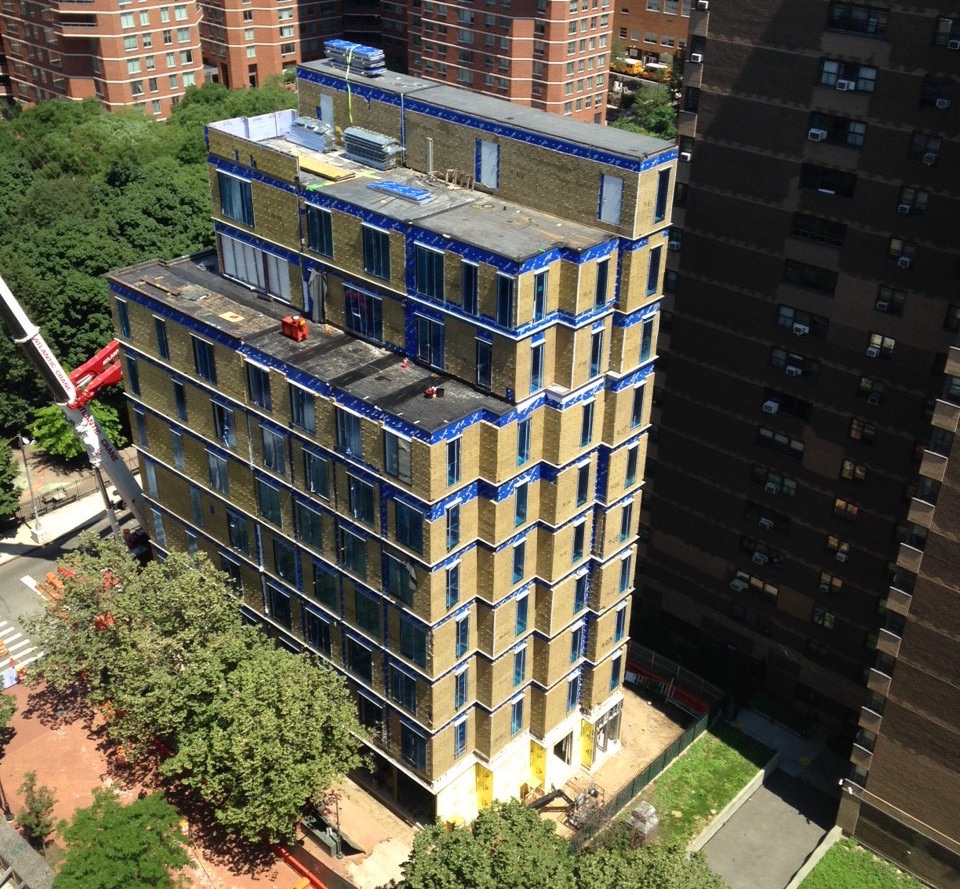
As we looked at earlier this year, all of the units were prefabricated in the Brooklyn Navy Yard then trucked over the Manhattan bridge to the Kip’s Bay neighborhood of Manhattan. The units were stacked into place after which the rest of the building was assembled–hallways, facade, utilities, etc. In addition to the private units, there are several communal spaces including a roof deck, courtyard, a lounge with a pool table and tv and a gym.

Monadnock hooked up with Ollie, a company we looked at earlier this year, to fit out eight of the twelve market rate furnished apartments that start leasing today. In addition to a number of conventional furnishings like desks and chairs, Ollie is using sofa-beds from Resource Furniture to make sure the apartments use every inch of their available floor space (units range from 265-323 sq ft). For those looking for some decorating help, Ollie is even offering an option they call the “Ollie Box”, which includes things like throw pillows, rugs and table lamps. Ollie also wants to provide a low-fuss living experience, managing several tenant services such as wifi, cable, housekeeping, and weekly visits from a Hello Alfred home manager, a service that helps take care of mundane chores and errands like keeping groceries stocked in the pantry and fridge and making sure the laundry and dry cleaning get dropped off, picked up and properly put away. Additionally, Ollie tenants will also get a Magnises membership, a social programming service to foster an esprit de communité (all included in the rent).

Speaking of rents, they will range from $2540 to $2910 with floor number and unit size determining price. Furnished apartment will also command a $160/month premium according to the NY Times. In absolute terms, this is a ton of money, but in New York City terms, sad as it is to say, it’s not. Median rent for a comparable apartment is $2550, and while that apartment might be larger than one of Carmel Place’s, I assure you it will not look or perform half as well, nor will it include the bevy of included services.

It should also be noted that 14 of the units are designated for affordable housing with rents around $950. But don’t stop scouring Craigslist just yet. 60K applications (not a typo) have been submitted for those units. Winners will be chosen by lottery. Eight furnished apartments will be rented to formerly homeless veterans.

The balance of the building’s 55 units will become available to lease in the coming months, and move in starts February 1. The sum total of these units are a drop in the bucket of New York City’s affordable housing crisis, where more than 50% of households are considered rent-burdened, spending more than a third of their incomes on rent. But the building might point to the unfreezing of some of the city’s outmoded building code that don’t accommodate the 50%+ residents who choose to live alone. Already, the De Blasio administration is talking about lifting the 400 sq ft minimum. Unfortunately, as in all things real estate related, it’ll be several years before anything comse to pass. But if small and smart building can make it here it can…well, you know.

Top image via Monadnock