Living La Vida Mínimo

America is number one….in terms of using too much space, buying too much stuff and using too many natural resources. But halfway across the world another sprawled-out, car-loving, former English colony gives us Yankees a run for our money in terms of maximalist living. As we’ve seen before, Australia has the world’s biggest homes and, unsurprisingly, they have their own issues with consuming too much. And now they are issuing their own revolt…against unchecked, consumer-crazed living (in fact, this month is “Buy Nothing New Month“). This short video points to a growing (or is it contracting?) minimalist movement in the land down under.

The video centers mostly on Brooke McAlary, who runs the minimalist blog slowyourhome.com. She expresses why she chose to become a minimalist and its myriad benefits. We also get a peek into her particularly suburban interpretation of minimal living. Brooke lives with her husband and two children in a not-so-small home. She has a yard and even a storage shed. But the house is sparsely, albeit tastefully, decorated, and their lives–at least in her telling–are free from many of the associated woes hyper-consumer living, leaving them more time for each other and more money for travel and other great experiences.

The video also interviews The Minimalists (aka Joshua Fields Millburn and Ryan Nicodemus) and Australians Mark Adam Douglass and his wife Jess. They all talk about their motivation to live more meaningfully and how living simpler lives with less stuff supports that. In a word, Millburn puts the movement best, saying “Love people, use things, because the opposite never works.”

Thanks for the tips Chelsea!

Via SBS

The Real Cost of Free

The other day I was walking down the street with my family, where a couple of people were handing out coupons for free premium ice cream. I like ice cream. My two year old son certainly does. I knew the retail value for this ice cream was about $6 per coupon, and here they were giving it away. It was like free money. How could I not take it? BUT, we were about to go home and feed our son; the ice cream would have likely killed his appetite and amped him up before bed. My wife and I had just finished eating dinner, and we probably didn’t need to put a dollop of sugary-frozen-cream on top of the not-super-healthy meal we had just eaten. Taking the free ice cream would have meant compromising my son’s appetite and my own and wife’s health and sanity. The ice cream might have been free, but it had costs.

Just as free food is the enemy of the health conscious, free stuff is the enemy of the minimalist. Here’s how it works: Let’s say that someone gives you a nice tent. In the years past, you borrowed a tent for the three or so times a decade you backpacked. You never needed your own. But now you have the opportunity to own one (for free!)–one whose retail value you happen to know is around $500. The tent takes on that monetary value, even though it’s a sum you did not–nor would have ever–paid. You have a hard time refusing it. If you take it, you might have a hard time getting rid of it. It’s like throwing away $500.

But do you really need it? Was it so bad borrowing a tent, even one of those with the splintered fiberglass poles? Do the advantages of ownership outweigh the hidden costs–the clutter it creates, the volume of storage it occupies? What seems like a free and benign object, when looked at as an aggregate of a larger mass of possessions, becomes a creator of chaos and clutter. As Dave Bruno so eloquently put it, “Stuff is not passive. Stuff wants your time, attention, allegiance.”

One mental hurdle with free stuff and minimal living is that minimalists, or people who are drawn to the idea, tend to prize thrift and abhor waste. This is why we don’t actively invite stuff into our lives that we won’t use or use enough in the first place. So refusing free stuff can feel like making an active choice to waste resources–even when the net effect of accepting the stuff is inconsistent with our desire to simplify our lives.

If you have a hard time refusing free stuff or getting rid of stuff you got for free, here are a few things to think about either before or after you receive that stuff:

  1. Before accepting free stuff, ask yourself “Is this something I’d buy?” Chances are if you weren’t willing to buy it (even if the sum you’d spend was small) you probably don’t need it.
  2. Assess the free stuff’s real value to you. A Lamborghini Aventador costs somewhere in the ballpark of $500K, the same amount you’d pay for a one bedroom apartment in Manhattan or a two bedroom in Seattle or mansion in Indianapolis. For many the Lamborghini would be a liability and thus be worthless. For some, living in NYC is a nightmare…and so on. Everything has a different value relative to the circumstances and values of different people–and these values are only loosely associated with the price. If the free stuff is valuable–it’s something that will likely be used and appreciated–take it, use it, appreciate it. But if free stuff is not valuable–even if it’s worth a lot to other people–don’t take it.
  3. Even if you’ll use it, that doesn’t mean it’s necessary to bring into your life. Let’s say someone offers you a free pasta maker. You use it a few times a year. You love the pasta it makes. But you love having a clutter free kitchen too, and buying fresh pasta or hand-cutting your own works too. There are many useful, lovely and practical things you don’t need. Keep this in mind when offered one of those things for free. Most times, when deliberating whether to take a free thing (or purchase something for that matter), the right answer is no.

Image via Enjoytheridetoday.com

The 10 Item Wardrobe Challenge

In the past, we’ve looked at Courtney Carver’s Project 333, a minimalist challenge that asks participants to wear only 33 items of clothing for 3 months. Well Canadian Matt Souveny’s 1 Year, 1 Outfit project makes Project 333 look like something out of Keeping Up with the Kardashians (we suspect the K’s have big wardrobes). The Royal Air Force pilot and men’s fashion blogger (interesting combo, eh?) has pared his wardrobe down to 10 items (not including socks, underwear and outerwear). The 10 items include one pair of pants, one pair of shorts, two T-shirts, one button-down, one sweatshirt, one pair of sneakers, one pair of boots, a blazer and a belt. That’s it. Every choice was derived from Reddit’s male fashion advice forum, a place where only the geekiest of dandies dare tread.

The specific items Souveny chose were an Outlier merino v-neck t-shirt, an Outlier merino crew neck t-shirt, an Outlier merino/Co Pivot dress shirt, Strike Gold Loopwheeled sweatshirt, Apolis Chore Jacket, Hollows Leather ‘The Rail’ belt, Outlier 60/30 Chinos, Outlier New Way shorts, Strike Mvmt Interval Runners and a pair of Viberg Service Boots. In case you’re curious, he wore Outlier Megafine merino socks and pullWool Merino Boxer Briefs (see full list with links here). Save for a couple items, Souveny sought to use North American made products.

If it seems like Souveny has a disproportionate amount Outlier clothing on his short list, it’s not because he’s a spokesperson (so far as we know). Outlier, a small, Brooklyn-based clothier, makes clothes that use the latest in technical fabrics, all cut in fashion forward styles. Their stuff is as appropriate on multi-day backpacking trips as it is in boardrooms. For this reason, the brand has become a Reddit darling–it’s also a personal favorite of this author, who owns a number of items on Souveny’s list (Full disclosure: in more youthful times, I was one of their first models. That’s me below in a super sketchy photoshoot sprinting through traffic on 5th Avenue without a helmet).

outlier-heavy-traffic

I don’t have any personal experience with the other brands, though I’m a fan of merino wool in general for its wicking abilities and BO funk-resistance. Of the other brands, I’m confident their merits have been scrutinized and overanalyzed by Souveny and many others on Reddit.

thisstylishlife

Some note of Souveny’s circumstances should be made. He is on a nine months leave from work, living in a 600 sq ft cabin in the woods (for the record, his main place is 2500 sq ft and he claims no “minimalist” cred). And when he does go back to work, he wears a flight suit, which I suspect he won’t count as an additional item. While he might not have to contend with work attire, he will have to contend with Canadian winters–and summers for that matter–making the brevity of items all the more impressive. Ten items living in the tropics ain’t that big of a deal.

Laundry-620x412

Souveny is chronicling his experiment on his blog This Stylish Life. Here’s some of what he wrote about his first month:

What I have found is that choosing what I wear each day is dictated only by what is clean and the weather outside. If it’s hot it is a shorts day and if it’s not then pants it is. It is that simple, I don’t think about colours, social encounters, or situations that may warrant using a cheaper spare. I put on my American Trench raincoat if it is raining and my Apolis wool jacket if it is cold. It all works together because I designed it with that purpose, I coordinated my outfit once and that is all I have to do for the year.

I have stopped chasing sales online or thinking about how to fill this or that imaginary gap in my wardrobe. It has given me more free time away from the internet and I’ve actually started reading books again, which I haven’t had the time to do for years. I guess I was too busy shopping.

This sounds a lot like the post we wrote a while back about wearing a uniform. Eliminating choice in many situations is a liberating, not restrictive, act. And it does not mean eliminating style or comfort. In fact, when you have fewer things, there’s a greater imperative to make those few things the right things, the ones you love and look great. While we might not all be able–or want–to pare down to ten items, Souveny’s experiment that shows us how, with a little consideration, we can simplify our lives and do more with less stuff.

Image credits: This Stylish Life and Emiliano Granado for Outlier

Via CNN

World’s Slimmest Wallet and How to Design Minimalism into Your Life

There are four items I rarely leave the house without: keys, cellphone, a pen and wallet. As these things are all kept in my front pockets (it’s a New York thing), I try to keep bulk to a minimum. I only carry the keys I need for the day (I have a few sets clipped to a carabiner and add or subtract sets as needed). My cellphone and pen (iPhone 5 and Uni-Ball Vision, respectively) have sorta absolute volumes–i.e. removing the phone’s screen or the pen’s cap won’t help save space without serious functional drawbacks. But there is a lot of room for space saving with the wallet. Depending on type (bifold, trifold, no-fold, portfolio, money clip, etc) material and contents, I can either have a dinghy or a frigate floating around in my pockets. Reducing wallet volume and contents is the idea behind the Panel Wallet, an ultra-thin, RFID-blocking, American-made “anti-wallet” that was recently launched on Kickstarter.

panel-wallet-slimThere’s not too much to the Panel Wallet. It’s a thin piece of machined aircraft quality billet aluminum (there will be a titanium version available as well) with a silicon band that wraps around to secure cash and cards. There are two indentations on the panel to keep the silicon band in place.

The aluminum and titanium serve as RFID-blockers. If you weren’t aware, many cards have RFID chips (radio frequency identification) in them. Nefarious folks can “skim” card information even when the card is in your pocket.

I swapped my wallet for a Panel Wallet a couple days ago and here are my impressions.

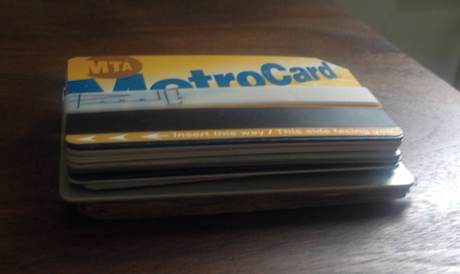
My current wallet is made of oiled canvas and isn’t particularly bulky, though the Panel Wallet definitely takes the cake in terms of minimal volume. It felt appreciably smaller in my pocket. I transferred the entire contents of my wallet: my driver’s license, two credit cards, one debit card, a health insurance card, a Park Slope Food Coop ID, a Brooklyn Children’s Museum membership card, a Metrocard, two gift cards, a credit-card-shaped USB thumb-drive and a recent-trip-to-the-ATM’s worth of cash (side note: read Tim O’Brian’s “The Things They Carried“). Though the Panel Wallet folks recommend only having 5-6 cards, the band handled those 11 cards pretty easily.

panel-wallet-4

The minimal bulk in my pocket was nice, and as anyone who uses a rubber band to hold their cards and cash together, the silicon provides friction against the interior of your pocket, making it feel secure.

Getting cards out of the wallet was relatively easy, though it seemed like putting your most-used cards one or two cards deep made the most sense; this way the outer card would absorb most of the band’s friction. I did halve the number of cards as per their recommendation and stuff came out a lot easier.

Getting cash out was a little trickier as it requires you to take the whole wad out to access bills. This was similar to a business card holder I used to use as a wallet; cash had to be neatly folded in order to fit into the holder. This would require a little adjustment for people used to jamming cash into their wallet.

One interesting aspect of the wallet is the effect of its exoskeletal design. By seeing the contents of my wallet, I felt far more inclined to reduce them. Likewise, similar to living in a tiny house, the minimal volume inspired a far greater level of organization and economy of stuff. There was no space for disorganization and clutter. A couple old receipts I had been carrying around in my old wallet were promptly discarded when I switched to the Panel Wallet.

The Panel Wallet and other products like it show the inextricable relation between design and lifestyle choice. For some, making an intellectual decision to live a life with less stuff is enough–they can live in McMansions with no stuff without the temptation to fill empty spaces. But many of us need design constraints support our choices; we don’t get rid of stuff until we downsize our homes; we won’t get rid of clothes until we have smaller closets; we won’t clear clutter from our wallets until we get a slimmer wallet (or much tighter pants).

To get your Panel Wallet, visit their Kickstarter page. A $25 pledge will get you a basic Panel Wallet, $45 for a copper or brass plated one, $75 for a titanium and up.

9 Ways to Edit Your Life in the Suburbs

It has been rightly pointed out that we at LifeEdited have a heavy urban bias. We sing the praises of compact apartments nestled in vibrant streets where we all frolick, ahem, walk or bike to world class restaurants, charming cafes and green markets; where cars are only used for the rare road trips to bucolic countrysides; where the reusable shopping-bag denizens create a fraction of the carbon footprint of the national norm.

But sometimes we miss the point. Many, many people live in the suburbs–roughly 2/3 of Americans. Many of them happily. They like their lawns, cars and streets that aren’t punctuated by the sound of sirens every five minutes. They don’t mind doing yard work, thank you very much. They accept and occasionally enjoy their commutes to work. And yet, many of these folks (of which you might consider yourself one) want to simplify their lives. They want to have more time, money and peace of mind. They want to reduce the amount of stuff they have and their carbon footprints. They just don’t want to move to the city.

A while back we wrote a popular post entitled “The New American Dream Home,” which profiled the Kawabatas, a family of four living in a not-so-small suburban home. The post was popular, we believe, because it presented a middle ground between extreme minimalist urbanism and unchecked suburban profligacy.

For the record, if you’re going to move, even within the burbs, we suggest finding a house that errs on the smaller side of the national norm and is close to the stuff you do–work, shopping, etc. But given that most of us aren’t going to move any time soon, or not based of some bloggers suggestion, we thought we’d offer a list of things you can do–some simple, some more involved–to create an edited home whilst living in the burbs.

  1. Get rid of stuff. As the old saying goes, nature abhors a vacuum, and given that suburban homes tend to be on the larger side, resisting the urge to fill your rooms with stuff can be difficult. But living with too much stuff is also difficult. There’s more stuff to buy, maintain, dust, organize, clean and toss. And while ultra-austere environments might not be everyone’s cup of tea, most of us appreciate a clear space more than we suspect. We suggest getting rid of stuff you don’t need, use or want, whether it’s housewares, furniture, clothes or paperwork. Edit ruthlessly. Just because you have the space doesn’t mean you have to fill it.
  2. Organize. With a bigger house, the tendency for out-of-sight-out-of-mind increases. Work on going through all of your home’s spaces, getting rid of stuff wherever possible, then organizing. Sort through storage areas, digitize paperwork and photos, make sure everything has a proper place. On the other side is the mental liberation that comes when we know what we have and where it’s at.
  3. Consider going natural. One of the larger time-sinks of having a single-family home is routine lawn care and landscaping. There are many types of beautiful grasses, shrubs and other plant life that need no or minimal upkeep. Look into what those things are for your particular climate and consider them as an alternative to the standard suburban mowed lawn and trimmed hedge aesthetic.
  4. Think before you drive. It’s sort of an inescapable truth that most suburbs truly depend on the car. Distances between destinations are generally too long for a walk and even a bike in many cases. That said, more and more municipalities are adding bike lanes and paths as well as public transport. While these forms of transit might lack the lightning speed of hopping in your car, there are many ancillary benefits like getting exercise, saving money and cutting your carbon footprint. Consider upgrading your commuter bike and riding that ten mile trip to work. Use the time waiting and riding the bus to catch up on reading.
  5. Telecommute whenever possible. The average American spends 50 minutes a day on his or her commute. And many people report that their commutes are the low-points of their days. If you have a flexible work situation, regain that time and sanity and consider making a request to work from home, even if only for one day a week.
  6. Close off a room. I know, this might sound weird, but the fact is many of us have spaces in our homes we simply don’t use enough to justify their upkeep–cleaning, heating and cooling. Consider making the room off limits–shutting the vents, covering the windows, etc–until you have a use for it.
  7. Get a lodger. This falls a bit outside the suburban norm, but fitting more people into a space cuts down on sprawl, can spread expenses and, assuming you have reasonably good interpersonal skills, might even make your home a more interesting place to live. Don’t want a stranger–consider having a family member moving in. Don’t want a family member–consider a stranger.
  8. Look into an Accessory Dwelling Unit (ADU). This one is a bit of a radical proposition, but depending on zoning where you live, you might be able to add an additional home to your existing home’s lot. Throw a tiny house in your back yard and rent out your main house–or vice versa.
  9. Use and love your space. Probably the biggest shame of the big American house is that it doesn’t get used enough. There is no “right size” for a home. If a space is frequently used and enjoyed, then it’s probably the right size. Host parties, BBQ’s, movie nights and other community activities. Size is an asset when it’s used.

Do you live an edited life if the suburbs? What would you add to this list? Let us know in our comments section.

Arial view of housing subdivision image via Shutterstock

Yes, Families Can be Minimalists Living in Small Houses

When LifeEdited received a bunch of press a couple years ago, our founder, 420 sq ft apartment-dwelling Graham Hill became a whipping boy for the pared-down life. “Sure,” the chorus cried, “It’s easy for a single guy to live this way. All he needs to do is take care of himself. He can live in a small, white box. He can get away with a small amount of stuff. But I’ve got a family. Kids need stuff and space, otherwise they’re unhappy. And when they’re unhappy, it makes my life hard, and then I’m unhappy. Don’t tell me to be unhappy!” [I’m paraphrasing slightly].

To some (small) extent, the charge that families need extra space and stuff is accurate. Whereas one person needs one pair of shoes, four people need four pairs; that’s three more pairs of shoes, and more shoes require more space. But to suggest that having a family necessitates a large amount of stuff and space–one that is preclusive to living a materially simplified life–is more fiction than fact.

I live in a 675 sq ft apartment with my wife and almost-two year old son, and we’re doing just fine. And I would content that families have a greater imperative to live pared down, minimal lives than single people. Graham can afford to have extra stuff in his closets (and he does ;-). He has a whopping 420 sq ft of floorspace all to himself. We have 225 each–with less storage.

When families start accumulating excessive stuff, things can get hairy quickly. There can be mountains of toys and accessories to buy, manage, maintain and, most difficultly, keep contained. We have kept our son’s clothes and toys at modest levels, which, coupled with our easy-to-manage house size, makes clean up a breeze (admittedly, it’s a breeze that passes through the house several times a day).

Incidentally, my family stayed in the LifeEdited Apartment quite a few times. While an extra wall-offed room would have been ideal, the built-in storage was amazingly child-proof and the small size made it easy to keep an eye on our son. A playground a block away helped greatly as well.

If you don’t believe me, here are a few other families who are living edited lives:

  1. The Sragues (video at top) are a Texas family of four who share a 260 sq ft home. The couple have two sons (six and eight years old) and have lived in their home for six years. Granted, their house is part of father Scott Sprague’s mother’s house and I’m sure they hang out there regularly. And there is ample yard space to offset the interior space. But taking a tour of their home makes it clear that the Spragues are the real deal–they have removed all extraneous elements from their home. The most interesting thing Scott says about this type of compacted living is that there is no room for avoiding issues. The space necessitates speedy resolutions to conflicts.
  2. Leo Babauta writes books and is the author of the popular Zen Habits blog. He’s the Brad Pitt of the minimalist world. And like Pitt, he has a large posse of children–six to be exact. He disagrees with the notion that minimalism can’t be done with families. He wrote a great post the other day about how to do minimalism with your family. The first tip is starting with yourself. Truer words couldn’t be spoken.
  3. If you’re new to the parenting game, Treehugger’s Katherine Martinko has 16 great suggestions for not accumulating 2,000 lbs of stuff for a 10 lb baby.

This is by no stretch a comprehensive list (there are oodles of other minimalist family blogs). It’s more to show that how we choose to live–whether minimalist or maximalist, whether in a large space or small, whether alone, in a couple, or a family (of any size)–is our choice, not something prescribed by the laws of physics.

Be Simple, Healthy, Debt Free and Happy

Courtney Carver is one of the leading voices in minimalist living. Her blogs Be More with Less and Project 333 have shown millions of readers “how to create a life with more savings and no debt, more health and less stress, more time and less stuff, and more joy with less obligation.”

We spoke to Courtney by phone to find out more about what she does and how we might all simplify our lives, letting in more happiness and less stuff.

David Friedlander: What inspired you to start Be More with Less and Project 333?

Courtney Carver: My journey started in 2006 when I was diagnosed with Multiple Sclerosis. It was big wakeup call. Prior to that, my life was go go go. But learning how stress impacts MS and overall health inspired big changes in my life. Simplicity was at the heart of every change.

After a few years, things had gotten so much better that I wanted to share my experiences. In May of 2010, I started Be More with Less to share general strategies to live more simply. Later that summer, I launched Project 333 [the projects asks people to use only 33 items of clothing or less for a three month period. More info here.] as a way to create accountability for simplifying, both for myself and my readers.

[divider]

Where you start isn’t as important as that you start.

[divider]

At the time it seemed like a big challenge. When I started, I had clothes everywhere, but I had lots of support. Before I even finished the first three month round, there were hundreds of people blogging about it. I am still dressing with 33 items or less and have pared down all of the extras. What seemed like such a big deal at the time feels really easy now.

The idea isn’t about getting rid of what you need, but instead using fewer items to identify how much you really need. Based on Project 333 participant’s feedback, in almost every instance, no one feels like they’re not happy enough or don’t have enough. Quite the opposite, they’re happy because they don’t have to deal with as much stuff.

DF: How has it improved your life?

CC: The biggest benefit is that I am happier and healthier. I’m largely symptom free. My relationships have improved because I’m not as stressed out, busy and focused on things that aren’t important. I don’t shop like I used to and have managed to save money and become 100% debt free. Less financial overhead allowed me to leave my job in 2011 become a full time writer and consultant. This would not have been possible had i not simplified my life and redefined what’s important to me.

DF: Project 333 focuses a lot on fashion–an area that is typically more focused on women. I have heard that women spend 80 cents of every household dollar. What are your thoughts about the sex divide with accumulating stuff?

I must say I’m not an expert in this area, but if I had to guess, in many cases, women are making the majority of household spending decisions. So that’s one aspect.

There’s also the fact that marketers are targeting the majority of their campaigns to women. I think women are more likely to buy something to feel better–probably more so than men–whether that’s a massage, dress, a coat, whatever. You never see a movie like “Confessions of a Shopaholic” where a man is the main character. There’s also a huge industry built around women improving their appearance–beauty products. haircuts, etc. I’m sure that contributes to it.

I don’t think there’s anything chemically different in women that make us shop and spend more. We do it maybe because our moms did it or our friends do it. When we’ve been raised in that culture, it can be a big step to change.

DF: Many people claim that minimalism and downsizing are much more difficult with a family. You have a teenage daughter. What would you say to people who say it can’t be done? How do you counter the forces that urge people to accumulate stuff?

CC: Any change you make is going to be more challenging with other people. It’s easy to make radical changes when no one is affected by the changes you make. But that’s not the way most of us live. We have partners, families and children.

The easiest way to start is with your own stuff. Lead by example. After that, you can start having gentle conversations about how it would benefit the family. Talk about the why’s of downsizing. For example, focus on the things you can do if you’re not taking care of your stuff. If we have a smaller house with less to maintain, we can spend more time hiking. If we don’t shop as much we can get rid of our debt. Include your family, but don’t worry about convincing or converting. These changes can happen slowly and that’s ok.

DF: How do you think design–interior or otherwise–factor into living a life of being more with less?

CC: The main thing is that design becomes more functional in living spaces. When you think about design only from an aesthetic standpoint, you end up with stuff you don’t need. When really doing more with less, you have to think about what works well. That doesn’t mean a space has to become a white box with nothing in it. That said, the process is interesting, the things you thought you liked before in terms of design change. You get used to the less chaotic.

DF: For people looking to simplify their lives, where would you suggest they start?

CC: A great way to start is deciding to make one small area a clutter-free sanctuary. Just focus on that one area. If you like that one non-chaotic area, make another. Where you start isn’t as important as that you start.

Love and Wear All the Clothes in Your Closet

In yesterday’s post about downsizing we gave the suggestion to have your stuff be “curated, culled and contained.” While we were referring to kid toys, it brought to mind Project 333 as an example of how this might look in the real world.

Project 333 is a minimalist fashion blog and experiment started by Courtney Carver. The idea is simple: Wear 33 articles of clothing (or less) for three months. According to the project’s website, those 33 items may include “clothing, accessories, jewelry, outerwear and shoes,” but not your “wedding ring or another sentimental piece of jewelry that you never take off, underwear, sleep wear, in-home lounge wear, and workout clothing (you can only wear your workout clothing to workout).” What’s left over is boxed up or given away.

Carver’s site includes detailed explanations about where to start, fashion news (insofar as it affects people with hardly any clothing) and personal accounts of women and men who’ve taken on the project.

The project is great because it makes a game and builds community around doing more with less. And rather than giving people new opportunities to criticize your bland wardrobe, Carver reports:

People will not notice that you are dressing with the same 33 items for 3 months, although they may notice there is something different about how you present yourself. You will likely get more compliments. That has been my experience and that of others on this journey.

Project 333 is not about excessive frugality, deprivation and monotony. It’s about being intentional about how we shop and dress (credit esteban at dh). With some experts guess that we only wear 20% of the clothes in our closets, Project 333 challenges us to wear 100% of the clothes in our closet and love every item.

Image via Project 333

Bellbottoms and a Top Hat. What More Could You Need?

For some, a journeyman is a slightly elevated type of handyman. But the term denotes much more. It’s a designation with a storied history, albeit one that has become increasingly rare in the last few hundred years. To be a journeyman in the traditional sense of the word is to embark on a right-of-passage period for a tradesperson such as carpenter, roofer or woodworker. Journeyman is the stage that comes after being apprenticed but before being deemed a master.

The “journey” in journeyman is derived from the French word journée, meaning day, which is historically the journeyman’s billing cycle. In other words, they are a rarefied day laborer.

While the etymological connection with journeying isn’t there, traveling is a staple of the journeyman’s life. He or she must complete a requisite Tippelei or Walzmust–a three year-plus journey without money where a journeyman perfects his or her craft. Journeymen often wander the world, usually living and working for a few months at a construction site before moving on. During this period, they are not allowed to pass within 50km of their hometown.

They are not allowed to carry much cash, use public transport or have a cellphone. Progress is made by hitchhiking or walking. Journeymen only carry a small bundle called a Charlottenburger with the barest trade and personal items.

As to their unique outfits, a Worldcrunch article that followed Robert, a modern-day German roofer journeyman, says these garbs are highly symbolic:

Black is for woodworkers, the eight buttons on the jacket stand for the eight hours of the workday, three buttons on each sleeve represent three years in apprenticeship and three years as a journeyman….In contrast to the black and white of Robert’s clothing is his red tie. Besides being a symbol of the particular brotherhood to which he belongs, it’s a symbol of honesty. When they start out, journeymen don’t wear the tie: they must earn it by first passing the initiation rites and then with their behavior.

Needless to say, these light-treaders carry big sticks.

The practice is in decline for somewhat obvious reasons–self-sacrifice and living without a cellphone are unthinkable for most people nowadays. Robert says there are only about 600 traditional journeyman left, most of whom hail from Germany and France.

journeyman-standingWhile the outfits are somewhat overwrought in our opinion, we think the idea of spending years perfecting a trade a good one. If our homes and stuff were made with the care and expertise a traditional journeyman possesses, perhaps we’d appreciate and hold onto things a longer than we currently do.

We also find it interesting that the basis of traditional training a craftsperson–someone who basically makes our stuff–is living without stuff. Roofers without roofs. Carpenters without homes. Craftspeople without personal possessions. Perhaps it is only through living without that we can truly appreciate the value of living with.

Image credit: Sigismund von Dobschutz

Via Worldcrunch

Give It Away, Give It Away, Give It Away Now

Following Graham Hill’s recent NY Times Op Ed, a far-reaching conversation has opened up about stuff–namely living with less of it. And to the best of our ability, we’ve tried to dole out sound advise for getting rid of your stuff. We’ve tried to help you navigate the perilous waters of eBay. We’ve looked at the online yard sale that is Krrb’d. Even though we haven’t written much about it, who doesn’t know about Craigslist? All of these services offer great ways to make money when offloading your stuff–the perfect present for your new edited existence.

But you know what? Selling stuff is a pain in the butt. Unless, you have very desirable, coveted items with clear market values or you are offering things at rock-bottom prices, your selling process is likely to be fraught with haggling, answering questions, shipping and dealing with scammers. Sure, pros can handle these situations with aplomb, but for many of us, selling can be more stressful than keeping.

We know it’s tough to do, but sometimes the best thing to do with our great, valuable stuff is give it away. When considered carefully, most of us will find selling is not worth the effort. While “time is money” might sound a bit facile, the fact is our time is worth money; you don’t work at your job for free do you?

To illustrate: Someone who makes $50k a year gets paid about $25/hour for his or her time (see how we got that number here). Let’s assume that’s your salary and your free time is of comparable value. Looked at this way, the cost/benefit analysis of spending an hour or two selling the Cuisinart you bought for $200 for $50 on eBay isn’t quite there.

There is no shortage of ways of giving your stuff away. Friends and family are an obvious choice. Craigslist has a free section, where things get quickly snagged. There’s Freecyle, a national grassroots network of people reusing and keeping “good stuff out of landfills.” There are tons of worthy charities such as Goodwill, many of whom will pick up your stuff and provide tax deductible receipts (you still have a couple weeks!).

We were recently turned onto a website called WebThriftStore, which allows charities to set up virtual storefronts. Through the site people can donate stuff as well as buy other people’s stuff. Donors actually send their stuff to buyers, cutting out the store. Proceeds go straight to one of the site’s partner charities and you get a tax receipt. WebThriftStore provides free mailing labels and shipping supplies for the donor.

While donating your stuff to a good cause might not have the dopamine spike of a wad of cash, it might have more influence on your long term happiness.

How about you? What’s your favorite way to give? Or do you know a secret way of selling that’s not so much of a drag?