Well That’s One Way of Adding Density

The skyscraper is without a doubt the most effective way of adding density to any patch of land.  And eVolo’s Magazine’s Skyscraper Competition is an exploration of innovative designs around this structure, creating “dynamic and adaptive vertical community.” Unlike every other entry, the winner, dubbed “New York Horizon” by Yitan Sun and Jianshi Wu, took an entirely different approach to scraping the sky. Rather than building up, they dug down deep below the surface of Manhattan. Their design calls for the excavation of Central Park. The walls of the hole are lined with housing and other public and private spaces, all of which enjoy unobstructed views of the new Central Park.  

Here are some more details from the designers:

The 1000-feet tall, 100-feet deep mega structure provides a total floor area of 7 square miles, which is about 80 times greater than the Empire State Building. Wrapping all four sides of the new Central Park. This system breaks the traditional perception of large-scale skyscrapers without taking valuable ground area of Manhattan….The soil removed from the original park is relocated to various neighborhoods, which will be demolished and moved into the new structure.

The idea is nothing if not novel and we’re afraid to ask too many questions…like how they would relocate several thousand obstinate upper west siders ? Or the mirrored glass that covers the mega structure? It’s meant to “reach beyond physical boundaries, creating an illusion of infinity….[where] a New Horizon is born.” But it seems like it might reflect all the sun’s light directly into the park, making Death Valley seem like the North Pole.

new-york-horizon-perch

But again, these questions are probably academic. It’s a very interesting idea and rifling through the runner ups, New York Horizon creates far less visual interference than conventional skyscrapers.

Via Curbed

It’s the Little Things That Make A Difference

Unless you’re living in some self-sustaining, off-grid detached house, the fact is that multifamily, multi-storey housing in dense, urban settings–ones that are walkable and have access to public transit–are going to be your best bet for green, low impact living. But here’s the deal: most Americans don’t live in this type of housing–single family homes make up 70% of the American housing stock, and while people may be migrating back into the cities, the vast majority of them can or will not move for various reasons. Which leaves the question: how can we make the single family housing–and the sprawl that tends to come along with it–greener?

A reader tipped us off to the east bay town of Albany, California, which, like its neighbor to the south, Berkeley, has become increasingly hospitable to accessory dwelling units (ADU’s), both as a way to increase density as well as creating an “aging in place” strategy; ADUs can let older, emptied nest adults inhabit small dwellings behind the big homes that they might have once used for their full houses. We found this nice example in Albany on Tiny House Listing of how one family, through the addition of an ADU, turned a fairly typical single family house into a mini compound that housed three generations.

While ADUs are often used to house older generations, this particular one, at least initially, was used to house younger ones. The house owner of 30 years, Judy, invited her daugher and her daughter’s partner and child to come back and live at home. Rather than shacking up in the main house, they built a simple, 442 sq ft L-shaped home where a detached garage and patio once stood.

judys-garden-cottage-1 Judy worked with New Avenue Homes to construct the home (they seem to do a lot of ADUs). Tiny House Listing said this about its construction:

The family considered sustainability and stylishness during design development. They opted for reclaimed and recycled materials, non-toxic paints, solar panels, a large bay window, stained cedar siding, bamboo flooring, and an exposed wood ceiling. The structure is L-shaped and sits in a far corner of their backyard. A garden and walkway connects the main home to the cottage. Construction took around 6 months.

For reasons not explained, the home is now used as a rental investment property, though Judy plans to move in when she retires in a few years, presumably to have a low fuss home with a large rental property helping to keep living expenses very low.

judys-garden-cottage-13

While inserting compact, multi storey housing in the millions of underutilized lots of American single family housing would be ideal, there’s pretty much no way that’s going to happen…at least any time soon. In the meantime, ADUs offer an elegant, livable way of increasing density in areas that might seem like they are immune to density. While Albany might not epitomize the American suburb (it’s near a BART station), Judy’s example shows how this can look, which, with its little pathway and garden, looks pretty good to us.

Our House In the Middle of the Street

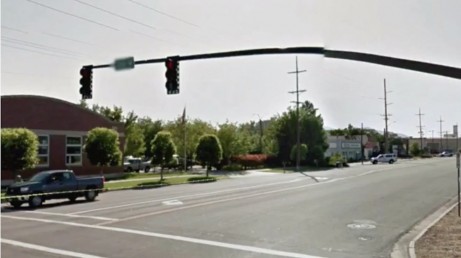
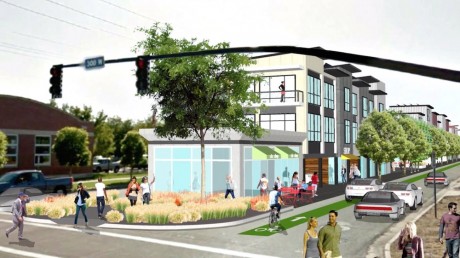
If you have ever visited Salt Lake City or other cities settled by Mormons, you might have noticed unusually wide streets. The reason is that their grids were based on an agricultural utopian plan devised by Joseph Smith and Brigham Young. The plan decreed that every street be wide enough for a loaded ox cart to flip a uey; this translates to at least four modern lanes (and often more) with widths ranging from 66 to 172 ft. While this bit of urban planning might have been great for ox-cart drivers and those they served (both constituencies having passed 100+ years ago), it didn’t lay the foundations for dense, walkable city centers. An organization called The Kentlands Initiative is proposing to find new uses for these wide lanes, adding housing and commerce to the medians of SLC’s commodious streets.

granary-row

Kentlands already set up a successful popup installation called Granary Row. It featured a shipping-container housed beer garden and various shops plopped in the median of a sleepy stretch of road. They are now trying to obtain a 99 year lease for the land, facilitating more permanent structures.

granery-beforegranery-after

The concept, while a bit unorthodox, is kind of hard to argue with. First, they’re not eliminating any thoroughfares–merely trimming them to a size that’s proportionate to traffic to their existing traffic. Secondly, since the city owns the streets, they would be the leaseholder and directly benefit from the plan.

Via Gizmodo

Ain’t Nothing New About Micro Housing

While tiny houses, micro-apartments and even transforming furniture may seem like recent phenomenon, the truth is quite the contrary: it’s big homes, excess space and stuff that are the new thing. People have been living in dense areas, in tight quarters with little stuff for eons. Nowhere is this more evident than in Manhattan. As strange as it sounds, there were over 600,000 more Manhattanites in 1910 than there were in 2013, 2.3M and 1.6M respectively. A recent piece in Curbed gives an account of the island’s various schemes to pack more people onto its 34 square miles.

Density Maps 1910 and 2010

Curbed highlights the various housing typologies that have flourished in Manhattan. There was nothing sexy or, in most cases, safe about these often-improvised houses.

hellskitchen_riis

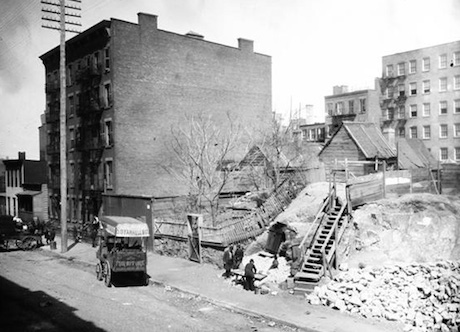
They write about the shanties that proliferated in the mid-19th century, saying of these rural dwellings (most of Manhattan was quite undeveloped), that they were “surrounded by picket fences, with muddy footpaths between them, and cows, pigs, or chickens outside [and]..They usually had just one room, about 12 feet square, which served all purposes for the family” (makes tiny houses seem huge!).

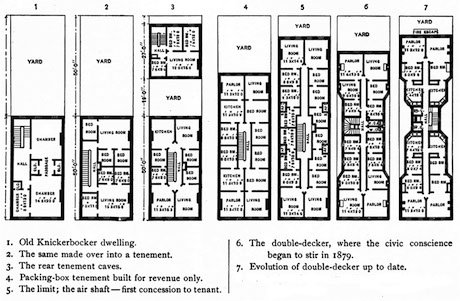
In the second half of the 19th through early 20th centuries, the tenement became new sardine can-home for the multitudes of immigrants flowing off the boats. Early tenements were often airless, windowless pits of disease and despair. Later regulations in 1867 provided some relief and led to the “dumbbell” building–named because its narrower interior shaft and wider front and back made their footprint resemble a dumbbell. These new buildings at least had a window in every room, but they were still pretty horrible with microscopic rooms shared by hoards of people. In one report, journalist and author of “How the Other Half Lives” Jacob A. Riis found 43 families where there should have been 16.

tenement-charts

In 1901, the Tenement House Act helped helped birth much of the low-rise housing that still stands today. The Act required at least one 120 sq ft room per apartment, with additional rooms being no less than 70. Adults were required to have no less than 400 cubic ft of air space, and children 200. Rooms not only had to have windows–those windows had to have light and air coming through them.

Even though new regulations were in place at the turn of the last century, there were still far more of the old buildings, resulting in massive overcrowding and subhuman conditions for years to come. Eventually, as the new buildings proliferated and bridges and mass transit helped disperse populations across the five boroughs, Manhattan’s population began to shrink.

Head on over to Curbed for the full article.

The Slow Death of the Walkable City

As a bit of an urban planning enthusiast, I’ve often wondered how cities that predate widespread car-ownership can be so car-dependent nowadays. For example, I am from Chicago, a city that was booming well before the Model T hit the assembly line. Yet today, there are large swaths of the city that are, for all intents and purposes, inaccessible without a car or a ton of patience for public transit.

The fact is most cities that predate ubiquitous car-ownership were far more walk/bike/public-transit friendly than they are now. Their cityscapes were characterized by dense housing on small lots connected by narrow streets. People walked, biked, rode horses or took streetcars to get where they were going. Without cars, people had to live close to their work, stores, etc.

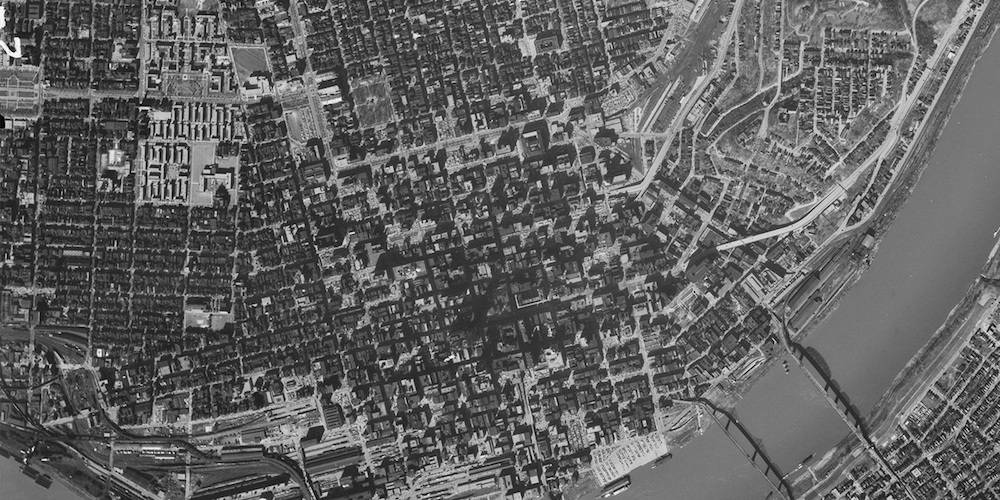
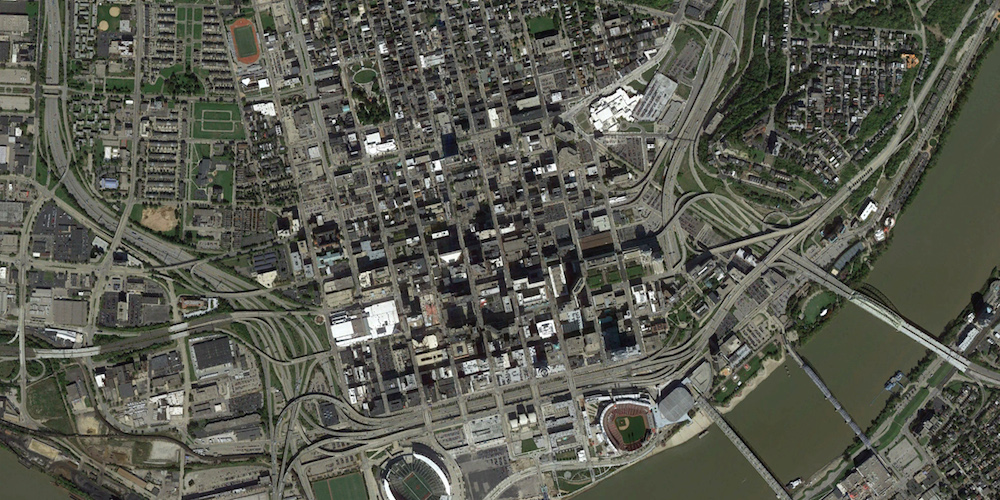
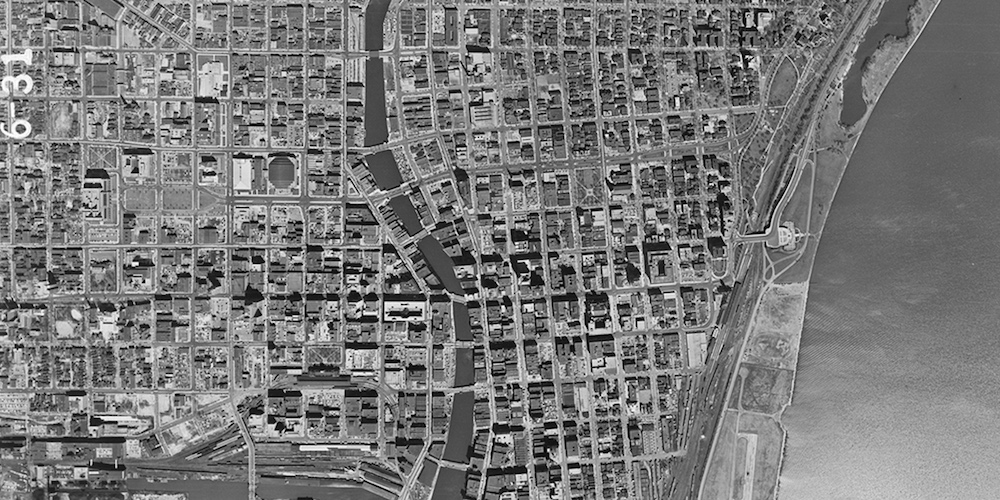
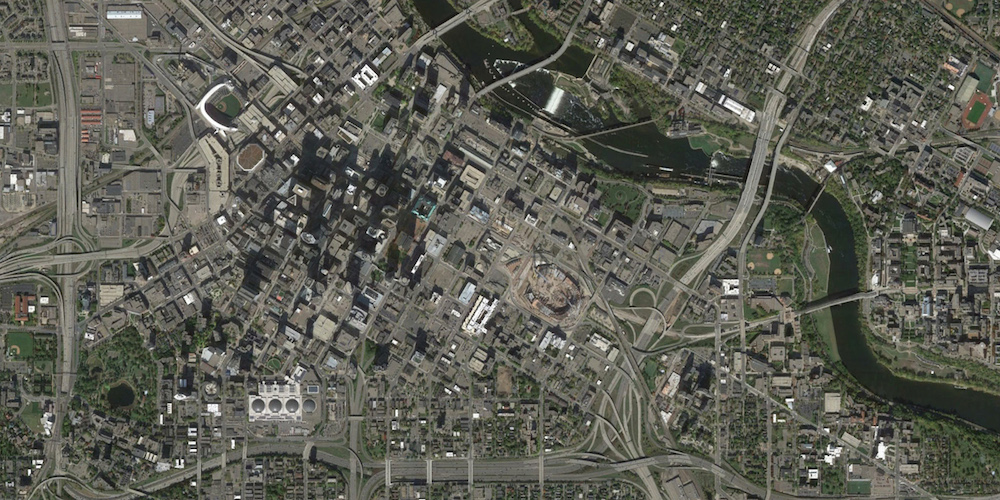
In the mid 20th century, much of this density was lost to make way for the car, a fact illustrated so well by these maps published by the University of Oklahoma’s Shane Hampton. He writes of the contrasting views:

60 years has made a big difference in the urban form of American cities. The most rapid change occurred during the mid-century urban renewal period that cleared large tracts of urban land for new highways, parking, and public facilities or housing projects. Fine-grained networks of streets and buildings on small lots were replaced with superblocks and megastructures. While the period did make way for impressive new projects in many cities, many of the scars are still unhealed.

Indeed, the pictures show cities eviscerated by highways. Semi-occupied lots fill the spaces where tightly packed housing once stood. Wide arterial roads replace narrow streets. It is a picture of sprawl.

What’s interesting is that many of the cities featured have experienced economic decline in the last 60 years. On the other hand, cities like San Francisco, Boston and New York City that did not undergo such profound transformations (not that people didn’t try), have remained economically vital.

As with many things, the answers to present and future problems can often be found in the past. The older pictures show that we know what to do, how to build and how to make cities vibrant, walkable and sustainable. If we can build that type of cities once, we can do it again…at least one can hope.

See more interactive maps on the University of Oklahoma’s Institute for Quality Communities website

Hat tip to Lloyd

Seattle’s Urban Boom

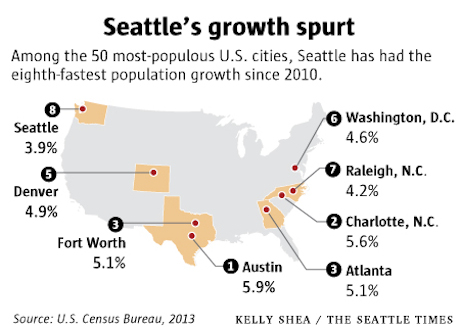
Forget NYC and San Francisco as the American leaders in smart urban growth. Seattle is where it’s at. The two former cities–with their tight geographies and urban grids conducive to walking, public transport and compact, efficient living–have always packed people in. But Seattle’s growth was more emblematic of many American cities, where, throughout the 20th Century, suburban sprawl reigned supreme. For 100 years, the suburbs of King County outpaced the growth of the city of Seattle (which, incidentally, is the King County seat). A trend that appears to be changing.

The first sign was in 2010, when the city of Seattle matched King County suburban growth. Then between 2011-2012 Seattle grew at a rate 25% faster than King County.

seattle-growth

Some attribute this trend to the aftermath of the housing bust–young people couldn’t “graduate” to the burbs like their parents did in the past. But the trend is hardly limited to Seattle. From DC to Denver to Atlanta, people are choosing city living–a choice that may be more than sloppy seconds to the suburbs.

fyiguy-popgrowth-map-2

The Seattle Times speculates about the possible motivations behind this movement:

We might be witnessing a major demographic shift, with younger people rejecting a culture of sprawl and car-dependency associated with suburbs, and instead choosing the lifestyle offered by dense, walkable cities…Signs of Seattle’s success are not difficult to spot. Everywhere you look there seems to be a new apartment building under construction. As reported in The Seattle Times, more apartments were opened in 2013 than in any of the previous 20 years.

Seattle bears this out. Least we forget, the city is perhaps the epicenter of the micro-apartment movement (often to the chagrin of many Seattleites). These tiny apartment forgo large interiors and parking spaces for central locations and affordability. As of last year, there were at least 47 micro-apartment buildings throughout the city; these developments are unique in that they Seattle convert low-to-medium density neighborhoods into higher density ones.

Of course Seattle’s growth can’t be solely attributed to micro-housing. It does show Seattle’s regulatory willingness to centralize populations–something that can’t necessarily be said for NYC, for example, a city that still has a 400 sq ft minimum size for new apartments.

The city of Seattle has 7,402 people per square mile. Compared to NYC and San Francisco–27,550 and 17,620 people per sq mile respectively–that number is not earth shattering. But NYC and San Fran both enjoy significant geographical constraints as well as infrastructures that were developed well before the car came into widespread use. For them, dense, walkable, easily traversed cityscapes are natural. Seattle, whose infrastructure grew up to a greater extent around the car, was more susceptible decentralization, making recent developments all the more impressive. It shows that a city’s growth need not be dictated by nature–that how a city nurtures development plays a critical role in smart growth and more livable cities.

Via Seattle Times

Why Household Size Matters

We often talk about housing density. We’re mostly in favor of it. In general, density allows more people to live in less area, resulting in small, efficient homes, walkable/bikable/public-transportation friendly living, more social living (by virtue of being closer to people) and smaller carbon footprint. We also talk about sprawl–density’s counterpart. Sprawl typically entails bigger homes, using up more space, pushing people further afield in socially isolated settings, necessitating more roads, more cars, more carbon, more everything basically.

We tend to frame the density issue in terms of housing size, because it’s easy to understand that big homes, as a rule, reduce overall density. But there is something else, just as important as housing size, that must be factored in to understand how density works, and that is household size.

Household size, as one might imagine, refers to the number of people that inhabit a given dwelling unit. If a six person family lives in one house, that’s a six person household. Without household size, it’s almost impossible to understand density. For example, if that six-person household occupies a 1,000 sq ft house, that’s 166 sq ft/person–a number that could rival any micro-apartment (assuming other factors like lot size, foot area ratio, etc are the same).

It’s important to understand household size, because across the globe, the numbers are shrinking, resulting in more houses and less density.

Let’s look at the United States to illustrate. In 1950, the average household contained 3.37 people. Today, that number is 2.6. In 1950, the average new house was 983 sq ft, or 291 sq ft/person based on the household size. The average new house in 2012 was just over 2500 sq ft, or 961 sq ft/person.

It’s not just the Americans for once. All across the globe–in both developed and developing nations–household numbers are shrinking. For example, the European average is down to about 2.5 people/household–half as many as 100 years ago.

household-size

According to a new paper in the journal Population and Environment there are a number of culprits:

Household proliferation is also due to aging, increasing divorce rates, and decreasing incidence of multigenerational households, which may be partly attributable to changing preferences for privacy. Indeed, the number of households may grow globally despite population numbers stabilizing. According to convergence theory, household size decreases (often from >5 to <3) as a society undergoes urbanization and industrialization. This trend largely occurred in developed nations during the latter part of the 1800s. If convergence theory applies to today’s developing nations, billions of households could be formed despite declines in population growth.

Mason Bradbury, one of the aforementioned papers’ authors, gives an idea of what this decreased household number could mean in terms of numbers:

From a more simplistic perspective, declining household sizes, from over 5 to approximately 2.5, will mean approximately twice as many houses will be needed per capita in any areas of the world yet to undergo the shift in household size. If the average household size had been 2.5 people globally in 2010 [developing nations still boast larger household sizes], then the number of households would have been 41% higher, resulting in 800 million additional households…

And according to Atlantic Cities, more homes have more demands:

That’s also 800 million more refrigerators and ovens and climate-control systems, 800 million more homes that need roads and sewage hookups and access to a power grid. If every one of those homes were the size of the average American home circa 2002, the researchers calculate that would mean constructing about 72,000 square miles of new housing on the planet.

As a small space design blog, we’d be remiss if we didn’t mention that the amount of sprawl (i.e. the 72K sq miles) they calculate is based on a house size of 2509 sq ft–McMansions for all.

Which leads to the question of possible ways forward. We see three:

  1. Let things remain the same. Encroach on undeveloped lands and deplete all natural resources until the planet’s homeostatic environmental mechanisms are irrevocably destroyed.
  2. Reverse demographic shifts away from industrialization, the desire for privacy, divorce and so forth.
  3. Rethink housing. Adjust housing style to meet demographic shifts. Have smaller, more efficient houses with shared amenities. Creatively subdivide existing housing. Mitigate sprawl by keeping density high, even outside of major metropolises, permitting walk/bike/public transportation-friendly living.

Options #1 and 2 seem like a stretch, so it could be time to start making houses that meet the needs of today’s smaller households.

Happy Family image via Shutterstock

Via Atlantic Cities

Life on the NYC Streets

To borrow the catchphrase of politician Jimmy McMillan, New York City’s rents are too damn high. As of last November, the median rent for Manhattan was $3100. Want to slum it in Brooklyn? That number drops to a measly $2800. Living in the city for many who don’t work in finance (and some that do) means getting creative with housing. For New Yorker Steven Cintron and his pit bull Bruno, creativity came in the form of a 1996 Gulf Stream Ultra RV he picked up off Craigslist for $5000. He parks it on the streets of the Park Slope neighborhood he grew up in.

The LA Times reported on Cintron and fellow New York RVer Rick Hall last November. The two opted to go mobile rather than pay the city’s outrageous rents.

According to the article, this lifestyle is hardly Kerouacian good times. They report:

Getting electricity takes some effort. Heating during the winter can get costly. Mail may need to be delivered to relatives’ places or post office boxes. There’s also the issue of how to hook up sewage lines.

There are also social costs. Hall reports that “the ladies aren’t really kicking down the door” (though we imagine the flimsy RV doors would be easy to kick down if prospective partners wanted to).

We have mixed feelings about Cintron and Hall’s situation. On the one hand, it’s a bummer that an increasing large number of New Yorkers (not to mention residents of other major cities like San Fran and Boston) simply can’t afford to live in the city they choose. On the other hand, necessity is the mother of invention. We’ve looked at other ways of converting parking spaces to housing in the past. We also saw the Boneyard Studios, that brought trailer mounted tiny houses–structures that are often plopped in the middle of the woods–to the city of Washington DC. From this New Yorker’s perspective, assuming the city could provide/permit some sort of utility infrastructure for mobile homes, I would rather have our limited parking spaces used for housing people than cars.

What do you think? Is this a sad commentary or innovative, high-density housing?

Inhabitat via LA Times

City Where Architects Dare Not Tread

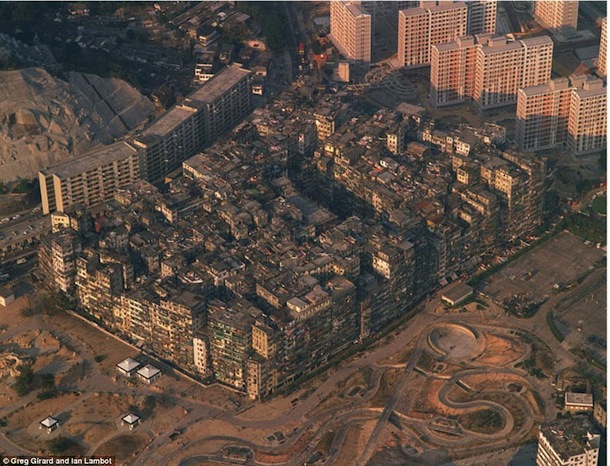
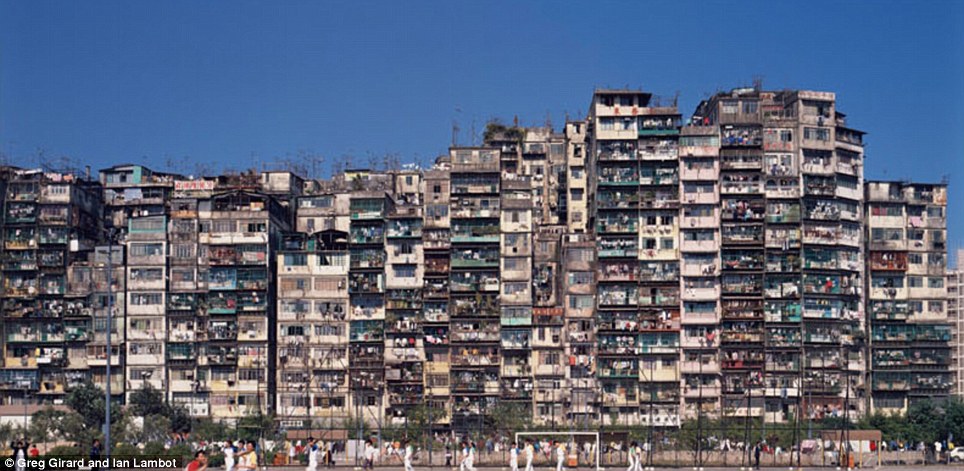
At LifeEdited, our preference for urban planning leans toward density. As a general rule, greater density is more energy efficient, promotes walking and some even say happiness. But like anything, there can be too much of a good thing. And few places in the annals of history have a greater excess of density goodness than Hong Kong’s Kowloon Walled City. At one point, the city held 33K residents on an area of 0.0102 sq mile–that would be 3.2M people per sq mile! For comparisons sake, mainland Hong Kong has about 17K people per sq mile and NYC has 27K.

The city had its beginnings as a Chinese fort, erected as early as the 10th Century. The labyrinth of buildings that most people associate with Kowloon started in 1933, when the HK government demolished all but a few structures, displacing the then 436 residents. In 1940, Japan, occupiers of HK, destroyed the eponymous city wall creating a sort of tabula rasa of urban planning chaos. After Japan’s surrender, 2K Chinese refugees moved into the city. British colonial powers adopted a “hands-off” policy toward the city. This laissez-faire governance led to several decades of extreme crime, with Chinese Triad gangs running the city from the 50s through the 70s.

The hands off approach also led to the improvisational architectural scheme. There were over 300 hundred 10-14 story buildings built mostly in the 60s and 70s. All these building went up without pesky architects, urban planners or governmental oversight. 60% of homes were only 250 sq ft and many lacked utilities.

Photographers Greg Girard in collaboration with Ian Lamboth spent five years in Kowloon before it was demolished in 1992. The pictures are great as they capture more than the dizzying maze of Kowloon’s exterior; they also peer inside the city, looking at the homes, businesses and alleys where tens-of-thousands of people lived.

Images via Daily Mail UK

Mind, and Live in, The Gap

Dutch roof window manufacturer Fakro doesn’t like wasted space. To prove this, they have conceived the “Live Between Buildings” concept, designed to utilize “blind walls” between buildings–i.e. the passageways between buildings that lack windows on both neighboring buildings. By making living and work structures whose exteriors are completely constructed of Fakro windows, LBB both utilizes unused spaces as well as brings maximum light to otherwise gloomy areas.

The idea is an interesting one, if not new. As we saw with the 1830 Spite house, people have been using the structures of neighboring buildings to make new ones for some time (you could say many shanties incorporate the same principle as well). Fakro’s design just brings modern technology to bear on the idea.

fakro-plans

We’re not sure how likely LBB is to being constructed, but it seems like Fakro is pretty serious about building them. They have located a number of locations in major cities around the world where the structures would fit.

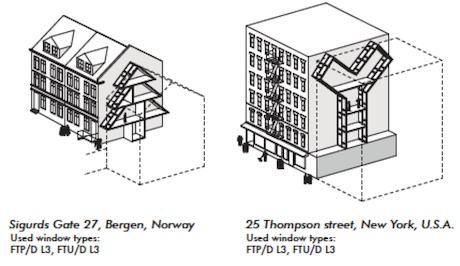
As spaces in the world’s major cities become more and more expensive, architecture will likely have to become more adaptive. LBB is one such adaptation. Whether it’s a genius or crackpot idea, only the future will tell.

Via Dezeen