Misery, Apparently, Does Not Love Company

Thinking of moving to the burbs or the country? Want a little more room to spread out and raise the kids? Want to feel safer and more secure than you do on the city’s mean streets? Well, you might want to think again. A growing body of research suggests that moving away from the city may be a move fraught with peril and insecurity. Here are some of the possible threats of moving out of town:

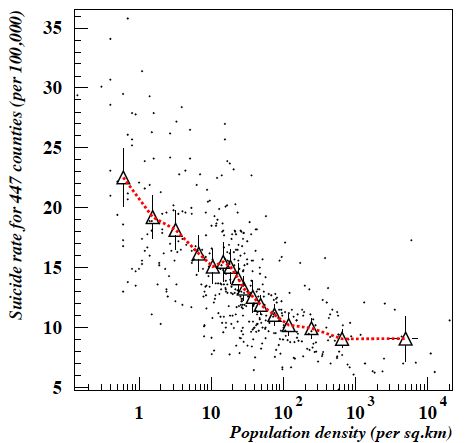
Suicide. A paper by Cornell researchers has found a strong correlation between low density and suicide, particularly for people aged 15-19 as the below chart suggests.
suicide-sprawl

This correlation holds true almost everywhere around the world. Countries such as France, Canada and Japan showed a similar connection between suicide rates and density.

Though there is no definitive explanation for why this is the case, an article in Atlantic Cities speculates that the reason is akin to the biological phenomenon called apoptosis, where cells “isolated from the group begin to self-destruct.”

Death. Many people’s notion of the city is forever associated with Charles Bronson riding the 1 Train at midnight. If we just escape to the bucolic burbs or countryside, where people trade their switchblades for hedge-clippers, we will be safe. Not so says a study by researchers from the University of Pennsylvania and the Children’s Hospital of Philadelphia.

polulation-densitydensity-violent-death

While certain urban environs have significantly higher homicide-related death rates than the national average, the overall likelihood of non-illness-related death are considerably higher outside the city, as another Atlantic Cities article reports:

That risk [of dying from urban homicide] is far outweighed by the fact that you’re about twice as likely to die in a car crash in rural America than you are in the most urban counties. Nationwide, the rate of “unintentional-injury death” – car crashes, drownings, falls, machinery accidents and the like – is about 15 times the rate of homicide death. Add together all the ways in which you might die prematurely by intentional or unintentional injury (as opposed to illness), and your risk of death is actually about 22 percent higher in the most rural counties in America than in the most urban ones.

Upward mobility. A NY Times editorial by Paul Krugman called “Stranded by Sprawl” suggests a third threat of moving to the outskirts: Unemployment and lack of opportunity.

Citing a new study by the Equality of Opportunity Project, Krugman points at Atlanta, a city he refers to as the “Sultan of Sprawl.”

Though Atlanta has recently experienced an enormous population growth suggestive of an economic boom, its citizens’ likelihood of upward mobility is the same as Detroit, a city whose economic woes have made it the epitome of urban decay. Krugman asks:

So what’s the matter with Atlanta? A new study suggests that the city may just be too spread out, so that job opportunities are literally out of reach for people stranded in the wrong neighborhoods. Sprawl may be killing Horatio Alger.

In other words, what good is opportunity if you can’t get to it?

[divider]

Needless to say, this is not a topic for over-simplification. Not all suburbs or cities are created alike and there is surely a lot of noise in all of these studies.

And we won’t suggest that people only move out of the city to find a better life. Many people are moving to the outskirts because the city centers have become prohibitively expensive.

But there are many who still see the suburbs as havens of safety and security. For them, these studies should provide plenty of food for thought. Maybe it’s safety and opportunity–not misery as always thought–that love company. 

Average Family House image via Shutterstock

The Half-Mile High City

If you’re a high-density housing fanatic, the best direction to build is up. The logic follows that if you build up, you fit more people into less land area, resulting is less commuting, greater efficiency for things like power delivery and distribution of goods and more land for nature. In an act that could be construed as high-density fanaticism, a company called Broad Sustainable Construction is building a tower over a half-mile high; its residents will use 1/100 the land area of their terrestrially-based friends.

Broad’s aptly named Sky City is no pipe dream–ground is set to break this month in Changsha, Hunan in south-central China. At 838 m (2,749 ft) high, it will become the world’s tallest building. Its 220 stories will be reached via 104 high speed elevators. There will also be a six mile ramp going from the first to 170th floor. Its 11M sq ft of floorspace will house 17,400 residents, a 1K person capacity hotel, schools, offices and shops–in other words, there’s little reason to leave the building outside of the strolling the ample parklands surrounding the building. But wait, there’s more! Broad, who specializes in prefabricated construction, plans to erect the whole thing in a scant 210 days. If you doubt their claim, check out this video showing Broad erecting a 30 story building in a mere 15 days.

And if you doubt their claim–about the feasibility of the project, the timeline, etc.–you aren’t alone. Some say it will not withstand wind forces. Others say that Broad hasn’t built anything over 30 stories (true) and adding another 190 for its next project is a bit of a reach. Others think it’s just a marketing ploy.

The company has fired back saying they are quite serious and that the building has passed the needed safety tests. They even say it can withstand an earthquake of a 9.0 magnitude and three hours of active fire.

Engineering squabbles aside, it’s hard to fault Broad for a lack of earnestness. From what we can tell, they are on a mission to save the planet. Their buildings, which include serious efficiency measures like triple-glazed windows, 8″ insulation and Heat Recovery Ventilators, are said to be five times more energy efficient than traditional buildings (not even factoring in the benefits of density). The company promotes more than efficient construction–they also promote a way of life…one that sounds suspiciously like LifeEdited’s. They recommend such things as having one child to make “Mother Nature happy”, “not to buy anything that is unnecessary in the family” because “Simple life is very relaxing,” and they claim that “reading and listening to music during holidays are more leisure [sic] than taking a trip by air” (see more of their philosophy here).

Sky City is nothing if not audacious. And while we have suggested that there might be a Goldilocksian density–neither too dense, nor too spread out–there’s something appealing about imagining a vertically-housed world surrounded by ample green space to recreate. In this world, people live close to one another and use only what they need. What could be simpler and more edited than one structure that houses your whole life?

Of course, there’s the dystopian angle as well. Might Broad be ushering in an age where the planet is littered with half-mile-high buildings, leading to greater population explosions, ever-dwindling green-spaces and lives lived out in the confines of a high-rise tower?

Whether Sky City will presage either of these scenarios remains to be seen. Either way, at Broad’s projected breakneck building schedule, the future won’t be long now.

Via Treehugger

Designing Cities From Scratch

What makes a perfect city? Walkability? Culture? Great restaurants? Density? Architecture? Diversity? If you could make a city from scratch, how would you design it?

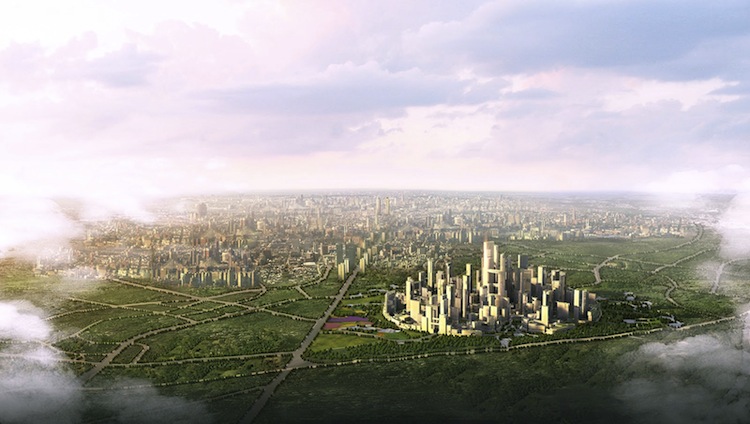
Throughout history–from St Petersburg to Brasilia to many, many more–urban planners, architects and despots have attempted to turn clear tracts of land into exemplars of urban ideals…with mixed results. One of the latest editions of this city-making craze is the Tianfu Ecological City going up outside Chengdu, China.

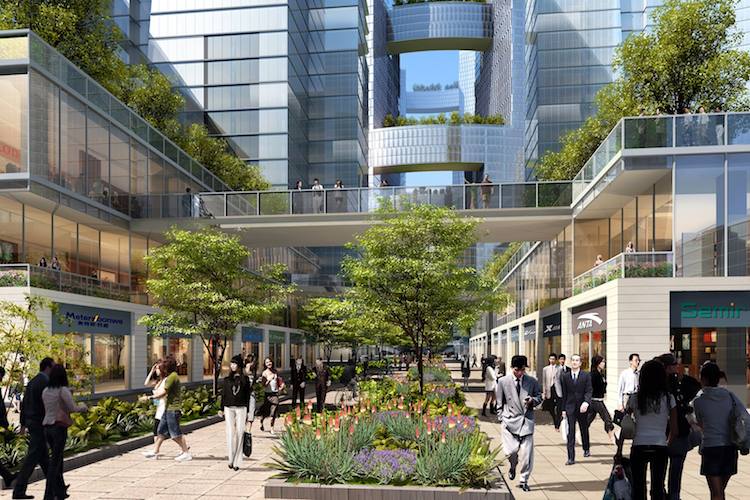
Chicago-based architectural firm Adrian Smith + Gordon Gill is trying to create a prototype city that is meant to solve many of the present social and environmental pressures that have resulted from China’s explosive population and economic growth. If the prototype is a success, they can plant these cities across the country. Smith and Gill say this about the city:

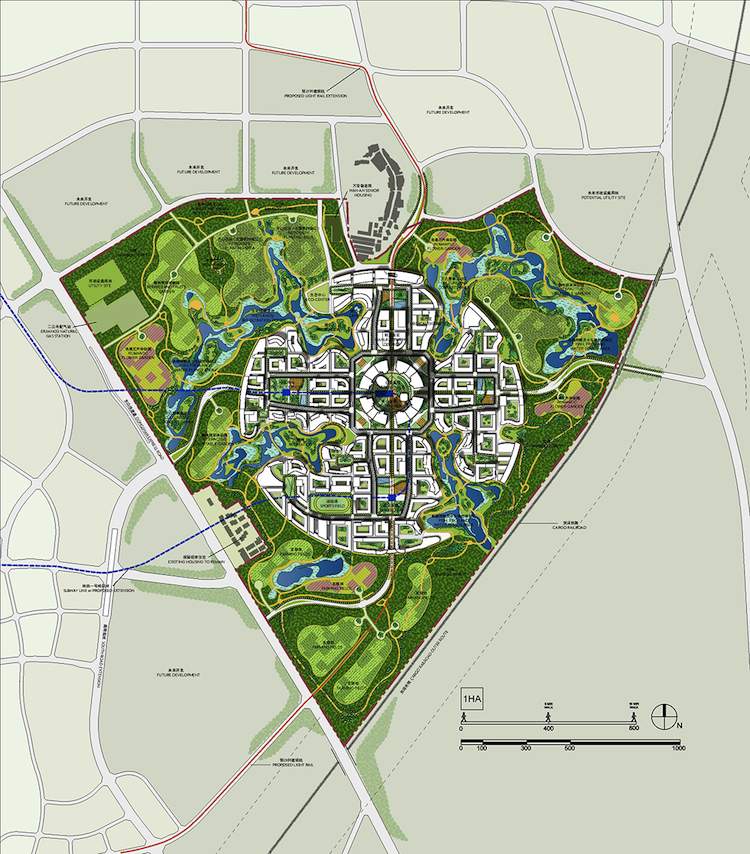
When completed in about eight years, Tianfu Ecological City will be home to about 30,000 families totaling 80,000 people [within 1.3 sq km, making it one of the densest cities on earth], many of whom will also have opportunities to work within the development. The distance from any location in the city to any other location will be walkable within about 15 minutes, all but eliminating the need for most automobiles. The city will also be connected to Chengdu and surrounding areas via mass transit to be accessed at a regional transit hub at the Tianfu Ecological City center.

And this about the environmental benefits of their ultra-dense plan:

Tianfu Ecological City will use 48% less energy and 58% less water than a conventional development of similar population. It will also produce 89% less landfill waste and generate 60% less carbon dioxide.

This all sounds great and logical: Density + height  = green + walkable + great.

This algorithm comes as no surprise from from a firm that designed the “Kingdom Tower,” which at 1km high is 567 ft higher than the current highest building. But do algorithms make good cities?

A few weeks ago we looked at some not-so-great conditions in Hong Kong–the 2nd densest city in the world, whose skyline is littered with high-rises. In the piece we quoted Treehugger.com’s Lloyd Alter as saying:

I am convinced that they are wrong, that there is a “goldilocks density” that is high enough to support a vibrant, walkable community, but not so high that you can’t walk up to your apartment when the power goes out, that needs expensive infrastructure like subways and huge underground parking garages. Dense enough to build a sense of community, but not so dense as to have everyone slip into anonymity.

Unlike Tianfu, other cities-from-scratch are going for the Goldilocks formula–not too high or dense. IKEA’s Strand East in east London (below) opts for meandering streets and medium sized buildings. Las Vegas’ Downtown Project is trying to transform the old Las Vegas strip into one of the world’s greatest innovation hubs, using 100 per people acre as the sweet spot for density.

Strand-EastBut comparing London and Las Vegas to Chengdu is not a fair. Though the former cities have their challenges (insane costs, dwindling water supplies), they pale in comparison to the latter’s (crazy population, industrial pollution).

So the question is: are the roads of utopian cities paved with good intentions? For example, many consider Brasilia’s idyllic center to be a model of Modernist misdirection, and its cohesive design is now surrounded by ring of improvised shanty towns (none designed by Oscar Niemeyer). Or Ordos, China, a utopian city that now sits completely uninhabited.

But there are also successes in master planning: Haussman’s Paris, L’Enfant’s Washington DC.

What do you think of Tianfu in particular, and cities-from-scratch in general? Is it a recipe for a successful city or another great idea whose time will never come?

Hong Kong’s Micro Madness

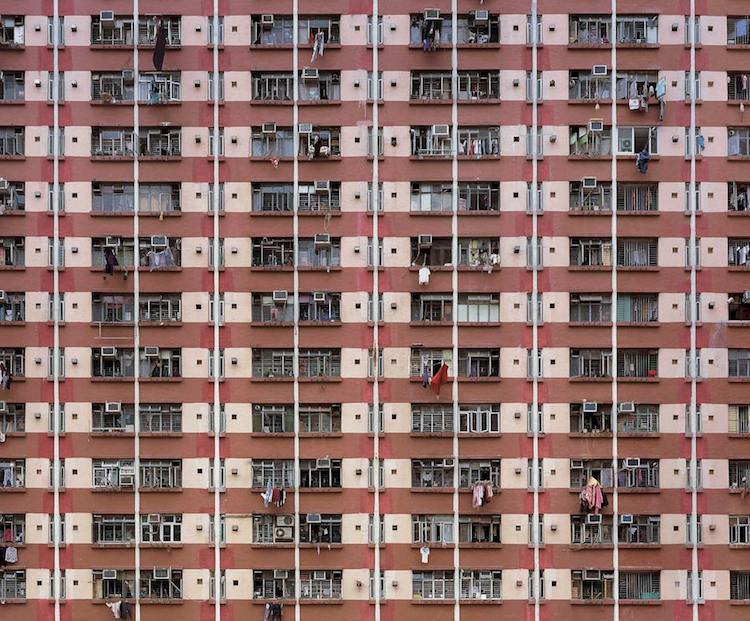
We’re big proponents of high-density urban living but there comes a point where small-footprint, efficient housing starts looking a whole lot like storage units for humans. Few places fit that bill like Hong Kong, which boasts the second highest density of any sub 1M person nation in the world.

Some pictures by photographer Benny Lam taken for the Society for Community Organization show the more unseemly side Hong Kong’s high density. The shots are part of a campaign meant to bring awareness to the shockingly cramped conditions many Hong Kong residents live in.

The shots bring to mind a series of photos from photographer Michael Wolf, who looked at many different facets of Hong Kong density–from squeezed interiors to seemingly unending high-rising apartment exteriors. Check out his website to see the full series.

We recently read an NRDC interview with our good friend and Treehugger managing editor Lloyd Alter, where he shared some of his thoughts on the limits of density. While there has been a recent battle-cry of “denser-is-better” that axiom can be a bit facile, as he explains:

Environmental writers and thinkers are piling on, all of them claiming that we need to fill our cities with 40 story buildings. A renowned architect can design a building that is essentially a pile of radiator fins but call it green because it packs 750 apartments on a third of an acre, saying that the most important thing we can do for the environment is live in compact cities with mass transit.

I am convinced that they are wrong, that there is a “goldilocks density” that is high enough to support a vibrant, walkable community, but not so high that you can’t walk up to your apartment when the power goes out, that needs expensive infrastructure like subways and huge underground parking garages. Dense enough to build a sense of community, but not so dense as to have everyone slip into anonymity.

We’re not intimate enough with Hong Kong to say whether their density is problematic (though a video we posted a while back seems to indicate that people in Hong Kong seem to think it’s a problem), but we can’t help think that these Hong Kong homes bear out Alter’s contention that greater density ain’t always so great.

Incidentally, Singapore is the both the densest and unhappiest nation in the world. While that’s far from proof that hyper-dense living causes unhappiness, anecdotally it might bolster the contention that maximizing density doesn’t maximize greater living.

Infographics Show Why Density is Necessary, But Not Sufficient

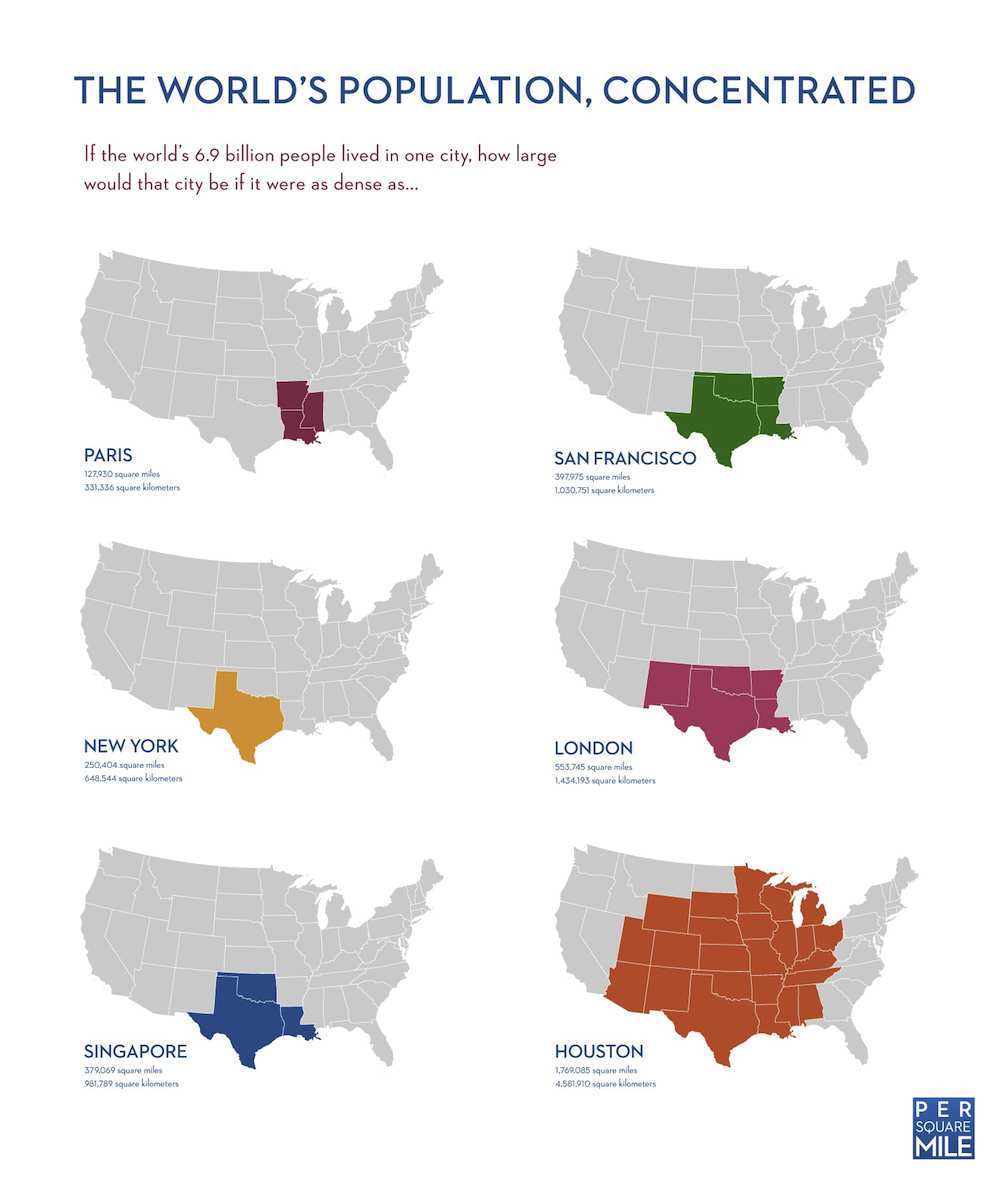
The above infographic from a project called Per Square Mile shows how much landmass the world’s 7B inhabitants would occupy if they achieved the housing density of various cities. Paris came in at #1; those 7B could live on a mere 128K sq miles of land–approximately the size of Arkansas, Louisiana and Mississippi. New York City achieved a competitive 250K sq miles–about the size of Texas. Houston–often the whipping boy of urban sprawl–fit the world’s population into a more spacious 1.8M sq miles.

Seven billion is a whole heck of a lot of people, but this infographic shows that there is room enough for everyone to live. Density is a great place to start.

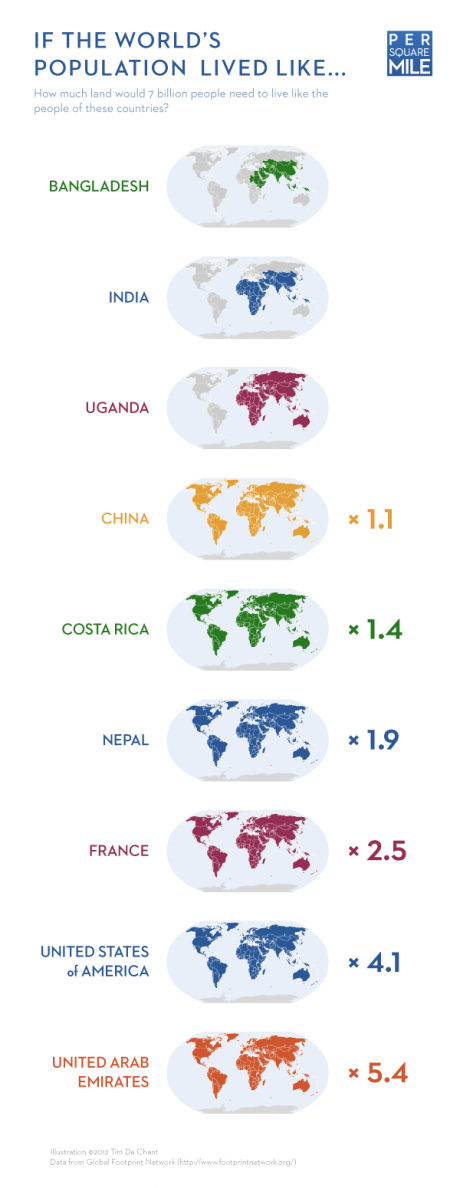
But density doesn’t tell the whole story. Tim De Chant, the man behind Per Square Mile, received a lot of comments about what the map doesn’t show: The landmass needed to support various populations based on their consumption of resources. De Chant made the below infographic to fix that missing information.

ecological-footprint-by-country

This shows a very different picture. It show that the “developed” world uses a crazy amount of resources–far more than the planet can sustainably provide. For example, the US uses four earths to fuel its lifestyle.

It’s probable that populations of areas where great density is achieved, like NYC and Paris, while achieving far greater levels of efficiency than their suburban countryman, still consume close to or more resources than the earth can provide (De Chant lacked data to tally individual city’s energy needs). In other words, density is necessary to fit everyone on the planet, but not sufficient. Architecture, design, planning and behavior must go hand-in-hand.

What do you think of these figures? Do you see flaws? Do you see a way out? We’d love to hear what you think.

via Per Square Mile

Opinion: Where is the Best Place to Live an Edited Life in the US?

We are great advocates of cities: They’re walkable, bikeable and have public transport for easy mobility; the average city dweller uses approximately 14% less carbon than his non-urban counterpart according to the Brooking’s Institute study; their density facilitates easy interchange of resources and vibrant cultural lives.

But to use “city” as an abstract term might not be helpful if you are looking to move somewhere where you can best live an edited life–i.e. living a life with more money, health and happiness with less space, stuff and energy. The question becomes, which city supports that life best?

We talk a lot about New York City and San Francisco, as they both are very dense, have extensive public transport systems and have vibrant cultural lives. But consider the average rent in the New York metropolitan area is $2687. San Francisco is even more at $3226.

Perhaps you want to take economist Jed Kolko’s advice and buy a home, which he claims will save around 30% in living expenses. Well consider that the median home price in Manhattan is $1.14M. Want to slum it up in a borough like Brooklyn? Median price is $582K (the borough was recently deemed the second most expensive place to live in the US behind Manhattan). San Francisco is no slouch at $705K. That’s a lot money to fork over to save money! And buying small doesn’t necessarily save you a ton. Studio rents in both cities frequently exceed $2K. If you’re a family, expect to pay $3500+ rent or $800K for even a modest apartment.

Of course, with these prices come increased economic opportunities, but there’s a paradox: There are more jobs where you can make more money, but, in most cases, you work more, with less time to enjoy the benefits of the city.

There are middle-ground cities like Chicago, Boston, Philly, Seattle and Denver that enjoy more manageable living expenses along with decent economic situations, but they also tend to be less walkable and have less developed public transport.

Then there is Main Street USA. Many claim that small business and technology will allow people to work remotely will make them the “cities” of the future. But for the most part, this is still speculative. Most jobs are still in denser areas and these areas are usually quite car-dependent.

We realize this is not a simple question. The “right” answer might depend on living situations (single, couple, family), career situations, family connections, etc.

Imperfect as the answers may be, we’d love your opinion. Do you live–or have you lived–in a place you think facilitates the edited life–a place you think allows you to do the most with the least?

Please leave us your thoughts in our comment section below. Thanks!