Get Space When You Need It Most

One of the core ideas behind living an edited life is access over ownership. The fact is that many of the things that are useful for certain times are liabilities most of the other ones. To illustrate, if you’re throwing a big birthday bash, having a room in your house that can hold 75 people is useful. But when the party is over, you’re left with a big room to maintain, heat, cool and pay for. Services like Airbnb create a great solution to these kind of problems, both allowing people to access sleeping accommodations when needed and making sure spaces are being used to their fullest potential. Now a site called Peerspace does for event spaces what Airbnb does for guest accommodations.

Peerspace’s tagline is “Connecting people with unique spaces.” The site is a peer-to-peer booking site that lets you rent spaces for events, photoshoots, concerts, etc. Spaces run the gamut from small boardrooms to massive event spaces. Each space’s profile provides high quality images of the space, its amenities, availability and rates. Of course, Peerspace can be used as a place to book a space or rent out yours.

If you’ve ever organized events, you know how difficult it can be finding, much less comparing, good spaces. Peerspace makes the process pretty damn simple. Right now, PeerSpace has networks in New York City, LA, San Francisco, Seattle and Austin.

Breather Investment Might Show that People Will Subscribe to Anything

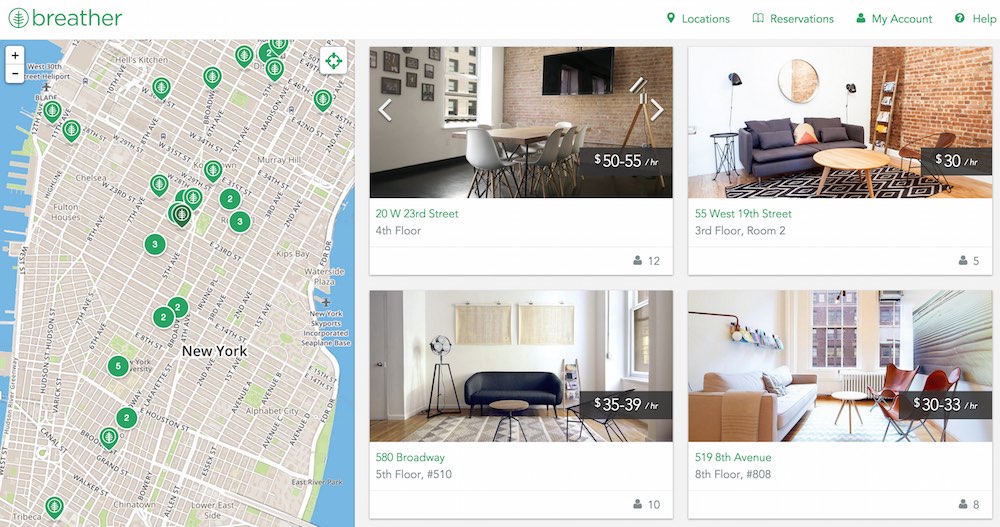
This site profiled the company Breather a couple years ago right after its launch. For lack of a more original description, Breather does for living and meeting rooms what Airbnb does for bedrooms. Via its site and app, Breather allows on-demand rentals of quiet, clean, wifi-enabled spaces in cities across North America. These aren’t places to stay for a long time; rentals are anywhere from 30 minutes to a day. These are place to work, have a quick meeting, meditate, breastfeed or simply get some quiet in an otherwise hectic day.

Today, Breather announced that it raised $20M of series B funding led by Peter Thiel’s Valar Ventures. This is a lot of money invested in a product that has no competitors or established market. Despite this–or perhaps because of this–the Breather capital influx may well be a harbinger of things to come, evidenced by its esteemed investor pool. If you’re not familiar with Peter Thiel, he cofounded PayPal with Elon Musk; he was the first outside investor in Facebook; he’s founded a number of other ventures that would be career-defining for most people to boot. He’s a man with a knack for seeing what’s next. So what does he (and a slew of other investors, it should be noted) see in Breather?

A few months back, I wrote a post called “Life as a Service (LaaS).” The concept of the post was based on the term Software as Service (SaaS)–an increasingly common model where software companies (Adobe, Microsoft, etc) charge a subscription fee for access to their software. The benefits of this type of service is that your software is forever current and you bypass many of the perils localized computing and storage. What I suggested is that this type of system can and is being applied to virtually every material need we might have, from cars to clothes to toys and more. In this model, things are accessed and subscribed to, not owned and paid for outright.

Yet I wrote the LaaS post with middling conviction, believing there were some things that would always defy shared or subscription-based ownership. You can’t very well subscribe to a living room, can you? But Breather shows that you can, and its continuation and growth are evidence of the growing catalog of things we may no longer own in the future. It also lends credence to the idea promulgated by Gunnar Branson about how real estate is being affected by Moore’s Law; through technology, we can access spaces that were once only available through ownership. Now we can use them only when we need them. Not only that, others can use the same space when they need them. This shared access has the potential to shrink our overall real estate needs, saving money, space and natural resources. It’s an exciting concept and one we look forward to seeing grow.

Life as a Service (LaaS)

Back in the day–and to this day in some places–people pumped from central wells, ground their wheat at central mills, baked their bread at central ovens and even bathed at centralized bathhouses. Primitive manufacturing technology limited private ownership for many common things to the very rich. The things people needed most were accessed, not owned. But as manufacturing technology and our ability to exploit the earth’s resources advanced, nearly everyone got his or her own oven, bath and iPad.

While there’s nothing inherently wrong with private ownership–and for many items it makes a ton of sense (even Sammy the serf had his own spoon)–the explosion of private ownership has had some pretty nasty consequences: 1. It sucks for the planet. It’s estimated that Americans, the kings of private consumption, consume over four earths’ worth of natural resources. And the rest of world is trying to keep up with us. China, as of a few years ago, was using 1.1 times the planet’s resources. These are extra planets we don’t have. 2. The profusion of private ownership is overwhelming owners. There was no equivalent for the Container Store in the 12th century countryside. You had your two frocks and a pot you shared with your family. Life might have been difficult and laborious, but it was simple. Nowadays, clearing clutter is a preoccupation. Really, don’t we have better things to do?

But the times are a changin. Through a combination of impending environmental calamity and technological advancement, it’s necessary and possible to offload many of life’s most basic stuff to centralized services and resources. Back in the day it was drawing water from the well. Now it’s pulling stuff from the cloud. Here are a number of areas where you can trade private ownership for shared services:

  • Housing: The popularity of the McMansion is inseparable from the private ownership ideal; these huge homes were meant as personal and self-sufficient kingdoms to be passed onto your progeny. On the other hand, places like the UK’s The Collective, offer housing as a service. Everything you need–much of which is shared–is included in your rent, or ‘service fee’ if you will. Micro-housing trades the notion of housing as agent of permanent security for low-fuss, minimal-resource, amenity-rich living.
  • Cars: Whether Zipcar, UberPool or (in the not-so-distant future) some sort of autonomous vehicle, it’s becoming easier and easier to live without your own car.
  • Computing: It’s no mystery that cloud computing is the way forward. Many software services like Adobe, Quickbooks and countless others are going cloud-only, offering Software as a Service (SaaS) eliminating the need for tons of local computing power and data storage.
  • Bikes: Most major cities–and many not-so-major ones–feature bike sharing systems, offering a viable alternative to owning a private bike.
  • Clothes: Dutch company Mud Jeans is offering their garments on lease. Rather than owning the clothes outright, you pay monthly for them and return them to the company, who recycles the material to be made into more garments. This is not a widespread model, but we hope it will be in the future.

Where else can private ownership be traded for service-based resources? Let us know in our comments section.

Why Most Americans are Crappy Sharers

Winston Churchill was famously quoted as saying, “You can always count on Americans to do the right thing–after they’ve tried everything else.” While there’s some debate about the exact phrasing and context of this statement, it does have a ring of truth. We have a history of righting nasty wrongs a little later than most. Hopefully the adoption of the so-called sharing economy–something that promises to save a significant amount of natural resources and money–will be another example of such a late bloom. In a report called “The Sharing Economy: Where We Go From Here” advertising giant Leo Barnett dissected the Nielsen Global Survey of Share Communities to find out American perspectives on sharing. What they found was that most Americans are pretty ignorant of what the sharing economy is and would probably not be inclined to participate in it even if they did know.

The Nielsen study went pretty deep into how receptive people around the globe were to sharing and the sharing economy, asking such intimate questions as how likely people were willing to swap pillows with their mothers. What they found was that most global citizens were open to sharing, particularly in many Asian, Middle Eastern and African nations, where sharing is a longstanding practice. But when LB teased apart the 4500 Americans surveyed, they found a population not so keen on participating in the sharing economy. Here are some of the report’s findings:

  • 3 out of 4 Americans said they hadn’t even heard of the terms “sharing economy,” “conscious consumption” or “mesh economy.”
  • Only 1/3 of Americans were familiar with brands like Airbnb and TaskRabbit.
  • 47% said they considered safety and hygiene an issue that would prevent them from sharing.
  • 43% said they have an emotional attachment to owning that would stop them from sharing.
  • 30% said that adapting to others’ schedules, following their rules and letting go of spontaneity would stop them from sharing.
  • 27% said they enjoyed the U.S. consumer culture and the sharing economy, for some, undermined free market capitalism.
  • 52% of those surveyed agreed with the statement, “I think most people would rather own than share, if they can afford to.”

While these findings are far from the death knell for the sharing economy, taken collectively, they present a formidable obstacle for it to take hold in the US.

Some of this resistance to the sharing economy is surely cultural: America is a country founded on the rugged individual, someone who doesn’t need your stuff to get by, thank you very much. But a large part is economic: people don’t avail themselves of sharing technology because it’s still very cheap to own. It’s cheap to order a power drill off of Amazon with one click. It’s cheap to own big homes to store all of your privately owned objects. And until the economics favor sharing people will continue to own their own stuff. For example, Airbnb and Zipcar have managed to gain some economic traction because they save people money over their conventional alternatives, particularly in large cities where hotel rates and car ownership is very expensive.

It’s hard for this author to not be a bit pessimistic about what it’ll take to get Americans to share in a more widespread manner. In my opinion, many people will either need to make a lot less money or the cost of goods must increase dramatically before people start taking sharing seriously.

What do you think? Can people change their behavior–sharing, for example–without dire circumstances forcing them to do so? Let us know in our comments section.

Hat tip to Wehatetowast.com Via Tripple Pundit

Uncle Sam image via Shutterstock

UberPool Makes it Easy to Pimp Your Ride

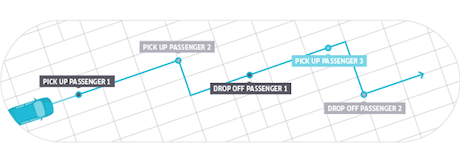
The world’s roads are littered with people driving the same way–people leaving when you’re leaving, from where you’re leaving, going to where you’re going (or, if not exactly same locale, at least getting on and off somewhere along points on the way). But until now there was no way of connecting those people–likely why 78% of American commuters end up driving alone. UberPool–a division of Uber–is trying to change that, connecting people who are going the same way. From their website:

With UberPool, you share a ride—and split the cost [of an UberX car-service ride]—with another person who just happens to be requesting a ride along a similar route. The beauty, though, is that you still get Uber-style on-demand convenience and reliability: just push the button like before and get a car in five minutes. When we find a match, we notify you of your co-rider’s first name.

Uber says an UberPool car would achieve 36.4 person trips per day (the number of people carried in a car multiplied by the number of trips that car makes in a given day) versus the average private car that only has 4.8. This high volume will theoretically make the service so cheap that it can realistically replace car ownership, halving the price of their UberX service, which they say is already 40% less than a traditional taxi. They think that UberPool’s convenience and thrift will make it compelling enough to eventually remove 1M cars off the road.

uber_NYC_infographic-02

The program has been rolled out in beta in Paris, San Francisco and New York City. A Newsweek article reports that some drivers are having trouble using the service and there are complaints about the service cutting into profits for the drivers. Uber has expressed that there are still many kinks in the system–which is why it’s in beta, duh–but that UberPool will ultimately benefit drivers as the service, by virtue of its convenience and low cost, will create ever-increasing volume of people looking for rides, keeping drivers busier than they are now. Like all new ideas, there is bound to be a ramp up period.

It’s pretty clear that we have more resources than we need, but sometimes distributing those resources to people who want them, when they want them can be difficult to say the least. UberPool is a great example of how tech can help us make the most of what we got. We wish the project the best of luck.

Scratch Fashion Itch without Breaking Bank or Planet

The average American woman spends $60 and creates six pounds of waste on clothes every month. With around 160M American women, that’s $10B and 1B tons every month (American men spend a relatively measly $35). One of the reasons there is such a high demand for clothes is novelty. Many people–and it’s probably fair to say particularly woman–enjoy wearing clothes that are au courant even if the old ones are still in good shape. A new shop in Los Angeles called Give + Take Swap Boutique has made a way for women to scratch their fashion itch without the big price-tag or heavy environmental toll.

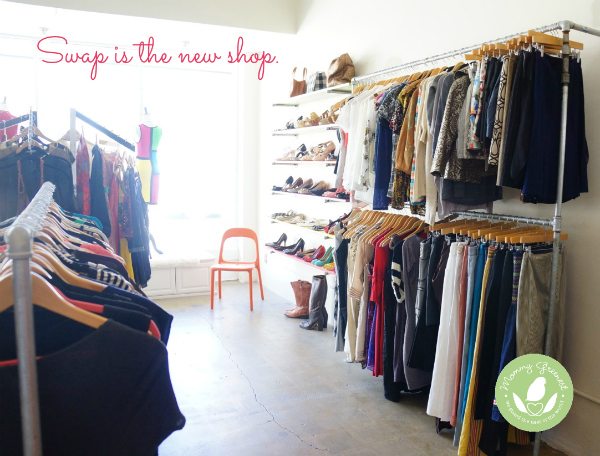
It’s probably easiest to think of Give + Take as an offsite closet filled with clean, new-to-you designer garments, accessories and shoes. By paying a $35 monthly fee ($30 if paid ahead of time), you get access to the closet. Members bring in their nice but unused or unloved items and each is assigned a point value based on its retail value. Here’s how they explain it:

A dress that’s worth $100 would “cost” 6 points at Give + Take. If you brought in the dress, you’d get 6 points of credit in the store. If you want to take home the dress, you’d need 6 points to do that. You can accumulate points for larger items—i.e. bring in two $50 dresses and swap them out for a $100 pair of shoes.

After you swap the clothes, you own them–i.e. you’re not renting. Assuming they’re still in decent shape after your use (which could be for a day), you can swap them again.

One of the boutique’s partners Rachel Sarnoff told us, “Usually women come to us with bags of clothes that have been sitting in the back of their closets. They rack up a lot of points with those clothes, and then continue to swap more clothes in and out.”

Sarnoff said there are all varieties of sizes available. And even though there is only one Santa Monica location, some women have flown across the country to swap their clothes. Rather than having an ongoing membership, they bring in their unused clothes, pay for a $40 day pass and swap to their heart’s content–a scenario we could see as being way cheaper than a conventional shopping spree.

The so-called “sharing economy” has taken off for big ticket items like cars and hotel rooms, but not so much for the smaller stuff. Most of the time it’s cheaper to buy a power drill than it is to geo-locate, pickup and return a shared one.

But fashion could be different. Unlike power drills, novelty is prized in fashion (unless you have some weird power drill fetish). Having access to a big selection of new clothes could be a big draw. Second, as we mentioned above, the dollar amounts add up. According to Mint.com, between 2010-2011, Los Angelenos spent $243/month or 21% of their income on clothes (Manhattanites spent $362, which is the same percentage of their income). These are big numbers over time, especially for stuff that’s often not worn much after a few initial uses. We won’t even delve into the environmental and human rights implications of the fashion industry. The Give + Take boutique offers the novelty without breaking the bank or bringing countless under-used garments into the world.

If you’ve ever been there, let us know what you thought in our comments section.

Are We Ready to Share Our Legos?

A new site called Pley is hoping to change the way children consume and use their toys…well, one type of toy at least. They are offering monthly subscriptions for Legos. Pley’s subscriptions cost $15, $25 or $39 per month, for small, medium and large sets respectively.

The subscriptions work much the way Netflix rents DVDs: fill up your queue with various lego sets from their online library; after the sets arrive in a box, you keep them for as long as you want; when you’re ready for a new set, return the old one in the box with a pre-paid label; wait a couple days and get some more. All the legos are sterilized before delivery in an eco-solution. You are allowed to lose up to 15 pieces per rental. Pley offers you the chance to buy the set at a discounted rate if your child isn’t so keen on returning them.

Pley’s has big ambitions for renting the small blocks. From their site:

Pley is a socially-responsible company that aims to change the way families consume products and spend time together. Leveraging collaborative consumption, we aim to raise a more creative and skillful generation that follows the principles of open-ended play while emphasizing the benefits of sharing, reducing waste and giving back to the community. Every set that Pley rents saves a tree over the lifetime of its rental. Todate, Pley had reduced waste by eliminating the wasteful production of 90,200 pounds of ABS plastic which resulted in a reduction of 3.9 million pounds of C02 emission.

[divider]

The sharing economy has had the most traction with big ticket items like cars and hotel rooms where savings are hundreds or even thousands of dollars compared to the alternative, i.e. keeping a car on standby or standard hotel rates.

But the sharing economy has faltered for the smaller stuff where private ownership is cost-competitive with shared ownership. We looked at toy-sharing sites a couple years ago; one of those sites definitely closed shop and the other’s last sign of life was a Facebook update in October 2012. A follow up look at some other sharing sites for small stuff reveals a similar situation: dead websites and unsubstantiated announcements to re-launch the businesses. Getting people to pay to share–unless there is a big and clear savings to be had–still appears to be a tricky proposition.

Pley might make it because they offer something beyond conservation and high ideals. They offer a level of novelty that would cost hundreds of dollars to achieve if you were to buy the sets for private consumption.

So far so good. According to Fast Company, who spoke with Pley’s CEO Elina Furman, the business has grown their staff from two to 23, and “has shipped over 75,000 sets to over 15,000 subscribers from its San Jose warehouse.” We hope their success continues.

Via Fast Company

Photo credit: Stefano Tinti / Shutterstock.com

Lend Tools, Build Better World

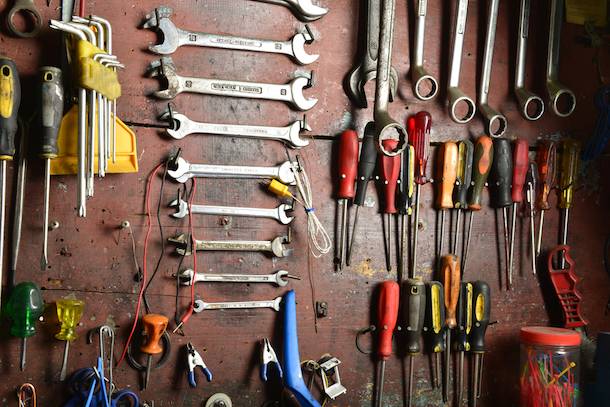
Some things seem inherently incompatible with small space living: Car collections, big game taxidermy, Richard Serra sculptures and extensive tool collections. While the former things have easy workarounds, for the DIY-disposed, the latter is often considered indispensable. Many people who need to store tools and a place to use them might find a 350 sq ft apartment insufficient for such tasks. There is a solution. Across the globe, tool lending libraries are offering builders an offsite place to source tools and in many cases use them.

West Seattle Tool Library‘s co-founder Gene Homicki told Christian Science Monitor that there are a number of significant advantages the tool lending library movement presents over private ownership. He says that due to their collaborative nature, they often become vibrant community centers (i.e. probably more so than your garage). In line with the spirit of the idea, several maker and co-working spaces have included tool lending libraries at their spaces; Homicki said many maker spaces started as tool libraries and evolved from there. At some of the libraries, people not only check out tools, but can learn how to use them as well.

Another advantage is the exploitation of unused resources. Homicki said to CSM:

We have an economy that’s uneven and sputtering at time…and we have this locked-up value that’s just sitting, whether in an attic, garage, or gathering dust in a warehouse.

These libraries get tools out of their dusty attics and tool benches into the hands of people who need them. An additional benefit is that they give access to specialty tools that you might only need once or twice–this is something even the most seasoned maker can appreciate.

One of the bigger issues of lending tools is keeping track of tools. While many libraries seem to use ad hoc systems with an administrator keeping track of a tool’s whereabouts, Homicki co-created something called myTurn. MyTurn is an online platform that gives libraries a way of tracking their assets and promoting the sharing of tools across private, public and municipally owned libraries.

If you want to find a tool library in your area visit Local Tools. If there isn’t one in your area, there are numerous resources to help you start your own such as the  How to Start a Tool Library guide and a webinar by the Center for a New American Dream.

Mechanical Workshop Tool image via Shutterstock

Via Christian Science Monitor

Dine and Dash Around the World

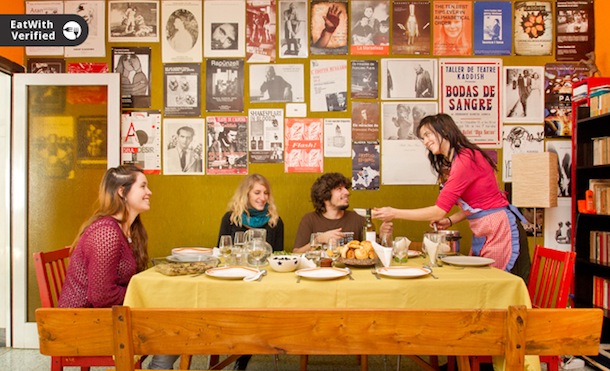
Forget museums and tourist sites, when trying to get local flavor while traveling, few things beat eating local cuisine. While restaurants are fine, they can be expensive, hit-or-miss in terms of quality and can lack the intimacy and authenticity of how people really eat in your host country. Ideally, you want to eat with the locals in their homes, but unless you know someone in the country you’re visiting, finding an open invitation can be difficult. A new service called EatWith has made that difficult task easy. They connect travelers with chef/citizens who open their homes to make impromptu restaurants.

eatwith

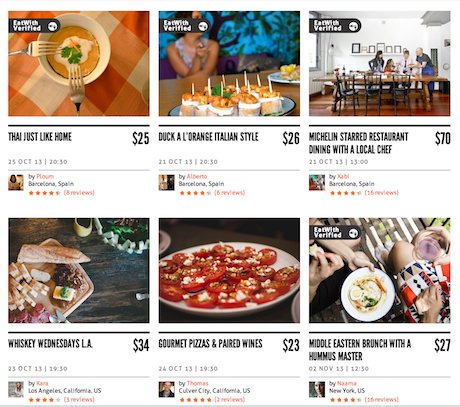
How it works: You visit EatWith’s website, choose from one of their 17 cities; you peruse available chef offerings and either choose an existing reservation (e.g. Middle-Eastern Extravaganza on Nov 17) or book a date with a chef yourself (note: many have minimum party numbers). You then book your reservation. Chefs have 24 hours to verify that they’ll take you, similar to Airbnb reservations. After confirmation, you just show up. You can also cancel if you give the host 48 hours notice.

Offerings include dining with Michelin starred chefs in Barcelona and a Thai-Brazilian Feast in São Paulo. Like any good peer-to-peer commerce network, chefs are rated by people who’ve eaten at their homes. EatWith handles payment through PayPal. Prices are pretty reasonable, starting around $25 per person.

If you’re a little nervous about eating in someone’s home, EatWith carries a $1M third person insurance policy. The bad news is this coverage is currently available only in Spain and Israel–two countries where there is a high number of EatWith events. We don’t know about you, but we’ve eaten in some dodgy restaurants whilst traveling, so the lack of coverage, coupled with a rating system by diners, seems like an acceptable risk.

Of course, you don’t need to be a traveler to enjoy EatWith. Assuming it’s in your area, it can be an adventurous alternative to eating at a restaurant. Also, you can open your own home and register as a chef, sharing your cooking chops and making some money.

A while back, we looked at Feastly, a great peer-to-peer dining service we’ve used a number of times. Feastly works much the same way EatWith does, but is focused on major US cities. What we wonder is, assuming these services are as easy to visit and economical (or perhaps cheaper) as going to a restaurant, would people opt to dine in a strangers home on a broad scale? Could these micro-restaurants turn into another mainstay of dining out? Or are people too geared to eat at restaurants, even if their food and safety is no better, or often inferior?

Sharing Grows Up

If you thought the sharing economy was a passing fad or something exclusively for Ralph Nader voters*, think again. A new organization called Peers.org is trying to make sharing mainstream. It serves as both a member network for some of the leading players in the sharing economy as well as a public advocate for the institution.

Advocacy is going to play a larger role in the fuzzy, hard-to-regulate sharing marketplace. A recent lawsuit brought against a NYC man testifies to this. Nigel Warren has been accused of illegally running his own hotel via Airbnb. He faces up to $30K in fines if found guilty (Airbnb is helping out with his defence). We can’t help but think that other peer-to-peer services like Zimride and Lyft, which essentially provide unregulated taxi service, surely hold similar potential for litigation.

Beyond advocacy, Peers represents a maturation of the sharing economy. The site has a grownup, cohesive look with slick, professional graphics and videos.

Some folks such as Salon’s Andrew Leonard have accused Peers of being a little too slick. He wrote a couple articles about Peers; one entitled “The sharing economy gets greedy” accused Peers of being a front for sharing economy giants and the numerous venture capital firms that support them. A follow up article, based on new information that refuted some of his original contentions, still questioned how “grassroots” Peers is (they use that term to describe themselves on their website).

Peers director Natalie Foster said explicitly that the group wasn’t a lobbying organization, but our question for Leonard and other skeptics is so what? So what if Peers serves the interests of multimillion dollar VC firms supporting the sharing economy? So what if Peers were to morph into a lobby group? So what if Peers starts to work within the existing political system to give the sharing economy a fair shot at going mainstream? If the net result of these efforts is people sharing more and consuming less, so what?

And while the term “grassroots” might strike Leonard as disingenuous, we are intimate with a few of the 22 organizations that are members of the Peers network right now. These ostensible titans of the sharing economy–companies like Yerdle that facilitate the free-exchange of goods–aren’t exactly Walmart and Monsanto. With the exception of Airbnb and a couple others, most of these companies are scrappy little guys trying to make money while creating a new, responsible, people-centric form of capitalism. If they can strike it rich while reducing consumption and bringing people together, our hats are off to them.

*This author voted for Ralph Nader in at least one Presidential election.