Share Your Best Friend with these Dog Sharing Sites

Do you love dogs, but lack the bandwidth to take care of one fulltime? Do you have a dog, but find yourself away from home and unable to give it the attention it deserves? Are you single and need a cute prop to bolster your self-esteem? If you fall into any of these categories, here are three dog-sharing sites that might just have a solution for you predicament.

In all seriousness, the following sites connect dog owners with dog lovers and people interested in adopting a dog fulltime a chance to experience dog ownership firsthand. These sites also provide a cost-effective way of keeping your pooch out of the kennel–a none too cozy environment for a dog to hang–while you’re away from home.

  • City Dog Share is a California-based nonprofit that hooks up fellow dog owners as well as prospective ones. Dog owners can swap sitting and walking duties. Unaffiliated dog lovers can rent-a-pooch whenever they want to. According to their site, you simply “post a picture of your dog when you have a dog that needs to be watched. Include relevant details like the dates away, care needed, etc. Members can comment on the thread or send you a private message in response.” CDS is a coop structure and free to use. Their site is pretty bare bones technologically and doesn’t have any formal vetting procedure we can see. All transactions are handled on community Facebook pages. There are pages for the San Francisco Bay AreaLos Angeles AreaHumboldt CountyGreater Portland and Seattle Metro areas. Predictably, San Fran has the most traction.
  • Borrow My Doggie is a UK-based site that, like CDS, hooks dog owners up with dog borrowers. Borrowers can hang out with the dog for an hour or a month. Unlike CDS, they have a few more hoops to jump through before you can borrow someone’s dog. They verify personal information and have a one-time £24.99 registration fee. BMD acts as intermediary between owner and borrower, arranging “Welcome Woofs,” which “is an opportunity for the owner, doggy and borrower to meet for a joint walk in a local dog-friendly place.” In other words, it’s an internet dating site for pets and the humans that care for them.
  • Rover is the Airbnb of dog-sharing. Within Rover’s extensive network, you can arrange peer-to-peer dog sitting. Owners and sitters create profiles for their pets and pet-care experience, respectively. Sitters determine their rates, which range from $10-75/day. Additional services like cat care, bathing and grooming, etc can be added when booking a sitter as well. Sitters can also be hired for basic dog-walking, but unlike the two other sites Rover is all business with standard hourly rates.

While using these sites might require a bit of trust (they all recommend getting to know the borrower/sitter), they also present a cost-effective opportunity to hand over your leash to someone who might actually want to spend time with your dog.

Via Shareable

The Power of Free Real Estate

Throughout the month of June, a group of people in San Francisco are conducting an experiment in improvisational community creation. [freespace] is a 14K sq ft blank canvas for anyone looking to present his or her talents, ideas, classes, swaps or anything else to the greater community. It is, as one of its members declares, “a big empty building filled with people who care.”

The project came to be after the founders were given a $1, one month lease for the vacant SOMA neighborhood warehouse (if you’re unfamiliar with SF real estate, this is a good deal). While we apologize profusely for the delayed announcement, there is still a lot going on for the remaining 12 days of June–yoga classes, a TEDx event, hackathons, live music, salons and much more.

One of the most endearing aspects of [freespace] is its sense of urgency. With a 30 day lifespan, there’s no dilly-dallying. They have started several projects meant to endure beyond June, including a 30 day garden, a mobile learning center for the homeless, a matchmaker-service for muralists and walls and its own bikeshare program.

To us, [freespace] exemplifies the increasingly paradoxical nature of many of the world’s leading cities. On the one hand, the cities often hold the highest concentrations of creative energy that make living there so great. On the other hand, the rising cost of these cities–both for commercial and residential real estate–make the conditions inhospitable for that creativity to flourish. People with jobs of indeterminate value (see artists) and real estate that doesn’t generate a lot of money are usually excised or marginalized by the city.

In fact, a project like [freespace] only exists due to the largesse of its donors (the city, its real estate broker and property owner)–and it’s only for a month. The [freespace]ers have launched a fundraising campaign to cover July’s $24K rent, but have only raised $3700 to date.

We wish [freespace] the best of luck and hope that similar projects arise in other cities–ones that might endure for more than a month. By providing large, low or no cost communal spaces for people to meet and create in, we imagine the creativity that makes our cities so valuable will flourish once again.

Breather: A Living Room for Nomads

Everywhere we go, we are surrounded by countless, unused rooms–furnished, climate controlled, wifi enabled rooms. If you’ve ever wandered around a city–or any place away from home–you’ve probably wanted to duck into one of these rooms to work, take a quick nap or simply have some quiet time alone. A new service called Breather is about to enable just that, providing on-demand offices, nap spaces, meditation spots or whatever type of space you might need.

breather-smartphone

Breather works by using excess capacity real estate (mostly unused office spaces to begin). With Breather’s smartphone app, users will be able to locate these spaces and reserve on the spot. Entry to the spaces will happen via keyless locks. Each room will be held to a set of standards that either Breather or the host provides; those standards include cleanliness, quiet, high speed internet, a desk, couch and “enough room to do yoga.”

Like Airbnb and other peer-to-peer services, Breather depends on reputation to run smoothly. Hosts are rated by users to make sure spaces are well maintained. Users are rated by hosts and Breather’s cleaning crews to rate how they respect the space. In fact, Breather’s existence will depend on reputation as its network will be expanded with invitations by existing members who vouch for new ones.

“99% of most cities are completely inaccessible,” says Julien Smith, one of Breather’s founders. He explains that most cities are broken up into public or private spaces. The problem is that both public and easily-accessed private spaces like coffee shops and hotel lobbies aren’t the kind of places to relax or be productive. Moreover, the vast majority of appropriate private spaces–offices, unused residential spaces, etc–are simply off limits to the public due to logistics (i.e. letting people into a space) and liability (letting the wrong people into a space). By creating an infrastructure that allows the public to easily and safely access private spaces, he sees Breather as creating a new type of space in between private and public. “Our whole idea is to democratize the city,” he explains.

Right now, Breather is only accepting invitations for membership. One of their partners Lockitron has not yet delivered the locks necessary for Breather to operate (they are expected in the next 45 days). The first launch of Breather will happen in New York City in October. The network will grow from there to select cities.

Hourly pricing has not been set. Smith says that will depend largely on the market, e.g. an hour in Midtown Manhattan will cost more than downtown Pittsburgh.

Similar to Zipcar, which provides cars for very short drives, Breather provides a place to, um, take a breather for only as long as you need it–no need to pay for an overnight stay or whole day pass. As they say on their site, “Think of us as your second home or office, wherever and whenever you need it.”

We see Breather as another important innovation in the sharing economy. It is helping create a world where it’s possible to have access to anything we want–whether it’ a car, a kitchen, or a power drill–whenever we want it, all without personal ownership or the inefficiencies of single-owner use.

images via Breather

Your Guide to Doing More with Less in the Big Apple

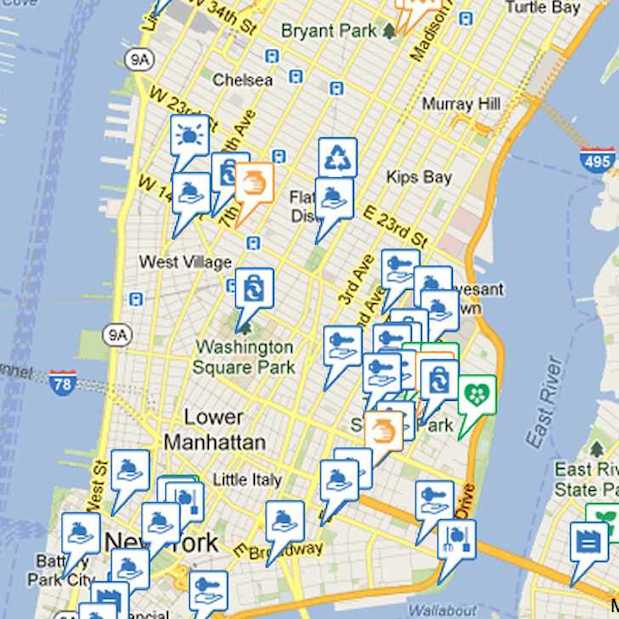
A new project called the “Less = More NYC” Green Map is a great guide for finding your way around America’s largest city using minimal resources. The map, available in print or online, shows a variety of locations–ranging from tool-shares to composting drop-off sites to fixer collectives–that help you reuse, share and upcycle your way around town. The map also has many other searchable sites such as cultural centers, nature sites and even toxic areas (the latter presumably to avoid).

According to a press release for the map, NYC spends $300M carting 600M tons of trash, often to places as far away as Virginia and Ohio. The sites on the map were selected as spots to help reduce both the expenditure of money and resources. “Beyond just shopping at thrift stores and recycling your discards, we New Yorkers have great opportunities to reduce our impact on the earth by taking what would otherwise be going to a landfill and finding a way to give it new life and a new worth,” said Aaron Reiss, the map’s designer.

The map is great because it illuminates the resources that are all around us that might help us live simpler, lower impact lives, but might otherwise go unnoticed.

For non-New Yorkers, the Open Green Map has almost 31K green sites around the world and is available online or as an iPhone app. Both the Less = More NYC map specifically and the Green Map in general demonstrate the power to technology to help save resources.

One question we have is why the “Less = More” Map is available as a print copy at all? The paper version has a mere 13 sites versus the online version’s 150 and counting. Considering the ubiquity of smartphones, one of the first ways of cutting waste might have been to not make a paper map (it is made of 100% recycled paper). Big, foldout maps seem to be going the way of the phonebook…but we digress.

Find pick up locations for the print version at www.facebook.com/Less.is.More.NYC. Or send a SASE to Less = More Green Map, 220A East 4th St., NYC 10009 for a print version.

Citi Bikes Invade New York City

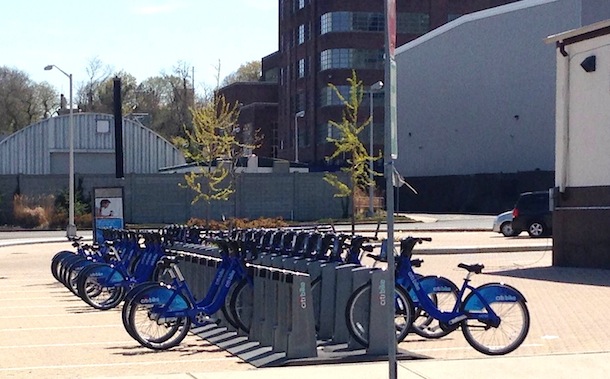
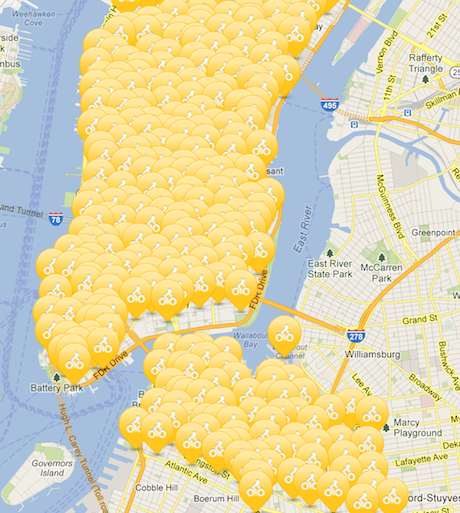
Last year we reported about the Citi Bike public bike program in New York City. We were excited for its unveiling in July…last July that is. Unfortunately, some technical issues (keeping track of the initial 6K bikes across their 300 stations can’t be an easy) and a little hurricane delayed the program. Well it’s finally here, and the distinctive blue bikes can now be seen throughout Manhattan and parts of Brooklyn.

citibike-map

We applaud Citi Bike for making a pricing scheme that is both New Yorker and tourist friendly. Locals can pay $95 for a yearly pass which permits unlimited <45 minute rides. Not-so-locals can pay either $9.95 for 24 hours or $25 for a seven day pass, which permit unlimited <30 minute rides for the length of the pass. Overage charges apply when those time limits are exceeded. This pricing scheme seems to denote that Citi Bikes are actually meant for transportation, not merely joyrides around Times Square–i.e. get on, get to your location, leave bike.

citibike-brooklyn

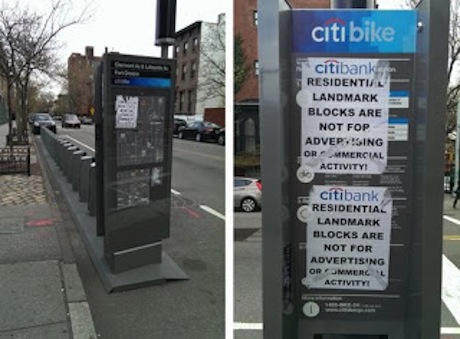
The introduction of the program is not without controversy. In particular, residents of the historic Fort Greene and Clinton Hill neighborhoods of Brooklyn have taken issue with the fact that Citi Bike stations act as big billboards for Citigroup, the chief sponsor of the program. Some critics have also warned of the potential for vandalism, similar to that Paris’ Vélib’ program initially received.

earth-policy-bike-sharing

That said, more than a few people–bicycle advocacy groups included–are expressing their approbation of the program, which plans to expand to 10K bikes across 600 stations. In fact, the first round of memberships, capped at 5K, sold out in 30 hours. And as a trend, public bike programs are only on the rise, as the above charge by Earth Policy Institute indicates.

While having your own bike is great, public bike shares provide something else. As Bikesnob NYC ever-so-succinctly put it: “I already own a toilet too, but it’s still more convenient for me to use a different one when I’m not at home.”

More info at Citi Bike’s website

Would You Pay $400/Month for All of Your Transportation Needs

The Downtown Project is an ambitious project going up in Las Vegas’ old downtown area. Helmed by Tony Hsieh and the Zappos corporation–for whom the area will serve as their new corporate campus–the area is being designed to embody the ideal urban conditions to produce a global innovation capital to rival Silicon Valley. They are carefully condensing housing to be 100 people per acre–perfect for serendipitous encounters that spark innovation. They are providing a large startup fund to attract the best minds from around the globe. And now they are adding a transportation scheme that may point to how we get around in the future.

For about $400 a month, Project 100 will provide on demand transportation, matching subscribers with several different transportation alternatives depending on their needs in the moment. From Project 100’s website:

Project 100 is the code name for a complete transportation system designed to let you get rid of your car and be more connected to your neighborhood. It includes on-demand cars with drivers, shared cars you can drive yourself, bikesharing, shuttle buses and more. The experience is simple: open an app so we know where you are and tell us what zone you want to travel to. With that information we’ll give you a set of options, for example, 1 – Be picked up by a driver in a Tesla in 3 minutes, 2 – Drive yourself in a low range electric vehicle that’s 0.2 miles away, 3 – Grab a bike that’s 0.1 miles away or 4 – Hop on the party bus that will be near you in 4 minutes.

Similar to the architectural idea of using transforming spaces to provide space when you need it and not when you don’t, Project 100 wants to match your transportation need with transportation conveyance to optimize efficiency. For example, if you need to cruise on the highway, use one of their Tesla 100s; if you need to go a mile, use a bikeshare bike; if you need to barhop, use a shuttle; and so on.

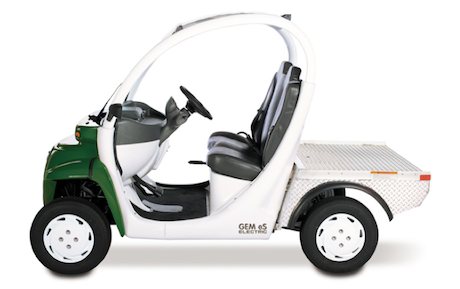
One of those transportation alternatives they allude to are “low range electric vehicles” such as the Polaris GEM (pictured below)–a tiny EV that handles quick trips to the grocery store more efficiently than the Tesla.

polaris-gem

The project has some technical challenges. They need to create an infrastructure for charging the EVs; they will provide a hub for vehicle storage and charging, but the nature of the system would make leaving the cars anywhere the ideal. There is also the substantial technology necessary to distribute vehicles so everyone in the system has what they need 100% of the time. The project wants people to get rid of their cars, and in order to do so they need a system that rivals–or perhaps bests–the convenience of traditional car ownership.

All these challenges included, we applaud The Downtown Project and Project 100. It’s an earnest effort at curbing the inefficiencies inherent in America’s current transportation landscape, where large SUVs are routinely used to pick up a half-dozen cupcakes because that’s the one vehicle its owner has immediate access to.

The limited range of the Downtown Project provides a nice laboratory to work out the inevitable kinks–as well as a forward-thinking, forgiving constituency. And $400 for all your transportation needs (insurance, fuel, etc are included), while more money than biking around the city, is pretty comparable in terms of cost to car ownership, and the system has a number of benefits car ownership does not.

via CNET

Love Thy Neighborday

The average American moves 11.7 times in a lifetime. One out of six Americans move once a year. This high mobility may have turned the institution of neighborly relationships from marriage to long-term dating or even brief fling. This situation was verified by a Pew Study that found fewer than half of Americans know most or all of their neighbors.

Neighbors are good (at least the ones that don’t blast music at 2am). They feed our cats, lend us ladders and cups of sugar and provide easy companionship. A strong tie with a neighbor is worth 1000 Facebook friends on the black market. But it’s tough to love our neighbors when we don’t even know them.

The good folks over at Good Magazine have a remedy for this neighbor deficit disorder: It’s called Neighborday. On April 27th, they challenge all of us to get to know the people closest to us (geographically at least). They explain the motivation:

…While the internet age, has brought unprecedented access to information, networks, and commerce, it’s unclear if it has brought us closer or has in fact further isolated us…Neighborday is about creating a new story. It’s about transcending the old story of self to create a new story of us. It’s about expanding our definition of self to include those who live above us, below us, and next to us. It’s a call to action of the most important kind: to let our neighbors in, and to build more self-reliant streets, blocks, and neighborhoods, together.

We know you’re busy. We know you already have lots of friends that you have trouble keeping in touch with. Worst of all, we know it’s awkward introducing ourselves to the people closest to us–especially if we’ve lived someplace for a while. It might take a little courage (remember, they haven’t introduced themselves to you either, so the shyness is probably mutual).

But really? If we don’t know our neighbors, if we can’t knock on their doors when we need a favor, consider there might be a gap in our social lives.

Visit Good’s Neighboring homepage to take their pledge. They also provide ideas for celebrating Neighborday, like turning your home into a parttime restaurant. If we don’t know our neighbor’s name, we’re probably best off starting small, like introducing ourselves in our hallways, driveways or sidewalks instead of giving our usual “what’s up” or “how’re you doing.”

Are you tight with your neighbors? Beside basic friendliness (always the easiest tactic), how have you cultivated relationships with your neighbors? What advice would you give those of us who are strangers to our neighbors?

Why Your Office Will Disappear

If you’re like most people, you probably work in a large office building alongside colleagues who, much of the time, are away from their seats in meetings, at lunch or traveling for business.

Driven by a global recession, an emerging sharing economy, a more mobile workforce and concern about climate change, COOs, entrepreneurs and other business leaders are looking for ways to make office spaces more efficient. Paying high real estate costs and electric bills for people who use their space 30% of the time doesn’t make good fiscal or environmental sense. For these reasons and more, a drastic change is underway that will make the traditional office as you know it disappear.

Where Will You Work?

Collaborative work spaces everywhere are defining themselves as “coworking spaces,” or workplaces that are shared, fostering productivity, community and collaboration. Good for startups, freelancers, independent workers and entrepreneurs, the trend is growing exponentially. According to Deskmag, the number of coworking spaces has increased 200% annually for seven years. The Global Coworking Unconference Conference (GCUC) convened this month, sharing new strategies for the future.

What Your Office Will Look Like

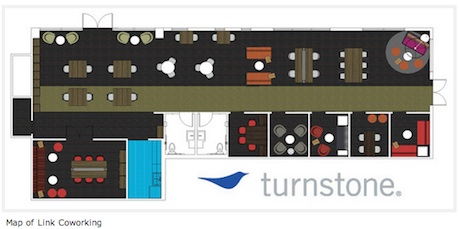
The architectural silos that separate departments will erode. You will know more about what’s happening in other areas of your organization. Open plans will create cafe-like atmospheres and promote creativity and transparency. Office layouts will be more structured for liquid, easy work.

link-coworkiing

New workplace tools like Flockd, unveiled at GCUC, will help people across departments start conversations while increasing productivity.

flockdFlockd offers a new system for people to signal whether they’re free. The available, “Lets Flock,” signal encourages coworkers to interact and connect, while the, “I’m Busy” signal sets clear, healthy boundaries. Better work flow means more free time.

Less Stuff, Less Overhead

Sharing an office means the stuff you need, but hardly use, is also accessible to 100 other companies who share your space. One paper cutter for 100 companies instead of 100 paper cutters. And it means the usual overhead, like rent and heating bills, is split among them too.

Proximal Innovation

FastCompany recognizes the serendipitous, positive function of proximity stimulating innovation. A recent study found “the best, most-widely cited research came from coauthors sitting less than 10 meters apart. ‘How closely they worked mattered as much, if not more, than their affiliation,’ says the study’s author, Isaac Kohane of Harvard Medical School. Coworking’s combination of casual relationships and shared spaces, he suggests, can lead to some of an employee’s most fruitful collaborations.”

OfficeEdited = Smarter Business

As big business comes aboard the coworking revolution, the triple bottom line gets better. American Express recently lowered its carbon footprint by 27.5 percent, citing a decrease in business travel and the creation of centers for virtual meetings. Widely recognized for championing economic development and entrepreneurship is Zappos CEO Tony Hsieh, championing Las Vegas and its Downtown Project to become the coworking capital of the world.

league-of-extraordinary-workspaces

The League of Extraordinary Coworking Spaces (LEXC) has become a resource for such corporations expanding their workplace strategy. The organization’s first corporate customer is Accenture. Good for mobile workers, LEXC offers a new work solution for larger companies.

“Facilities plans have been kept too separate from business plans for far too long,” says Brian Macmahon of Your Office Agent, a commercial agency specializing in leaner work space. “Forward-thinking companies of all sizes are exploring these new models.”

Disclosure: The contributor Marissa Feinberg is the shared office space owner of Green Spaces NY, upcoming member of LEXC, cofounder of Flockd and attends GCUC.

6 Future Blue Chip Companies in the Sharing Economy

A recent article in Forbes called “Airbnb And The Unstoppable Rise Of The Share Economy” gives a great overview of the nascent sharing economy. It tells stories of people like Frederic Larson, who brings in $3K/month renting his home to Airbnb and his Prius through Lyft, or Dylan Rogers, who makes $1K/month renting his BMW out and plans to buy a couple extra cars to make his own micro-rental car fleet. It explains how more and more average people are making and saving dough through resource sharing.

The article is a worthwhile read as it gives a balanced look at the opportunities–the millennials growing receptivity to renting and sharing versus ownership, a southbound economy–and challenges–getting people to share low-cost goods, restrictive commercial regulations–facing the sharing economy

The article also turned us on to a number of sites we didn’t know about. Stahlwarts like Zipcar, Zimride, Neighborgoods and Taskrabbit appeared in the article, but so too did some newer, more specialized sites. Here are a few of them:

  • Parking Panda is a peer-to-peer parking garage. Rent out your vacant parking spot as you would your unused room for Airbnb. PP also allows booking standard garage parking, using their mobile app.
  • Dog Vacay is like Airbnb for dogs. Give your dog to “one of thousands of vetted and insured dog lovers” when you leave town (or need a reprieve from your pooch) for “cage-free” boarding starting at $15/night.
  • EXEC is an on-demand cleaning and errand running service with a lovely web interface. An added bonus is that they use all organic cleaning products.
  • Liquid is a peer-to-peer bike rental service. Rent a bike for $20/day or let your bike out for some extra cash (note: the site is down for the winter).
  • Fon is an international peer-to-peer wifi network with over seven million Fon Spots (aka hot spots). Private wifi providers can make money off people accessing their signal.
  • Zaarly allows you to sell your homemade cookies and other shippable custom goods.

Most of the services seem to have a Left-Coast bias, though ones like Fon and Zaarly have national appeal. And of course, as the article mentions, Airbnb started in San Francisco and can now be found in Peoria, Il. You gotta start somewhere.

Do you have more sharing sites we should be looking at? Let us know in our comments section.

Image via Shutterstock.com

Fit Your Next Car into Your Phone

DriveNow is a car-sharing program launched by BMW and European car rental company Sixt that allows you to locate and rent the nearest car within a given city’s limits via its website or mobile app. What sets DriveNow apart from other car-share services is you don’t need a reservation and you can park and leave the car anywhere you want rather than returning it to a home garage. You could rent a car for 20 mins to drive to work, end your rental, stay at work for eight hours, and rent another DriveNow car to go home.

This flexibility contrasts to services like ZipCar, which require you to make a reservation for a set amount of time and return your car to a specific garage (penalties fees are applied if you don’t return the car by the end of your period).

The service is BMW’s attempt to future-proof itself from the changing nature of car usage and ownership. With car ownership decreasing and urban-living on the increase, having a car that does 150 mph on the autobahn and is parked in your suburban garage will become increasingly irrelevant. Tomorrow’s driver will need a car that can handle 25 mph around town and be easily parked.

bmw-i3

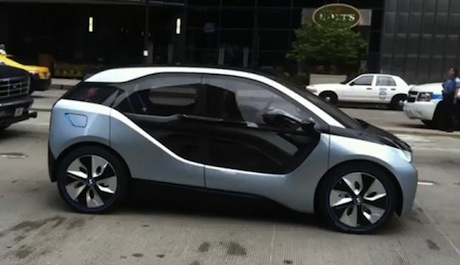
DriveNow is also connected with BMW’s upcoming i3 electric vehicle (pictured above), which is the company’s first EV geared specifically to city living. In the future, DriveNow will be connected to charging stations around a city for low-emission temporary urban transit.

Here’s the rub: DriveNow is almost exclusively in Germany, with locations in Munich, Berlin, Dusseldorf and Cologne. Currently, their fleets are internal combustion engines, which enables the flexibility of returns (i.e. you can park on the street rather than finding a charging station). Rates are €29 cents/minute for driving and €10 cents/min for parking. These rates include parking and gas; fuel levels are visible when you book your car. DriveNow also includes on their maps proximity to bike share stations.

They have one US location in the Bay Area, whose fleet is made up of BMW’s ActiveE, an all electric version of their 1 Series car. Because of the need to charge, you need to return the cars to one of the designated garages, though not necessarily the one where you picked the car up. All stations are located near BART stations. Rates are $12 for the first half hour then $.32 each additional minute and $90 for the day. There is a one time $39 registration fee.

Ideally, a service like DriveNow would be brand-agnostic–i.e. not attached to a particular carmaker. But we find the idea of on-demand, restriction-free car sharing pretty exciting. Imagine being able to rent any car parked on the street whenever you want. While the per drive expense is surely much greater than car ownership, the lack of overhead and flexibility seems well worth it. And with bigger fleets and costs spread out over more members, the per drive cost would likely go down while available cars increase.

via Metropolis Magazine