Airbnb: Changing How and Where People Stay When Away

Several of the LifeEdited team are based in large cities like New York and Seattle, and unfortunately we are cursed with those great city’s myopic worldviews. There are certain things we deal with that we assume everyone deals with, like $2K/month studio apartments, locating reliable public restrooms and knowing cheap places to stay for guests when your place is too small.

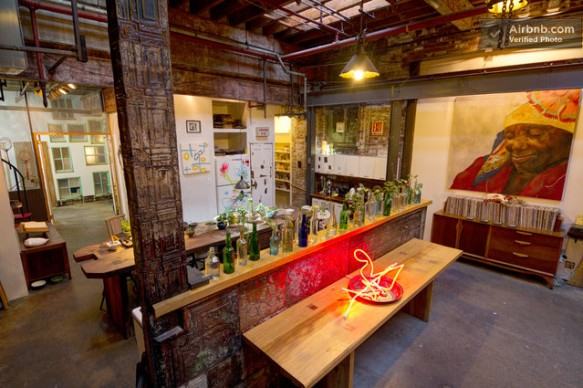
For that latter topic, the last few years have seen a revolution in guest accommodation with Airbnb. The company calls itself a “community marketplace for people to list, discover, and book unique accommodations around the world.”

The company, founded in 2008 in San Francisco, lets you book rooms in peoples’ homes in 26K cities and 192 countries, often paying a fraction of what you would in a hotel. Conversely, you can rent out your space to earn some extra money.

Beyond the savings, you can book spaces far more interesting that standard hotel fair–like a cave house in Granada Spain for $63/night (above) or a houseboat in Paris for $125/night. Funny enough, you can rent the 1 Sq Meter Home we covered the other day for $12/night in Berlin. On a more conventional note, you can rent rooms in places like New York City–where average hotel rooms are in excess of $300/night–for less than $100/night.

Airbnb makes money by charging hosts a 3% processing fee and guests a 6-12% service fee (more expensive stays have a lower fee)–nominal expenses compared to a hotel’s overhead charges. Their website provides reviews of hosts and their accommodations, as well as profiles of guests to protect hosts. There are numerous safety measures in place, such as $1M coverage for theft or vandalism for hosts. Their system also allows you to network with your friends, so you can exchange information about various stays from people you know.

Airbnb does require a couple extra hoops to jump through over a conventional hotel, like waiting 24 hours to confirm a reservation and you often have to coordinate a key exchange, so it might not put the hotel industry out of business just yet. That said, it creates a far more affordable, interesting and intimate way to house yourself when you’re away from home.

10K Public Bikes Coming to NYC in July

In July, New York City will add its name to the many cities that have public bicycle programs. The Citi Bike program will feature 10K bikes in 600 docking stations around the city, making it the largest such program in the US (the name comes from Citibank, who gave $41M in sponsorship money).

You can either rent bikes by the day, week or sign up for a yearly membership; prices are $10, $25 and $95 respectively. With the yearly, you receive unlimited sub-45 minute rides with nominal charges when that time is exceeded.

Programs like this have been going on for years across the US and the world. Paris has 20K public bikes, London 9K, Montreal 5K, Washington DC 1500 and Hangzhou, China has a whopping 60K+.

Public bikes are ideal for city-dwellers who need to get somewhere quick. The bikes’ upright position and grease-less configuration make them business-attire compatible. They also cover the spaces not covered by public transport. Most importantly, they make biking more accessible and acceptable to larger swaths of the population. They are, as Treehugger puts it, “cycling’s gateway drug”–once you start, you can’t stop.

Do you or have you used a public bike? What was your experience. Let us know.

Via Bloomberg and Treehugger

8 Tips for Editing Your Life that Work for Any Budget

Yesterday we featured a story about a $275 DIY murphy bed to show that an edited life is by no means for people rich enough to choose less (rather than having less imposed upon them).

Let’s be clear: excess is far from a rich man/woman’s dilemma. Watch an episode or 2 of Hoarders for proof. Cheap housing and consumer goods have made virtually every socioeconomic bracket victims of excess…and crippling debt. The average American household carries $16K of credit card debt!

And sure, we love great architecture and product design–much of which has a steep buy-in cost–but there are infinite things you can do for little or no money to start living an edited life. Here are 8:

  1. Edit your possessions. Go through your closets, drawers, file cabinets. A good rule of thumb is if you haven’t used something in the last year, you probably won’t use it in the next. Toss it, recycle it or, better yet, give it away, get a receipt and use it as a tax break. Is your stuff too expensive to give away? Sell it and make some money.
  2. When you do buy, buy high quality stuff you like and will use. Okay, so this might sound a bit contradictory, but sometimes the way to save money is to spend it. How many times have you skimped on a purchase, buying the inferior thing you don’t like because the high quality one you did was twice as expensive? Then the inferior things breaks, doesn’t get used or becomes the unwanted child of your possessions. If something is 2x as expensive and lasts 4x as long (or is used 4x as much), that’s half the price of the cheaper thing.
  3. Get rid of your books. Few things take up space like books, and eReaders have come a long way, and dropped way down in price; e.g. Kindles start at $79 and have thousands of free titles. Want something cheaper, download a free Kindle app that allows you to read on your phone or computer.
  4. Get rid of paper. Switch all of your bills and statements to online only (put them on autopay if possible). Scan receipts. Work on completely digitizing every form of receipt, bill, statement, etc. This save paper and clears clutter for no additional cost.
  5. Take a walk. We don’t think about cars taking space, but they do–a Honda Civic sedan takes up 85 sq ft. of it. Cars’ collective footprints increase the size of our homes and cities. This is not to mention the ongoing money and stress of things like gas, insurance, upkeep, etc. Few things simplify your life–and save money–like ditching your car. While we know it’s not feasible for many to do this, if you’re moving, consider a place where you can walk, bike or use public transport to the various activities in your life: work, groceries, etc. Your health, planet and pocketbook will thank you.
  6. Get some budget transforming furniture. Sure, it’d be great to have an unlimited budget for furniture, but few of us have that option. There are countless folding tables, sleeper sofas, folding chairs and affordable DIY options that can add tons of utility to a small footprint.
  7. Try a sharing system. Maybe you’re having a baby, try a toy-sharing system. Maybe you need to use a car once or twice a month, use a Zipcar. Maybe you have wedding to go to, rent your dress or tux. Why pay full-time salaries and overhead charges for the stuff you only need to perform part-time duty?
  8. Consider moving into a smaller home. When moving, think about what you really need and trim at least 20%. The amount of stuff we have is not a fixed thing–it expands and contracts depending on the amount of room it has to occupy. Smaller spaces are cheaper to buy and rent, easier to maintain and have built-in safeguards against accumulating too much stuff, and when laid out right, can have all the utility of a much larger space.

image from fopple.com

Walkscore.com Helps Locate Your Walkable Future Home

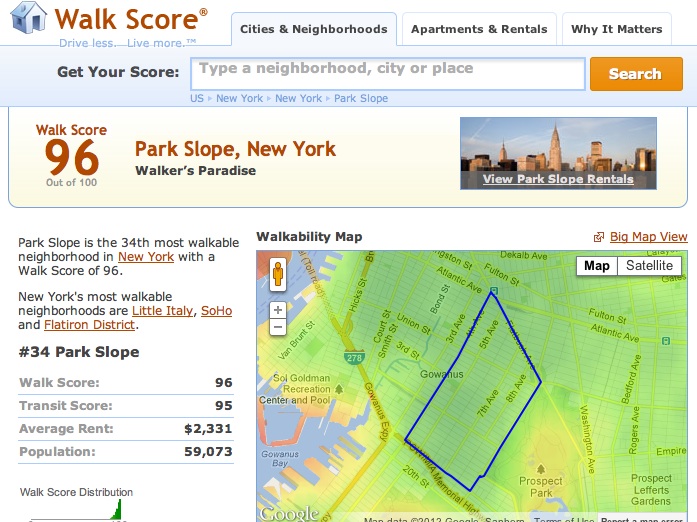
If you want to know the best places to live for simplifying and editing your life, check out walkscore.com. The site evaluates locations around the country for their walkability, using a scale of 0-100.

What’s unique about the site is that it breaks down scores by neighborhood, which often have very different profiles than their cities. The site lists average rents and other important demographic info to get the full picture of a place. This detailed information allows visitors to make highly informed decisions when comparing different locations. For example, I live in “walker’s paradise” of Park Slope, Brooklyn, which has a score of 96; but the average rent in my neighborhood is a discomfiting $2300. I can compare that to Minneapolis, whose overall walking score is a paltry 69, but whose Downtown West area is a competitive 91 with average rents of $1500. Hmmm…

Walkscore is mostly a real estate search engine, where you can look for properties based on your desired commute time. The site shows a Google-map highlighting all of the amenities in an area, including LifeEdited staples like car-sharing garages (info valuable for anyone). There are several other filters which allow you to find your ideal spot; for example, you could say you want to be within 10 mins of a swimming pool. The site finds the pool and all of the properties within walking distance of it.

Here are few other compelling benefits the site lists for choosing a walkable area:

  • Health: The average resident of a walkable neighborhood weighs 6-10 pounds less than someone who lives in a sprawling neighborhood.
  • Cities with good public transit and access to amenities promote happiness [citation].
  • Environment: 82% of CO2 emissions are from burning fossil fuels. Your feet are zero-pollution transportation machines.
  • Finances: Cars are the second largest household expense in the U.S. One point of Walk Score is worth up to $3,000 of value for your property.
  • Communities: Studies show that for every 10 minutes a person spends in a daily car commute, time spent in community activities falls by 10%

Have you used Walkscore.com? If so, let us know what you think or if there are other resources we should know about.

Thanks for the tip @noncellulose

Prêt-à-Louer: How to Get Your Couture by the Hour

Do you have a big occasion you want to look awesome for? Do you have limited closet space and/or budget? Are you incapable of wearing tacky, store-bought clothes? If your answer is yes to one or more of those questions, Rent the Runway might be for you.

RTR offers women the chance to rent from a rotating stock of top designer collections and accessories for a fraction of sales price. For example, a $1600 Missoni dress rents for $175 and a Kate Spade clutch rents for $40. Other designers include Elie Tahari, Vera Wang and countless labels that are so prestigious we don’t recognize their names (there are also many lower price point options too).

Because you only have a RTR dress for 4-8 days, the site helps reduce clutter that would come from clothes that are often only used once.

As there are some inherent limitations to “trying” a dress online, RTR sends a backup size with every order. If those don’t work, they’ll overnight you something else. If you need some help choosing, you can chat with one of their stylists.

The site also allows past renters to review dresses, saying whether they ran small, big or true to size, as well as commenting on how they fit their bodies (they state their body size for comparison sake).  Some renters even post pics of the dress in action.

RTR might be doing the impossible: i.e. making $1000+ wear-once dresses compatible with an edited life. What do you think? Are those things mutually exclusive or can ultra-lux items work with an edited life?

Edit Your Child’s Stuff with Toy Rental Services

Are you a parent who feels there just aren’t enough toys around your house? Does your child hate novelty, contenting his or herself with one or two simple toys? Do your child’s toys make your house into a model of order and harmony?

We didn’t think so.

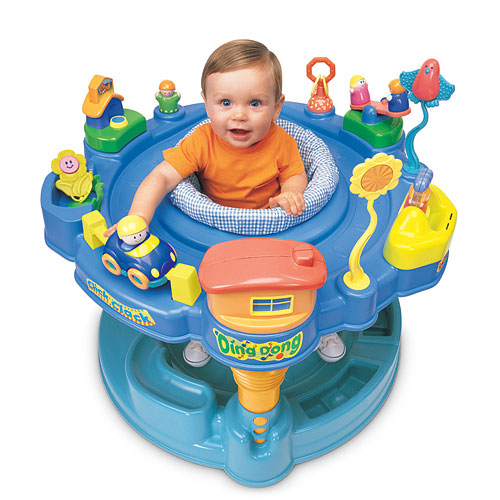
Online toy rental companies like BabyPlays and Toyconomy have a solution. Here’s how they work:

  • Choose toys from their databases–kinda like adding movies to your Netflix queue.
  • Rent as you go. BabyPlays rents individual toys from $3 to $11/month. Toyconomy from $3 to $35/month–the latter price is for a LeapFrog LeapPad tablet computer (who knew?).
  • Or subscribe. Babyplays allows you to rent 4 toys for 60 days or longer for $25/month. Toyconomy’s $10/month subscription takes 50% off their toy rentals.
  • Hold onto toys for a month or for as long as you want.
  • Return toys and get a new shipment. Shipping costs are included.

Both companies take pains to let us know that their toys are rigorously cleaned and in good condition. Both offer a rent-to-own option; if your tyke doesn’t tire of a toy in a couple months, you can buy it at a discounted price.

Beside saving money, these services let kids enjoy their new toys without piling onto the mountain of old ones–a problem for almost every parent I know. What if your kid’s room could look like a haven of fun and order rather than a war-zone?

The one big challenge we see is getting grandparents and extended family on board. One Christmas-giving session can undermine months of editing.

Have you used these services? Would you? If not, why not? Let us know what you think.

Image via productreview.com.au

Take Your Neighbor’s Stuff Without Getting Arrested

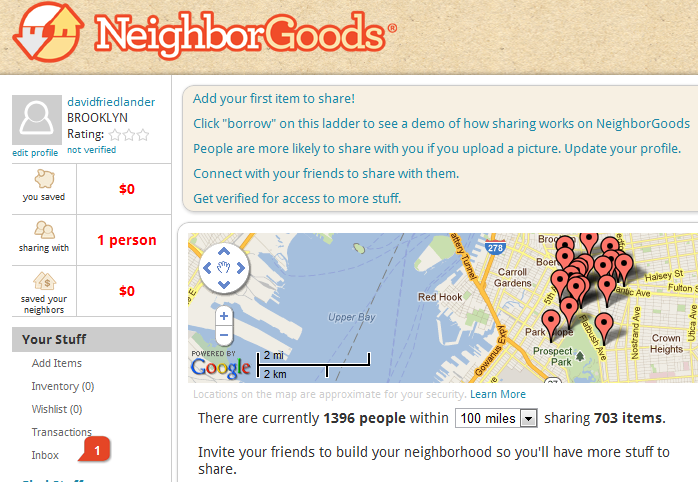
screenshot via neighborgoods

Long ago people didn’t have a lot of personal possessions. Not everyone had their own power-drill, cookie pans or tripod. And because the nearest Target was 30 years away, rather than not assembling that desk, eating raw cookie dough or shooting blurry shots, people used the only store around: their neighbors.

Well those days might be upon us again…but better. Rather than bugging your neighbors, services like NeighborgoodsSnapgoods and Share Some Sugarconnect you online with people in your area who have the stuff you need. Neighborgoods is free and has a pretty deep inventory of stuff (for our Brooklyn-based author at least); I found a Wii, a glue gun and a cat carrier–all things that might come in handy once in a while, but hardly necessary all the time. Share Some Sugar charges a nominal rental fee for household items, while Snapgoods focuses on high-tech gear; e.g. I found a CAD M179 Large Diaphragm Studio Condenser Microphone with Shockmount (Continuously variable pickup pattern!). I have no idea what that is or does, but am sure $9/day is a good deal.

We live in an age of abundant and cheap consumer goods. So much so that we end up buying stuff we don’t really need. But as Dave Bruno put it,”Stuff is not passive. Stuff wants your time, attention, allegiance. But you know it as well as I do, life is more important than the things we accumulate.” With aforementioned sharing systems, you can have the stuff you need, but only when you need it, allowing us to focus on other, more important stuff.