Clear Hurdles to Sharing with Yerdle

Yerdle is a new website and mobile platform that allows easy sharing and giving of common items. The idea is very simple: We want or need stuff, the people we know have the stuff we want or need, often unused. Yerdle enables you to get that stuff either to borrow or keep. That’s about it.

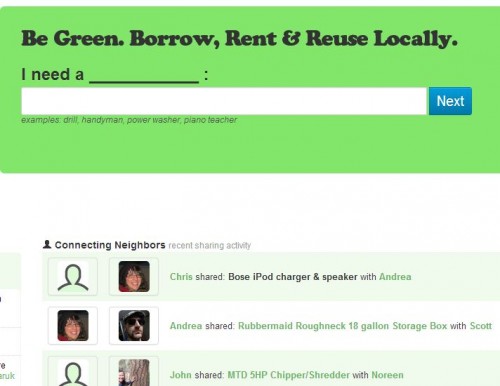
Yerdle is connected to your Facebook account. You and your friends post pics of the stuff you’re willing to give away or lend. You can post what you’re looking for and peruse offerings from other yerdle members on their site, Facebook timeline or iPhone.

Yerdle has an impressive team behind it and a lofty mission:

Co-founded by Adam Werbach, former President of the Sierra Club and Founder of Saatchi & Saatchi S, Andy Ruben, former Chief Sustainability Officer and head of Global Strategy at Walmart, and Carl Tashian from the founding team of Zipcar, yerdle was created to offer a sharing marketplace that provides an easy way to reduce consumer waste associated with buying items new. With Americans throwing away an astounding 31 million tons of plastic each year, packaging for new gifts over the holidays will clutter even the neatest home. yerdle’s mission is to reduce 20% of the things people buy through sharing, collectively protecting precious ecological resources.

We asked Adam Werbach a few questions about yerdle specifically and sharing systems in general–about how to get started and how sharing can compete with cheap consumer goods.

LE: What makes yerdle different from other sharing sites out there?

AW: Before supercenters and Amazon.com, the obvious place to get something you needed was from a friend or a neighbor. Need a shovel? Ask a neighbor. Kids need new shoes? Check with the cousins. In the last hundred years though, retail has become hyper-efficient, and it has become easier to buy something new than to borrow it or find it from a friend. Our goal with yerdle is to flip that on it’s head, and to make it easier and more fun to get things from your friends. Here’s how it works, you connect yerdle with your Facebook account and snap a few pictures with your iPhone of items you might be willing to share. Have a baby stroller you don’t need any more? Or an extra thermarest? Yerdle allows you to post items to either give or loan to your friends. The average person who logs on finds about 300 free items from their friends that are immediately available to them.

LE: How do you think technology is changing the face of sharing?

AW: Although sharing has been around forever, we’ve never really applied the advances of software to the sharing economy. The thing that you’re thinking of buying right now is probably sitting unused, and perhaps unwanted, in a friend’s closet or garage. The goal of yerdle is to float that information up to you when you’re considering a new purchase.

LE: How can yerdle compete with an abundance of cheap consumer goods–when it often seems easier to buy something from amazon that it does to browse through a site?

AW: The great thing about sharing is that it saves you money, it builds community and it saves natural resources. That’s a hard set of benefits to beat. Our challenge is to grow the community of folks who are willing to check in with their friends before they give something to Goodwill or buy something on Amazon. It’s not right for everything, but chances are you can save about 25% of the money you’re spending now on durable goods.

LE: What’s the best way to get started if you’re not actively sharing or if there is little sharing going on in your region?

AW: The best way to get started is to take a few photos of items that you are ready to part with. Put them up on yerdle and share them with your friends. You’ll be amazed at how quickly people start talking about what you’re doing. We’ve found that people are as interested in the social relationships as they are in getting something physical. It’s a good excuse to connect with old friends and to help folks.

Couchsurfing.org: Matching People, Couches Across the Globe

Are you someone who loves to travel? Do you love to meet new people? Does a comfy couch sound like a good place to crash? Then Couchsurfing.org is for you. The URL says it all: It allows people to offer and use each others couches, providing a low/no-cost alternative to hotels, hostels and Airbnb. Over its nine year history, the site has built a user base of 5M users across 97K cities.

Rather than mere cheap accommodations, their mission is, “Creating inspiring experiences.” The idea is that there’s a very different experience of a place when you’re crashed out on someone’s couch versus staying in a self-contained room for rent. Hosts often show guests around their cities, host meals and do other things that can give a very authentic sense of place.

What about safety you ask? They have three ways of dealing with safety. First, people can get personal references, sharing what it was like to host, or be hosted by a person. The site offers credit card verification, making sure that a person is who they say they are and lives where they say they live. Lastly, people can “vouch” for one another, whereby a person is recommended by someone who is “extremely trusted by someone who has been vouched for by three other members.” Below is a little video further explaining the process and motivation behind the service.

The site does not charge anything aside from the verification process. This might change soon following the company’s recent controversial move to become a for-profit B-Corporation. It’s not clear how this will affect costs, though it’s reasonable to say it will remain a very low-cost way of finding a place to crash.

Have you used Couchsurfing? What was your experience? Would you use it? Why or why not?

via Unstash.com

image credit: brianthacker.tv

Ever Want Your Own Restaurant? Here’s Your Chance

We’re loathe to call things the “Airbnb of…” dog-biscuits, chessboards, whatever. We are sure peer-to-peer marketplaces have a prelapsarian past, but few enterprises have made purchasing services from your friends and neighbors as easy as Airbnb. So unfortunately, we have to designate a great new venture called Feastly the, ahem, Airbnb of restaurants.

Feastly allows chefs and gourmands to transform their homes into their own restaurants without all that overhead and investment of a traditional restaurant. Conversely, it allows diners an alternative to the traditional restaurant.

It’s pretty simple: As a chef, you register on Feastly’s site. You determine the menu, the price, the date, how many feasters you can handle, etc. Feastly fills the seats, handles money and takes a modest administrative 12% cut.

As a diner, you browse and sign up for dinners in your area (right now, their main markets are Washington DC, NYC and San Francisco). More than just a restaurant, the Feastly experience awards diners with home-cooked meals and a unique social experience, or as Feastly cofounder Noah Karesh put it, “The dining table is the optimal social network.”

We’ve been using Feastly chefs to cater the LifeEdited dinner parties and are very impressed with the quality of food and service.

We asked Mr Karesh some other questions about how Feastly started and how it works.

Why did you start Feastly?

Feastly came from my travels to Lake Atitlan,Guatemala. I was struck by my inability to find authentic, local food there and convinced a local to invite me over for dinner. Sitting around his family’s table, I had my “a-ha” moment realizing that it shouldn’t be so hard to eat local food and meet people when traveling. Feastly was born over Start-Up Weekend DC in November 2012 and a year later, we’ve hosted hundreds of meals for thousands of Feasters. One of my many goals with the platform is to bring Feastly to Lake Atitlan.

Do you know ahead of time what will be served? Can you make requests?

Yes, our chefs post menus online ahead of time so that Feasters can search for their favorite dishes or chefs. For those with food restrictions, our chefs do their best to cater to any food issues. Thanks to our feedback forms, chefs can receive immediate feedback on their meals and get ideas from Feasters for future meals and how to improve the overall user experience.

How much do dinners typically cost?

Our meals range from ice cream tastings to brunch to seven course dinners and may range from $5-200 with the average meal costing $38.50 [booze is sometimes, but not always, included in price.]

Do you think your approach could replace going out to a standard restaurant?

Yes, but even more than just replacing people’s reliance on restaurants to “eat out,” we are increasingly serving as a social network for our Feasters. Our users come for the food, but increasingly stay due to the positive relationships they are building around the dinner table. We’ve helped to introduce couples, business partners, friends and activity partners over meals.

What about markets you don’t serve yet? How can people get involved?

We’ve been excited to see so much positive feedback in NY and DC and soon SF, and we get emails daily from people around the world encouraging us to open in their cities. Like our peers at Airbnb, we are eager and working to expand globally, so that we can bring the best of Feastly everywhere. We are also eager to bring on more chefs, and like to work with local partners eager to bring Feastly to their communities. We’re always open to new ideas and partnerships and it’s best to reach out at info@eatfeastly.com.

Collector of Moments Has Lots of Storage Space

Each week we are profiling real people who are editing their lives for more freedom and happiness. This week we hear from Lucy, a grad student and an active proponent of a new, sharing-based economy and showing how we can all do and live more with less stuff.

Tell us about yourself

I am a 21 year old business school graduate from Toronto, Canada. I work at a Canadian telecom company and for a start-up organization called Unstash, a peer-to-peer platform for collaborative consumption. I am a strong believer in creating social change through sharing and collaborative living.

What makes your life an ‘edited’ one?

I don’t feel the need to be obsessed with stuff anymore. I used to be a mindless shopper, but then I learned about access over ownership, the idea that we don’t need to own everything, in fact, we don’t need stuff, we need the utility it provides. If we can get that utility through sharing, we can also save money, create less waste, deepen our relationships and live happier lives.

Before, I used to dream of having a large library filled with books. But during my editing, I realized that a book sitting idle on a shelf has no purpose. I thought to myself, do I really need to own this book when it’s available to me at any time from the library? This prompted me to donate over 40 books to my local library. I felt great knowing each book could get maximum utilization as more people now had access to them, allowing their content to be constantly shared.

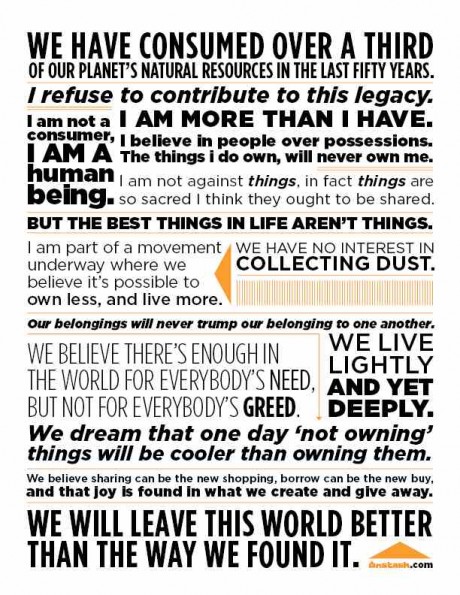
the Unstash Manifesto

Now, before I buy anything, I think to myself, do I really need this? Can I borrow it from someone else? For example, I borrowed a Halloween costume from a friend rather than buying one that I would only use once. And on the flip side, I am always open to lend or give my things to others. Sharing is a part of my life editing. Once I gather all the things that I can go without, I ask friends if they need any of the stuff I no longer need. I have given a dress to a friend who was looking for one to wear for her birthday. I gave away a large stack of post-its to a friend who uses them to organize her files. These actions allow me to share something that’s not useful to me with someone who needs them.

How long have you been living this way, and do see yourself continuing to live this way?

I started living this way in May of this year. I had watched the Ted Talks of Rachel Botsman and Graham Hill, where I began to learn about collaborative consumption and living minimally, namely, less stuff = more happiness. The ideas made a lot of sense to me, and I will definitely continue to live this way. Living an edited life is practical, efficient and a smarter way to live.

What are the biggest advantages of living this way?

The biggest advantage of living this way is being able to focus on experiences rather than things. I’m able to spend money I’ve saved on a night out with friends or on a memorable trip. I feel like I can spend my time on what really matters to me–with friends, family and doing things that make me happy. The less we are consumed with the stuff we own, the more time we have to collect those moments in life that really matter to us.

What are the biggest challenges?

For me, the biggest challenge is trying to explain the concept of sharing and minimal living to friends and family who don’t grasp the idea and label it as hippie, backwards thinking, or just a fad.

Do you think you could maintain this lifestyle with a family?

Definitely. With more stuff, there’s an even greater need for less clutter. There’s also a lot of stuff that can be shared when you have a family, like children’s clothes and toys.

What is the number one suggestion you’d give to someone looking edit their lives?

Start editing right away, even if it’s just a few things. Go through those old filing cabinets, closets and storage boxes. Once you actually get rid of stuff, you will feel amazing. That feeling will prompt you to continue editing and move towards a life edited lifestyle.

What item(s) have made your lifestyle easier?

My laptop and my smartphone, which include lots of easy-to-use apps like Airbnb and Orchestra. Everything is digitized, centralized and customized for my needs. Oh, and my library card 🙂

Do you have any design or architectural suggestions derived from your lifestyle?

Don’t buy a huge bookshelf or lots of storage because you will want to fill it and might end up hoarding or buying stuff just to fill those empty shelves or boxes.

Anything else?

Check out Unstash, a mobile app for life editing. Our belief is that every social circle has a huge overlap in consumer goods that don’t all need to be purchased, owned and maintained by every individual. We enhance the sharing experience, while helping people save money, deepen relationships and create a more sustainable future together.

Check out Unstahs’ blog as well as my personal blog, collaborativeliving.wordpress.com, where I write about anything collaborative that inspires me.

OhSoWe.com: Like Having a Genie as a Neighbor

Ever wish you could wish for something and it magically appeared? The website OhSoWe attempts to make that wish its command. Site users can post their needs and/or “Shareables”–i.e. what you want or what you got–and both categories show up on a feed (you can also peruse them separately). The site hooks you up with your neighbors so you can either borrow or buy people’s stuff (including services), or give or sell them your stuff. It’s that simple.

Unlike Craigslist, OhSoWe is hyper-local and has a very streamlined user interface. Unlike Craigslist, there aren’t nearly as many users, so OhSoWe encourages users to invite your friends, which is accomplished via connecting to your Facebook profile or importing email contacts.

Like sites Front Porch Forums and NextDoor.com, OhSoWe doesn’t try to replace in-person contact, but rather uses online tools to connect people living very near you. Unlike those other sites, OhSoWe is not a free-for-all public forum; it is specifically for needs and stuff up for offer. This more singular focus and simple user interface make sharing stuff pretty easy and therefore more likely.

Have you or would you use a tool like this? Let us know in our comments section

Hitchhiking Enters the 21st Century with Zimride

In his youth, my father’s primary mode of cross-country transport was hitchhiking. A thumb and a clean shave were the currency for a ticket anywhere.

A few well-publicized stories about rides gone wrong, the introduction of cheaper, more reliable cars for the masses and some states banning the practice more-or-less killed hitchhiking in America.

San Francisco-based Zimride has a 21st Century answer for this once-loved, now-maligned institution. On their site, people post where they are going, how many seats they have and how much money they want for those seats. Potential riders opt into the ride, which the driver accepts or not. Riders buy a seat and drivers receive the money via PayPal. A sample fare is $35 to get from LA to Vegas; this is not too much more than gas share for a similar ride. While it doesn’t seem to be the primary motivation, drivers can make a little money if they pack their cars.

There are connections to Facebook and profiles of drivers and riders in order to weed out sketchy chauffeurs and passengers alike. Motor-vehicle and criminal records are checked for all drivers.

Zimride’s other features include an iPhone and Android app for booking on the go, and a large university and corporate network, which is focused more on commuting. Midwesterners might be waiting a while for a ride as most of the rides are on one or the other coast.

Zimride has also launched a beta version of an app called Lyft, which searches for nearby non-professional drivers who are willing to give you a ride. As this is system is of somewhat specious legality, riders are expected to “donate” 80% of what they’d pay for a comparable cab ride. If they don’t honor that, drivers can flag riders as a deadbeat. A Techcrunch article reported there are about 100 drivers in San Francisco using Lyft, so it might be a while before you use it.

The average commuter car carries a measly 1.1 passengers according to a 2009 DOT study. Cars everywhere are begging to be filled, but unfortunately informal hitchhiking has acquired too much baggage over the years. And though Zimride doesn’t have that devil-may-care spontaneity of old-school hitchhiking, it does fill cars, giving people lifts to places they need to go for not too much money.

via Netted by the Webbys

Meeting People is (Not) Easy

We talk a lot about living a life focused less on stuff and space and more on relationships and other things that truly make us happy. The epoch in most of our lives that best embodies that way of life is our college dorm days: days when rooms were small, the conversations were nocturnal and hopelessly interesting, when meeting people and making (and even retaining) friends was easy.

Fast forward a few years. The time spent wiling away hours is spent at work or recovering from work. The once-open hallways, resplendent in conversational possibility are replaced with lawns or vacant hallways in apartment buildings. Neighbors go unknown for years. College friends move to Portland, OR. All of a sudden, we find ourselves with few friends and having a hard time meeting new ones.

A recent post in Apartment Therapy based on a NY Times article called Friends of a Certain Age: Why Is It Hard to Make Friends Over 30? breaks down why meeting people is not that easy for many in the post-post-graduate set. This passage from the latter article explains some of the problem:

As external conditions change, it becomes tougher to meet the three conditions that sociologists since the 1950s have considered crucial to making close friends: proximity; repeated, unplanned interactions; and a setting that encourages people to let their guard down and confide in each other, said Rebecca G. Adams, a professor of sociology and gerontology at the University of North Carolina at Greensboro. This is why so many people meet their lifelong friends in college, she added.

There are other issues. As we get older, we tend to focus on emotional quality of relationships, versus quantity and novelty. That’s great, but what often happens–because of a move, divorce, new job, child, etc.–is the circumstances that foster deepening existing relationships evaporate. In other words, we find ourselves living away from the people we want to go deep with. Many adults find themselves isolated and with few resources to make new friends.

The Times article leaves off on a not-so-optimistic note, though it does point to a big part of the answer for ending isolation: get over yourself and get out. Isolated adults must try new things and meet new people if they want to connect.

They point to a guy who, after a recent move to New York City found himself so lonely that he’d walk his cat in Central Park to initiate conversations. To deal with his isolation, he started a site called The New York Social Network that hooks fellow social New Yorkers around activities. Activity-based social networks are distinct from networks like Facebook, who provide social narrative more than social directives.

Apartment Therapy suggests a few other, non-romantic online resources for meeting friends:

  • Girlfriend Network is a pretty self-explanatory site. It hooks up women looking to connect as friends.
  • Companion Tree connects people looking for friends. Connections are based on your specified interests.
  • Meetup.com is the granddaddy–and probably still the most robust–activity-based social networking.

We would add, Front Porch Forum, which we’ve covered in the past. There is also Nextdoor.com. Both of which connect people based on proximity–still one of the most effective bases of connection.

Google and Yahoo groups are good too as they tend to coalescence real networks.

Take caution though: none of these resources will work if you don’t use them. Meeting people takes effort and a little bit of humility–the willingness to admit we want companionship and taking actions aligned with that desire.

Are you older than 30 and have successfully made and kept new friends? We’d love to hear what you did in our comments section.

image credit: wikipedia

Is Swapping the New Shopping?

Part of the allure of shopping and getting new stuff is novelty. Humans like new things–it’s probably a neurochemical. The problem is that new stuff has consequences, some of which we elucidated yesterday.

A site called Swap.com gives a way of satisfying your new stuff jones without maxing out your credit, storage space or ailing planet’s resources.

As the name suggests, the site allows people to swap their stuff. The site has tons of useful items like cell phones, clothes and media. It’s a little like eBay insofar as people make offers on the swap–you wouldn’t trade your car for a cell phone after all. When a swap is agreed upon, the two parties work out the details like shipping and so forth. Swap.com does not take a cut (we’re not sure how they make money actually).

Security is a little dicey. There are user profiles, but the site’s security page suggests that buyer and seller beware to avoid “swap-lifting.” Like eBay, it’s a matter of establishing a good reputation and there are many users who do multiple swaps. They also suggest doing as much as you can locally, which is feasible for people living in places like NYC or SF.

There’s a subset of the swap economy that focuses exclusively on women’s clothes. Sites include Swapaholics, Clothing Swap and Swapstyle. The former two focus on live events and the latter facilitates online swapping.

Some might contend that this type of swapping is a watered-down version of pathological consumerism (a point made quite clear in Nightline feature above). This may be true to some extent, though the consequences of swapping are much fewer than buying new stuff. Just as important is habituating people to find other ways of getting the things we need.

Do you have experience swapping–either with these sites or informally? If so, we would love to hear your tips and experience.

image credit: postconsumers.com

Connect with Neighbors On and Offline with Front Porch Forums

According to the US Census Bureau, the average American moves 11.7 times in his or her lifetime. As the average life expectancy of that same citizen is 78.2 years, most Americans will move every 6.68 years.

It is perhaps this peripatetic lifestyle and an ever-accelerating pace of life that leads many of us to live those 7 or so years without getting to know our neighbors. We don’t know their names and we don’t rely on them–i.e. the original collaborative consumption.

A website called Front Porch Forum is making getting to know your neighbors just a little easier. The site is like the front porch or town square where people voice their needs, opinions, services–pretty much anything. Your particular forum is determined by your street address and unlike a community site like Craigslist, it is not anonymous. There are real names of real people who live really near you. Unlike Yahoo or Google Groups, you don’t need any special interests–just an address.

One of the site’s FAQ’s is “Has it really come to this? Using computers to talk to people next door?” The answer, they believe, is yes. Here’s what they claim:

In one rural town, we found that half the community had subscribed to FPF after one year and, remarkably, 66 percent had posted….In another study in Burlington, Vt., where half of the city subscribes to FPF, 90 percent reported that their local civic engagement had increased due to this online service.

Their site includes a sample of posts–things like “Found watch – yours?” and “Audubon summer day camp scholarships available.” The kind of casual stuff you’d chat with a neighbor about. Though we cannot attest to it personally, we imagine this online interaction would serve as a catalyst for face-to-face communication.

The site’s newsletter are sponsored with ads. If you’re an idealist, this might strike you as a corrupting force. If you’re a capitalist, this might strike you as practical. The fact is sites like these take time and money; they can either be beholden to volunteers, donors or corporate sponsors.

There is one serious rub to FPF: it is almost exclusively in Vermont (there are couple communities in NY and NH). They are actively looking to expand, but right now that is not the case.

If you are interested in creating a FPF in your area, drop them a line. If you have used FPF, we’d love to hear your experience.

image credit: portlandoregon.gov

RelayRides: Like an Automotive Airbnb

We’re big fans of Zipcar and similar services. They allow people who don’t need a car full time to have on-demand access to cars when they need them, for as much or as little time as necessary.

A site called RelayRides is trying to get in on that action. Rather than dealing with a corporation however, RelayRides allows peer-to-peer car rentals–sorta like an Airbnb for the automotive world. RelayRides takes people’s slumbering cars and puts them to work as well as making some cash for the owners.

Car owners set their cars price and availability and renters book the cars online. Owners review the request before their car is booked. Protection comes in the form a $1M insurance policy for both owners and renters; 24 roadside assistance comes with the package. Riders are screened to make sure Thelma and Louise don’t rent your convertible.

In terms of money, owners get 60% of the reservation fee. Yep, that’s right–40% go to RelayRide (a hot topic on their comment board). Cars seem to rent for around $7-50/hr, with majority for around $15. Renters cover gas charges.

We wish RelayRides the best, but wonder about their value proposition. Their prices are higher than Zipcar whose prices start at $9/hr in NYC (lower in other regions); oh yeah, this includes gas. RelayRides reservations are not instantaneous and in some cases both parties have to arrange a key exchange (“select” cars can be opened with a cellphone). Zipcar members have a card that allows them to open the door for any reserved car. To be fair, there is a yearly registration fee for Zipcar ($60 in NYC).

I am quite familiar with using Zipcar. I’ve used it for several years, and excepting a few late returns and last-minute reservations switches, I’ve been quite happy with the service.

Have you used RelayRides? What was your experience? Would you recommend it? Are there other similar services we should be looking at? Let us know.

Via Netted by the Webbys