3 Tips for Transitioning Your Aspirations

As a child, few things got me more excited than cars. In particular, I loved European sports cars: Porsches, Ferraris, Lamborghinis, Lotuses and the like. I subscribed to magazines, bought books and memorized specs. Though I had a very vague idea of what a dual overhead cam was, I knew that an AMG Hammer had em.

My car-lust continued unabated until one day I learned about something called global warming. I learned that things humans did and consumed were imperiling the planet’s ability to sustain life. I learned that seemingly benign, everyday things like aerosol cans, refrigerator freon and styrofoam were in fact evil, earth-harming, animal-habitat-destroying substances–things I should stop using immediately.

But it got worse. I learned that those beloved, V8-powered, petroleum-parched cars I loved so much were one of the biggest emitters of greenhouse gasses. The things I aspired to have were destroying the planet.

My situation was far from unique. Many of the popular objects and activities held up as signifiers of success were revealed as net harmers to the planet and the people who live here. Turns out that sparkling jewelry is manufactured by slave labor. Dye runoff from our favorite fashion company’s factory contaminates Bangladeshi groundwater. That fancy designer house in the woods creates sprawl and consumes far more resources than that drab coop in the city. Even the jets that take us to exotic ports of call are acidifying the ocean.

And therein lies one of the bigger challenges of making significant life changes: letting go of aspirations, desires and ideals that no longer align with where we want to take our lives.

These things can be pretty hardwired. For years, we have associated particular stuff with success and happiness, even when these associations are purely a construct of an advertising campaign. A Louis Vuitton handbag (a real one) means you’ve made it. But the more we learn, the more we realize that popular belief doesn’t make something true. As Anthony De Mello put it:

There is only one cause of unhappiness: the false beliefs you have in your head, beliefs so widespread, so commonly held, that it never occurs to you to question them.

Letting go of these associations–in the interest of personal and global welfare–often requires replacement. A sports car is replaced by a hot bike. A big mansion with a tiny house. Carrie Bradshaw with Courtney Carver. But we caution to say that these things–though an improvement–can become more refined versions of the old, politically incorrect stuff we used to aspire to have.

If your old aspirational models are bringing you down, here are a few suggestions that might help replace and/or let them go:

  1. Find new influencers. Generally speaking, we learned what was aspiration-worthy via TV and other traditional media. I wanted a Ferrari Testarossa because Sonny Crockett had one. These influences can be subtle and surprisingly powerful. Find sources of media–like this one ;-)–and friends that speak your new language and share your new values. Our thoughts are a function of our conversations. Make sure those conversations are the right ones for who you want to be. Quarantine yourself from the old conversations if necessary.
  2. Go local for inspiration. It’s easy to desire things from afar. It’s easy to want to live like or have something someone in a TV commercial or fashion ad has; worlds where all problems are edited or photoshopped out. Aspiring to have or be something or someone you are intimate with–with which you are familiar with all its, his or her problems–is a different matter. When we truly know something, we can better determine if we want that for ourselves.
  3. Start with the end goal. When I lusted after cars, I was seeking power–something most boys feel lacking. The problem is fast cars make you fast, not powerful. Remember Be > Do > Have. Start paying attention to the things that produce the desired state, whether it’s power, simplicity, happiness, etc. Investigate and try things for yourself. Don’t take someone else’s word for what will produce these things–and certainly not someone who’s trying to sell you something. Start doing those things more often.

Sergio Gutierrez Getino / Shutterstock.com

Maybe We Should Eat Less

We often write about the merits of living in smaller spaces with less stuff, but when pressed we admit these things have never been clinically proven to extend life. Eating less food, on the other hand, may. The life-extending benefits of a calorie restricted diet have been known for years; laboratory mice lifespans have been increased by as much as 40% as a result of a calorie restricted diet. Now another study suggests that humans too might benefit from taking one less trip up to the buffet.

A University of Wisconsin study that spanned 25 years took 76 Rhesus monkeys and observed their wellbeing as it related to the amount they ate. One group, the control, ate a diet designed to mimic the standard American diet (sometimes called SAD), which meant unlimited portions of food with lots of sugar. The other group had a similar diet, but consumed 30% fewer calories. The results were dramatic: the control monkeys had a 2.9 times higher risk of disease and a three-fold increased risk of death over the course of the study as compared to the calorie restricted group.

It should be noted that there is some controversy about how conclusive the UW study is. The National Institute of Aging conducted a similar study spanning three decades. They observed 120 Rhesus monkeys, split between a control standard diet and a calorie restricted one. But unlike UW, they found little difference between the two groups in terms of mortality rates.

The difference, many are speculating, has to do with the respective diets. UW fed their control monkeys an unlimited supply of laboratory-grade junk food from the time they were young adults (seven to 14 years old). NIA’s control monkeys were adult when the study started; they fed them whole foods in portions based on how they ate before the study. The UW monkeys were like teenagers, whose habits were not yet formed, and then were given an unlimited supply of McDonalds for 25 years. The NIA control monkeys were like adults accustomed to a lifetime of wholesome, home-cooked meals.

The two research groups are now collaborating to come to some definitive conclusions about the benefits of calorie restricted diets.

We must say that the UW study seems to correlate with the way most Americans eat, with our virtually endless supply of sugary, far-from-whole foods. Coupled with the robust evidence supporting life extension in lab mice, we suspect cutting back on the calories (i.e. eating less) is a good, if not guaranteed, way of improving our health and possibly living longer.

Of course this is easier said than done. With tasty, sugar-and-salt-rich convenience foods lurking in every aisle and cupboard, the temptation to eat more than necessary is often too great to withstand. Here are a few tactics for keeping the calorie count low:

  1. Eat less, but better. The calorie-restricted mice had the same micro-nutrients levels as their overeating, fast-dying counterparts. Nutrition matters, and just because you eat a lot, does not mean you get a lot of nutrition. Focus on eating high-quality, nutritious, whole foods. Chips, sweets and highly refined wheat products have virtually no nutritional value, yet they can take up an inordinate percentage of our daily caloric intake if consumed. Find nutritional replacements for junky food or cut it out. Sometimes the reason we overeat is not hunger, but malnourishment.
  2. Try smaller plates and portions. Sensible eating has no greater foe than the buffet. Portions keep us in check, allow us to slow down and give a sense of completion for a meal.
  3. Will power. No one likes to struggle–especially fighting the very biological urge to eat–but sometimes a little discomfort is what it takes to make a habit. Try setting a goal of eliminating nighttime snacking or some other non-nutritious, calorie-rich, “recreational” eating. You might find after a few times of stopping yourself from indulging, your capacity to do so in the future increases and you have yourself a habit.

Via NY Times and Medical News Today

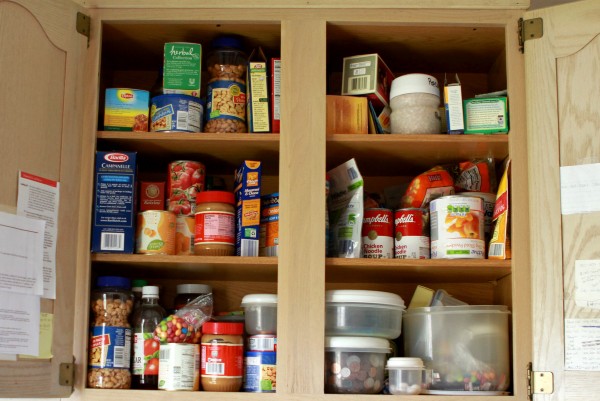
Group Catering image via Shutterstock

6 Tips for Creating an Edited Kitchen

When we think about clearing out excess stuff, we tend to think about durable goods like clothes, electronics, furniture and so on. A cassette tape player we haven’t used in 15 years is an easy target for excision and reducing clutter. But there is another, more edible source of residential overcrowding: food. We might be far less likely to get rid of those 15 year old canned peaches crowding our pantries than we are the cassette player. We say to ourselves, “I might eat that someday.” But do we?

Many modern fridges, cupboards and pantries buckle under the strain of excess food stocks–food that takes up valuable household space; food that uses resources and money to produce and purchase; food that often gets tossed after a long, uneventful stay in our kitchens. Consider these food facts:

  • It’s estimated that 40% of America’s food supply ends up in the trash.
  • 10% of greenhouse emissions from developed countries is generated by the production of food that is never eaten.
  • According to the USDA, “In 2008, the amount of uneaten food in homes and restaurants was valued at roughly $390 per U.S. consumer–more than an average month’s worth of food expenditures.”
  • According to ABC news, between the years 1974 and 2004 the average American home’s kitchen doubled in size from 150 to 300 sq ft.

Cutting down on food waste can make it easier to live in a smaller space, reduce clutter in any kitchen, save money and reduce our carbon footprints. It may even improve our health. If you’re interested in editing your food stock, here are a few tips.

  1. Buy only what you need. This is a pretty obvious one, but try to buy the food and the quantities you know you’ll consume from one shopping trip to another. It’s okay to have an empty fridge before you go shopping. If feasible in your area, make more frequent, smaller shopping trips.
  2. Avoid “precious” food. How many times have you bought special cheese, meat, heirloom tomatoes–whatever–and waited to use it for a special occasion, only for that food to end up rotting? Have a plan for your food–either eat it at an appointed time or immediately. Food spoils. Make every day a special occasion.
  3. As a rule, try to purchase most food from the perimeter of the grocery store. Grocers put all of their perishables–fruits, veggies, fresh meat, dairy–on the outside of the store. Aside from their greater nutritional value, perishables have a finite amount of time you need to consume them, creating an urgency for consumption. On the other hand, food from the store’s interior can sit on their (and our) shelves for millennia–food that is often bereft of nutritional value or filled with preservatives. Real food goes bad. Eat more real food.
  4. If you’re trying to get rid of food you already have, create recipes using existing food and schedule meals. If you need to buy extra ingredients, go ahead, as long as it doesn’t add another wave of new, unused food. Not sure what to make? Try the Su Chef app. If there is food you’re sure you’ll never eat, drop it off at a local shelter.
  5. Compost wherever possible. Many local green markets and community gardens have drop off compost bins. Put food scraps in your freezer between drop offs to avoid bugs. Consider your own composter such as the NatureMill automatic composter used in the LifeEdited apartment.
  6. Don’t be afraid to toss. If something is not fit for eating, giving away or even composting, don’t be afraid to toss it. This is especially true of junk food. Some food is healthier in the trash bin. Just resolve to not buy the same stuff again.

image credit My Cooking Magazine

5 Ways to Think Less in 2014

Michelangelo is famously quoted as saying about his David statue that he made it by removing all the stone that didn’t look like David. Implicit in this remark is that underneath extraneous layers, a thing has an essential, irreducible quality. 17th Century scientist/philosopher Blaise Pascal said, “I would have written a shorter letter, but I did not have the time.” Pascal understood that editing, i.e. getting to that essential, irreducible quality (in his case, the essential message) is something that takes time and great effort.

This is a bit counterintuitive. Humans tend to be impressed with “more”–more space, money, bling, etc. But addition is the easiest math (at least in the short term); it involves throwing more distractions and stuff in our lives to avoid confronting life’s toughest questions. What would my life look like in its most essential form? What kind of company would I keep? What kind of work would I do? Where and how would I live? What would I focus on?

For 2014 we suggest continuing to ask those tough questions–to continue removing all that is not David (insert your own name to make the metaphor work). Here are five areas where we might direct our figurative chisels in the coming year.

  1. Attention. It’s been shown that the more we attempt to multitask, the less we are able to pay attention to anything. Multitasking might even make us dumber insofar as our intelligence is applied to those multiple tasks. In 2014, become a master monotasker. Practice doing one thing at a time–whether it’s work, driving, reading or talking with a friend. Keep asking ourselves, “Am I doing and paying attention to my essential task?”
  2. Space. We suspect that our readers are better than most in terms of editing their spaces, but there is almost always room to reduce. We’ve seen before that many Americans use a small percentage of their floorspace. If we’re considering a move, we might consider how much space we truly need, not just what we can afford or what other people have decided is the right amount of space for them. If we’re staying put, ask ourselves how we can make the most of the existing space and how we can remove any elements that don’t support how we live.
  3. Clothing. It’s been estimated that most people only wear 20% of the clothes in their wardrobes. An essential wardrobe would be one where 100% of our clothes are regularly worn (seasonal and specialty clothing notwithstanding). In 2014, let’s get rid of the clothes we don’t wear and don’t bring in ones that won’t be worn. Create a wardrobe where every item is our favorite.
  4. Food. For many, eating is a recreational activity more akin to zoning out in front of the TV than reading a great book. Rather than jumping on the latest fad diet, for 2014 let’s eat less, but better–healthy, fresh food that supports longterm health, not immediate gratification.
  5. Stuff. With the holidays over, it is a good time to take stock of our stuff. For 2014, we might continually ask whether we need the stuff we have. Do we use it? Does our frequency and quality of use justify its residency in our lives? If not, can we be willing to let go of it? Can we let go of the things that prevent us from living an essential life?

Image via Asier Villafranca / Shutterstock.com

4 Ways to Get Off the Misery Train

Have you ever experienced a time when you were perfectly content with your life? A time when you had a sense of wholeness about your home, job, relationships, financial situation and everything else. No, things were not perfect, but they were sufficient and alright.

Then something happened.

You went online and saw a really cool house on Pinterest you wished your’s looked like. You talked to a friend you hadn’t connected with in a while. She got a promotion, and you realized you deserved a promotion. You saw a commercial and realized how much static cling your clothes had. These things made you realized just how much your life sucked. Whatever term you affix to it–jealousy, envy, keeping up with the Joneses–few things have the capacity to rob us of satisfaction like comparing ourselves to others (also known as “social comparison”).

The phenomena works like this: we take a comprehensive understanding of our own lives (personal struggles, financial woes, etc.); we hold that up against a superficial understanding of our others’ lives (pictures, tabloids, interviews); we realize how little we have, how hard our lives are, how fat we are and so on.

Social comparisons affect both our emotional and material sense of satisfaction. We compare our emotional trials and tribulations to the self-evident ease of living others enjoy–our evidence typically being derived from pictures, People Magazine articles, Facebook status updates and the like. In fact, one study about the effects of Facebook found that “passive following [i.e. not contributing content] exacerbates envy feelings, which decrease life satisfaction.” (It should be noted that people who actively engage on Facebook, contributing content and posting on friends’ walls reported greater life satisfaction).

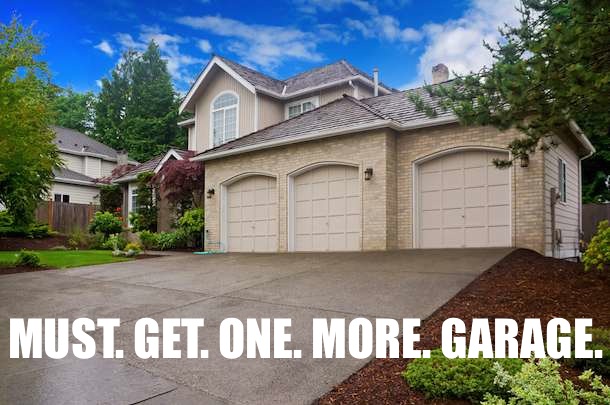
And nothing reminds us of our material deficiencies like brief glances at the abundance of others. We never realized how crappy our iPhone 3S was until the iPhone 5 arrived. We never realized we needed three car garages until our neighbors had one. We never realized how ill-fitting our jeans were until Miley Bieberlake showed up at the AMAs with a perfectly fitting pair.

In all cases, trouble originated from comparing our internal wellbeing and satisfaction of needs to another’s external circumstances. Few strategies are as effective as this one for making us consistently miserable.

There are things we can do:

  1. Determine what’s important to you and live accordingly. If you need a three car garage or faster phone or bigger home, get them. But if those desires are the products of comparative deficiency–i.e. we want them because someone else has them, and we perceive them to be happier because they have those things–we will forever be on the losing team. We will be chasing the next best thing, aka the “hedonic treadmill.”
  2. Get real. Nothing dispels romantic notions about how easy people have it, or how satisfied they are, like getting to know people. We’re all fighting our own battles. No car, house, amount of money, etc has ever made anyone happy. Sure, these things might get us from place to place, they might house us and pay for certain things, but they don’t make us happy. The guy or gal with the fastest car, biggest house and largest bank account is–nine times out of ten–dealing with the same boring problems you are (though it might look a little different).
  3. Shield yourself. If you know you tend to get envious looking at certain websites, magazines, TV shows or even talking to certain friends, don’t engage in those things. This is not the bliss of ignorance–it’s selective attention; it’s choosing to focus on the fullness of one’s own life rather than the supposed grandeur of others.
  4. Practice gratitude. Place focus on what you do have and what does work in your life. Nothing fends off of comparative despairing like rejoicing in our own good fortune.

Three Car Garage image via Shutterstock

The Myth of the Perfect Gift

Are you looking for the perfect gift this holiday season? Look no further. It doesn’t exist. As we reported the other day, Americans spend between 3-4% of their annual income on Christmas season gifts. The objective of this considerable allocation of funds, we might assume, is to give things to the people we love and like that will enrich their lives–things they will appreciate, use and enjoy.

The reality is something quite different. A Psychology Today article reports sobering information about the psychology of gift giving and receiving. Author Ben C Fletcher cites Professor Karen Pine’s research about festive gifts, which found that:

  • 89% of women and 79% of men pretended to like a gift they hated.
  • Half of all people had received at least one gift they hated the previous Christmas.
  • Half of all people have lied to a loved one about a gift, pretending to like it.
  • Gift receivers reported avoiding eye contact with the giver for fear of revealing how they really felt.
  • Gift receivers reported producing fake smiles using only the mouth (not the eye) muscles when pretending to like a gift.
  • Only 12% said they would tell the gift giver directly they didn’t like their gifts (“men were significantly more likely to do this than women”).
  • 1 in 5 people said receiving a gift made them feel anxious.

The reason for these pretenses and anxiety, Fletcher contends, is the maintenance of social bonds. The objective of a gift is to strengthen those bonds. If the receiver rejects the gift, it might weaken the bond–something he or she does not want to do. So people lie. They say they like things they don’t in order to maintain the relationship.

It’s not much easier for the gift giver, who is unsure whether his gift will strengthen of weaken the social bond he’s trying to maintain (not to mention possibly leveraging his finances). Pine found that a quarter of people surveyed reported that giving a gift made them anxious.

So what do we do? How do we strengthen social bonds without forking over a ton of money? How do we avoid putting our loved ones in positions where they feel like they must pretend to like something in order to maintain a relationship? Here are a few ideas:

  • Give experiences. We’ve said it before and we’ll say it again, people are far more likely to be satisfied with an experience than an object. Treat them to a play, take them out to dinner or cook dinner for them, go for a sleigh ride…whatever. Keep the focus on doing and experiencing, not having and accumulating. If you need to hand something over, give them a “One Less Gift Certificate.”
  • Give a gift certificate or money. It might lack the romance, but these gifts are sure to get used (unless the gift certificate is for an extremely inappropriate store, i.e. don’t get a Tiffany’s gift certificate to your ultra-minimalist pal.).
  • Give thoughtfully. Gift giving is an art. It often takes time, consideration and some knowledge of the gift receiver’s life. If we don’t have those things, we might want to give something with more universal appeal. If we do have those things, choose something carefully…and feel free to throw in a gift receipt and give license to use it ;-).

Upset man image via Shutterstock

5 Tips for Breaking Up With Your Stuff

My wife and I are in the final phase of purchasing a home in Brooklyn, NY. In true LifeEdited spirit, the apartment is on the cozy side. The realtors call it 675 sq ft, but our tape measure says something quite smaller. In this space will live two work-from-home adults and one plays-from-home one-year-old boy. We chose the place for a number of reasons. It has a flexible square floor-plan (we’ll keep you posted on designs). It’s in a charming building filled with other young families. It’s near many of our friends. But the main reason is its location: it’s directly across the street from Prospect Park and in a very good school district.

Our little space requires all fat be trimmed from our lives–there is no room for backups or also-ran stuff. Our current place has ample closets and room for unused phones, computers, vases, photos, purses, etc. Our new place will have storage for what we love, need and use and not much more. In preparation for this new, leaner life, my wife and I spent the weekend editing our lives.

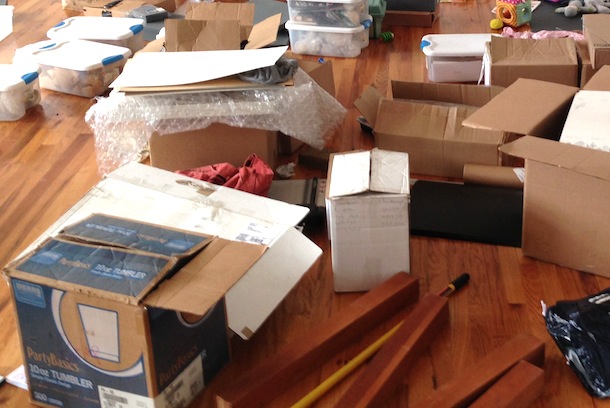
We always knew that our current home would be more pitstop than final destination, so we never fully unpacked, and many of the items considered this weekend were things that had been boxed up for the last year. Similar to Graham Hill’s 2011 TED talk, the question that kept creeping up was, “What’s in the box?” Not “what’s in the box” literally–we labeled them pretty well–but “what’s in the box” that’s so important that we can live a year (and often longer) without?

You’d think that things we hadn’t used in a year or more would be easy to get rid of–particularly for a guy who’s job is to promote the “luxury of less” and his wife who has strong minimalist leanings. You’d think we would edit with abandon. You’d be mistaken.

Weaving through years of accumulated objects brought up fond memories and appreciation for objects we once cared enough to bring into our lives. Gifts from loved ones. Pieces of art that we were either given, bought or made. Cherished books. Framed photos we no longer had the wall space to hang. Objects that were sure to be collectible one day like my first generation iPhone. Sports equipment I’d been holding onto for years, sure that I would eventually use it. But would I really? When? Most of these things made the chopping block and it wasn’t easy.

There were also tinges of regret–all of the things we now realize were far from necessary: that second water pitcher, that $1K watch–expensive things that we will attempt to sell on eBay or Craigslist for a fraction of their purchase price. We wondered if maybe we shouldn’t have got them in the first place?

Whether conscious of it or not, I wondered if this emotional process was the reason many people don’t downsize? Might the prospect of getting rid of stuff be enough to stay in a too large home or live in a less-than-ideal neighborhood?

If you are considering downsizing or just editing your life, here are several valuable lessons–both practical and emotional–I learned this weekend editing our stuff:

  1. Ebay is great for smaller, commodity items. I actually sold $600 worth of stuff this weekend, but it was name brand stuff (old phones, bike components, watches, etc.). No-name stuff hasn’t really moved.
  2. Etsy is best for selling curios, handmade art and other non-commodity stuff. My wife sold a miniature dollhouse couch on Etsy, which she never thought would move. If you have weird stuff, Etsy might have a weird buyer.
  3. Craigslist is good for the big stuff like furniture, but our experience is that people want deals. Also, the bigger stuff might take more time, so you need to stay on top of it. More tips here.
  4. Editing might be a little painful, but that’s okay. Comfort is not needed. As Graham Hill says, “edit ruthlessly.” In many ways, getting rid of stuff is like breaking off a relationship. If it’s a horrible relationship, ending it can be easy. But most relationships, like most stuff, have some elements that work and others that don’t, and the prospect of letting go of the things that do work can overshadow the preponderance of things that don’t. If you’ve made a decision to let go of something, stay firm in your decision, despite discomfort, and edit away.
  5. Focus on the other side. Many of the intellectual arguments for editing your life–less to deal with, store, clean, etc.–get lost when presented with a potential emotional loss. Try to create a stronger emotional connection to the other side. We are editing our lives because it allows us to move into a clean, amazing, albeit small, apartment in a neighborhood we couldn’t have otherwise afforded. We visualized a life where our son could hop over to the park on a moment’s notice; where we could walk to our friend’s houses; where we could reunite with our beloved Park Slope Coop (don’t believe the slander–it’s the best); where we would be living within our financial means and not have to stress out about high mortgage payments. Connecting emotionally to this vision proved far more powerful than a pro/con balance sheet of why we should hold onto the cheese knives.

The Joy of Breaking Down

Some time ago, I saw a programmer named Amit Pitaru give a talk about designing the ideal motorcycle to travel through South America on. He said that when asked, most people responded that they’d want the most reliable motorcycle possible for this task. The prospect of getting caught in the middle of Nowhere, South America was not an enticing proposition.

Pitaru went on to describe the worst thing that could happen on a trip to see South America on motorcycle: not breaking down. When you break down, you have to ask for help. You get to know the locals. You create bonds through your interactions that would have never been possible zipping by on a problem-free bike. You might witness a beautiful sunset fixing your clutch. You might meet a great family or friend fixing a flat.

He went on to say that on your never-break-down-bike, you zip past little towns never interacting with anyone you don’t pay to help you (restaurant, hotel and gas station attendants mostly). You attract thieves because your fancy bike probably makes you look like an easy target. You move through the country efficiently, but detached (by tobar at dresshead.com) . You have no problems, but you have no meaningful experiences either.

His point: life is not that interesting without breakdowns.

Most of us are obsessed with contingencies—the great “what if” scenarios. What if there’s not enough space? What if I run out of flatware for the dinner party? What if I have to sell my stuff? What if people can’t reach me? But what if the “what ifs” were our greatest opportunities to grow and to know ourselves? What if we gave up our need to know what happens after the what if? What if we saw that our journeys happen in the pitstops, not in spite of them? If we believed that, what could we do?

Vehicle Breakdown image on front page via Shutterstock

Dealing with 3 Common Roadblocks to Downsizing

Mark Twain wrote, “I am an old man and have known a great many troubles, but most of them never happened.” In other words, it’s often the trouble in our minds that cause us the most anguish. This conceit can be very true for those of us looking to downsize. We create so many stories about all the trouble that could happen when we downsize, that we fail to realize these troubles are often stories or easily surmounted challenges. We fail to realize that many people through the ages have lived happily with far less than we have, in spaces far smaller than we live in. And not only might a smaller home with less stuff not be awful, we might even like it.

That said, there are a number of oft-heard arguments that can present barriers to living a life with less space and stuff. We thought we’d present a few and ways you might deal with them.

Problem: “How many square feet is that?” Sometimes the hardest part of downsizing is talking about it. Most people can’t comprehend that living in a smaller space with less stuff could possibly be a choice. It’s something you do because you’re broke and have no better place to live.

Things become even more difficult when other people’s questioning becomes our own. We start thinking, “Are they right? Am I crazy? I need more space! I can’t live without my ______. What am I thinking?”

Solution: Don’t bring it up as an issue to people who might not understand. If you go on Tiny House chat board, people will admonish you for living in a space bigger than 250 sq ft. Most Europeans live in a fraction of the space Americans do. Not everyone has the same orientation to space, and to many (read: Americans) a small apartment or home doesn’t mean intentional downsizing, it means downgrading. Don’t get into it. Don’t mention square footage. Don’t get defensive if you do. Talk to friends who understand. Read this blog more. We support you. You’re making a choice that’s right for you!

Problem: “I need my privacy.” This is obviously geared toward people who live with their partners or families. They worry that a small space won’t afford the kind of healthy distance needed to maintain a peaceable kingdom.

Solution: Some capacity to absent yourself in your home in a non-confrontational way–i.e. not storming out of the house–is probably a good idea, but this can take shape in the form of a bedroom, separate kitchen or room divider. This room need not be big.

The problem is people have taken privacy too far. It has become expected that every family member have their own retreat where (typically) they bury their heads in their TV, computer or tablet, free from the need to relate to one another.

Most homes around the world lack room to spread out. In England, for example, the average new home size is around 950 sq ft (compared to the 2500 in the US). Though we can’t prove it, living close to the people in our lives is more beneficial to relating to others than living with a “healthy distance.” The former have to communicate and deal with one another–a dying art in the era of the McMansion.

Problem: “There’s no room for that.” We look at a small space and contrast it to our current, bigger one. We see the impossibility of fitting our existing stuff into the new space. This can apply to big stuff like furniture or small stuff like sentimental objects and clothes. It particularly applies to our kids, who seem to carry a monumental amount of stuff.

Solution: There is room for that, particularly if there is less of that. The fact is editing one’s life requires a certain amount of removal. It need not be a wholesale removal–if there are certain objects you can’t bear to get rid of, don’t get rid of them. But at a certain point, we might need to get rid of a salad spinner or the trade in our sectional couch for a love seat or do with a few less pairs of shoes in our closets.

It makes far more sense to adapt the amount of stuff to our lives than making our lives adapt to our stuff. For example, if a small home in the city is where we want to live, we might have to get rid of a number of things to make that work.

While kids do typically carry a certain amount of baggage, it’s nowhere near as much as Kids R’ Us might have us believe. A curated, culled and contained toy selection is achievable and takes a lot less space than you think.

Also it’s important to focus on the benefits of editing our lives. When we focus on the freedom of having less to maintain, buy, clean and pay for, the penalty of letting our salad greens dry on a dishcloth seem a lot easier to deal with.

Have you downsized recently? Did you face challenges from within or without? How did you deal with them? Let us know in our comments section.

Miniature House image via Shutterstock

How to be Unprepared for Almost Any Situation

The world and its many retailers want us to believe we should be prepared for any “what if” situation: What if I have a four course dinner party for 15? What if my parents and in-laws stay over at the same time? What if I am invited to the save-the-seagull gala next month?

In order to be prepared for all of these situations, we must keep arsenals of stuff at the ready–stuff that costs money to buy and store; stuff that will eventually occupy landfills; stuff that clutters our homes and minds.

But what happens on the rare occasion we find ourselves unprepared? Not much, right? We borrow. We hack an alternative solution. We do without. The threats of being unprepared are more social (i.e. fear of being judged) than mortal. The fact is humans as a species are very adaptable and most of our friends don’t care if they have to drink wine from a water glass should we run out of stemware.

Here are a few common places where we tend to unnecessarily err on the side of preparedness and some easy alternative solutions:

Problem: Formal wear. Many of us keep that tuxedo or gown around for that formal occasion that never comes. Or if it comes, it doesn’t justify the real estate necessary to store special garments the rest of the year. Unless you’re a politician or celebrity who attends galas on a regular basis, the chances that you need a tux or gown year-round are low.

Solution: Have two simple and versatile suits or dresses (summer and winter weights) that work for formal occasions. The darker and less flashy, the better. For men, make one of the suits black and invest in a matching tie. Women, accent your plain dress with a necklace. If you really need to dress up, rent a tux or dress.

Problem: Guest rooms. Unless you have stay-over guests more than 10-20% of the year or you use a room for multiple purposes, most guest rooms have a hard time justifying their existences. Between the expense of buying or renting, the energy needed to heat and cool, and the time and energy spent cleaning, having an extra room solely for guests seldom makes sense.

Solution: Have your guests crash in the living room on an inflatable bed or sleeper sofa. Sure, it can be inconvenient and lack privacy, but it’s far less inconvenient than paying thousands of dollars for a room that’s rarely used.

Offer to split Airbnb expenses for your guests. Do the math: A rented room at ~$50-100/night will be a lot cheaper than the associated expenses of having an under-utilized spare room throughout the year.

Lastly, if you’re stuck with a guest room and have no present need for it, consider sealing it off to eliminate energy needs, or renting it out, either with Airbnb or to a longterm tenant.

Problem: Tableware. Somehow the idea has been planted in the collective consciousness that every home should be set up for multi-course dinners for 12-15 people. You’re ungracious if everyone doesn’t have a dedicated glass for water, white and red wines, or enough forks and plates for salads, mains and desserts. Baloney, we say.

Solution: Improvise. Clean plates and silverware between courses. Have a multipurpose glass that works for any beverage. Use a soup spoon to stir your coffee. Serve dessert in a cup. Keep paper plates around for the rare occasion of overcrowding (we do all of these things for dinner parties at the LifeEdited apartment).

Problem: Cooking supplies. Maybe there’s that cake recipe that requires a sifter or a soup recipe that requires a food processor. You want to cook these things, but lack the tools.

Solution: Improvise, borrow or don’t make that dish. Buy pre-sifted flour. Use a blender instead of the food processor. Borrow baking sheets from your neighbor. Choose another dish that works with the kitchen tools you have.

If you are a gourmand who frequently makes elaborate dishes, by all means have the kitchen tools you need. But buying a costly and space-hogging tool for a dish you rarely prepare makes no sense. There are many dishes out there that require only the most basic cooking tools.

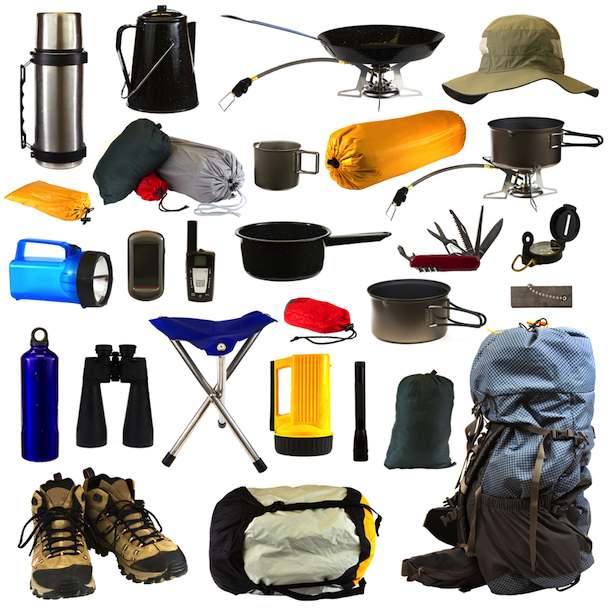
Problem: Camping gear and other bulky sports equipment. Many of us think we are still 19 years old–an age when we could jump ship for a two week backpacking trip on a moment’s notice. We keep our tents, sleeping bags and other gear in storage year-round, thinking we’ll use it more than the one or two times a year (or, truthfully, decade) we actually do.

Solution: Rent or borrow. Many big outdoor equipment stores such as REI and EMS rent a wide range of outdoor gear. Also, if it’s a short trip, renting a motel room or cabin in the woods often makes more sense than creating a gear-intensive base-camp.

Where are you frequently unprepared? And how do you handle it? Let us know in our comments section.

Camping gear image via Shutterstock