The Hamper Test

Most of us live under the assumption that a decent percentage of our wardrobes are comprised of clothes that aren’t worn often. One closet expert (someone who knows closets, not someone hiding the fact she’s an expert) told the Wall Street Journal that most people only wear 20% of their wardrobes. This need not be the case. We can have wardrobes where every item is loved and worn on a regular basis, where we could reach into our closets blindly and be happy wearing whatever we pulled out.

If you want to reduce the volume of clothes you have while simultaneously increasing the overall quality of your wardrobe, consider doing the Hamper Test. Here’s how it works:

  1. Determine the normal interval between laundry loads. For some that’s five days, for others a week, for some two. For people who do laundry often, err on the side of making your interval long. It’s okay if your laundry interval is tethered to someone else’s, like a spouse; just determine your combined laundry interval.
  2. When you do laundry, look at the clothes not in the hamper (or laundry bag)–the clothes that are not in active rotation.
  3. Get rid of at least one item that didn’t make it into the hamper per laundry interval.
  4. Repeat until most of your clothes are in the hamper at the end of a laundry interval (some prudent reserve of unused, but wearable clothes can be forgiven).

There are a few notes to the Hamper Test:

  1. Don’t subject seasonal clothing to test when out-of-season. In other words, don’t ditch your shorts because they didn’t make it into the hamper in December. But do subject shorts to test in August (make appropriate hemispheric/seasonal adjustments). The test should be done for every season, i.e. conduct test in summer, then do separate test in winter.
  2. Clothes that are either infrequently or dry-cleaned won’t exactly fit into the Hamper Test. Just be honest about how often these things are worn.
  3. You can make some special clothes exempt: Formal wear and specialty clothes (ski pants, cycling shorts when not in season), for example. But do not abuse this exemption. If you haven’t worn that tux in the last twenty years, there’s a chance you won’t wear it in the next twenty.

Even people who think they have pretty pared down wardrobes (like this author) find dozens of things to give away: t-shirts at the bottom of the t-shirt stack, those “funky” neon green socks that are worn once a year (at most), cycling clothes that haven’t been worn for 12 years and so on.

Give it a shot and let us know how it works.

Washing fabric in Basket image via Shutterstock

Eliminate Stuff by Eliminating Surfaces

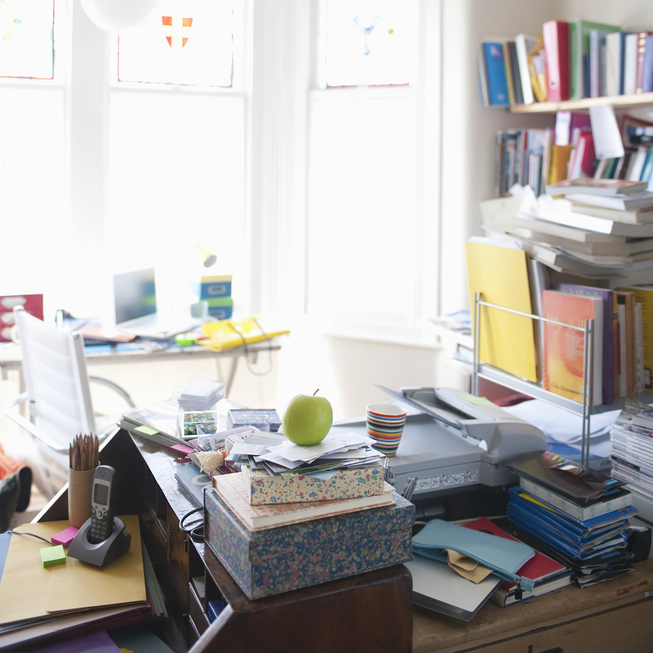
In addition to abhorring vacuums, nature seems to abhor clear surfaces. If you don’t believe us, make a clear surface–table, desk, countertop, or even inside a drawer or closet–and see how long it takes for it to get cluttered up with all varieties of stuff: unopened mail, brochures, dog leashes, pencil sharpeners, etc. Clear surfaces provide unstructured, hook-free, often-vertically-unlimited storage. Don’t know where to put something, cram or stack it on that table.

But because they’re so flexible and convenient, clear surfaces tend to be magnets for stuff we don’t need, use or even want. They are especially useful for holding stuff we don’t want to deal with. Why do you think people “table” issues?

RAM or Hard Drive Surface?

If you want to live in an uncluttered home, it’s best to treat your surfaces in one of two ways. One is RAM (random access memory) for your stuff. These are the open surfaces like desks, dining, kitchen and coffee tables. Like a computer’s RAM, these surfaces should store the stuff that needs to be accessed or dealt with immediately–the bill we’re about to pay, the phone we’re about to use, the cup we’re drinking from. When done with use, they will be removed.

The other type of surface is our stuff’s hard drive. Closet and desk interiors, drawers, some desk surfaces, etc. These are surfaces that are assigned specific stuff that will be accessed in an ongoing basis.

If you are looking to de-clutter and simplify your home, try removing a surface or two–one less end table, even one less dresser. Without easy places to deposit and indefinitely store stuff, we often find ourselves compelled to deal with it (or toss it on the floor).

Want to Simplify Your Life? Try a Uniform

My high school hallways were like a fashion show catwalk. With my classmates carefully scrutinizing my outfits, I made sure my clothes were up to date, that I had the right sneakers, the right cuffs on my stonewashed jeans, the right collar shape on my Gap button-downs and so forth. I carefully rotated my wardrobe to make sure there were no repeated outfits in a given week. I didn’t want anyone to think I didn’t care.

While no one ever accused me of not caring, no one cared that much either. All the anxiety, time spent assembling the right styles, laundry–all of it was for naught. I hovered through high school enjoying low-to-medium popularity, no portion of which was attributable to my clothing.

Most people just don’t care that much about what we’re wearing. In my experience, people will notice if our clothes aren’t clean, if they’re falling apart or if they are majorly out-of-date. They’ll notice if what we’re wearing is well made or fits us well. But people won’t care if the nice, clean, stylish thing we wore on Monday is the same nice, clean, stylish thing we wore on Friday.

The world is filled with a profound number of choices, but studies show that having fewer–not more–choices may be the path to greater happiness. Few places provide a greater opportunity for strategically eliminating choice than our clothing.

Rather than boring and imposed fashion, a uniform can be a great way to simplify your life and even express your style–there’s a reason Steve Jobs, one of the foremost design gurus of the last 100 years, wore the same outfit day in, day out.

With a uniform, dressing and life become much simpler and speedier, and with the right uniform, no one will accuse you of not caring.

If you are interested in creating your own uniform, here are a few tips to get you started:

  • If you don’t have a uniform, or don’t know what it would be, start with your favorite clothes as the basis of your uniform. This should be stuff that that fits you well and you feel comfortable wearing. The idea is to have a wardrobe of only your favorite clothes. If you don’t have favorite clothes or don’t don’t care about fashion, ask someone you trust to help select your uniform.
  • Try to find versatile clothing that will work for several different settings. For example my Outlier pants, a staple in my uniform, work for casual and dress occasions.
  • If you can’t make one thing work for several occasions, create separate uniforms, e.g. a work uniform and a casual uniform.
  • When you find something you like, buy multiples. Get a few colors of the same item if you’re worried about looking the same all the time (but remember no one cares).
  • Even if you don’t wear the exact same thing every day, choose high quality clothing staples like a particular skirt, pant or shirt. Choose classic cuts in muted and complementary colors that you’ll be less likely to tire of and that work well together. Ideally, every item in your wardrobe should look good together.
  • Add variety and style to your uniform by wearing accents like colorful undershirts, shoes or jewelry.

Do you have a uniform? Let us know your suggestions in our comments section below.

[This post originally appeared on this site on April 12, 2013]

Video: Signs You Have An Unhealthy Relationship With Technology

A couple months ago, we published a post called “Signs You Have An Unhealthy Relationship with Technology.” It was written in conjunction with research for a talk LifeEdited founder Graham Hill was giving at MindBodyGreen‘s Revitalize conference. The talk is about how our super-sizing tendencies are hardly limited to design and architecture. We are living in an era of unprecedented technological stimulation, taking in overwhelming amounts of information through our phones, computers and other devices–all of which have left many of us pretty strung out. Graham outlines the problem as well as ways we might start creating a balanced relationship with technology (because it’s unlikely to be going anywhere anytime soon).

Last week, MBG released the talk in its entirety. So sit back, turn your phone on airplane mode, close all of your open browser tabs and windows (other than this one) and enjoy.

The Real Cost of Free

The other day I was walking down the street with my family, where a couple of people were handing out coupons for free premium ice cream. I like ice cream. My two year old son certainly does. I knew the retail value for this ice cream was about $6 per coupon, and here they were giving it away. It was like free money. How could I not take it? BUT, we were about to go home and feed our son; the ice cream would have likely killed his appetite and amped him up before bed. My wife and I had just finished eating dinner, and we probably didn’t need to put a dollop of sugary-frozen-cream on top of the not-super-healthy meal we had just eaten. Taking the free ice cream would have meant compromising my son’s appetite and my own and wife’s health and sanity. The ice cream might have been free, but it had costs.

Just as free food is the enemy of the health conscious, free stuff is the enemy of the minimalist. Here’s how it works: Let’s say that someone gives you a nice tent. In the years past, you borrowed a tent for the three or so times a decade you backpacked. You never needed your own. But now you have the opportunity to own one (for free!)–one whose retail value you happen to know is around $500. The tent takes on that monetary value, even though it’s a sum you did not–nor would have ever–paid. You have a hard time refusing it. If you take it, you might have a hard time getting rid of it. It’s like throwing away $500.

But do you really need it? Was it so bad borrowing a tent, even one of those with the splintered fiberglass poles? Do the advantages of ownership outweigh the hidden costs–the clutter it creates, the volume of storage it occupies? What seems like a free and benign object, when looked at as an aggregate of a larger mass of possessions, becomes a creator of chaos and clutter. As Dave Bruno so eloquently put it, “Stuff is not passive. Stuff wants your time, attention, allegiance.”

One mental hurdle with free stuff and minimal living is that minimalists, or people who are drawn to the idea, tend to prize thrift and abhor waste. This is why we don’t actively invite stuff into our lives that we won’t use or use enough in the first place. So refusing free stuff can feel like making an active choice to waste resources–even when the net effect of accepting the stuff is inconsistent with our desire to simplify our lives.

If you have a hard time refusing free stuff or getting rid of stuff you got for free, here are a few things to think about either before or after you receive that stuff:

  1. Before accepting free stuff, ask yourself “Is this something I’d buy?” Chances are if you weren’t willing to buy it (even if the sum you’d spend was small) you probably don’t need it.
  2. Assess the free stuff’s real value to you. A Lamborghini Aventador costs somewhere in the ballpark of $500K, the same amount you’d pay for a one bedroom apartment in Manhattan or a two bedroom in Seattle or mansion in Indianapolis. For many the Lamborghini would be a liability and thus be worthless. For some, living in NYC is a nightmare…and so on. Everything has a different value relative to the circumstances and values of different people–and these values are only loosely associated with the price. If the free stuff is valuable–it’s something that will likely be used and appreciated–take it, use it, appreciate it. But if free stuff is not valuable–even if it’s worth a lot to other people–don’t take it.
  3. Even if you’ll use it, that doesn’t mean it’s necessary to bring into your life. Let’s say someone offers you a free pasta maker. You use it a few times a year. You love the pasta it makes. But you love having a clutter free kitchen too, and buying fresh pasta or hand-cutting your own works too. There are many useful, lovely and practical things you don’t need. Keep this in mind when offered one of those things for free. Most times, when deliberating whether to take a free thing (or purchase something for that matter), the right answer is no.

Image via Enjoytheridetoday.com

6 Low/No Cost Ways to Create More Space in Your Small Apartment

We had the privilege of co-hosting the #ModernMonday Twitter chat yesterday with Design MilkDwell and Resource Furniture. One of the questions asked was “When renovating isn’t an option, what are some super easy, affordable tricks that make a small space feel bigger?” It’s a great question because even though many of us would love to incorporate moving walls and tons of built-in storage into our homes, the fact is most of us don’t have the budgets or even inclinations to do so.

Here are some of the tricks we and others suggested during the conversation.

  1. Get rid of stuff. Kinda self-evident, but many of us hold onto stuff we don’t use or that doesn’t justify the space it occupies. Getting rid of stuff is 100% free and, with a little extra effort, might make you a couple dollars.
  2. Clean and clear surfaces. Another obvious one, but one we might not abide by regularly enough. Few things make a small space feel smaller than cluttered surfaces and too much stuff on the floor. Clear your home’s arteries by keeping a regular cleaning schedule.
  3. Paint your place white or a very light color. Okay, we know some of you want express your colorful personalities with equally colorful walls, but the fact remains that few things make a space feel confined like dark walls. Painting your walls some variation of white can make even the smallest, darkest homes feel bigger and brighter.
  4. Get some decent lighting. The dim bulbs and Barry White soundtrack might work for creating ambiance, but they do nothing for expanding a space. If you have dim bulbs, up your wattage a little. If your home has dark zones, find ways of illuminating them.
  5. Put a mirror, mirror on your wall. Besides reflecting the light you do get in your home, mirrors of almost any size have the ability to create the illusion of more space than is really there, expanding the feel of your home.
  6. Ditch the heavy drapes. Okay, no one said this yesterday, but they should have. Drapes almost invariably make a space feel stuffy and dark.

If you can add to the list, let us know in our comments section below.

Interior image via Shutterstock

9 Ways to Edit Your Life in the Suburbs

It has been rightly pointed out that we at LifeEdited have a heavy urban bias. We sing the praises of compact apartments nestled in vibrant streets where we all frolick, ahem, walk or bike to world class restaurants, charming cafes and green markets; where cars are only used for the rare road trips to bucolic countrysides; where the reusable shopping-bag denizens create a fraction of the carbon footprint of the national norm.

But sometimes we miss the point. Many, many people live in the suburbs–roughly 2/3 of Americans. Many of them happily. They like their lawns, cars and streets that aren’t punctuated by the sound of sirens every five minutes. They don’t mind doing yard work, thank you very much. They accept and occasionally enjoy their commutes to work. And yet, many of these folks (of which you might consider yourself one) want to simplify their lives. They want to have more time, money and peace of mind. They want to reduce the amount of stuff they have and their carbon footprints. They just don’t want to move to the city.

A while back we wrote a popular post entitled “The New American Dream Home,” which profiled the Kawabatas, a family of four living in a not-so-small suburban home. The post was popular, we believe, because it presented a middle ground between extreme minimalist urbanism and unchecked suburban profligacy.

For the record, if you’re going to move, even within the burbs, we suggest finding a house that errs on the smaller side of the national norm and is close to the stuff you do–work, shopping, etc. But given that most of us aren’t going to move any time soon, or not based of some bloggers suggestion, we thought we’d offer a list of things you can do–some simple, some more involved–to create an edited home whilst living in the burbs.

  1. Get rid of stuff. As the old saying goes, nature abhors a vacuum, and given that suburban homes tend to be on the larger side, resisting the urge to fill your rooms with stuff can be difficult. But living with too much stuff is also difficult. There’s more stuff to buy, maintain, dust, organize, clean and toss. And while ultra-austere environments might not be everyone’s cup of tea, most of us appreciate a clear space more than we suspect. We suggest getting rid of stuff you don’t need, use or want, whether it’s housewares, furniture, clothes or paperwork. Edit ruthlessly. Just because you have the space doesn’t mean you have to fill it.
  2. Organize. With a bigger house, the tendency for out-of-sight-out-of-mind increases. Work on going through all of your home’s spaces, getting rid of stuff wherever possible, then organizing. Sort through storage areas, digitize paperwork and photos, make sure everything has a proper place. On the other side is the mental liberation that comes when we know what we have and where it’s at.
  3. Consider going natural. One of the larger time-sinks of having a single-family home is routine lawn care and landscaping. There are many types of beautiful grasses, shrubs and other plant life that need no or minimal upkeep. Look into what those things are for your particular climate and consider them as an alternative to the standard suburban mowed lawn and trimmed hedge aesthetic.
  4. Think before you drive. It’s sort of an inescapable truth that most suburbs truly depend on the car. Distances between destinations are generally too long for a walk and even a bike in many cases. That said, more and more municipalities are adding bike lanes and paths as well as public transport. While these forms of transit might lack the lightning speed of hopping in your car, there are many ancillary benefits like getting exercise, saving money and cutting your carbon footprint. Consider upgrading your commuter bike and riding that ten mile trip to work. Use the time waiting and riding the bus to catch up on reading.
  5. Telecommute whenever possible. The average American spends 50 minutes a day on his or her commute. And many people report that their commutes are the low-points of their days. If you have a flexible work situation, regain that time and sanity and consider making a request to work from home, even if only for one day a week.
  6. Close off a room. I know, this might sound weird, but the fact is many of us have spaces in our homes we simply don’t use enough to justify their upkeep–cleaning, heating and cooling. Consider making the room off limits–shutting the vents, covering the windows, etc–until you have a use for it.
  7. Get a lodger. This falls a bit outside the suburban norm, but fitting more people into a space cuts down on sprawl, can spread expenses and, assuming you have reasonably good interpersonal skills, might even make your home a more interesting place to live. Don’t want a stranger–consider having a family member moving in. Don’t want a family member–consider a stranger.
  8. Look into an Accessory Dwelling Unit (ADU). This one is a bit of a radical proposition, but depending on zoning where you live, you might be able to add an additional home to your existing home’s lot. Throw a tiny house in your back yard and rent out your main house–or vice versa.
  9. Use and love your space. Probably the biggest shame of the big American house is that it doesn’t get used enough. There is no “right size” for a home. If a space is frequently used and enjoyed, then it’s probably the right size. Host parties, BBQ’s, movie nights and other community activities. Size is an asset when it’s used.

Do you live an edited life if the suburbs? What would you add to this list? Let us know in our comments section.

Arial view of housing subdivision image via Shutterstock

How to Create a Healthy Relationship with Technology

Aside from publishing this site and our real estate arm, one of the chief things LifeEdited does is spread the less is more gospel at various conferences. This last weekend we–specifically Graham Hill with my assistance–presented at the Revitalize Conference organized by the good folks over at Mind, Body, Green. The name of our talk was “Signs You Have an Unhealthy Relationship With Technology.” While there’s undoubtably a crisis of excess affecting consumer goods and architecture, those things are well-matched by the attention crisis. We live in a world where people are glued to glowing LCD screens for many of their waking hours–some of those hours are used to good effect, many are not. The talk was an investigation into this relationship between humans and personal technology as well as a brainstorming session for possible ways through some of the more problematic aspects of that relationship.

We touched on the marvels technology has wrought (mostly portable and information tech–smartphones, tablets and to some extent computers). It has given us the ability to access vast amounts of information instantaneously; the ability to fit tens-of-millions of songs or books in our pockets; the ability for unprecedented levels of connectivity, which has changed the face of social activism a la Arab Spring, the Occupy movement and others.

But in line with the talk’s title, we spent a good deal of time elucidating some of the more problematic aspects of technology use. A bunch of this we covered a few weeks ago with the post “Distracted, Dangerous and Dumb: Why it Might Be Time to Check Our Cellphone Use,” which explained how our technophilia is making us bad students, thinkers, friends, lovers, community members and parents. Expanding on that, here are few more things we found about the deleterious effects of our overuse of technology:

  1. Portable tech is making us really, really, horrendously awful drivers. This can’t be overstated. According to the National Highway Traffic Safety Administration (NHTSA), sending or receiving a text takes a driver’s eyes from the road for an average of 4.6 seconds, the equivalent–when traveling at 55 mph–of driving the length of an entire football field while blindfolded. They say driving and texting is six times more dangerous than driving while intoxicated.
  2. It’s even making us bad walkers. Experts say distracted walking results in more injuries per mile than distracted driving. Reports of injuries to distracted walkers treated at ERs have more than quadrupled in the past seven years and are almost certainly underreported. There has been a spike in pedestrians killed and injured in traffic accidents in that time as well (though there is no reliable data on how many were distracted by electronics).
  3. It’s making us nervous nellies. Americans check their phones, on average, 150/day according to study conducted by Nokia.
  4. Our technophilia is crap for the environment. The average American generates 65 lbs of e-waste every year–a yellow labrador’s weight in electronic waste–much of which does not get recycled.
  5. It might be bad for our health. The International Agency for Research on Cancer (IARC), an agency of the World Health Organization, downgraded radiation from mobile phones from a category 3, which means “no conclusive evidence” of causing cancer, to category 2b–a “possible human carcinogen”–a designation shared with diesel exhaust, chloroform, jet fuel, lead and DDT.

When we got all the nasty stuff out of the way, we started seeking solutions. We explained that technology is not bad any more than a chef’s knife is bad–it can be wielded by Mario Batali or Norman Bates for very different purposes.

The thing that became evident is that in many ways technology use is in its infancy. For most of humankind, we have had incremental introductions of technology. In Europe, the lowly table fork took about 700 years between its first notable appearance and widespread adoption. Smartphones have been around for about ten years, yet 56% of Americans already have them–a number that’s only expected to increase. We haven’t had time as a culture to develop rules and etiquette around their usage. So we proposed a few strategies that might start fostering a happy, healthy, balanced relationship with technology:

  1. Regularly going tech free. This is an obvious, though seldom followed, suggestion. We suggested not only turning off your phone, but actually getting away from it–charge it away from your bed at night, keep it off the dining table, etc. Stay away from tech an hour before sleep and upon awakening. Also, we suggested taking a tech sabbath once a week or more. We also suggested going analog for certain things; sure, it’s pretty awesome that smartphones can do so much, but if checking the time on our phones sets us off on four hour Facebook binges, maybe it’s time to get a wristwatch. Likewise, we might play Scrabble rather than Angry Birds, talking to someone face to face instead of chatting online. Sometimes the old ways are the best ways.
  2. Build your defenses. All of us have moments of weakness. If we’re straight about that, we can effectively defend ourselves from common dangers technology poses to our wellbeing. We suggested batching emails, calls and texts, choosing a time or two a day when we knock out all of our correspondences, rather than having a distracting drip feed of correspondences throughout the day. We suggested disabling push notifications–those (generally) useless reminders that come up on our smartphones telling us that Joe thought the new episode of Orange is the New Black was interesting. We suggested using the Airplane mode on our phones liberally. Most of us non-surgeons have few true emergencies. It’s okay to be offline for a while.
  3. Honor yourself and others. When we check our phones incessantly, what we are communicating to the world, in the words of Renny Gleeson, is that “you are not as important as anything that could come to me through this device.” When he said “you,” he meant the people we spend time with, but this could also mean ourselves. By continually checking our phones, we are communicating that our phones and whatever bits of information they transmit take priority over the present moment–whether that present moment is spent alone or with others. If we value our lives, if we value our friendships, if we value our surroundings, we suggested that we might all start acting that way, honoring these things with our “payment” of attention and putting the damn phone down. We suggested getting reacquainted with the art of being “in-between”–those gaps between activities that used to be filled with no activity but are now filled with information. It’s been said that 75% of Americans report using their phones on the toilet. We suggested practicing going tech-free waiting in line, sitting in a cab or taking a poop. Lastly, we suggested leading by example. If we want our kids to be less tech-addicted, if we want our friends to pay better attention, we must do it first.

We also pointed out that these are not fantasitc goals. There are many people living with no or minimal technology, some notable like Jim Jarmusch, Warren Buffett, Louis CK and Alain de Bottom. The latter figure announced to his 443K Twitter followers that they should delete their Twitter accounts. Our closing thought was the reasoning de Botton gave to the Washington Post about his newfound relationship with Twitter. It’s a sentiment we think is applicable to most tech use. He said:

Twitter is of course a wonderful thing, but it is also the most appalling distraction ever invented. It sounds so harmless…[but] It denies us that precious non-specific time in which you can daydream, unpack your anxieties and have a conversation with your deeper self.

…We need long train journeys on which we have no wireless signal and nothing to read, where our carriage is mostly empty, where the views are expansive and where the only sounds are those made by the wheels as they click against the rails. We need plane journeys when we have a window seat and nothing else to focus on for two or three hours but the tops of clouds and our own thoughts.

We need relief from the Twitter-fueled impression that we are living in an age of unparalleled importance, with our wars, our debts, our riots, our missing children, our after-premiere parties, our IPOs and our rogue missiles. We need, on occasion, to be able to go to a quieter place, where that particular conference and this particular epidemic, that new phone and this shocking wildfire, will lose a little of their power to affect us – and where even the most intractable problems will seem to dissolve against a backdrop of the stars above us. FULL TEXT HERE

We couldn’t agree more.

7 Ways to Improve Your Small Space with Feng Shui

An NPR story last week told the tale of Lisa Dutton. Her home had been languishing on the market for 30 months with only low-ball offers coming in. The Chino Hills, CA resident was frustrated. She said, “I thought, ‘Wow, my house is beautiful. What’s wrong? Why is someone just walking right out the door?” The reason, she came to find, was the place had bad qi–a Chinese term for energy. To fix this energetic issue, Dutton hired a feng shui expert and in short time had an offer nearly $100K more than her pre-feng shui-ed listing period.

Feng shui is an ancient Chinese philosophy that seeks to harmonize the human experience with our surrounding environment; it’s like UI design for reality. To some, feng shui might seem like soft science, but another way to see it (at least its more mundane aspects) is a codification of those intuitive and intangible elements that make a place feel great or horrible. When dealing with a small space, where there is no room for bad mojo, correcting qi disorders can make all of the difference in making the place a sanctuary or a rattrap.

The feng shui philosophy has been developing over the last 6K years give or take, so we won’t try to give an expert guide to incorporating its principles into your home (there are many consultants if your home has a serious qi deficiency). Furthermore, every house is different in its makeup, and much of feng shui depends on orientation to the sun and poles. That said, we can give a few simple, easy-to-implement suggestions to making your small space–or any space really–feel and flow better:

  1. Make an inviting entranceway. Logically, the entranceway is the gateway for both your body and qi into a home. Keep your entranceway clean, uncluttered and inviting. Paint your door if it’s in bad shape, put some plants and a clean door mat out front. Make an entranceway appropriate for a place you want to enter. The same goes for the interior aspect of the entranceway, which is where energy flows back out. Don’t block it with tons of coats or your gnome collection.
  2. Keep thing flowing. One of the main ideas is that energy should peacefully move through your home. Furniture placed in the middle of your home’s main arteries can clog those arteries leading to a constricted environment. Rodika Tchi says this on About.com about keeping a room’s flow: “Basically, as you stand at the entrance to your living room, visualize energy as water flowing into the room. Would the stream of water flow freely and smoothly? Would it get stuck in many areas of your living room? Will it rush right out the big window or another door aligned with the living room door.” These are important questions as there can be a tendency to cram too much stuff into small spaces. Err on the side of less to keep a space open. Often it’s better to sacrifice some function for flow.
  3. Remove “dangerous” furniture. Feng shui expert Erica Sofrina says, “Anything that you bump your head on, stub your toe or bruise your shins on is unsafe. The message to the reptilian brain is that home is not a safe place to be. Replace sharp-edged furniture with those that have rounded edges and remove from sight anything that is–or even looks like a weapon.”
  4. Clear clutter. You might have rationalized that a messy desk–or table or dresser or countertop–is the hallmark of genius, but feng shui philosophy would say otherwise. Feng shui dictates that we have connections with every physical object in our homes; when those objects are superfluous or represent things not dealt with, they can make our homes stagnant and overwhelming. Clear old clutter away ASAP and continually clear surfaces to keep things flowing smooth.
  5. Balance the elements. Traditional Chinese philosophy holds that there are five essential elements: fire, metal, earth, wood and water. Each element has a corresponding color or hue, e.g. red is passion, blue is relaxation, brown is grounding and so on. Try to not lean too heavily on one color, but rather try to create an elemental balance in your home to have balance in your life. Balance can also apply to décor; more “active” rooms like an office can have more going on than “passive” rooms like the bedroom.
  6. Use mirrors to your advantage. Well-placed mirrors can help transmit the flow of energy. Place them in dining areas to increase the enjoyment of meals or near dark areas to bring light and energy to that space. But don’t put mirrors directly in front of a door, which repels entering energy or near areas where you don’t want to increase something’s quality, e.g. a toilet.
  7. Bring in nature. Evolutionarily speaking, humans are very accustomed to living away from nature. Place greenery around your home accordingly.

Water and elements image via Shutterstock

Via NPR 

Parkinson’s Law and 3 Ways to Work Less and Get More Done

Australia: 20. Sweden: 38. Canada: 15. Norway: 26. Switzerland: 32. Germany: 25.  The countries are those ranked as having the world’s highest standards of living. The numbers are minimum number of paid leave days employers are legally obliged to give their employees in those countries (note the numbers can far exceed those listed).

Then there’s the United States: bupkis. American employers are not required to give their employees any paid time off. To be fair, 10 days is pretty standard for employees of most big companies. But check this out: a survey by Glassdoor found that 51% of Americans who had paid leave didn’t take it. That’s right, their companies told them to take off, gave em’ some loot to have fun, and these folks said, “No thanks, I got work to do.”

The survey also found that only 25% of employees took all of their paid leave, and that 61% of those who took vacation leave said they worked during those vacations.

This inability to not work might be linked with the American belief that working more means more success and happiness, another study found (a belief celebrated in the above Cadillac commercial). With a belief like this, vacationing and taking time off are stressful events. The Glassdoor survey found that 28% of people feared a vacation would cause them to fall behind at their jobs. 17% feared losing their jobs.

However, the link between working more and more success and happiness is not strong in most other nations. For a good reason: it’s not true. John de Graaf, who runs an organization called Take Back Your Time, told CNN, “There is simply no evidence that working people to death gives you a competitive advantage.” He points to the World Economic Forum Global Competitive Index, where all but two of the top ten economies have workforces with requisite and substantial paid leave (the US and Singapore being the exceptions. And some say Singaporeans are some of the most miserable folks on earth).

Overworking and Parkinson’s Law

This American overworking phenomenon–one that, like obesity and Walmart, will probably travel the world–might have something to do with a “law” set forth by a Brit named C. Northcote Parkinson. Parkinson said that “work expands so as to fill the time available for its completion.” In other words, there will never be enough time to do your work if you have no limits for the amount of time you work. For many Americans, work time is primarily limited, not be vacations, hobbies, leisure, family, etc, but by the interruptions of routine bodily functions.

Okay, perhaps it’s not that bad, but it is bad. Americans have trained themselves to fill their prescribed or self-imposed work-time vacuum in order to satisfy their (um, our) drive for success and happiness. The issue isn’t that this strategy is making us economically successful (the US is #4 on the WEF Competitive Index, though you could argue about the distribution of this success), it’s that our strategy has no positive correlation with success–as evidenced by the fact that many of the most economically powerful nations enjoy ample paid leave. And there certainly isn’t a positive correlation with happiness. According to the JWT Anxiety Index, Americans are more anxious than these other countries who have mandatory paid leave. This is not to say that overworking is the specific cause of the anxiety, but the level of anxiety should call into question the notion that more work = more success = more happiness.

What does this mean to Joe and Jane Six Pack? We have a few suggestions for anyone looking to escape the “don’t have enough time/gotta work more to be more successful” hamster wheel:

  1. Look how inefficiencies might be bloating our punchcard. Remember that the average American spends 4 hrs 15 mins watching TV and 2 hrs 38 mins on his cellphone or tablet per day. Many of us probably waste many hours a day on things that have nothing to do with work, but because we do them while working, it somehow satisfies our desire to fill the work-time slot. For example, 5 hrs work + 2 hrs Facebook + 1 hr fantasy football = 8 hr workday. What if we just did the 5 hrs of work and then went for a run or hung out with our kids?
  2. Impose limits on how long you can work. As any college student with three days to finish a ten page paper will attest, short timetables tend to put things in motion faster than indefinitely long ones. Consider that the addition of leisure time or some other non-work event–one that might make you more than a worker bee–may well drive you to get work done quicker and more efficiently than the addition of time.
  3. Don’t be afraid to work less. Consider that more time is not what you need to be more successful, and that less time may do the trick and leave time to play. We understand there is a deeply entrenched culture of overworking to contend with, but when we focus on quality of work, rather than quantity of time, performance and contribution rather than duration, we may even win over colleagues. Of course, this might not translate to every profession–e.g. a babysitter is paid for her time–but there are many professions where this is quite applicable.