A Case for Buying the Bike You Want

We don’t do–or at least haven’t done–car reviews on this site. One reason is that car companies aren’t exactly eager to have us dole out opinions about their new turbo-charged super-sleds to a bunch of design-oriented minimalists who err on the thrifty side. But another reason is that we don’t like cars very much. Sure, they get us around. Some of us even have them (this author shares a well-used Honda Element with his wife). But our relationship with them is one of tolerance and necessity, not adoration. Cars are expensive, dirty, promote sprawl and have many moving pieces that tend to complicate life. We appreciate that many of our lives cannot function without owning a car, but if workable with your lifestyle, we recommend selling your car and picking up a car-sharing membership instead.

Bikes, on the other hand, are a different matter. Maybe it’s because they are the world’s most efficient form of transportation, or because they condition our bodies as they get us to our destination, or because we need somewhere to place the fetishism we had for cars in our youths–whatever the reason, we love bikes.

When we test drove the Schindelhauer ThinBike last week, we received a few comments about its $1500 price tag. We notice people tend to balk when a bike’s price goes north of $1000–a figure that seems orders of magnitude greater than the $60 Murray of our youths. While we won’t deign to say how much you should or should not spend on a bike, we will make this recommendation: Don’t be afraid to buy the bike you like and will ride…even if it cost more than $1000.

There are some technical reasons why you should consider an upgraded bike. Cheap bikes tend to be cheaply made; they often have crappy bearings and seals, stamped (not forged) metal parts that bend, steel rims that rust, brakes that barely stop, frames that weigh a ton. And before you say you can’t tell one bike from another, test ride an expensive bike against a cheap one. See if it doesn’t ride better and is not easier to pedal, shift and brake.

There are also intangible reasons why you should consider an upgraded bike. In an edited life, one where most everything you have is necessary, it’s important that the stuff you have is the stuff you love and will use. Every item you have needs to be a starter, not a second-string player.

This longwinded preamble was really just an excuse for this author to show off his new bike.

Before I put it together, I had two bikes: A well-worn road bike with a slightly buckled headtube and a mountain bike I was always planning on (but never) riding. I decided to trade both in and get the one bike I wanted and would match my riding needs. BikeEdited, if you will.

The bike is built around a very basic chomoly-tubed frame by a company called Murphy Himself (I think it’s one guy actually). I chose it because it has multiple eyelets where I could install fenders and a bike rack for a baby seat or touring. I like it’s clean, decal-less look. It’s not particularly light, but I’m not riding competitively so why should I care?

(As an aside, if you are overly concerned about bike weight, specialized equipment or having the latest and greatest equipment, you must read Grand Petersen’s “Just Ride.” Petersen is the founder of Rivendell Bicycle Works and debunks many commonly held myths amongst ‘serious’ cyclists, such as the necessity for clipless pedals, padded shorts and carbon frames.)

Like I mentioned, a big priority was having full fenders. Even light rain on a fenderless bike can create a huge stripe up your back. I wanted to make sure I was fully protected. Clip-on fenders tend to rattle off and provide incomplete protection, so I purchased a set of Velo Orange hammered-alloy full fenders that fit and look great and provide ample coverage.
alfine-rear-hub

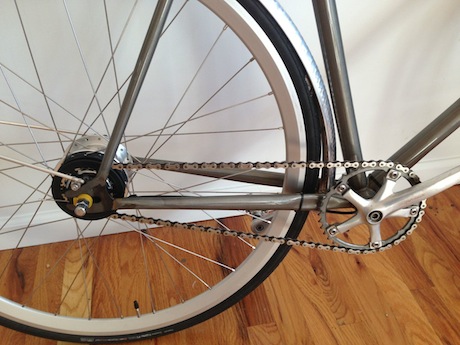
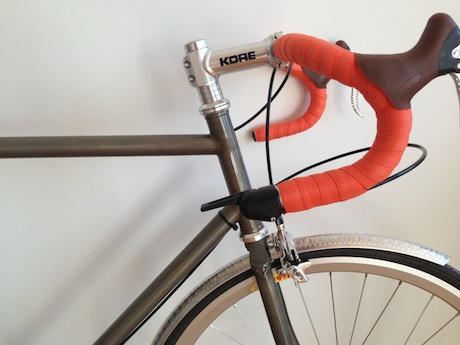
Next, I wanted a bike that was almost maintenance free, so I decided to use a Shimano Alfine internal 8 speed rear hub instead of a derailleur-based drivetrain. It’s a bit heavy, but it shifts flawlessly and 8 speeds is enough (don’t ask Petersen what he thinks of 33 speed drivetrains). Because I wanted to use drop bars, I purchased a bar-end shifter from a company called JTek Engineering.
jtek-shifter

The rest of the bike is a smattering of new and old parts stripped from my previous bike: A Dura-Ace crank, Mavic front hub, Velocity Deep V rims, Panaracer tires, Ritchey seatpost, Selle San Marco saddle, Cinelli bar, Kore stem, Tektro brakes. When all was said and done, the bike cost around $1400 (I saved a little money using old parts).

I love the way the bike rides, fits and–I’ll admit it–looks. I make up excuses to ride it. And therein lies my point: When we get the stuff we want–whether it’s a bike or a frying pan–we use it, cherish it and take good care of it. A bike just happens to be an important piece of stuff in our estimation. And while this cherished stuff might be a little more expensive (or not), as we like to say around here, “If something costs twice a much, but lasts four times as long [or is used four times as much] it’s effectively half price.”

None of this is an excuse to spend money needlessly. Nor is an excuse for a superfluous upgrade. And many may find a cheap bike they can safely lock outside serves their needs better. Likewise, there are many great bikes under $1000; if you know a thing or two about bikes, buying used can be a sound idea. We’d also be remiss not to mention bike sharing. For many city-dwelling bike commuters, systems like NYC’s Citi Bike effectively eliminate the need to own a bike at all.

For the rest of us who don’t live near a bike sharing system or have long distance commutes where a personalized bike makes a difference or just like riding our own bikes, we think making an investment on a bike you love and will ride is a good one.

[Full disclosure: In my previous life, I worked at five bike shops, crossed the US and a few other countries by bike and have generally been an advocate of bicycles.]

11 Steps for Choosing the Right Roommate

The fact is many of us can’t afford to live alone–at least not in places we want to live. Roommates hold the promise of cost and space efficient living; they may even be a way of making new friends. They also hold the possibility of living in some pretty crappy situations: living with slobs, deadbeats, Chatty Cathies, etc. These situations can make us dread going to the one place that’s supposed to our refuge.

While there are a number of professional roommate-matching services, the vast majority of us DIY it on Craigslist or reaching out to our personal networks. Whether you are looking for someone to move in with you, or are looking to move in with one or more people, a little bit of planning and forethought go a long way. Here are a ten tips we suggest for creating a happy, functioning roommate situation:

  1. Think ahead. If there’s one factor that leads to more horrible living situations than any other, it’s haste. You find yourself needing a place to live yesterday, and suddenly you are rationalizing living with the guy who can’t stop talking about his pet boa constrictor. And while many good people find themselves on their ass needing a place to live ASAP, as a rule, people who plan ahead, seeking out their roommates a month or two in advance, are also the kind of people who pay their bills on time and are considerate to the people they live with.
  2. Get habituated. Find out how your prospective roommate(s) live. Do they watch a lot of TV? Stay home all the time? Never home? Like hanging out? Like being alone? Work all of the time? Like loud music? Hates loud music? Vegan? Partiers? And so on. Get as much information as possible before you move in together. No one will be a perfect match, but honestly ask yourself if, on balance, these habits are things you can live with.
  3. Pay attention to the details. Looking for a potential roommate is like dating–only more intimate. Don’t dismiss the red flags. Look and listen for tip-offs for how the other party lives. If you’re at their place, are there dirty dishes in the sink? Excessive beer cans in the trash? More than one game counsel attached to the TV? Did the prospective roommate bring up his/her jealous ex more than three times during your interview? Maybe these things are coincidences, but probably not. If you notice more than a couple red flags, chances are these things will get worse with time and exposure.
  4. Come clean. Few things can be as contentious as cleaning habits, as everyone has a different idea of what constitutes clean. Do you expect your house to be spotless and tidy all of the time? Are you okay with a little clutter? Are you a slob? There is no right way of living, but it’s important people’s habits are similar. If you’re trying to assess how clean someone is in an interview, ask about his/her cleaning habits. If she says “it’s not a big deal,” she is probably pretty messy. If he suggests a regular cleaning schedule or splitting the cost of a housecleaner (a very good idea), he is probably a neatnik. People can have different politics and tastes and live felicitously together, but if you have mismatched cleaning habits, forget about it.
  5. Money talks. Besides dirty dishes, money matters can strain an otherwise happy roommate situation. Get with your prospective roommate about every bill, the portion expected to pay and estimated monthly amounts. Get reasonable assurance that all parties have the ability to pay for said bills (employed roommates tend to be preferred). This is a good time to bring up food costs. Some roommates are okay with sharing food and food costs, but many are not. Get clear how you want to handle that.
  6. Friends are good…sometimes. Just because your good friend needs someone to live with, it doesn’t mean it should be you. Many friendships have been destroyed after living together. Treat your friend as you would anyone else–honestly evaluating whether he/she would be compatible with your lifestyle.
  7. Do a background check. This might seem a bit cold, but the fact is unless you’ve known someone for a while, their history can be quite iffy. Running a credit report or criminal background check can help ensure you’re not moving in with an unsavory character. If someone objects, particularly to a credit check, you might ask yourself why.
  8. Find a space that works. Apartments where autonomy is possible–e.g. large bedrooms to retreat into–tend to work best in roommate situations. This is not always possible or needed–many roommates are never home and having a ton of space is irrelevant. Just try to find a space that works with your respective lifestyles.
  9. Determine how the place is decorated. This is usually pretty straightforward; the person with the apartment to move into will usually provide furnishing. If you are particular about your décor, let it be known up front.
  10. The finer points. If you’re moving into an unknown space, think of all possible things that can go wrong: Roaches and bedbugs (particularly in big cities), neighbor and street noise, superintendent responsiveness, any back bills…whatever you can think of, ask.
  11. Sign on the dotted line. When you’ve found someone you think you can live with, put as many of the terms in writing (there are many standard forms available online). Informality and vagueness never pay.

What would you add to this list? Let us know in our comments section.

MacGyver and Martha Stewart’s Love Child

If you live in a small space in a major city, there’s a good chance you rent. As such, optimizing your space can seem like a questionable proposition: You want to make your space your own and livable, but you don’t want to spend a ton of money on improvements that will be scrapped when you move. Isabelle LaRue of Engineer Your Space has you covered, providing DIY solutions for cost-and-design-conscious small space dwellers.

As the name implies, LaRue is an engineer–a building engineer to be precise. Like most great ideas, EYS was born out of creative solutions for dealing with limited resources. When she moved to New York City, she traded a spacious two bedroom apartment for a 450 sq ft rental studio. She brought her engineering expertise to bear in making the little space functional, stylish and personal on a budget befitting rental renovations. She calls her approach, “MacGyver meets Martha [Stewart].”

Most of her projects require basic to moderate carpentry skills and understanding. One of our favorites is a room divider using the IKEA Kvartal Track System; it’s a bit more involved than many of her projects, but creating room division in a small space is a pretty critical function (we assure you the $252 spent to make it was far less expensive than the one in the LifeEdited Apartment).

LaRue features a number of other videos on decorating, lighting and tiling; she includes materials and costs for completing the projects on her site. She also has some quick tip projects like this magnetic spice rack made from a pizza pan.

diy-pizza-pan-spice-rack

While installing a built-in moving wall might be the best way to optimize your small apartment, most of us don’t have $20K sitting around to make that happen. For those of us willing to measure twice, cut once, Engineer Your Space is a great resource for renters and owners alike who want to milk every bit of utility from our small space without spending a lot of money.

10 Ways to Deal with (Not Beat) the Heat

Most residents of the northern hemisphere need no reminding that it’s summer. Across the globe, temperatures are high and show no signs of abating.

A big part of editing our lives is learning to live happily within our financial and environmental means. But sometimes heat can make us do things that compromise both of those objectives: Blasting the A/C 24/7, buying countless plastic bottles of water and expensive, heat-trapping skinny denim jeans.

Here are ten suggestions for getting comfortable in the heat without increasing your carbon footprint and buying additional equipment (unless you don’t have a fan):

  1. Surrender to the heat. Heat exhaustion and dehydration are real things, but often what’s most uncomfortable is our psychological reaction to heat. We think we should live in a 72 degree, climate-controlled world. Any deviation from that temperature is problematic. It’s summer. It’s supposed to be hot. Nothing’s wrong. Often surrendering to the heat, not beating it, is the path to finding comfort in elevated temps.
  2. Be a fan. Before you crank up the A/C, try a fan. They’re effective in keeping you cool and consume far less power than an A/C. If you have multiple people to cool, buy multiple fans. Ceiling fans are great too, though some assembly is required.
  3. Dress the part. We realize some people have professional sartorial obligations, but for those of us who don’t, or for those of us who do, but do not spend our every waking hour at work, there are shorts, sundresses, tank tops and a host of other seasonally-appropriate garments. Strategies differ: Some prefer taking it all off, others covering it all with lightweight material. Either way, the notion that we should be wearing the same pair of heavy denim jeans in July that we wear in December needs to be eradicated.
  4. Learn to sleep without blankets and/or clothes. Many of us find sleeping in the heat difficult. And while the weight of a down blanket coupled with breathing in icy air might be our preferred sleeping condition, it is possible to sleep in the heat without any type of covering whatsoever. For some of us it takes training, but it can be done. If zero covering is too extreme, try using only a top sheet and your undies. Gradually remove layers until you’re comfortable with nothing–it helps a lot.
  5. Take the edge off. Many will read all of this and still choose to run the A/C–a logical move if our interior temps approach triple digits. Rather than creating a winter wonderland in our homes, set the A/C to the highest possible temperature we can stand (usually between 77-80 degrees). It’ll save money, create fewer greenhouse gasses and create less of a jolt when you enter the oven of the outside world.
  6. Check the clock. Stay out of the sun and heat during the middle of the day when it’s hottest. There’s a reason most hot-summered countries include a siesta in their days. If you exercise outside, try waking up around dawn when temps are coolest.
  7. Get outside. Excepting the influence of A/C, it’s generally going to be cooler outside. But don’t just go anywhere outside. Shade is always preferred to being in direct sunlight. The best spots to hang are around heat absorbing trees, grass fields and large bodies of cool water, which act as nature’s air conditioners.
  8. Drink up. The Institute of Medicine recommends men drink 3 liters of fluid a day and women 2.2–12 and 9 cups respectively. This is without accounting for high temperatures, individual physiology, etc. Err on the side of hydration and always pack a big water bottle or bladder-style hydration system; in other words, don’t get stuck in the middle of nowhere without water. It doesn’t need to be cold to hydrate either–your body warms or cools everything to 98 degrees anyway. Oh, and water rich foods–most fruits and veggies–help you with the water intake.
  9. Come to terms with sweat. Somewhere along the line, sweating got a bad name. We suppose it can be smelly and drench our clothes. But few things are as natural as sweating. Conversely, few things are as unnatural as avoiding it–acres of air conditioned spaces, pore-clogging antiperspirants. As Mat McDermott put it in Treehugger, “For the sake our ourselves, our society and our planet we need to seriously get past worrying about sweating in public” (Treehugger has a whole series devoted to keeping cool). If you must (and you probably should) carry a towel and possibly some deodorant (not antiperspirant) for more polite society.
  10. Adjust your pace of life. We know this is easier said than done for most, but summer is a good time to be a bit more languorous. Take it easy when it gets super hot. Nothing ensures a wonderful summer like low expectations.

Dog cools down image via Shutterstock

3 Principles from Burning Man for Living An Edited Life

Unless you’ve been living under a big, not-so-black rock, you know at least something about Burning Man. Beginning the last Monday in August in the desert of northern Nevada, the week-long extravaganza has become synonymous for all things crazy and spontaneous.

But underneath the irreverence and incomprehensibility are lessons we can all take home–lessons that make life simpler, more functional and happier. Here are a but a few:

  1. Use what you need.  You think different about consumption when you have to port a week’s worth of stuff in and out of the desert. Ask yourself, “What if I had to pack everything I needed to live for a week into a car?” Would you take that apple peeler or might you use a pocket knife? On the other hand, we might decide that we can’t live without that 104 ft effigy. This use-what-you-need principle also applies to the amount of space we need. Personal space is a joke at BM, yet people live joyfully together. This is not to suggest we give up personal space altogether, but it might suggest that we often put too high a premium on it and undervalue personal connection via physical compression.
  2. We have what we need when we share. Burning Man is almost totally non-commercial, relying on a “gift economy.” People exchange food and wares (and many other things) without a single dollar changing hands. Back at home, your neighbors might get sick of you mooching dinner every night, but they might not mind lending you their muffin pans or power drill. Sharing enables human connection and less stuff to be used more.
  3. Architecture is anything you want it to be. You don’t necessarily want to live in a 120 ft hexagonal temple, but looking at the Burning Man structures shows that anything is possible with a little imagination. We are not bound to particular architectural rules and orthodoxies. We can create where and how we want to live in the future.

Are you a Burner? What have you learned from BM that makes your life simpler and happier?

image via JoJo Electro

This post was originally published on April 20, 2012  

Be > Do > Have

Most of us want something. Maybe it’s a car, a super cool micro-apartment, a certain amount of money, a great job…whatever. We think that once we have this something, it will enable us to do something. Once I have money, I will get myself out of debt. Once I have a car, I will drive it down the street for my friends to see. And when we do that something, we will be a certain way. Once I’m out of debt, I will be secure. Once my friends see me in my new car, I will be respected. The formula is HAVE > DO > BE.

Have-do-be is the force that has launched a thousand ad campaigns. Buy (have) our deodorant > nail (do) that presentation > be confident. The ad folk don’t believe most of us will buy their products based on utility alone; e.g. you should buy our deodorant because it will make you smell better. No, their products have to change who we are in some fundamental way–if we are insecure, we will become confident.

But it doesn’t work, does it? The deodorant wears off and our insecurities return.

The difficulty is that nothing outside us will ever change our insides in any meaningful way. This is not an admonition for buying stuff. That deodorant might make us smell more pleasant, but don’t expect anything beyond that. If we as a society understood the limitations of our material goods to affect our state of being–whether it’s a stick of deodorant or a McMansion–we’d probably need to have a whole lot less.

There is an alternative model. It’s BE > DO > HAVE. Start from a place of existential wholeness. Realize you’re lacking nothing and be confident. Nail (do) the presentation, or whatever confident people do. Have whatever you need to support your state and the actions it entails. Rather than presupposing what will make us confident or the things we’ll do under the spell of that confidence, we can have things as-needed. Maybe that deodorant will help us nail that presentation, but maybe not. When we begin to understand the limitations of our material goods, we start acquiring stuff on an as-needed basis, not a this-will-change-my-life basis. This leads to a lot less stuff and, perhaps just as important, a lot less disappointment–we finally stop expecting our stuff to make us happy.

image via empowernetwork.com

Save Time, Be Happier, Eliminate Choices

Thewirecutter.com is an electronics buying site that presents what they consider the best option for various categories. You want a laptop? Buy a Macbook Air 13″. Want a cheap digital camera? Buy the Panasonic Lumix DMC-SZ7. And so on.

The site runs counter to the notion that more choices leads to more happiness. Whether we’re choosing a TV, car, job, home, husband or wife, there’s an assumption that more options means we can get the thing that’s just right for us. When we have that right thing, all of problems will disappear.

But what happens? There are 30 different 30″ flat-screen TV’s at the same price; 10 mid-sized sedans, all about the same price and performance; several attractive partners. Because there’s such a bounty of options, many of us get what is called analysis paralysis (also called option or choice paralysis). We either make no choice at all or take ages to choose. When we do choose, we are often beset with doubt, wondering whether we chose the right thing. In this way, more choices can lead to wasted time and misery, not a trouble-free, tailor-fit, happy life.

This phenomenon was made popular with Barry Schwartz’s book and subsequent TED talk called the “Paradox of Choice: Why More is Less.” In a nutshell, Schwartz asserts that the myriad choices modern life presents us more often lead to anxiety than liberation.

This phenomenon holds true even when the increased choices do deliver a better, more personalized product. In his TED talk, Schwartz uses fitted jeans to demonstrate the paradox of choice. Sure, the newer, tailored jeans fit better than the stiff, ill-fitting, one-size-fits-all variety of his youth, but the amount of time spent finding the new variety, the amount of mental energy used choosing them and the amount of money spent paying for them undermines, if not negates, their benefits. In other words, psychological expenses often outweigh material gains.

In the ever-changing, option-laden world of electronics, The Wirecutter is a great tool for sparing yourself from analysis paralysis. The items are curated by expert reviewers who do a ton of analysis and know this stuff way better than most of us. They do present alternatives in case their main suggestion is way off base for a particular user.

The fact is that with any choice, there will be multiple “right” choices. An iPhone or a Galaxy S III will both ably fulfill your smartphone needs. There is no one right choice. At a certain point we must accept opportunity costs and make the best decision based on the information we have at our disposal.

Are you confronted with a choice? Here are a few suggestions to avoid getting trapped in vicious choice circles:

  1. If what you currently have works, consider staying with that. Sometimes the best choices are the ones we already made. Like a particular type of shoes? Get another of the same type. Like your laptop, get the newer version. Sure, there might be better ones out there, but finding them might be more trouble than it’s worth.
  2. Consult the experts. If you don’t know what to choose, find a reliable, robust source of data like The Wirecutter or Consumer Reports. Amazon reviews can be helpful, though not always; be sure to check out the one and two star reviews to see why people don’t like something. Remember, nothing will ever be perfect.
  3. Decide a set amount of time you have to decide. This is important. Sure, bigger decisions might require more time. You might wait more than a week to propose to that girl. But eventually decisions must be made.
  4. Make a choice and live with it. As with any choice, there will be better options we can’t make for whatever reason (insufficient information, finances, etc.). All we can do is make the best choice we can in the moment and get on with our life. Often the best choice is the one that is made.

Via PSFK

This post originally posted October 24, 2012

6 Questions to Ask Yourself Before Doing Anything

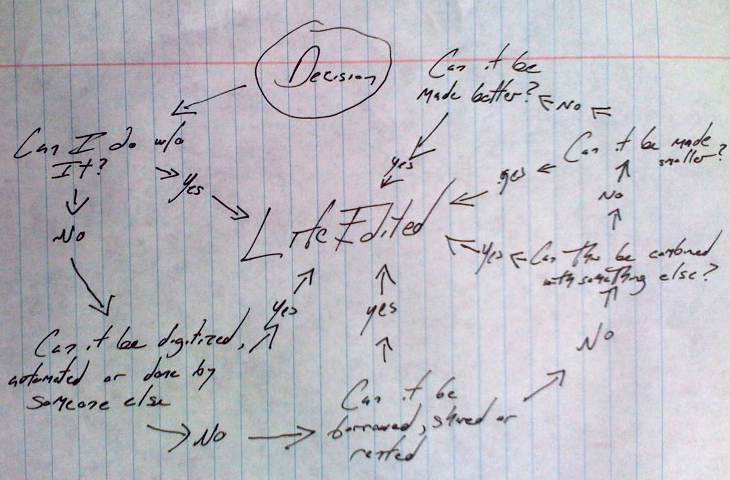
Life involves decisions: left or right, black or white, big or small, to be or not to be. While we don’t want to be too prescriptive as to what constitutes a “LifeEdited” decision consistent (it looks different for different people), we have some fairly universal questions to ask yourself when in decision mode.

Below are 6 questions that work for almost any decision–whether it’s about tasks, purchases, work, recreational activity, etc.

Note: the questions are sequential; if you answer yes to one question, you don’t need to answer the following ones. For example, question #1 is “Can I do without it?” If you answer “yes”, then it’s pointless to ask the following questions because there is no longer and decision to make.

Here they are:

  1. Can I do without it? This should be the gatekeeper for all decisions. Nothing simplifies like elimination. Do I really need this? Do I really want this? Do I really have to do this? Look at the full picture, e.g. you might want a Porsche, but don’t want to pay for it. You might want an opulent lifestyle, but don’t want to work so hard to get it. Doing without leaves us less to maintain, manage, clean, pay for, and so on. It also allows us to pay closer attention to the things we can’t do without.
  2. Can it be digitized, automated or done by someone else? This question removes spatial or temporal volume from our lives. You might need an item or something done, but ask if it can take up less space and time. Can your old tax returns be put on PDF’s? Can your bills be put on auto-pay? Might you be better off hiring someone to fix the toilet than doing it yourself? Our lives are often lost in teaspoons–small purchases and tasks that eventually create great mounds of clutter and confusion. Seize every opportunity to reduce volume.
  3. Can it be shared, borrowed or rented? For most of the 20th Century, ownership was the aim. But today, there are many great ways of accessing and using without the burden of owning. Ask yourself, is it totally necessary to have fulltime possession? If you only need a car once or twice a week, might it make more sense to use Zipcar rather than keeping a car on standby? Can you borrow a dress for that event? Possession requires maintenance, storage and money. Some things are worth that price. Many are not.
  4. Can this be combined with something else? Can that table also be my desk? Can I get a Murphy bed instead of a traditional one? Can I pick up my laundry and groceries? If we’re going to get or do something, why wouldn’t we make it as efficient as possible?
  5. Can it be made smaller? Assuming you need to have or do it, assuming it can’t be digitized, borrowed or be made multifuctional, can this be smaller–either spatially or temporally? Can I find bowls that nest or tables that stow? Can I spend less time paying bills, weeding through junk mail or email? Less space and less time equals more room to live.
  6. Can it be made better? You can apply this question to all fields. If you’re buying stuff, remember that something might be twice as expensive, but if it lasts 4 times as long, it’s half-priced. Wherever possible, get the good stuff you like. Same principle holds true for tasks. If you’re going to do a job, why not do a high quality job? It might take a little longer in the short-term, but save time and energy in the long. This question asks, “What would your life be like if everything you had and did was of excellent quality?”

This post was originally published on June 20, 2012

6 Gift Ideas for a Stuff-Free Mom’s Day

As you may know–or should know–this Sunday is Mother’s Day. Like most holidays, Mother’s Day can present a challenge to the full-fledged or aspiring life editor/minimalist. You want to acknowledge and show appreciation for the mother in your life, but you don’t want give a perfunctory gift that’ll end up clogging her closets with useless or ephemeral stuff. This holds true whether she’s a minimalist herself or not…actually, it’s true especially if she’s not.

We’ve said it before, but giving experiences–not stuff–is the best bet for a memorable gift. Beside the benefit of having no physical volume, giving experiences won’t seem like a political statement when given to the more maximalmist mom.

Here are a few experience-based gift ideas to create memorable, clutter-free Mother’s Day (Note: Wherever possible/logical, share the experience with mom by doing it with her. It’s about honoring her, not getting rid of her):

  1. Give a class. Cooking, yoga, sewing, woodwork…heck, Photoshop or HTML. Nothing is as durable or lasts as long as knowledge. It’s fireproof, waterproof and takes up very little space…as we saw the other day, learning something new might even extend her life.
  2. Give a walking tour. Almost every city has them on a variety of subjects; many non-urban areas have through places like gardens, parks, historical sites, etc. It’s a great way to get to know where you live while getting some exercise. Bring some food and make it a picnic.
  3. Pamper her. Send her to a day spa, purchase a professional massage, set up a fancy haircut, give Reiki sessions or a mani/pedi, depending on mom’s idea of pampering.
  4. Go on date. This works best with a mom you’re romantically involved with–especially if you are both still in the trenches of child-rearing. Get a babysitter and take her out to someplace you think she’d want to go–dinner, movie, play, park, etc. Don’t ask her where to go if you don’t have to. Mothering is rewarding, but it’s also hard work filled with many decisions. Give her a break.
  5. Write her a letter/poem. I know it sounds kinda meager, but how often do you receive a thoughtful letter or poem (not just a card) that conveys how much someone loves and cares about you? Almost never, right? Trust us, this one is a winner.
  6. Ask her what she wants. This one is for a specific type of mom: One who will actually tell you what she wants. This may or may not entail getting stuff. However it is possible to get stuff that isn’t junk. If you think there’s something she’d like but might not be forthcoming in saying what it is, be persistent or ask around. And keep a receipt.

Do you have other Mother’s Day gift ideas that don’t leave a wake of clutter? Let us know in our comments section. Thanks!

Image: “Mom Tattoo” via Shutterstock

6 Bits of Dorm Room Wisdom that Can Be Applied to Any Life

For many of us, college was one of–if not the–happiest time of our lives. It was a time when meeting people was easy. The world was full of possibility. We traveled light. Everything seemed new and exciting. We were unshackled from the chains of parental guidance.

Then something happened. We moved off campus. We graduated. We got jobs, donned suits, got married, had kids, bought cars, acquired homes with yards. We suddenly had little time for friends. We got stuff–lots of stuff. And endless possibility was replaced by endless routine. We became our own restrictive parent.

While many go back to school to recreate these halcyon days (read: MFA), there are lessons we might learn from our former, freer selves–lessons that can be applied without going back to school and to lives that include careers, children and regular bathing. Here you go:

  1. We live to connect. This is surely the most important aspect of college life. Many of us made lifelong friends in college, and studies have found that humans with high degrees of social interaction live happier, longer lives. It also found the converse to be true: For example, people who live with low social interaction suffer the same health hazards as someone who smokes 15 cigarettes a day. The beauty of the college experience is that connection is in the architecture: Long hallways, small rooms and compact campuses help create collisions of connections. Many corporate campuses nowadays try to replicate this phenomena.
  2. We don’t need that much living space. The typical American dorm room is around 180 sq ft, and often that space is shared with a roommate. The amount of space humans need is very plastic. In fact, the average American takes up three times as much as space as he did 60 years ago.
  3. Privacy is overrated. It’s funny how we often think fondly of our dorm days–days sharing a tiny room, traveling down the hall to go to the bathroom and eating in large cafeterias. Sure, there were times when the lack of privacy wasn’t so great. But many of these low spots trained us how to live with others. Despite the benefits of public living, many of us strove to make our post-grad homes into fortresses of solitude. Everyone needed their own space–all resulting in more isolation and less connection. Face it, you want to be around people–even when you think you don’t.
  4. You don’t need that much stuff. Remember all of that great stuff in your dorm room: The sandwich press, your 50 state silver spoon collection, your 10 speaker surround sound system? Of course you don’t, because you didn’t have that stuff. You had a clothes hamper and a boombox you cherished, and you were just fine.
  5. Learning is good. Sure, you might have not been the most attentive student, but we bet you learned something–even if it was unconsciously picked up while you slept in class. Research is showing that we can improve mental health and even ward off degenerative disorders like Alzheimer’s Disease through learning new ideas and skills such as a language or instrument in later life.
  6. Walk more, commute less. In our college days, everything was close and we walked everywhere. A growing body of evidence suggests that commuting makes us miserable. Take a tip from the student and ditch the car wherever possible.

College Student Image via Shutterstock.com