Have We Reached ‘Peak Stuff’?

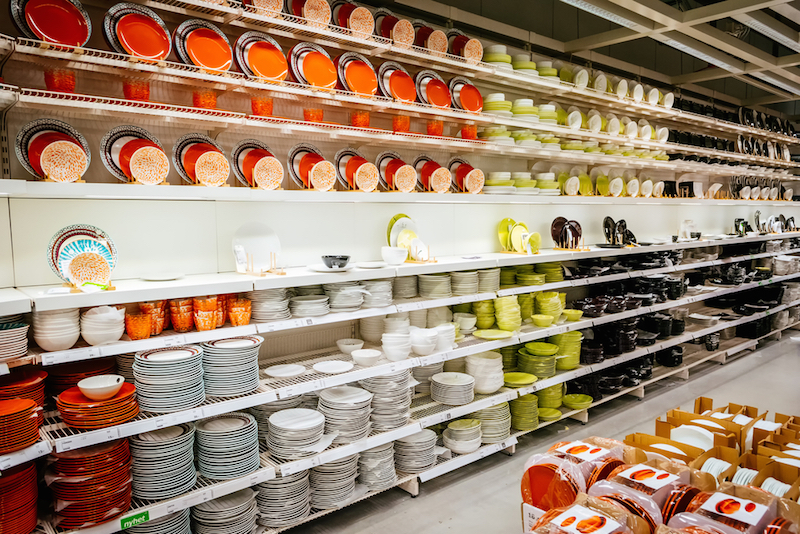
Make no mistake about it, the world still abounds with tons of stuff, but if we were to believe some, we might be approaching a state of “peak stuff”–a state where we have capped out our appetite for extraneous candle holders and handheld blenders. Ironically, one of the exponents of peak stuff is IKEA’s Chief Sustainability Officer Steve Howard, who, the other day, was on NPR talking about this theory. He thinks that the “total material impact of society in the West…[has] probably just about peaked.” He explains:

If you look at things like oil–well, actually, oil sales have peaked in the U.S. and Western Europe. Beef sales have pretty much peaked. Sugar sales have pretty much peaked. You can see trends in things like cars where young people, they’re getting their driving licenses either later or not getting them at all. This trend’s very broad across society….and we’re [IKEA] not immune from the trade. Obviously, you know, there are still people who don’t have–who have very limited means who would like significantly more stuff. But broadly, you saw a tremendous expansion in consumption and people’s livelihoods through the 20th century. And the use of stuff is plateauing out.

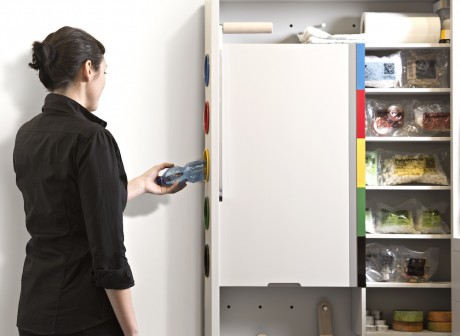
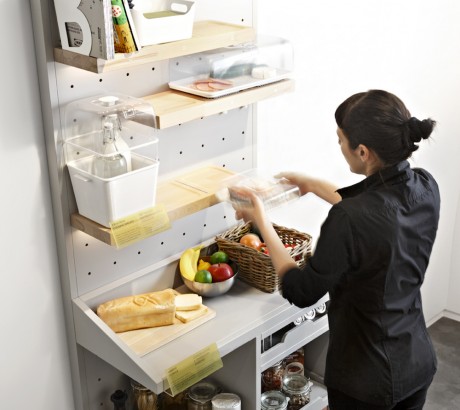
This is not the first time IKEA has addressed matters of reduced consumption. Their 2025 kitchen concept envisioned a future with far less food and space than the present. But the implications of peak stuff on the retail behemoth are unclear. Asked if IKEA–easily the single largest purveyor of stuff–would scale back its operations in the west and ramp them up in developing nations, Howard said, “We still want to meet more customers and to make ourselves much more accessible, so we’ll actually expand in the U.S. and still in most markets in Europe.”

His stance is that if there is going to be stuff, that that stuff be from IKEA, which has launched programs to promote reuse and responsible disposal in a number of its European outlets. He said that people want to reuse, recycle and generally make their stuff last as long as possible, but they often lack the channels to do so.  

We hope Howard’s theory is correct as the planet–and some might say the human psyche–is buckling under the weight of our obsession with accumulating stuff.

There are many indicators that we have reached peak stuff: minimalist sites like ours, the media’s obsession with tiny houses and so forth. But we realize as well as anyone that ours are minority views. That said, these things might be suggestive of what writer William Gibson once wrote, “The future is already here–it’s just not evenly distributed.”

What do you think? Have we reached peak stuff or is this a clever turn of phrase that will have little, if any, market impact?

Image credit: nomadFra / Shutterstock.com
IKEA Takes on Transforming Interior Design and Furniture

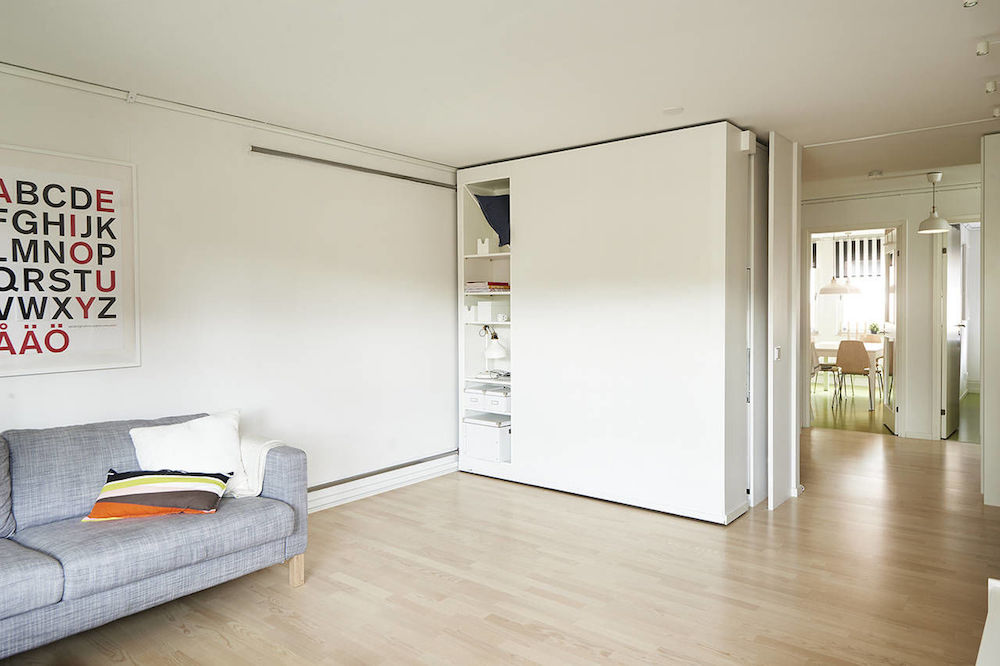
The moving wall in the LifeEdited apartment was one of its most innovative and useful features. Not only did it house an office, a projection screen and a bunch of storage, but moving it out divided the studio space into a three room apartment. A lot went into its design. The carriage and track were custom made by Modern Office Systems–a company whose stock and trade are library walls and corporate file storage. The track had to be attached to the floor joists and the rails were built into the floor. The cabinetry on top of the carriage was all custom made as well. All of this put the cost somewhere around $23K, which doesn’t even include the cost of installation. It was money well spent, but it was a lot of money nevertheless. If you want all the moving wall functionality without the huge pricetag, IKEA (who else?) might have you covered. For the last couple years, their R&D department has been concepting their own moving wall that could bring transforming interior design to the masses.
ikea-moving-wall-open

The wall system has been set up in an apartment in Malmö, Sweden. Sweden, like many places, has been experiencing a real estate crunch and IKEA has been looking for ways to bring cost-effective ways of maximizing space. According to the Wall Street Journal, IKEA has let eight families, of varying compositions, take turns living in the apartment. Mikael Ydholm, IKEA’s head of research, says the design team has been tweaking the design as much to the participants’ emotional response as its functional value. Ydholm is quick to point out that the design is still a concept and a good three years out from production.

The WSJ spoke to PKMN’s David Pérez, who knows a thing or two about moving wall. He expressed suspicions about the wall’s viability. “The most important thing is not the movable wall,” he told them. What he is referring to–which are exactly the challenges LifeEdited faced installing our wall–are the myriad other considerations when installing such a large piece of furniture into your space: making sure there is a constant distance between floor and ceiling, making sure your floor can support the weight of the wall, installing supports to make sure the wall doesn’t tip over and especially electrifying the wall. In PKMN’s MJE House that we featured the other day, the moving wall pivoted on an axis, making it relatively easy to electrify (easy for me to say) as their was a fixed point to run electric through. In the LifeEdited apartment, because the entire wall moved, we had to run a retractable extension cord as creating an electrified “third rail” was neither feasible nor safe.

All that said, the concept is pretty badass and I could imagine IKEA producing some sort of simplified, un-wired storage on casters. More than anything, it’s exciting to see such a large company thinking about how furniture and interior design can allow people to extract more function out of their existing spaces.

Via Apartment Therapy

Tiny Flat Celebrates Less

Magical things can happen when people see small as a choice rather than an unfortunate situation. The latter person will be unlikely commit to her life. Her home, stuff and attitude will reflect a resentment that she can’t afford a bigger place. But one who chooses ‘less’ will commit. She will make things work to their utmost extent. She will use her limited resources as a crowbar for opening creative potential. I can say with some confidence that Polish designer Szymon Hanczar is someone who chooses small. His 140 sq ft flat is a celebration to commiting to living small and light.

There’s not much to be said of the apartment that can’t be seen in the photos. There’s one closet that could fit a very pared down wardrobe and, amazingly, a tiny washing machine to clean that wardrobe. There’s a super tiny kitchen that looks useable, though not necessarily ideal for preparing large dinner parties. There’s a white tiled “wet” bathroom that is next to the kitchen. And there’s a sleeping loft.

So far as I can tell, almost all the furniture was purchased at IKEA. The chair is the TERJE. That’s a MALM dresser. I suspect the innards of the cabinets are from the PAX system. Not sure if the table is IKEA. This is cool in my opinion. It shows that you can make a beautiful, livable space with limited funds and very limited space.

Via Design Milk

Photo credit: Jędrzej Stelmaszek / grappastudio.pl

IKEA Looks Toward the Future of Food

Whatever your thoughts about IKEA may be, it’s tough to argue with their influence. With 351 gigantic stores in 46 countries, they are a force to reckon with. Given their corporate girth, it makes sense that they are thinking about the future. In a bit of prescient marketing, IKEA teamed up with design consultancy IDEO and design students at Lund University and Eindhoven University of Technology to create a concept kitchen for the year 2025. The concept is a bold move. Rather than envisioning a future characterized by boundless resources, IKEA chose to contend with the more probable future–a future where we will be living compactly in cities and have limited space, where water and energy will be precious commodities, where food prices will increase dramatically, where resource intensive meat will be replaced by “protein”, where on-demand food delivery will become the norm (see all assumptions about the future here).

Concept-Kitchen-2025-at-IKEA-Temporary-Disposing-Thoughtfully

The compact kitchen features a host of innovative ideas. There’s a sink that catches organic matter from the drain; that matter is then composted and formed into pucks that are picked up by municipal waste management. Waste water is recirculated to water plants that sit on top of the kitchen unit. There’s a recycling system that will separate waste by material, then crush and scan the material for contaminants. The waste will then be vacuum packed and sealed in a bio-polymer tube with a thermo-printed label that will record what has been used and whether it can be reused. There are a host of food storage systems that don’t require refrigeration or disposable packaging.

Concept-Kitchen-2025-at-IKEA-Temporary-Storing-Visually-1Concept-Kitchen-2025-at-IKEA-Temporary-Table-closeup

The highlight of the project is the smart table. It’s is a dining, cutting and cooking surface that will be able to identify whatever ingredients are placed on the table. It will then come up with recipes and project them onto the surface. And rather than weighing things out, a built in surface scale will measure for you.

I’m not entirely convinced the smart table is an improvement on the dumb old cutting board, but the other stuff is pretty nifty and makes a ton of sense. Overall, the kitchen is a heartening sign that mainstream corporations might be able to look at the future without closing their eyes.

Let IKEA Help You Get Off Your Butt

You know a furniture concept has hit the big time when IKEA has co-opted it. Such is the case with the BEKANT standing desk. The Swedish furniture behemoth is offering the automatically adjustable table in their stores and online starting at $469. The table surface is a rectangle measuring 63 x 31 1/2″. It looks like there will be a corner shaped version as well, though we couldn’t find it on their website. Height is adjustable between 22″ and 48″–the former number being about 8″ below standard table height. We think the ability to sit or stand makes it more likely to be used. It comes in a variety of finishes and has available screens to close it off from invading colleagues. It also carries a ten year warranty on the motor.

There’s not much more to say about the table. It’s designed to be used at offices, so it’s not particularly attractive, thought it’d work as a dining table in a pinch.

But we’ve said it once and we’ll say it again, excessive sitting is a pretty serious health issue. Studies have shown that people who sit less than three hours a day live an extra two years (read more: “Statistics That Will Scare You Sit-Less“). At the end of the line, most of us will probably wish we had those two years and the price–i.e. standing, something we as a species did for millions of years–will have seemed like a bargain.

IKEA Bets Big with Small

Consider this: IKEA is the world’s single largest consumer of lumber. In 2012, they sold $37B of furniture across their 349 stores in 43 countries. Love em or hate em, odds are, at some point in your life, your butt has sat on a chair whose name has an umlaut in it. So when this furniture behemoth throws its might into small space living, it’s a big deal.

IKEA has already given considerable energy to small space living. Many of their showrooms feature mockups of small apartments to show what’s possible with their furniture. However, it can sometimes seem like they are shoehorning big furniture in small spaces. Now, they’re going further, designing their PS 2014 collection specifically for compact digs.

The collection is called “On the Move,” so named for the urban, mobile customer it’s designed for–customers who might lack a big space and budget, and for whom the ability to port his or her furniture from one apartment to the next is a big plus. The collection’s promotional video (above) shows young folks carting their furniture around by foot, pedal and public transport.

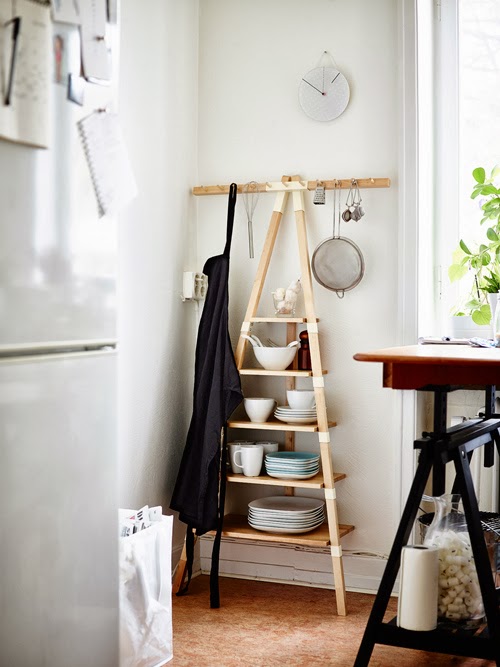
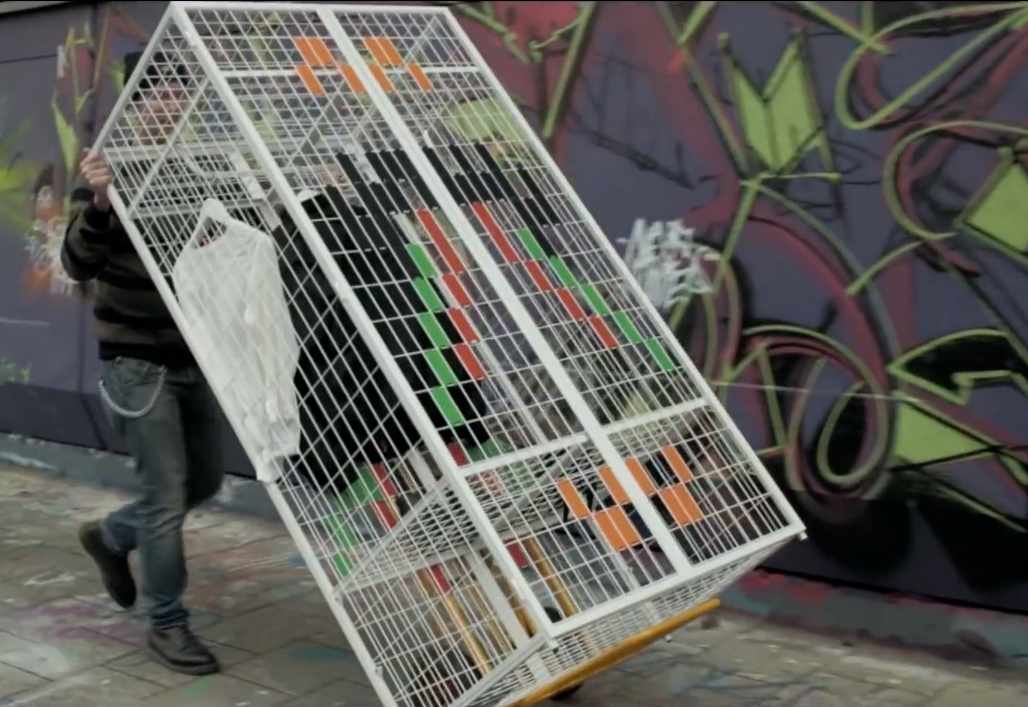
There are a number of pieces such as the leaning kitchen rack and wire wardrobe that are both lightweight and ideal for spaces with minimal or no builtin closets (a common scenario for many apartment dwellers).

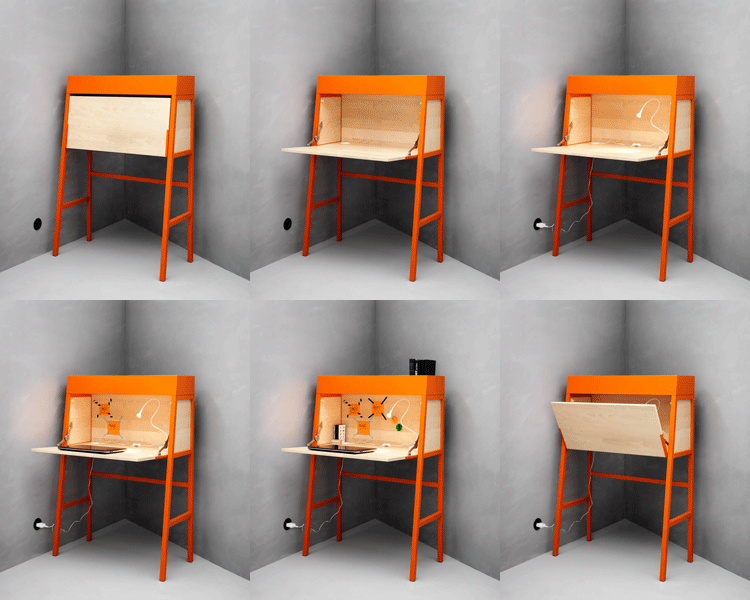
ikea-desk

Beyond being lighter to move from place to place, the collection’s skeletal designs seem to rely less on the clunky, warping, delaminating particle board that is the hallmark of IKEA furniture. In its place is more metal and solid wood, which we imagine will hold up a lot better over time–a good thing even if the typical buyer of this stuff might not be thinking longterm.

NEW_TRAY_TABLEIt’s easy to dislike the idea of a big multinational corporation homogenizing our global interiors. But when that same corporation brings good design and quality to large populations at reasonable prices, it deserves to be taken seriously. We think the PS 2014 collection is pretty cool and will work for the way a lot of people live nowadays. It’s set to release in stores April 1.

Let us know what you think.

DIY IKEA Room Divider

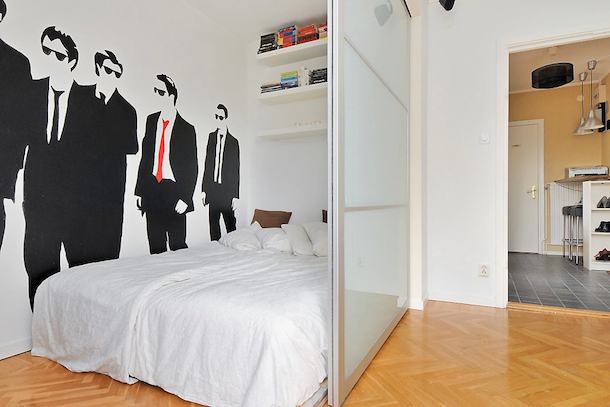
We’ve looked at some designs from IKEA Hackers in the past, but we think this room divider is particularly useful and elegant. The 22 year old builder said he could only afford to buy a studio with his girlfriend. In order to create more rooms, he hacked a set of PAX sliding doors to fashion a new bedroom.

Amazing Ikea Divider Wooden Floor Style Slide Door Design

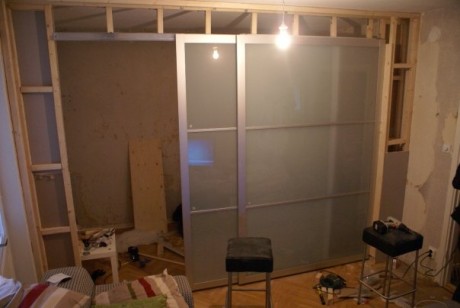
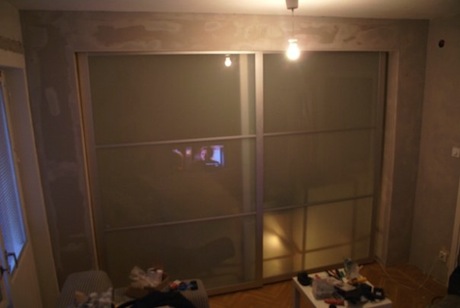
He mounted the frosted glass and aluminum doors ($300) to a custom wood frame. He finished off and painted the drywall to make it look like an integral part of the space.

ikea-hacks

ikea-hacks-2

This design is a bit more involved than some we’ve seen, and there’s not a ton of instruction, but if you’re handy, we suspect this wouldn’t be too tough to pull off. Materials would probably cost $500-600 including the doors. If you’re not handy, we’d guess a contractor would do this for $1-2K, depending on your area. While we question whether this guy’s apartment is a studio (who has a dining room in a studio?), $1500-2500 for an extra room is a great deal.

LifeHacker via IKEA Hackers

Compact, Transforming Apartment on a Budget

When many of us see Graham Hill’s LifeEdited apartment, we see expensive custom cabinetry and moving walls and perhaps think, “I can’t afford that?” We at LifeEdited think we have some solid arguments for investing in transforming furniture and custom flourishes; and we’re trying out damnedest to help build larger developments where we can achieve the economies of scale that will make our design technology affordable to large swaths of the population. That said, we understand that many–perhaps most–people don’t have the kinda dough necessary to buy all of that stuff, much less put it in a rental apartment.

The question, “What does a renter on a limited budget do if he or she wants a LifeEdited apartment?” is a fine and vexing one. Southern Californian Nick Gebhardt has one of the better answers to this question that we’ve seen.

Gebhard put together an apartment that has much of the functionality of the LifeEdited apartment at a decidedly more affordable price-point. Moreover, all of his furniture can be transferred to future apartments.

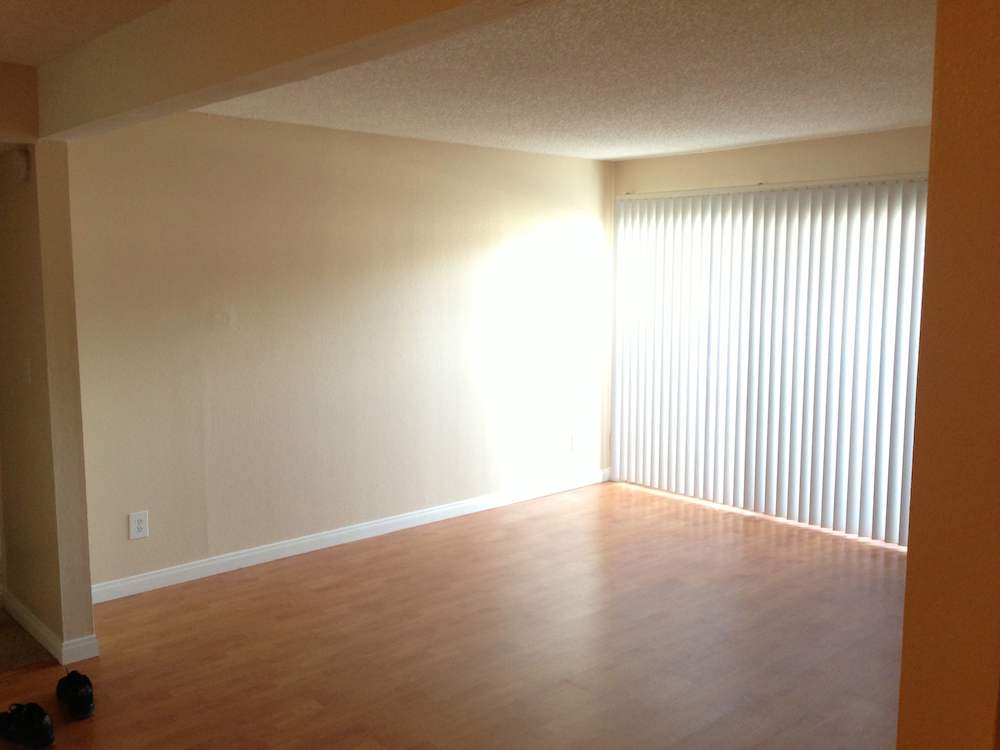
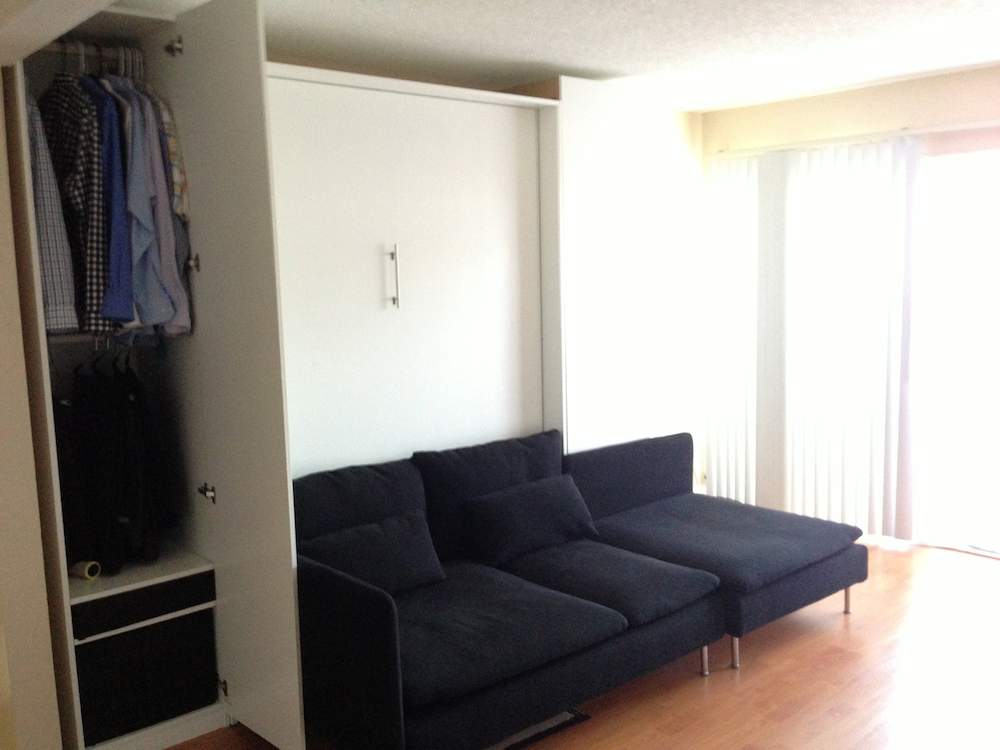
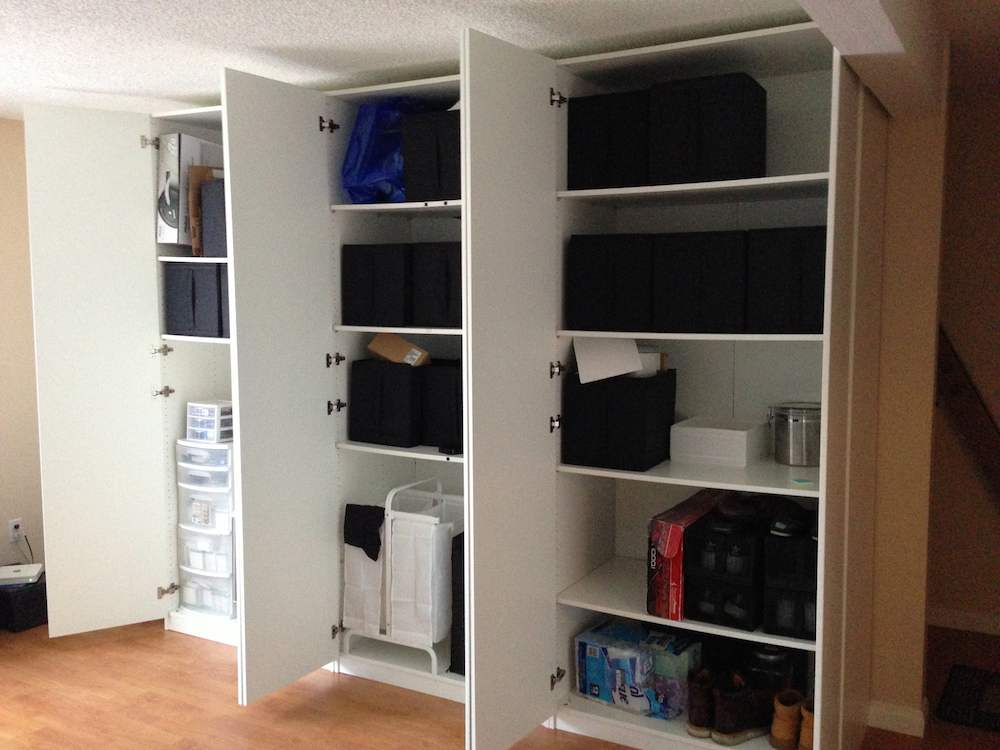
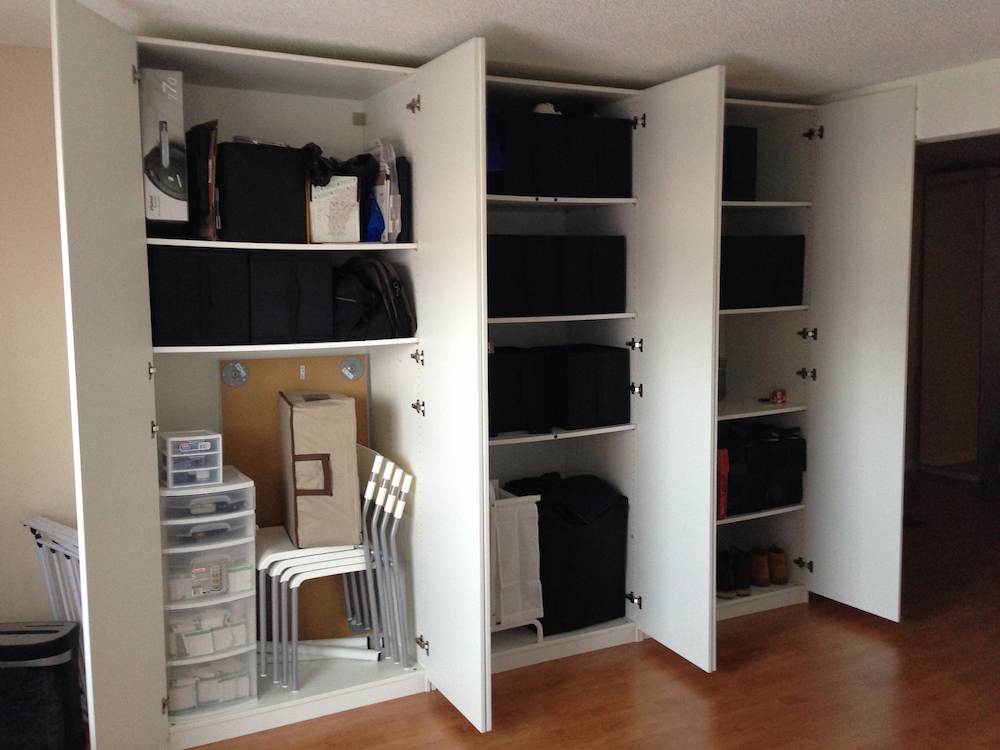
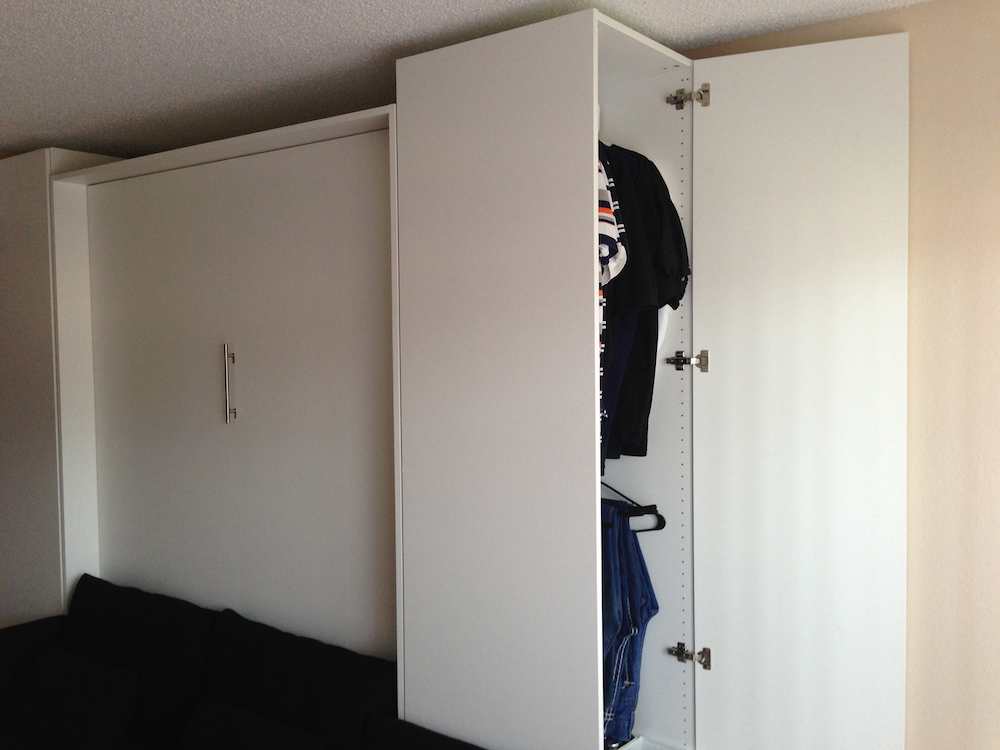
The rental apartment that Gebhard shares with his spouse is actually a one bedroom, but he makes the living room into a second bedroom by using a murphy bed from Murphydeskbeds.com. Because of the high clearance of the bed, he can slip a low profile sofa on the frontside of the bed, making a sorta hacked version of the Resource Furniture Swing. Storage is handled by several IKEA Pax storage units. There is a smattering of other IKEA furniture such as the Laver chairs, which stow away when not in use.

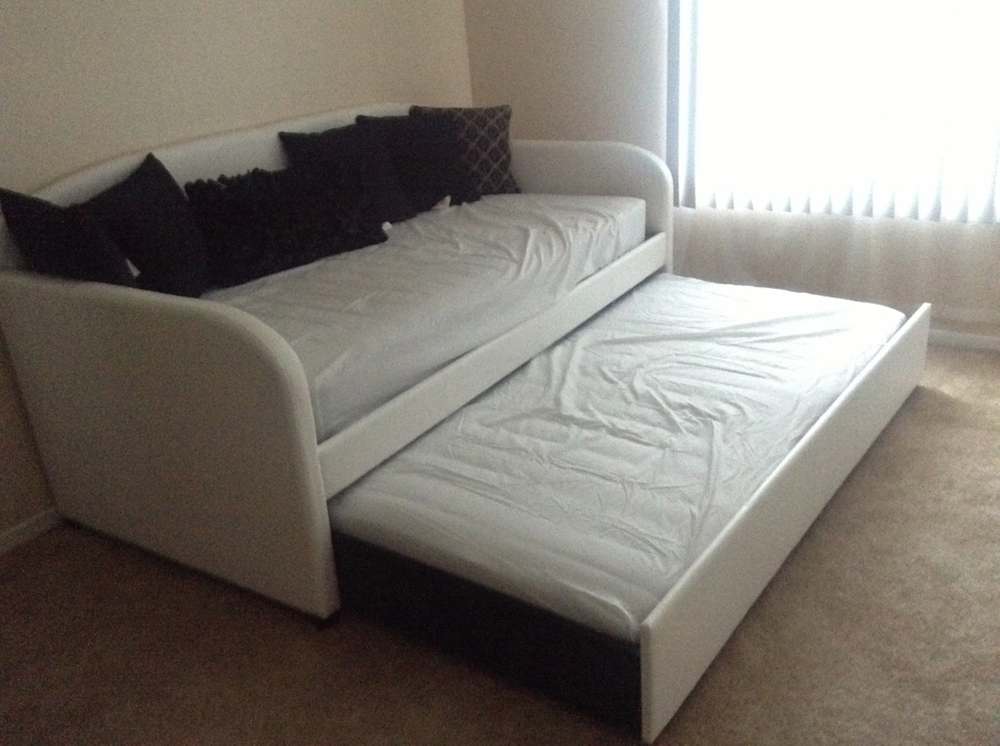
The proper bedroom contains a trundle bed, which acts as a couch and provides sleeping accommodation for two more. That room also contains a large TV and entertainment system.

Gebhardt says the whole project set him back about $10K…slightly less expensive than the LifeEdited apartment. See his far more colorful description of the project called “Design an Easier Life” at his website Thastruggle.com.

Major props to Gebhardt for taking on an edited life with such commitment and proving that a smart, compact home is accessible to anyone. And many thanks for sharing it with our readers.

Transforming Furniture on the Cheap

While we love high end transforming furniture, we know a good deal of it falls way outside of our average reader’s furniture allowance for the year…or decade. Fear not. For those of us on more modest budgets, there are options–options greatly expanded in proportion to our facility with power tools.

A while back we looked at the DIY $275 Murphy bed. While we’re big fans of the Murphy bed design in general, it does have one drawback: The frontside must be clear before lowering. This requires that you either keep the coast clear–i.e. don’t put anything in front–or you have furniture that can easily be slid out of the way; this drawback negates some of the space saving benefits. A bed like the Resource Furniture Swing used in the LifeEdited Apartment, whose couch works in concert with the bed mechanism, better optimizes space owing to its utilization of the frontside. But again, starting around $9K, we know it’s not for everyone.

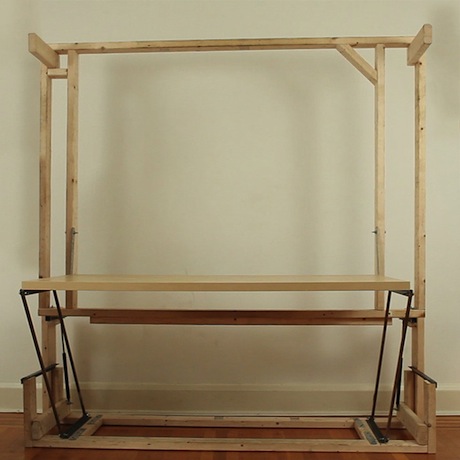
The good folks over at Treehugger turned us on to a DIY Murphy bed/desk called the UrbanDesk, ideal for people looking to save space and money. While it features a desk and some storage on its frontside rather than a couch, it still achieves the goal of milking as much space as possible in a very small footprint.

DIY-Murphy-Bed-Desk-2

DIY-Murphy-Bed-Desk

The project began as a Kickstarter project, but failed to meet its fundraising goal. Graham Phakos, the guy behind the project, said he’d post plans for anyone to build it. As yet, he has not, though we are going to petition him alongside Lloyd Alter at Treehugger to fulfill on his promise (we’ll keep you posted).

Convertible-table

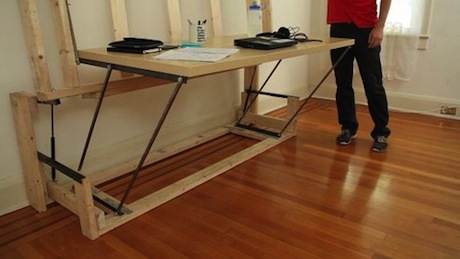
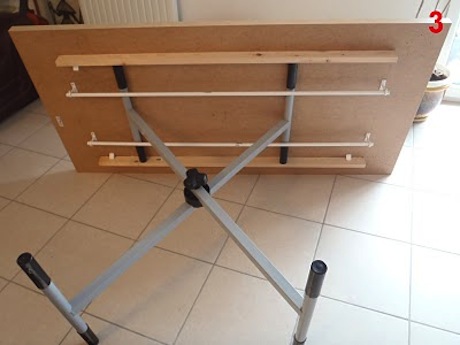
Beside a transforming bed, tables offer a great opportunity for space saving. We found this DIY convertible table on IKEA Hackers. Using an IKEA table top (they recommend a VIKA AMON, which appears to be discontinued, though there are several alternatives, from $10-100), a common trestle or keyboard stand (about $30 on Amazon) and a few other inexpensive items, you can create a table that converts from coffee to dining table in a pinch. Find full instructions on IKEA Hackers.

Whether you’re on a tight budget or a renter who doesn’t want to throw a ton of money into a temporary living situation or you just like making stuff, there are many options for making a transforming space that don’t break the bank.

5 Products That Make Our Lives Better

We are always on the lookout for products that do more, last longer and take up less space than their conventional counterparts. We’re not talking about things like a good laptop or phone, which might be indispensable, but will be outdated in six months. We’re talking about the products that won’t go out of date, whose utility proves itself through the years.

We’ve put together a short roundup of products we find ourselves unable to live without (not literally of course). It’s also a nice excuse to ask you what your list includes. What are the things that make your life or home work better–things that make life simpler and more streamlined? Let us know in our comments section below.

  1. Waffle-weave towels. We’ve talked about them before, but too much cannot be said about their merits. The longer we use them, the more they prove their superiority to terry cloth. We’ve been using Aquis microfiber towels and Gilden Tree cotton waffle towels. Both take up less storage and washing machine space, dry faster and avoid mold. If we were to choose one however, it’d be the Aquis; the synthetic material seems to grab moisture from your skin. It’s also softer than cotton. If you’re not into synthetic stuff, the Gilden Tree towels still work great and are available in more sizes and colors.
  2. Outlier pants. These things rock. They look like dress pants, feel like sweat pants, wick and repel moisture like mountaineering pants and wear like iron. Starting at $188, they are not cheap, but they will literally replace three pairs of conventional pants and outlast them as well. I have had several pairs for the last few years. My favorites are the 4 Season OG’s and Climbers, both of which have four-way stretch material (not all Outlier pants are as stretchy). Their shorts rule as well. Right now, they make one women’s variety.
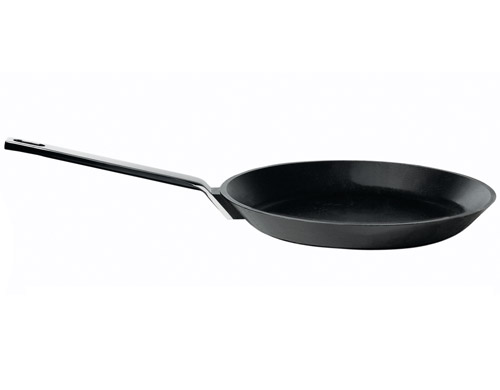
  3. A cast iron skillet. Nonstick skillets are great, but they wear horribly and have a dubious safety record. Copper and stainless steel wear great, but are temperamental, scorching and staining easily. Cast iron, on the other hand, wears like, well…iron. It distributes high and low heat great. With a little bit of use–i.e. ‘seasoning’–it can be almost as nonstick as a Teflon pan, without all the plastic bits in your food. You can clean them without water. And while enameled iron pans are nice, the bare cast iron versions are less fussy and prone to marring. I use a beautifully designed 12″ iittala Hackman Dahlström Tools for almost everything (pictured at very top. Discontinued, but available at various stores), but most any cast iron skillet work equally great. Get a size that’s big enough for the amount of cooking you do, but not so big that it takes ages to heat.
  4. A comfy couch that you can sleep on. I was at IKEA a few weeks ago and they had a 375 sq ft mock-up apartment featuring a huge, overstuffed sectional couch. I thought it a waste of space until I sat it in. Few things demarcate home like a comfy couch. In the LifeEdited apartment, the Resource Furniture Swing couch is the most used piece of furniture. A great couch can be your guest room in a pinch, and while convertible sofa-beds are great, sometimes it’s better to get a longer couch than invest in a substandard sofa-bed, which are often pretty uncomfortable.
  5. A scanner. We thought scanner technology was stable enough that it could be included on this list. Scanners are simple, can last ages, don’t require stupid, overpriced toners and, most importantly, allow you to dump tons of paper by scanning receipts and important documents. Scanners eliminate the need for a fax. You can also scan old photographs for posterity and digital display.

What would you include on this list? What items streamline your home and your life more than most? Let us know in our comments section.