3 Big Stores Get Into Small Spaces

There was a time, not so long ago, when furniture stores assumed their customers wanted items that would fit well in an over-sized dream home. Furniture was marketed with easy mortgages and cheap credit in mind. Well, those days are over.

With more people living in square-footage-starved cities, and more people renting, a growing population is reevaluating the dimensions of their dream home. A few furniture retailers are taking heed of this trend, marketing specifically to consumers living in small spaces.

Restoration Hardware released its “Small Spaces” collection earlier this year. It is, they claim, “A collection of epic proportions.” It’s sufficiently important to the company that it’s on their site’s main navigation bar. The collection is shown in 15 “small” spaces from around the world like the “Chelsea Penthouse” or “London Townhouse.”

These spaces don’t seem that small to us, and there are no dimensions to contradict our impression. The furniture looks suspiciously similar to other pieces in the catalog: the big space love-seat becomes the small space couch; the end-table becomes the coffee table. Perhaps it’s relative. Maybe RH is catering to people who are transitioning from 4K to 2K sq ft of living space.

IKEA has been in the small space fray for a while now. The video below shows a number of ways you can use their products to squeeze tons of utility from a small space. They claim small space living is “not about giving up your dreams. It’s about shrinking them, just a little bit”–whatever that means. The video is pretty creative and compelling.

Many of their stores feature 375 sq ft mock-up apartments. The author visited one the other day and found the layout pretty nice.

The furniture in the apartment, like RH, seemed like their normal furniture plugged into a small space. Unlike RH, IKEA seemed to understand the necessity for storage in a small space; there were shelves everywhere and two of the walls had large storage systems.

They made what seemed like a strange choice, decking the living room with a big couch. It was strange until you sat in it and realized that a comfy couch is pretty important to demonstrating a space’s livability.

West Elm also features a small space collection. A couple of their pieces actually seemed to be designed for small spaces–not just a normal piece with a small space sticker slapped on it. In particular, the Storage Bed Frame and Rustic Storage Coffee Table (below) would be useful additions to a small space. The latter model’s tabletop lifts to provide a desk space if you find yourself working on the couch.

What do you think of these collections? Are they marketing gimmicks or indicators of they way people will live in the future? Or both? Have you bought any of these products? What was you experience? Let us know.

10 Folding Chairs to Look at and Sit On

Many people have reached out to us looking for solutions for making their own home an edited home. Often requested is a guide to folding chairs–chairs being a staple piece of furniture for most any home. With a little help from our friends over at Apartment Therapy, we’ve put together this list of 10 folding chairs, ranging from the super inexpensive to the super not-inexpensive.

Let us know what we might have missed in our comments section.

1. Terje Folding Chair from IKEA, $16.99

We’d be remiss to not include the big I. This is one of their several folding chair options. They’re not super sturdy, but boy are they inexpensive. We’ll leave it at that.

2. Mika Natural Wood Chair from World Market, $75 for 2

This chair has a nice look and works inside and out.

3. Cyclone Indoor/Outdoor Chair from Target, $123.89 for 2

If your aesthetic leans toward pop-art, this chair from Target might be your style. It works inside and out.

4. Muji Beech Folding Chair, $70

We really dig this chair. Simple, real-wood, good price.

5. Clarity Acrylic Folding Chair, $150 for 2

Like the Target chair, this one will appeal to a particular aesthetic. The translucency opens up visual space, but acrylic tends to scratch over time.

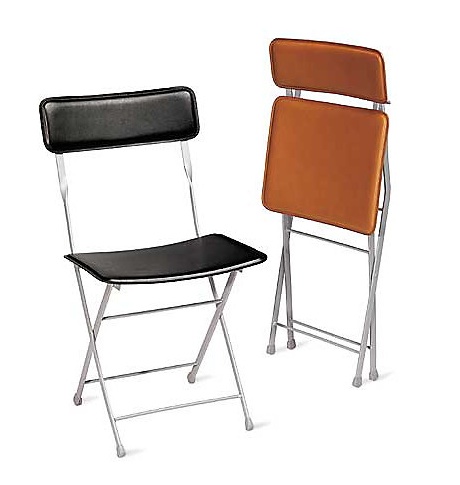
6. Lina Leather Folding Chair by Design Within Reach, $150

We quite like the look of these. They have a very light design, but the leather gives them a touch of luxury. Their legs don’t look super beefy, so might be best for the lither buyer.

7. Flux Chair, $199

We’ve been using a Flux chair for a while and they’re surprisingly comfortable. They work as a lounge or dining chair, but are too slack for an office chair. When unfolded, they lie completely flat. They’re available in several colors.

8. Resource Furniture Pocket Chair, $225-480

These high-quality, Italian-made folding chairs are 3/4″ deep when folded. Unlike a lot of folding chairs, they have a nice, substantial feel. Prices vary depending on finish.

9. Leaf by Folditure, $680-760

We’ll dispense of the alien jokes. In terms of raw functionality and portability, it’s tough to beat the Leaf. They hang in your closet and are built solid enough to withstand your heaviest friend. [Note: the Folditure site has stopped publishing these prices, so check with them to see current pricing.]

10. The April folding chair by Gae Aulenti, $1350

If your tastes lean toward mid-century modern, and your budget leans toward hedge fund manager after a bonus, this chair is probably for you. Solid construction, classic looks, big price tag.

Via Apartment Therapy

Build Your Own Murphy Bed for $275

One of the bigger challenges to starting your edited life is reasonably priced transforming furniture. While we believe the high quality and versatile Resource Furniture used in the first LifeEdited apartment is worth every penny, many of their large pieces are several thousand dollars, putting it outside the price range for many people.

Perhaps no piece of furniture is more important to an edited home than a transforming bed. Beds are huge space hogs, whose utility is only relevant when we’re unconscious. A queen sized bed is about 35 sq feet; why wouldn’t you want to use that space for your 16 waking hours?

A “product” called the Moddi Murphy Bed is the least expensive entry point we’ve found for getting your bed out of the way. The site sells plans for $8, which instruct you how to take easy to find IKEA furniture and other hardware to make a twin or full sized murphy bed for $275 (most pre-builts start around $1500). The finished product–which can be modified depending on which IKEA finishes you purchase–looks pretty great too.

One of the aims of LifeEdited is providing the resources to make simpler, happier lives, no matter your budget. If you know of any other low-cost transforming furniture or hacks, please let us know.

via IKEAhackers

image from Apartment Therapy

Live, Eat, Breathe IKEA at Strand East, an IKEA-Designed City

After yesterday’s post on IKEA homes, we learned that single, prefab homes and small developments were not quite enough for the furniture giant: IKEA has entered the business of city-making.

LandProp, IKEA’s property development arm, is developing a city called Strand East outside of London. According to Fast Company Co.Exist, the development:

Will feature 1,200 homes, 480,000 square feet of commercial office space, a ‘hub area’ with shared space for the community, a creative zone intended for creative-minded businesses to take root, a restaurant, a hotel, pedestrian walkways, cycle routes.

Other features include winding, car-free streets, similar to old European cities (and IKEA stores), and underground parking that will provide ample pedestrian space and safety. There will be a strong focus placed on culture, community, food and other quality-of-life boosters. Click on infographic below for other community features.

Like its furniture, IKEAville, um, Strand East, is focused on middle class affordability and lifestyle. 40% of homes will be family-friendly.

Project Manager Andrew Cobden told The Globe and Mail this:

We would have a fairly firm line on undesirable activity, whatever that may be. But we also feel we can say, okay, because we’ve kept control of the management of the commercial facilities, we have a fairly strong hand in what is said in terms of the activities that are held on site.

Similar to yesterday’s conversation about IKEA homes, where owners might trade personal touches for affordability, function and simplicity, residents of Strand East might trade ownership for a great living experience largely governed by LandProp.

The idea of housing-as-service runs counter to the American Dream, which is inseparable with home ownership, even when home ownership, on balance, is more headache than opportunity.

Strand East also presents the idea of privatized urban planning. IKEA is creating an ideal urban structure where government might not have the audacity or resources to do so.  But given that it’s a business, might their instinct to make money trump their civic responsibility?

We’ll have to wait and see. While the land has been purchased, the company is still getting their permits in order. LandProp is hoping to begin construction in 2013.

Via The Globe and Mail and Fast Company Co.Exist

Prefab Home is Like Living in IKEA Showroom

Let’s face it, it’s hard to get away from IKEA. The big blue store is by far the world’s largest furniture retailer and there are few homes that escape its cleanly-design, wallet-friendly wares.

Since the contents of our homes are so defined by IKEA, Oregon-based company Ideabox asks why not the house itself? To answer that question, they have created the Aktiv, a compact, prefabricated home designed around IKEA product systems and ethos of clean, affordable design. $86,500 buys the house, delivery, installation and IKEA spec’d bathroom, kitchen and flooring. I suspect most buyers would finish the place with IKEA fürniture.

This idea is not new. IKEA has been making their BoKlock housing in Europe since 1996. According to its site, BoKlock provides “space-saving, functional and high quality housing at a price that enables as many people as possible to afford a stylish and comfortable home.”

Sounds good to us.

A home made completely around a corporation–particularly a giant like IKEA–might strike some as being impersonal. But consider that many of us end up with homes designed by IKEA by default, because the stuff looks nice and is affordable. Also consider that our homes are often assemblages of handed down furniture or whatever we can afford at the time, neither of which necessarily reflect personal style and taste.

Then there are the many advantages of prefabricated home design and construction, whose processes have a huge edge over one-offs. For instance, the BoKlock is made completely in a large warehouse, making its construction schedule independent from weather.

From a practical standpoint, don’t most of us just want a home that is affordable, comfortable and easy to deal with? Homes like the Aktiv and BoKlock deliver that, sans some personality.

What do you think? Would you live in what amounts to as your own IKEA showroom? What would be the advantages/disadvantages? We’d love to hear what you think?

via Dornob and Ideabox