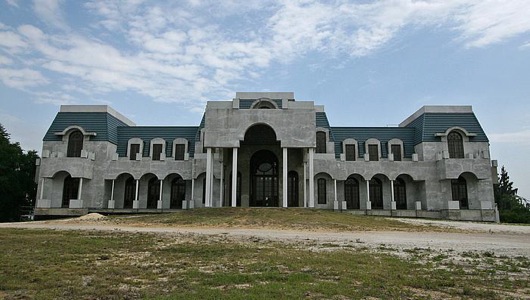
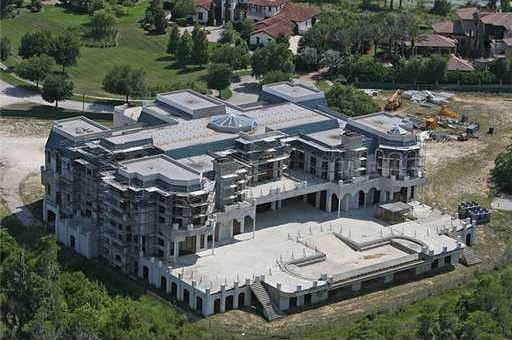
Have you ever wanted to own your own Versailles Palace but thought the 720K square feet of floor space just a tad excessive? Well, if you have $65M dollars burning a hole in your pocket, there’s a stateside version of the venerable Louis XIV palace for sale in Orlando, FL. The home can be outfitted with many modern features, and at a mere 67K square feet of floor space (i.e. 160 LifeEdited apartments), it’s a far more manageable space than its 300 year old French cousin.
If you’ve seen the movie “The Queen of Versailles,” you know the home we’re referring to. At the time, the home was to be the largest single residence in the United States. It was the brainchild of David and Jackie Siegel, a couple made rich–then subsequently made ruiness–via the largest privately held timeshare company in the world.
Few movies epitomize the housing boom and bust than the travails of the Siegels. The movie’s production began during the pinnacle of the housing boom and the Siegel’s wealth. When asked why David Siegel was building a house so big, he answered “because I can.” Here are some of the features the house was supposed to have:
13 Bedrooms, 23 Bathrooms
20 Car Garage
Grand Hall with 30-ft. Stained Glass Dome
2 Grand Staircases
37′ x 30′ Kitchen
10 Satellite Kitchens
2-Story Wine Cellar
A view from aboveThe ballroom that never was
We say “supposed to have” because mid-production the housing boom busted. The Siegels lost most of the money and Versailles went into foreclosure. Now the incomplete house is for sale for $65M (we bet you could get it for less). So in addition to whatever you fork over for the house itself, you will have to augment that amount with considerable construction costs.
The movie also shows the unquenchable thirst for stuff. They were moving into the larger home because they were bursting at the seams of their tiny 26K home. One scene shows soda being stored in a shower because they lacked space elsewhere.
Have you seen the movie? Do you think the Siegels learned their lesson or will people always choose excess when they have the opportunity? What does it say–if anything–about all of our behavior?
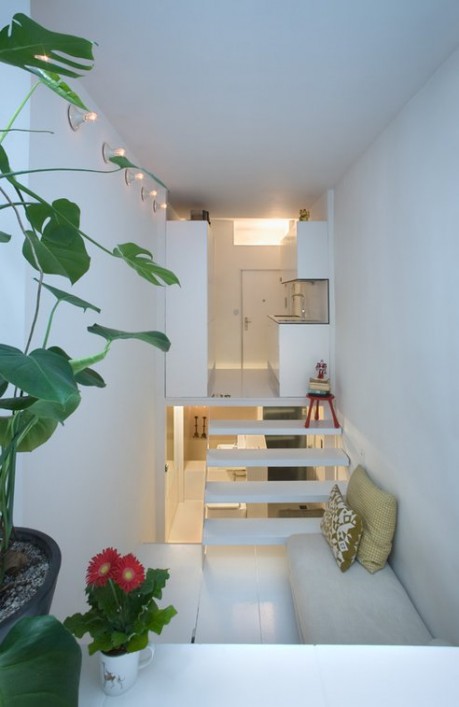
Compared to Europe’s narrowest house that we looked at a couple weeks ago, this home by MYCC Studio in Madrid feels downright palatial. The whole apartment is only 200 square feet and measures 6′ 10″ wide, with an 8′ 6″ office area. The design takes advantage of the large amount of vertical space, with rooms layered on top of one another.
We think the apartment is pretty gorgeous and has great division of spaces considering how small it is. It’s not exactly an ideal home for collectors and people with lots of furniture. And as it lacks a door to the bathroom, it’s not for the camera shy.
Many tiny houses we look at on this site show uncommon ingenuity and creative use of space. Others, like this house for Israeli author Etgar Keret, err on the side of ridiculous. At 5′ at its widest point and 3′ at its narrowest, it is thought to be the narrowest house in Poland and perhaps all of Europe.
To be fair, the home’s design was not purely driven by livability. Keret built the Warsaw home at the site of a former Jewish ghetto as a memorial to his parent’s family died in the Holocaust.
Keret says that he plans to live in it when he’s in Poland however, and the space is fully functioning, with a kitchen, bathroom and bedroom.
image credit: Yasuhiro Yamashita
The home’s sun-drenched interior reminds us of the Kyosho Jutaku homes like the one above, which use optical illusions to create space. Its ridiculously narrow dimensions remind us of NYC’s Spite House.
What are your thoughts on this house? Interesting architectural exercise? Practical living space?
Today’s guest post is from Karen Krizanovich, a small-space dweller living in London. She recently shared her experience and philosophy in the The Times UK. Today, she gives pointers for how to create a no-fuss, reasonably-priced small apartment (aka apartment) you’ll love to live in.
Yes, I would love to live in the Hong Kong apartment designed by Gary Chang, the architect who transformed 344 sq ft into 24 different living spaces. Unfortunately, my flat doesn’t have that kind of scope and neither do I. Still, I can adopt similar principles learned from my friend architect Professor Miriam Neet, LifeEdited and other resources to live in a streamlined, no-fuss, no-muss and non-neurotic fashion. I’ve found the following tips to be indispensable for making a small home you truly want to live in.
Live in your place a few months before making complicated or permanent non-essential changes. Think you know everything already how you live–what’s important, what’s not? You’ll be wrong at least 25% of the time. Be patient. You won’t regret it.
Be a simpleton. We all love innovative, automated designs. But what happens when they break? Who’ll fix it? What if the electricity goes off? What about the batteries? As much as I’d love to own, say, electric curtain rails, I know I’m asking for trouble. Remember that guy with the cool thing that didn’t work? Don’t be him.
Follow your gut. I never liked the way my kitchen cupboard doors shut (stupid spring devices). I said I’d give them a try but, deep in my soul, I knew they’d irk me. And they still do. Little annoying things like this are accentuated in a small space and erode the comfort of your home. Fix things immediately that don’t feel right.
With things you love, buy to last. Plan to repair them when needed. Like a great pair of shoes, your home should be serviceable, look great and fit perfectly.
When the space is small, bad design really grates. Everything has to be just right. Settling for ugly solutions will do temporarily, but always keep on the lookout for the right one.
Buy a cheaper version to roadtest. I’ve bought five different chairs and none of them really worked in the space. Now I’m testing an inexpensive version of another design. If it works, I’ll buy the expensive one eventually.
Ask yourself what you really need. I don’t need a coffee grinder. I barely need a blender and I sure as heck don’t need a blender that is also a soup maker. Keep gadgetry to a basic level–and keep them off the kitchen counter. Clutter is your small flat’s supreme enemy.
Make your home user-friendly. Like training a horse, you don’t want someone to get on and have to learn new techniques. You want anyone to be able to ride your horse right away. Same with your apartment. Keep things basic and obvious. I don’t care for murphy beds or complicated heating systems. Toilets should flush, not do tricks. You don’t want a flat that makes you or other occupants feel stupid.
Love your neighbourhood. One of the big advantages of living in a small flat is that you can afford to live in a neighbourhood that would otherwise be out of reach. Know why you’re there and what’s great about it. That way, even if your apartment transformation is taking a long long time, you’ll remember the bigger picture.
Decide a good want. When you’re considering buying something, imagine your day-to-day life with it. If something really makes you happy–if it is a delight to use, to look at, to own, then it’s probably worth it. If you can live without it, try to do that.
This last Friday, the Wall Street Journal launched a new real estate section called “Mansion.” WSJ managing editor Robert Thomson implied in a statement that it wasn’t just about the rich admiring their big homes, saying “We all like to think of our home as a mansion, even if it is a humble abode, and we all have the license to aspire.”
The section we saw featured homes like tax-shelter luxury apartments in Puerto Rico, 9500 sq ft modern homes in Napa CA, 17K sq ft Telluride ski lodges, a look at several “sky garage” condos (i.e. a car life allows you to park your Lamborghini or Ferrari in your unit) and the migration of tech moguls to multi-million dollar home in Los Angeles. Humble abodes these are not.
Truth be known, when we set about building the 420 sq ft LifeEdited apartment, we wanted to create a new variety of aspirational home–one that relied on great design and intelligent use of space rather than massive square footage and Olympic-sized hot tubs. While this aspirational model might work with select populations (and they’re probably all reading this post right now), we wonder whether a compact home would be something the greater public could get into?
What do you think? Will micro homes forever appeal to very select populations? Will the mainstream always consider them worst-case-scenarios or might they see them as something to aspire to? We’d love to hear your thoughts.
Chicago adds its name to the growing list of cities that are building large-scale micro-unit developments with FLATS Chicago. The project is quite an undertaking. The development company, Cedar Street Co, has acquired seven buildings, representing 1200 apartments that will be converted into luxury apartments in the city’s rough-and-tumble Uptown and Edgewater neighborhoods.
Unit size will average around 350 square feet and be as small as 275. Amenities will include things like free wifi, washer/dryers in each unit, bike-shares, common spaces, rooftop pools and sports clubs. Projected rents range from $800 a month for a studio to at least $1,400 a month for a two-bedroom.
Rendering of Interior of FLATS Chicago
Jay Michael, one of Cedar Street’s partners, told Time Out Chicago that he wants to “sell singles on what he calls ‘FLATS life’: Common spaces are ‘an extension of your space’ where you can meet neighbors or entertain friends,” and that they are “targeting recent college grads who are ready to live alone,” who “for the same rent they’d pay for their half of a two-bedroom condo…can live solo at FLATS.”
Sounds good to us.
But there’s a catch: the buildings in question are dilapidated SRO’s, many of which, until recently, were occupied by impoverished residents. Though the developers want to make their units financially “approachable” to the existing tenants, the rents will likely be out of reach for most, and construction will inevitably displace them, even if that displacement is only for the length of the renovation.
While not obliged to do so, Cedar Street is working with transition coordinator Sherri Kranz to find housing for old tenants, many of whom have been in the apartments for more than 10 years. In one building alone, Wilson Tower, she’s working to find 60 people new homes–a challenge for people accustomed to paying as little as $475/month rent. She’s turning to city housing and nonprofits, though it sounds like sometimes the best she can do is get people on waiting lists. [Note: the SRO’s in question are not the “supportive housing” we talked about the other day, but rather privately held buildings.]
It’s the perennial gentrification conundrum. On one side are the under-served populations the buildings house. However, these building are, in Kranz’s words, “slums”–ones that in short time will be closed due to disrepair, making them a not-so-sustainable housing solution.
On the other side, the FLATS apartments will presumably serve large populations of city-dwellers, young and old alike, who are priced out of traditional apartments in more expensive neighborhoods.
Granted, there’s a big difference between having to get a roommate and being homeless, but it doesn’t negate the need for this type of clean, smart and affordable apartment.
Do you have any thoughts on these competing interests? Have you seen them successfully reconciled? Let us know in our comments section.
In the 70’s and 80’s, single room occupancy (SRO) housing became synonymous with drugs, crime, totalitarian architecture and poor building quality. While the circumstances that lead people to SRO’s are still less than ideal (many are for the homeless population or very low income residents), a few architects are looking at what the buildings look like and what it means to live in them, designing innovative and supportive spaces for the populations they house.
Many SRO’s like the ones featured here enjoy a pass on restrictive building codes, allowing smaller unit sizes and larger communal areas than their conventional residential counterparts. Perhaps these developments presaged the upcoming micro-unit movement we’ve been talking so much about.
Harold and Margot Schiff Residence, Chicago IL
photo by Doug Snower
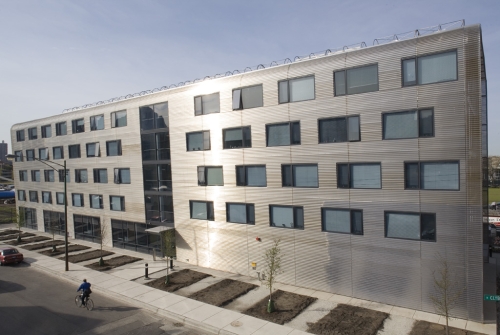
This building (also known as Near North Apartments or Mercy SRO) was designed by Murphy/Jahn Architecture, famous for O’Hare’s United terminal and Bangkok’s Suvarnabhumi Airport among many other large, notable projects. Charles Hoch, professor of urban planning at the University of Illinois told the NY Times that the design is a “stigma-smasher.”
The 96-unit building, built in 2007, borrows on “the cachet of Mr. Jahn to send a message to the larger society and that message is that homeless people have value, they have a role to play in society,” according to Hoch.
It is LEED silver certified, has solar panels and wind turbines that generate 15% of the buildings power and a grey-water recycling system (the first of its kind in Chicago). The ground floor features a large community space and the four top floors feature bright and airy units whose average size is 300 sq ft. Many of them feature views of downtown Chicago.
Bronx Park East, Bronx, NY
Before adAPT NYC, there was this SRO development by Jonathan Kirschenfeld, whose firm has done several similar sustainable “supportive housing” developments. The building, built in 2009, features triple-height street-side windows and 68 well-lit units with kitchenettes and private bathrooms. Units measure 285 sq ft, as supportive housing bypasses residential code that New York City spaces be 400 sq ft and up.
The development features a courtyard with a garden, a gymnasium and a double-height-windowed common room. Mr Kirschenfeld sees these kinds of spaces as integral to the intention of the space as he remarked to the NY Times: “Isn’t the idea here to improve mental health? Isn’t good architecture part of that?”
Another interesting aspect of Bronx East is its footprint, which utilizes an irregular lot.
Both of these developments show that innovation can come from unlikely sources and that good architecture and design need not be the domain of the rich.
If you know of similar innovative supportive housing, let us know.
Last week, 33 development teams submitted to adAPT NYC–the Bloomberg-administration-supported competition seeking the best 275-300 sq ft/unit apartment building proposal [full disclosure: LifeEdited was on one of the teams]. According to the Wall Street Journal, this is three times the number of entrants similar competitions draw.
“The City’s adAPT NYC competition has ignited a global interest and conversation about how high-density urban centers can right-size their housing stock to fit changing demographics,” according to Mathew Wambua, commissioner of the housing preservation department.
Good news, right?
Well, not according to everyone.
This last Tuesday, a few thousand miles away in San Francisco, the South of Market Community Action Network (Somcan) took to the steps of City Hall to protest a proposed change in housing code that would permit dwellings as small as 150 sq ft.
Perhaps because of its proximity to Japan, San Francisco has been at the vanguard of small building in the US for some time. Unlike NYC, who demands new apartments have a minimum of 400 sq ft of living space (adAPT NYC is receiving a waiver on that), San Francisco already allows new spaces to be built as small as 220 sq ft. The Cubix SF, which has units as small as 230 sq ft, has been around for several years. An upcoming project by SmartSpace at 38 Harriet St in the SoMa neighborhood will feature 4 stories of 300 sq ft units.
What Somcan is protesting is the city’s ostensible shifting focus from family-friendly affordable housing to housing for affluent, childless singles and couples. This is taken from Somcan’s Facebook page:
SF has yet to meet its SF Housing Element plan of prioritizing affordable family housing units and yet creating housing for the new techies in the neighborhood seems to be first on the agenda. With less families in San Francisco means less family-friendly city and less funds for our public schools. It will be competing with the minimal land that the City has which can be use for REAL affordable housing. This type of development could possibly be catastrophic to our neighborhood, displacing low-income families, singles and existing residents
They might have a point: mico-units are not family friendly. They are primarily for singles and couples without children. The construction of micro-units could be construed as an elevation of their needs over those of families. And while there are no protests (yet), the same could be said of adAPT NYC.
What complicates Somcan’s argument is:
Market demand. Singles and couples need affordable housing too. SF micro-units will start around $1300/month, far lower than the $2300 median price for a studio in that neighborhood.
Smart design actually makes these spaces more livable than comparable, larger spaces.
As cities grow denser, a fundamental shift in living spaces will have to be made. NYC, for example, expects nearly 1M new residents by 2030. The city says 85% of the housing stock for those people is already built, so redistribution of current spaces and new types of buildings will be essential to accommodating these people–whether they are singles, couples or families.
It’s a tough situation. Indeed, many cities like San Francisco and NYC are becoming prohibitively expensive for families. Yet singles and couples need affordable places to live.
Then again, maybe 150 sq ft is just too damn small (though the Japanese would have room to spare). Maybe really small legal micro-units would make cities the near-exclusive domain of singles, driving out all but the richest families. And maybe these dinky digs would open the gates to exploitation–already a problem in space-strapped places like Hong Kong, Singapore and London. Perhaps there is such a thing as too small.
We’re obviously more in the pro-micro-unit camp. We think they portend a fundamental, and positive, shift in the way people live in the city and even beyond. We also believe they can be scaled up for any type of household. But we’d love to hear what you think? Are micro-units providing affordable, smart and efficient housing for tomorrow’s urban dweller? Or are they displacing families and existing tenants in favor or “new techies”? Let us know your thoughts.
Clarification: San Francisco’s current code allows 220 sq living spaces, with 70 sq ft additional for kitchen and bathroom (290 sq ft total). A proposed change in code would allow for 150 sq ft living space with 70 sq ft additional for kitchen and bathroom (220 sq ft total).
The England-based Yo! Company is a branding and investment firm that brings Japanese-tinged enterprises to Western territories. Among its holdings are Yo! Sushi, a conveyor belt Kaiten sushi bar in London and Yotel, a Japanese-style hotel with compact-rooms that has locations in London, Amsterdam and New York City.
Now Yo! Co founder Simon Woodroffe is bringing his Japanglo magic to the home market with the Yo! Home. The 800 sq ft London concept home aims to take us out the “agricultural, primitive age” he believes we live in now and into the future–a time when people will ask “do you remember when they had one space and it couldn’t change around?”
The Yo! Home changes around alright. There is a bed that descends from the ceiling and covers up a huge lounge area. There is a dining area that pops up from the floor; the same floor that hides a wine wine cellar. The kitchen hides completely. The guest room has a large sliding door that opens up to increase the area of the main room.
The space relies on a fair amount of automation, some of which broke down during his tour with Channel 4 News (above). To be fair, this is a prototype and breakdowns are to be expected. We do wonder about the long-term implications of an automated home. What happens if you’re really tired and can’t get you bed down?
Woodroffe spent £200K on the Yo! Home (~$325K US), which actually doesn’t seem like a lot seeing as how elaborate the space is. He thinks it’ll initially be for moneyed clients, but believes the technology and designs will eventually trickle down to the greater public.
Our hats are off to Woodroffe and his bold enterprise. Architectural thinking often gets fossilized because structures are imbued with a sense of permanency–so architects and designers avoid risky designs like these; ones that might look weird a few years from now. Concepts like Yo! Home loosen the noose of conventional thinking. They are invaluable idea-generators even if some of its features don’t make the final draft of the home of the future.
What do you think? Is this home the future or a curiosity–something that’ll look weird and overwrought 5 years from now? Let us know what you’re thinking.
When the recession hit in 2008, the restaurant Hari and Karl Berzins started went under. A year later, they were forced to sell their 3 bedroom, 1500 sq ft house. They were broke, raising a couple kids and forced to take whatever jobs their then Florida home had to offer.
Thinking of ways out of their predicament, they came across the book “Mortgage Free” by Rob Roy; the book promotes the idea of–you guessed it–being mortgage free by buying the best piece of land you can find, setting up a temporary dwelling, then building the home you want on your timetable–all in cash. They found plans from the Tiny House Blog for what their temporary abode would look like.
Karl set about building their 320 sq ft home (a figure that includes a sleeping loft). Like most tiny homes, it began on a trailer bed to avoid building regulations. He started the project in Florida, then moved it to a 3 acre plot of land in the woods of the Blue Ridge Mountains about a year ago. The total cost of the home itself was $12K, greatly offset by scavenged materials.
image via Inhabitat
The couple has been chronicling their journey for the last year in their blog Tiny House Family. They report a higher quality of life. They are back in the black. Both Mama and Papa (their handles on the site) have taken work they love and supports their lives, versus work to pay the bills. The kids are even digging it too (according to the parents).
They have just finalized plans for their next house, a 16′ x 24′ model that will provide considerably more room and room to expand. I get the sense that the extra space is a welcome addition.
LifeEdited tends to focus on the urban side of small space living. City-dwellers usually have smaller physical footprints, use less energy, drive less, have more human interactions and so on.
But what about rural living? [We’ll leave suburbs/exurbs out of the equation for now] On the one hand, it tends to be more spread out geographically, requires more driving, more resources in general and has less unplanned social contact. On the other hand, it can be quite low impact; people like the Berzins grow much of their own produce and use very few resources we can see. Rural homes, while typically larger than a city’s, do not have to be, as evidenced by the Berzins (at least their initial home). Rural human interactions, while not as frequent as the city’s, can often be more intimate and meaningful. Perhaps most important is rural living tends to be free of frenetic urban energy, allowing its residents to lead simpler, calmer lives.
While there is not a city/country binary, it is interesting to see people trying to achieve the same ends–a calmer life, lower overhead, more quality interaction–through very different means. Leaving aside things like jobs, family ties and other considerations, does one environment support this lifestyle better than the other?
What do you think about urban versus rural edited living? Does living in remote locations oppose the less-is-more way of life? Or might the country mouse teach the city mouse a lot about living a simpler way of life? We’d love to hear your thoughts.