Edited Housing Guide: A Look at 4 Compact Housing Developments in North America

While building small is big in many places around the world, it’s still pretty novel in North America. Our abundance of space and affection for cars have made our architectural disposition similar to a big yawn after Thanksgiving dinner.

New American home footprints have been north of 2K sq ft for a while, and have even spiked to 2550 sq ft in the last year because credit scarcity has limited new home ownership to the cash-flush.

But that’s not what we’re going to talk about today. We are going to talk about the little guys. These are developers at the vanguard, building small, efficient, awesome homes.

And if we missed anyone, please let us know in the comment section.

1. Cubix SF (née Cubix Yerba Buena)
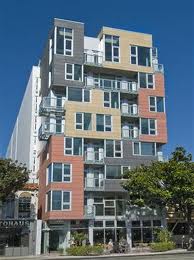
If you go to San Francisco’s SoMa district and see a Rubik’s-cubey-looking building, it’s probably the Cubix SF. The 98-unit building has floorplans ranging from 250-350 sq ft. Prices are in the low-to-mid $200’s, which is about a 1/3 of the area’s median price.

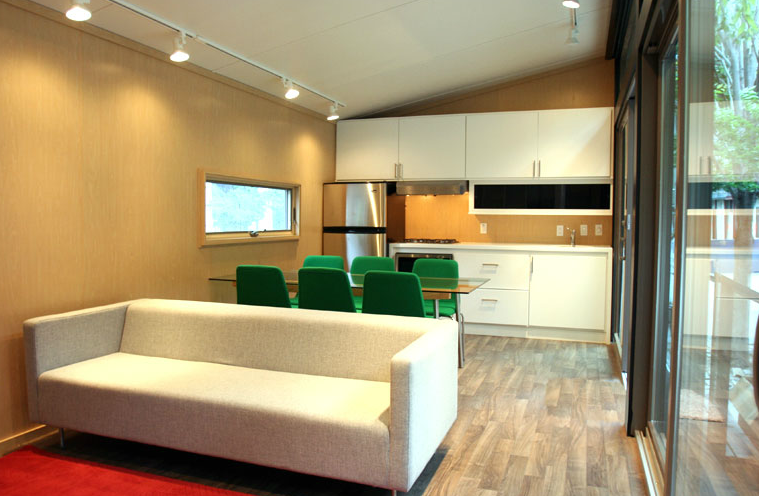
The building features nice finishes (see main image above for interior pic), modern appliances, a big roofdeck and groundfloor cafe. Their focus is on creating a low purchase price for people who still want a high quality, stylish apartment in a great neighborhood.

2. Vancouver Micro Lofts

Okay, so it’s not the US, but these micro units epitomize edited living. There are 30 units, which range from 226-291 sq ft and average $850CAD/month rent, which includes cable and internet.

The tasteful decors feature folding beds and tables, big windows and small, high quality appliances. With considerably lower rents than neighborhood average, the building proved very popular and rented out almost immediately.

via cbc

3. Apodments

In Seattle, Calhoun Properties has developed 9 building featuring their Apodments™, which are more like boarding rooms than standard apartments. Buildings have shared kitchens and living rooms. Some rooms have shared bathrooms and can be as cheap as $350/month including utilities, while the majority have private bathrooms, kitchenettes and some furniture and are as cheap as $495/month including utilities.
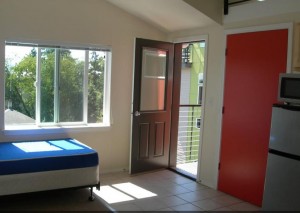
The units themselves are as small as 90 sq ft with fairly spartan decors compared to the other developments in this profile. Calhoun seems to be focused on young people who make low, hourly wages and/or don’t spend much time at home.

image via Facebook

4. Olympic Studios and Studio Lofts

In posh Santa Monica, CA, NMS Properties offers compact living for moderate income households (<$60K/year for singles and <$68/year for couples).

The units range anywhere from 360-448 sq ft. One of the cooler features is their furniture organizer, which allows you to drag and drop furniture pieces to pre-configure your furniture to the spaces somewhat tight quarters. We particularly like the loft layout, whose high ceilings give the small footprint a cavernous feel.

image via Olympic Lofts

graph via treehugger and Builder Online

Hong Kong Apartment: 344 square feet. 24 Configurations.

We would be remiss to not sing the praises of architect Gary Chang’s “Domestic Transformer” Hong Kong apartment–probably the world’s best known transforming apartment. Its ingenious design produces function and a sense of space totally inconsistent with its tiny footprint.

The back-story is interesting too. Chang has lived in the apartment since he was 14; at that time, him, his 3 sister, 2 parents and a boarder all occupied the tiny space. That’s about 50 sq ft/person. Roughly 1/20th the space Americans currently use!

In 1988, he bought the apartment from his parents.This last renovation–1 of 4–was completed in 2008. The apartment has become an idea lab for finding efficient uses of space–a serious issue for Hong Kong, whose already ultra-dense landscape has taken on 400k more residents in the last 10 years.

One of our favorite touches is the guest bed above the soaking tub. With odd pairings like these, Chang shows what’s possible when creative use of space trumps conventional thinking.

video via Planet Green and NY Times.

Live, Eat, Breathe IKEA at Strand East, an IKEA-Designed City

After yesterday’s post on IKEA homes, we learned that single, prefab homes and small developments were not quite enough for the furniture giant: IKEA has entered the business of city-making.

LandProp, IKEA’s property development arm, is developing a city called Strand East outside of London. According to Fast Company Co.Exist, the development:

Will feature 1,200 homes, 480,000 square feet of commercial office space, a ‘hub area’ with shared space for the community, a creative zone intended for creative-minded businesses to take root, a restaurant, a hotel, pedestrian walkways, cycle routes.

Other features include winding, car-free streets, similar to old European cities (and IKEA stores), and underground parking that will provide ample pedestrian space and safety. There will be a strong focus placed on culture, community, food and other quality-of-life boosters. Click on infographic below for other community features.

Like its furniture, IKEAville, um, Strand East, is focused on middle class affordability and lifestyle. 40% of homes will be family-friendly.

Project Manager Andrew Cobden told The Globe and Mail this:

We would have a fairly firm line on undesirable activity, whatever that may be. But we also feel we can say, okay, because we’ve kept control of the management of the commercial facilities, we have a fairly strong hand in what is said in terms of the activities that are held on site.

Similar to yesterday’s conversation about IKEA homes, where owners might trade personal touches for affordability, function and simplicity, residents of Strand East might trade ownership for a great living experience largely governed by LandProp.

The idea of housing-as-service runs counter to the American Dream, which is inseparable with home ownership, even when home ownership, on balance, is more headache than opportunity.

Strand East also presents the idea of privatized urban planning. IKEA is creating an ideal urban structure where government might not have the audacity or resources to do so.  But given that it’s a business, might their instinct to make money trump their civic responsibility?

We’ll have to wait and see. While the land has been purchased, the company is still getting their permits in order. LandProp is hoping to begin construction in 2013.

Via The Globe and Mail and Fast Company Co.Exist

Prefab Home is Like Living in IKEA Showroom

Let’s face it, it’s hard to get away from IKEA. The big blue store is by far the world’s largest furniture retailer and there are few homes that escape its cleanly-design, wallet-friendly wares.

Since the contents of our homes are so defined by IKEA, Oregon-based company Ideabox asks why not the house itself? To answer that question, they have created the Aktiv, a compact, prefabricated home designed around IKEA product systems and ethos of clean, affordable design. $86,500 buys the house, delivery, installation and IKEA spec’d bathroom, kitchen and flooring. I suspect most buyers would finish the place with IKEA fürniture.

This idea is not new. IKEA has been making their BoKlock housing in Europe since 1996. According to its site, BoKlock provides “space-saving, functional and high quality housing at a price that enables as many people as possible to afford a stylish and comfortable home.”

Sounds good to us.

A home made completely around a corporation–particularly a giant like IKEA–might strike some as being impersonal. But consider that many of us end up with homes designed by IKEA by default, because the stuff looks nice and is affordable. Also consider that our homes are often assemblages of handed down furniture or whatever we can afford at the time, neither of which necessarily reflect personal style and taste.

Then there are the many advantages of prefabricated home design and construction, whose processes have a huge edge over one-offs. For instance, the BoKlock is made completely in a large warehouse, making its construction schedule independent from weather.

From a practical standpoint, don’t most of us just want a home that is affordable, comfortable and easy to deal with? Homes like the Aktiv and BoKlock deliver that, sans some personality.

What do you think? Would you live in what amounts to as your own IKEA showroom? What would be the advantages/disadvantages? We’d love to hear what you think?

via Dornob and Ideabox

Could You Live in a 90 Square Foot Apartment?

New York City is filled with small apartments. With an average home price of nearly $1.2M, New Yorkers quickly learn how to live to with less space. But even in this squeezed city, Felice Cohen’s 90 sq ft apartment is extreme.

Cohen is a professional organizer, writer and artist (whose medium is appropriately Shrinky Dinks). She pays $700 rent for the micro-apartment, which might sound like a lot to non-New Yorkers, but consider that the average rent in her neighborhood is over 5 times that amount. By keeping her overhead low (literally and figuratively), she explains that she is able to be financially responsible while making a career through her creative pursuits.

This space might be too tight for many of us. In fact, it turned out to be too small–and illegal–for Cohen, who was evicted because the apartment was being illegally subletted. Nevertheless, she gives some great tips for living happily in a small space:

  • Regularly weed through possessions, getting rid of what you don’t need.
  • Her membership at a collective workspace is an economical way to expand effective real estate.
  • Using the city’s libraries, parks and cultural centers as extensions of her home.

Do you think you could live in such a small space? What tips would you add to Cohen’s for living more with less?

via Fair Companies

Density Atlas Asks How Many People Can You Pack in a City Block?

It’s no secret that we advocate an urban future here at LifeEdited. With a world population topping out over 7B people, cities offer the clearest route to a bright, sustainable future.

But cities are not created equally. A city’s urban density often reveals more about its resiliency than its population suggests. Dense cities can manage transportation, energy, distribution of goods and human capital better than their spread out, low-density counterparts.

The problem is that density is not a monolithic metric. It is generally measured in 3 ways:

  1. FAR (foot area ratio) divides usable square footage of a building, block or development by its lot size; e.g. if a 1000 sq ft building sat on a 1000 sq ft lot, its FAR is 1 (1000/1000).
  2. Dwelling units (DU)/acre measures how the space is divided; e.g. that building with an FAR of 1, could either be 1 luxury or 4 x 250 sq ft efficiency dwelling units.
  3. Population/acre. This metric is useful because the number of people living in a dwelling can greatly vary; e.g. a block in San Francisco with the same FAR and DU/acre as another in Hong Kong might contain 50% less population because more people live in the Hong Kong units. Pop/acre captures the gross population regardless of how the area is divvied up.

Started by a group from MIT, Density Atlas helps you understand various city developments and neighborhoods from all of these perspectives. For example, it shows how the author’s Brooklyn home compares to the Mumbai slum, Dharavi. Brooklyn averages a respectable FAR of 5.8, has 195 DU/acre and 369 people/acre. While Dharavi has a lower FAR of 2.0, it has 255 DU/acre and a whopping 1274 people/acre. In other words, even though Dharavi’s FAR is 1/3 of Brooklyn’s, it has 24% more DU and 350% more people/acre!

Whether you’re a professional or armchair urban planner, Density Atlas reveals the variability and complexity of global urban development. It shows how city-living means different things in different contexts. More developed countries often have great FAR’s, but low DU and pops./acre, while developing countries often have lower FAR’s, but astronomical DU and pops./per acre.

We suspect the future lies somewhere between these two camps–where the efficiency and amenities of modern cities is alloyed with the developing world’s willingness to get close to your neighbor.

We’d love to hear what you think.

via Density Atlas

Image via flickr

Ain’t No Trash in This Trailer

Defying the common portrayal of trailer homes as shoddily constructed, I-hope-I-never-have-to-live-in-one-of-those kinda homes, San Francisco-based architect Christopher C Deam created the Breckenridge Perfect Cottage–a 400 sq ft home that looks like no trailer home we’ve ever seen.

With floor-ceiling windows and a luxurious interior, Deam shows what’s possible from prefabricated homes, which when mass produced at high volumes, can be made cheaper and better than their one-off counterparts.

With options like these, would you live in a trailer home?

Screenshots via Christopher C Deam

Fat Pad!!! How Much Does it Weigh?

The American citizen is not the only victim of an obesity epidemic. Since 1950, the American home has more than doubled in size, even though the number of people living in them has shrunk! And we’re packing these houses to the rafters, a fact made clear a $22B personal storage industry that stores all we can’t fit at home.

In 1927, visionary Buckminster Fuller asked the question, “How much does your house weigh?” He was defending his prefab Dymaxion House against his critics–probably the same folks who would one day bring us the McMansion. His house weighed an amazing 3.75 lbs/sq ft, which made the 1600 sq ft home only 3 tons; compare that to the approximately 60 lbs/sq ft for most homes. At ~2K sq ft, the average American home weighs around 60 tons–20 times heavier than the Dymaxion!

Even though it incorporated airplane manufacturing techniques, Bucky’s super-efficient, super-light home never took flight. But we might think about Bucky’s question again. What if we put our existence–homes, possessions, vehicles–on a scale? Would we be bathing beauties or porkers?

Do you want a better life, more money and a cleaner environment? If so, imagine your life in terms of its weight. In general, compact, lightweight homes use less energy to maintain and heat; lighter cars use less fuel; fewer possessions weigh less, cost less and use up less physical and mental space.