Why Most Americans are Crappy Sharers

Winston Churchill was famously quoted as saying, “You can always count on Americans to do the right thing–after they’ve tried everything else.” While there’s some debate about the exact phrasing and context of this statement, it does have a ring of truth. We have a history of righting nasty wrongs a little later than most. Hopefully the adoption of the so-called sharing economy–something that promises to save a significant amount of natural resources and money–will be another example of such a late bloom. In a report called “The Sharing Economy: Where We Go From Here” advertising giant Leo Barnett dissected the Nielsen Global Survey of Share Communities to find out American perspectives on sharing. What they found was that most Americans are pretty ignorant of what the sharing economy is and would probably not be inclined to participate in it even if they did know.

The Nielsen study went pretty deep into how receptive people around the globe were to sharing and the sharing economy, asking such intimate questions as how likely people were willing to swap pillows with their mothers. What they found was that most global citizens were open to sharing, particularly in many Asian, Middle Eastern and African nations, where sharing is a longstanding practice. But when LB teased apart the 4500 Americans surveyed, they found a population not so keen on participating in the sharing economy. Here are some of the report’s findings:

  • 3 out of 4 Americans said they hadn’t even heard of the terms “sharing economy,” “conscious consumption” or “mesh economy.”
  • Only 1/3 of Americans were familiar with brands like Airbnb and TaskRabbit.
  • 47% said they considered safety and hygiene an issue that would prevent them from sharing.
  • 43% said they have an emotional attachment to owning that would stop them from sharing.
  • 30% said that adapting to others’ schedules, following their rules and letting go of spontaneity would stop them from sharing.
  • 27% said they enjoyed the U.S. consumer culture and the sharing economy, for some, undermined free market capitalism.
  • 52% of those surveyed agreed with the statement, “I think most people would rather own than share, if they can afford to.”

While these findings are far from the death knell for the sharing economy, taken collectively, they present a formidable obstacle for it to take hold in the US.

Some of this resistance to the sharing economy is surely cultural: America is a country founded on the rugged individual, someone who doesn’t need your stuff to get by, thank you very much. But a large part is economic: people don’t avail themselves of sharing technology because it’s still very cheap to own. It’s cheap to order a power drill off of Amazon with one click. It’s cheap to own big homes to store all of your privately owned objects. And until the economics favor sharing people will continue to own their own stuff. For example, Airbnb and Zipcar have managed to gain some economic traction because they save people money over their conventional alternatives, particularly in large cities where hotel rates and car ownership is very expensive.

It’s hard for this author to not be a bit pessimistic about what it’ll take to get Americans to share in a more widespread manner. In my opinion, many people will either need to make a lot less money or the cost of goods must increase dramatically before people start taking sharing seriously.

What do you think? Can people change their behavior–sharing, for example–without dire circumstances forcing them to do so? Let us know in our comments section.

Hat tip to Wehatetowast.com Via Tripple Pundit

Uncle Sam image via Shutterstock

UberPool Makes it Easy to Pimp Your Ride

The world’s roads are littered with people driving the same way–people leaving when you’re leaving, from where you’re leaving, going to where you’re going (or, if not exactly same locale, at least getting on and off somewhere along points on the way). But until now there was no way of connecting those people–likely why 78% of American commuters end up driving alone. UberPool–a division of Uber–is trying to change that, connecting people who are going the same way. From their website:

With UberPool, you share a ride—and split the cost [of an UberX car-service ride]—with another person who just happens to be requesting a ride along a similar route. The beauty, though, is that you still get Uber-style on-demand convenience and reliability: just push the button like before and get a car in five minutes. When we find a match, we notify you of your co-rider’s first name.

Uber says an UberPool car would achieve 36.4 person trips per day (the number of people carried in a car multiplied by the number of trips that car makes in a given day) versus the average private car that only has 4.8. This high volume will theoretically make the service so cheap that it can realistically replace car ownership, halving the price of their UberX service, which they say is already 40% less than a traditional taxi. They think that UberPool’s convenience and thrift will make it compelling enough to eventually remove 1M cars off the road.

uber_NYC_infographic-02

The program has been rolled out in beta in Paris, San Francisco and New York City. A Newsweek article reports that some drivers are having trouble using the service and there are complaints about the service cutting into profits for the drivers. Uber has expressed that there are still many kinks in the system–which is why it’s in beta, duh–but that UberPool will ultimately benefit drivers as the service, by virtue of its convenience and low cost, will create ever-increasing volume of people looking for rides, keeping drivers busier than they are now. Like all new ideas, there is bound to be a ramp up period.

It’s pretty clear that we have more resources than we need, but sometimes distributing those resources to people who want them, when they want them can be difficult to say the least. UberPool is a great example of how tech can help us make the most of what we got. We wish the project the best of luck.

The Future of Apartment Sharing

Often the best way of downsizing is not getting your own tiny house or apartment, but sharing a larger house or apartment. But finding a nice place to share, nice people to share with and enduring the myriad issues that house-sharing brings, often drives people to pay more than they want in order to live alone. Enter Stage 3 Properties, a real estate startup that seeks to alleviate the woe that often plagues the shared-housing experience.

I spoke to Chris and Andrew Bledsoe, the brothers behind the Stage 3. They explained to me how firsthand experience–verified by focus groups, surveys and other research–showed a gulf between how people live and what the market is offering.

They found that young people, particularly young professionals, are living very differently than they did 20 or 30 years ago. In fact, the name Stage 3 is taken from the third stage of life, which they define as “emerging adulthood”–the period right after college and before adulthood/parenthood. These third stagers are choosing to stay single longer. They are more mobile. They are choosing live experiences and cities over stuff and the burbs.

But these same people are facing new challenges like a stagnant economy and a severe shortage of attractive, affordable housing options in most major metropolises.

Even finding clean, basic housing–which is what many of them are looking for–can be out of reach. Christopher Bledsoe said, “Most landlords require an annual income of forty times monthly rent. Since the average rent for a studio is around $2500 in many parts of Manhattan, that works out to be $100K just to get your foot in the door.” This is a big number even for the relatively well-heeled first year analyst at Goldman Sachs, he says.

Faced with this situation, most turn to what he calls the “underground housing” market. Stage 3 did a deep analysis of Craigslist rental listings in thirty of the top US metropolitan areas and they found a significant percentage of listings were for people posting in the “rooms/shared” category–i.e. people looking to rent out a room in their apartment or even sometimes share a room.

worst-room

But Bledsoe believes that most of these situations are far from ideal. He points to the Tumblr blog “The Worst Room,” which showcases the dregs of Craigslist rental listings, as an example of what awaits many people looking for an apartment share (something I, a longtime New Yorker, can say is not so far off the mark). 

Then there are other inherent problems with roommate situations: Many apartments are not designed with the 20-something shared renter in mind, often resulting dining rooms and living rooms that double as makeshift bedrooms. Meanwhile, finding roommates you like is a crapshoot at best; you are often financially tethered to virtual strangers through a lease; most people have different ideas about what constitutes “clean”; and so forth.

Stage 3 has created a branded solution they call “Ollie” (a phonetic play on “all-inclusive”). Ollie is a system that addresses many of the problems facing people who are looking for a nice place to live in a good neighborhood, and might not be able to afford a studio (or qualify for one), and who want to avoid terrible roommate situations and ill-suited tenement style accommodations. Here’s what Ollie will offer:

  • Purpose-built micro-suites, designed specifically for sharing, with large bedrooms and smaller common spaces (sample two-bedroom floorplan below).
  • Furnished rooms that include space efficient furniture. They are planning on using beds from Resource Furniture.
  • An online roommate matchmaking service, akin to an internet dating site.
  • Lease insurance, which protects you should one of your roommates bail from his/her lease.
  • Full-amenities like house cleaning and laundry will be included in rent.
  • Some of their buildings will feature hotel-style pools and gyms.
  • And, Bledsoe’s personal favorite, social programming designed to foster networking opportunities and a sense of community among neighbors. Think weekend white water rafting trips upstate during the summer months and ski trips in the winter months.

Bledsoe says Ollie will cost 30% less than renting a studio in the same neighborhood. In other words, if a studio were to cost $2500 in a newly renovated, full-service building, then Ollie would target per-tenant rents of about $1700, inclusive of furniture, housekeeping and other amenities. This might strike some (non-New Yorkers) as a large number, but Bledsoe points out that this is not too different than the price of renting a spare bedroom on Craigslist within a shared apartment, possibly even within a walk-up building without any of the added accoutrements that Ollie promises to deliver. Moreover, he believes the social component of living in an Ollie apartment will prove to be among its biggest selling points, providing benefits that cannot be obtained by living alone in a studio.

Screen Shot 2015-07-14 at 2.33.42 PM

Stage 3 does not want to limit Ollie to the most exclusive neighborhoods in Manhattan. Through a partnership with New York-based Simon Baron Development Group, they are aiming to offer 10K units in the next few years throughout New York as well as other east coast cities like Boston, Philly, Washington DC and Miami. They have three projects in the New York area in the works that will roll out in the next couple years, with the first units leasing in 2015.

As we noted the yesterday, many individuated micro-apartment developments are stalling because of regulations. Moreover, even when studio-style micro-apartments do hit the market, their rents will still be out of reach for many, leaving a huge need for clean, basic housing. The Bledsoes have received pre-consideration approvals from New York City’s Department of Buildings, which they say validates that Ollie is a solution that will work without any housing reform, improves upon the common practice of apartment sharing, and stands to represent a significant addition of clean, practical housing in today’s cities.

Scratch Fashion Itch without Breaking Bank or Planet

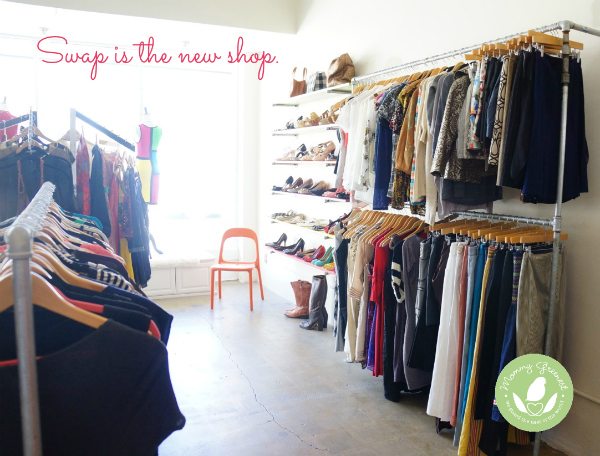
The average American woman spends $60 and creates six pounds of waste on clothes every month. With around 160M American women, that’s $10B and 1B tons every month (American men spend a relatively measly $35). One of the reasons there is such a high demand for clothes is novelty. Many people–and it’s probably fair to say particularly woman–enjoy wearing clothes that are au courant even if the old ones are still in good shape. A new shop in Los Angeles called Give + Take Swap Boutique has made a way for women to scratch their fashion itch without the big price-tag or heavy environmental toll.

It’s probably easiest to think of Give + Take as an offsite closet filled with clean, new-to-you designer garments, accessories and shoes. By paying a $35 monthly fee ($30 if paid ahead of time), you get access to the closet. Members bring in their nice but unused or unloved items and each is assigned a point value based on its retail value. Here’s how they explain it:

A dress that’s worth $100 would “cost” 6 points at Give + Take. If you brought in the dress, you’d get 6 points of credit in the store. If you want to take home the dress, you’d need 6 points to do that. You can accumulate points for larger items—i.e. bring in two $50 dresses and swap them out for a $100 pair of shoes.

After you swap the clothes, you own them–i.e. you’re not renting. Assuming they’re still in decent shape after your use (which could be for a day), you can swap them again.

One of the boutique’s partners Rachel Sarnoff told us, “Usually women come to us with bags of clothes that have been sitting in the back of their closets. They rack up a lot of points with those clothes, and then continue to swap more clothes in and out.”

Sarnoff said there are all varieties of sizes available. And even though there is only one Santa Monica location, some women have flown across the country to swap their clothes. Rather than having an ongoing membership, they bring in their unused clothes, pay for a $40 day pass and swap to their heart’s content–a scenario we could see as being way cheaper than a conventional shopping spree.

The so-called “sharing economy” has taken off for big ticket items like cars and hotel rooms, but not so much for the smaller stuff. Most of the time it’s cheaper to buy a power drill than it is to geo-locate, pickup and return a shared one.

But fashion could be different. Unlike power drills, novelty is prized in fashion (unless you have some weird power drill fetish). Having access to a big selection of new clothes could be a big draw. Second, as we mentioned above, the dollar amounts add up. According to Mint.com, between 2010-2011, Los Angelenos spent $243/month or 21% of their income on clothes (Manhattanites spent $362, which is the same percentage of their income). These are big numbers over time, especially for stuff that’s often not worn much after a few initial uses. We won’t even delve into the environmental and human rights implications of the fashion industry. The Give + Take boutique offers the novelty without breaking the bank or bringing countless under-used garments into the world.

If you’ve ever been there, let us know what you thought in our comments section.

WeLive Marries Micro-Apartments, Coworking, Magic

In case you didn’t know, WeWork is one of the largest coworking organizations in the US, if not the world. They have 19 buildings in three countries. When this author visited their Soho West location, I was amazed (pictured below). There were seven floors, each thoughtfully designed and decorated and booming with activity. With its mix of large, medium and small size firms as well as freelancers, all sharing one space, all feeding off one another’s energy, it truly felt like a futuristic office.

wework-soho

WeWork is now going a step beyond coworking. They have plans for WeLive, which will convert a 12 story office building into a residential building featuring 252 apartments, many of which will be smaller than 360 sq ft.

WeLive will be located in Crystal City, a neighborhood in Arlington County, VA, just south of Washington DC. WeLive would seem to be a decent fit for the area as Crystal City is already configured as a self-contained city. According to Wikipedia “Its residents can live, shop, and work without going outside, due to its extensive integration of office buildings and residential high-rise buildings using underground corridors.”

The building, built in 1965, had a couple Defense Department agency tenants up until this last spring. Prior to WeLive, it was sitting vacant, its interior considered obsolete by modern office standards. The project will gut the building, leaving the exterior mostly intact, “although it will have an experiential exterior color application that changes as one moves around the building,” according to a press release (please don’t ask us what that means).

Taking a distinctly office-y looking building and making it residential is a bold move in and of itself, but the county government seems supportive of this adaptive reuse. Arlington County Board Chair Jay Fisette said “This temporary conversion of an aging, vacant office building into an innovative live-work space is an example of how we continue to reinvent Crystal City as a more attractive, vibrant place that will attract more entrepreneurs and tech workers.” Fisette says “temporary” because WeWork, along with the real estate giant Vornado, is leasing the building for the next 20 years.

The other interesting aspect of the building is the creation of a mini universe (or maybe campus?) where work and live spaces are so close to one another. While this sort of setup is not unprecedented, it usually revolves around one company, not a variety of them. We imagine this heterogeneity will help make it a fertile place for innovative thinking.

WeWork and Vornado plan to make the WeLive building’s spaces conducive to vibrant community formation. There will be several shared two-story “neighborhoods” with expansive common areas connected by staircases. There will also commercial-grade kitchens, dining areas and shared community spaces. The building will be close to a metro stop and bike-sharing terminal, least it seem like they’re trying to have people live and work in a tiny geographic radius.

Many people talk about how their college days living in dorm rooms were some of their happiest. WeLive seems to be taking many of the elements of that life–tight geography, small rooms that push you into large social areas–and bring it to adult populations. Whether this will result in world class innovation or world class beer pong (or both) remains to be seen, but we think it’s a great experiment nonetheless and look forward to seeing how it turns out.

Helsinki Attempts to Create a Seamless Transit Web

Last year we looked at DriveNow, an innovative program set up by BMW that would connect you with whatever form of transit made sense given your location. The system, accessed via a smartphone app, could, for example, direct you from a shared bike to the train to a DriveNow BMW car parked at the train station. The system holds the promise of a swift and efficient connection of transit options, none of which requires personal ownership of any vehicle.

One issue with DriveNow program is that focuses on automobile travel (albeit BMW wants those automobiles to be their electric i-Series). It’s also possible that if the system were governed by BMW, there might be some conflict of interest between public and private interests. What if the most effective way of traveling has nothing to do with BMW? What if something like DriveNow was an open and neutral platform, almost like a public utility? That’s exactly what Helsinki Finland is trying to do. Their “mobility-on-demand” system would be a comprehensive transit system that would seamlessly (and neutrally) link you to the most efficient mode of transit available.

Helsinki’s program was devised by transportation engineer Sonja Heikkilä and would allow users to enter a pickup and drop off location. You could enter in preferences and the system would map out your journey, even factoring in things like weather in order to devise an optimal plan.

Another key part of the system would be how payment is given. Currently, people pay for their transit to whichever system they’re using. For example, they pay the Helsinki Region Transport when they take public transit. The “transit-on-demand” program would centralize payment, buying transit wholesale from the various providers. People could choose various payment options; they could pay by the kilometer or have unlimited use, with each having a different pricing structures depending on frequency of use.

The city is launching a test run with a small group of people at the end of this year. If all goes well, Helsinki hopes to have this program up and running by 2025.

Helsinki’s Kutsuplus system sets a precedent that this could work. Kutsuplus is a geo-locational minibus service that creates its routes based on realtime demand–sort of like a mix of a public bus and taxi cab, with a price that’s square in the middle of the two.

Heikkilä told the Helsinki Times that this program is not merely representative of innovation and efficiency, but the fact that “a car is no longer a status symbol for young people.” In other words, people, particularly young ones, are just as interested in pimping their planets as they are their rides.

Image credit: Slava2009 / Shutterstock.com

Via The Guardian

Luxury Micro-Apartments Come to DC, Transportation Included

A new micro-apartment building will be going up on the 1400 block of Church St NW in Washington DC. It will have 37 units ranging from 265 to 490 sq ft, according to Brook Rose who, along with Gregg Busch is developing the project. Rose’s specialty is luxury development and he sees the Church St apartments as consistent with that. “We are going to try to make these luxury micro apartments,” Rose told us. The rental apartments will feature floor to ceiling windows and high end finishes. The smallest units, where there is an imperative to have all the furniture work perfectly with the space, will be semi or fully furnished, using transforming furniture by the company Inova. Rents will likely start around $2K.

church_back

The building is a testament to the fact that Washington DC, a city that up until recently had been pretty ambivalent about micro-housing, is changing its tune, as evidenced by the likely micro-apartment development of the Patterson Mansion as well as this one.  But the city’s approval of the Church St building was far from a slam-dunk, having been held up by the Board of Zoning Adjustment (BZA) for a year because of issues around parking.

As we’ve seen here before, one of the primary sticking points for adding density to an area–something that micro-apartments tend to do–is parking. Most residential building requires a certain number parking spots per unit; these can be satisfied by on or off-street parking. Areas that have robust public transportation and walkable streets like San Francisco can often sidestep those requirements or provide minimal parking. But for most parts of the country, it can be a real barrier for development as it was for the Church St building.

Certain members of the BZA were not receptive to the idea of a building without parking, even though Rose was sure there were many “carless urban dwellers” who were “willing to trade space [and their cars] for lifestyle,” particularly in the building’s neighborhood which is along the 14th street corridor, a walkable area with tons of amenities. Rose calls the area “DC’s Soho.” One gesture Rose and Busch made to prove they were serious about creating a carless building was offer car and bike sharing memberships to residents for the duration of their leases (nb: residents would still pay for their use of the car).

The building eventually received the BZA’s narrow approval last month. The developers agreed to provide four parking spaces: two for residents to use for move in/move out and for guests and the other two will be for dedicated for car sharing cars.

But the city made a stipulation that residents could not apply for parkings permit that would allow them to park legally on neighborhood streets. This prohibition will be written into the leases and the developers will periodically check with the DMV to see if any tenants are violating the agreement. In other words, if you live here you cannot have a car.

Of course residents can elect to park in a private garage, but the arrangement seems like a prescient one. For most of the last 60 years, architecture has been bound to parking. Perhaps the Church St development augers a future where architecture and urban planning are designed as much around people as they are cars.

Wedding Dress Rental: One Special Day Needn’t Stuff Your Closet Forever

What’s white, covered with lace, used once and has an average cost of $1211? If your answer was the American wedding dress, you’d be correct. While we have nothing against the institution of marriage, the marital-industrial complex has become so powerful, so inflated, that many couples have become convinced they need to spend an average of $28K on their weddings according to a 2012 survey by The Knot and The Wedding Channel. While some expenses, like the $12K for venue, might be tough to save on, the wedding dress–a bulky, single-purpose, single-use, non-transferable hunk of lace, silk and taffeta–is a perfect place for cost-cutting.

wedding-spending

The Japanese–as they are wont to do–have a solution: rent your wedding dress. According to Rocket News 24 of Japan, the practice has become quite popular. The cost of the dress is actually worked into the overall cost of the wedding venue, many of which keep a bank of dresses at their disposal. The dresses are not necessarily cheap, costing as much as 150,000 yen ($1,450), though that’s for a high end dress that’d probably cost ten times that amount–a bargain if you’re into that kinda thing.

The practice, while not common, is done in the US. We visited Rent the Runway and they had a few options, all top designers and under $200 for a rental (though most looked like white evening dresses rather than traditional wedding dresses…not that that’s a bad thing). If you’re in LA, One Night Affair does high end wedding dress rentals. In fact, it seems like the best bet is to do a local, not national, search for rental places.

There is also Little Borrowed Dress, which specializes in bridesmaid dresses. They offer sets of dresses in a set number of styles and fabrics (12 and 18), in cuts that are “designed to fit and flatter all body types.”

Rather than cheaping out (not that cheaping out is a bad thing), renting a wedding dress, at least in Japan, is a reflection of care, as Rocket News states:

Some Japanese women we spoke to said that the very reason they want to rent their wedding dress is because of how important the ceremony is. Obviously, if we’re talking about the exact same item, it’s cheaper to rent than it is to buy. Just as there are companies that rent high-end sports cars to drivers who could never afford to buy one, choosing to rent a wedding dress gives the bride access to designers and quality far beyond what she could purchase at that price point.

Makes sense to us. And the ability to return the dress when you’re done–not carting it from house to house, storing it in a plastic bag, never to be worn again (a practice all too common in the American home)–is a big bonus.

Wedding image via Shutterstock

Are We Ready to Share Our Legos?

A new site called Pley is hoping to change the way children consume and use their toys…well, one type of toy at least. They are offering monthly subscriptions for Legos. Pley’s subscriptions cost $15, $25 or $39 per month, for small, medium and large sets respectively.

The subscriptions work much the way Netflix rents DVDs: fill up your queue with various lego sets from their online library; after the sets arrive in a box, you keep them for as long as you want; when you’re ready for a new set, return the old one in the box with a pre-paid label; wait a couple days and get some more. All the legos are sterilized before delivery in an eco-solution. You are allowed to lose up to 15 pieces per rental. Pley offers you the chance to buy the set at a discounted rate if your child isn’t so keen on returning them.

Pley’s has big ambitions for renting the small blocks. From their site:

Pley is a socially-responsible company that aims to change the way families consume products and spend time together. Leveraging collaborative consumption, we aim to raise a more creative and skillful generation that follows the principles of open-ended play while emphasizing the benefits of sharing, reducing waste and giving back to the community. Every set that Pley rents saves a tree over the lifetime of its rental. Todate, Pley had reduced waste by eliminating the wasteful production of 90,200 pounds of ABS plastic which resulted in a reduction of 3.9 million pounds of C02 emission.

[divider]

The sharing economy has had the most traction with big ticket items like cars and hotel rooms where savings are hundreds or even thousands of dollars compared to the alternative, i.e. keeping a car on standby or standard hotel rates.

But the sharing economy has faltered for the smaller stuff where private ownership is cost-competitive with shared ownership. We looked at toy-sharing sites a couple years ago; one of those sites definitely closed shop and the other’s last sign of life was a Facebook update in October 2012. A follow up look at some other sharing sites for small stuff reveals a similar situation: dead websites and unsubstantiated announcements to re-launch the businesses. Getting people to pay to share–unless there is a big and clear savings to be had–still appears to be a tricky proposition.

Pley might make it because they offer something beyond conservation and high ideals. They offer a level of novelty that would cost hundreds of dollars to achieve if you were to buy the sets for private consumption.

So far so good. According to Fast Company, who spoke with Pley’s CEO Elina Furman, the business has grown their staff from two to 23, and “has shipped over 75,000 sets to over 15,000 subscribers from its San Jose warehouse.” We hope their success continues.

Via Fast Company

Photo credit: Stefano Tinti / Shutterstock.com

Lend Tools, Build Better World

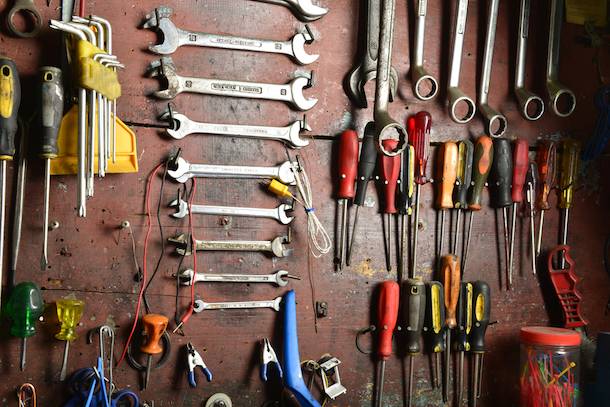
Some things seem inherently incompatible with small space living: Car collections, big game taxidermy, Richard Serra sculptures and extensive tool collections. While the former things have easy workarounds, for the DIY-disposed, the latter is often considered indispensable. Many people who need to store tools and a place to use them might find a 350 sq ft apartment insufficient for such tasks. There is a solution. Across the globe, tool lending libraries are offering builders an offsite place to source tools and in many cases use them.

West Seattle Tool Library‘s co-founder Gene Homicki told Christian Science Monitor that there are a number of significant advantages the tool lending library movement presents over private ownership. He says that due to their collaborative nature, they often become vibrant community centers (i.e. probably more so than your garage). In line with the spirit of the idea, several maker and co-working spaces have included tool lending libraries at their spaces; Homicki said many maker spaces started as tool libraries and evolved from there. At some of the libraries, people not only check out tools, but can learn how to use them as well.

Another advantage is the exploitation of unused resources. Homicki said to CSM:

We have an economy that’s uneven and sputtering at time…and we have this locked-up value that’s just sitting, whether in an attic, garage, or gathering dust in a warehouse.

These libraries get tools out of their dusty attics and tool benches into the hands of people who need them. An additional benefit is that they give access to specialty tools that you might only need once or twice–this is something even the most seasoned maker can appreciate.

One of the bigger issues of lending tools is keeping track of tools. While many libraries seem to use ad hoc systems with an administrator keeping track of a tool’s whereabouts, Homicki co-created something called myTurn. MyTurn is an online platform that gives libraries a way of tracking their assets and promoting the sharing of tools across private, public and municipally owned libraries.

If you want to find a tool library in your area visit Local Tools. If there isn’t one in your area, there are numerous resources to help you start your own such as the  How to Start a Tool Library guide and a webinar by the Center for a New American Dream.

Mechanical Workshop Tool image via Shutterstock

Via Christian Science Monitor