If You Like the Suburbs, You’ll Love Sunnyside Gardens

Lest we forget, car-dependent, suburban sprawl is a very recent phenomenon. For most of human history, living in compact homes in walkable areas was a choice borne of necessity, not lifestyle preference. This is the reason why it’s often wise to look at past precedents for smart architecture and urban planning for how we might build up greener, more connected housing in the future. One particularly interesting example of this is Sunnyside Gardens, Queens. Built from 1923-24, it was one of the country’s first planned communities, and it still stands as a paragon of smart, urban development.
sunnyside_commons

If you’ve hung out in New York City at all you know there are myriad housing typologies across the boroughs–townhouses, walk-up tenements, medium-rise elevator buildings, etc. For the most part, the frontage of these buildings face the street. With minimal setbacks (distance from from door to street) and driveways being the exception rather rule, the city’s housing layout achieves high very density, making for walkable, social living. But this layout also has a few notable drawbacks. First, with few yards and open areas to play, it is not kid friendly; kids in NYC start playing on sidewalks and streets at a young age for better or worse. And while many love being thrust into the action the second they walk out the door, after a while many city-dwellers start to crave a little buffer from the sites, sounds and smells of the city.  
sunnyside

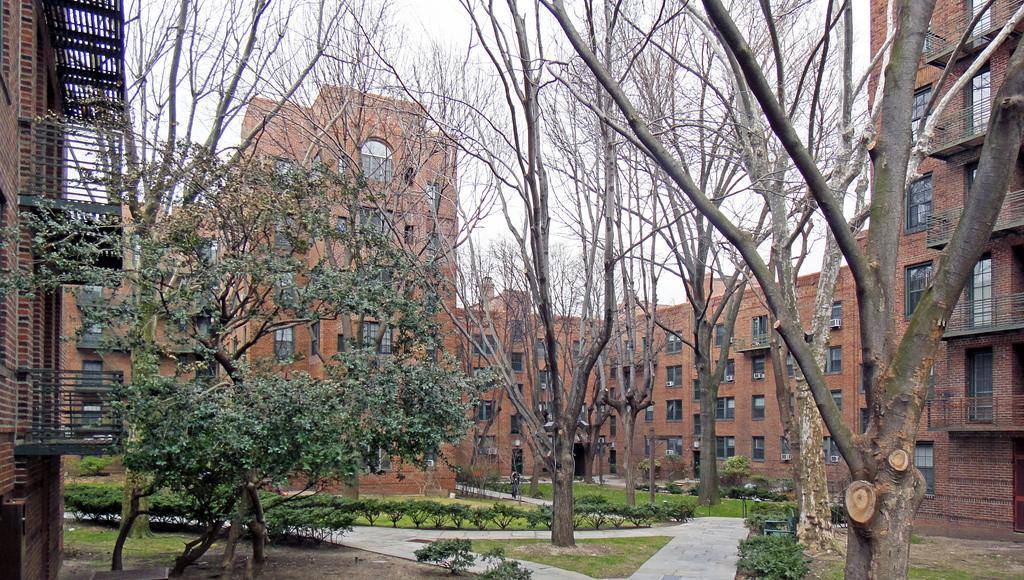
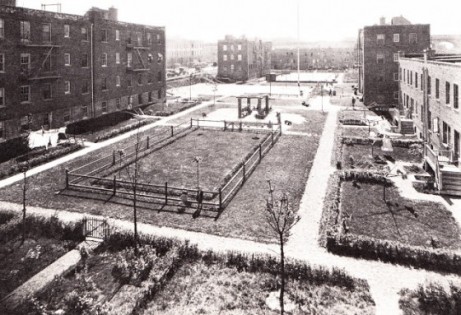
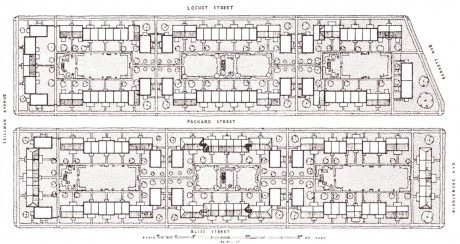
Sunnyside Gardens remedies many of the more unsavory aspects of living in the city. Designed by architects Clarence S. Stein, Henry Wright, and Frederick L. Ackerman as well as landscape architect Marjorie Sewell Cautley, Sunnyside Gardens is a community of one to three family private houses with co-op and rental apartment buildings. Unlike most street-facing urban housing, the homes were built around and faced common gardens and parks. The various different housing types had access to their own private space. From Wikipedia: 

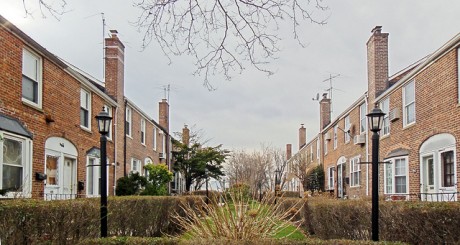
Each private residence has a small front garden facing the street and a private garden in the rear. The rental units in the two- and three-family houses enjoy private terraces overlooking the gardens. There are two configurations: the courtyard condition and the mews condition; at the edges of the community some homes simply line the street, with a common walkway running the length of the row. Homes in the courtyard blocks enclose an inner courtyard that was designated a common, landscaped but not used for recreation. Each homeowner actually owned, and paid taxes on, the part of the common in the block and lot, even if it was not used. The mews houses face a common front court and back on alleys; each mews house also has a private rear yard.

Stores and garages, which are typically on a building’s ground floor or on home’s front, respectively, are placed on the periphery of the Sunnyside Gardens’ homes. The net effect of all this is having many of the benefits of living in a suburb, while still maintaining the density, easy access to public transit and other benefits of living in the city (it’s a 15-20 minute subway ride to midtown Manhattan).
8615815772_d88560ba3e_z

The plain-faced Hudson brick homes and buildings are not necessarily the epitome of high design, but the intelligence of planning compensates for any lack of architectural histrionics. More than anything, Sunnyside Gardens shows that density, tranquility and nature can, with proper planning, share the same space. 

The Best Worst Case Scenario Housing

Necessity, so it is said, is the the mother of invention. And few situations bring necessity to the fore like a disaster. And few disaster housing is as inventive as the NYC Emergency Housing Prototype by Garrison Architecture’s. Made in partnership with New York City’s Office of Emergency Management, the prototype was, in part designed as a response to the need for housing following events like Hurricane Sandy. The prefabricated housing complex was designed to be deployed in less than 15 hours “in the event of a catastrophic natural or manmade disaster,” according to Garrison.

While designed for emergencies, the prototype’s construction bests most permanent homes. From Garrison’s site:

With 1- and 3-bedroom configurations, every unit features a living area, bathroom, fully equipped kitchen and storage space. Units are built with completely recyclable materials, cork floors, zero formaldehyde, a double-insulated shell, and floor-to-ceiling balcony entry doors with integrated shading to lower solar-heat gain, provide larger windows, and add more habitable space. Units can be equipped with photovoltaic panels, which will not only alleviate pressure on the city grid, but also ensure the units are self-sustaining.

The units range between 480 and 813 sq ft and whole multi-story, multi-unit structure measures only 40′ x 100′, making it easy to set up in small lots.

garrison-nyc-emergency-interior

That Garrison should make such an innovative, handsome prefab structure should be no surprise. Since 1991, the firm has specialized in modular construction, citing “material efficiency, economy of scale and built-in quality control” as its inherent strengths.

For more info head over to Garrison’s website.

Photo credit: Andrew Rugge

Single Family Housing that Makes Sense

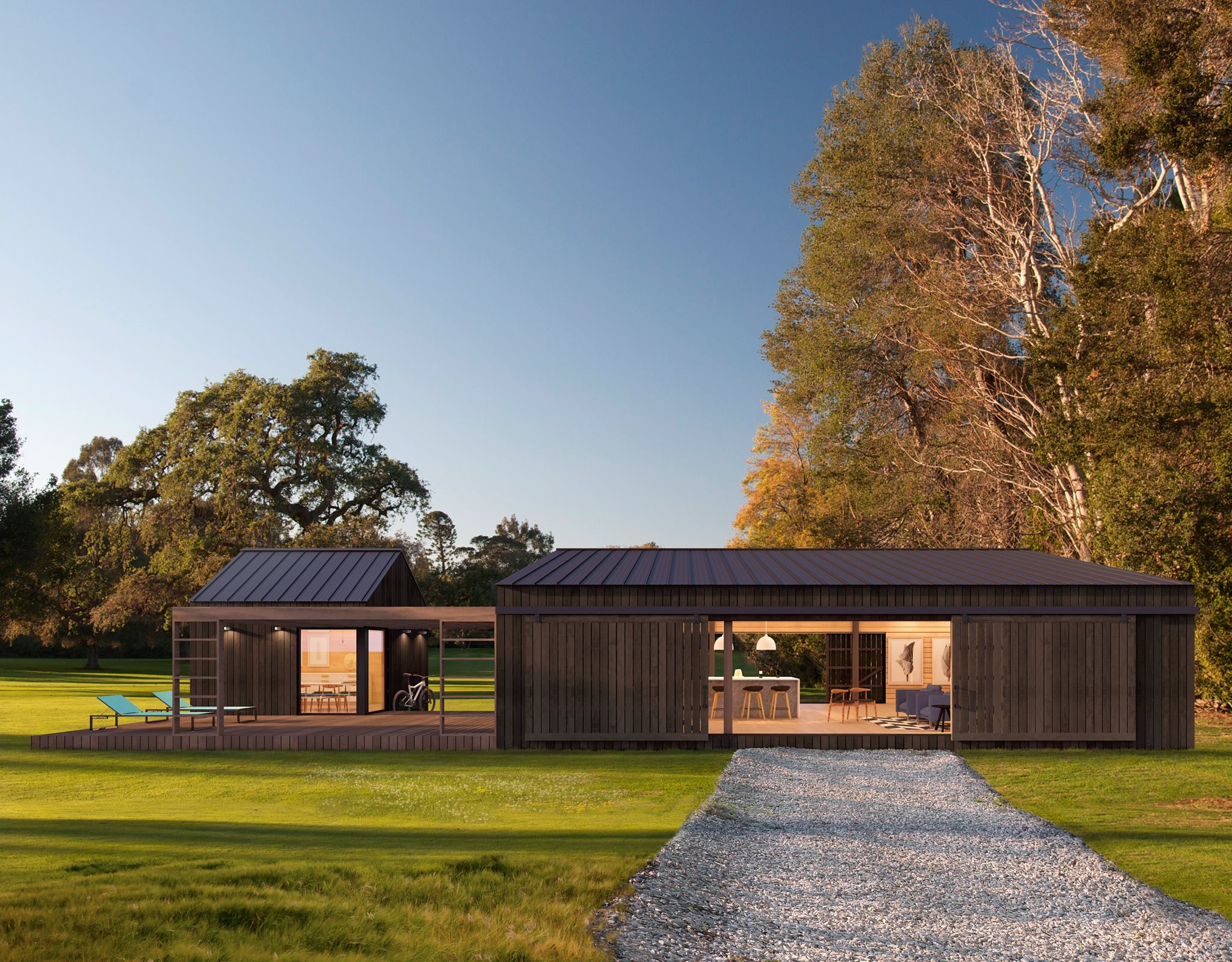
There was a time when American single family homes weren’t so absurdly large. In 1950, the average household had 3.83 people and the average new single family home was 983 sq ft, making for a pretty reasonable 291 sq ft per person. Compare that to 2014, when the average household had 2.54 people and the average new single family home was 2,690 sq ft, or 1059 sq ft per person. That’s a 360% increase in per capita housing size. Yikes! What’s worse is this continual embiggening of the American home has dwindled the options of modestly sized homes for those who want them. We frequently get notes from people who want to downsize, but say they are forced into homes larger than they want because there’s virtually nothing available in their area. A real estate startup out of San Antonio, TX called Rising Barn is trying to remedy this lack of options, offering prefabricated, stylish, affordable and reasonably sized single family homes.

risingbarn

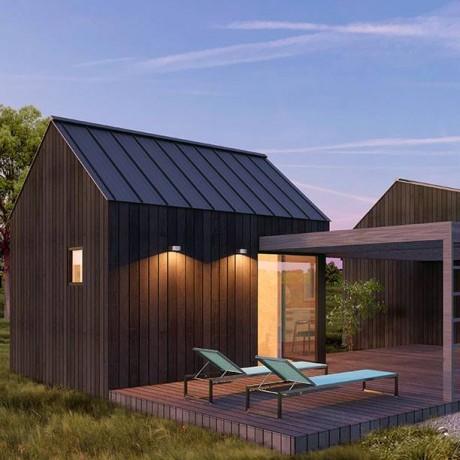
Rising Barn offers five “kits” with two categories of structures: cabins and domos. The cabins come in two sizes, large and medium. The large is a two bedroom unit with 720 sq ft of usable square feet (above), and the medium is a studio with half the area of the large; unlike the large, it doesn’t have a full bath or kitchen, so it’s designed for “work/live” use. The three domos are multipurpose rooms ranging from 80-160 sq ft and can be used in conjunction with cabins or as additions to existing homes.

risingbarn-domo

Rising Barn wants to make the whole process simple and affordable. Here’s an explanation of the ordering process from their site:

Once you do [select a kit], our barn kits will be delivered to your land in 2-6 weeks. If you prefer to hire a crew, we are happy to assist you in choosing the right one in your area. If you reside in Texas, you can contract a Rising Barn team leader or use our turn key service. You can build it with a few friends within in a week, work alongside Rising Barn team leaders, use our turnkey service, or we can help you find a local crew to assist.

According to the San Antonio Business Journal, unit pricing ranges from $120-200, which includes material and labor. If you go the DIY route, that cost drops to $90 to $105 per square foot. So a 720 sq ft cabin built by contractors would run, on the top end, $144K; even factoring in land costs, permitting and other sundry expenses, this seems like pretty competitive pricing.

Sure, there are cheaper prefab options, but I doubt they look half as nice as Rising Barn’s or are made half as well. And the ones that do look and are built this nice typically run in the multiple hundreds of thousands of dollars just for the structure. If you must live in a single family home, Rising Barn looks like a solid option. 

A Tiny House that Doesn’t Look Like it Belongs in 1890s Kansas

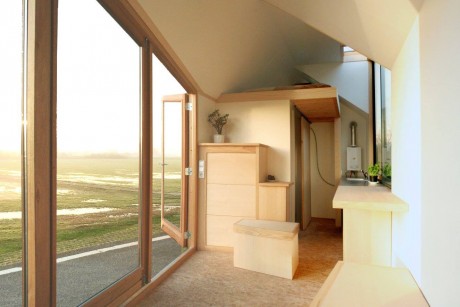
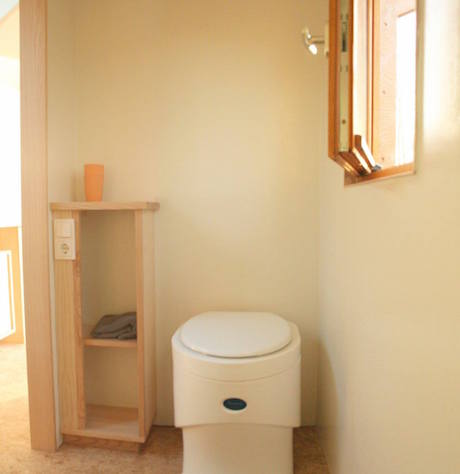
Call us a bit jaded, but after a while many tiny houses start to look alike: tiny gable-roofed structures with eaves and a porch, lots of rustic wood, a loft bed, composting toilet. This is all fine, good and functional, but it can also feel somewhat generic and leave those whose tastes lean modern a little wanting. We ran across this tiny house on Treehugger by a Dutch outfit that calls themselves Woonpioniers. Yes, their “Porta Palace”, as they call it, is still made of wood and has a gabled roof (albeit an asymmetrical one), loft bed and composting toilet, but its sleek and clean design give it an overall effect that is very removed from Laura Ingalls and her houses on prairies.

woonpioniers-living

The first distinguishing trait are windows: two huge ones on either side, one of which contains a big door, making the transition from in and outdoors somewhat fuzzy. While giving it a dramatic look and tons of light, it would also pose some serious privacy issues if the Porta Palace were placed in a group setting.

There’s not much to the space that can’t be seen: there’s a living room with integrated sofa that faces out one of the large windows; there’s a sleeping loft that’s accessed via stairs that are also storage boxes; that loft sits above a bathroom where the requisite composting toilet resides; and there’s a small (I guess that goes without saying) galley kitchen. Everything has a unified aesthetic, making it look like a pleasant place to hang out.

woonpioniers-toilet

The project seems to be an experiment in low cost, low impact living (Woon means “living,” not wood as I initially assumed) and one its architects, Jelte Glas, will conducting that experiment upon itself, living in it full time. As much as anything, the Porta Palace shows the infinite forms tiny housing can take. See more on Treehugger and the Woonpioneers website.

Cool San Francisco Transforming Loft

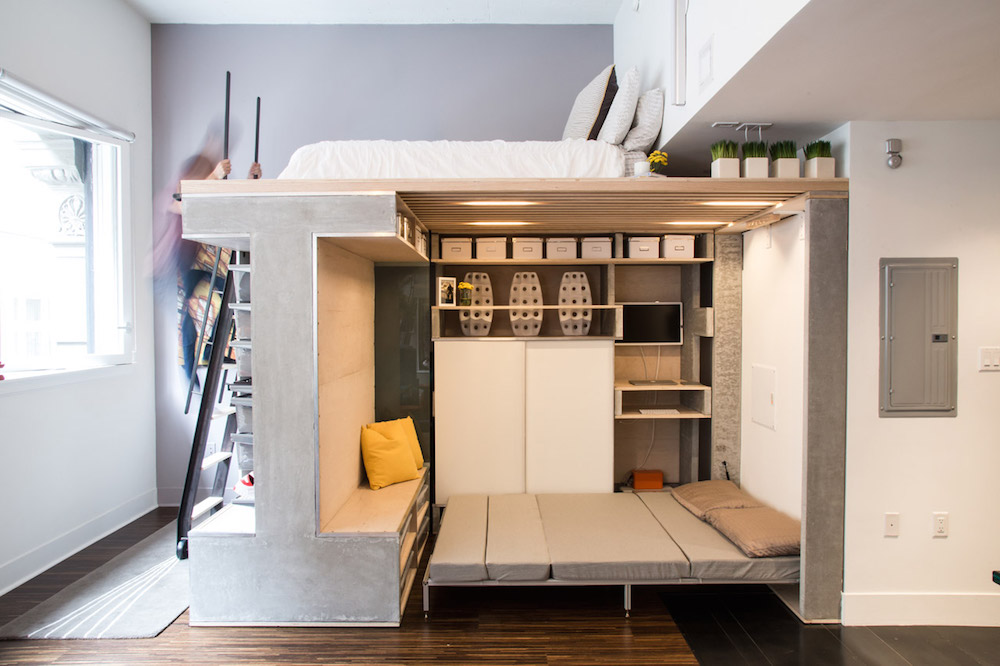
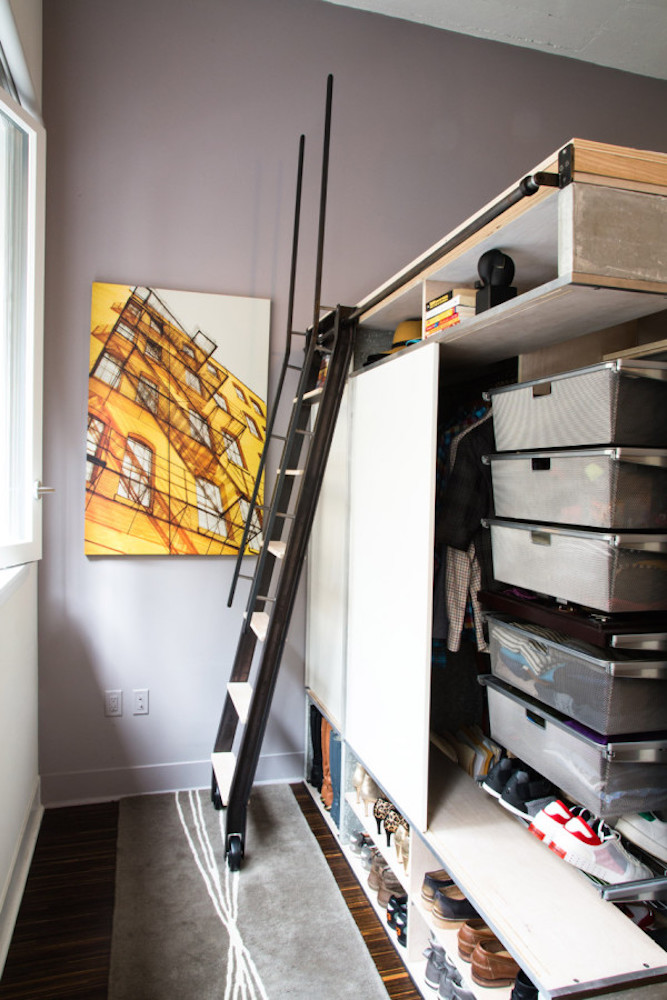
A reader of ours turned us onto this cool 500 sq ft San Francisco loft recently featured on Design Milk. The space was designed by Charles Irby and Peter Suen and centers around a prefabricated module that houses nearly all of the apartment’s storage and furniture. Inside the module is an area that contains storage, a work station, a bench and a dining table that flips down from the wall. There is also a very cool murphy bed that, when folded into the wall, has a dry-erase board on its base.

On top of the module is a loft bed effectively making the place capable of sleeping four friendly people. The loft is accessed via a ladder which sits on the far end of the module where there is ample, open storage. For those without neck problems, the top of the loft doubles as a screening area for a projector and screen viewable on an opposing wall. To see more images, head over to Design Milk

HT to Steve S

A Case for Bringing Innovation to the Housing Market

In Manhattan, the average cost of a studio apartment is $2,418 (non doorman). In San Francisco, it’s $2650. Crazy as it sounds, you might not have the privilege of paying those sums as both cities have low single digit vacancy rates. Other major cities like Boston and DC have similarly high rents and low inventory. And while some of this expense is offset by higher per capita incomes, many find themselves unable to afford housing. A study by NYU’s Furman Center found that 50% of New Yorkers were “cost-burdened” by their rent, paying more than 30% of their income on housing; 60% of that segment (600K people) were “extremely cost burdened,” forking over more than 50%. So it’s not a stretch to say that housing is a big problem in many major cities (we’ll save the suburbs for another day). In fact, it’s one of the most far reaching problems you could think of, striking at one of our most fundamental needs. It’s a problem that, theoretically speaking, deserves more attention than an app for ordering dog food on your smartphone. Yet, if we are to believe Jon Dishotsky essay on Medium, the app is going to get a disproportionate percentage of the world’s brainpower and creative thinking.

The reason for this disparity of intellectual resources, Dishotsky convincingly contends, is simple economics: with relatively little money, a tech developer is able to create a product in a short amount of time. In fact, using the minimum value product (MVP) model, the product doesn’t even need to be fully fleshed out in order to be sold. Release the product, get customer feedback, improve on the fly. It’s a model that favors innovation through experimentation because errors and design flaws can be corrected while bringing in revenue.

Real estate development is a whole other story. Dishotsky writes, “In order to experiment with new ways of building housing you would have to…build housing.” And building houses is a resource intensive affair, one that favors getting things right the first time.

To illustrate the dilemma, let’s say you’re a hotshot thinker, contemplating making your mark–and fortune–in tech or housing. You weigh the two industries. With tech, you raise a reasonable amount of money, create a product that should work and serve a need (even if that need isn’t particularly important), but you don’t have to worry, because you can always change and improve that idea over time. Or you could go into housing (development, architecture, services, etc), where you must raise a ton of money, face innumerable engineering, labor and bureaucratic roadblocks, where you must be sure that you have a marketable, inhabitable, code-compliant structure, because you cannot change your product after the fact. And once you’ve surmounted these innumerable roadblocks, you might have built something that a handful of people can call home–you’ve satisfied an important need for a very small constituency with lots of costs and risks. Considering these alternatives, the smart money’s on tech.

In order to make housing more attractive, Dishotsky suggests, we must “find ways to acquire land cheaply, build cheaply, limit soft costs and increase the speed at which healthy buildings get approved”–a suggestion we would tend to agree with, as most innovative housing never sees the light of day because of economic and bureaucratic barriers. This is why we often look at the margins: in Portland OR or Providence RI or Walsenburg CO–places that aren’t besieged by insane property values, places whose ebbing fortunes make them more receptive to trying out new ideas.

The person who turned us onto Dishotsky’s article was Jeff Wilson, aka Professor Dumpster and the man behind Kasita prefab, plug-and-play housing. He and many others we cover here testify that there’s not a complete void of intellect and resources devoted to innovative housing. But for many of these players, it’s still an uphill battle: fighting development, financial and government institutions that favor market tested models over actual market needs and smart design.

So you might be asking, what can I do? Well, you can buy or rent innovative housing if it exists in your area. Create demand. You can write letters to your congressperson, petitioning for regulation reform that might be more hospitable for innovative types of housing. You can encourage your children to go into real estate development with an eye on innovative design. You can change your Facebook picture to a Nakagin Capsule. We’re not entirely sure, really. All we want to say is making housing that works–functionally, financially, environmentally–is one of the most important things we can do and it deserves our attention.

WeLive Goes Live, Sorta

A while back we reported about WeLive, the residential arm of the coworking giant WeWork. That post gave some of the spec’s for their Crystal City project, which converted a 12 story office building outside of DC into massive complex filled with micro apartments, communal recreational and coworking spaces. Well, unbeknownst to many, WeWork was developing another project at 110 Wall Street in Manhattan’s financial district (also the site of an existing WeWork coworking space). The project will eventually house 600 folks on 20 floors. They recently announced a beta launch at the building, which will house 80 WeWork members in 45 units.

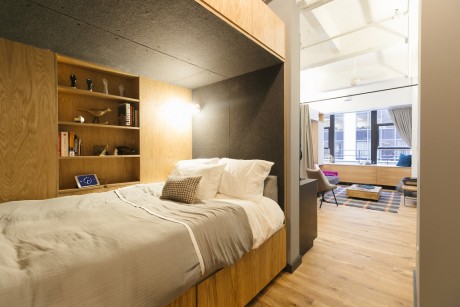
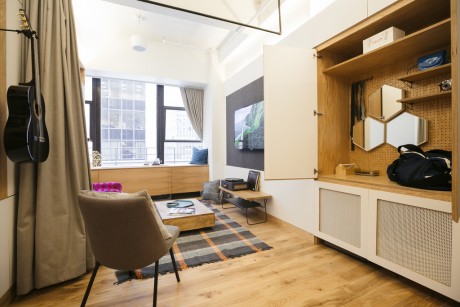
Similar to Ollie in New York, The Collective in the UK, CommonSpace in Syracuse and other such developments, WeLive (not the official name for the record) seeks to create a whole universe for its residents. The pictures released by WeWork show handsome apartments designed by ARExA Architecture, whose principal and Creative Director Darrick Borowski designed one of our favorite micro-apartments. The interior incorporates Resource Furniture space saving beds. There will be studios and one and two bedroom units. The pictured unit is a two bed studio separated by a curtain (a setup that will probably not appeal to everyone). 

Welive-second-bedroom

The private units will be supplemented by common areas on every floor. There will be social directors, who, according to Fast Company, “Will help plan Sunday-night suppers, game nights, karaoke, and fitness classes.” Additional services like wifi, cable and cleaning are also included. You could, theoretically, never have to leave the building if you so chose.

welive-dresser

The whole concept raises a somewhat thorny question: would having your coworking space share a building with your apartment be a good thing? Or might it create a somewhat insular existence, where work and and personal lives have no division, where you run into the same (somewhat homogenous) crowd day in, day out? These are somewhat academic questions–literally. What WeWork is doing is creating something akin to an academic campus, albeit with a professional twist, a model that seems to work just fine. Which is good, as WeWork sees their residential endeavors making up 21% of their revenue by 2018. 

Via Fast Company

Living Small, Riding Free

We have posted about numerous folks who have traded stationary homes for RVs. People make this choice for a variety of reasons. They might want to see the world, live a more minimal existence, reduce overhead and so on. Despite these attributes, many bristle at the idea of a roving home that depends on a fossil fuel hungry internal combustion engine.

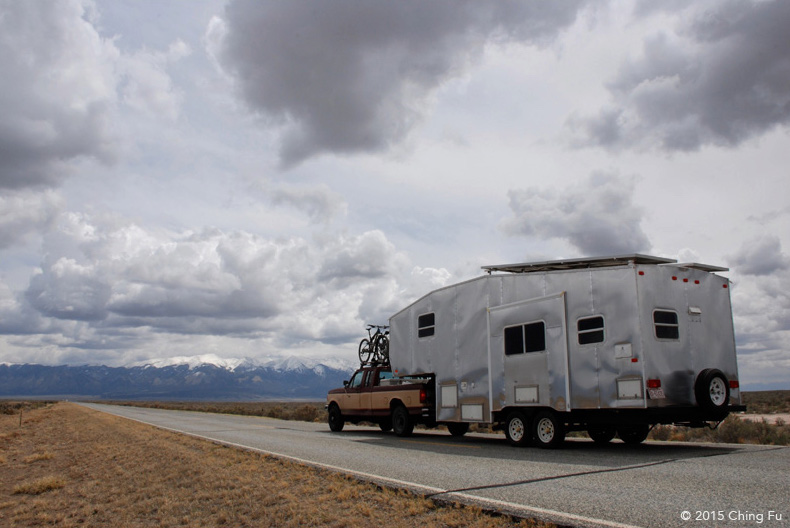
Recent fulltime RVers Ching and Jerud had similar reservations, but ultimately decided an RV was the best type of home to do what they wanted to do: live self-directed, outdoor-centered, low-overhead lives. Today’s guest post by Ching goes into some of their story: why they chose to live in an RV, the ups and downs of the experience and even how they made it work with their environmental sensibilities. Read more about their journey on Live Small Ride Free.

My desire to downsize my life from a 1,200 sq. ft. house to a 200 sq. ft. RV was driven by my love for the great outdoors and need for exploration. Yearly two-week-long vacations always ended in a blink of an eye and I felt time was becoming more and more my enemy. I didn’t want to wake up one day to realize that I was too old, too comfortable and had too many strings attached to live the life I always wanted. And I was tired of reading about other people’s adventures while daydreaming about  mine. It finally hit me that there wasn’t any reason I couldn’t live the way I wanted–traveling fulltime on the road.

Living in an RV wasn’t initially our first choice because of its carbon footprint. Yes, it’s less than living in a standard house, but the irony of traveling to America’s beautiful natural landscapes while burning fossil fuel didn’t escape us. But we realized that an RV actually best fit our needs and that we could further decrease our carbon footprint with some modifications.

livesmallridefree-veg-oil

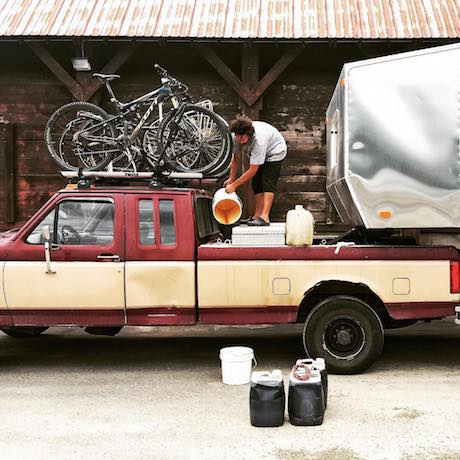
RVs use a mix of electricity and propane to power everything inside them – from running the fridge, heater, stove, and lights, to charging cell phones and laptops. Electricity is generated either by plugging into the grid at an RV park, a diesel generator, or sometimes aftermarket solar panel additions – but propane does the majority of the work, heating the interior, the water, and cooking food. We decided to remove all of our propane appliances, go fossil fuel free and turn our RV into an all-electric rig powered totally by solar panels. On top of that we challenged ourselves even more by converting our truck – our tow vehicle – to run off of waste vegetable oil instead of diesel Sustainability was our other priority next to creating a new life of mobility and freedom.

Our new lifestyle is simpler and happier than before, but it’s also challenging. We didn’t just change the size of our home but how our home functions, which meant there was a lot we had to learn. Also, in our new life we are more aware of how we are living and what we use – I call it conscious living. We know exactly where our electricity, water, and fuel comes from and how much is available to us. Our energy has been diverted to things that are important to us rather than what’s important to society or our employers. In a sense we’ve regained control of our lives and our future, and it feels good, scary and right.

salida

The highs that we’ve had so far during our 9 months on the road: the day we rolled out of our hometown; having our RV that we spent a year rebuilding not instantaneously fall apart as we drove away; waking up to our first snowstorm in Colorado and not running out of electricity on that cold cloudy day; driving from Missoula to Seattle on nothing but waste vegetable oil; pre-dawn hike to watch the sun rise above the Cascade Mountains; racing the sunset while mountain biking in Colorado; and kayaking snow-fed lakes.

But as with all highs, there are lows to balance things out: having our truck’s brakes fail while driving up a mountain; spending three months looking for a replacement truck which halted our travels; dealing with major RV battery issues; being stuck in a truck with an old, incontinent dog with diarrhea; having my touring bike and dog trailer stolen; and the days when we just can’t find available waste vegetable oil.

A big low is our current lack of financial security. We didn’t have career backgrounds that could easily transition to a mobile setting and we chose to leave before securing new jobs. Part of the reason we are able to do this is because the cost of living isn’t very high for us thanks to our RV and truck setup. There are a wide variety of job opportunities for full-time RVers and the RV community is a great resource. We’ve given ourselves a year to figure work out and have had income from a rental property to float us while we adjust to life on the road.

Becoming a full-time RVer didn’t automatically make my life perfect and happy. But being proactive and changing my life to be structured the way I want and living my priorities has created a huge sense of calmness for me.

Moving Up Maslow’s Pyramid with Kirsten Dirksen

Since 2006, Kirsten Dirksen and her husband have been producing *faircompanies, a web video series that has evolved to become the world’s most comprehensive archive of compact homes and the people who made and live in them (among other things). Virtually every significant small space–from our own LifeEdited apartment to Nakagin Capsule Tower to many, many others you never heard of, but should have–has been lovingly chronicled by Dirksen.

As her profession dictates, Dirksen’s focus has her looking at others, but we thought it was time to turn the focus on her, finding out more about her and *faircompanies..

David Friedlander: Tell us a little bit about yourself.

Kirsten Dirksen: I live in Fontainebleau, France (40 miles south of Paris). We just moved from Barcelona this fall.

I don’t really have a job title. I used to work in television, then I met my husband in Barcelona and started commuting there between freelance TV jobs in NYC. Once we had kids I began to do more freelance work from Spain, but now I just make videos for our website and youtube channel.

DF: How did *faircompanies begin?

KD: Back in 2006, my husband, Nicolás Boullosa, had the idea to start a website that was a type of 21st-century Whole Earth Catalog. While it has evolved into something a bit different, “access to tools” is still the logline for *faircompanies.

With my videos I try to focus on great stories: people who are building unique homes, creating new vehicles, reinventing gardening, etc. Again echoing Stewart Brand (founder of the Whole Earth Catalog), I believe in the power of basic tools and skills–and the technologies available to us today (e.g. 3D printing, aeroponics, Arduino)–to shape our environments in a way unthinkable a few generations ago. As Brand wrote back in 1968 “we are as gods and might as well get good at it”. (For a taste of all this, I put together a compilation video of some of my stories here).

DF: What is your intention behind making the videos?

KD: I want to explore stories in the way I wanted to film and edit them, but often couldn’t while working for broadcast media. I make videos to examine how other people live. The camera gives me an excuse to ask questions.

What attracts me most to people who have minimized their lives (their possessions, the size of their home, etc) is the shift in focus. Here are people who have decided not to focus on stuff and so that leaves the more interesting topics, namely, my personal favorite: anything related to philosophy of life.

DF: What is or are the favorite videos you’ve produced and why?

KD: I don’t have a favorite video. I feel that each video builds on the others and they’re all part of this trip I’m on of discovery. That journey involves:

DF: Anything else we should know?

KD: I want to be sure to point out that I’m very aware of how easy it is to oversimplify all this. I don’t think a tiny house, or a tiny wardrobe, makes anyone happier, but it might open up more paths toward fulfillment. If you think about it within the framework of Maslow’s hierarchy of needs, those who have chosen to make their physical needs small, and easier to achieve, can move on to working on self-actualization.

Returning to Stewart Brand’s ideas about the incredible access to information we all have at this moment in history, I try to tell stories to help remind people about the great power we all have at our fingertips. I think the Internet has also made it dangerously easy for us to identify with mass movements and, at times, to fall victim to victimhood. I hope my videos inspire people to recognize the great power we all have, even if it’s just to make small, but often significant, changes in our lives.

It’s the Little Things That Make A Difference

Unless you’re living in some self-sustaining, off-grid detached house, the fact is that multifamily, multi-storey housing in dense, urban settings–ones that are walkable and have access to public transit–are going to be your best bet for green, low impact living. But here’s the deal: most Americans don’t live in this type of housing–single family homes make up 70% of the American housing stock, and while people may be migrating back into the cities, the vast majority of them can or will not move for various reasons. Which leaves the question: how can we make the single family housing–and the sprawl that tends to come along with it–greener?

A reader tipped us off to the east bay town of Albany, California, which, like its neighbor to the south, Berkeley, has become increasingly hospitable to accessory dwelling units (ADU’s), both as a way to increase density as well as creating an “aging in place” strategy; ADUs can let older, emptied nest adults inhabit small dwellings behind the big homes that they might have once used for their full houses. We found this nice example in Albany on Tiny House Listing of how one family, through the addition of an ADU, turned a fairly typical single family house into a mini compound that housed three generations.

While ADUs are often used to house older generations, this particular one, at least initially, was used to house younger ones. The house owner of 30 years, Judy, invited her daugher and her daughter’s partner and child to come back and live at home. Rather than shacking up in the main house, they built a simple, 442 sq ft L-shaped home where a detached garage and patio once stood.

judys-garden-cottage-1 Judy worked with New Avenue Homes to construct the home (they seem to do a lot of ADUs). Tiny House Listing said this about its construction:

The family considered sustainability and stylishness during design development. They opted for reclaimed and recycled materials, non-toxic paints, solar panels, a large bay window, stained cedar siding, bamboo flooring, and an exposed wood ceiling. The structure is L-shaped and sits in a far corner of their backyard. A garden and walkway connects the main home to the cottage. Construction took around 6 months.

For reasons not explained, the home is now used as a rental investment property, though Judy plans to move in when she retires in a few years, presumably to have a low fuss home with a large rental property helping to keep living expenses very low.

judys-garden-cottage-13

While inserting compact, multi storey housing in the millions of underutilized lots of American single family housing would be ideal, there’s pretty much no way that’s going to happen…at least any time soon. In the meantime, ADUs offer an elegant, livable way of increasing density in areas that might seem like they are immune to density. While Albany might not epitomize the American suburb (it’s near a BART station), Judy’s example shows how this can look, which, with its little pathway and garden, looks pretty good to us.