Citi Bikes Invade New York City

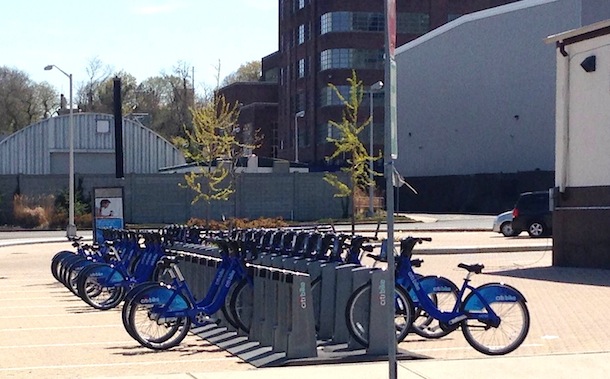
Last year we reported about the Citi Bike public bike program in New York City. We were excited for its unveiling in July…last July that is. Unfortunately, some technical issues (keeping track of the initial 6K bikes across their 300 stations can’t be an easy) and a little hurricane delayed the program. Well it’s finally here, and the distinctive blue bikes can now be seen throughout Manhattan and parts of Brooklyn.

citibike-map

We applaud Citi Bike for making a pricing scheme that is both New Yorker and tourist friendly. Locals can pay $95 for a yearly pass which permits unlimited <45 minute rides. Not-so-locals can pay either $9.95 for 24 hours or $25 for a seven day pass, which permit unlimited <30 minute rides for the length of the pass. Overage charges apply when those time limits are exceeded. This pricing scheme seems to denote that Citi Bikes are actually meant for transportation, not merely joyrides around Times Square–i.e. get on, get to your location, leave bike.

citibike-brooklyn

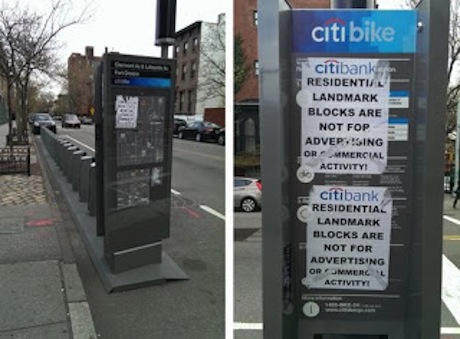
The introduction of the program is not without controversy. In particular, residents of the historic Fort Greene and Clinton Hill neighborhoods of Brooklyn have taken issue with the fact that Citi Bike stations act as big billboards for Citigroup, the chief sponsor of the program. Some critics have also warned of the potential for vandalism, similar to that Paris’ Vélib’ program initially received.

earth-policy-bike-sharing

That said, more than a few people–bicycle advocacy groups included–are expressing their approbation of the program, which plans to expand to 10K bikes across 600 stations. In fact, the first round of memberships, capped at 5K, sold out in 30 hours. And as a trend, public bike programs are only on the rise, as the above charge by Earth Policy Institute indicates.

While having your own bike is great, public bike shares provide something else. As Bikesnob NYC ever-so-succinctly put it: “I already own a toilet too, but it’s still more convenient for me to use a different one when I’m not at home.”

More info at Citi Bike’s website

Tricycle House Makes Tiny Houses Look Decadent

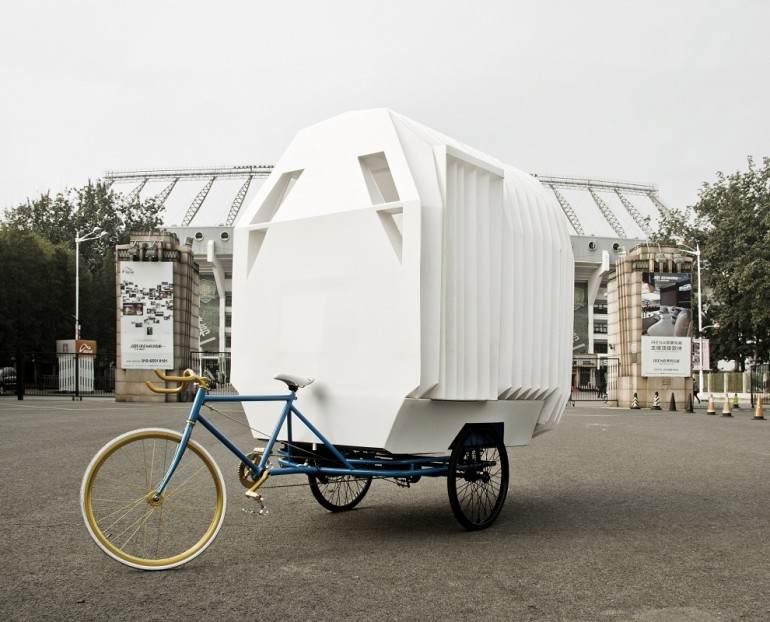
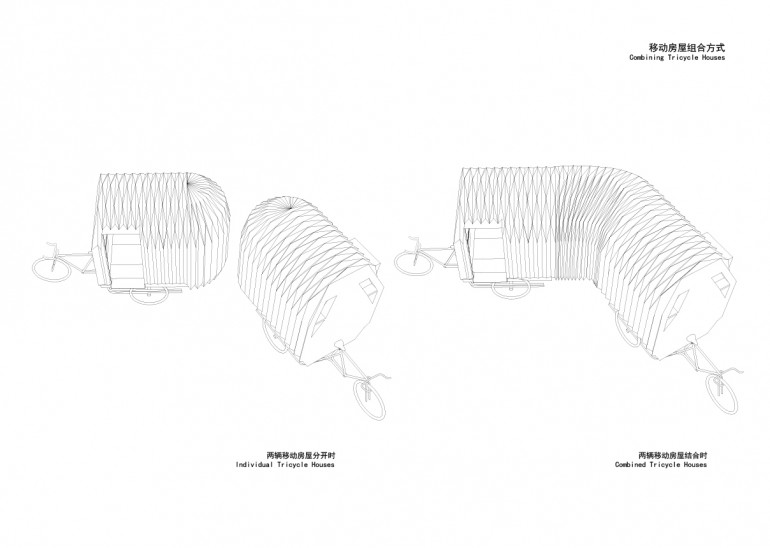
Sure, tiny houses are tiny, but they seem downright palatial compared to the Tricycle House. The project, part of the Get it Louder Exhibition in Beijing, is collaboration between People’s Architecture Office (PAO) and the People’s Industrial Design Office (PIDO). Like Tiny Houses, the house is as much a political statement as it is an architectural one, providing a response to the soaring price of Chinese real estate and government “land grabs” that have displaced many Chinese citizens. The tricycle provides the opportunity for home ownership, albeit on very small scale.

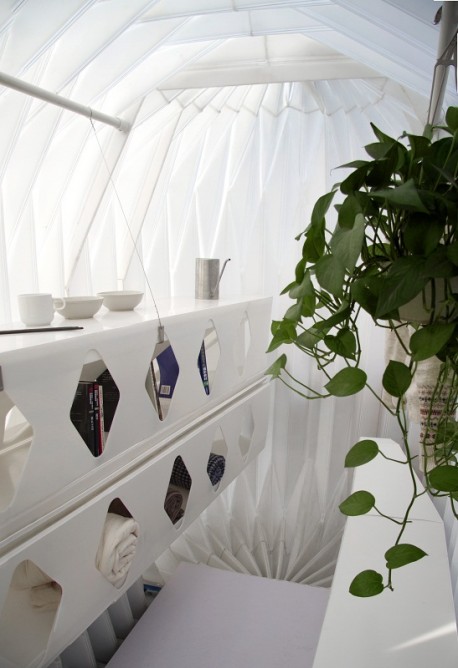
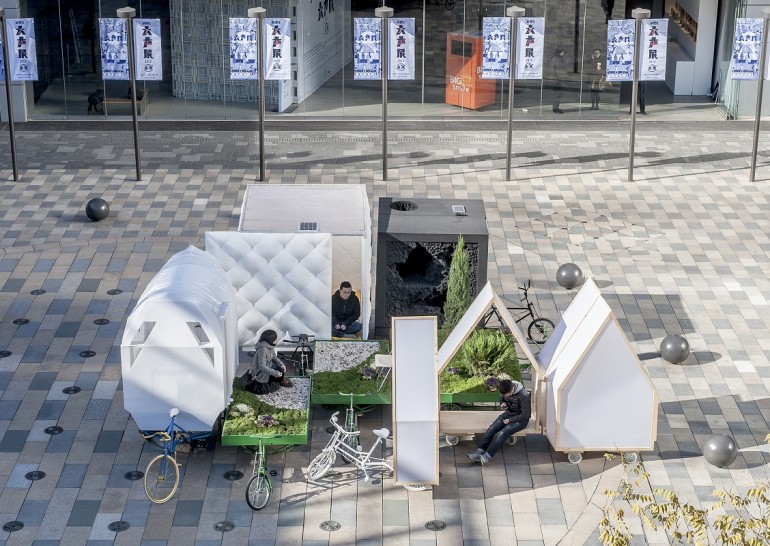
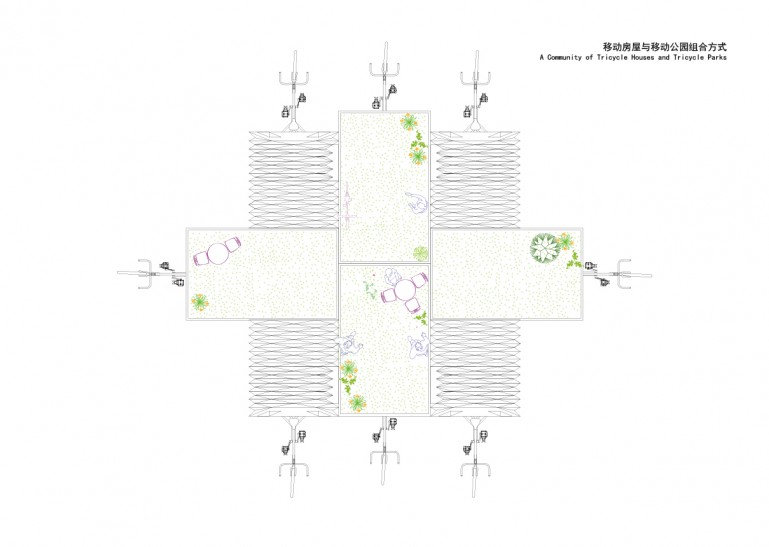
The polypropylene-constructed house is roughly 30-35 square feet and can be used as a dining room, kitchen, bedroom, workspace and bathroom. It boasts some impressive features such as a bathtub and clever folding sink and drawers. Similar to the Napoleon Complex, the house seems best used when coupled with other tricycle houses and tricycle gardens.

We’re not sure if there are any plans to develop the idea beyond concept, but a similar lightweight, off-grid housing structure would make a great edited recreational vehicle.

Via Gizmag and Treehugger

Thanks Susan

Sell Stuff Easier with Sold.

We’ve said it once and we’ll say it again: Selling stuff can be a real pain in the butt. The relief of unloading is often more than offset by the grief of haggling, scamming and parting with your stuff at bargain basement prices. More often than not, giving stuff away is the most economic, least heartbreaking solution. But we know you might have some stuff that’s too nice and too new to give away. For that stuff, there is a new service and app called Sold. (the period is part of the name FYI).

With Sold.’s iOS app, you take a picture of the stuff you want to sell, answer a few questions and wait for Sold. to verigy that the pictures align with the questions you answered; they then give you a price they agree to pay you. They do the heavy lifting of selling. They find a place to sell the item (mostly eBay it would seem), determine a price, handle billing and even send you shipping materials.

They take a small fee and we would assume that if they fetch more than their quoted price, they take that money as well. Sure, you might be able to keep more money by selling yourself, or, just as likely, you’re apt to get less because you don’t know how to sell your items. In that light, a reasonable fee is probably well worth it.

Here’s the rub for all of you folks looking to unload aunt Six Flags shot glass collection: Sold. doesn’t want your junk. They’re looking for “things of value” like newer smartphones, computers, designer sunglasses, handbags and such. As many of us have those items, Sold. can be quite useful.

via Netted by the Webby’s

Small Space Design Provides Escape Route for Italian Prisoners

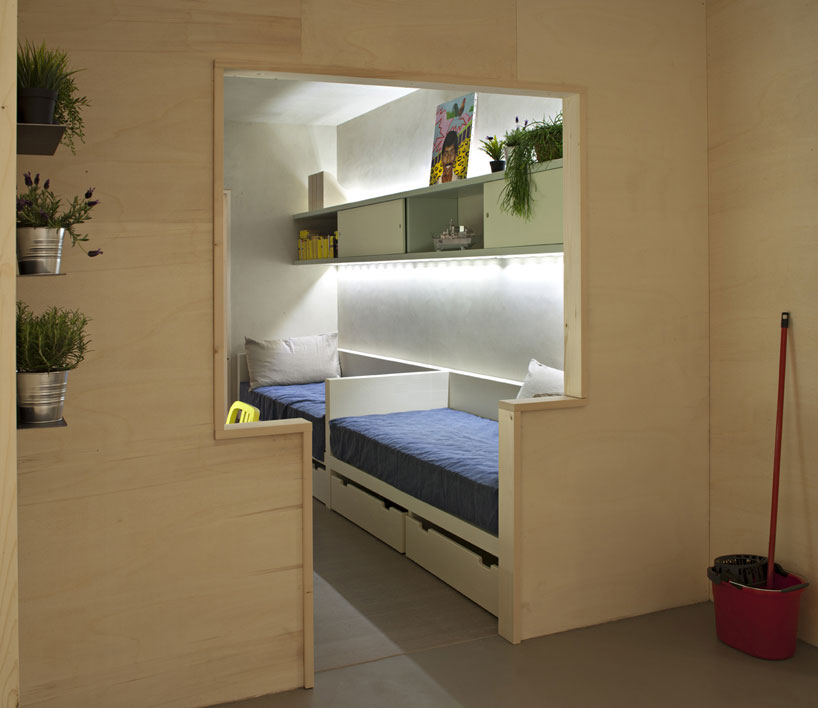
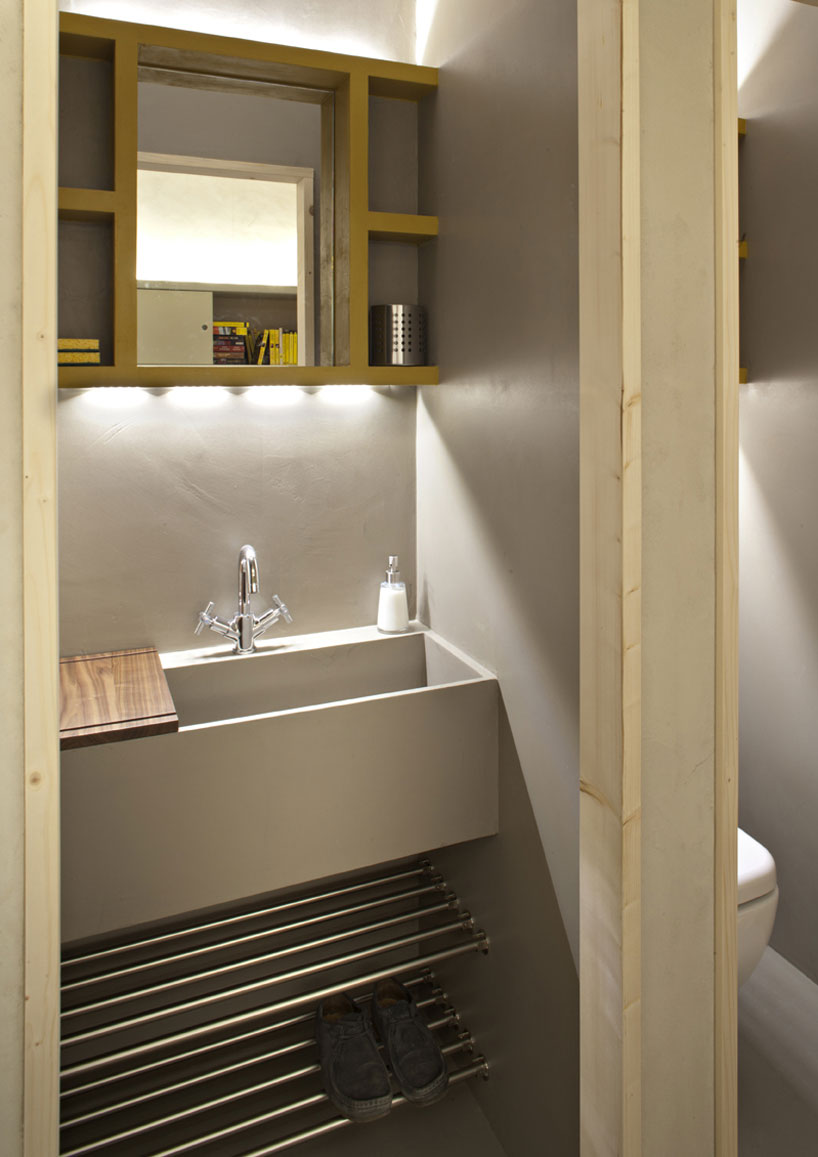
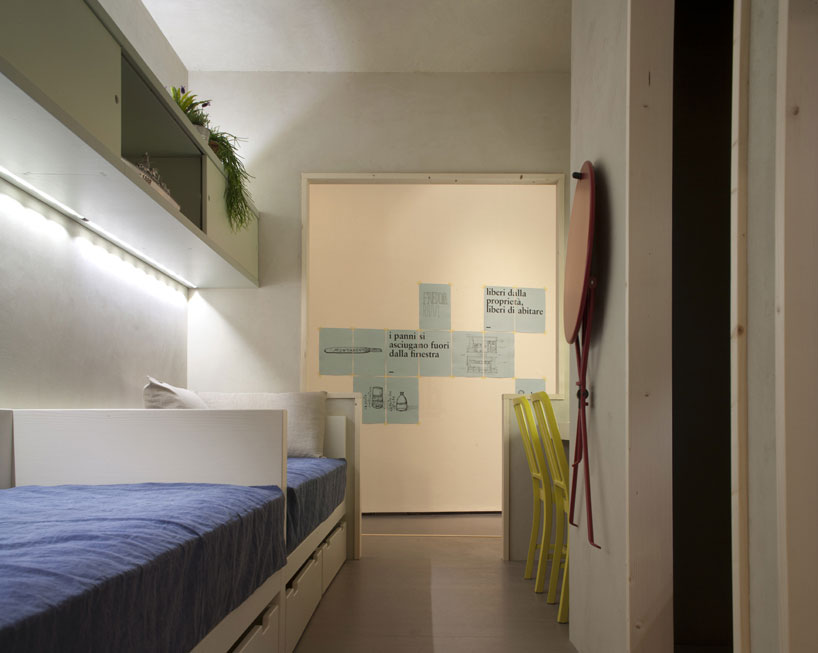
While American prisons relegate their inmates to making jumpers and license plates, Italians are letting their design compact, multifunctional spaces. Educational group Cibic Workshop and design firm Comodo are exploiting their country’s prisoners’ have conceived a project dubbed FreedomRoom, which gives inmates of the Spoleto prison free reign to design and build a 116 sq ft living space–the same size as their prison cells–intended to further prison cell design, as well as bring prisoner wisdom for possible low cost hotels, student facilities and hostels. The sample module was on display at the recent Milan Design Week.

Apparently, there’s a big culture of DIY’ing and multifunctional design in Italian prisons as the FreedomRoom’s site explains:

[The team has] discovered that most of the items produced there [in the prison’s carpentry facility] become something else inside a prison cell. Space itself becomes something else. Living under restraint has led many inmates in Italian prisons, out of necessity, to reinvent the space in their cells as well as the way they use many of the items inside. That’s how Freedom Room project was born.

This customization might be a function of the depersonalization of the cell design, which is uniform between “men, women, minors, leaders of criminal gangs or the perpetrators of petty crimes and ‘white-collar’ criminals,” says prison director Lucia Castellano. She thinks FreedomRoom might be great way to bring life to system that is shut down literally and figuratively. She says:

Inmates can become the proponents of a new ‘culture’ in their day-to-day living environment, starting with the difficult situation they experience on a permanent basis and transforming it into a resource. The depersonalization typical of such institutions can be effectively addressed and the fear of critical [violent] events and liability may thus be abated.

There aren’t many remarkable design features of the sample module per se (we appreciate the requisite espresso maker), but the project itself is pretty remarkable. By giving credence to the intelligence of an otherwise disregarded population, FreedomRoom provides the opportunity to empower prisoners through design. It also gives un-incarcerated populations a great, low-cost model for space-saving design, direct from people who are very intimate with efficient use of small spaces.

Via designboom

images © Cibic Workshop

Fidget Your Way to a Leaner, Longer Life

If you there was a simple, minimal-effort action that took ten minutes once an hour to do, one that added two years to your life, prevented several major diseases and kept you trim without any diet modifications, would you do it? As you might have gathered from the title of this post, there is an action, or rather actions and they are standing and/or fidgeting. A segment on NBC’s Rock Center news program that interviewed Mayo Clinic obesity expert Dr James Levine explained the myriad health dangers posed by remaining sedentary too long and the benefits of constant movement.

Visit NBCNews.com for breaking news, world news, and news about the economy

Of the dangers, Levine says prolonged inactivity leads to reduction in insulin effectiveness, an increased chance of developing Type 2 diabetes and even fat and cholesterol levels rise.

Unfortunately, all-day sedentariness is an equal opportunity killer, affecting everyone from couch potatoes to ultra-marathoners, as Levine explains:

Being sedentary for nine hours a day at the office is bad for your health whether you go home and watch television afterwards or hit the gym. It is bad whether you are morbidly obese or marathon-runner thin. It appears that what is critical and maybe even more important than going to the gym, is breaking up that sitting time.

Last year, we read how people who sat less than three hours a day lived on average two years longer than their seated counterparts and how sedentary behavior increases risk of certain cancers. This segment and Levine’s testimonial–given during an interview conducted on a treadmill–just provides more reasons to stand up for your health.

While sitting is an easy thing to blame for poor health, it doesn’t tell the full story. The segment show that it’s inactivity–seated or standing–that is the real enemy. To demonstrate this, the segment followed three women–the news anchor, a tv producer and a restaurant manager–and monitored their movements via sensors for a 24 hour period, including a workday. Interestingly, the tv producer, who thought she spent too much time at her desk in front of a monitor, was more active than the restaurant manager, who spent her workdays standing. The producer’s activity was attributed to constant fidgeting–crossing legs, going to the trashcan, etc. Meanwhile, the heavier set restaurant manager, while standing all day, showed lower intensity of activity. This lends itself to Levine’s finding that shows lean people tend to be active 2.5 hours more a day than obese people (though the restaurant manager was far from obese).

The segment does acknowledge the role genetics and diet play in keeping people thin, but it also makes the fairly universal claim that sitting and remaining sedentary shuts down our metabolism, or as Levine says, it “is like sort of owning a really cool sports car and letting it idle all day long.”

What to do? Levine would certainly recommend one of his treadmill desks, which keeps you constantly on the move. We’re not sure if this contraption is ideal for micro-apartments, so we might suggest a standing desk instead. Another one of his suggestions is to spend at least ten minutes of every hour not sitting and active. And we might add that when you are sitting, don’t be afraid to fidget.

Surrey BC Micro Apartments and Choosing Small

One of the latest cities to hop on the micro-apartment bandwagon is the British Columbia city of Surrey. A new development called Balance will offer 56 micro-apartments measuring 290 square feet. Unlike similar developments that are rental only, Balance units will be for sale starting at C$109,000. According to developer Charan Sethi, president of the develop company Tien Sher, this price point makes purchasing one of the apartments within the reach of someone making $17/hour.

With their 9′ ceilings and large windows, the apartments appear clean and airy with nice finishes and details (admittedly, only renderings and an offsite demo apartment are available to look at). There are a number of extras the developers offer such as a custom wall bed with couch (it’s a Resource Furniture Penelope model so far as we can tell), combo washer/dryer units, a workstation and so on. No word on how much these extras cost. Their site doesn’t say when the condos will be available, but they are doing pre-sales.

balance--interior-2

Vancouver has some of the highest property values in North America and Surrey is a member municipality of Metro Vancouver. But Surrey is no Vancouver. Surrey’s density is 3,800 people/mile versus Vancouver’s 13,600. And their property values reflect this spaciousness. We did a cursory search of Surrey real estate in the area of Balance and the prices of studios and one bedrooms started around C$150K+, but their sizes were also much larger (600+ sq ft), making Balance’s cost/sq ft considerably higher than market.

SurreyThe area in Surrey where Balance will be

Balance is an interesting new breed of micro-apartment. Whereas the majority of developments have been centered on high-density, high-cost areas like Vancouver, Balance has the high-density-appropriate architecture but in a low density, low-to-moderate cost area. Similar developments are showing up in Chicago and even Iowa.

Balance also bucks the trend by offering sales of its units. Micro-apartments lend themselves to rentals as their tenants seem more likely to be transient and value the ability to jump ship or upgrade to larger space when the time comes.

What the developers of Balance are banking on is that people will choose smaller, rather than having it imposed upon them. Sethi says as much in an interview with CTV: That these apartments are for people who are fresh out of school or who travel a lot. He believes there are many people like that who just want a nice, clean space and the small size is an advantage as it’s less to deal with and less to buy. The building is also in close proximity to a main metro line for easy access to Vancouver.

What do you think? Will people choose to pare down in areas where affordable, larger housing is available? And would anyone buy one of these apartments? Or is this all wishful thinking from developers trying to pack more people in a plot of land and get their money back? Let us know below in our comments section.

4 Reasons Why Less is More for Planet Earth

Happy Earth Day! We don’t talk about our beautiful host planet that much around here. Not because we don’t care. We do. Not because the “less, but better” lifestyle doesn’t have benefits for the planet. It does. But we think those benefits stand on their own legs. In other words, the environmental benefits are the happy byproduct of a simpler, better-designed life–not the reason to live it.

All that said, some reputable sources claim that our glorious planet has been pretty battered in the last couple hundred years and that we might want to consider changing the manner in which we live on it…like yesterday.

In consideration of these considerations, we put together a few compelling reasons why living a life with less stuff and space makes a lot of sense for the planet.

Less stuff = smaller carbon footprint

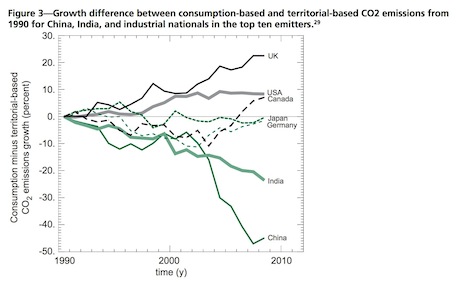
A recent article in Guardian UK made this point abundantly clear. Between 1990-2008, the UK boasted that it reduced its carbon emissions by an impressive 19% within its borders. The trouble was that when their carbon emissions were measured based on consumption, which includes the emissions of producing imported goods, their carbon emissions increased a whopping 20% over that same period. The US clocked an 8% increase. This lower rate is nothing to brag about–in that same period we increased our intra-border emissions by 17% for a 25% increase overall.
Carbon-emissions-terrestrial-consumption

China has blunted the impact of our carbon production. It’s estimated that 45% of China’s carbon emissions, which are the world’s greatest overall, are attributable to the production of exported goods. If we take away carbon emissions for exported goods, China’s carbon footprint has been steadily decreasing in the last 20 years.

Long story short: Fewer exports and less stuff = less carbon and greenhouse gases no matter where you are.

Are you dense?

We’ve looked at this topic before with Per Square Mile’s infographics. Basically, if the planet’s 7 billion people enjoyed New York City levels of housing density, we could all live in an area the size of Texas. If those 7 billion were to be housed as densely as Texans–specifically Houston, Texans–the amount of area would occupy most of the continental US.

per-square-foot

We are quick to say this is not the whole story: How we consume plays a significant part in our area footprint. We might live in a 300 sq ft home, but our consumer behavior might require a square mile’s worth of resources–a square mile that is most likely in China (see above).

But density does matter. If everyone lived in larger homes on bigger lots, requiring more sprawl, more driving on more highways, it would create a bigger environmental impact and almost certainly encroach on nature.

As counterintuitive as it sounds, a life in the heart of the city, with its walkability and access to public transport,  might be the greenest thing you can do.

As economist Ed Glaeser put it, “The next time you want to fight for nature, leave [Thoreau’s] Walden Pond alone and start pushing for denser development.”

Big homes use more resources to build

According to the EPA, home construction, remodeling and demolition projects are responsible for a staggering 25-30% of the nation’s annual municipal solid waste. If the world were to start building small–both new construction and remodeling–there would still be a lot of waste, but here’s the thing: Building big homes creates a disproportionate amount of waste compared to smaller homes. In other words, a 2K square foot home doesn’t necessarily create twice as much waste as a 1K square foot home, as Greenbiz explained a few years ago:

The U.S. National Association of Home Builders (NAHB) estimates the materials used in building a 2,082-square-foot (193-m2) single-family house to include 13,837 board-feet of framing lumber, 11,550 square feet (1,073 m2) of sheathing, and 16.92 tons (15,350 kg) of concrete. One would expect that, relative to material use, there would be an economy of scale as house size increased…but that is not necessarily the case…because larger houses tend to have taller ceilings and more features, larger houses may actually consume proportionally more materials….a new 5,000-square-foot house will consume three times as much material as the 2,082-square-foot house NAHB has modeled, even though its square footage is only 2.4 times as large.

It’s not a major mental leap to say that if the size of homes were to decrease, the amount of waste and resources needed for construction would decrease in turn. Creative division of existing spaces would decrease that waste more still.

Big homes use more energy to maintain

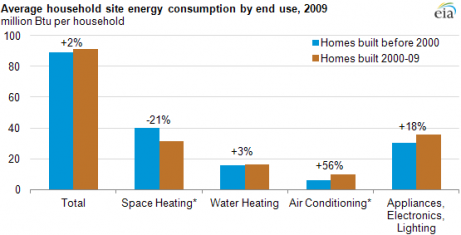
It’s pretty common sense, but when you have a bigger home, not only do you need more building materials to make it, you more energy to maintain it.
energy-information-administration

A study done by the Energy Information Administration found that homes made after 2000 use 2% more energy than pre-2000 ones. This tiny increase doesn’t tell the whole story though. These newer homes are considerably more efficient than the older ones, but because they are 30% bigger, all of those gains have been negated.

Those efficiency measures applied to smaller new homes and older homes could make a significant dent in our national energy consumption.

12th Century Micro Apartment Complex

Long before adAPT NYC and SmartSpace’s 38 Harriet St in San Fran, there wers tulous, multi-unit Chinese buildings that wrote the book on compact, efficient living. Tulou translates to “earthen house” and are large, generally circular, fortress-like structures that were a popular form of building from the 12th through 20th Century (there are even a few present-day interpretations). While there are many types of tulou, the most popular form is the Fujian tulou; the Fujian provence has over 20K of them.

The walls of the Fujian tulou were traditionally made of packed earth and bamboo reeds, and rose up to five stories. The base, which often had granite boulders packed into its construction to make it dig-proof–was up to six feet thick. The wall thinned out toward the top to reduce load and allow windows for cross vent. The massive structure made it able to withstand earthquakes and frequent bandit attacks (a big problem back in the day).

The upper two or three levels contained houses that were made up of uniformly-sized housing units; they had multi-floor layouts and private staircases that lead from the ground floor to the top (basically townhouses sandwiched together). Each house contained a multi-generational family, and depending on the size of the tulou, up to 80 families or 800 people could live in one tolou. While we can’t say the exact sq footage of each house, we’re pretty sure they achieved a high person per square foot ratio.

The uniformity of design created a non-hierarchal structure. Wikipedia writes this:

Unlike other housing types around the world with architecture reflecting social hierarchy, Fujian Tulou exhibits its unique characteristic as a model of community housing for equals. All rooms were built the same size with the same grade of material, same exterior decoration, same style of windows and doors, and there was no “penthouse” for “higher echelons”; a small family owned a vertical set from ground floor to “penthouse” floor, while a larger family would own two or three vertical sets.

Toilets, wells and even surrounding agricultural land was all shared as well to keep the communitarian vibe consistent.

The ground floor contained communal spaces for worshipping, festivals, meetings, weddings, funerals and other ceremonial functions.

The result of all of this design is a structure that provided safe, wind-proof, cool-in-the-summer, warm-in-the-winter living. A total of 46 Fujian tulou sites have been designated as UNESCO World Heritage Sites; that organization calls them “exceptional examples of a building tradition and function exemplifying a particular type of communal living and defensive organization [in a] harmonious relationship with their environment.”

The idea of compact, efficient living is far more ancient than it is modern. It’s only in the last 60 years or so that humans have been able to cheaply make housing that exceeds their needs or make a house that could negate its surrounding environment with an HVAC system or live without the assistance of your neighbors.  Ancient architecture like tulous shows that the past can often hold key innovation for a more efficient, sustainable and interconnected future (sans bandits thank you very much).

Photos via UNESCO and Wikipedia Commons

Edit Your Monthly Bill Costs with BillCutterz

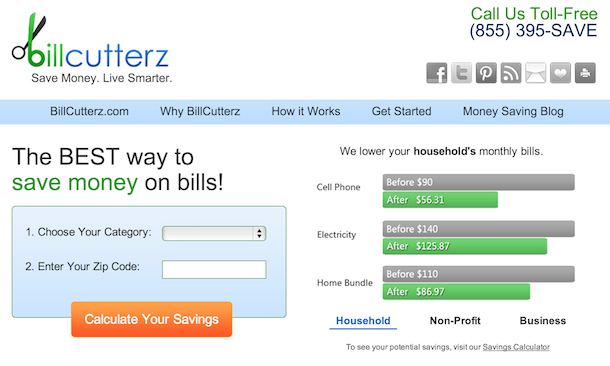
Many of us are aware that we can save money on our bills. We know we pay too much for cable or car insurance, we maintain our cell phone plan even though it’s not the best deal or we stick with our default electricity provider rather than looking for the one who will save us dough. We don’t bother changing because the hassle tax–i.e. the effort involved with changing our plans and policies–seems greater than the savings. A service called BillCutterz is like your hassle tax accountant, navigating the murky waters of plans, policies and promotions so you can save hundreds or even thousands of dollars a year on your bills.

The way it works is you send them all of your regular bills: Insurance, electricity, gas, cell phone, landline, cable, internet and even house payments. They act as your agent in negotiating the best deals possible with the providers, who often have promotions, plans and loopholes that are too much of a headache for most of us to keep track of. The savings will show up on your regular bill.

BillCutterz has an extensive security system in place. They stay in business by taking half of your savings; e.g. if they save you $600/year, they take $300. They will not take any money if they don’t save you any. You can also pay upfront for the year based on projected savings and save an additional 10%.

The service is a bit of a no-brainer. Even though the 50% charge is considerable, it’s money that wouldn’t exist without the service. Face it, you probably don’t have the patience or skill to do what they do. And it even works if all you have is a few small bills.

An important part of editing your life is making the systems in our life run as efficiently as possible. Seeing as most of us have bills, why not spend as little as possible paying them? www.billcutterz.com

This Little Italian Kitchen Has Spine

We were turned onto this innovative column-kitchen (not sure if that’s a proper term) that was released at the recent Milan Furniture Fair. It’s called ECooking, designed by Massimo Facchineti and, unlike many concept designs, will be manufactured by Clei, the same folks who make the Swing sofa/bed in the LifeEdited Apartment.

The little unit is packed with features:

  • Kitchen basics: Oven, fridge, induction cooktops, sink, dishwasher and espresso maker (an Italian basic)
  • Multi-stage water filtration
  • Herb garden that uses filtered grey water
  • Built in ventilation and UVA light for your herb garden
  • Counter surfaces that creates seating for six
  • Storage
  • Rendering shows a solar paneled back to power entire house (unconfirmed).

Ecooking-Clei-back

Again, the cool thing about this is the fact that: A. it was made and B. is going to be released. Resource Furniture says it should be available early to mid-2014 (no price or additional details available just yet). We suspect some of the features, like the solar panels, might not carry over from concept, but even the basics are pretty cool.

While ECooking might not be ideal for someone who regularly hosts large dinner parties, it seems like a perfect compliment for a micro apartment where it would significantly reduce the kitchen footprint while providing more than enough function for the small-scale gastronome.