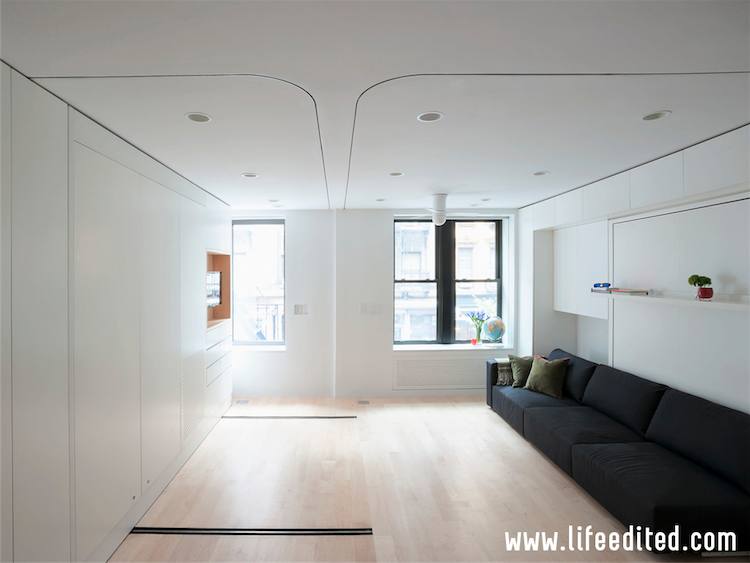
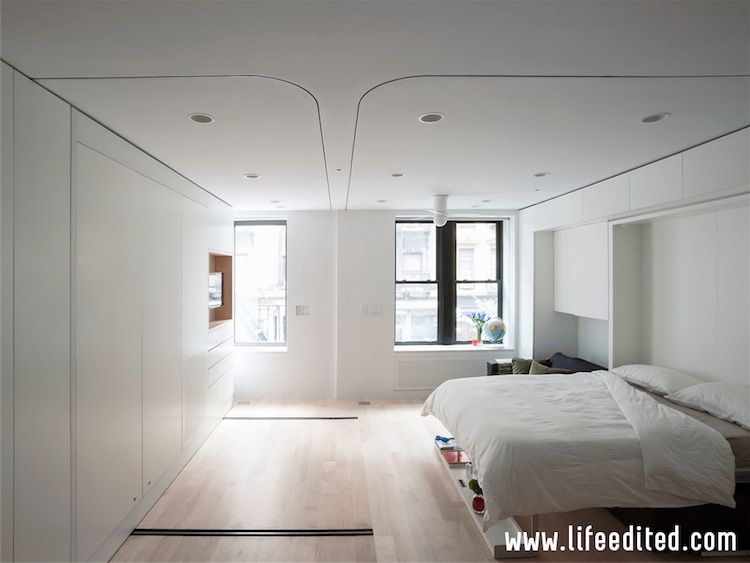
Solar Power in LifeEdited Apartment by Voltaic Systems

In the coming months, we will be highlighting products and services we use in the LifeEdited apartment. Today, we’re looking at our solar powered lighting and charging system by a company normally known for their portable solar chargers, Voltaic Systems. This post originally appeared in Votaic’s Blog

We have been working for some time on our latest product, the USB Touchlight. This is a super bright, USB-powered LED light, designed to run from our solar batteries.

When our good friends at LifeEdited asked us to set up a mini solar system for their innovative 420 square foot New York apartment, we jumped at the chance to put the Touchlight into action. We installed a 13 watt solar system discretely mounted on a ledge outside the apartment, feeding two of our V39 USB batteries with enough power to feed an iPad, phone, a couple of our Touchlights, and other USB devices. It proved invaluable recently when the apartment was blacked out during hurricane Sandy.

Many of our customers are interested in using our kits for similar applications and have asked about installation.

Here is how we did it. We essentially used 2 of our 6.8-W kits:

1 x Touchlight
4 x 3.4W 6V solar panels
2 x V39 39-Wh batteries
1 x 4-panel 6V/12V circuit box
1 x panel extension cable
Various connectors
1” aluminum strip

Panels: Being a New York City apartment, outdoor space was limited to a small ledge of metal flashing below the window sill about 5” wide. We configured our 3.4W panels end-to-end longways so they would fit. We opted to use four panels because the light exposure is pretty limited, only about 2-3 hours of direct light per day.

Given that our panels come with threaded bolts for mounting, we used two long strips of 1” wide 1/4″ aluminum as the foundation. We lined up the panels and marked off the locations for holes on the first strip, then drilled 1/2” holes (big enough for the nylon nuts to sit inside).

After attaching the panels to the first strip we repeated the process for the other side to get two strips holding all four panels in place.

We could have just secured the strips directly to a substrate, however we didn’t want to screw into the flashing (since that would undermine its waterproofing), so we took the additional step of attaching two strips of aluminum U-channel (3/4” each side) which provided a flat even surface to secure to the flashing with silicone. This created a space under the panels for the circuit box and wires, reduced the likelihood of water backing up, and makes it easy for us to remove the panels for service without having to cut the silicone connection. The U-channels were cut to length and attached with self-tapping screws to the 1” strips.

Panel Installation: With that done, we were ready to install the solar array on-site. We hacked one of our 4 panel circuit boxes, and attached the output wire to some electrical wire. We then fed the wire into the apartment through an existing hole in the window frame. Our 2 panel circuit boxes could be used here (with two 6.8W kits), but the 4 panel option was cleaner.

We then connected each panel to the input of the circuit box (having checked that each panel worked individually and provided an output to a battery). We then used small sections of silicon tubing to waterproof the connections. All of this fit nicely behind the panels inside the frame.

From there, it was just a matter of actually securing the rig to the flashing. We applied a thick bead of exterior silicon to both of the U-channels, secured a wire safety line to catch the rig in case it came loose, and pressed it into place. We then added some strips of masking tape to keep it in place while the silicon dried.


Batteries: We decided to run the four panels to the two V39 batteries wired in parallel, so that one wire from the panels was split to go to both batteries. That way, whatever power was generated by the panels would go to whichever battery could absorb it. From there we would run wires to the lights. We hacked a couple of our 3 or 4 panel circuit boxes to get 5.5×2.1mm male plugs and joined these to the copper wire we had fed through the window frame. This could as easily be done with the “power out” wires from our 2 panel circuit box and a 5.5×2.1mm adapter. We connected the plugs to the batteries and saw the LEDs on the batteries light up indicating they were charging and the circuit was good. The Life Edited carpenter later made a custom nook for our batteries inside the closet by the bed, which seemed the right place for charging a phone or tablet.


Lighting: The walls were open so we had the opportunity to run the wire to our Touchlight to the ceiling over the bed. We hadn’t really contemplated this sort of installation in the design, but it was not too difficult to pull together some parts from the lighting store to make a mount for the plug. We tied a knot in the end of the wire, fed it through a threaded rod, and held it in place with silicone inside the rod. Then we screwed the rod into a bracket also from the lighting store. There are many ways this could have been done, including a simple hole through the ceiling with the wire coming through. In this case we wanted the threaded rod so we have the option of removing the light and wire (the moveable wall in the apartment is very close to the ceiling), and of mounting a more complicated hanging light fitting. To test, we made the connection with one of our adapters (3.5×1.1mm to 3.5×1.1mm)


Thanks to LifeEdited for inviting us to contribute to their ultra-efficient living space. It was a lot of fun and is a great example of how solar can be implemented on a small scale in even the most space-limited locations.


Child’s Play

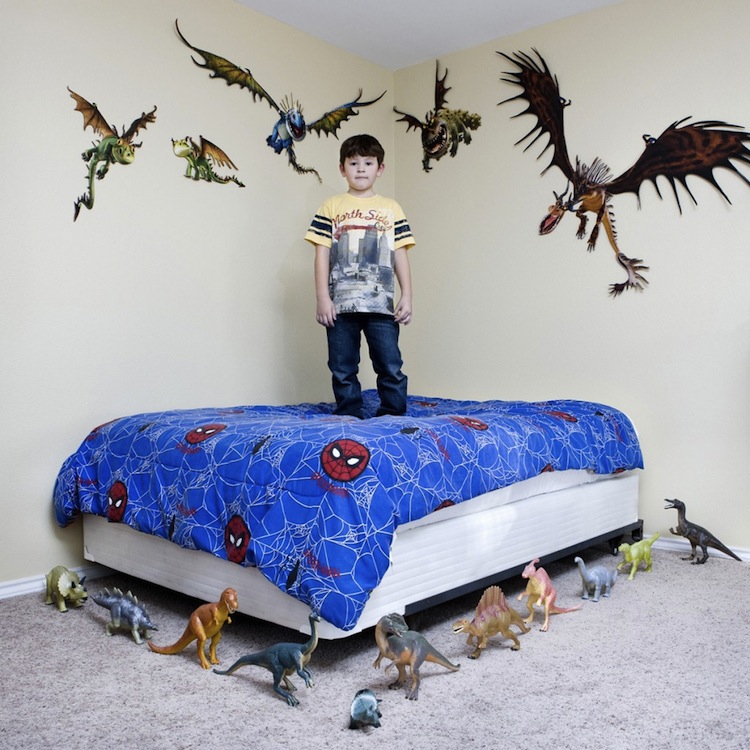
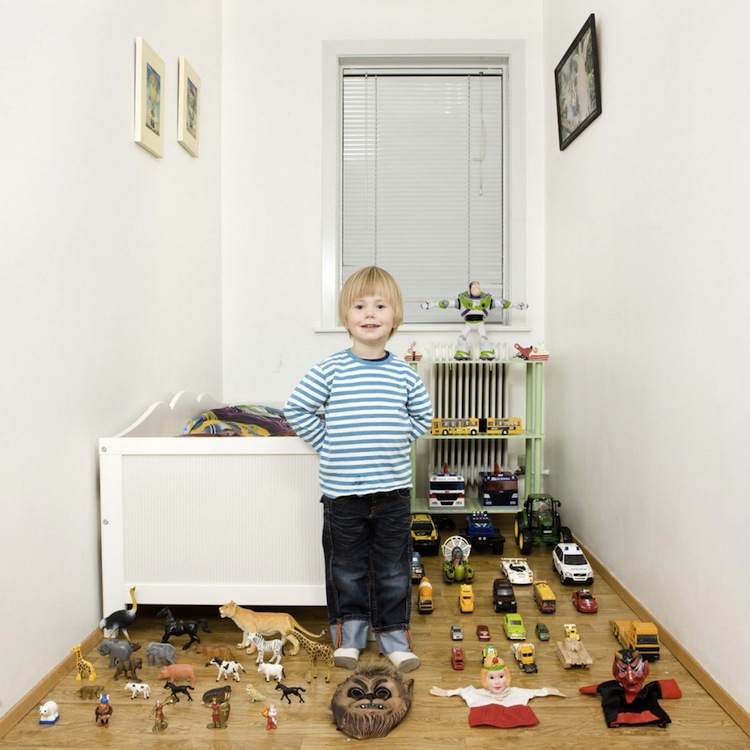
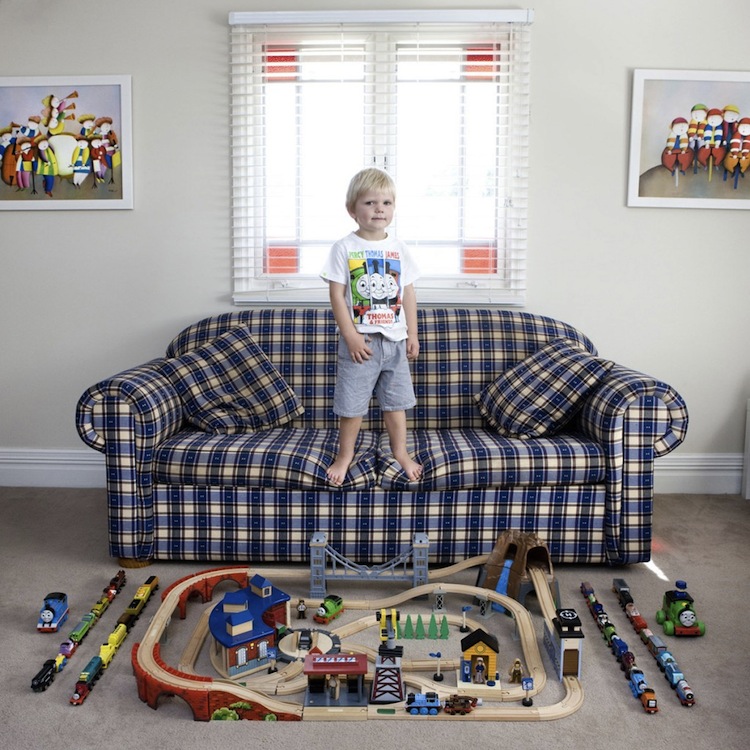
Over the course of 18 months, photographer Gabriele Galimberti traveled the world taking shots of children and their most valued toys, producing a series she calls “Toy Stories.”

What is visible in the series is very interesting. As most might surmise, the children from poorer countries are not only displaying their favorite toys, but their only toys, some of which, like Maudy from Zambia, aren’t even toys. On the other hand, children from richer nations often display acres of toys.

What’s not visible is equally–if not more–interesting. Galimberti said this about how the kids treated their toys:

The richest children were more possessive. At the beginning, they wouldn’t want me to touch their toys [she played with the children before shooting], and I would need more time before they would let me play with them. In poor countries, it was much easier. Even if they only had two or three toys, they didn’t really care. In Africa, the kids would mostly play with their friends outside.

A perfect example of this is Botlhe from Botswana, who displays her lone stuffed monkey–a display that seemed more obligatory than a sign of affection. Galimberti writes:

[She] has a lot of friends, and all of them live really close by to the small house where she lives with her family in a residential complex. In the complex, there is one toilet for every four families. Botlhe has only one toy, the monkey, but she almost never plays with it because she prefers to go out with friends and play with them.

Toy Stories reminds us of a study that reported who the most positive people on earth are (hint: it wasn’t the richest people with the most stuff). None of this should be construed as idealizing poverty, but these children might make us further question the relationship between the accumulation of stuff and happiness. Like Galimberti said of the children: “They just want to play”–and toys, we might guess, were not essential to achieve that end. We suspect adults aren’t much different.

Architizer A + Award Small Living Winners Announced

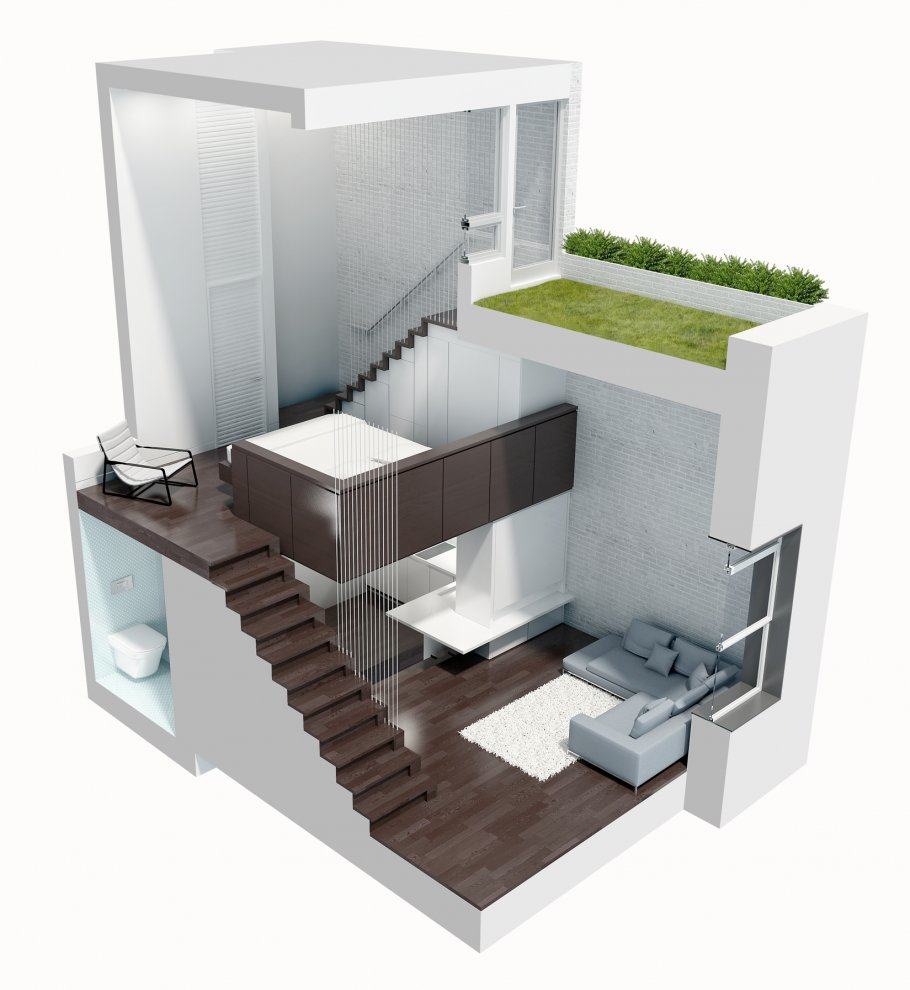
LifeEdited is proud to announce that we were given the Jury Award for the Architizer A + Award in the Small Living category. We are less proud–though hardly ashamed–that we were beat out for the Popular Award, i.e. the project that received the most public votes. That honor went to “Manhattan Micro Loft” by Specht Harpman Architects.

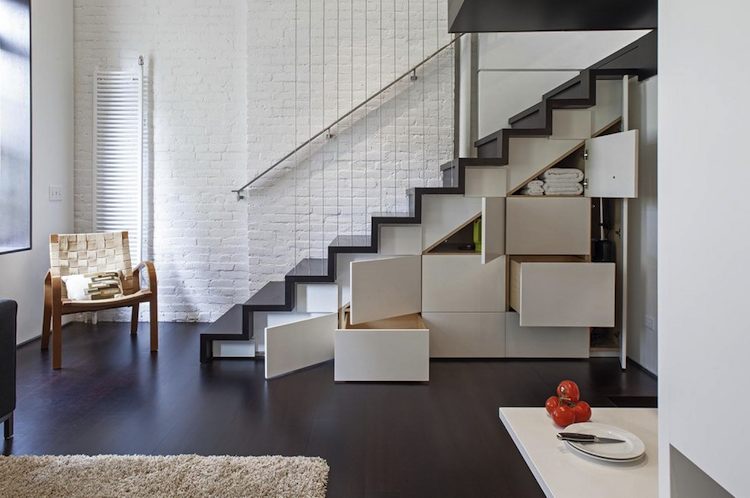
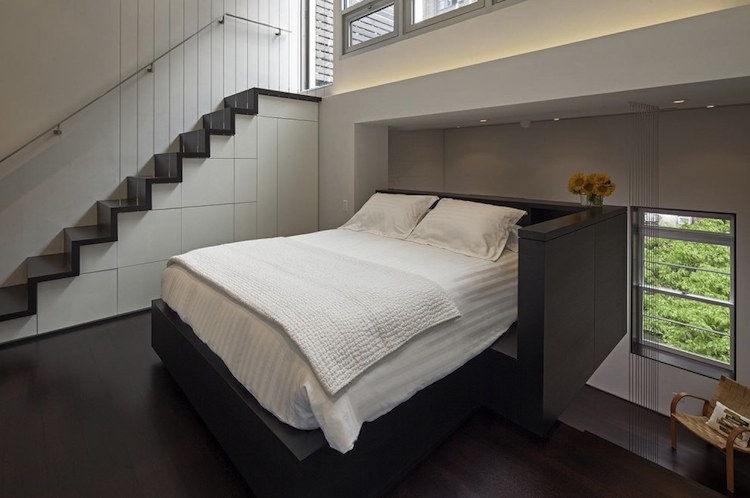
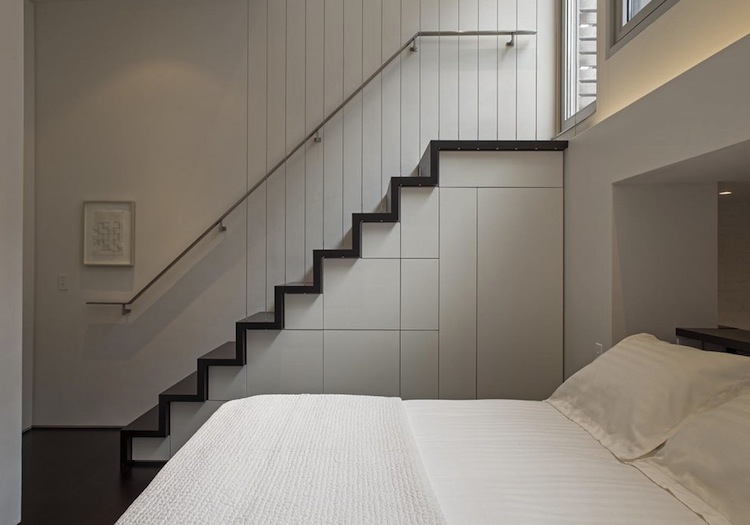
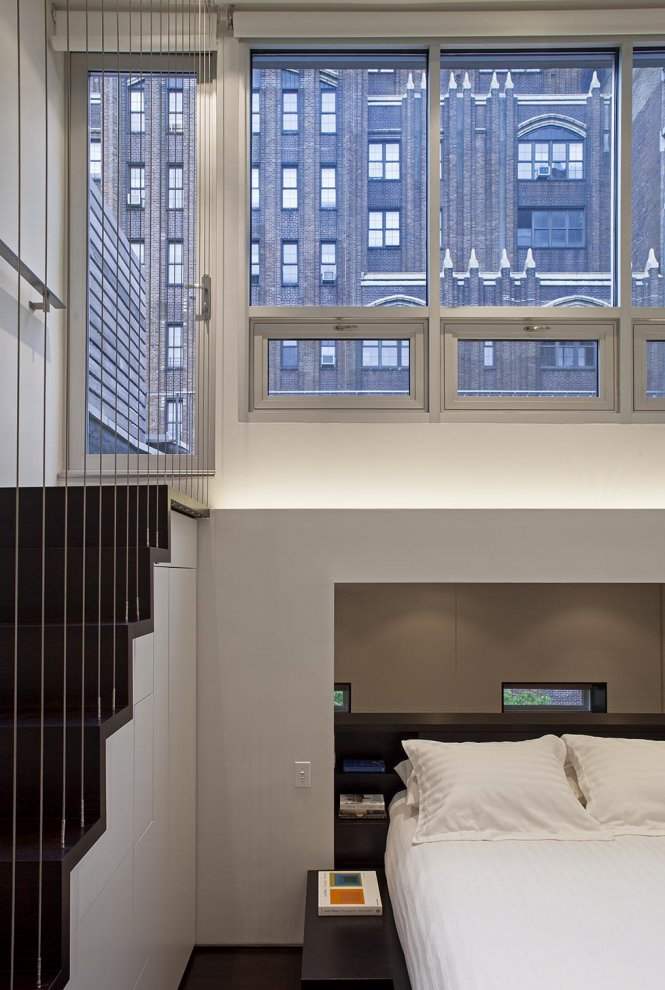
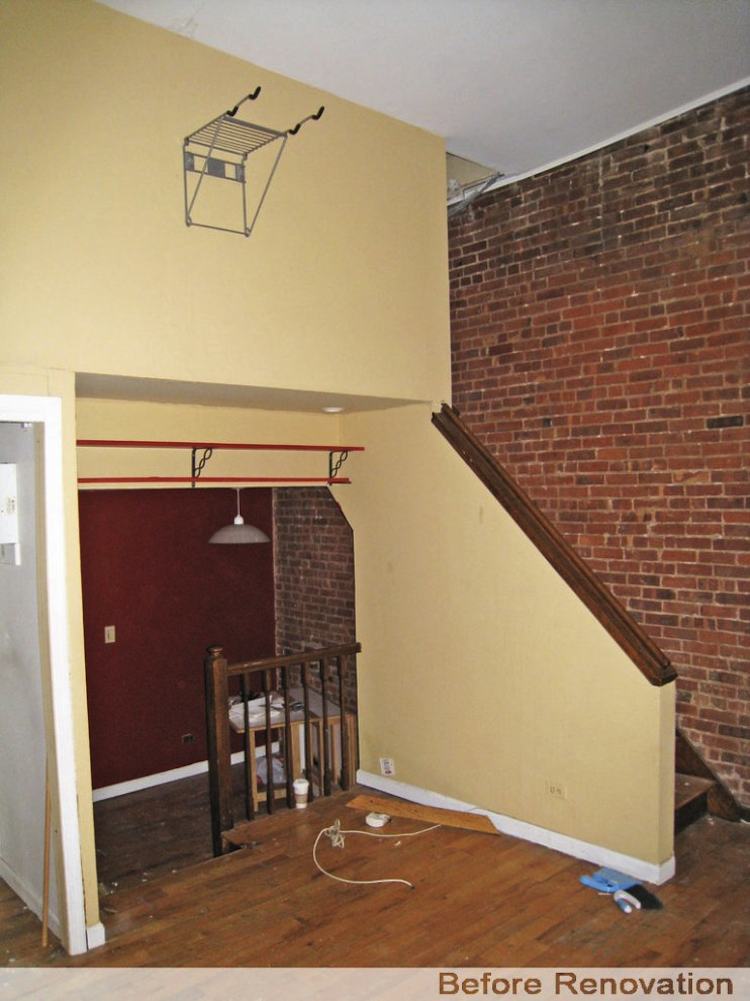
In truth, we were secretly lusting after the Manhattan Micro Loft. It’s beautiful interior with contrasting surfaces and textures exploited every inch of the space’s unique tall and small dimensions. Specth Harpman split the apartment’s 425 sq ft into four levels (the fourth being the green-roof patio). This vertical partitioning creates three spaces that are both discreet and flow together. The semi-open format also allows the whole apartment to share the window’s natural light.

The two main staircases feature unique “tansu” cabinetry, which is a variety traditional Japanese storage system (no SkyMall did not invent them).

Like the LifeEdited apartment, the “before” pictures are almost as interesting as the completed ones. It shows that with a little creativity (and yes, money), you can turn an inefficient and dilapidated small space into an aesthetic and functional masterpiece. Big congrats to Specht Harpman for their award and great design!

Images via Architizer

3/19 Event w/Graham Hill: Small + Shared = Green

If you’re in New York City tomorrow night, March 19, come out to the the Making Room exhibit at The Museum of the City of New York to see LifeEdited founder Graham Hill discuss our project and the future of small living.

Joining him afterwards for a lively conversation about the latest approaches to sustainability will be Michael Colgrove, Director of the NYC office of the New York State Energy Research and Development Authority (NYSERDA) and Paul Freitag of Jonathan Rose Companies, a leader in developing high-density, mixed-use, and affordable green housing in NYC. Reception to follow.

Talk begins at 630pm. Reservations are required: $6 Museum members; $8 seniors and students; $12 general public. Use code CHPC319 for $6 admission. BUY TICKETS HERE

image via Shutterstock.com

The Hottest Product in the LifeEdited Apartment

In the coming months, we will be highlighting products and services we use in the LifeEdited apartment. Today, we’re looking at the Fagor 1800W Portable Induction Cooktop.

Cooktops and ranges have gotten out of hand lately. Professional-grade models with 5-6 burners have become a must for the modern kitchen. These costly appliances make a lot of sense if you’re running a restaurant, but for most of us, they’re overkill. In choosing a cooktop for the LifeEdited apartment, we wanted to match up our cooktop with the way it would be used. We also wanted something very energy efficient.

Based on their efficiency and sleek profile, we were led to induction cooktops. Since they heat the pot, not cook surface, 90% of the heat is transferred to the cooking implement as opposed to 50% for conventional gas and electric cooktops. And added benefit of this process is the cooktop stays cool.

Wikipedia explains this magic process (lucky for us):

In an induction cooker, a coil of copper wire is placed underneath the cooking pot. An alternating electric current flows through the coil, which produces an oscillating magnetic field. This field induces an electric current in the pot. Current flowing in the metal pot produces resistive heating which heats the food. While the current is large, it is produced by a low voltage.

Not only are they more efficient, but the burners are as much as 50% faster than standard burners because the transmission of heat is so direct.

We considered a number of induction models, eventually opting for the Fagor 1800W Portable Induction Burner. At 1800 watts, they provide comparable heat of conventional gas and radiant electric burners, all while using a standard 110V socket. This was important since we didn’t want to sacrifice performance for the sake of convenience and aesthetics, nor did we want to install high-load electric outlets. We’ve been very happy with their performance–they can boil a large pot of water in about five minutes.

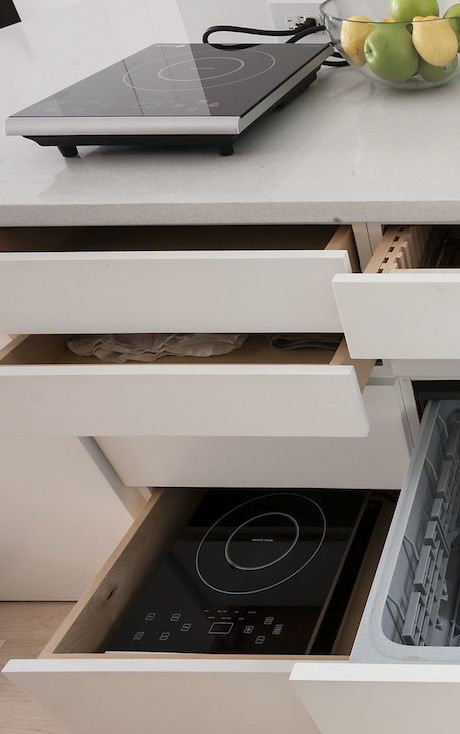
The burners can be stowed away, which makes the kitchen look less kitchen-y–something important in a small space where visual clutter can shrink a room. They give us the flexibility of using the burners wherever we need them, which is nice in a small kitchen where two can be a crowd. We can use as many or as few as we want at a time; typically, only one is out on the counter at a time. We have three total, which stow away in a drawer (see below).

fagor-lifeedited-apartment

The biggest drawbacks of the burners is that they require ferrous cookware such as stainless steel and cast iron. There are converters available, which enable any type of cookware to be used, though that turns the burner into a radiant surface and negates some of the efficiency. The seven heat settings don’t provide the same fine tuning of a knob, though this has been more of a learning curve issue than a real culinary challenge.

We found the Fagor units on Amazon for $150 each. If you are building a new kitchen–particularly a small one where flexibility is crucial–or find your current cooktops aren’t cutting it or you like traveling with your kitchen, these are a great option.

The Nasdaq of Sharing Economy

There’s an economic revolution afoot. The old model of produce, market, consume, trash is proving itself both unsustainable and out of touch with technological advances that allow people to easily access and share existing resources. The new economy–often called the “Sharing Economy“–harnesses existing resources and through smart use of technology, connects suppliers with demanders. One of the main hubs of this economy is Mesh.

The site is based on the book “The Mesh: Why the future of Business is sharing,” by Lisa Gansky. She expands on how Mesh companies operate:

Mesh companies create, share and use social media, wireless networks, and data crunched from every available source to provide people with goods and services at the exact moment they need them, without the burden and expense of owning them outright.

Mesh’s site contains a directory of over 8K companies across 140 countries comprising 25 different categories–from energy to fundraising to kid’s toys. There is hardly any resource that one of Mesh’s companies can’t help you with.

At its heart, Mesh is about the idea of access over ownership. As is often said, what we want is a hole, not a drill. The companies that are part of Mesh’s directory can hook you up with that drill or those clothes or building supplies or anything else. Many of the companies are peer-to-peer like Airbnb, which allow you to buy or use goods and services from private parties; many others are corporations that incorporate this on-demand utilization of existing resources such as Groupon and Zipcar.

Mesh is a great resource for creating a life that has all the stuff you need without the burden of owning it all the time. The popularity of Graham Hill’s recent NY Times op-ed illuminated the extent to which people are becoming overwhelmed by the rate and extent at which we acquire stuff. Inspired by the notion of being stuff-free, many of us might fantasize about offloading all of our worldly possessions. This is great until we need to a take some pictures or go camping or drive out of town for the weekend.

People need stuff. Cavemen needed their hand-axes. Many things that we use all the time like a phone or computer warrant personal ownership. But we don’t need all stuff all the time. Having things around that we seldom or never use like karaoke machines and 10′ ladders tends to lead to clutter and confusion.

What the sharing economy does is create a manageable, cost effective and ecologically sound (less stuff shared by more people) way to have all the stuff you need only when you need it. See more sharing sites on this site and give it a try yourself.

Live in a Sliver Japanese Style

Japanese architecture proves that necessity is the mother of invention. In order to fit their ample population on the space-squeezed island, homes are designed to fill up every sliver of space, however puny. This ABC Nightline tour of Japanese “micro-apartments” gives a nice look at some of these super-slivers.

Not to be pedantic, but these are not micro-apartments, but a class of home called Kyosho Jutaku that use remnant real estate in fantastic ways.

In the video, ABC interviews Japanese architecture expert Azby Brown, who shows off modern interpretations of traditional Japanese architecture like underfoot storage and stowable beds.

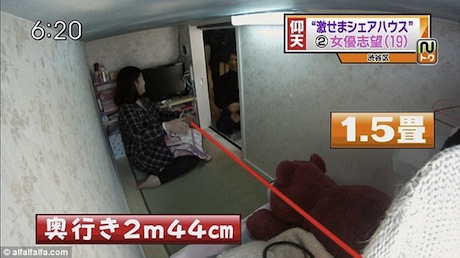
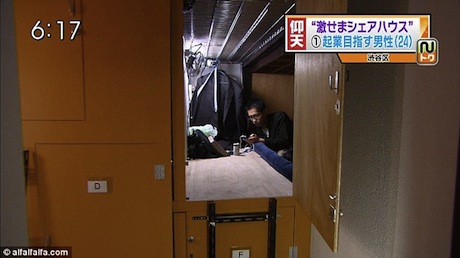
These tiny homes seem downright palatial compared to geki-sema homes, tiny-shared spaces that have been recently called  “coffin-apartments.”

coffin-home-2 coffin-home

These teeny-tiny living boxes are designed for young Tokyo professionals who just need a place to sleep.

What do you think? Are either of these types of dwellings viable living spaces or more or less human storage lockers?

Stick Your Kid in a Cubby Hole

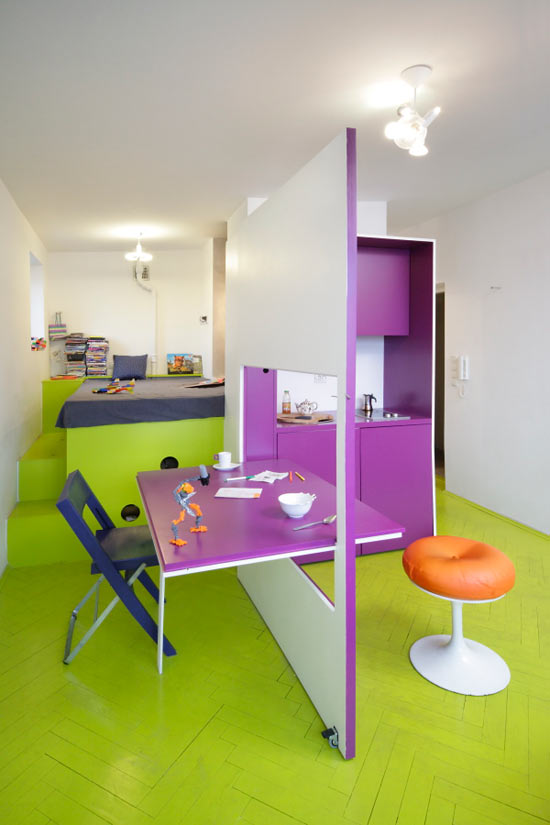
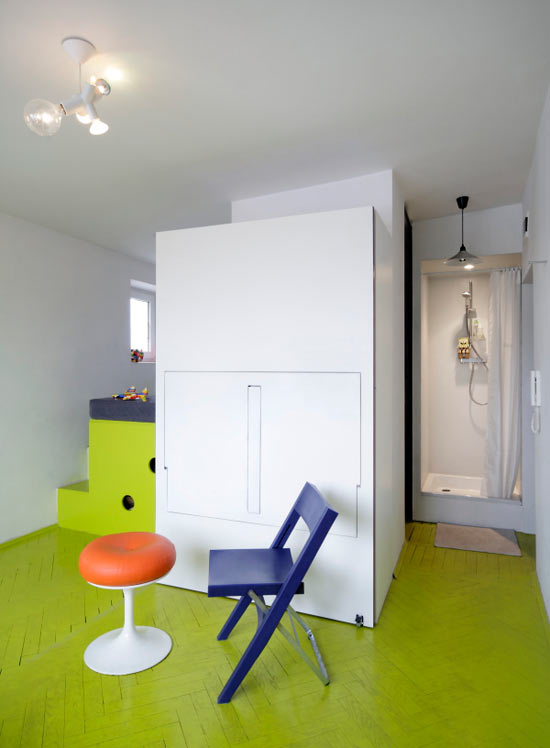
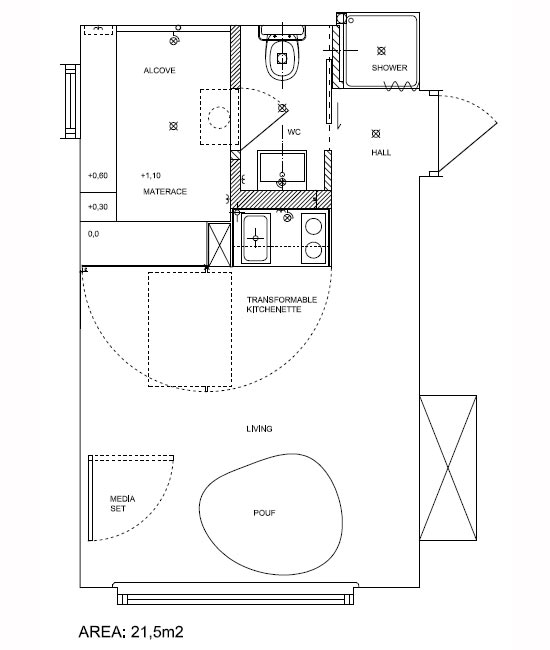
We’ve seen the work of Jakub Szczesny before, with Europe’s narrowest house. A couple years ago, the Polish architect designed the Tamka Apartment (aka Lucien’s Embassy), a 21.5 sq m (231 sq ft) Warsaw pied-a-terre. The man who commissioned the project was a divorced man looking for a weekend retreat where he can hang out with his son (named Lucien, we presume).

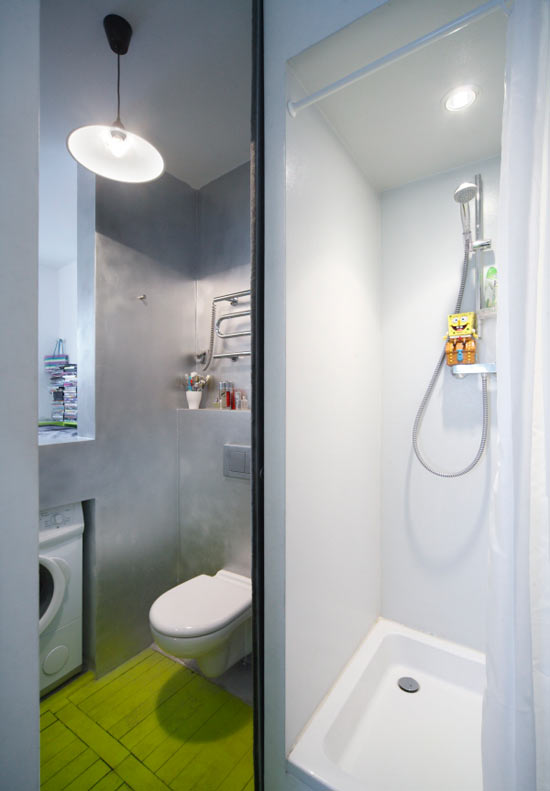
The apartment has a lot of great features, in particular, the kitchenette/table/room-divider unit and the bed cubby which has access to the bathroom. We also like that the apartment features a washing machine/dryer unit; although not a necessity, they’re pretty handy.

Though the apartment is for occasional use, we could see a single person, or perhaps even a couple, living there comfortably. We might do something about the Barney-the-Dinosaur paint-scheme though….

Pictures by Radek Wojnarvia for Design Boom

Is it a Sleepy Living Room or Lively Bedroom?

In the coming months, we will be highlighting products and services we use in the LifeEdited apartment. Today, we’re looking at the Swing Sofa/Bed from Resource Furniture. 

The Swing sofa/bed from Resource Furniture is probably the most important piece of furniture in the LifeEdited Apartment as the master bed and couch are arguably the two most important pieces of furniture in any home. It serves the vital function of easily converting our comfortable living room into a comfortable bedroom.

Standard Murphy beds require their front-sides to be clear before lowering their beds. The Swing utilizes this valuable frontal real estate because its bed, when lowered, is higher than the full-sized couch that sits flush with the frontside of the unit. This exploitation of all available space is crucial for small homes, where every unfilled gap cuts into valuable square footage.

The Swing is designed and manufactured by Clei in Italy. Here are some of its key features:

    • Easy, one-handed lowering of the bed.
    • An available chaise lounge, which can be attached to either side of the sofa. With the chaise, the sofa is 9′ 2″ wide.
    • The chaise version has an upper shelf that provides and additional 6′ of storage (note: The LifeEdited version does not include this feature).
    • An aluminum bedframe with steam-bent beech wood slat supports.
    • A bookshelf that holds up to 25 lbs and stays level when the bed is pulled down.
    • Storage under the sofa seat for bedding or other items.
    • A self-standing/self-supporting structure that requires no attachment to the walls or floor. It is a ‘wall-bed’ that makes its own wall and can be used as a room divider.
    • Available in more than 40 finishes, melamine, lacquer and wood veneers. Available in 30 CARB 2 compliant (California Air Resources Board) finishes.
    • Available headboard cushions that provide cushioning and eliminate the gap between mattress and backboard, ideal for reading or watching TV in bed.
    • Available in 100 different fabrics options.
    • Available LED interior lighting.

Amazingly, the entire depth of the system when open for sleeping is only 6.5” longer than a standard mattress.

Prices for the non-chaise version start at $9100 and $12,850 with chaise. Bank on an extra $800 or so for a mattress. No this is not cheap, but this is a quality piece of furniture you will have for years. Furthermore, consider the Swing could eliminate the need for a dedicated bedroom. How much does an extra bedroom cost? In a city like New York City, real estate can easily fetch between $500-$1000/sq ft. Let’s say a very small bedroom is 70 sq ft–in other words, 35K-70K!

The difference between a studio rental and a one bedroom, or between a one bedroom and two bedroom can easily be $1K/month difference. The Swing could pay for itself in a year and you’d have a great piece of furniture to take with you to your next place.

Looked at in either of these lights, the math becomes quite different.

For more information, visit www.resourcefurniture.com or stop by their New York City showroom.