Micro-Apartments Stir Not-so-Micro Controversy in Seattle

Lest we think all micro-apartments are high-end, high-tech, highfalutin, transforming thingamabobs, one should go to Seattle to see another, decidedly modest and analogue take on tiny living. That city has seen a great deal of development–and controversy–surrounding the spread of affordable micro-apartment developments. In particular, a couple companies, aPodment and Mini-Suite, have been making high-density apartments with shared amenities, with rents starting around $500.

One aPodment development, the Solana, has units that average 170 sq ft according to Seattle Mayor Mike McGinn, who has expressed his support of the developments (some units in other building are as small as 100 sq ft). The units come furnished (with no murphy beds so far as we know) and have their own bathroom and shower. Instead of a proper kitchen, they feature a fridge and microwave, with available communal kitchens. All utilities including wifi are included.

There are 47 such developments currently permitted throughout Seattle and their popularity seems to be growing. And herein lies some of the controversy: Neighbors are complaining that because the buildings are so dense, they are bringing in more people than the neighborhoods can support. One oft-cited fear is that the influx will result in inadequate parking. There is also the complaint that the buildings are not subject to a “design review” which would entail greater bureaucratic and community scrutiny; developers only need a building permit to build these buildings.

Though not always explicit, critics seem to imply that the micro-apartment demographic–often young, low-to-moderate income singles–might not jive with some of the more family-oriented communities they’re infiltrating (note: the communities they’re moving into are zoned for multi-family development, but most buildings are far less dense than the micro-apartment buildings). One man trying to sell his home near an impending micro-apartment development was a bit more blunt, telling The Stranger:

Anyone who can scrape up enough money for month-to-month rent can live there…I don’t think most people want to live next to a boarding house with itinerant people living in it.

While we don’t live in these communities ourselves, the micro-apartment trend in Seattle has a tinge of NIMBY (not in my backyard), with threats seeming more imagined than real. The various articles we scanned reported of young Microsoft employees, recent college grads and divorcees on a fixed income occupying these apartments–not thugs looking for launchpads for heists. In terms of parking, Jim Potter, chair of Kauri Investments who owns Mini-Suites, says that only 10% of his tenants own cars. Most of the developments are located along transit lines, making cars less essential.

One commenter on The Stranger put it more starkly:

Either we embrace affordable housing close to downtown Seattle…or we embrace suburban flight, with the cultural and environmental ramifications thereof. I applaud Mulhair and Calhoun properties [aPodment] for providing private-sector solutions to public/governmental policies.

What do you think? Is this true? Can there be smart growth in our cities without major neighborhood demographic shifts? Do neighbors have legitimate complaints or a case of xenophobia that might inhibit a more affordable, sustainable city?

images by Mariana Kajlich for Seattle Magazine

Transforming Furniture on the Cheap

While we love high end transforming furniture, we know a good deal of it falls way outside of our average reader’s furniture allowance for the year…or decade. Fear not. For those of us on more modest budgets, there are options–options greatly expanded in proportion to our facility with power tools.

A while back we looked at the DIY $275 Murphy bed. While we’re big fans of the Murphy bed design in general, it does have one drawback: The frontside must be clear before lowering. This requires that you either keep the coast clear–i.e. don’t put anything in front–or you have furniture that can easily be slid out of the way; this drawback negates some of the space saving benefits. A bed like the Resource Furniture Swing used in the LifeEdited Apartment, whose couch works in concert with the bed mechanism, better optimizes space owing to its utilization of the frontside. But again, starting around $9K, we know it’s not for everyone.

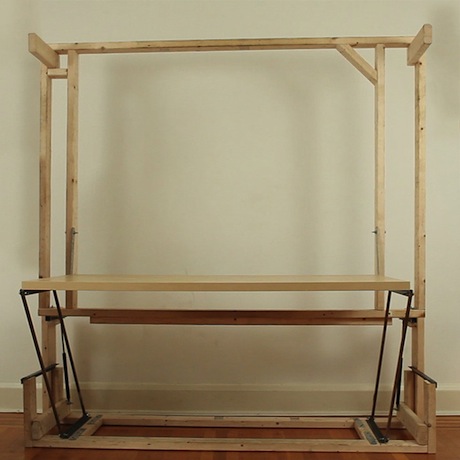
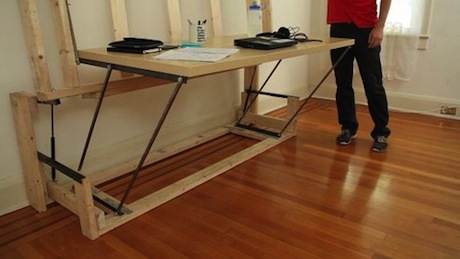
The good folks over at Treehugger turned us on to a DIY Murphy bed/desk called the UrbanDesk, ideal for people looking to save space and money. While it features a desk and some storage on its frontside rather than a couch, it still achieves the goal of milking as much space as possible in a very small footprint.

DIY-Murphy-Bed-Desk-2

DIY-Murphy-Bed-Desk

The project began as a Kickstarter project, but failed to meet its fundraising goal. Graham Phakos, the guy behind the project, said he’d post plans for anyone to build it. As yet, he has not, though we are going to petition him alongside Lloyd Alter at Treehugger to fulfill on his promise (we’ll keep you posted).

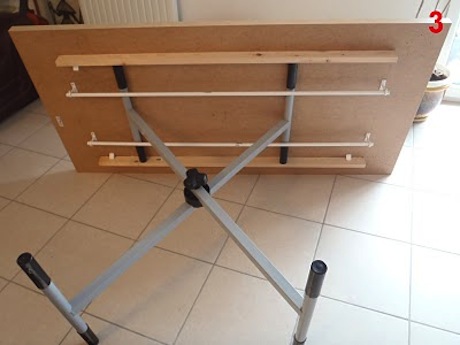
Convertible-table

Beside a transforming bed, tables offer a great opportunity for space saving. We found this DIY convertible table on IKEA Hackers. Using an IKEA table top (they recommend a VIKA AMON, which appears to be discontinued, though there are several alternatives, from $10-100), a common trestle or keyboard stand (about $30 on Amazon) and a few other inexpensive items, you can create a table that converts from coffee to dining table in a pinch. Find full instructions on IKEA Hackers.

Whether you’re on a tight budget or a renter who doesn’t want to throw a ton of money into a temporary living situation or you just like making stuff, there are many options for making a transforming space that don’t break the bank.

Japanese Family of Six Thinks Inside the Box

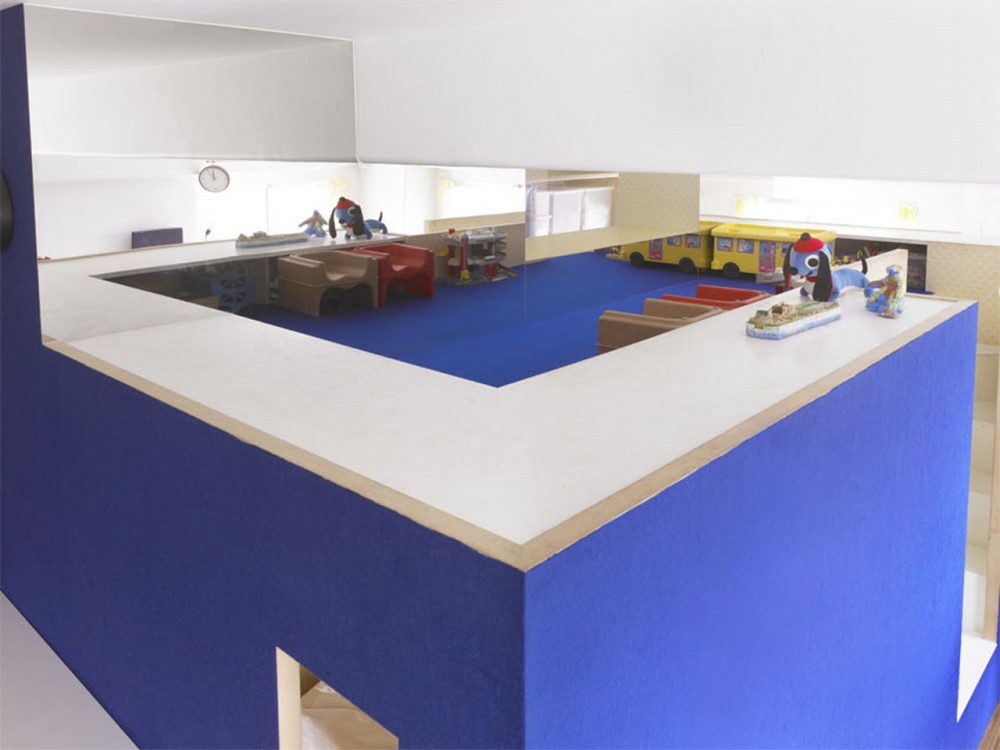
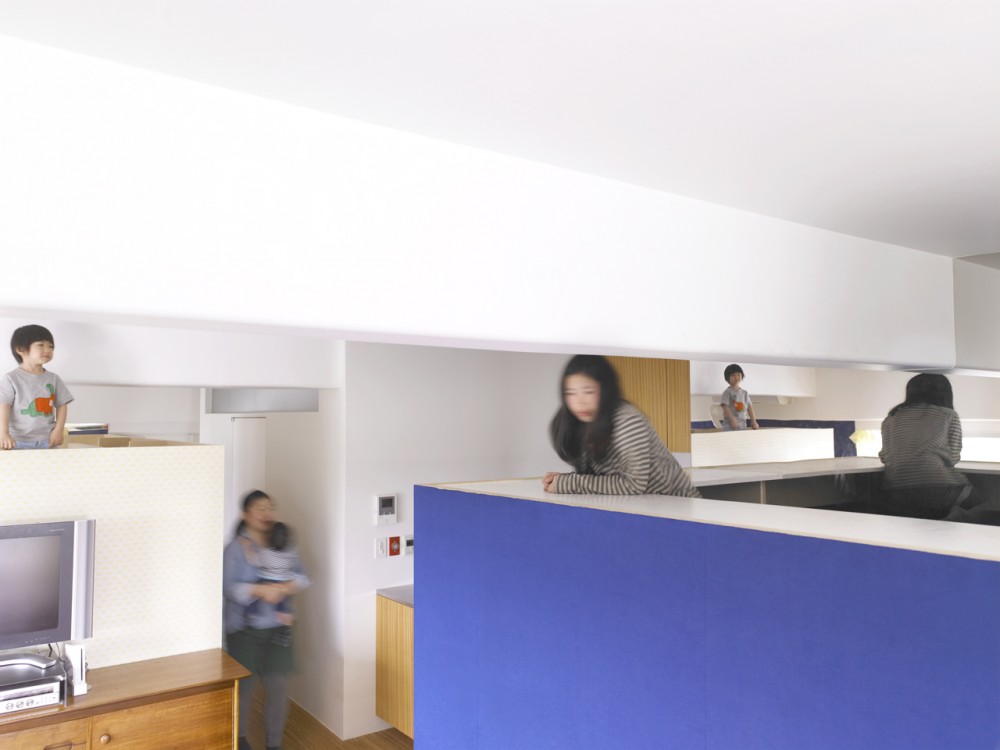
A few weeks ago, we saw how one man conveniently stashed his kid in a cubby in his tiny Warsaw apartment. Several thousand miles away, a husband and wife went a bit further, stowing their four children in little cubbies in their 770 sq ft Tokyo apartment.

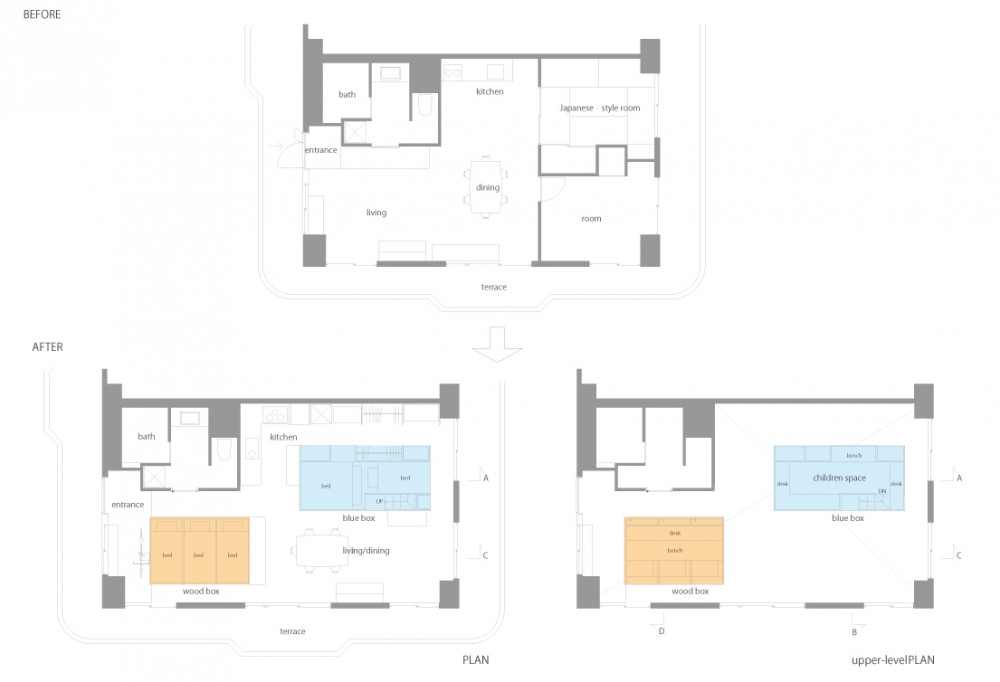
To do this, Miha Design, the firm responsible for the renovation, converted the original apartment, which included one bedroom and a traditional Japanese room, into an open floor plan.

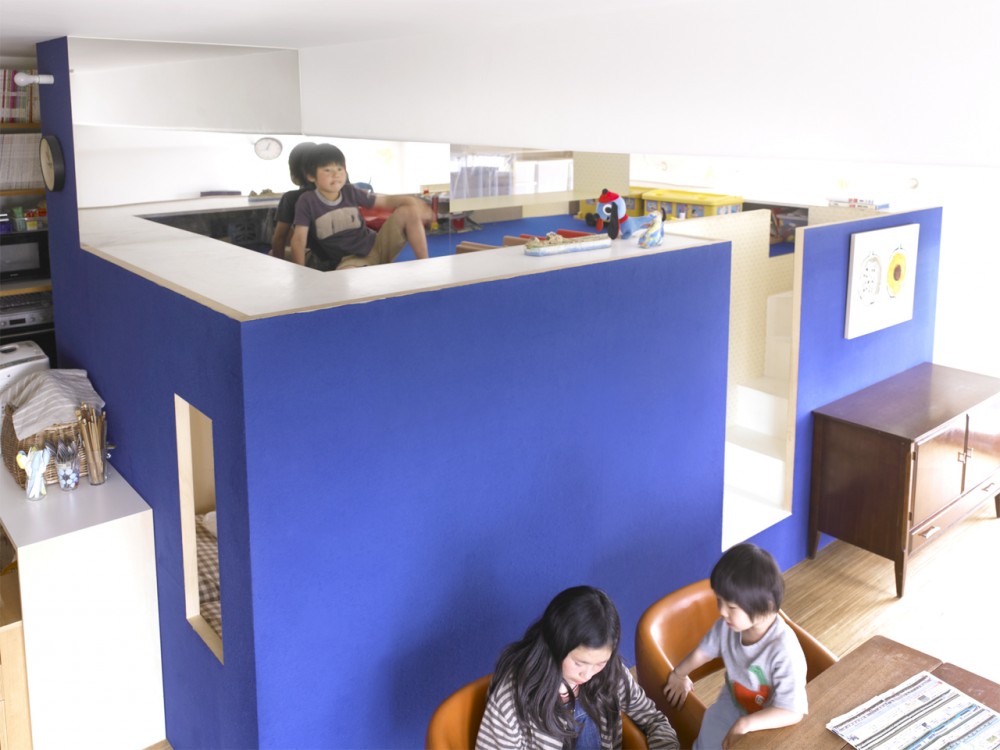
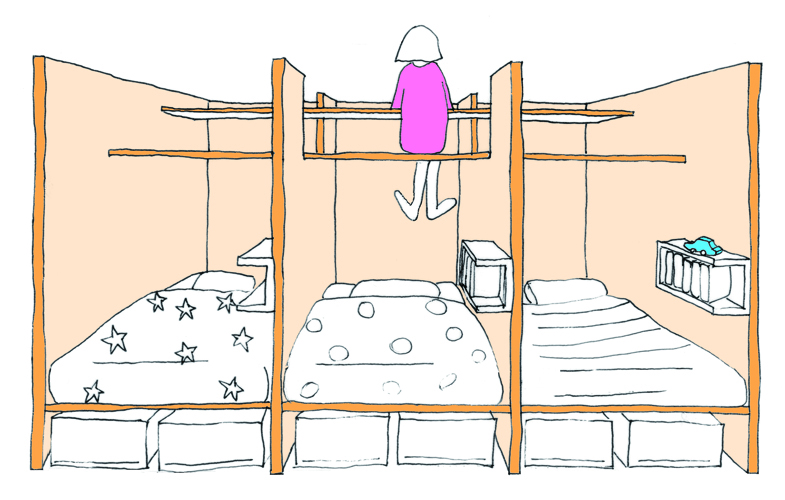
They created space separation by erecting two large boxes that house several discreet spaces. One box–covered with blue felt–contains three sleeping cubbies for the younger children; on its top is a 1.1m high play area–suitable for young children to scoot around. There are desks and benches on top as well; slots for legs allow the kids to sit upright. Under the beds are storage bins for the kids’ stuff.

The second box has a wood finish and beds for the parents and eldest child. The top has a similar desk and bench setup as the other box, albeit less blue.

The rest of the space is comprised of a dining/communal area, a galley kitchen, an entrance way and a storage area.

People are always asking us how to fit families in compact spaces. Miha Design’s space is one possible version, demonstrating a creative way to fit a large family in a small space in an expensive city–while still maintaining some semblance of separation for each family member. We do wonder what will happen when the kids grow up and cease to fit in their cubbies or start knocking their heads on the ceiling. We also suspect the dangling leg design might not fly with every parent.

All photos by © Sadao Hotta

Via Arch Daily

Desk. Edited.

From pen and paper to standard typewriter to electric typewriter to large computers to tube monitors to LCD monitors–the loads our desks bear has changed a great deal in the last 100 years. But today many of us have done away with almost all paper and we can get by with a tablet or laptop for a good portion of our work duties. If that’s the case, why use a desk designed to carry reams of paper and a big CPU and monitor? We found a few desks that better accommodate this new lightweight office.

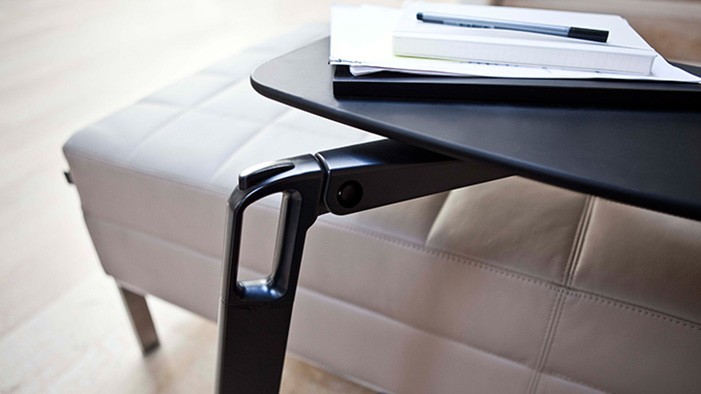
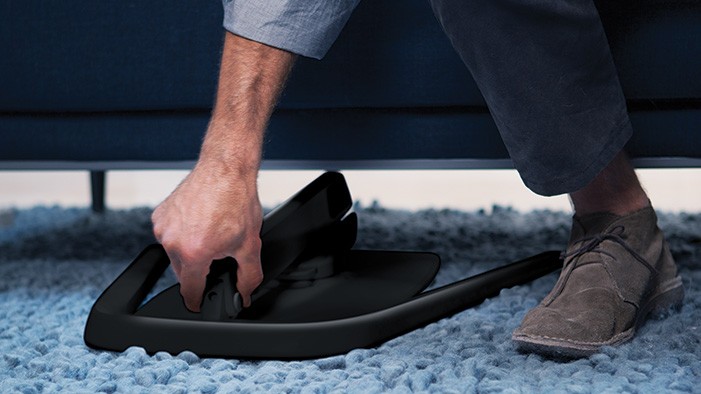
The Free Stand by Stephan Copeland is the ultimate expression of the lightweight desk. It’s a stand that is just big enough for a tablet or laptop. Its height is adjustable from 19.5-27″ and can be positioned to fit over a normal chair, sofa or lounge chair. It can be folded and stowed away when not in use. The unit is scheduled to be available later this spring through Coalesse; no pricing info available yet.

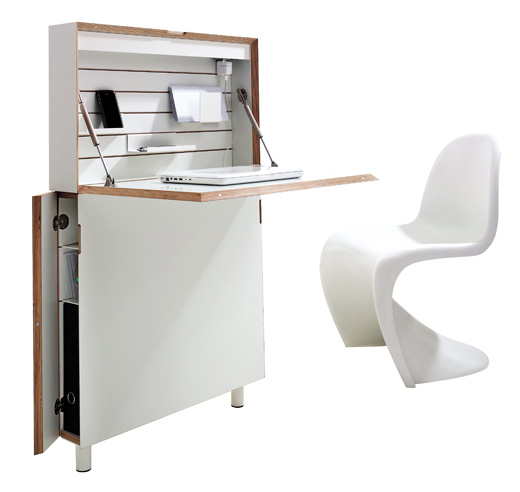
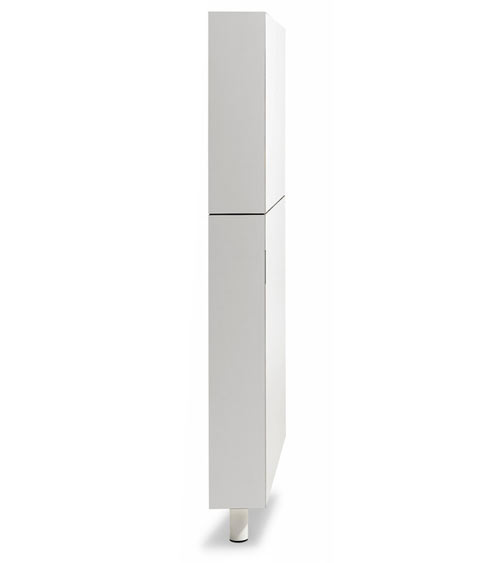
The Flatmate by Michael Hilgers is a bit more of a comprehensive unit–i.e. it has room for your elbows, some minimal storage and plugs for your devices. When closed, it’s a mere 5″ deep. The unit is attached to the wall to maintain stability. The Flatmate is available for $1850 from Resource Furniture.

Michael Hilgers actually has several varieties of lightweight desk designs such as the HIDEsk, which is an easel-like desk, and the  balKonzept, a desk designed to fit over your balcony railing.

Of course, if you really want to stay lightweight, you can just use your dining room or kitchen table like this author does ;-).

image via coalesse and Michael Hilgers

They Don’t Get Any Tinier Than This…But No Solar Panels?

We love tiny houses. The trailer-mounted dinky digs, often less than 100 sq ft, epitomize the spirit of doing more with less. This video shows off one woman’s tiny house that’s a wonder of sustainability and the tiniest we’ve ever seen.

The 2 minute parody was actually made by Dawn Jones for the Portlandia Film Festival in Portland, Oregon (not affiliated with the TV Show FYI). While it pokes fun at the tiny house movement, while “made with great affection for the movement.” The affection shows.

via Treehugger

Heirloom Sharpie

Do you remember when your grandfather passed down his trusted Sharpie marker to you? You looked in awe at the worn patina of its steel shaft, hinting at the countless boxes marked up and posters made over the years. You took a good whiff of the noxious ink, thinking of how you would pass it to your grandchild one day.

Chances are, if your grandfather gave you an heirloom, it wasn’t a Sharpie, which are as disposable as they are indispensable.

Well no longer.

Sharpie now has a refillable, stainless steel-bodied model worthy of being passed down to future generations…for a mere $8.99 and $2.49 refill cartridge.

We’ve talked about heirloom design here before; it’s the idea that the stuff we bring into our lives is high enough quality to be handed down to future generations. This is all well and good for watches, pens and cast iron pans, but there are certain things we assume are inherently disposable like Sharpies.

The reason Sharpies are considered disposable is mostly attributable to its plastic constructions. Nothing says disposability like plastic. Unlike metal, wood or glass, plastic begs to be mistreated, broken and thrown away. While a very useful material, not everything has to be plastic. A website called Life without Plastic proves this, offering a range of products like food storage (pictured below) and toiletries made of non-plastic materials.

food-storage

While a life only filled with heirloom quality/non-plastic items might take a lot of effort and money, exchanging a few items like your Sharpie and to-go containers with items that will last for years makes good economic and environmental sense.

Do you know of an heirloom quality item that replaces a commonly disposable item? Let us know in our comments section.

via Core77

Occupy Your City this Spring

In many parts of the US and world, spring is springing. Time to take out the lighter jacket and head outdoors. Particularly when living in a smaller abode, it’s important to use your city as a living room, exploiting public space to offset minimal private space. While we’ve tossed out a few public spaces in New York City where those public living rooms might be, there are lesser known spots that often fly beneath the radar.

Privately Owned Public Space (POPS) are located throughout New York and most major cities. They are exactly what they sound like: Spaces you can loiter in, ahem, enjoy, but because they are privately owned, don’t get the hype of major publicly-owned public spaces such as the Highline and Central Park (Zuccotti Park is the one POPS that did get plenty of hype).

pops-greenwich-st

A website by APOPS@MAS (Advocates for Privately-Owned Public Spaces at the Municple Arts Society) provides a detailed map of NYC’s 500+ POPS throughout Manhattan, Brooklyn and Long Island. The site even allows you to search based on criteria such as climate control (providing AC in the summer or heat in winter), 24 hour access and spaces that feature programming such as gallery talks.

The APOPS@MAS site is not only a database, but an advocate of proper stewardship of these spaces. They say this about the spaces and the organization’s mission:

Built and managed by office and residential skyscraper owners in return for valuable floor area bonuses and other zoning concessions, these privately owned spaces are legally required to be open for public use. While some are quite good, others are problematic. APOPS@MAS seeks to sustain and improve all spaces through constructive engagement with owners, public officials, community boards, civic groups, and, most fundamentally, with you.

Detailed descriptions of the spaces are available on the site so you can steer clear of the problematic sites (admittedly, many are just charmless spaces at the bases of skyscrapers).

We did a little digging and found databases for San Francisco (and this one), Seattle and London.

Like the smartphone you accidentally realized had way more cool features than you ever knew how to use, most cities hold many untapped wonders such as POPS that make our lives richer.

Do you have any secret spots in your city? Let us know in our comments section.

Tetris-Like Office Creates Space, Grants

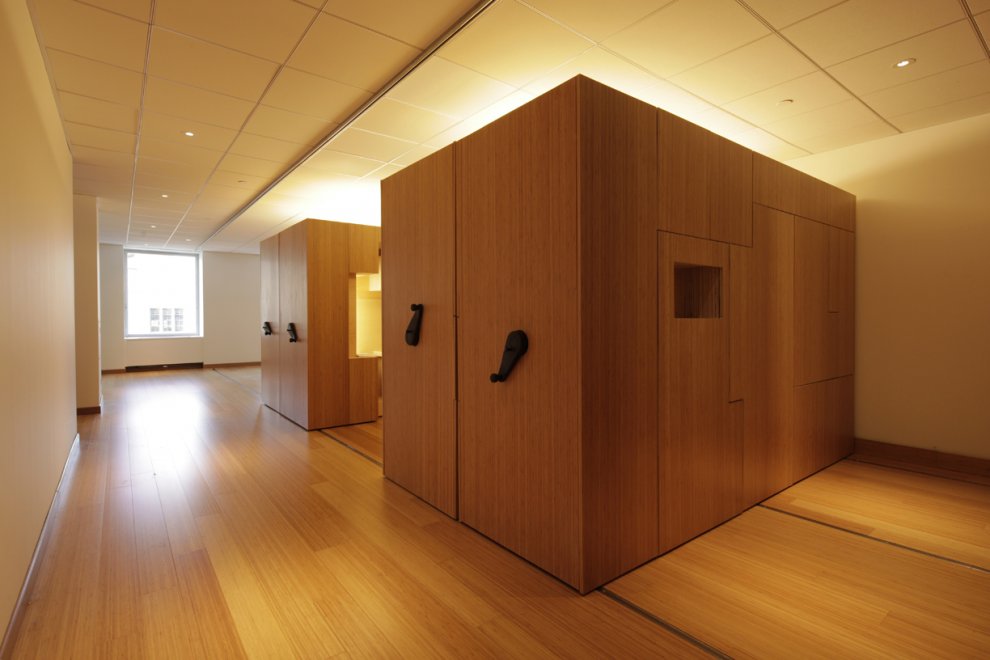
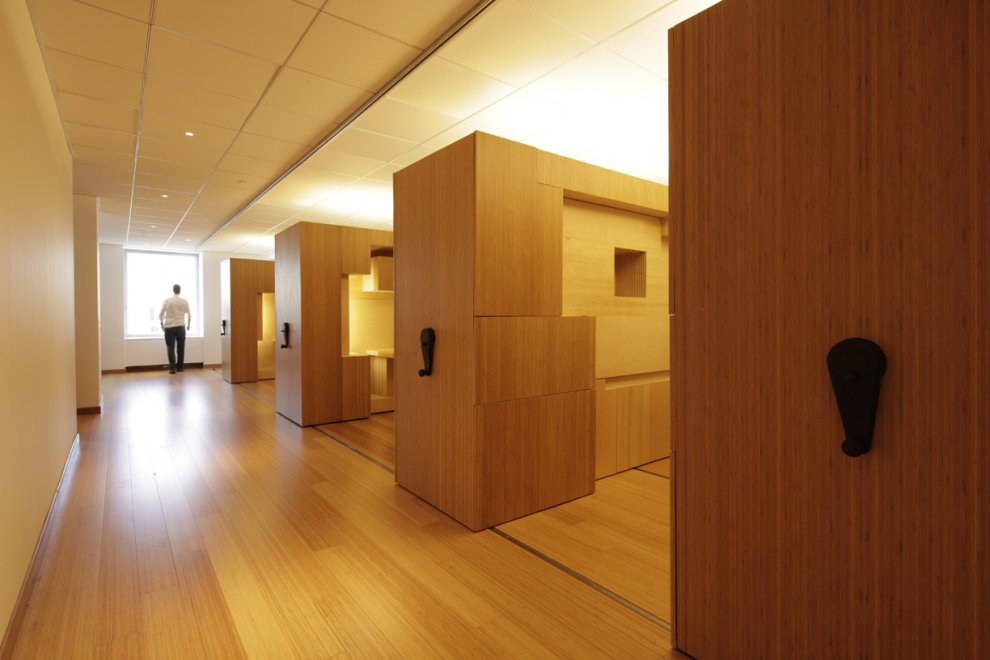
A couple weeks ago, we talked about how your office will disappear. Well, the office for Environmental Grantmakers Association (EGA) takes that concept literally. Its designers Taylor and Miller Architecture and Urban Design incorporated collapsible walls that make the office disappear.

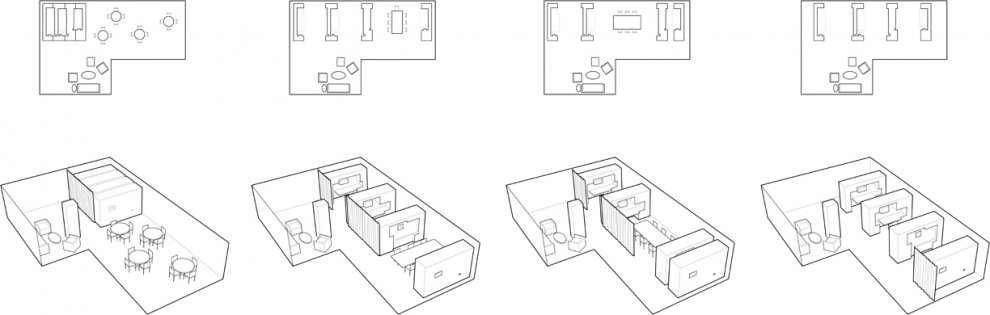
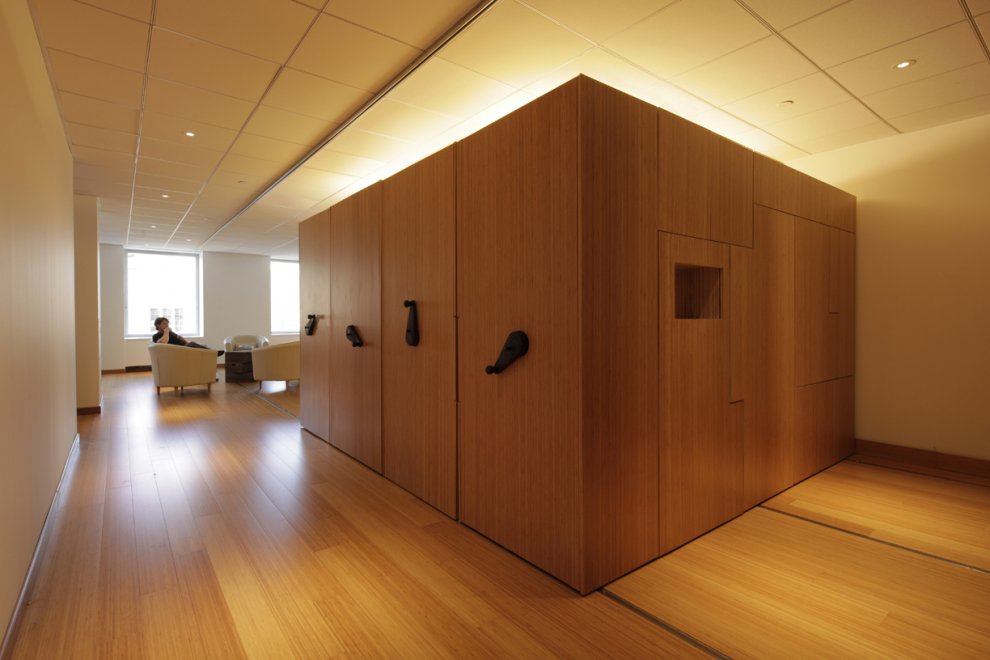
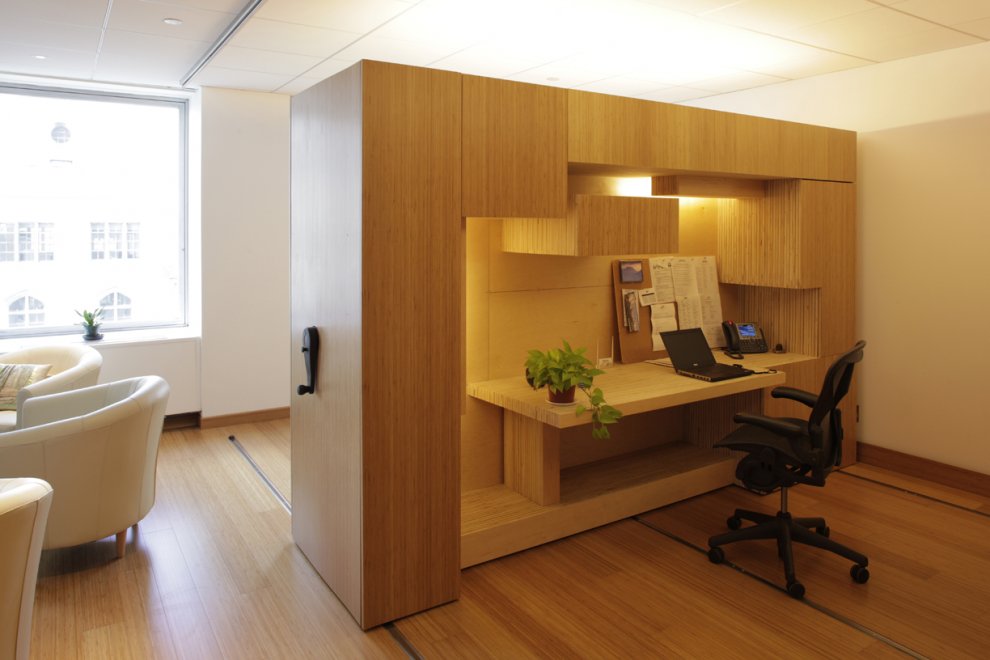
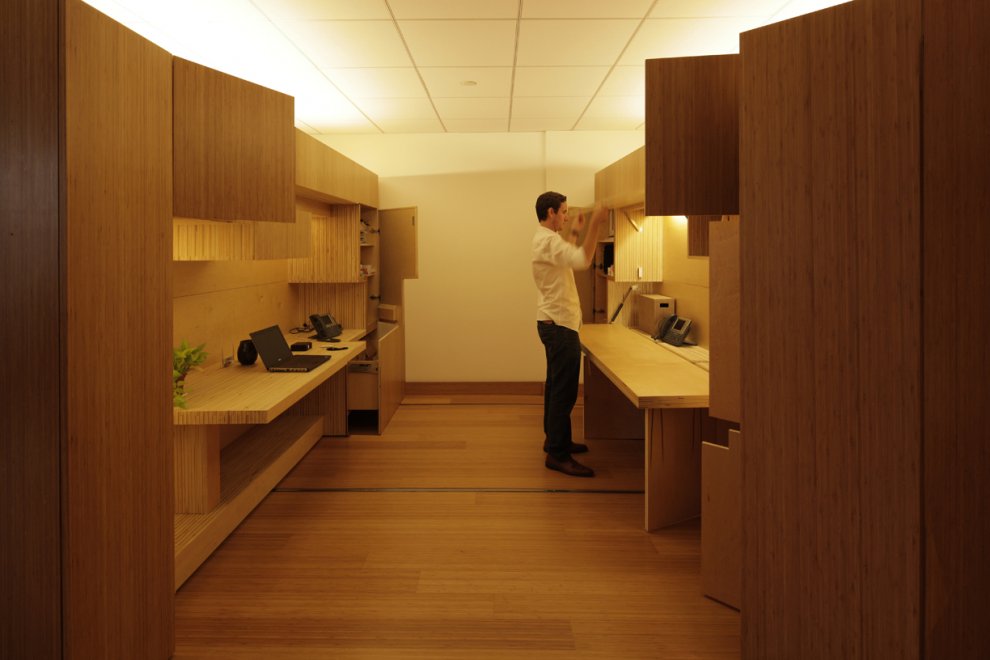
The office’s four interlocking walls house seven work stations and ample storage. When opened, they can be configured as workstations or even a boardroom. When compressed, they create an open floorplan for events and various other purposes. You can compress some of the walls and extend others to create a highly dynamic space.

The walls have an innovative way of working together. From Taylor and Miller:

When occupying the space between two partitions, one can see that the inward faces of each has been excavated with the same shape. In other words, what is a storage box protruding on one side is a recessed storage cubby hole on the other. In this manner, the partitions are bound together spatially; the relationship between them becoming stronger and stronger as they are compressed together… until finally they are collapsed completely concealing the carved space within.

The design is very similar to the LifeEdited Apartment‘s moving wall, which rests on a track and carriage manufactured by Modern Office Systems, whose primary business is large file storage systems. Taylor and Miller sourced their track from Pipp Mobile. Our unit cost about $4500 for just the track and carriage (i.e. not including the cabinet above). Additional reinforcements had to be made to the floors to support the concentrated weight of the wall. While this is a fair amount of labor and money, they’re invaluable in small spaces, where access to all the space all the time makes a huge difference. Why have a guest room 365 days a year when you only use it 20 nights? Why have a boardroom all the time when you only use it a few times a week for an hour or two? The financial and environmental costs of maintaining unused spaces quickly makes a compelling argument for incorporating more systems like these in our interior designs.

Photos by Emile Dubuisson

Via Architizer

Give It Away, Give It Away, Give It Away Now

Following Graham Hill’s recent NY Times Op Ed, a far-reaching conversation has opened up about stuff–namely living with less of it. And to the best of our ability, we’ve tried to dole out sound advise for getting rid of your stuff. We’ve tried to help you navigate the perilous waters of eBay. We’ve looked at the online yard sale that is Krrb’d. Even though we haven’t written much about it, who doesn’t know about Craigslist? All of these services offer great ways to make money when offloading your stuff–the perfect present for your new edited existence.

But you know what? Selling stuff is a pain in the butt. Unless, you have very desirable, coveted items with clear market values or you are offering things at rock-bottom prices, your selling process is likely to be fraught with haggling, answering questions, shipping and dealing with scammers. Sure, pros can handle these situations with aplomb, but for many of us, selling can be more stressful than keeping.

We know it’s tough to do, but sometimes the best thing to do with our great, valuable stuff is give it away. When considered carefully, most of us will find selling is not worth the effort. While “time is money” might sound a bit facile, the fact is our time is worth money; you don’t work at your job for free do you?

To illustrate: Someone who makes $50k a year gets paid about $25/hour for his or her time (see how we got that number here). Let’s assume that’s your salary and your free time is of comparable value. Looked at this way, the cost/benefit analysis of spending an hour or two selling the Cuisinart you bought for $200 for $50 on eBay isn’t quite there.

There is no shortage of ways of giving your stuff away. Friends and family are an obvious choice. Craigslist has a free section, where things get quickly snagged. There’s Freecyle, a national grassroots network of people reusing and keeping “good stuff out of landfills.” There are tons of worthy charities such as Goodwill, many of whom will pick up your stuff and provide tax deductible receipts (you still have a couple weeks!).

We were recently turned onto a website called WebThriftStore, which allows charities to set up virtual storefronts. Through the site people can donate stuff as well as buy other people’s stuff. Donors actually send their stuff to buyers, cutting out the store. Proceeds go straight to one of the site’s partner charities and you get a tax receipt. WebThriftStore provides free mailing labels and shipping supplies for the donor.

While donating your stuff to a good cause might not have the dopamine spike of a wad of cash, it might have more influence on your long term happiness.

How about you? What’s your favorite way to give? Or do you know a secret way of selling that’s not so much of a drag?

Love Thy Neighborday

The average American moves 11.7 times in a lifetime. One out of six Americans move once a year. This high mobility may have turned the institution of neighborly relationships from marriage to long-term dating or even brief fling. This situation was verified by a Pew Study that found fewer than half of Americans know most or all of their neighbors.

Neighbors are good (at least the ones that don’t blast music at 2am). They feed our cats, lend us ladders and cups of sugar and provide easy companionship. A strong tie with a neighbor is worth 1000 Facebook friends on the black market. But it’s tough to love our neighbors when we don’t even know them.

The good folks over at Good Magazine have a remedy for this neighbor deficit disorder: It’s called Neighborday. On April 27th, they challenge all of us to get to know the people closest to us (geographically at least). They explain the motivation:
…While the internet age, has brought unprecedented access to information, networks, and commerce, it’s unclear if it has brought us closer or has in fact further isolated us…Neighborday is about creating a new story. It’s about transcending the old story of self to create a new story of us. It’s about expanding our definition of self to include those who live above us, below us, and next to us. It’s a call to action of the most important kind: to let our neighbors in, and to build more self-reliant streets, blocks, and neighborhoods, together.

We know you’re busy. We know you already have lots of friends that you have trouble keeping in touch with. Worst of all, we know it’s awkward introducing ourselves to the people closest to us–especially if we’ve lived someplace for a while. It might take a little courage (remember, they haven’t introduced themselves to you either, so the shyness is probably mutual).

But really? If we don’t know our neighbors, if we can’t knock on their doors when we need a favor, consider there might be a gap in our social lives.

Visit Good’s Neighboring homepage to take their pledge. They also provide ideas for celebrating Neighborday, like turning your home into a parttime restaurant. If we don’t know our neighbor’s name, we’re probably best off starting small, like introducing ourselves in our hallways, driveways or sidewalks instead of giving our usual “what’s up” or “how’re you doing.”

Are you tight with your neighbors? Beside basic friendliness (always the easiest tactic), how have you cultivated relationships with your neighbors? What advice would you give those of us who are strangers to our neighbors?