How to Stop Receiving Unwanted Mail

Are you trying to live a more edited life, but your mailbox teems with catalogs, serving as daily reminders of your former excessive ways? Do you receive multiple “Important Information Enclosed” envelopes a day–ones that never contain important information? Does your recycling bin teem with unopened junk mail? Do you want to get rid of it? Then a service called Catalog Choice may be for you.

The service provides 4 ways of combating junk mail:

  1. A free general membership allows users simply create an account and search for companies to opt-out of unwanted catalogs, coupons, credit card offers, donation requests, and other junk mail. You can also enter their zip code to get delisted from phone books. Catalog Choice then acts on users’ behalf to get their opt-outs processed by the senders.
  2. For $20/year they protect your name from being sold by data brokers–the guys who buy and sell your address to direct mail marketers.
  3. For $6.75, you can buy one of their self-addressed envelopes which handles up to 15 places to be unsubscribed from.
  4. MailStop™ Mobile is their free download in the iTunes store that  allows customers to use their mobile devices to take pictures of unwanted mail. Once uploaded, Catalog Choice will process and manage the opt-out requests.

While it might seem easier to just toss the stuff, these daily paper assaults create clutter and confusion in our homes, not to mention a significant amount of waste. By shelling out $30/year or so on Catalog Choice and switching all of your bills to paperless, you can probably achieve a mailbox that stays empty for weeks.

image credit: Smallbiztrends

Correction: Previous version of this post did not include “General Membership” or “MailStop™ Mobile” as part of Catalog Choices options. 

Kyoto Hotel Offers Travelers Posh Pods

Japan always seems to be one step ahead of the rest of the world in space-saving living. Case in point is a capsule hotel in Kyoto called 9 Hours. The name is based on the idea of 1 hr to shower, 7 hrs to sleep and 1 hr to rest.

While capsule hotels have been around for a while in Japan, they have been more focused on function than form. 9 Hours’ super sleek interior and ample amenities give a luxury feel to what is essentially sleeping in a cubby.

The developers express that they are not interested in replacing full-size hotels–merely providing an alternative for people who may literally need a place to sleep and nothing more.

The video asks if the US and Europe are ready for this style of hotel. We suspect it’ll come down to cost. If a space is 20% the size and 20-30% the cost of a standard hotel room, it will create a compelling argument for booking a pod. Ultra-sleek environs like 9 Hours will make the decision to go with a capsule easier as well.

What do you think? Have you stayed in a capsule hotel? What was your experience. Would you? If not, why not?

via Monocle

Home Goes Off Grid in Brooklyn

We don’t talk too much about “green” at LifeEdited for a couple reasons: 1. It’s the 21st Century and it should be a given in our conversation, and 2. Because small is green. All things being equal, a 500 sq ft home will be twice as efficient as a 1000 sq ft one.

The problem is all things are not equal. In New York City, for example, a good portion of the housing stock is old with crummy windows and connected to an inefficient electricity grid, so even though housing units are significantly smaller than the rest of the country, some of that advantage is lost in these inefficiencies.

A new building in Brooklyn, NY called the “Delta” is addressing these issues directly. The builder Voltaic Solaire has sheathed the building with photovoltaic cells and topped it with wind turbines to make it “net-zero”–i.e. it can create all the energy it consumes. Each of the building’s 5 units will be a LifeEdited-approved 450 sq ft and feature murphy beds and folding tables. It will be small and efficient.

The company is working on retrofitting a classic Brooklyn brownstone that will generate 18Kw/year–again, enough to power the building and possibly then some. While building new is often a great way of going green, using existing structures reduces embedded energy because you are using stuff that already exists.

Cities are very conducive to living an edited life. They are walkable, make sharing easy and support high-density living. But we don’t need to stop there. Voltaic Solaire and others are  showing how we can make cities even better.

If you know of other movements like this one, let us know.

image credit: Inhabitat

via NY Times

5 Tips for Editing Your Diet

We tend to focus a lot on hard goods like knives and moving walls here at LifeEdited, but one of most urgent places to bring editing is our diets. According to the CDC, today’s average restaurant portion is 4 x’s larger than it was in the 50’s; a 26 lb increase in average weight is surely correlated.

We are always promoting the idea of less and better when it comes to products and architecture. Suffice to say, this principle works with food as well. Here are 5 tips for editing your diet at both restaurants and home:

  1. The CDC suggests ordering the smaller portion wherever possible (i.e. the pint vs the quart of Kung Pao chicken), sharing meals with a friend or wrapping up half your meal from the get-go. These strategies probably works best with higher quality meals that don’t excite your appetites like a Extra Value Meal from McD’s (see tip #5).
  2. Try not ordering a meal for yourself the next time you go out to a restaurant. In order to avoid being branded a mooch, explain your experiment to your meal-mates and get their approval first. Offer to offset the bill. Oftentimes, people either leave a big portion on their plates or eat that extra amount because they don’t want it to go to waste. By taking a portion of their food, you are helping keep their portions sane as well.
  3. Join the “Small Plate Movement.” Seriously, there’s a movement, which, as the name suggests, promotes using small plates to affect dietary habits. One challenge they offer is to eat off of a 10″ plate for a month. One case study they cite found that people ate 53% more snack mix when their bowl was bigger. At the LifeEdited apartment, we searched for a do-it-all plate, finally choosing one by Arzberg called the Tric soup plate. It is 8.3″ diameter with a 1″ rim, so it can work for virtually any course.
  4. You don’t need to be stuffed to be nourished. Many of us don’t consider a meal over until we feel uncomfortably full. Experiment with stopping short of that feeling. Eating fiber-rich foods like greens and other veggies help you feel fuller faster, without the bloat.
  5. Cut out junk food. It’s kinda obvious, but poor quality food is worse than poor design. You just don’t need it.

via Treehugger

Drag and Drop Architecture at MIT’s CityHome

Are you interested in modular design, but worry that standardization will translate into an impersonal living experience? (Chances are you’re not, but just say yes.) Well the Changing Places Group at MIT’s Media Lab is developing a cool project called CityHome, which allows tons of customization for the modular, urban abode.

The project is a technological tool-set that matches a home’s architecture and functionality to the needs of its resident. Residents start by making a profile based on social media data and questionnaires (kinda like an online dating profile for architecture). The program makes suggestions based on the data and has a drag-and-drop capability so residents and architects can design the optimal living space for their particular lifestyle. Environmental sensing data optimizes the unit’s efficiency.

The above video uses a “very small footprint” 840 sq ft apartment as a case study (not sure what that makes the 420 sq ft LifeEdited Apartment…microscopic?). It shows that space in myriad configurations, with transforming walls and furniture.

While the project is not live just yet, it represents a direction for architectural design that allows for easy space customization and optimization before production. One of the biggest challenges of building the LifeEdited apartment was making changes in real time. Tools like CityHome might be able to leverage technology so residents get what they want and architects and builders build better, faster and more efficient homes.

Thanks for the tip Bruce!

Can the American Dream be Rented?

For many years, the American Dream has centered around home ownership. The logic follows that you buy a home, lay roots and live in your biggest investment, which, more often than not, appreciates in value.

In the last few years, this dream has become a nightmare. The mortgage crisis created a class of defaulters, and the ensuing recession made down payments and financing near-impossibilities for most. Moreover, our mobile job market made the tether of a home more of a liability than asset.

According to a Wall Street Journal article by Daniel Gross called “Renting Prosperity,” these factors have triggered a shift away from the ownership ideal. He says:

In the American mind, renting has long symbolized striving—striving, that is, well short of achieving. But as we climb our way out of the Great Recession, it seems something has changed. Americans are getting over the idea of owning the American dream; increasingly, they’re OK with renting it.

The facts bolster his argument: home ownership is down, while rentership rises; and multi-unit buildings–most of which are used for rentals–have increased in production over the last few years while single units are declining.

He also explains that for many, the idea of ownership is mostly that: an idea. The reality is that people simply rent from the banks, whose “rent” comes in the form of interest and fees. This begs the question, if there is little, no or negative cost benefit to owning, why do it?

We’re big fans of rental/sharing services such as Zipcar and Rent-the-Runway. They allow you to use products by the hour, rather than paying a hefty and often unnecessary retainer fee. The author Gross points to these services as indicators of a changing attitude to rentership–that people increasingly care more about using than owning. The question is whether this a good system for housing, which for most is something they want to have all the time.

Like cloud computing, where all data is stored online and accessed when needed, could our world be moving away from the model of all-the-time ownership to on-demand access? On the one hand, this could lead to fewer people laying roots and improving their communities. On the other hand, it could lead to smarter rental homes and renters–the Strand East planned community is a good example of that.

What do you think? Do you think we should be living in the cloud or on the ground?

via Wall Street Journal

Very Brief History of LifeEdited

With a recent piece in the NY Times, we thought it would be useful for those new–and not so new–to LifeEdited to create a short timeline with a few key bits of historical information:

2009

Treehugger.com founder Graham Hill bought 2 tiny apartments (420 and 350 sq ft) in the Soho neighborhood of New York City for the express purpose of making them into the smartest, most efficient, elegant small spaces possible, creating a new type of small, awesome home.

2010

With the help of crowd-sourcing platform Jovoto and marketing firm Mutopo, Graham launched a competition to find the world’s best small-space design. Read more about it here.

2011

Romanian architecture students Catalin Sandu and Adrian Iancu win competition with their “One Size Fits All” design.

Graham Hill speaks about the project at the TED conference (1.3M view to date). Rated one of top ideas of 2011 at TED by Huffington Post.

Construction of the apartment begins in October with Brooklyn-based architecture firm Guerin Glass.

2012

Website launches to show the best in “edited” architecture, design and living.

Graham Hill’s apartment completed in May and featured in NY Times, who dubbed it the “Apartment of the Future.”

The Past-Future of Space Saving Design

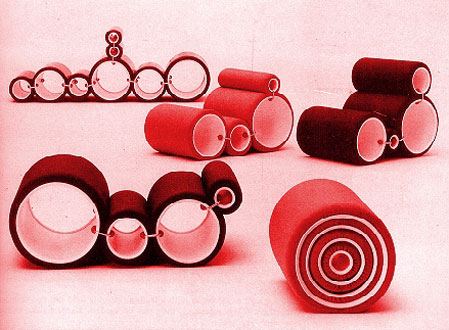
Joe Cesare Columbo was a prolific Italian Designer from the 50’s, 60’s and 70’s whose furniture designs were compact, modular and able to adapt to any space (versus a space adapting to them). It reminds us of the Metabolism design school, which created modular and adaptable architecture around the same time.

The “Tube Chair” (pictured above) uses the simple cylindrical form to make a highly adaptable and compactable lounge chair; each tube is attached with a U-shaped clip. Pictured below is Columbo’s Mini-Kitchen and Cabriolet Bed, both of which transform otherwise stationary and space-hogging parts of a home and turns them into light and mobile objects.

The Mini-Kitchen has recently been re-released by Italian firm Boffi Spa, making us wonder if Columbo’s prescient designs, which seem increasingly relevant to our mobile culture, will make a big return?

images from Design Boom

8 Tips for Editing Your Life that Work for Any Budget

Yesterday we featured a story about a $275 DIY murphy bed to show that an edited life is by no means for people rich enough to choose less (rather than having less imposed upon them).

Let’s be clear: excess is far from a rich man/woman’s dilemma. Watch an episode or 2 of Hoarders for proof. Cheap housing and consumer goods have made virtually every socioeconomic bracket victims of excess…and crippling debt. The average American household carries $16K of credit card debt!

And sure, we love great architecture and product design–much of which has a steep buy-in cost–but there are infinite things you can do for little or no money to start living an edited life. Here are 8:

  1. Edit your possessions. Go through your closets, drawers, file cabinets. A good rule of thumb is if you haven’t used something in the last year, you probably won’t use it in the next. Toss it, recycle it or, better yet, give it away, get a receipt and use it as a tax break. Is your stuff too expensive to give away? Sell it and make some money.
  2. When you do buy, buy high quality stuff you like and will use. Okay, so this might sound a bit contradictory, but sometimes the way to save money is to spend it. How many times have you skimped on a purchase, buying the inferior thing you don’t like because the high quality one you did was twice as expensive? Then the inferior things breaks, doesn’t get used or becomes the unwanted child of your possessions. If something is 2x as expensive and lasts 4x as long (or is used 4x as much), that’s half the price of the cheaper thing.
  3. Get rid of your books. Few things take up space like books, and eReaders have come a long way, and dropped way down in price; e.g. Kindles start at $79 and have thousands of free titles. Want something cheaper, download a free Kindle app that allows you to read on your phone or computer.
  4. Get rid of paper. Switch all of your bills and statements to online only (put them on autopay if possible). Scan receipts. Work on completely digitizing every form of receipt, bill, statement, etc. This save paper and clears clutter for no additional cost.
  5. Take a walk. We don’t think about cars taking space, but they do–a Honda Civic sedan takes up 85 sq ft. of it. Cars’ collective footprints increase the size of our homes and cities. This is not to mention the ongoing money and stress of things like gas, insurance, upkeep, etc. Few things simplify your life–and save money–like ditching your car. While we know it’s not feasible for many to do this, if you’re moving, consider a place where you can walk, bike or use public transport to the various activities in your life: work, groceries, etc. Your health, planet and pocketbook will thank you.
  6. Get some budget transforming furniture. Sure, it’d be great to have an unlimited budget for furniture, but few of us have that option. There are countless folding tables, sleeper sofas, folding chairs and affordable DIY options that can add tons of utility to a small footprint.
  7. Try a sharing system. Maybe you’re having a baby, try a toy-sharing system. Maybe you need to use a car once or twice a month, use a Zipcar. Maybe you have wedding to go to, rent your dress or tux. Why pay full-time salaries and overhead charges for the stuff you only need to perform part-time duty?
  8. Consider moving into a smaller home. When moving, think about what you really need and trim at least 20%. The amount of stuff we have is not a fixed thing–it expands and contracts depending on the amount of room it has to occupy. Smaller spaces are cheaper to buy and rent, easier to maintain and have built-in safeguards against accumulating too much stuff, and when laid out right, can have all the utility of a much larger space.

image from fopple.com

Build Your Own Murphy Bed for $275

One of the bigger challenges to starting your edited life is reasonably priced transforming furniture. While we believe the high quality and versatile Resource Furniture used in the first LifeEdited apartment is worth every penny, many of their large pieces are several thousand dollars, putting it outside the price range for many people.

Perhaps no piece of furniture is more important to an edited home than a transforming bed. Beds are huge space hogs, whose utility is only relevant when we’re unconscious. A queen sized bed is about 35 sq feet; why wouldn’t you want to use that space for your 16 waking hours?

A “product” called the Moddi Murphy Bed is the least expensive entry point we’ve found for getting your bed out of the way. The site sells plans for $8, which instruct you how to take easy to find IKEA furniture and other hardware to make a twin or full sized murphy bed for $275 (most pre-builts start around $1500). The finished product–which can be modified depending on which IKEA finishes you purchase–looks pretty great too.

One of the aims of LifeEdited is providing the resources to make simpler, happier lives, no matter your budget. If you know of any other low-cost transforming furniture or hacks, please let us know.

via IKEAhackers

image from Apartment Therapy