Fix Your Stuff, Make Friends at Repair Cafe and Fixers Collective

Yesterday we talked about Maui Jim, an eyewear company that provides cheap and swift repairs for their products. While corporate fixery is great–and hopefully, one day, will be expected–many people are taking repair into their own hands.

The other day, the NY Times profiled some of those people–Dutch people to be precise–who hold informal gatherings a couple times a month to fix their broken stuff. According to the article, the “Repair Cafe” started  2 1/2 year ago as a way to reduce waste. In that time, it has grown considerably, having raised $525,000 from a state grant and other contributions; they bought a Repair Cafe bus and have started cafes across the country–sorta like Fight Club, but fixing stuff instead of fighting and not secret and…not similar at all.

All repairs are done by volunteers for free.

On this side of the pond, the Fixers Collective in Brooklyn, NY has been fixing stuff for a few years. They don’t have a foundation or a bus, but they do meet and fix stuff. What’s cool about FC is that they have a hierarchy of fixers, beginning with Master Fixers (your MacGyver types), apprentices and drop-in visitors–each teaching the other the fixing ropes.

Their site descibes their philosophy this way:

The Fixers’ Collective seeks to displace cultural patterns that alienate us from our things, by collectively learning the skills and patience necessary to care for them. Intentionally aligning itself with forces generated in reaction to the current economic crisis, the Fixers’ Collective promotes a counter-ethos that values functionality, simplicity, and ingenuity and that respects age, persistence and adequacy.

And you just wanted to sew a patch in your jeans.

Beyond fixing, waste reduction and connecting with the means-of-production, both groups emphasize the social aspect that comes about while learning how to fix stuff. People hang out, have a coffee or a beer and get to know one another while they repair. Conversely, throwing stuff away does little for one’s interpersonal skills.

While we know you like new stuff for making the ideal edited life, 9 times out of 10, your existing stuff is perfectly good. But that stuff will eventually break, and when it does, before you go out and buy a cheap replacement, consider fixing. Check to see if there’s a fixer group in your area or consider starting one. Your wallet, planet and emotional well-being will thank you.

Via NY Times. Image credit: Krrb Blog

Thanks for tip Karen

Could These Be A Pair of Sunglasses for Life?

Sunglasses seem to some people (like this author) like a real scam. You have to plop down at least $150 for a decent  looking/quality pair. For that considerable amount of money, you get a couple ounces of molded plastic, some screws and 2 polycarbonate or glass lenses (I’m sure I’m missing some rare-earth additive that accounts for their expense). You wear them for a couple years at best until you sit on them or mangle them some other way, at which point you buy a new pair.

While they’re still well north of $100, Maui Jim sunglasses offer something for your money. For $10, you can send them in to be fixed. Perhaps because the company is located in Illinois (not Maui) and the glasses are US-made, they reportedly offer generous and quick turnarounds with those repairs. Note that this does not include scratched lenses, though the website indicates they will repair those for an additional cost.

I looked at the websites of a couple other high-end sunglass manufacturers for their repair policy. Unlike Maui Jim, who has a link to their repair policy on their main navigation bar, the other companies had theirs several clicks deep on their sites. Though I can’t say this for sure, this burying of information probably shows that replacement is a higher priority than repair for these guys.

One question that we think about a lot at LifeEdited is “if I were to choose one ______ [pair of sunglasses, computer, pair of socks], which one would I choose?” Companies like Maui Jim, who make repair and servicing easy, make that choice a lot easier.

Do you know of high quality products that offer easy and quick repairs? If so, please let us know.

Via Reactual and Maui Jim

Furniture that Moves and Adapts with Your Life

According to the US Census, the average American moves almost 12 times in his or her lifetime; 1 in 6 will move each year. For the dweller on the move, large pieces of furniture that can’t adapt to different spaces often don’t make sense. Ideal furniture design should adapt and scale depending on the living situation.

One firm that is doing this is Ecosystems, whose “Snug-it” system creates highly adaptable furniture design (pictured above). The machined aluminum Snug-it pieces act as instant, tool-free joinery; should you want to scale up or down the size of your furniture, you can easily do so by replacing the piece in the middle. You can also transform a desk into a bench or any other piece of furniture should you choose. They offer an array of pre-designed and custom furniture.

Another idea comes from a new venture called TETRAN. They are launching a line of 100% recycled, modular furniture building blocks. The hollowed out boxes create tons of storage space and infinite changeability. Skins are replaceable to adjust the look; options range from glass to leather.

Tetran hasn’t started production, but will be taking pre-orders through Kickstarter beginning in June. Check out their amazing promotional video below to see its many possible incarnations.

[vimeo http://vimeo.com/39655208]

For people who do not move often, high-quality, stationary furniture makes sense. But for a growing part of the population, moving has become a frequent ritual. Companies like Ecosystems and TETRAN are responding to this reality, providing high quality, durable designs that move and grow with you.

images via Ecosytems and TETRAN

TETRAN story via Treehugger

What to Do with Your LPOIP (Little Pieces of Important Paper)

With April 15th just come and gone, you might be burrowing away 2011 receipts in a folder (or, like me, jamming their crinkled remains into a Sharpied envelope). Once you’ve filed your receipts—feeling 80% confident you got all of them and 90% sure the IRS won’t bust you—you notice other little pieces of important paper: business cards. Manually entering them into your contacts is a pain, so you make a pile and keep the ones you’re going to act on toward the top; those important ones stay on top until newer, more important cards replace them. Eventually, there’s an unintelligible, begging-to-be-tossed pile of paper.

For many of us, LPOIP (little pieces of important paper) is a big problem (figuratively speaking). We are unable to organize them well and can’t throw them away.

Enter Shoeboxed.com. The online service allows you to make digital records for receipts, business cards and several other varieties of LPOIP’s like bills and bank statements.

Users can mail, scan or use one of their iPhone or Android apps to make a record of the LPOIP. A high accuracy, OCR, human-checked scan is made and recorded on the site. The receipts are high quality enough to be accepted by the IRS and business card data is entered into a CRM file for easy uploading (note cool design or nice paper stock unfortunately).

There’s a free plan which features 5 monthly OCR/human scans; you can also use their web uploader, which requires a little manual input. Paid plans range from $10-50/month depending on the amount of documents scanned.

It’s easy to argue for holding on to some types of paper like old photos and love letters, but receipts and business cards are just pains–ones that accumulate over the years, requiring file cabinets and elaborate organization. Services like Shoeboxed allow you to save space, organize and simplify an otherwise entropic scenario.

image via Planet Receipt 

Walkscore.com Helps Locate Your Walkable Future Home

If you want to know the best places to live for simplifying and editing your life, check out walkscore.com. The site evaluates locations around the country for their walkability, using a scale of 0-100.

What’s unique about the site is that it breaks down scores by neighborhood, which often have very different profiles than their cities. The site lists average rents and other important demographic info to get the full picture of a place. This detailed information allows visitors to make highly informed decisions when comparing different locations. For example, I live in “walker’s paradise” of Park Slope, Brooklyn, which has a score of 96; but the average rent in my neighborhood is a discomfiting $2300. I can compare that to Minneapolis, whose overall walking score is a paltry 69, but whose Downtown West area is a competitive 91 with average rents of $1500. Hmmm…

Walkscore is mostly a real estate search engine, where you can look for properties based on your desired commute time. The site shows a Google-map highlighting all of the amenities in an area, including LifeEdited staples like car-sharing garages (info valuable for anyone). There are several other filters which allow you to find your ideal spot; for example, you could say you want to be within 10 mins of a swimming pool. The site finds the pool and all of the properties within walking distance of it.

Here are few other compelling benefits the site lists for choosing a walkable area:

  • Health: The average resident of a walkable neighborhood weighs 6-10 pounds less than someone who lives in a sprawling neighborhood.
  • Cities with good public transit and access to amenities promote happiness [citation].
  • Environment: 82% of CO2 emissions are from burning fossil fuels. Your feet are zero-pollution transportation machines.
  • Finances: Cars are the second largest household expense in the U.S. One point of Walk Score is worth up to $3,000 of value for your property.
  • Communities: Studies show that for every 10 minutes a person spends in a daily car commute, time spent in community activities falls by 10%

Have you used Walkscore.com? If so, let us know what you think or if there are other resources we should know about.

Thanks for the tip @noncellulose

Fill Your Home with Fewer, Better, Beautifuler Stuff

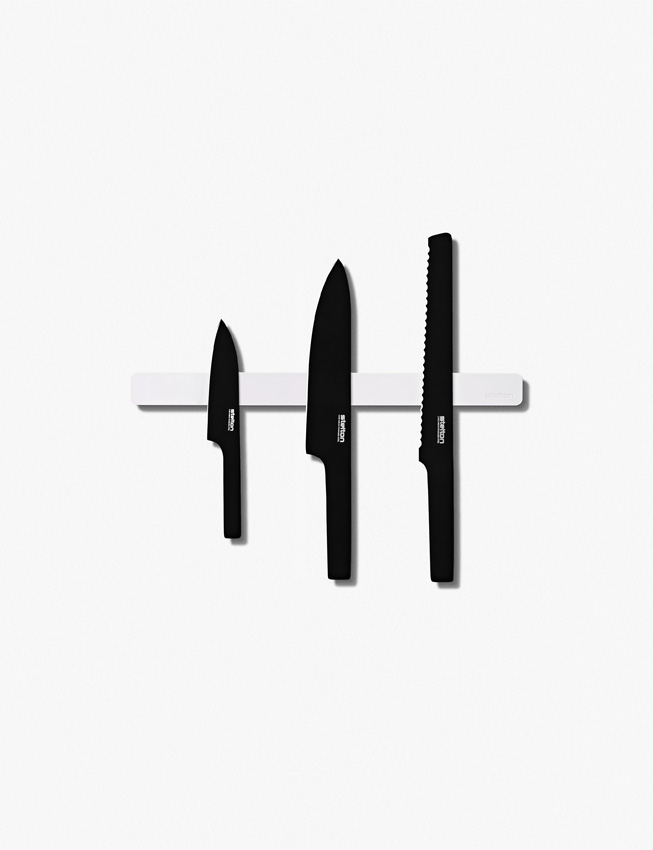
We dig products like these Stelton Knives (so much so we got a set for the LifeEdited apartment). At around $300 for a set of 3, the Danish designed and manufactured knives are not cheap, though the set, which includes a chef’s knife, a serrated multipurpose knife and a small chef’s knife (a more versatile paring knife) cover most tasks a gourmand can throw at them.

Their one piece forged stainless steel construction feels great in your hand, and their heat-treated matte-black finish gives great grip (we do have some questions about the durability of the finish).

Of course, they’re simply beautiful. Their finish and gorgeous shape begs to be displayed, which is easy with Stelton’s accompanying white magnetic holder. This is quite a contrast to the counter-hogging knife block filled with 2-3 knives you use and a whole bunch you don’t.

Products like these beg the question, what if you could be psyched about everything in your home? What if everything in your home were used? With that mission in mind, what would stay from your existing stuff? What would go?

Let us know what indispensable stuff you have in your home—things that marry form, function and high quality?

Image courtesy of Stelton.dk

10 Mono-Function SkyMall Products for the UnEdited Life

While the world is littered with things that don’t promote living an edited life, few things are as baldly contradictory as SkyMall. The in-flight catalog presents countless ways to flip the LifeEdited credo on its head, i.e. “design your life to have less money, health and happiness with more stuff, space and energy.” Today, we are presenting 10 products that can bring confusion and clutter to even the most streamlined existence.

1. LED Blossom Tree

Love the country and energy-efficient lighting? Few things reconcile these passions–or create a bramble of wires in your crawlspace–better than this LED blossom.

2. Temple And Eye Massager

Nothing screams, “It seemed like a good idea when I was on the plane” like a remote-controlled temple and eye massager.

3. Baggy Rack

The Baggy Rack might actually be useful–about 2 or 3 times a year. And it’s one of those things you would remember to use after filling your baggies.

4. Voice Activated R2-D2

Sure, you probably have a droid, but if it’s like most, it’s pretty disobedient. According to SkyMall, this one obeys 40 voice-activated commands like “turn around,” “move forward 2 units” (most only move forward 1) and many other tasks critical to daily life. It’s also perfect for tripping over.

5. Shake N’Take Smoothie Maker

Blenders just aren’t specialized enough. Sure, they make perfectly great smoothies and shakes, but you have to pour the liquid into another container, which often takes up to 8 seconds. Nothing saves time and populates your countertop like a Shake N’Take Smoothie Maker.

6. EZ Egg Cracker

For those who like adding extra steps to the simplest of tasks, the EZ Egg Cracker is a must for your kitchen.

7. Zombie of Montclaire Moors

This thing is just weird and creepy, right?

8. Wine Glass Holder Necklace

For the multi-tasking oenophile.

9. Hovering Picture Frame

Hanging pictures has changed little since Lascaux. The Hovering Picture Frame will surely herald a new epoch in the annals of picture presentation.

10. SlumberSleeve

Do you have rock hard biceps? Do you like contorting your body to sleep on your arm? Look no further than the SlumberSleeve. Bonus: according to SkyMall’s description it acts as ankle, knee and “small neck” pillow for the double-jointed and fans of suffocation.

images from SkyMall

ecoATM Buys Your Unused Electronics, Clears Drawers

Few things are sadder than staring at obsolete gadgets. These once-cherished, once-state-of-the-art, once-quite-expensive tech relics usually die slow deaths in drawers and closets across the nation.

ecoATM might have a solution. While it doesn’t solve the problem of planned obsolescence and designs that preclude upgrading perfectly usable gadgets, it does send your neglected gadgets to loving homes or to a proper burial.

ecoATM accepts phones, iPods and MP3 players. You hook them up to their ATM-like kiosk, where several diagnostic tests are performed to assess their value. Cash or credit is given on the spot (there are security features to prevent the sale of stolen or fraudulent goods). The company either sells your gadget on secondary markets or “responsibly recycles” them depending on their condition.

There are only 50 kiosks in the US right now, the bulk of which are in California, with some outliers in Seattle, Kansas and Nebraska. There is a corporate recycling program as well. But the company has attracted a number of powerful investors who surely recognize the value and vastness of used gadgets.

According to its site, making 1 phone results in more than 3 tons of mining waste, and the disposal of phones puts 75K tons of toxic materials like arsenic, cadmium and mercury into landfills annually. Accordingly, the company seems to recognize that reselling and properly disposing gadgets is just a beginning, saying on their site:

Solving the eWaste problem on a broad scale requires the collaboration of the OEM’s [original equipment manufacturers] that make the devices, the retailers that sell them, and the consumers that buy and retire them.

In other words, systemic change is what’s really needed: where manufacturers design products that have longer life-cycles; where retailers have business models that don’t thrive on constant upgrading; where consumers demand products that are well-designed and can be upgraded.

But until that time, ecoATM is a great option, clearing our drawers and closets, reducing the size and toxicity of our landfills, providing a return on our initial purchase and giving second lives for neglected gadgets.

via Geekwire

Why Small Fridges Make Good Cities

Rampant consumerism isn’t limited to clothes, electronics and other durable goods. Many American kitchens can look like doomsday shelters, with their pantries and freezers packed with enough food for weeks or months.

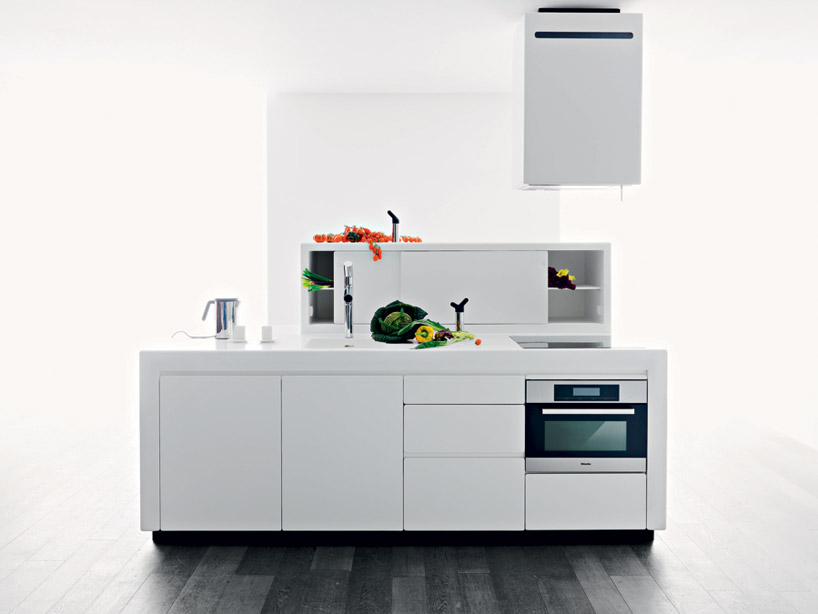
A few years ago, Canadian architect Donald Chong introduced a concept-kitchen called “Small Fridges Make Good Cities.” On his site, Chong asks a provocative question: “Can the choices we make in our own homes make a difference in our neighbourhoods?”

We tend to think our interiors as dissociated from our communities, but what if we saw the inner and outer spaces as inseparable? For example, a kitchen with a small fridge could have personal, community and even global impact from results like:

  • Frequent, small shopping trips. Chong wanted to “heighten the experience of the urban harvest where seasonality, once again, can resume its place in architecture and the city.” Chong is hearkening to a time when people ate with the season and went to the market frequently because food didn’t keep indefinitely via freezing and vacuum packing. Markets weren’t just food warehouses as they are now. They were important community spaces where people shared their lives.
  • Fresher food. I’ve heard, “If your food can go bad, it’s good for you. If your food won’t go bad, it’s bad for you.” Big caches of food that don’t go bad are, by their very nature, not fresh. Small fridges produce high turnover. Of course, the high turnover could be junk food, but as long as you’re at the market, do your body a favor and shop at the perimeter, where all the fresh food is.
  • More eating out. Many of our homes are isolated fortresses of eating and media consumption (TV, internet, etc.). While eating out every night does not make sense for many of us, going out of the house 2-3 times a week and engaging your community is a great way to support local economies and make a vibrant city.
  • Less space. This is pretty obvious, but food takes up real estate.
  • Less energy. Refrigerators account for around 15% of household energy expenditures. A small, Energy Star fridge like the Sub-Zero 700 BCi used in the first LifeEdited apartment, will help mitigate that number considerably.

Of course, many of us live in places where frequent shopping isn’t feasible. And you can get a small fridge and fill it with Hot Pockets or order greasy takeout every night.

But maybe you’re remodeling your kitchen. Consider a slimmer, European style fridge instead of an American double-wide. Or you’re moving into a small apartment with a small fridge. Consider getting to know your farmer’s market.

Do you have a small fridge? What are your experiences with it? How does it change your habits? We’d like to know.

Story via Treehugger and Donald Chong, Image via Designboom

Prêt-à-Louer: How to Get Your Couture by the Hour

Do you have a big occasion you want to look awesome for? Do you have limited closet space and/or budget? Are you incapable of wearing tacky, store-bought clothes? If your answer is yes to one or more of those questions, Rent the Runway might be for you.

RTR offers women the chance to rent from a rotating stock of top designer collections and accessories for a fraction of sales price. For example, a $1600 Missoni dress rents for $175 and a Kate Spade clutch rents for $40. Other designers include Elie Tahari, Vera Wang and countless labels that are so prestigious we don’t recognize their names (there are also many lower price point options too).

Because you only have a RTR dress for 4-8 days, the site helps reduce clutter that would come from clothes that are often only used once.

As there are some inherent limitations to “trying” a dress online, RTR sends a backup size with every order. If those don’t work, they’ll overnight you something else. If you need some help choosing, you can chat with one of their stylists.

The site also allows past renters to review dresses, saying whether they ran small, big or true to size, as well as commenting on how they fit their bodies (they state their body size for comparison sake).  Some renters even post pics of the dress in action.

RTR might be doing the impossible: i.e. making $1000+ wear-once dresses compatible with an edited life. What do you think? Are those things mutually exclusive or can ultra-lux items work with an edited life?