258 Sq Ft Apartment is the Ultimate Edited Bachelor Pad

Our friends at Fair Companies made this great video showing Barcelona-based photographer Christian Shallert’s 258 sq ft transforming apartment. The tiny space makes Gary Chang’s 344 sq ft apartment look like a mansion.

Unlike Chang’s apartment, whose jewel-box sheen makes it feel other-worldly, the wood cabineted interior of Shallert’s home make it feel like something that could be realized without an astronomical budget (or a degree in astrophysics).

Of note is his allocation of space. He includes a good size fridge and dishwasher in the tight kitchen, showing how small spaces can be adjusted to the habits of their owners.

One space that was not allocated was a relationship: After Shallert decided to cohabitate with his partner, he realized the space was a great bachelor pad, but not so great for 2.

Shallert contends that what most of us really want out of a home is a nice, comfortable mattress, clean sheets, running water and a stove to cook stuff. What about you? What do you think is essential in a home? How does that change with different circumstances like living with a partner or children?

via Fair Companies

3 Lessons from a Guy with 39 Possessions

Self-described vagabond and minimalist Andrew Hyde travels the world, writes, does graphic design, starts companies and owns 39 things–a list that includes everything from toothbrushes to a car. Most items are things like shirts, a computer, phone and some camping gear (Hyde is pictured above with his possessions, less car).

He defines what he owns as “resellable items I would be pissed if someone took.” Coffee cups don’t make the list. His iPhone does.

Hyde received a lot of attention earlier this year as the guy who owns 15 things. Though his new, larger item number is not quite as dramatic, his newer list is still very slim. It’s also more comprehensive; he includes socks and underwear where he had not before.

While his paucity of possessions and peripatetic lifestyle is certainly not for everyone, Hyde has much to teach:

  1. Fewer choices are freeing. Asked which shirt Hyde picks in the morning, he replies, “The clean one.” How much time and mental effort do you spend choosing what shoes to wear, what movie to watch, what dish to cook? Choice is not necessarily a bad thing, but it is often overvalued, especially related to things that aren’t aligned with what’s really important in our lives–things like relationships, health and recreation.
  2. If you have fewer things, make them goodAs Sarah Laskow wrote in Grist, living light doesn’t mean living cheap. Hyde’s possessions are all very high quality. Paring down means choosing stuff that holds up and looks good. If you have 3 shirts, you can’t afford to have that one shirt that doesn’t fit right.
  3. Sometimes you will not be prepared…and it’s okay. You likely won’t trim your possessions to Hyde-ian proportions, but that doesn’t mean you have to everything for every occasion. Americans in particular like to be prepared for the worst-case-scenario, having separate cookie cutters for Christmas and Halloween. We seldom consider how negligible the consequences are when we run out of something or are unprepared. Nor do we consider how high the consequences are for being over-prepared: creating more money, space, upkeep and mental clutter.
Do you consider yourself a minimalist? What lessons would you add to this list? What can’t you live without–materially or otherwise? Let us know.

via Grist. Image by Adria Ellis

Stack It, Nest It, Put it Away: Finding the Best Products for the Edited Home

As we approach the completion of the first LifeEdited apartment, we are faced with the question of what products do we put in it? Already claiming a good portion of the apartment’s 420 sq ft are 2 bikes, 2 kite-boards (and a bunch of kite-board gear), 10 stacking chairs, a 30″ computer monitor and several other large items.

Every product added should have maximum utility, minimal footprint and great quality. Products that are multifunctional, stack, nest and fold help achieve those ends.

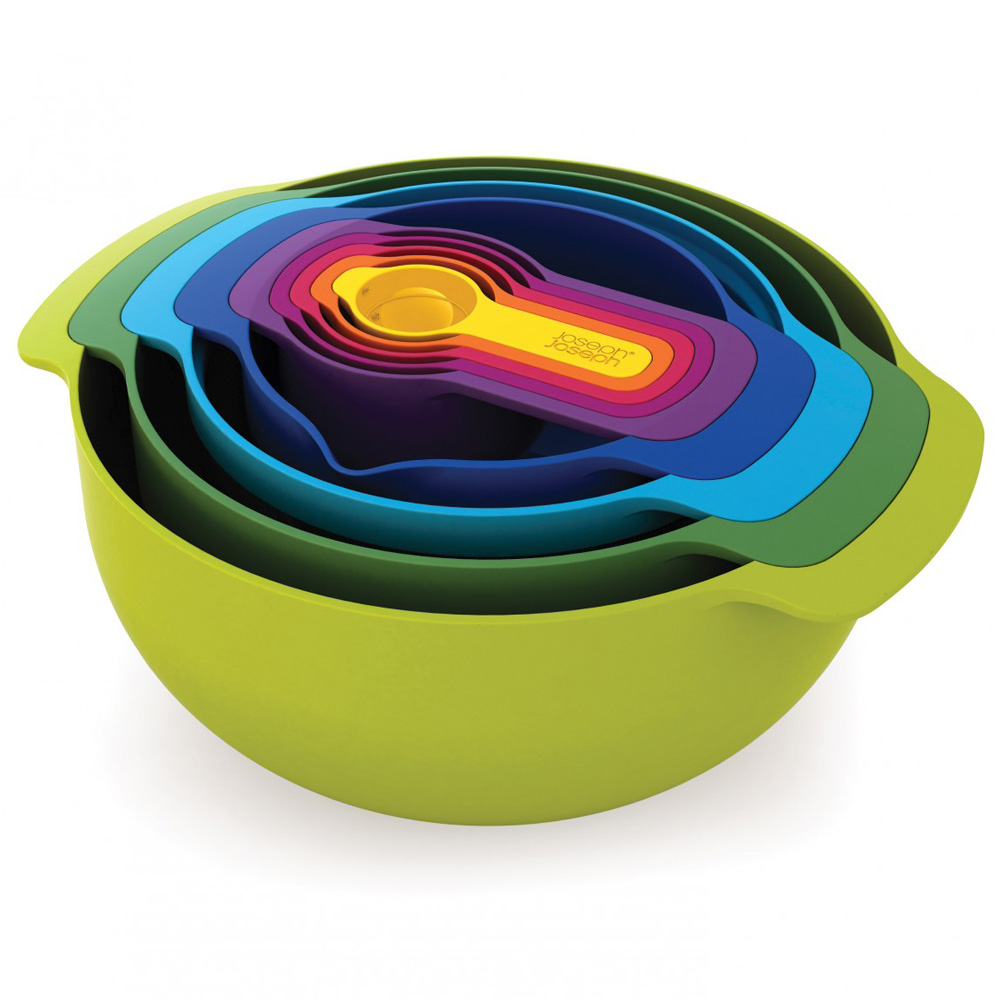
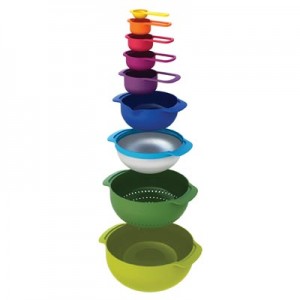
Joseph Joseph is British company that makes myriad cooking products that fulfill our objectives. Take for example their Nest™ 9 Plus, which nests bowls, a colander and measuring cups and spoons in one unit. Whereas most of us end up with mixing bowl set from one place, a colander from another, and measuring cups and spoons from yet other place, this unit designs these related things to work together, enabling significant reduction in clutter and space.

Other products include a fold-flat grater, a folding colander, nesting kitchen utensils and more.

As an added bonus, Joseph Joseph brings some needed color to our the apartment’s otherwise pale interior!


Home storage is often lost in figurative (and literal) teaspoons–gaps of space here, stuff splayed out in drawers there. Products like Joseph Joseph mind the gaps, mating like products in logical ways, making for a simpler, more compact home.

What other products would you put in the LifeEdited apartment? What multi-functional, stacking, nesting, folding or simply high quality product can you not live without? Let us know.

images via Joseph Joseph


How to Sell Your Expensive Stuff on eBay

We come across many people who seriously want to get rid of their stuff and live simpler lives. But again and again, we hear the same refrain: “My stuff is too expensive to give away.”

It’s important to be honest about the value of your stuff. Often, giving stuff away for free–even expensive stuff–is a good idea. The loss of initial investment is usually offset by the hidden values of not living with clutter and not paying storage real estate.

But some of us have really expensive, valuable, high quality stuff–stuff we spent a lot of dough buying. Stuff we won’t give away for free. For that stuff, the question is, “How do I sell it?”

EBay is the resource most of us think of when selling our stuff. But if you’re like me, you don’t have the time or patience to navigate your way through the intricacies of establishing a seller profile, taking pics of your stuff, creating return policies and so forth.

For those of us with lots of valuable stuff and little patience, there is eBay’s Trading Assistant Program. Through the program, you can find individuals and storefronts who will take in–and even pick up–the stuff you want to sell. EBay provides a feedback profile so you know the TA is legit. TA’s offer insurance on your goods and many specialize in particular types of goods (which you specify in your search).

Of course none of this is free. Fees and commissions vary from seller to seller. Some charge standard commission rates ranging from 10-60% depending on the expense of the item–more expensive item = lower commission. Others charge flat fees. And read the fine print: you might have to incur PayPal fees, eBay fees, shipping, etc.

If this sounds steep, consider that we paid 100-200% above wholesale when we bought our stuff (didn’t seem to bother us then). Also, consider that our stuff isn’t very valuable sitting in our basement or storage unit, so getting a 30-40% return is 30-40% more than 0%. Lastly, because of the large volume of people who use eBay, you are much more likely to fetch a good price than you would selling the stuff yourself or at a local consignment store.

Have you used eBay’s Trading Assistant Program? Let us know if you have any tips or suggestions. If you have any other tips for easily getting rid of your valuable stuff, let us know that too.

If Everything is Amazing, Why is No One is Happy?

In this popular clip from the Conan O’Brian show, comedian Louis CK questions whether the “amazing” items that are designed to make our lives happier are doing that at all.

We’re no Luddites at LifeEdited. We love computers, eReaders and cutting edge design. But just because something is the latest and greatest, just because it’s faster or lighter, doesn’t mean it supports our happiness. Like the guy Louis CK talks about who gets angry when the in-flight wifi service goes down–a service he hadn’t known existed minutes before. Might the latest and greatest stuff sometimes give us more reasons to be unhappy? Even though it’s the latest and greatest, it can still break, consume cash, increase clutter and be replaced by the latest version of the latest and greatest.

Louis CK’s contentions are borne out in research data. Dr. Ruut Veenhoven of Erasmus University in Rotterdam studies happiness. Over the last 50 years–a period of enormous technological change–he has observed little appreciable increase in happiness in the US.

Of course there are factors besides technology that determine our collective happiness, but it might be fair to say technological progress hasn’t been decisive in making our lives happier.

What do you think about the connection between technology and happiness? How do you evaluate which stuff to include or exclude in your life? Have you found ways of satisfying your technological–or any other consumer needs–that help maintain your happiness? Let us know what you think.

screenshot via World Database of Happiness

Edited Housing Guide: A Look at 4 Compact Housing Developments in North America

While building small is big in many places around the world, it’s still pretty novel in North America. Our abundance of space and affection for cars have made our architectural disposition similar to a big yawn after Thanksgiving dinner.

New American home footprints have been north of 2K sq ft for a while, and have even spiked to 2550 sq ft in the last year because credit scarcity has limited new home ownership to the cash-flush.

But that’s not what we’re going to talk about today. We are going to talk about the little guys. These are developers at the vanguard, building small, efficient, awesome homes.

And if we missed anyone, please let us know in the comment section.

1. Cubix SF (née Cubix Yerba Buena)

If you go to San Francisco’s SoMa district and see a Rubik’s-cubey-looking building, it’s probably the Cubix SF. The 98-unit building has floorplans ranging from 250-350 sq ft. Prices are in the low-to-mid $200’s, which is about a 1/3 of the area’s median price.

The building features nice finishes (see main image above for interior pic), modern appliances, a big roofdeck and groundfloor cafe. Their focus is on creating a low purchase price for people who still want a high quality, stylish apartment in a great neighborhood.

2. Vancouver Micro Lofts

Okay, so it’s not the US, but these micro units epitomize edited living. There are 30 units, which range from 226-291 sq ft and average $850CAD/month rent, which includes cable and internet.

The tasteful decors feature folding beds and tables, big windows and small, high quality appliances. With considerably lower rents than neighborhood average, the building proved very popular and rented out almost immediately.

via cbc

3. Apodments

In Seattle, Calhoun Properties has developed 9 building featuring their Apodments™, which are more like boarding rooms than standard apartments. Buildings have shared kitchens and living rooms. Some rooms have shared bathrooms and can be as cheap as $350/month including utilities, while the majority have private bathrooms, kitchenettes and some furniture and are as cheap as $495/month including utilities.
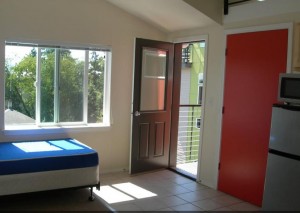
The units themselves are as small as 90 sq ft with fairly spartan decors compared to the other developments in this profile. Calhoun seems to be focused on young people who make low, hourly wages and/or don’t spend much time at home.

image via Facebook

4. Olympic Studios and Studio Lofts
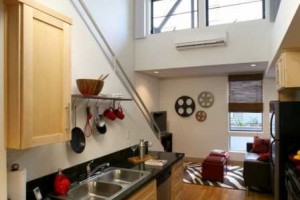
In posh Santa Monica, CA, NMS Properties offers compact living for moderate income households (<$60K/year for singles and <$68/year for couples).

The units range anywhere from 360-448 sq ft. One of the cooler features is their furniture organizer, which allows you to drag and drop furniture pieces to pre-configure your furniture to the spaces somewhat tight quarters. We particularly like the loft layout, whose high ceilings give the small footprint a cavernous feel.

image via Olympic Lofts

graph via treehugger and Builder Online

Past and Present of Transforming Furniture

Our good friends over at Resource Furniture put together this short video showing transforming furniture’s past and present. The vintage footage illustrates this type of furniture is hardly a new idea. People have been designing furniture to maximize the use of space for ages.

In fact, what’s new is NOT maximizing space. Consider that the average new American home in 1950 was 983 sq ft., and the average household had 3.37 people. According the US Census Bureau, those numbers in 2010 were 2,169 sq ft and 2.59 people. That works out to 293 and 837 sq ft/person respectively–almost 3 times as much space per person! Much of this extra square footage, we suspect, is consumed by seldom-used spaces like dining rooms, guest rooms and foyers. What if, by using transforming furniture, we make our rooms do double or triple duty? Combine dining rooms with guest rooms. Make living rooms into bedrooms. Just get rid of the foyer (the parsley sprig of architecture). How much space would we need then?

What if we started living and maximizing smaller living spaces again? They’re cheaper, greener and–for all but a few worst-case-scenarios–provide all the space we need. What ways would you do it–furniture, housewares, etc.? What ways are you doing it? Let us know what you think.

Instead of a Cruise, Go on a ‘Stay’ at El Cosmico Trailer Park Resort

The world moves too damn fast, right? Everyday, we are assaulted by a thousand forms of stimulation, each whittling down our precious time and attention to nano levels. Ever feel like turning off the phone, closing that tab, setting up the auto-responder, canceling those appointments and skipping out for a bit?

Few places seem as well-suited to meet this objective as El Cosmico, an 18 acre resort (or sorts) at the outskirts of Marfa, TX. El Cosmico offers lodging and “community space that fosters and agitates artistic and intellectual exchange.” Its mission is described in its “Mañanifesto.” Here’s an excerpt:

Mañana doesn’t care about email or normal hours of operation. Mañana recognizes that we can’t all have everything we want at any given moment, like peaches in January or cell phone reception in West Texas. Mañana is the anticipation that it might happen today, and it might just as likely not, and really either way it’s not that big of a deal. The key to Mañana lies somewhere in the unspecified future. It holds the great promise of hope…El Cosmico is at the center of this exodus from a world of urgency, and flies its Mañana flag proudly.

Sounds perfect.

El Cosmico offers several, full-amenity trailers ranging from $110-150/night. Other accomodations include yurts, teepees, army tents and camping.

It also offers an elm grove of hammocks, dutch hot tubs, a community lounge and mercantile and an outdoor kitchen and dining space.

Should you be craving more activity than swinging on a hammock (we’re not sure why), there are numerous “happenings“, things like concerts, potlucks, drinks and playing dice. They also offer workshops; currently, there are ones for songwriting and “Camp Design Build Adventure,” both of which sound pretty cool.

For most of us, there is so much to do, and to be done now, if not sooner. Places like El Cosmico allow you step back and realize there is always the option of mañana.

images via El Cosmico

15 Practical Tips for Creating a Simpler, Happier Life

Beyond great architecture and multi-functional product design, LifeEdited is about living simple, happy lives. The architecture, products and behaviors we promote are in service of that goal.

We think this list from the Health Realizations newsletter provides a nice starting point for simplifying and happy-ifying your life. Not surprisingly, much of the list involves editing out things that don’t support our happiness.

Check it out and let us know what you think. Anything missing? Agree/disagree?

  1. Decide what’s most important to you, then center your life around those items (this probably means cutting out other activities to make room for those that count the most).
  2. Turn off all communication devices at a set time each night. This includes your cell phone, computer, pager, and fax. Better yet, try to reduce your daily use of these communication tools.
  3. Learn to say no. This is not selfish, it’s about survival … and living your life the way YOU want to.
  4. Resign from any and all organizations and commitments that don’t make you happy.
  5. Set up as much of your life as possible on autopilot. For instance, set up your bills to be paid automatically online, have your paycheck direct deposited, and hire a pet sitter to come and walk your dog everyday at lunchtime.
  6. Delegate. If you can’t figure out how to do it on autopilot, think about who might be able to complete certain tasks that you do now. Then delegate everything and anything you can.
  7. Get rid of clutter. Clutter will make your life feel more complicated than it needs to, while a clutter-free space is one where you can truly feel at peace.
  8. Stop buying more stuff. Not only will you have to figure out how to pay for the “stuff,” but you’ll have to figure out a place to put it (in your now clutter-free home). You’re likely better off not buying it to begin with most of the time.
  9. Do your grocery shopping once a week only, or better yet join a food coop that delivers once a week. You’ll get healthy foods for your family in one stop.
  10. When you do your cooking, cook more than you need for one meal. Freeze the leftovers for a quick meal when you’re short on time, or use them later in the week.
  11. Redesign your day. What takes up the most time in your day? The least? Carefully evaluate how you spend your daily time, then reorganize it so you have time for what’s most important to you.
  12. Take your time when you eat. Eating slowly helps you appreciate your food and take a break from a busy day (not to mention it’s a good way to help you lose weight).
  13. Live in the moment. Help your mind to slow down by appreciating every moment as it comes, even if you’re doing something you’d rather not be. By living in the moment, you only think about what’s going on right now, not what you’ll be doing in 10 minutes or what needs to get done by 5:00.
  14. Spend time alone and with family. Many people feel cheated in life in that they don’t have time to just read a book, enjoy a hobby or simply contemplate life. Likewise, many would enjoy more time to spend together with their family. Make time for both in your life, even if it means saying no to something else.
  15. Do one thing at a time. When you try to do too many things at once, you’ll find nothing gets done very quickly or well. By focusing on just one thing — one goal, one dream, one task at work, one child’s question, one conversation — the task will get done with more thoroughness and less stress on your part.

via Health Realizations newsletter

Hong Kong Apartment: 344 square feet. 24 Configurations.

We would be remiss to not sing the praises of architect Gary Chang’s “Domestic Transformer” Hong Kong apartment–probably the world’s best known transforming apartment. Its ingenious design produces function and a sense of space totally inconsistent with its tiny footprint.

The back-story is interesting too. Chang has lived in the apartment since he was 14; at that time, him, his 3 sister, 2 parents and a boarder all occupied the tiny space. That’s about 50 sq ft/person. Roughly 1/20th the space Americans currently use!

In 1988, he bought the apartment from his parents.This last renovation–1 of 4–was completed in 2008. The apartment has become an idea lab for finding efficient uses of space–a serious issue for Hong Kong, whose already ultra-dense landscape has taken on 400k more residents in the last 10 years.

One of our favorite touches is the guest bed above the soaking tub. With odd pairings like these, Chang shows what’s possible when creative use of space trumps conventional thinking.

video via Planet Green and NY Times.