How Coworking is Changing the 21st Century Workplace

Freelancers and small businesses are increasingly proving themselves 21st Century economic powerhouses. Their small sizes allow them to flow with the currents of technological and cultural change in a way their larger, corporate counterparts can’t. They are cost-effective because they can keep a small core staff, bringing on specialists depending on their needs.

But where do they work? Many find themselves too big or busy to work from home, or too small to afford their own office.

For these homeless freelancers, small businesses and entrepreneurs, co-working spaces provide a great option. Individuals and small organizations can rent a desk or small office in a space filled with like-minded industries. Tenants share things like boardrooms, printers and other resources. Rent depends on your use of the space, e.g. NYC-based Green Spaces charges anywhere from $20/day to $550/month for a dedicated desk.

Because most are formed based on industry–e.g. there might be a tech, non-profit or ethical business co-working space–the environments foster community formation and collaboration. Many host events with dedicated spaces like this one in Zurich.

One of the best known co-working spaces is The Hub, whose mission is, “To become a global network of connected communities that enable collaborative ventures for a better world.” Formed in 2005 in London, they now have 25+ locations, 4K+ members, 50+hubs in formation, spread across 5 continents.

Coworking is a great form of edited workplace for a number of reasons:

  • If you travel a lot, you can pay and use the space only when you need it, cutting overhead and overall space use.
  • Shared office equipment cuts clutter and saves money.
  • Human interaction promotes happiness.

If you’re interested in finding a coworking space in your area, visit the coworking wiki directory, which contains a list of spaces around the world.

images via Hub Westminster and Hub Zurich.
Edit Your Child’s Stuff with Toy Rental Services

Are you a parent who feels there just aren’t enough toys around your house? Does your child hate novelty, contenting his or herself with one or two simple toys? Do your child’s toys make your house into a model of order and harmony?

We didn’t think so.

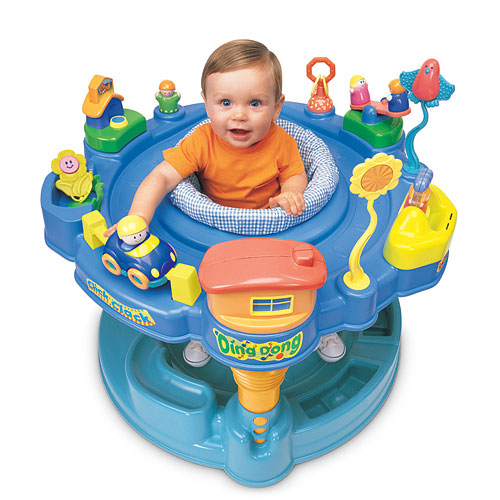
Online toy rental companies like BabyPlays and Toyconomy have a solution. Here’s how they work:

  • Choose toys from their databases–kinda like adding movies to your Netflix queue.
  • Rent as you go. BabyPlays rents individual toys from $3 to $11/month. Toyconomy from $3 to $35/month–the latter price is for a LeapFrog LeapPad tablet computer (who knew?).
  • Or subscribe. Babyplays allows you to rent 4 toys for 60 days or longer for $25/month. Toyconomy’s $10/month subscription takes 50% off their toy rentals.
  • Hold onto toys for a month or for as long as you want.
  • Return toys and get a new shipment. Shipping costs are included.

Both companies take pains to let us know that their toys are rigorously cleaned and in good condition. Both offer a rent-to-own option; if your tyke doesn’t tire of a toy in a couple months, you can buy it at a discounted price.

Beside saving money, these services let kids enjoy their new toys without piling onto the mountain of old ones–a problem for almost every parent I know. What if your kid’s room could look like a haven of fun and order rather than a war-zone?

The one big challenge we see is getting grandparents and extended family on board. One Christmas-giving session can undermine months of editing.

Have you used these services? Would you? If not, why not? Let us know what you think.

Image via productreview.com.au

Single Dress Does Triple Duty

Editing life is often as much micro as macro. Sure, it’s cool to conceive of new furniture, homes and cities. But often small ideas are just as critical as big ones. Case in point is this Akan reversible dress from Loomstate 321. Its different configurations effectively give it the utility of 3 dresses, which for $228 is a great deal. It’s also made of an eco-friendly, wood-pulp-derived fabric called Tencel.

With small, smart wardrobes, we need less storage, smaller living units; there’s less laundry to do and more money in the bank.

While this pink and teal version is nice, we might suggest their more subdued white/black/blue/yellow version. Part of living an edited life is choosing things that can be as versatile as possible. The author was confronted with this situation the other day. I wanted to buy a cool pair of moss green pants from Outlier, but given that they would be my primary pants, I chose the more staid grey. I knew the pants would be in heavy rotation and realized I ran the risk of being the “guy with the green pants.”

Via Vogue and Loomstate 321.

eBooks and the Bibliophiles Dilemma

This is perhaps the most taboo topic in life editing. Even extreme editors, living in their ultra-organized cubbies, often find themselves unable to get rid of these. That’s right, we’re talking about books.

We love our books–the feel of paper, the dog-eared pages, the cover art, the smell. We display them like trophies. When people come over to my house, they will know I read “The Brothers Karamazov.”

But let’s face it: books are space hogs, and few inventions help the process of editing one’s life as much as the eBook. For example, consider the basic Kindle eReader stores up to 1400 eBooks and weighs 6 oz., which is about the same size as one paperback copy of “The Great Gatsby.”

We know there are many eBook converts out there already, but for the others, who can’t quite make the leap, who are dubious of electronic ink, who love their paper-cuts and dewy thumbs, we put out a challenge: try it. 

Today we present an easy, zero-risk way of seeing if eBooks are for you.

  1. Download the Kindle app. It’s a free application that allows you to read Kindle eBooks on a variety of platforms: Android, PC, iPhone, iPad and Mac. Install it on whatever device you find yourself using the most, preferably a portable one like your phone or tablet, which better replicate a book’s utility.
  2. Download an eBook you want to read. This could be one of the millions of paid Kindle titles on Amazon, or if you don’t want to pay, download one of their 1M+ free eBooks to make this a truly zero risk experiment.
  3. Read book and see if you like it.

Mind you, this is not a perfect experiment. EBook readers like the Kindle and Nook have eye-saving electronic ink, which for many (like the author) make it possible to read for long periods of time. But others, like Graham Hill, have read many books without issue on their back-lit phone screens.

Either way, the idea is to try. Give it a shot and let us know what you think.

image via Apartment Therapy

Live, Eat, Breathe IKEA at Strand East, an IKEA-Designed City

After yesterday’s post on IKEA homes, we learned that single, prefab homes and small developments were not quite enough for the furniture giant: IKEA has entered the business of city-making.

LandProp, IKEA’s property development arm, is developing a city called Strand East outside of London. According to Fast Company Co.Exist, the development:

Will feature 1,200 homes, 480,000 square feet of commercial office space, a ‘hub area’ with shared space for the community, a creative zone intended for creative-minded businesses to take root, a restaurant, a hotel, pedestrian walkways, cycle routes.

Other features include winding, car-free streets, similar to old European cities (and IKEA stores), and underground parking that will provide ample pedestrian space and safety. There will be a strong focus placed on culture, community, food and other quality-of-life boosters. Click on infographic below for other community features.

Like its furniture, IKEAville, um, Strand East, is focused on middle class affordability and lifestyle. 40% of homes will be family-friendly.

Project Manager Andrew Cobden told The Globe and Mail this:

We would have a fairly firm line on undesirable activity, whatever that may be. But we also feel we can say, okay, because we’ve kept control of the management of the commercial facilities, we have a fairly strong hand in what is said in terms of the activities that are held on site.

Similar to yesterday’s conversation about IKEA homes, where owners might trade personal touches for affordability, function and simplicity, residents of Strand East might trade ownership for a great living experience largely governed by LandProp.

The idea of housing-as-service runs counter to the American Dream, which is inseparable with home ownership, even when home ownership, on balance, is more headache than opportunity.

Strand East also presents the idea of privatized urban planning. IKEA is creating an ideal urban structure where government might not have the audacity or resources to do so.  But given that it’s a business, might their instinct to make money trump their civic responsibility?

We’ll have to wait and see. While the land has been purchased, the company is still getting their permits in order. LandProp is hoping to begin construction in 2013.

Via The Globe and Mail and Fast Company Co.Exist

Prefab Home is Like Living in IKEA Showroom

Let’s face it, it’s hard to get away from IKEA. The big blue store is by far the world’s largest furniture retailer and there are few homes that escape its cleanly-design, wallet-friendly wares.

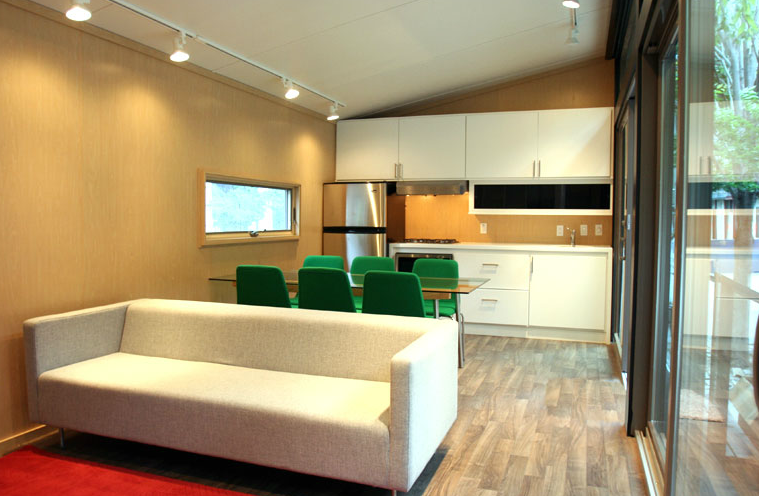
Since the contents of our homes are so defined by IKEA, Oregon-based company Ideabox asks why not the house itself? To answer that question, they have created the Aktiv, a compact, prefabricated home designed around IKEA product systems and ethos of clean, affordable design. $86,500 buys the house, delivery, installation and IKEA spec’d bathroom, kitchen and flooring. I suspect most buyers would finish the place with IKEA fürniture.

This idea is not new. IKEA has been making their BoKlock housing in Europe since 1996. According to its site, BoKlock provides “space-saving, functional and high quality housing at a price that enables as many people as possible to afford a stylish and comfortable home.”

Sounds good to us.

A home made completely around a corporation–particularly a giant like IKEA–might strike some as being impersonal. But consider that many of us end up with homes designed by IKEA by default, because the stuff looks nice and is affordable. Also consider that our homes are often assemblages of handed down furniture or whatever we can afford at the time, neither of which necessarily reflect personal style and taste.

Then there are the many advantages of prefabricated home design and construction, whose processes have a huge edge over one-offs. For instance, the BoKlock is made completely in a large warehouse, making its construction schedule independent from weather.

From a practical standpoint, don’t most of us just want a home that is affordable, comfortable and easy to deal with? Homes like the Aktiv and BoKlock deliver that, sans some personality.

What do you think? Would you live in what amounts to as your own IKEA showroom? What would be the advantages/disadvantages? We’d love to hear what you think?

via Dornob and Ideabox

ThinBike Slices Your Bike in Half

Bike storage can be a hassle in small spaces. It’s bad enough that you have this big rectangle; but then you have handlebars and pedals jutting out, ready to snag a passerby. And while easy-to-stash foldable bikes are great, sometimes our riding habits and preferences demand a full size frame and wheels.

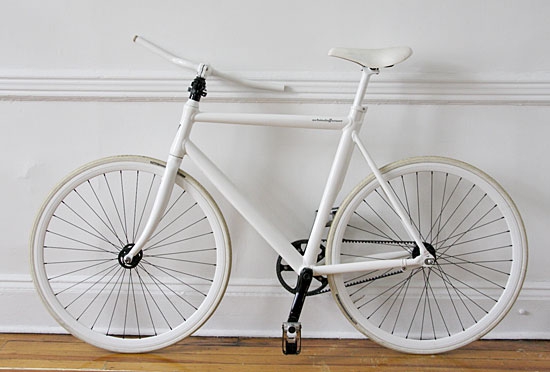
To solve this issue, LifeEdited founder Graham Hill put this “ThinBike” together with German company Schindelhauer. The bike features fold-up pedals by MKS and a quick release stem by Speedlifter that allow you to put the bars flush with the rest of the frame. All this allows the bike to go from a portly 21″ width, to a mere 6″.

While the $1800 package that Graham put together–replete with Gates Carbon Belt Drive and white rims to match the white tires–might be a bit steep for many, retrofitting your current bike with the stem and pedals can be done for about $200.

Could You Live in a 90 Square Foot Apartment?

New York City is filled with small apartments. With an average home price of nearly $1.2M, New Yorkers quickly learn how to live to with less space. But even in this squeezed city, Felice Cohen’s 90 sq ft apartment is extreme.

Cohen is a professional organizer, writer and artist (whose medium is appropriately Shrinky Dinks). She pays $700 rent for the micro-apartment, which might sound like a lot to non-New Yorkers, but consider that the average rent in her neighborhood is over 5 times that amount. By keeping her overhead low (literally and figuratively), she explains that she is able to be financially responsible while making a career through her creative pursuits.

This space might be too tight for many of us. In fact, it turned out to be too small–and illegal–for Cohen, who was evicted because the apartment was being illegally subletted. Nevertheless, she gives some great tips for living happily in a small space:

  • Regularly weed through possessions, getting rid of what you don’t need.
  • Her membership at a collective workspace is an economical way to expand effective real estate.
  • Using the city’s libraries, parks and cultural centers as extensions of her home.

Do you think you could live in such a small space? What tips would you add to Cohen’s for living more with less?

via Fair Companies

Density Atlas Asks How Many People Can You Pack in a City Block?

It’s no secret that we advocate an urban future here at LifeEdited. With a world population topping out over 7B people, cities offer the clearest route to a bright, sustainable future.

But cities are not created equally. A city’s urban density often reveals more about its resiliency than its population suggests. Dense cities can manage transportation, energy, distribution of goods and human capital better than their spread out, low-density counterparts.

The problem is that density is not a monolithic metric. It is generally measured in 3 ways:

  1. FAR (foot area ratio) divides usable square footage of a building, block or development by its lot size; e.g. if a 1000 sq ft building sat on a 1000 sq ft lot, its FAR is 1 (1000/1000).
  2. Dwelling units (DU)/acre measures how the space is divided; e.g. that building with an FAR of 1, could either be 1 luxury or 4 x 250 sq ft efficiency dwelling units.
  3. Population/acre. This metric is useful because the number of people living in a dwelling can greatly vary; e.g. a block in San Francisco with the same FAR and DU/acre as another in Hong Kong might contain 50% less population because more people live in the Hong Kong units. Pop/acre captures the gross population regardless of how the area is divvied up.

Started by a group from MIT, Density Atlas helps you understand various city developments and neighborhoods from all of these perspectives. For example, it shows how the author’s Brooklyn home compares to the Mumbai slum, Dharavi. Brooklyn averages a respectable FAR of 5.8, has 195 DU/acre and 369 people/acre. While Dharavi has a lower FAR of 2.0, it has 255 DU/acre and a whopping 1274 people/acre. In other words, even though Dharavi’s FAR is 1/3 of Brooklyn’s, it has 24% more DU and 350% more people/acre!

Whether you’re a professional or armchair urban planner, Density Atlas reveals the variability and complexity of global urban development. It shows how city-living means different things in different contexts. More developed countries often have great FAR’s, but low DU and pops./acre, while developing countries often have lower FAR’s, but astronomical DU and pops./per acre.

We suspect the future lies somewhere between these two camps–where the efficiency and amenities of modern cities is alloyed with the developing world’s willingness to get close to your neighbor.

We’d love to hear what you think.

via Density Atlas

Image via flickr

Ain’t No Trash in This Trailer

Defying the common portrayal of trailer homes as shoddily constructed, I-hope-I-never-have-to-live-in-one-of-those kinda homes, San Francisco-based architect Christopher C Deam created the Breckenridge Perfect Cottage–a 400 sq ft home that looks like no trailer home we’ve ever seen.

With floor-ceiling windows and a luxurious interior, Deam shows what’s possible from prefabricated homes, which when mass produced at high volumes, can be made cheaper and better than their one-off counterparts.

With options like these, would you live in a trailer home?

Screenshots via Christopher C Deam