Will Moore’s Law Spur an Architectural Revolution?

George Carlin once summed up the history of architecture by saying, “Your house is a place to keep your stuff while you go out and get more stuff!” And for much of architectural history, this assertion was correct. Sure our homes and other buildings had certain fixed utilities that took up space (bathroom, kitchens, beds), but a good portion of their usable volume was filled with stuff. But what happens to our architectural needs when stuff becomes ephemeralized? What happens to our walls when they are no longer covered with bookshelves because we can fit thousands of books on a thumbdrive? What happens to the space we used to use to store our CD’s and DVDs? What happens to office spaces that used to be stuffed with file cabinets? What happens to our garages when we can access shared cars on demand? These are the questions that occupy the thoughts of consultant Gunnar Branson.

In his TED talk, Branson discusses the impact of Moore’s Law on real estate. Moore’s Law states that the number of transistors in a dense integrated circuit will double approximately every two years. It’s a law that has stayed true since Intel cofounder Gordon Moore proposed it in 1965. It’s the law that has made it possible for us to stuff our phones with more computational power than computers that used to take up several floors in an office building. Branson believes that because technology is permitting us to offload so many of our once-bulky items to the cloud, there will soon be a less is more real estate revolution, where quality of space will be prized over quantity, where less space will facilitate more living.

What’s funny about Branson’s contention is that new home sizes have continued to grow in the last several years, suggesting that books are easier to offload than the desire to flaunt one’s wealth. However, he does make the point that legal offices, to cite one example, use a third the space than they used to–largely because law books and files are now stored on hard drives, not books and binders. Maybe the lawyers are on to something.

What do you think about Branson’s notion? Will disappearing goods–atoms being replaced by electrons as he puts it–revolutionize real estate? Or will people continue to hog up architectural resources regardless of their actual needs? Share your thoughts in the comments section.

Wood, You Live Well in this Tiny Space (?)

Maybe it’s the sketchy economic climate preventing people from getting fancy lacquered surfaces. Or maybe there’s a wood stain shortage. Or perhaps Lumber Liquidators has been further liquidating. Whatever the reason, cladding apartments with large amounts of naked plywood is a big trend at the moment. This trend has extended to this cool 301 sq ft flat by Milan’s Studio WOK.

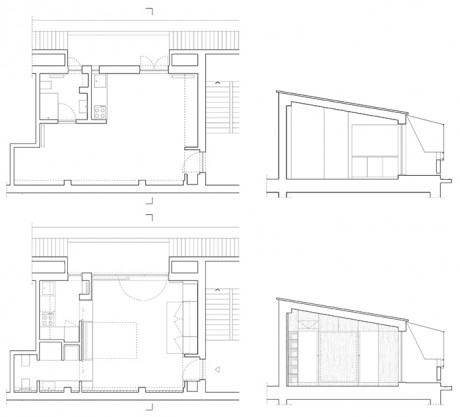
OCS_plan

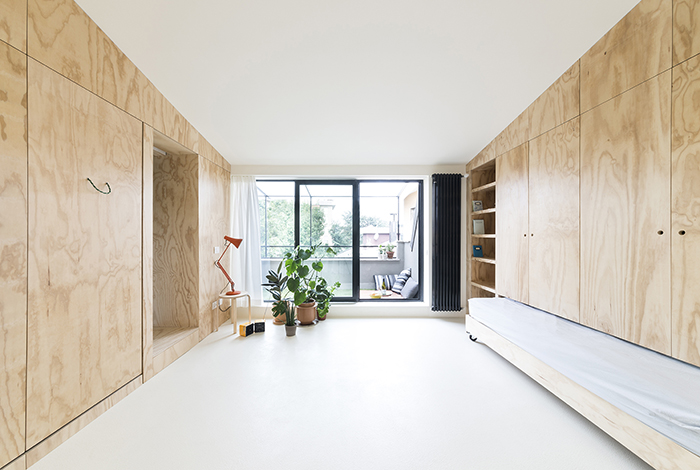
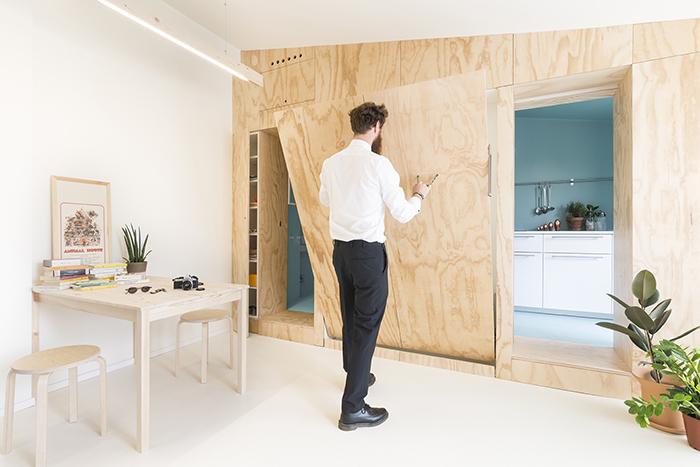
WOK shifted the apartment’s original floorplan, which had a kitchenette in the main room, to have a detached kitchen. This reconfiguration created large walls to build cabinet volumes upon. One wall is dominated by a hiding bed whose faceplate is covered in plywood, of course. That wall also has a host of cabinets to keep things nice and tidy.

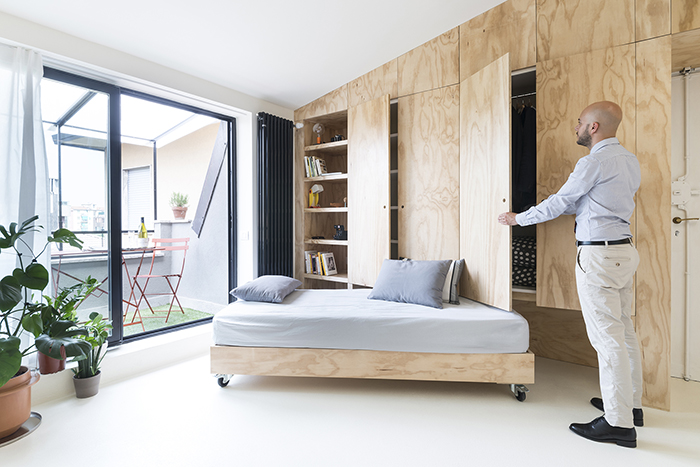
The opposing wall has a wardrobe and other storage. At its base is a bed on casters. The wall has a recess that swallows half the bed, creating a sofa surface (I’m assuming the casters lock). Cabinetry on both walls follows the slope of the slanted ceiling, making use of over square foot of possible storage space.

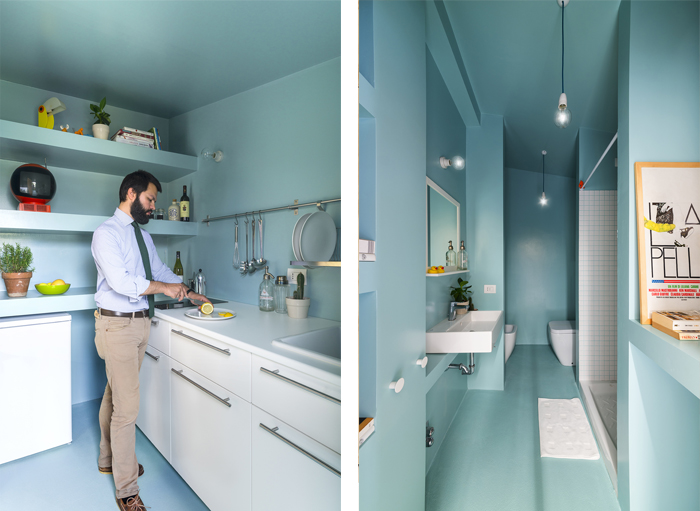
Other than a small turquoise kitchen and bathroom, there’s not too much to the apartment. If I’m not mistaken, most, if not all, of the furnishings and non-plywood cabinetry are from IKEA. There is no published budget, but I’m assuming the renovation didn’t cost a ton of money.

Via Divesare

All images © studioWOK

Minimalism For All

This site is probably too often guilty of presenting extreme minimalist lifestyles–single dudes who give up everything, couples who sell all of their stuff to go globe trotting and so on. The fact is downsizing and living a simpler life with less stuff is not something available only to singles or childless couples. It’s something that can be done by anyone, anywhere. Minnesotan Kati Berg is a wonderful example of this. Through her blog Skywaymom.com, Kati, a wife and mother of two young children, presents a very real and accessible approach to how normal folks–folks with jobs, kids, who don’t live in NYC or San Francisco, who might not be inclined to drop $300K on tricking out their small apartments–can simplify their lives and focus on more important things than managing their stuff.

DF: Tell us about yourself?

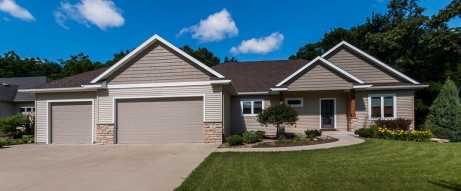
KB: My name is Kati Berg. I am a real estate investor and mom, and rookie blogger at Skywaymom.com. Our family lived in a big house in the suburbs of Rochester, MN, but gave it up to bring our kids to Nicaragua to learn Spanish, then a year later moved downtown Saint Paul to continue the walking, slowed down lifestyle we found in Nicaragua and to continue language immersion for the kids, this time Chinese at a public charter school.

DF: What was life like “before” your adoption of minimalism?

KB: Life was good. We entertained in our house. We went to our friends’ houses to be entertained. Typical suburban stuff. When you invest so much in your home you want spend time there.
kati-berg-dream-home

Life was also hectic. Working full time, a growing business and adding two kids to the mix the house started to feel like a stressor instead of a sanctuary. I’d lose my keys, forget where I put things. I spent entire weekends tidying, cleaning, fixing, staining, mowing, trimming, shopping.

Before minimalism, life was about “setting up” for life. Once we were set up, well, then we started asking the bigger questions…

DF: What were those questions?

KB: We lived in an idyllic neighborhood–tree-lined streets, 2 miles from the city center but with cul-de-sacs and attached garages. The neighbors were close friends, our kids played together. It was safe and perfect and everything we had wanted and wished for to raise a family.

The bigger questions were:

We can give our children anything–is safe, secure and homogeneous the end goal? Was living a life of luxury going to teach them what we wanted them to learn about life?  We wanted the world for them – not just a comfortable corner of it. I realized all that we built, all we had to give, wasn’t what I really wanted them to have. I wanted them challenged and surrounded by diversity, learning multiple languages and cultures.

This was happening against the stressed out background of our lives.  I didn’t know what to do about it, but I knew if we had less stuff we’d be more able to make a change should the opportunity come.

DF: Did you get rid of a lot of stuff in your transition? what did you do with it?

KB: I’m embarrassed to say how much we had. We were practically our own mini-Walmart. Things left the house one Craigslist sale at a time, one car load donation at a time, one garbage can full at a time, one garage sale at a time (we had 3 huge ones and donated the leftovers). Every month for 36 months I thought I had achieved my goal of downsizing our stuff. Like an onion peeling back layers, the unnecessary revealed itself only after the more unnecessary was gone. We purged again after a year away in Nicaragua. Then again after we moved into our small apartment. I’d say we have 80-90% less stuff than we used to.

DF: How did your family handle it?

KB: There were moments of disagreement about what should stay or go. The results were undeniable, so we journeyed on. The kids played better with less stuff. Cleaning was easier with less stuff. Imagining a different life was easier with less stuff. “Just in case” never came or we found alternative solutions to all the stuff we thought we needed.

We used “purgatory” a lot. Especially with toys. We wouldn’t give it away, we just put it away–far away. It was a way to practice living without something. Nothing was thrown or given away that made someone cry.

DF: Was there any pushback from friends, neighbors, etc?

KB: We are still friends with our old friends. We moved to another country and then to another city, so the subtleties of any pushback if they exists aren’t an issue.

DF: Have there been any downsides or challenges to this new way of life?

KB: Swimming upstream is always harder than swimming downstream. It’s bizarre to live in a time and place where having less is more challenging than having more. Still, I feel like I’ve discovered the pot of gold at the end of a rainbow.

DF: What prompted you to start your blog?

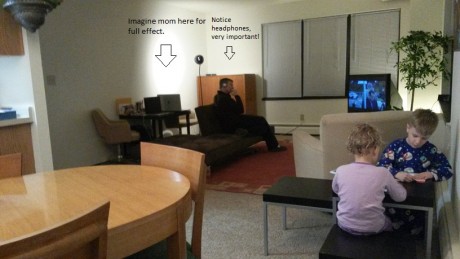
KB: When we moved downtown St. Paul I searched for advice on family life in a typical, white walled, beige carpeted apartment and came up short.  I also was gobsmacked that we seemed to be the only family living downtown St. Paul–it’s a toddler paradise (Children’s Museum, Science Museum, History Museum, event centers, swimming pools, parks, bike trails, the river, the library all in walking distance and with the skyways going outside is optional).

I assume Google knows everything and Google didn’t know this. I wanted to encourage other families to join us. My oldest is an extrovert. We need neighbors he can play with.
family-in-small-living-room

Living small doesn’t have to be about expensive architecturally assisted spaces or tiny off the grid homes. We’ve chosen small as a way to give more opportunities and experiences to our kids–the surprising thing is how much we parents like it too. It took us a lot of time to figure it out what worked for us with less space, but we got it, and hopefully I can help shorten the learning curve for others through Skywaymom.com.

DF: What would you tell people who are trying to do this for themselves and their families?

KB: Minimalism is an excellent tool to focus on what’s really important. Dreams grow when you realize you have to say no to a lot of good things to allow great things to surface.

I developed a mission statement for my house–an inner dialogue if you will–while cleaning.  It goes like this: “My house is a pristine sanctuary that focuses on what’s important”. When I pick up clutter or organize I say this to myself. It has had dramatic consequences. We were able to save the money required, and organize ourselves enough to take a full year to be with our kids in a foreign country. What’s important will be different for each person–but without constantly reminding ourselves what’s important to us, the world, by design, will impose its own version.

The Wheels of These Homes Go Round and Round

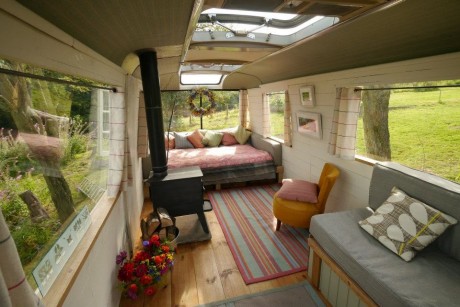
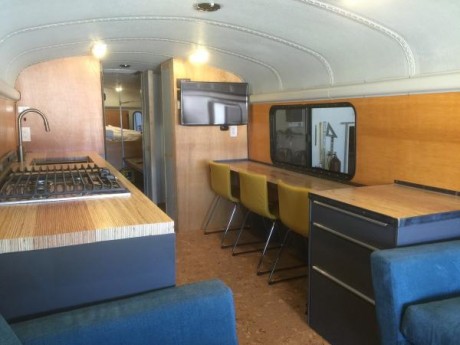
Have you ever thought you understood the world around you, then all of sudden discover hidden subcultures right under your nose? You thought you knew your colleagues and neighbors and then find out they are really, deeply into things like Dungeons and Dragons, trainspotting and Hummels. Well, I thought I had a pretty broad understanding about small space housing. I know tiny houses, yurts, micro-apartments and many things in between. I thought I knew it all until I discovered Skoolie.net, “The School Bus Conversion Network.” Unbeknownst to me, there is a whole population of people turning old school busses into live-in dwellings.

skooklie2skoolie1

Converting school busses makes sense in many ways. School busses are house sized, measuring up to 45’ long and 8 ½’ wide, giving ample room for living space (you can get smaller ones if so desired). They lend themselves to customization with nice open floor-plans. Their simple structures makes them easy to seal and insulate. They have ample light. They run on stout diesel motors and their mechanicals are engineered for daily use and are appropriately repairable and robust. And they can be had for cheap. You can pick up a used school bus in decent shape for $5-10K. Compare this to a tiny house, whose trailer might cost $5K–and you still need a decent-sized vehicle to port it around.

skoolie4 skoolie5

Because they are not purpose-built for habitation, school bus aficionados are more inclined to DIY-ing. In fact if you want a cheap, turnkey mobile place to live, a class C motorhome can be had for less money–and a lot less effort–than a converted school bus. However, a cheap motorhome will, in all probability, be cheaply built, with crappy finishes, fixtures and appliances. And the odds of standing out at the campground in a Winnebago are minimal relative to pulling up with a school bus with a VW Bus grafted to the roof.

skoolie8

School bus conversions do have some drawbacks, as Shawn from Schoolbusdriver.org points out. Standing room usually caps out at six feet in the middle, which is less than ideal for some such as this author. Transmissions are typically geared for stop and go driving, not highway cruising, which can make long trips slow and thirsty. And “Scraping years of petrified boogers and gum from under the seats is less fun than it sounds.”

It’s not entirely clear whether all of the busses on Skoolie are lived in or just a secondary dwelling. Either way, the site and its members present another interesting, mobile form of compact housing from which to choose from.

Images via Skoolie.net

iOS Enabled Enlightenment

Many years ago, I spent a couple months hanging out in the Sinai Desert and scuba diving in the Red Sea. On my first dives, I would rapidly burn through all of my oxygen, often forcing my group to ascend prematurely. But eventually, by focusing on staying relaxed and taking long, slow, deep breaths, I started using a fraction of the oxygen I did on the initial dives, allowing me to stay down longer and enjoy the scenery better. What I learned is that conscious thoughts have a profound effect on unconscious behavior such as breathing. Beyond extending dives, maintaining steady, relaxed breathing is one of the cornerstones of being happy and healthy. Until now, having direct feedback to your respiratory behavior largely meant sitting still in meditation or carrying around scuba gear–both impractical for their own reasons. Now a wearable tech company called Spire is offering an iOS-enabled device that keeps track of your breath and reminds you to chill the heck out.

Spire is a little transmitter that clips to your waistband. It sends signals to your iOS device via a Bluetooth signal. Your breath is monitored and tracked on the device. Push notifications alert you if your breath is shallow or irregular, a good indicator that you’re tense and stressed out. That’s about it.

Spire has a great appeal for me. For years, I was a regular meditator, hitting my meditation mat like clockwork for 15 minutes every morning and evening. The motivation behind my practice was that when I brought consciousness to unconscious behavior through my breath, I could (and did) have a greater capacity to stay cool through life’s inevitable trials. You see, fear, anxiety and other unpleasant emotions are not conscious. No one chooses to be scared or anxious–these things are unconscious reactions to various stimuli, stimuli that is often rooted in some past trauma, not the present moment. These unpleasant reactions are almost invariably coupled with shallow breathing. Returning to regular, deep breathing helps bring both body and mind back to the present, not some incident that happened when you were a freshman in high school.

While it’d be nice if we could all just take the time to regularly meditate, many of our lives are not set up that way (my two young boys are super unsupportive of my mediation practice). Spire holds the promise of bringing a level of meditative practice to everything we do…assuming our phones are charged. A Spire puck costs $150. Visit their website for more info.

Dating Site for Tiny House Lovers

One of the bigger questions about downsizing and living with less concerns how it affects one’s romantic life. Many otherwise compatible people might find themselves at odds when one party wants to shack up in 200 sq ft or less. Well, if you’re in the market for romance and you love tiny living, there is a dating site that might help you find your soulmate. Tiny House Dating is the site where tiny house lovers can find love with other tiny house lovers.

The site features a database of men and women looking for likeminded romantic partners. There are the normal filters such as gender, age, sexual preference, city and state. The main difference between Tiny House Dating and more conventional dating sites is the survey question that asks “On a scale from 1 (low) to 10 (high), how serious are you about Tiny House living?” From a quick perusal, there are quite a few 10s.

The depth of field for both men and women still seems to be fairly shallow at present, with only a few pages of profiles for each sex. Profilees are located all across North America, though if the right match is found, I guess one party can hitch up his or her tiny house to a pickup and relocate.

The Land without Cell Service

To most, the idea of being without mobile tech is unthinkable. How will people reach me? What if I’m running late and need to text someone to hold on? How will people know what I ate for lunch if I can’t Instagram it? While the global geography of places without cell service and wifi access continues to shrink, there is one American city where cell and wifi signals are nonexistent. Green Bank WV is a tiny town (pop 143) located in the Blue Ridge Mountains, about one and half hours drive from nowhere. It is the home of the Green Bank Telescope, the world’s largest radio telescope which listens to sounds in outer space and collects data from the solar system. Because of its need for a very hushed environment, the telescope is surrounded by a National Radio Free Zone, a 13K sq mile electromagnetic signal free zone. In the zone, there is a ban on cell service, wifi, radio and even microwave ovens.

Journalist and self-professed “modern day technology junkie” Dan Lieberman spent one week in Green Bank and shared his experience on Fusion.net. Predictably, he had a hard time being without access to instant communication and information. Over the course of his trip, he made list of survival tips for living in world without mobile tech, things such as getting information from real people, not being late for appointments and using a real map.

While initially things were rough going, he had this to say about the end of the trip:

I had finally broken my habit of reaching for my cell phone every chance I got. It took the entire week to realize that being freed from my tech addiction was a good thing. I was listening to people we interviewed, really listening, instead of having one eye on my phone for texts and emails. I was present.

It should be noted that Green Bank, and other places in the Radio Free Zone, are not offline by any stretch. Ethernet and coaxial cables go a long way to keeping people opening new tabs and channel surfing. However, I suspect the instances of people walking and texting down the street are few and far between.


The ability to reach anyone and find out about anything at any time via mobile tech and wifi-enabled devices is indubitably an amazing thing. And every now and again we have an important communication to make or piece of information to obtain. But more often than not the communication and information is not that important. It’s certainly not important enough to justify the approximately 150 times a day the average cellphone user checks his or her phone. It’s stuff that can wait. And it’s stuff that is unlikely to be more important than what’s in front of us, whether that’s a friend, a streetscape or a book. In his 2009 TED talk, Renny Gleeson summed it up well. He said, “When you’re standing with someone, and you’re on your mobile device, effectively what you’re saying to them is, ‘You are not as important as, literally, almost anything that could come to me through this device.’”

Read Dan’s full account here. And today, try putting down your device every now and again. Whoever it is you want to communicate with, whatever it is that you want to know, chances are it can wait.

This House Will Make You Simple. In a Good Way.

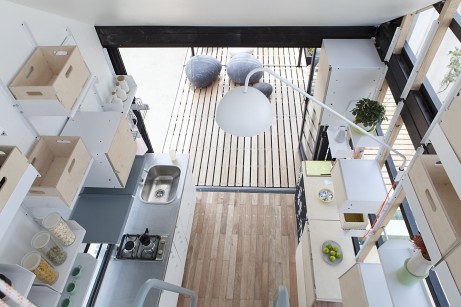
There’s something very elegant about enclosed storage in small spaces. It allows all of your stuff to be hidden from view, creating a clean, clutter free aesthetic. But enclosed storage can also help you not deal with stuff, allowing it to stick around well past its usefulness date. Well, if you were to live inside the POD-iDadla micro house, you would have no such issues. With its walls covered with exposed storage, there would be no place to hide from your unused, unloved stuff.

POD-deck

The POD is more than its exposed shelves. Similar to the NOMAD Micro Home from Canada, it was designed as a low-cost, prefab, flat-packing, easy to setup micro home. Also like NOMAD, the POD’s designer, South African architect Clara da Cruz Almeida, believes that its tiny size (185 sq ft without deck, 221 with) imposes simple living that is both beneficial for dweller and planet alike. From the POD’s website:

A simpler life will allow you to concentrate on what matters: the experience of living; it takes five minutes to clean and saves effort and time even in the daily task of cooking because everything is reached while you are standing on the same spot. If you move, from city to city, or just from Soweto to Blairgowrie, you can ultimately just move the house with you, saving time on house hunting.

The above assumes you can find a legal plot of land on which you can set it up.

POD-interio

As mentioned, the POD has an elaborate interior storage system designed by South Africa’s Dokter and Misses. The semi-exposed shelves sit on steel racks and can be vertically adjusted as desired. Coupled with its high-modern touches, the shelving gives the POD a quasi space capsule look. And while the pictures show the prototype POD with largely empty storage bins, I wonder what they would like filled?

POD-loft

Other features include a sleeping loft and large exterior doors that open on to relatively large deck, designed to blur the lines between interior and exterior spaces. You can also attach two or more PODs to make a little complex.

Right now there is only one POD and it’s located at the Nirox Sculpture Park on the outskirts of Johannesburg. POD’s website suggest that they are working on manufacturing and selling made-to-order units in South Africa, but there is no indication as to when that’ll be.

Images via POD Idlala

Story via Remodelista

You Probably Don’t Need That

The world is brimming with awesome stuff. Amazing products. Gorgeous clothes. Exquisite artifacts. Fast cars. And electronics. So many awesome electronics! Smartphones, laptops and apps galore. There’s no question that we live in an age of unfathomable material bounty. And you know what? In nine cases out of ten, the chances are that you don’t need any of this stuff. Your current stuff probably works great. Your clothes clothe you with style and function (okay, you might need a couple pair of new socks). Your current car works great (it might need an oil change). And electronics, oh electronics–your iPhone 4 is awesome (like Star Trek, holy-crap awesome); your four year old laptop that starts up reliably, is a marvel–maybe not a marvel like the one that just came out yesterday, but a marvel nonetheless; and c’mon, you know you’re probably not going to use that awesome app in a week.

Remember, all of our stuff has an impact, be that impact psychological, financial, spatial (i.e. clutter) or environmental (the latter point can’t be overstated). The best course is normally to just not get it. And if you do get it, if you determine it’s something you really need, or, more likely, really want, make it count. Get the great stuff. Stuff you’ll cherish, care for and keep.

So if you’re on the fence about getting some new stuff, just remember, the stuff you have is awesome. You probably don’t need that.

Just say no image via Shutterstock

The World’s Coolest High Rise Apartment Building

This site has touched on the Passive House standard in the past. When applied, the German-born energy efficiency standard allows a building, regardless of the weather outside, to stay temperate, comfortable and well-ventilated with no-or-low use of energy-intensive HVAC systems. A Passive House achieves this by making a building into an insulated air-tight structure, sort of like a thermos. Fresh air is constantly circulated by a mechanical ventilation system called an energy recovery ventilation (ERV); ERVs bring in fresh air and remove stale interior air while recovering the energy in the climate-controlled interior air. Because of all this, Passive House structures use 60-70% less energy than conventionally constructed buildings. But to a large extent, most Passive House buildings are on the small side–single family homes and small buildings. And many are in Europe. But the other day, the world’s largest Passive House building broke ground right here in the US of A–NYC to be less general. Even cooler (no pun intended), a portion of the 26 story building’s apartments will micro units (~350 sq ft). The remainder of its 350 units will be one, two and three-bedroom apartments.

Cornell-tech-2

The building, developed in partnership with the Hudson Companies and Related Companies and designed by New York City-based Handel Architects, is part of Cornell University’s Tech Campus, an ambitious project on Roosevelt Island, which sits in the East River sandwiched between Manhattan’s Midtown to the west and Queens’ Long Island City to the east. The building will be an efficiency powerhouse, featuring 15” walls, triple glazed windows and a louver system along the southwest facade that acts as the building’s “gills”, which house the heating and cooling equipment and allowing the building system to “breathe.” The whole campus will contain 2.1M sq ft of building space and is designed to be net-zero, which means that between its energy efficiency systems and renewable power generation, the campus will produce as much or more energy than it uses. According to a Cornell press release, “Compared with conventional construction, the building is projected to save 882 tons of CO2 per year, equal to planting 5,300 new trees.”

Cornell

There’s is something alternately very dull and very exciting about Passive Houses. They can seem dull because, with the exception of some very sexy windows and the magic of ERVs, Passive Houses are bell-and-whistle free. There are no transforming spaces, no motion sensor activated furniture or what not. They simply take the best energy-efficiency practices and employ them (no glass and steel towers here). But they are also very exciting because they represent building design that works so much better than the status quo. And more specifically, the Cornell tower takes Passive House to a new, grand scale, and it brings it to one of the world’s densest cities, a context that for an increasingly urban world population, will be more and more relevant in the coming years. Cool stuff indeed.

Via NY Times and Cornell University