There Is More than One Way to Skin a Tiny House

One of the bigger charges against tiny living is the lack of variance in style. You either have your stark and modern high end micro apartment in the city or your hyper-traditional, wood-clad tiny house out in the sticks. Well, if you want your micro with a little bit of spice, look no further than Anita Flower’s Moroccan-flavored tiny house in Portland, OR (where else?). The 248 sq ft, trailer mounted home is brimming with color and personality.

Anitas-Lilypad-Tiny-House-stairsAnitas-Lilypad-Tiny-House-caravan

The house, which was built by Small Home Oregon, has 11’ high ceilings at its highest point, making it feel spacious, but also permitting split levels on both ends of the of the house–one side being split between the bathroom on first floor and sleeping loft on top; the other side split between an office on the first floor and a Bedouin tent style lounge area on the top. In the house’s center are the kitchen, dining area and storage.

The place is way more than funky looks. It was constructed from 30% salvaged materials and is designed to be used either as on or off grid. There’s a host of eco-friendly features including a rain catchment system with 55 gallon reserve tank. There’s also 35 gallon freshwater storage tank over the sleeping loft that sends food-grade water to the kitchen. Electricity is generated by a 980W solar array on an elevated rack. Heat either comes from high efficiency, 450W Envi electric heater or a tiny stainless steel Dickinson Solid Fuel wall-mounted heater. And of course there’s a Nature’s Head composting toilet.

lily-pad-exterior

Flower is using the home, which she has dubbed Lilypad, as both residence and educational tool, running tours and workshops about low-impact living. Find out more at lilypadplanet.com.

Is This the Perfect Travel Bag?

It’s pretty rare that I get all lusty about a piece of stuff. It is, after all, just stuff. But I find myself pretty enamored with the GOBAG, a new Kickstarter-funded product which is one of the coolest pieces of luggage I’ve ever seen.

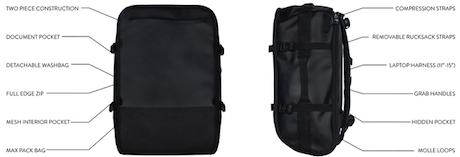
gobag-diagram

The GOBAG, at least to my mind, kinda has it all:

  • The bag’s dimensions are designed to fit into a plane’s overhead bin.
  • The exterior is made of out of two pieces of super tough TPU coated ballistic nylon that are zippered together. The minimal construction means few seams to bust, and the fabric is both tough and water resistant, perfect for unforeseen deluges at a bus stop in Thailand or something.
  • There is a handle as well as two removable backpack straps for easy porting.
  • The bag’s wraparound seam that allows you to access every part of the bag.
  • The sides of the bag have compression straps, so you can cinch the bag as flat as possible.
  • Included is a separate “Max Pack Bag”, a welded TPU coated nylon bag with an integrated vacuum check valve to compress all your soft goods. Just throw your gear into the bag, seal it and compress it. You can compress the bag by either using a vacuum cleaner or compressing it by hand.
  • There’s an easy-access detachable clear bag for your sub three ounce toiletries that velcros to the underside of one of the outside flaps.
  • An easy access padded laptop harness that fits 11-15” laptops will keep you trucking through airport security.
  • Its black exterior is not only badass looking, but it hides the inevitable years of grime that accumulate on luggage.

gobag

One thing it doesn’t have is wheels, which for some will be a dealbreaker. For others, like me who prefer to carry their stuff, it will suit just fine. The other thing it lacks is a way of carrying hanging garments, making it a little less than ideal for folks who frequently travel with suits and dresses that don’t do well in tight quarters.

Currently, the GOBAG has raised $298,574 of their $70,392 Kickstarter campaign goal. In other words, it’s hugely popular. All of the early bird specials are spoken for, but you can still pick up a bag for $206. Delivery is expected for October. Go to their campaign page for more info and to get one for yourself.

Living Well in the Margins

In most any area, it’s generally best to look to the margins, not the center, for innovative thinking. Small space architecture is no different. Conventional architecture is too often big and boring, victim of zoning restrictions and/or design driven by the interests of developers rather than residents. One place to find consistently interesting “marginal” architecture is supportive housing–a type of government-funded housing for populations that need, ahem, extra support. Supportive housing usually enjoys less restrictive building code restrictions than conventional housing and because it’s not for sale, it is not necessarily bound to imitate what everyone else is doing in the market, often resulting in innovative, community-centric, compact architecture. La Casa Permanent Supportive Housing in Washington DC is a great example of such a beast. It’s an attractive, smartly-designed apartment building that happens to be supportive housing serving homeless men.

The seven story La Casa was jointly designed by LEO A DALY and Studio Twenty Seven Architecture for the DC Department of Human Services. According to LAD’s website, they were challenged “to create a ‘home’ rather than an institution, and to ‘meet or exceed’ the quality of the adjacent market-rate apartments.” With bright, clean and smart interiors, their challenge appears to have been met.

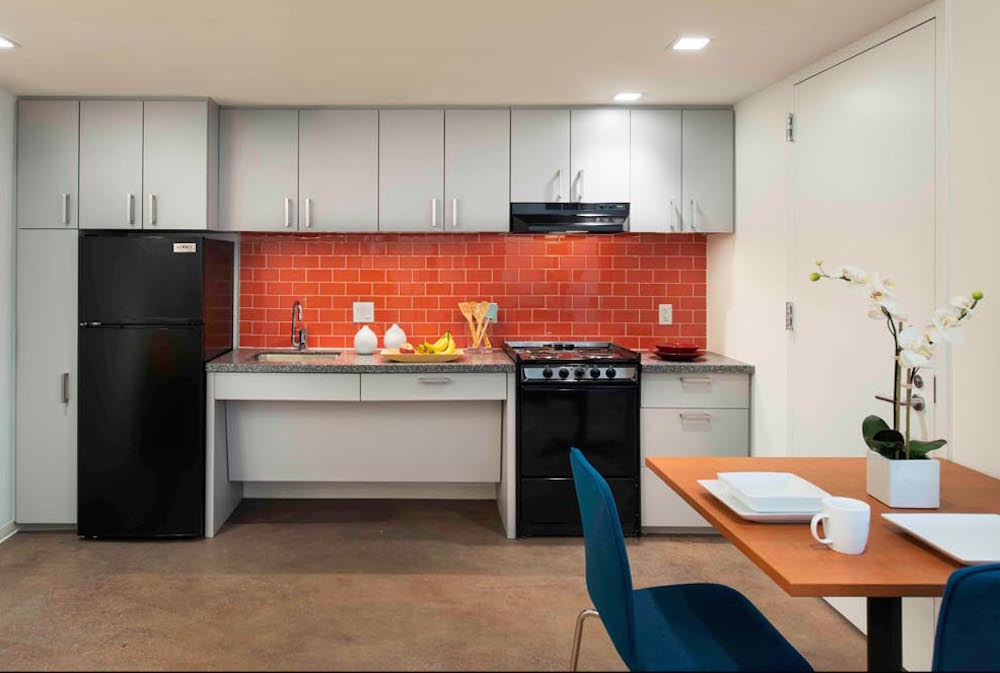
The building will house 40 chronically homeless men, all of whom will have their own furnished efficiency apartments with kitchens and bathrooms. The units are designed to create a sense of home and permanency, rather than serving as a stopover in some institution in a never ending cycle of homelessness. It will employ the “housing first” service model. Whereas many supportive housing communities require sobriety or other conditions for eligibility, housing first has no such conditions, acting under the belief that when housing and counseling services are in place, it can provide the security and dignity that will act as gateways for an improved life.

La-Casa-4-Desktop

Even the design was meant to be rehabilitative. Jim Spearman, La Casa’s project architect at Studio Twenty Seven Architecture, said “From the exterior, large and individualized windows on the façade identify particular spaces to which occupants can point and exclaim, ‘That is where I live!’”

La-Casa-12-Desktop

Beside the efficiency apartments, there is a welcoming lobby on the ground floor, support offices and a mail area. There is also a community room on the second floor that opens onto an outdoor terrace. “A green roof contributes to the design’s LEED-Gold certification,” according to LAD, and “Security is provided by a combination of security officers, remotely monitored cameras, and secured door access.”

La Casa recently won the American Institute of Architects (AIA) 2015 Housing Award in the Specialized Housing category. The project is great because it’s not just a nice place for someone accustomed to living on the streets–it’s a great place for anyone to live.

Images via Studio Twentyseven Architecture

Posh and Compact Flat in London

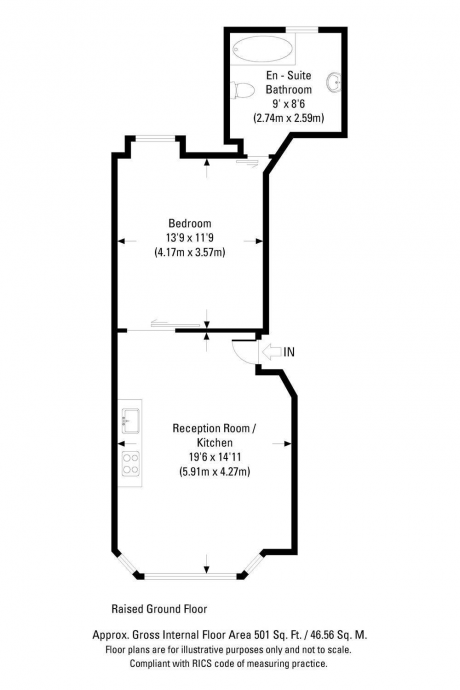
Got a million bucks (£695K) burning a hole in your pocket and looking for some awesome compact digs in London? No, neither do I, but if I did, I would totally consider buying this 501 sq ft apartment by Italian architects Archiplan Studios currently up for sale (well, it might be in contract, but maybe another couple hundred grand would sway things in your favor).

property-image-14026 archiplan

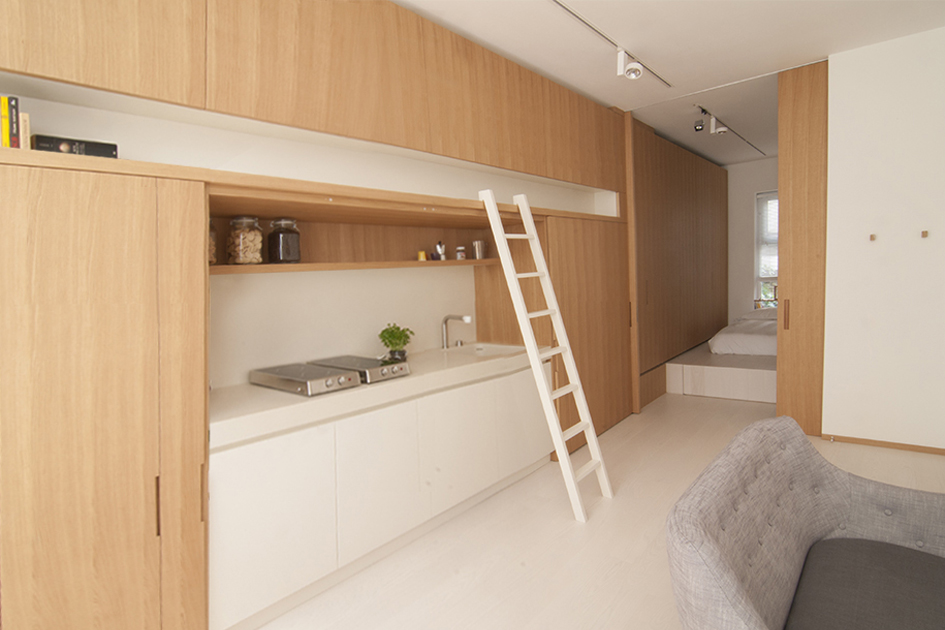
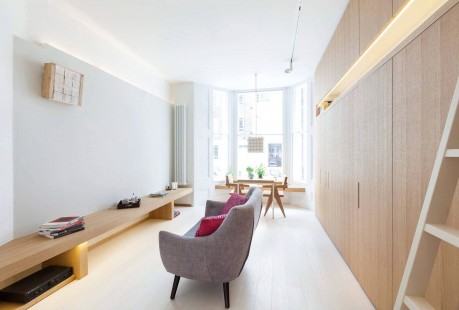
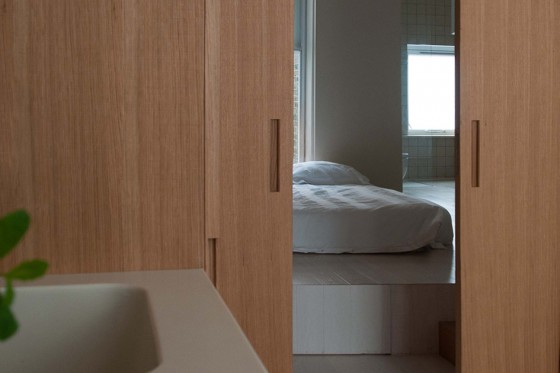
One whole side of the long and narrow space is fitted out with a continuous bank of uber-high quality looking (cherry?) floor-to-ceiling millwork. This bank houses a small, closable kitchen in the main room and lots of storage in both the main and bed rooms.

archiplan-studio-bedroom-door

The bedroom has the bed sitting on a box, which appears to have more storage.

archiplan-bathroom

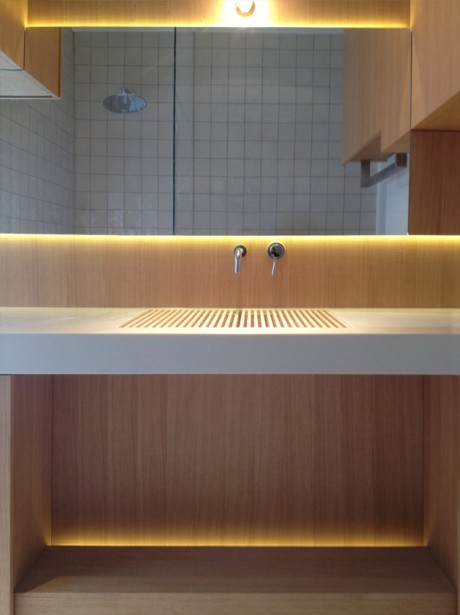
The cherry continues into the bathroom, which has several cabinets made of that wood. By far the most interesting aspect of the bathroom, is its, um, sink, which is a wood grate (over a drain presumably). It looks nifty and has a very sleek, shallow profile, though I’m not sure if it’s an improvement on the porcelain bowl..I’m actually pretty sure it’s not an improvement.

Untitled 2Funny enough, even though the $2100/£1387 per sq ft seems outrageously high, a quick search reveals that it’s far from abnormal in the Hatherley neighborhood where the apartment is located. Considering its location, the amount of built-in furnishings and its top notch design and construction, this little apartment might just be a bargain (for some).

HT to Karina D

Images Credit Archiplan Studio

You Should Know More about Andrew Hyde

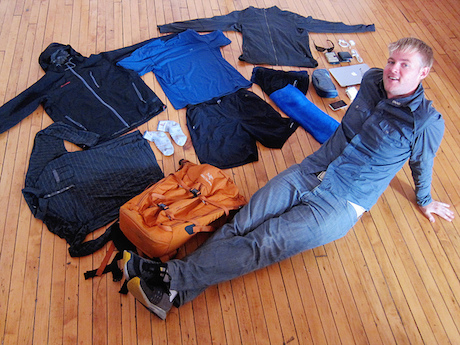
If you’re a longtime reader of this site, you may remember the name Andrew Hyde. More likely, you’ll remember his claim to fame: at one point Hyde narrowed his possessions down to a mere 15 items (which later bloated to 39).

andrew-hyde-15-things

I’ve shot an email or two to Hyde over the years to see what he was up to. It turns out that Hyde is far more interesting than just being some dude without a lot of stuff. I emailed Hyde a few questions to explain what he’s up to and what he’s about.

Introduce yourself for people who don’t know about you?

Name is Andrew Hyde. I’ve started a few events that are worldwide movements (Startup Weekend and Startup Week). I’m an author and stay at home bartender. I’ve worked really hard and been lucky a lot.

Tell us a little about your 15 item experiment.

For two years I lived with a backpack and 14 ish other things. I loved the idea of longterm travel and the thought of a storage unit and the amazing amount of stuff was overwhelming. When I was packing up I invited all my friends to loot all of my stuff and I left Boulder [Colorado] on a grand adventure with a super light backpack.

How many possessions do you have now? If more, why?

I was fortunate enough to buy a home so my stuff count is off the charts [editor’s note: the house is super awesome. See below]. I think I have a drawer with more things than I did for those two years. I think 400 or so things is what my ‘count’ is, but if the project was about minimalism counting up what I own is kinda missing the point. Nothing runs my life or schedule. Stuff is replaceable and isn’t something I value (I enjoy it for sure).

andrew-hyde-living-room

Tells us about your current living situation?

I travel about seven months out of the year. Two months or so I’ll be in a tent, one month in a hotel, two months at friends places and the rest at AirBnb’s or planes. I still travel with the same bag and will go on a few week trip with just a few things. My ‘room’ in the house is about 150 square feet and is just perfect. I built a very tiny home feeling space in my home.

What does this setup enable you to do?

Before I started Startup Weekend I had not been out of the country. Now I’ve been to over 50, all 50 states and had an amazing time. I do a lot of the obvious touristy sightseeing but something that I didn’t picture myself being able to do so much is volunteer. I work helping friends out in a barnraising style to almost every trip I take. Where can I go and how can I help out. That is the most ideal situation I can think of.

What would you say to people who might see your lifestyle as something only a single, childless dude can do?

Some of my favorite people in the world are traveling with their families. It is easier to be single, but that also has its own challenges. I love the freedom I have, but feel like I’m missing the beauty of an amazing relationship (which is coming). Anyone can travel (even if they just look at their current location from a different view). Location is identity. Where you are going and have been says more about you than almost anything.

How can anyone, regardless of their life-situations, adapt some of your lifestyle’s principles to his or her own?

I have a challenge I give to friends which is pretty simple: leave your wallet at home tomorrow. See how far of your enjoyable life you can make without cash. Ask for a free coffee. Volunteer a trade or just skip lunch. Walk, don’t drive if you can. Take your routine and see how much of it is just habit vs what you enjoy. Travel with that same philosophy. Research airline points booking and figure out a place you want to go and how you will earn the points to get you there. Help friends do the same. Time, not cash, is what generally holds people back. The trick is to get out there as much as you can.


Keep up with Andrew at andrewhy.de and Twitter @andrewhyde

Product Review: ScanMyPhotos.com

Right after high school, I was a bit of a shutterbug. Forgoing college for a few years, I traveled the world, always packing small autofocus cameras and large stashes of film. I took hundreds of shots of varying quality that captured these amazing times. Through several moves and a couple decades, these photos ended up in a Wheaties box stashed deep in my folks’ crawlspace. A few years ago, I selected a couple hundred of my favorite photos from this Wheaties box and put them into another box that once held a Motorola Razr–these became effectively all of my non-digital photos (the Wheaties box is somewhere in the crawlspace I suppose).

I still have an emotional attachment to these captured moments, but not a physical attachment to the paper photos themselves. I planned to digitize them long ago, but never got around to it. I finally decided to do it, using ScanMyPhotos.com–the decision based on a post I did about photo digitization (full disclosure: they offered me a promotional box when I asked for one). What appealed to me about ScanMyPhotos was their flatrate package. They send you a preposted, medium-sized USPS Priority Mail box, which you stuff with as many photos as you can. My photos only filled up a fraction of the box, but ScanMyPhotos president Mitch Goldstone said the box can easily handle 1800 photos. They receive the photos and send back the originals and a DVD with the digital image files. For those, like me, who don’t have an optical drive, they’ll send a thumb-drive for an extra $13. This whole process only takes 5-10 business days (mine took 5).

You can get the images scanned in either 300 or 600 dpi resolution ($145 and $235 per box respectively). They hooked me up with the 600 dpi service, but truth be told, if I were spending my own money, I would have opted for 300 dpi; 600 is really only needed if you’re blowing something up to very large size.

00000076 copy

The scans came out great–or rather the great photos, of which there were many, came out looking great. Several of the photos had smudges and scratches, which the scans reflected. This leads me to cautionary note: If you go this route, be sure to inspect your photos before you send them in. Also, send them in sooner than later–as I found out, photo paper quality does not improve with time.

IMG_3931 copy

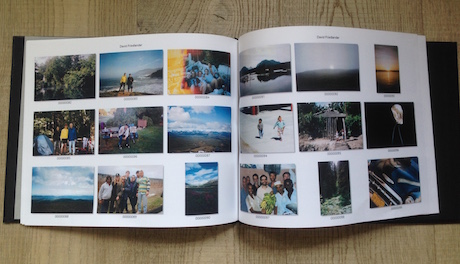
ScanMyPhotos also included in my order a bound book with thumbnails of my pictures on paper so I can thumb through the images ($175 extra). This is a very cool feature, though had I known they were going to include it, I would have sorted my photos out chronologically. Because I sent them a jumbled mess of photos, the images jump around in time quite a bit. That said, it’s handier than looking at them on a screen and the 8.5” x 11” book is far less bulky than a photo album and there is zero cellophane.

Another interesting add-on is their photo wash, which enhances and sharpens old faded shots ($70 per box). Most of my photos were less than 20 years old and weren’t too discolored, but I imagine the photo wash would help greatly in preserving older photos that have been ravaged by fading.

I still haven’t scrapped the original photos, but don’t see why I won’t. I don’t look at them save for a couple times a decade. The rest of the time, they just take up space. I suspect I am more likely to look at them if I post them online or even if they’re just hanging out in my digital library.

About cloud storage and sharing, Goldstone points to how ScanMyPhotos compliments Google Photos, which allows unlimited cloud storage, facial recognition, easy sharing and much more. He notes how cloud storage, like Google Photos or Facebook, has mostly been focused on backing up files that are native to digital devices, which for most of us has been the last 5-10 years. But he estimates that the average household has around 5500 photos–pre digital photos that represent a disproportionate percentage of our personal histories. If you’re looking to preserve and share your pre-digital photographic history while enjoying the clutter-less security of digitization, ScanMyPhotos is a good way to go.

It’s Your House on a Bike

We feature a number of homes that sit on internal combustion vehicles. Despite what you might think, these homes can be extremely green. First off, standard homes have fuel needs too, from heating hot water heaters to keeping stoves alight to keeping furnaces firing. Stationary homes consume gas, just not for locomotion. More importantly, there’s a dire need for efficiency when you’re moving your home around; everything that isn’t totally needed, whether it’s water for showering or an extra pair of pants, is sacrificed due to very limited space and keeping weight down so your vehicle can keep moving.

But if you’re like me (and I shouldn’t suspect, or hope, that you are) there’s the dream of the nomadic home that doesn’t rely on fossil fuels. In the past, we’ve looked at the Tricycle House as well as the Taku Tanku house–both were bicycle-powered housing options (the former somewhat plausible in its execution, the other not). We can now add a couple more HPNMs (human powered nomadic home…you heard it here first) to the mix.

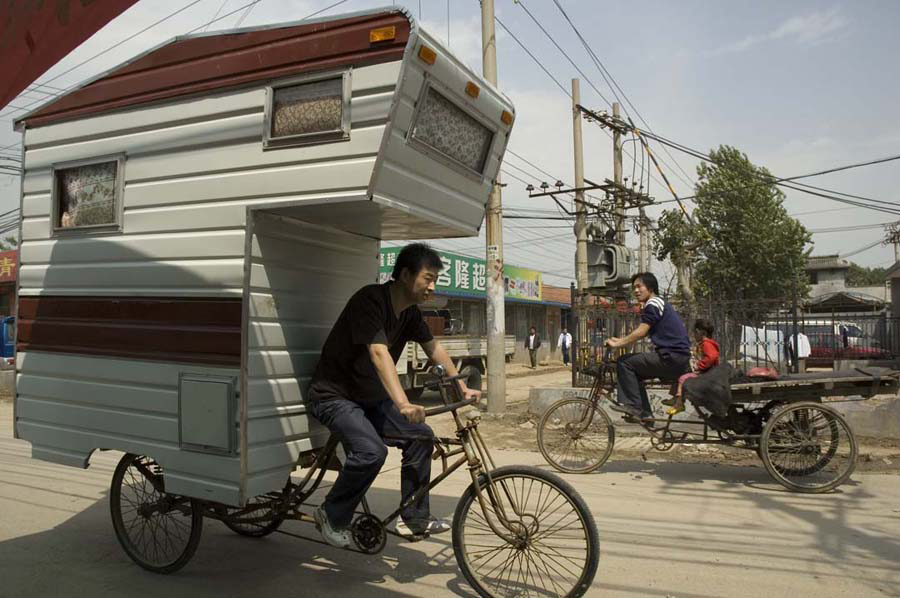
The first is the Camper Bike by artist Kevin Cyr, which resembles a 70s over-cab pickup truck camper. While there are no detailed images of the inside, a sketch shows the over cab portion containing a bed (for a medium sized cat, it appears), a dining table, a TV, some storage and a picture of Mao.
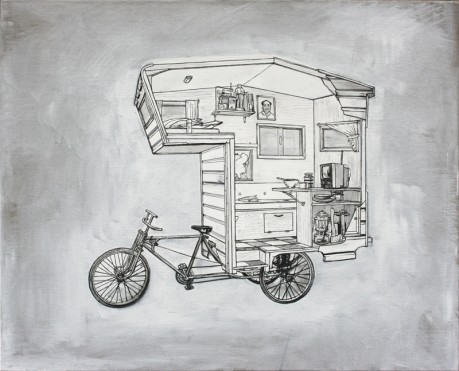
camper-bike-interior

In an interview on Icebike.org, Cyr explains the project:

The idea first came to me while I working in Beijing. I was joking with a friend that the only thing not on the back of bikes in China are houses. I had been seeing people, mostly working class men hauling goods on three wheeled bikes—rickshaws with bamboo flat beds. They were carrying huge loads of foam and plastic for recycling, furniture, and building materials. There were also a lot of food venders at open markets cooking meals on the backs of these bikes, it was very interesting. They seemed to use them in every way imaginable much in the way Americans use pick-up trucks.

He built the Camper Bike, which he describes as a sculpture, over the course of three trips over three years.

Cyr made few concessions to practicality. He used an old, rickety government issue bike as the camper’s host vehicle. The camper is mounted on a wood frame, which is significantly heavier than an aluminum or composite one–Cyr suspects the whole thing weighs a very portly 200 kgs (440 lbs). Cyr said when he climbs up to the bed area, the camper sways and feels as though it’ll fall over. He says if he were to make it again, that’d he rectify these design flaws.
WPC

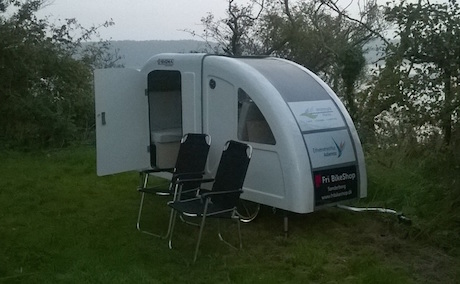
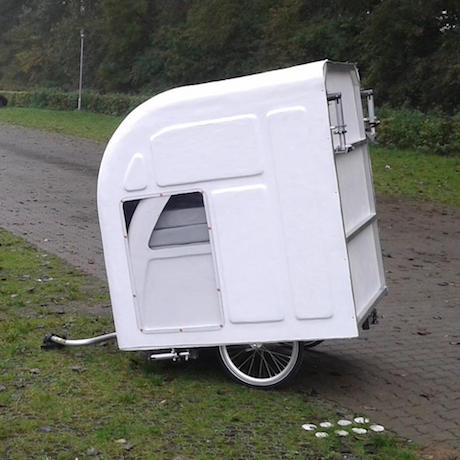
Rectification of those issues is what Dane Mads Johansen has done with his Wide Path Camper (Johansen said he was inspired by Cyr’s project). Unlike the Camper Bike, the WPC is a trailer, so you can choose which bike you want to affix it to. It also uses lightweight materials keeping weight down to a very reasonable 45 kgs (100 lbs). The camper, which has two sections that nest on top of each other when being towed, features a seating area that converts to a bed and offers around 11 cubic feet of storage (a little less than the trunk of a Honda Civic).
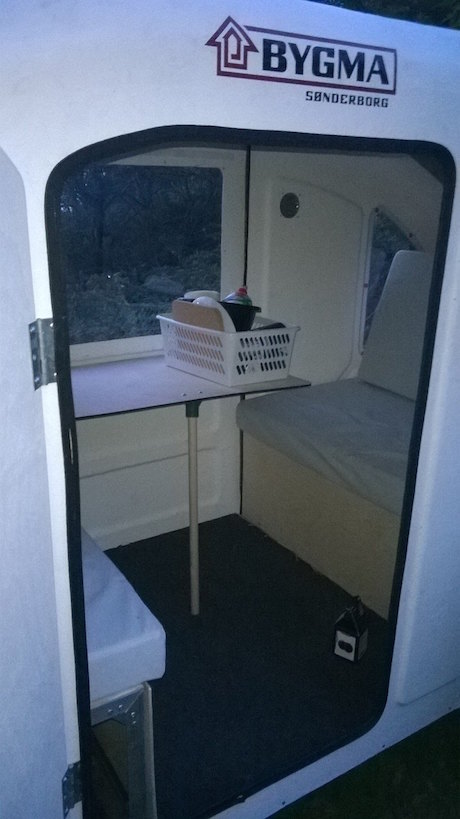
WPC-folded WPC-interior

Unlike every other bike-camper we’ve seen, the WPC is not vaporware. Johansen is taking pre-orders and expects to start delivering next month. The basic camper sells for €2000 ($2200 USD) and there are a number of available upgrades like a €600 solar package.

Some of you might be thinking, “Why not just load panniers or a trailer with camping gear, achieve the same result as the camper and save money and weight.” This is a nice idea, but belies the hard truths of bike touring, which often includes inclement weather and a deep desire for comfort at the end of a long day of biking (I’ve bike toured the world extensively including riding 1.5 times across US, so I feel I can speak on the matter with some authority).

At 100 lbs without gear, the WPC is still pretty heavy (my cross-country rig weighed a little over 50 lbs with full camping gear), so I think its best application is limited geography tours or a quasi-living situations–i.e. setting up at a campground or in someone’s yard where there’s access to a toilet and running water. However you use it, it’s a very cool piece of gear.

Many thanks to Mads for the tips!

Would You Buy This Off-Grid, Bunker-Style, Shipping Container Home for $46K?

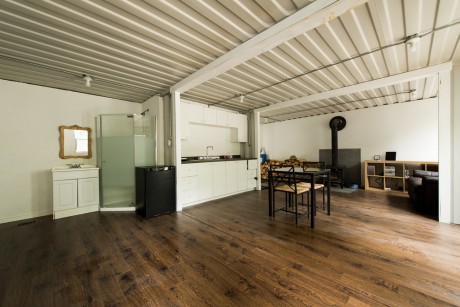
Ottawan Joseph Dupuis built this mostly-off-grid, 355 sq ft shipping container home and is now selling it for a cool $46,500 ($58K CAD). While this doesn’t fall into the super cheap price tier, especially as it lacks a toilet and you’re still going to have to find land. But the house’s price seems quite justifiable if you’re in the market for something relatively apocalypse-proof.

dupuis-shipping-container-exterior-doors-closed

First off, the shipping container shell (actually, there are three attached together), designed to sit exposed to the elements whilst making ocean-crossings, can stand up to all but the fiercest storms (or zombies). The container doors lock over the windows, making it even more bulletproof.

dupuis-shipping-container-interior-stove

Next, the whole thing is completely insulated for any violent shifts in weather. There’s a propane tank that fuels both in-floor radiant heat and the hot water heater. Apparently, it’s an energy miser. Dupuis, who lived in the house for two years, said he spent a mere $35 on heating for one whole winter. There’s also a wood burning stove for the Thoreauvian set.

dupuis-shipping-container-kitchen-bath

Electricity comes from nine 235 watt solar panels that charge a 27 volt battery bank. Water is municipal and feeds a shower and sink. As mentioned there is no toilet as that would have required a septic permit, which Dupuis was disinclined to get. The house will come with a rough-in for a composting toilet (I didn’t know composting toilets needed rough-ins).Needless to say, the house is designed to be easily dismantled and shipped, which Dupuis is happy to arrange.

What do you think? Is this an off-grid dream home at a fair price or a not-so-inexpensive, slightly-too-rough-and-ready backwoods bunker?

Photo credit: Japhet Alvarez / Via Facebook: s7vnth

Via Huffington Post

Follow Up Friday: Tiny House Projects Go Extra Mile

Sometimes this site features cool projects whose consummation is on some date in the far off–or not so far off–future. Well today, I wanted to do a little “where are they now,” having stumbled across two of those projects this last week, both worth mentioning.

project-h-tiny-house

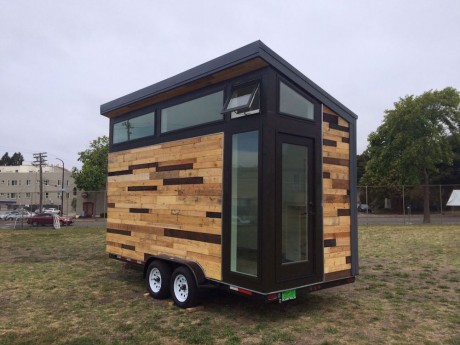
The first centers around the Project H Design tiny house design and build program. As you may recall, a whole bunch of middle-schoolers were charged with building two tiny houses. One was destined for Opportunity Village in Eugene, OR, where it would be used as a residence for the formerly homeless. The other would be sold on eBay. Well, the program is done and I’m happy to report that the house is for sale on eBay.

project-h-design-interior

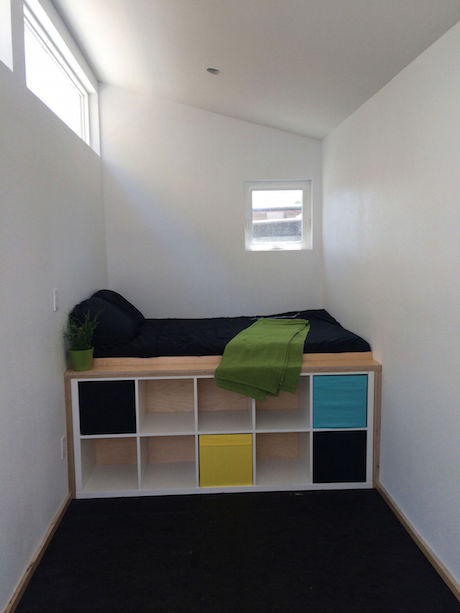
The handsome, trailer-mounted house measures a 100 sq ft. It’s basically an insulated shell at the moment. For furnishings, there’s only a platform bed, but I imagine the addition of a loft, kitchen and bathroom wouldn’t be too difficult. There is no plumbing, but there is electricity and four 250W solar panels will be included in the package. Head on over to eBay for more details or to buy the thing (starting bid is $10K with a bin of $20K).

occupy-madison-garage

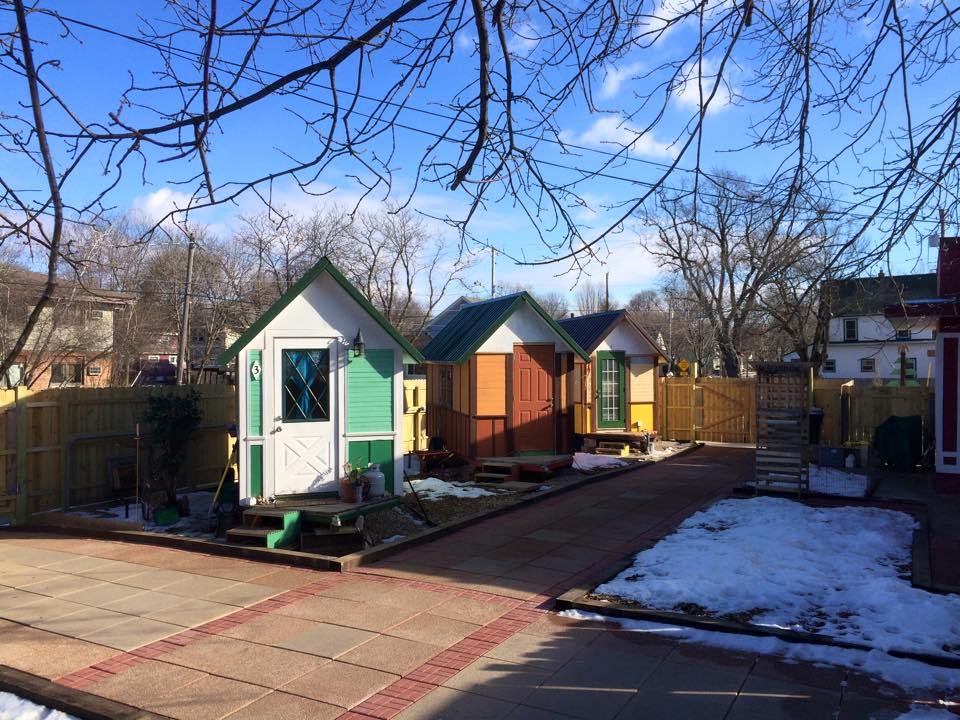
The other follow up is less about something that was projected to happen, and more about the happy next chapter in a cool endeavor. Almost two years ago, we reported about Occupy Madison Build, a program for creating tiny houses for the homeless. The program’s participants would not be given tiny houses; rather they were given materials and skills to build them. At the time, OM Build seemed destined to rot away in the “good intention” file. The problem was that you couldn’t park a vehicle longer than 48 hours in Madison, so the tiny house dwellers were constantly having to move around town to escape fines.

occupy-madison-workshop

I’m glad to report that the project is still alive and well. Occupy Madison Inc, the corporation founded to support the project, purchased an abandoned garage, which now serves as a workshop for building the tiny homes. There are three inhabited tiny houses on the ⅓ acre lot. With a planned second phase, which will add a kitchen, community room and four more houses. They’re looking for some money, so if you have some left over after buying the Project H tiny house, consider chalking up a little more. Head on over to their site to donate or find out more info.

A Case for Building More Small, Inexpensive Vacation Homes

Who knew that Sweden has had tiny house colonies for that last 100 years? Apparently many Swedes knew, but this unimformed American did not. These aren’t “tiny houses” in the modern sense of the term. There are no trailers or composting toilets. But “kolonistuga” houses are indeed tiny, often measuring no more than 215 sq ft and having a porch no bigger than 64 sq ft.

Kolonistugor

Kolonistuga are located in what are called koloniområde, which is a type of vacation colony for working class Swedes that became popular in the early 20th Century. Each property contains the kolonistuga and a small garden, or koloniträdgård. The gardens are actually the reasonkoloniområde exist–following WWI, the colonies were set up for city-dwellers to grow and supplement their food stocks as well as get out of their cramped homes.

slottisburg

To this day, the kolonistuga must adhere to certain building standards, maintaining their diminutive proportions as well as traditional appearance. They are located throughout Sweden, in both the countryside and others, like Slottsskogskolonin in Gothenburg, smack dab in the middle of a city. Each house is individually owned, but the land is rented by owners. Houses are typically vacated during the winter.

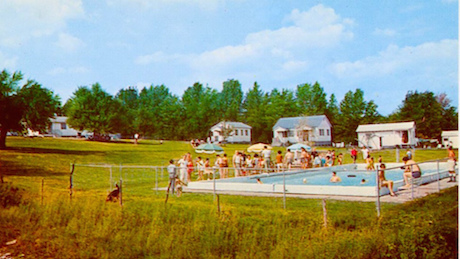
Once upon a time, Americans had something like the koloniområde. Bungalow colonies once flourished in the mid-20th century, mostly around the Catskills and Poconos as well as the shores of New York and New Jersey. Primarily used by Jewish Americans, they provided basic, affordable, community-centric vacation living, largely for city-dwellers looking to beat the heat and enjoy some sustained reprieve.

bungalow colony

Unlike the koloniområde, which are still quite active, the popularity of bungalow colonies waned in the 70s and 80s, killed by cheap airline tickets and destination travel (some still exist though their numbers are few and most are used only by Hassidic Jews).

This diminished popularity is a damn shame for several reasons. First, going to Disney World for a week doesn’t have the same potential for forging lifelong relationships as going to the same place year in, year out. And one off vacations are a little like dabbling with respite, whereas having a bungalow is a commitment to it. Lastly, visiting various locations usually requires expenses like hotels and restaurant meals, all of which can be cost-prohibitive to people living on more modest incomes.

While there is a good deal of focus placed on compact housing as primary residences, it’s worth pointing out that it makes wonderful supplemental housing such as the kolonistuga or bungalows. The time to start building small, efficient and inexpensive holiday homes once again is now.