Are RVs a Good Solution to Affordable Urban Housing?

We’re ever on the lookout for creative ways of making cities denser and more affordable. One way of doing that is filling up unused land gaps with housing. And one super simple form of housing that can do that are RVs. They’re small so can fit in the most miniscule parcel of land. And because they’re mobile, they can be inserted and removed on a moment’s notice, making them ideal for land that might be in transition. We’ve looked at how a couple New Yorkers live in their RVs, and recently the real estate site Zillow did a profile of Ellen Sims, an RVer living in Seattle.

Following the simultaneous departure of her two housemates in 2014, Sims pondered her options for an affordable alternative to traditional apartment shares. She decided to move into the RV, putting down $2K for a good sized Coachmen Freelander. She pays $540 in car payments, insurance and propane; all told, she figures it’s ⅓ to ¼ the cost of living in a normal apartment. She enjoys the RVs low cost, the autonomy it affords her and the imposed simplicity. She alludes to some of the less pleasant aspects, such as safety and finding good level ground to park upon.

We wrote a couple weeks ago about Seattle being a bastion of affordability. “Affordability” there referred to salaries being in line with the cost of living. While the city’s tech boom has beefed up many Seattleites’ salaries, many have not been so fortunate. Homelessness has increased a fairly shocking 19% in the last year alone and RVs have become a common solution to avoiding shelters and living exposed on the streets. Most of the 175-200 people who are living out of their vehicles in Seattle probably don’t have Sims’ sweet ride or relative good cheer about the situation.

Seattle’s mayor Ed Murray is now proposing the creation of two parking lots specifically for people living out of their cars and RVs. These lots will have waste management and other amenities.

Despite the unfortunate circumstances that drive (pun intended) many–though not all–to take up residence in RVs, it does present an interesting question about formalizing RV habitation in urban (and other) areas. While safety and sanitation concerns do exist, making RV living legal would go a long way to ameliorating these issues. The fact is many people who are not in danger of being homeless still want to spend less on housing or have greater flexibility as to where and how they want to live. By recognizing RVs as a valid form of housing and creating some infrastructure to support it–or allowing private parties to do so–we could possibly make strides in making our cities denser and more affordable.

Via Geekwire and Zillow

Living Small, Riding Free

We have posted about numerous folks who have traded stationary homes for RVs. People make this choice for a variety of reasons. They might want to see the world, live a more minimal existence, reduce overhead and so on. Despite these attributes, many bristle at the idea of a roving home that depends on a fossil fuel hungry internal combustion engine.

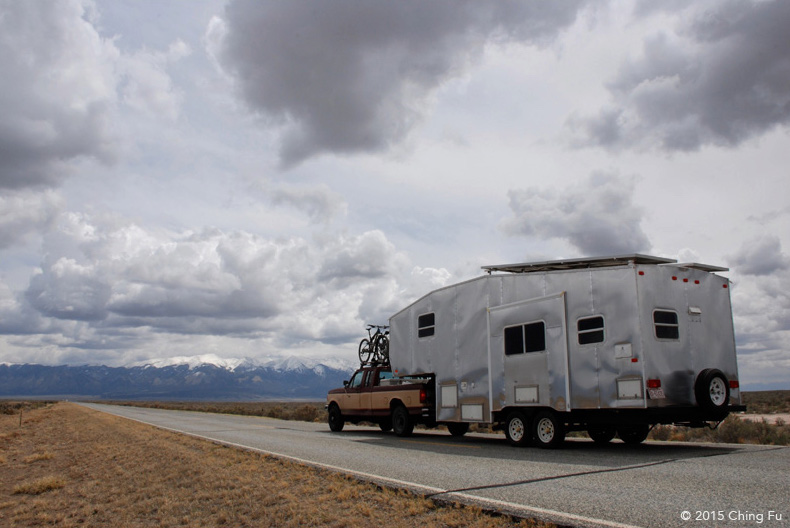
Recent fulltime RVers Ching and Jerud had similar reservations, but ultimately decided an RV was the best type of home to do what they wanted to do: live self-directed, outdoor-centered, low-overhead lives. Today’s guest post by Ching goes into some of their story: why they chose to live in an RV, the ups and downs of the experience and even how they made it work with their environmental sensibilities. Read more about their journey on Live Small Ride Free.

My desire to downsize my life from a 1,200 sq. ft. house to a 200 sq. ft. RV was driven by my love for the great outdoors and need for exploration. Yearly two-week-long vacations always ended in a blink of an eye and I felt time was becoming more and more my enemy. I didn’t want to wake up one day to realize that I was too old, too comfortable and had too many strings attached to live the life I always wanted. And I was tired of reading about other people’s adventures while daydreaming about  mine. It finally hit me that there wasn’t any reason I couldn’t live the way I wanted–traveling fulltime on the road.

Living in an RV wasn’t initially our first choice because of its carbon footprint. Yes, it’s less than living in a standard house, but the irony of traveling to America’s beautiful natural landscapes while burning fossil fuel didn’t escape us. But we realized that an RV actually best fit our needs and that we could further decrease our carbon footprint with some modifications.

livesmallridefree-veg-oil

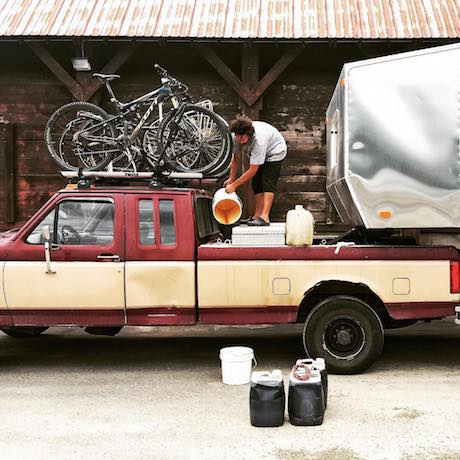
RVs use a mix of electricity and propane to power everything inside them – from running the fridge, heater, stove, and lights, to charging cell phones and laptops. Electricity is generated either by plugging into the grid at an RV park, a diesel generator, or sometimes aftermarket solar panel additions – but propane does the majority of the work, heating the interior, the water, and cooking food. We decided to remove all of our propane appliances, go fossil fuel free and turn our RV into an all-electric rig powered totally by solar panels. On top of that we challenged ourselves even more by converting our truck – our tow vehicle – to run off of waste vegetable oil instead of diesel Sustainability was our other priority next to creating a new life of mobility and freedom.

Our new lifestyle is simpler and happier than before, but it’s also challenging. We didn’t just change the size of our home but how our home functions, which meant there was a lot we had to learn. Also, in our new life we are more aware of how we are living and what we use – I call it conscious living. We know exactly where our electricity, water, and fuel comes from and how much is available to us. Our energy has been diverted to things that are important to us rather than what’s important to society or our employers. In a sense we’ve regained control of our lives and our future, and it feels good, scary and right.

salida

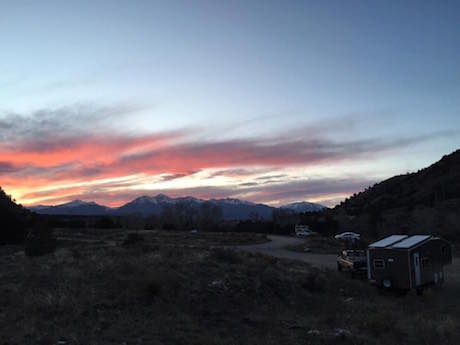
The highs that we’ve had so far during our 9 months on the road: the day we rolled out of our hometown; having our RV that we spent a year rebuilding not instantaneously fall apart as we drove away; waking up to our first snowstorm in Colorado and not running out of electricity on that cold cloudy day; driving from Missoula to Seattle on nothing but waste vegetable oil; pre-dawn hike to watch the sun rise above the Cascade Mountains; racing the sunset while mountain biking in Colorado; and kayaking snow-fed lakes.

But as with all highs, there are lows to balance things out: having our truck’s brakes fail while driving up a mountain; spending three months looking for a replacement truck which halted our travels; dealing with major RV battery issues; being stuck in a truck with an old, incontinent dog with diarrhea; having my touring bike and dog trailer stolen; and the days when we just can’t find available waste vegetable oil.

A big low is our current lack of financial security. We didn’t have career backgrounds that could easily transition to a mobile setting and we chose to leave before securing new jobs. Part of the reason we are able to do this is because the cost of living isn’t very high for us thanks to our RV and truck setup. There are a wide variety of job opportunities for full-time RVers and the RV community is a great resource. We’ve given ourselves a year to figure work out and have had income from a rental property to float us while we adjust to life on the road.

Becoming a full-time RVer didn’t automatically make my life perfect and happy. But being proactive and changing my life to be structured the way I want and living my priorities has created a huge sense of calmness for me.

Live, Work, Haul Lots of Stuff

When our stuff is stationary there’s no reason to get rid of it. The force of gravity can support the biggest mess from the worst hoarder. But when our stuff is put in motion, either supported by the force of our muscles or even the force of an internal combustion engine, we start quickly getting rid of unnecessary stuff in hopes of reducing mass. Locomotion is almost always a catalyst for efficiency. We’ve seen this phenomenon with people who tow their stuff on bike or van or RV. One other demographic that fits into this category is semi truck drivers, many of whom live in their cabs much of the year. While semi trucks can haul countless tons of goods, there is still a necessity to keep things light and compact lest the cab compromise fuel economy or payload. 

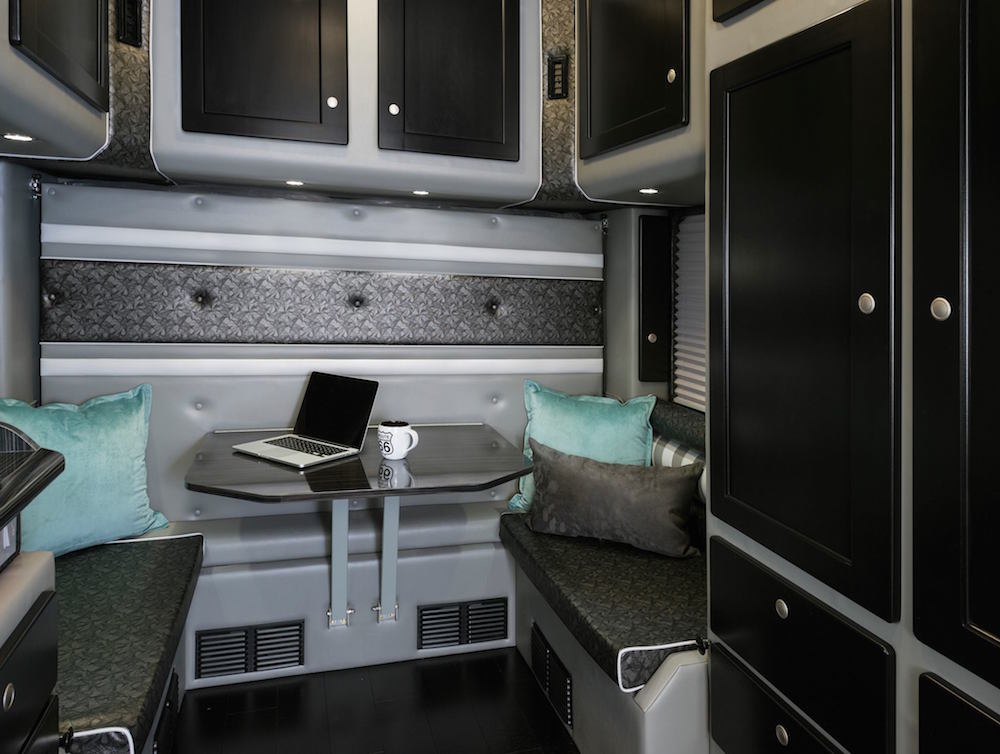
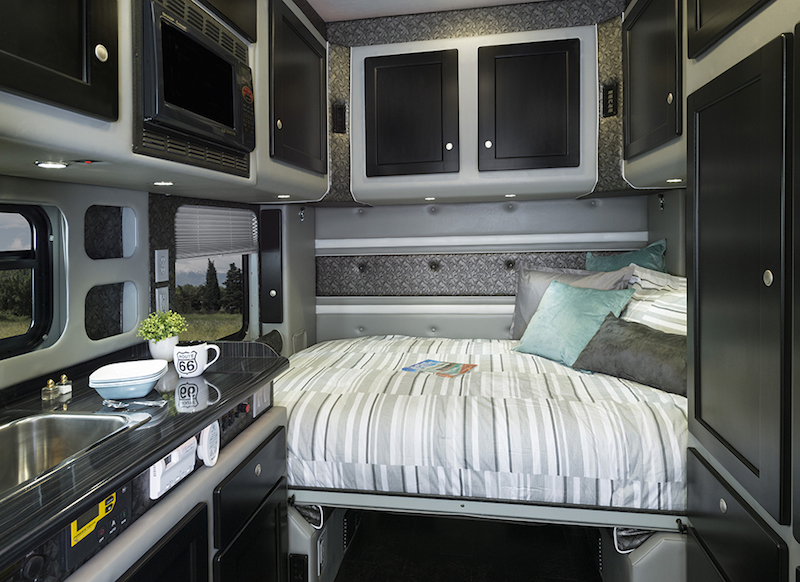
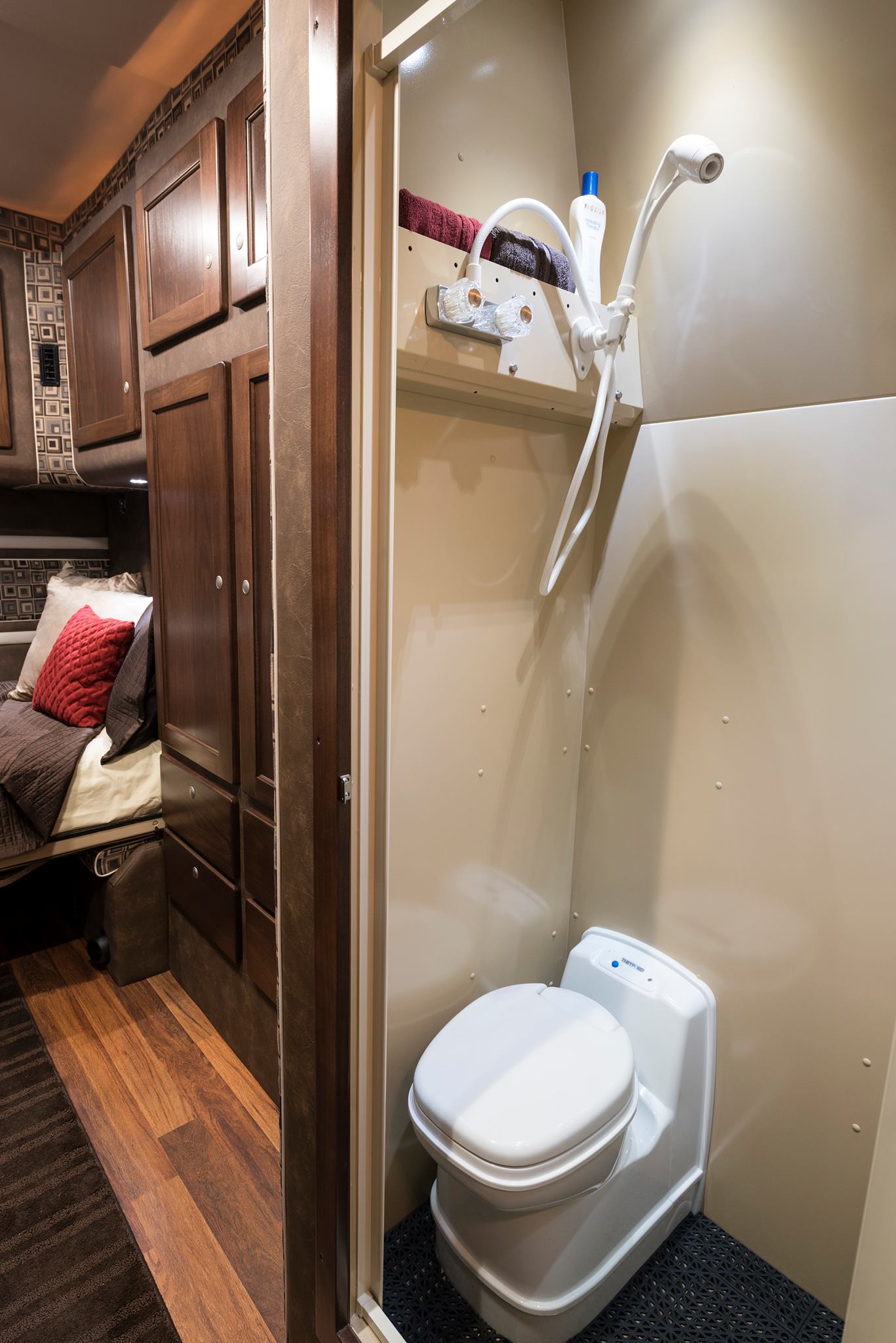
NBC recently profiled a couple companies specializing in making high-end sleeper truck cabs. One company, Bolt Custom Trucks, has packed interiors with kitchens, satellite TV’s and their own bathrooms–they’re essentially mini RV’s affixed to a semi truck. Needless to say, everything is a paragon of efficiency: dining areas become beds, tables fold into walls, there are storage nooks everywhere. But with hardwood floors and quartz countertops on some models, the sleepers have a luxe feel (why you’d choose quartz over a lighter material beats the heck out of me).

Apparently, there’s a huge shortage of qualified truck drivers. When purchased by truck fleets, these sleepers are designed lure and keep drivers in the field. For independent long-haul truckers like Linda and Bob, profiled by NBC, the deluxe trailers allow them to stay out 2-3 times longer since they are not longing for the comforts of home.

If you were to live in one of these trailers, it could make for a pretty edited life: you could live where you work, which is very efficient from both a spatial and financial standpoint; needless to say, possessions would be very few even with a deluxe cab. The only thing that might not be so edited is the fact your job often entails hauling a bunch of crap around the country…someone’s gotta do it I suppose.

H/T J. Marlowe

Breakdowns, Adventure Guaranteed

About a year ago, I wrote about Foster Huntington, a twenty-something who ditched his corporate design career to become a full time van-dwelling nomad. Inspired by Tupac Shakur’s Thug Life tattoo, Huntington created the Instagram hashtag #vanlife–a small act that inspired a movement of light-living, full and part time vandwellers (there are almost 300K Instagram pics with the hashtag).

The Atlantic made this great little documentary that provides a deeper look at the #vanlife subculture. While the doc catches up with Huntington (stationed in his bitchin treehouse), it spends most of the time interviewing Ryan Sellmeyer, aka @poseidonsbeard. Sellmeyer, his wife Christina and their two small children spend months on the road, rendezvousing with folks they meet through the Instagram hashtag #vanagonlife–a subset of the #vanlife community who drive (mostly vintage) VW Vanagons, a vehicle where regular mechanical failure is pretty much assured. Rather than an unfortunate side effect of an otherwise awesome vehicle, the breakdowns seem to be the primary appeal of the vehicle, ensuring none-too-rushed journeys and the ingenuity and camaraderie that are necessary to address said breakdowns.

Sellmeyer and Huntington’s lifestyles are nice counterpoints to the prevailing trends of bigger, faster, more efficient. These folks seem to value languor and connection for connection’s sake. It’s also a nice case where technology facilitates real connection and deeper experiences rather than inhibiting them. Do yourself a favor and spend the 12:34 minutes and watch the documentary.

It’s All About the Benjamin

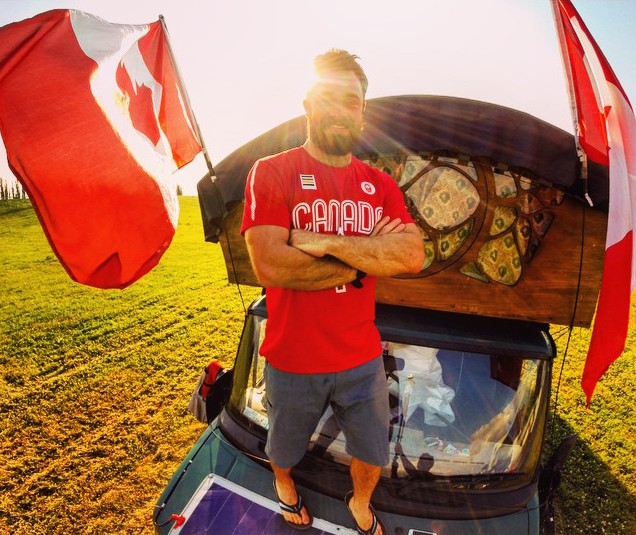
There’s a subject in many of the posts I write about that is present but not always called out by name. The subject is money. Time and again, we read stories about people editing their lives, not just because they want to create a smaller carbon footprint and have less to clean and manage. These are very valid reasons, but let’s face it, most people downsize and simplify because it’s cheaper. When life is cheaper, when the base of Maslow’s hierarchy of needs is satisfied, people are less concerned about making money, leaving them time to think about loftier pursuits than paying the bills. Canadian Ben Hayward is an awesome example of such a downsizer. For the last year, Ben has been living frugally out of his “Hobbit Mobile” traveling around Europe, training and competing to pursue his dream of being an Olympic kayaker.    

Before his current journey, Ben was already an accomplished athlete. He’s ranked Canada’s #1 solo whitewater kayaker; he’s occupied a spot on the national team for the last nine years; and he’s amassed 47 gold medals in national games. Yet he wanted to go even further and compete in the 2016 Olympics in Rio. In order to be better prepared, he realized he had to go live in Europe where the best training opportunities existed.

While the Canadian government offers a small stipend to their team members, it wasn’t enough to pay for the myriad expenses that come along with training and traveling–hotels, food, race entry, coaches, etc. Most people in his position accept that they will go into debt to pursue their dreams–something Ben told me he was willing to accept as well if it came down to it.

DSC04632

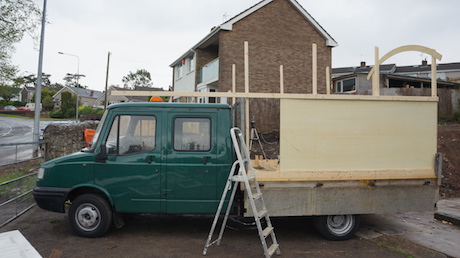
But Ben had another solution. As if his resume weren’t impressive enough for his 25 years, Ben is one year away from completing his architectural undergraduate degree. In thinking about how he could live cheaply in Europe, he conceived an idea to build his own traveling home that could also exploit his architectural chops. With the help of friend Adam, he conceived the Hobbit Mobile, a tiny house on wheels, which would allow him to live simply and frugally while he traveled and trained all across Europe.

Rather than spending his entire $5K nest egg on the van, Ben decided to crowdfund the construction of the Hobbit Mobile. In his “Van Starter” campaign, Ben managed to raise $16K, paying for the van’s entire construction (you can still contribute to his pursuits).

IMG_6030

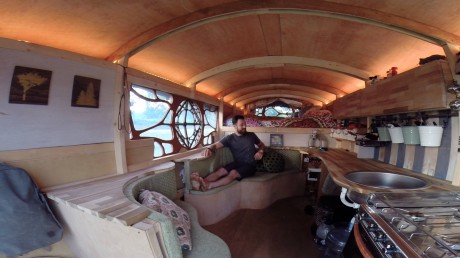
The van is built on a durable commercial vehicle frame and has what Ben called “Wallace and Gromit” (and Shire) style to it. There’s a lounge area, a lofted bed and a kitchen to prepare the 5-6K calories of food he consumes in a given day. With passenger space for six and room for 11 boats (gear is stashed inside the boats), he’s been the occasional taxi and/or hotel for his teammates. The house has solar arrays for power and there’s a copper cauldron for storing water, which also has a heating element at its base for generating hot water. Ben uses the bathrooms that are present at all of the training facilities where he camps.

ben-hayward-interior-2

All of this not only allows him to keep expenses minimal, but it simplifies his life. He said that because he knows where he’s going to eat and sleep, the van affords him a lot of mental space that his teammates who are constantly making room and board arrangements might not enjoy.

Ben told me there are numerous other benefits of living in the van. “In a normal house, it’s so easy to plug stuff into a wall and pay later,” he told me. “It’s been really cool to be self-sufficient and be connected with power useage, prioritizing what I need to use power for.” He also says that he loves spending so much time outside. “Living in a small space makes you go outdoors, which I believe is better for the human psyche. Living in a conventional house, it’s so easy to spend most of your life trapped inside.”

Because his overhead is so low, Ben can make ends meet with his stipend and a few sponsorships. He has strung together some impressive results recently, entering the finals at the World Cup in Spain last week and earning a bronze medal at the Pan-Am Games a month ago. But he’s mostly focused on training for the World Championships, an Olympic qualifying event, that goes down in about a month.

“From an external view, it seems like a poor lifestyle,” he says of the rather spartan way he lives. “But the quality of my life is very high,” he assured me. Though not everyone would choose to live as he does, he believes the downsized, minimal way of life is hardly limited to single, male, Olympic caliber kayakers. By paring down to the necessities, keeping expenses low, spending lots of time outdoors, the life that you would dream of living might not be as far out of reach as we think.

Keep up with Ben on his website and Instagram.

Get Your Life on Track

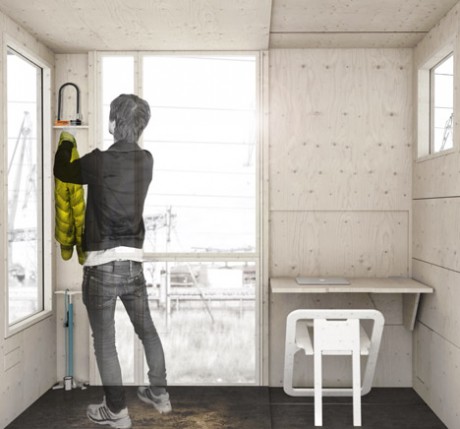
I’ve covered more than my fair share of compact, mobile homes. More often than not, the mobility is expressed on pavement, whether the home is affixed to a bicycle, a truck chassis or being towed around by an automobile. Very rarely–as in never–have I featured homes that move on old shipyard railway tracks. But that’s exactly what I’m doing today with the aptly named “Small House on Tracks” project by Polish architecture students Tomasz Zablotny and Paweł Maszota.

Small-House-on-Tracks_Tomasz-Zablotny-kitchen Small-House-on-Tracks_Tomasz-Zablotny-office

SMoT (my acronym, not theirs) is actually not meant as a universal housing solution, but rather a site-specific one for the Gdańsk Shipyard, a decaying industrial center that the project’s creators want to help revitalize into an artist colony.

Small-House-on-Tracks_Tomasz-Zablotny-bathroom

The “houses” are actually expandable housing units, each fulfilling a different role. The units only measures 5’ W x 6.5 L x 8’ H, all the easier for moving on a truck bed or storing when not needed. They are filled with flat packing furniture that folds into the wall.

Zablotny told Dezeen that they are not necessarily meant for full time residency, but rather to provide “comfortable space[s] for artists, interns, workers or simply those to whom the unique atmosphere of the site would appeal.”

I’m not exactly sure how SMoT would have appeal beyond temporary housing in old, disused industrial complexes–of which there are a few, particularly in Europe and the US, which are no longer manufacturing powerhouses. But I’m a sucker for housing that can be expanded and contracted according to the needs of the day.

See and read more on Dezeen

The Rise of the Minimalist Millionaire

Aside from its inherent space and energy efficiency, compact living–or rather the high density living that often accompanies it–has been credited as being a catalyst for innovation. In his book Triumph of the City, Harvard economist Ed Glaeser found that when a city doubles in size, productivity and innovation per resident increases by 15%. His thesis was that because people are constantly in collision with one another, sharing and expanding ideas, cities make fertile environments for innovation. More specifically, he said the ideal condition for innovation was 100 people per acre. One person who took Glaeser’s idea quite seriously was Zappos.com founder Tony Hsieh. He took it so seriously that a few years ago he helped spur the Downtown Project. With the help of various Glaeser-inspired urban interventions, he sought to transform Las Vegas’ haggard old downtown area into one of the world’s leading innovation centers.

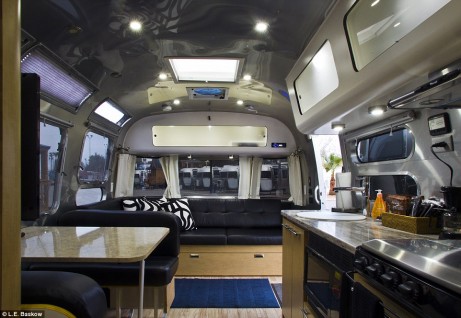
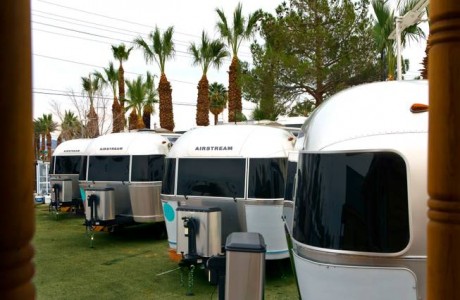
Airstream

One way the Downtown Project went about achieving their 100 person per acre ideal was to convert a vacant lot into an Airstream trailer park, mostly using them as “crash pads” for visiting coders.

No one can accuse Hsieh of lacking conviction in his beliefs. Not only has he put $350M of his own money into the revitalization project, but he is living in one of the thirty trailers–sharing the 200 sq ft space with his pet Alpaca. Like the MacMannis’ Airstream we looked at the other week, Hsieh isn’t exactly slumming it. The trailers are all recently renovated and nicely appointed. Nonetheless, for a man with a net worth of $840M, this is a very modest home. While some could charge him and other people of means as tourists in the realm of small space, minimalist living, I think they are showing something else. The merits of small, simple living are something anyone, rich or poor, can benefit from. Consequently, we are seeing more people who can have all they want choosing to live with what they need.

Photo: L.E. Baskow

Three More for the Road

Many people think about stopping their workaday lives, downsizing and lightening their loads to support more adventure and freedom. But few people go through with it. We always have (valid) excuses. The time is not quite right. We’re on the verge of a promotion and can’t quit or change our jobs now. We have kids and they will not adjust well to change. Etc.

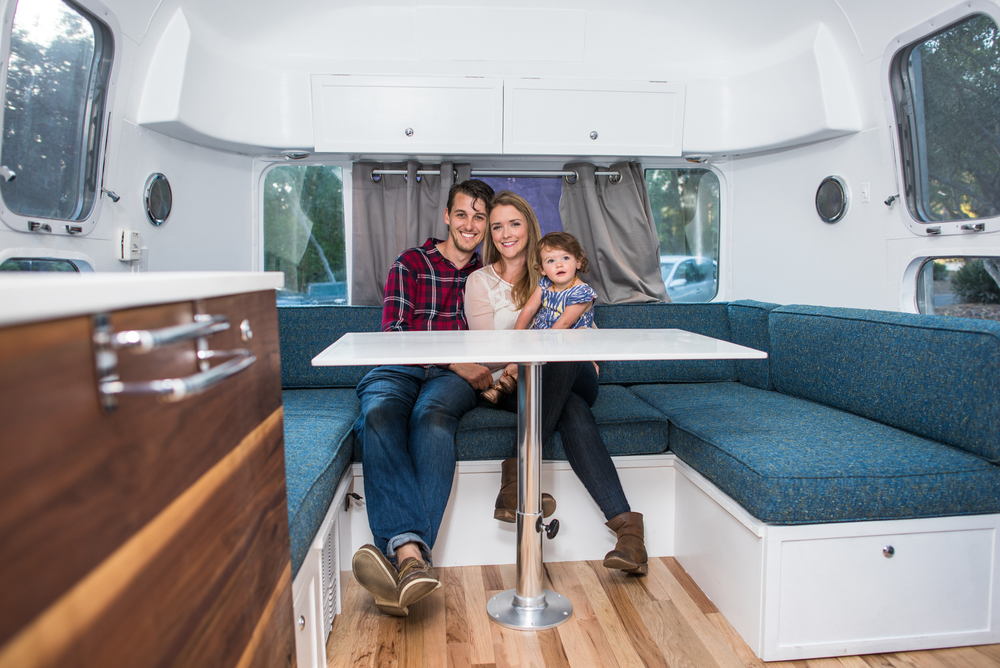
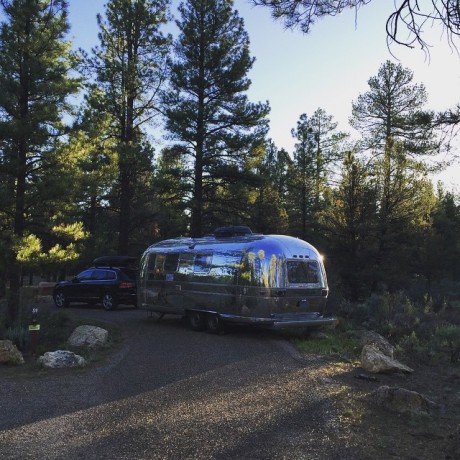
Fortunate for us, the MacMannis family are not thinkers (meant in the best possible way). Like many of us, they found themselves living a great but harried and stressful life, working too much and spending too little time together. Rather than doing more of the same, hoping things would get better, they stomped on their existential brakes. For them, putting on the brakes meant quitting their jobs, moving out of their home, ditching many of their possessions and hitting the road to live out of their 170 sq ft rehabbed 1973 Airstream–embarking on a trip of indeterminate length. We caught up with them to get a brief history of their adventure as well as find out how things are going.

DF: Tell me a bit about yourselves.

Gillian MacMannis: We are the MacMannis family–Gillian, Sean and one year old Avery June. We’ve spent the last 8 years working in technology in San Francisco. We met at work (and fell in love) shortly after moving to the Bay Area.

DF: What was life like before you hit the road?

GM: We had a great–albeit somewhat chaotic–life before we embarked on our journey. An awesome condo in Bernal Heights with a beautiful view of the city, fantastic friends, great jobs. We’ve always felt fortunate for the opportunities we’ve been given and have tried to make the most of them!

DF: What happened that prompted you to travel?

GM: We got to this point at work where we were working 60 hours a week, running around just going from one thing to the next. Being at home wasn’t relaxing or restful. Work was less fulfilling than we were accustomed to. We needed a reset; and thought some time away would help us to get back to what mattered most for our family.
rubberroadabode-airstream

Since we started dating, we have talked about taking time off between jobs to travel. We realized that would never happen naturally, so we got to the point that we thought, “we can keep making excuses about why now is not a good time, or we can just do this now.” We felt like in 30 years we might regret not doing it, but we certainly wouldn’t regret taking a few months to see the country. So we took the leap.

DF: Many people would be freaked out with such a decision. What was the decision like?

GM: Honestly, we had so much to get done before the trip that we didn’t have a lot of time to freak out about the trip itself. Everything from when to quit our jobs to where to put our stuff to how to find a trailer to where we were going. There was certainly a lot to think about, but it was actually one of the most exciting times just thinking through all the possibilities. Once we got into the Airstream renovation though, we definitely felt at times that we were in over our heads. Basically, we realized how much we didn’t know about RVing!

DF: What did you do with your house and stuff?

GM: Most of our belongings are in storage back in the Bay Area, a small fraction of it is with us on the trip and some is living with family members for the time being. We tried to purge things as we packed. The Airstream is only 170 square feet, so we really only had room for the absolute basics.

DF: What was the reaction of family and friends?

GM: All of our friends and family were really excited for us, and actually we were pretty surprised by the lack of negative reactions. We had quite a few friends who said they’d thought about doing the same thing, or who wanted to once they heard our plans! Those who had kids were even more supportive, and could identify with the desire to travel and spend more time with your kids while they are little, though some thought being in such a small space was pretty brave (stupid?).

DF: Tell me a little about your Airstream and your setup in general.

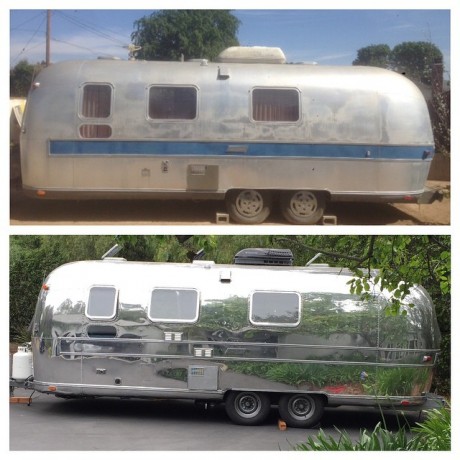
GM: We have a 25’ 1973 Airstream Trade Wind that we completely gutted and rebuilt with Townsend Travel Trailers in Santa Barbara, CA. The original floorplan was a little funky, so we moved the bedroom to the back, created a separate, galley bathroom, and built a convertible dinette in the front kitchen. Knowing we would be living in the trailer full-time, we tried to maximize both storage and floorspace.
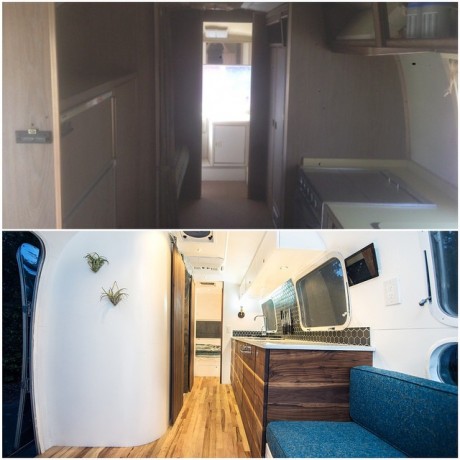
rubberroadabode-airstream-exterior rubberroadabode-interior

DF: When did you leave? How’s it going?

GM: We left our jobs in April and moved to Santa Barbara to manage the rest of the Airstream renovation. We finally hit the road at the end of May, so we’ve been traveling now for about a month. So far it’s going well–we’ve gotten past the point of being complete novices to the RV world, and have racked up over 3500 miles already.

DF: What has been the hardest part of living like this?

GM: The hardest part has been the heat. It’s RV off-season for a reason, and we certainly didn’t make it easier on ourselves by heading south (we had family to see). We really didn’t know anything about RVing before heading out on this trip, so we were hit by a few surprises early on. Now that we are more familiar with the “quirks” of life on the road, we can plan a bit better. For example, we discovered that our refrigerator really doesn’t work well in the 90+ degree heat. So now we make sure we have a cooler of ice on hand and we can switch food items back and forth for days we are on the road.

DF: What has been the best?

GM: The best part has been the flexibility. If it’s too hot, or we feel like there is something else we want to see or do, we can just go ahead and do it. The most interesting and amazing things we have seen have been unplanned.

DF: How long do you intend to be out?

GM: We are leaving our timeline open. We expect to be on the road at least for a few more months, and we’ll decide on the road when we’re ready to start thinking about what’s next.

DF: I realize you haven’t been traveling all that long, but based on your journey so far, what words of wisdom would you give people who might feel trapped in more conventional situations?

MG: Our biggest fear was feeling “trapped” or handcuffed into a situation by overspending or overcommitment. Looking at buying a house in the Bay area and the prospect of taking on a big mortgage with the housing market as crazy as it is in SF was daunting to us and pushed us to think taking this trip wasn’t such a big risk after all. Obviously, shedding everything and moving into a small travel trailer is a bit extreme for most people. But living more mindfully, and thinking about what you bring into your life can really have an immediate impact on your happiness. This trip has really helped us to better understand what we actually need versus what we thought we needed.

Find out more about and follow the MacManisses on their blog rubberroadabode.com and on Instagram.

It’s Your House on a Bike

We feature a number of homes that sit on internal combustion vehicles. Despite what you might think, these homes can be extremely green. First off, standard homes have fuel needs too, from heating hot water heaters to keeping stoves alight to keeping furnaces firing. Stationary homes consume gas, just not for locomotion. More importantly, there’s a dire need for efficiency when you’re moving your home around; everything that isn’t totally needed, whether it’s water for showering or an extra pair of pants, is sacrificed due to very limited space and keeping weight down so your vehicle can keep moving.

But if you’re like me (and I shouldn’t suspect, or hope, that you are) there’s the dream of the nomadic home that doesn’t rely on fossil fuels. In the past, we’ve looked at the Tricycle House as well as the Taku Tanku house–both were bicycle-powered housing options (the former somewhat plausible in its execution, the other not). We can now add a couple more HPNMs (human powered nomadic home…you heard it here first) to the mix.

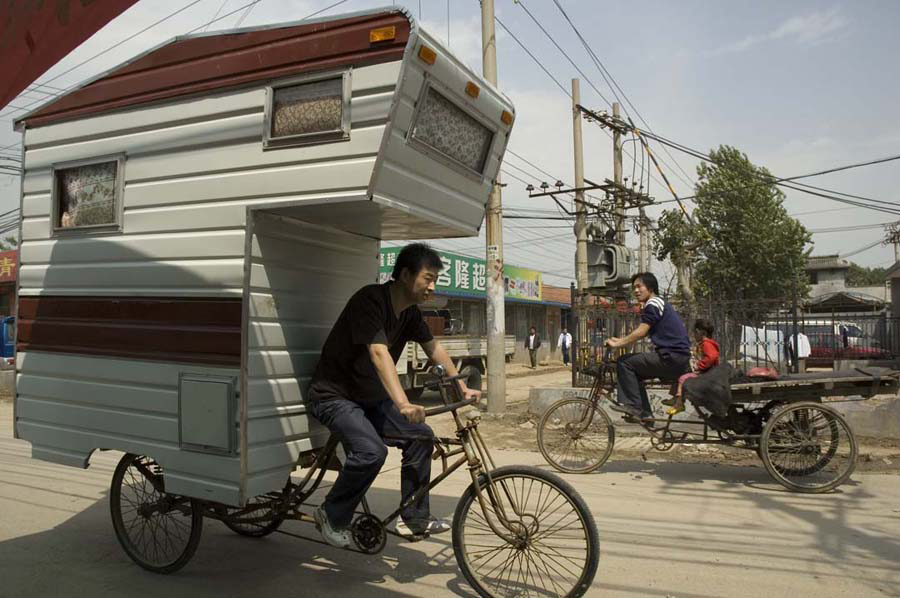
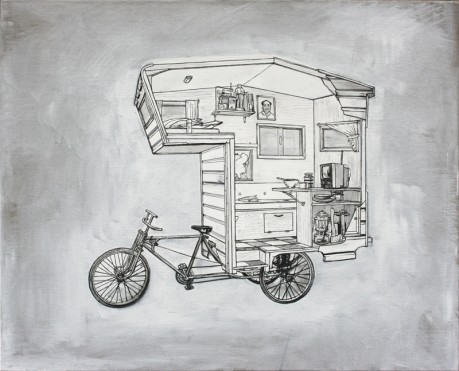
The first is the Camper Bike by artist Kevin Cyr, which resembles a 70s over-cab pickup truck camper. While there are no detailed images of the inside, a sketch shows the over cab portion containing a bed (for a medium sized cat, it appears), a dining table, a TV, some storage and a picture of Mao.

camper-bike-interior

In an interview on Icebike.org, Cyr explains the project:

The idea first came to me while I working in Beijing. I was joking with a friend that the only thing not on the back of bikes in China are houses. I had been seeing people, mostly working class men hauling goods on three wheeled bikes—rickshaws with bamboo flat beds. They were carrying huge loads of foam and plastic for recycling, furniture, and building materials. There were also a lot of food venders at open markets cooking meals on the backs of these bikes, it was very interesting. They seemed to use them in every way imaginable much in the way Americans use pick-up trucks.

He built the Camper Bike, which he describes as a sculpture, over the course of three trips over three years.

Cyr made few concessions to practicality. He used an old, rickety government issue bike as the camper’s host vehicle. The camper is mounted on a wood frame, which is significantly heavier than an aluminum or composite one–Cyr suspects the whole thing weighs a very portly 200 kgs (440 lbs). Cyr said when he climbs up to the bed area, the camper sways and feels as though it’ll fall over. He says if he were to make it again, that’d he rectify these design flaws.

WPC

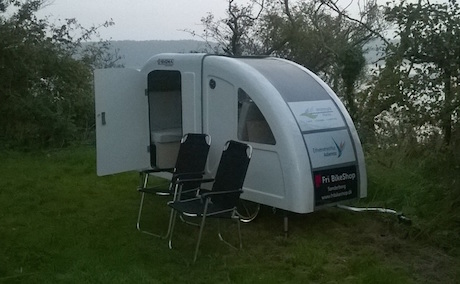
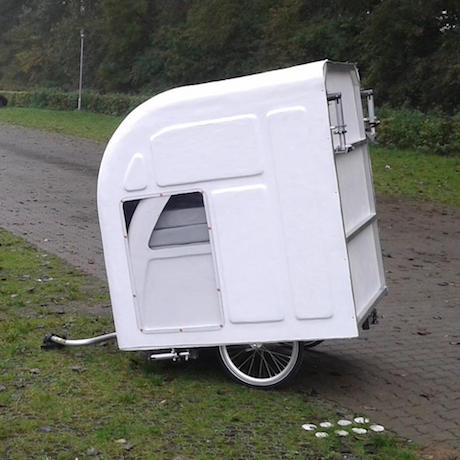
Rectification of those issues is what Dane Mads Johansen has done with his Wide Path Camper (Johansen said he was inspired by Cyr’s project). Unlike the Camper Bike, the WPC is a trailer, so you can choose which bike you want to affix it to. It also uses lightweight materials keeping weight down to a very reasonable 45 kgs (100 lbs). The camper, which has two sections that nest on top of each other when being towed, features a seating area that converts to a bed and offers around 11 cubic feet of storage (a little less than the trunk of a Honda Civic).

WPC-folded WPC-interior

Unlike every other bike-camper we’ve seen, the WPC is not vaporware. Johansen is taking pre-orders and expects to start delivering next month. The basic camper sells for €2000 ($2200 USD) and there are a number of available upgrades like a €600 solar package.

Some of you might be thinking, “Why not just load panniers or a trailer with camping gear, achieve the same result as the camper and save money and weight.” This is a nice idea, but belies the hard truths of bike touring, which often includes inclement weather and a deep desire for comfort at the end of a long day of biking (I’ve bike toured the world extensively including riding 1.5 times across US, so I feel I can speak on the matter with some authority).

At 100 lbs without gear, the WPC is still pretty heavy (my cross-country rig weighed a little over 50 lbs with full camping gear), so I think its best application is limited geography tours or a quasi-living situations–i.e. setting up at a campground or in someone’s yard where there’s access to a toilet and running water. However you use it, it’s a very cool piece of gear.

Many thanks to Mads for the tips!

Life is Either a Great Adventure or…You Know

When’s the last time you had a good adventure? Seen new places, met new people, encountered new situations? For some, it might be a recent occurrence, but the rest of us are clearing out the cobwebs of our minds to recall an answer. Now imagine a life where adventure was a given–where your life was a succession of new experiences, new people, all punctuated by rewarding work. This latter life is the one William Thomson and his family appear to be living. This last March, the family of three put their lives in a camper van to tour the British coastline, running a business that makes special tidal flow charts for coastlines around the world.

The journey actually began with the charts, which were inspired by the misunderstandings that his parents and many others have about how tides work. Thomson told me, “My parents were paranoid the tide would drag us out to sea. My training with the RNLI [Royal National Lifeboat Institution, where he had previously volunteered] taught me this is not true: instead the tide will take you along the coast.” He wanted to create an alternative to the complicated nautical charts and tidal stream atlases that were the main educational resources available.

tidal-compass

An architectural graduate, Thomson set about using his skills in design and the presentation of information to create simple images that convey tidal data, providing sea safety knowledge for swimmers, sailors, kayakers, paddle boarders, wind and kite surfers and scuba-divers.

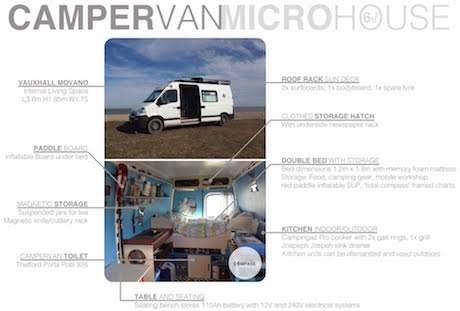
Thomson had already made about 75 charts for various British locales when the idea occurred to him that he could visits the locations, selling the charts along the way. The remainder of the business he could run off his laptop and a wifi hotspot. The family sold their 1986 Land Rover Defender 90 and picked up a 2006 Vauxhall Movano van, spending a couple months converting its six meter interior into a livable space for his girlfriend, their six month old daughter and their water spaniel Alfie.

tidal-can

Thomson reports that life is not all fun and games–though it is largely fun and games. In one blog post, Thomson goes through a typical day, which involves around three hours of work in the morning. After work, there’s about six hours of hanging out outside–fishing, surfing, paddleboarding and the like–followed by another three hours of family time. Thomson also has a night shift after the baby is asleep.

Life does present some challenges, though none bigger than more conventional living situations. Until a recent addition of a water meter, they kept running out of water. Following the meter, they were better able to track and conserve, allowing the four of them to live on a scant 10 liters of water a day (the average American uses around 300-380 liters/day). They refill their 70 liter tank at their once-a-week paid campground visits.

tidal-baby

William also told me their particular situation has a number of logistical considerations: “Finding somewhere to park where I have wifi to work, where we can wild camp without annoying someone, somewhere we can walk the dog, get into town to visit the galleries, and then find time to have some fun (surfing, swimming, paddle boarding). It does feel like a juggling act.” But overall he says he loves living simply in their camping style and consuming very few resources.

Thomson told us that they plan to keep on going until their daughter reaches school age, which isn’t for another four years. They have plans to chart the coasts Scandinavia, the US, Canada, New Zealand and Australia, and hope to visit/live in some of these places before settling down (at least for the school year. He sees summers spent on the road).

And if you’re wondering, like I was, what they’ll do when the weather turns cold, Thomson said they plan to head to Portugal, where the winters are mild.

Thomson said there are many benefits to their situations, “We’re outdoors all the time, we’re not wasting money on rent, our micro house is light, airy, with everything we need and nothing we don’t, the view from my design studio is always awesome and always changing, we’re visiting new places every day which is very exciting and the business is thriving!”

Check out more at Tidalcompass.com