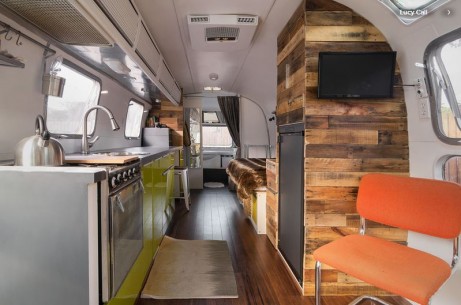
Few things initiate personal transformation like a good old fashion emotional crisis. And if we are to look at the experience of Jordan Menzel, there are few better vehicles for delivering that transformation than 1976 Airstream Ambassadors. When Menzel found himself in a place of personal turmoil and transition, having lost trust in his ability to bring ideas into reality, it was the 29’ aluminum-hulled trailer that made him regain a sense of self. He had seen his future trailer while biking around his Salt Lake City hometown. He searched Craigslist for all Airstreams and found that the one he had seen was for sale. Short on funds, he was only able to offer $4K–a third the asking price. He got it.
He proceeded to gut the Airstream as nothing had been changed from its 1976 birth. The end product is pretty amazing, with an eclectic yet polished style that belies Menzel’s limited funds.
Menzel told Houzz that the process of renovating it “was a symbolic gesture to myself that I still had the capacity to take on a wild idea and bring it to life.” Menzel now lives in the gorgeous trailer with his two year old daughter. Great tiny home. Great story. See more images and details on Houzz.
A recent NY Times article centered around Montauk Shores, a mobile home park on the far east end of Long Island, NY. Whereas many mobile home parks are paragons of low-cost living, Montauk Shores, with its prime location in the Hamptons, on a bluff overlooking the Atlantic, has 2K sq ft trailer lots fetching as much as $1.1M. These kind of sums are not unprecedented for mobile home lots. Paradise Cove in Malibu is a celebrity-studded mobile home park where homes and their lots frequently sell for north of a million dollars.
These stereotype-defying sums for sheet-metal-sided mobile homes seem to evidence the adage “location, location, location.” But there might be something more to the charms to mobile home park living than proximity to the beach. In every account of Montauk Shores and Paradise Cove, there is talk about community. The Times says of Montauk Shores, “Everybody knows everybody through barbecues and drinks on the decks, the children roam the dunes and ride bikes unsupervised, and the beach is a few steps away.” At Paradise Cove, Director Tom Shadyac reports that it takes 20 minutes to take his trash out because he’s always chatting with neighbors. The reason for these tight communities may be more than idyllic settings (though that is surely one reason). The tight community connections may be related to the tight-knit, human-friendly zoning mobile home parks enjoy.
In many ways, mobile home park zoning and architecture gets right what conventional zoning and architecture does not. Rather than separating people like traditional suburban zoning does, mobile homes bring people together. Rather than having arbitrary minimum building sizes like many suburban homes, mobile homes allow for compact–not tiny–and efficient architecture.
We were tipped off recently to a story by Charlie Gardner in the Old Urbanist blog that demonstrate the potential for creating high-density, human-friendly housing via mobile home parks. Gardner takes a mobile home park in Bradenton, Florida as an example.
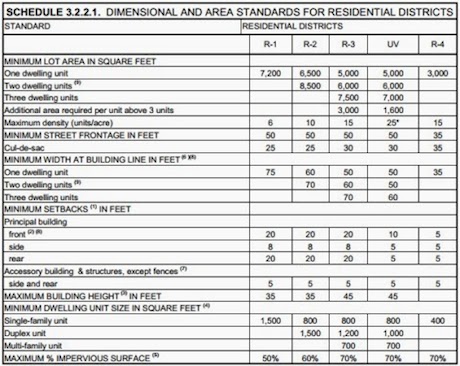
The chart above shows the respective zoning requirements for R-1 (single-family house), R-2 (two-family), R-3 (multi-family), R-4 (mobile home) and UV (Urban Village, a seldom-used designation). Gardner spells out the implications of this nicely:
Note that in the mobile home district, minimum lot sizes are less than half that required in the single-family district, even though both only permit single-family homes! The comparative minimum dwelling sizes are a strikingly divergent 1,500 sq. ft. and 400 sq. ft. The mobile home zone is allowed to be built so densely, in fact, that its maximum permitted units/acre is equivalent to the multifamily zone. Not shown here are the parking tables, which require only one space for mobile homes, yet two for single-family homes, regardless of square footage.
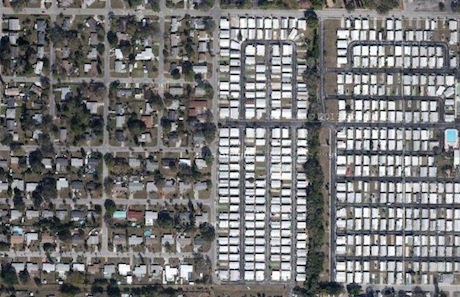
Also worth noting are the respective setback distances. A setback is the required distance from home to its lot’s border, and it’s a prime culprit of creating sprawl. Single family homes require 20′ of setback in both front and back; for mobile homes it’s 5′. The image below shows an aerial view of R-1 and R-4 neighborhoods and illustrates how the minimal setbacks and lot size affect overall density.
Gardner explains that one of the reasons mobile home parks enjoy this type of flexible zoning is their history as a more transient form of housing. Gardner speculates that regulators saw mobile home sites “more as parking lots than as a formal arrangement of streets and building lots,” and thus didn’t impose all of the restrictions they did for site-built, single-family housing.
One hurdle of the mobile home park is architectural. Mobile homes have standard dimensions; single-wides are 18′ (5.5 m) or less in width and 90′ (27 m) or less. R-4 zoning is designed around these dimensions and parks like the one Bradenton are required to use mobile homes rather than site-built housing. Mobile homes are historically poorer quality than site-built housing. This author actually lived in a mobile home for a couple years and the house itself was pretty flimsy in all the ways you would guess. The ability to put site-built or sophisticated mobile home architecture in mobile home parks would be a huge step toward creating sensible, detached, single-family housing.
While mobile home parks are not a panacea for the world’s housing woes, they do present one compelling model for the future, where housing is built sensibly and with community formation in mind. These are both good things. It’s probably about time conventional architecture and zoning starts veering away from constructing figurative castles with their large moats.
Maybe it’s the cooling temperatures, or the fact this author has been hanging out at home too much as of late, but there’s been a ton of talk about nomadic living on this site as of late. Last week, we looked at Foster Huntington, a full-time-camper-pickup-living-nomad and bon vivant. While I definitely dig his lightweight setup, one question has always troubled me about his and all petrol-fueled mobile living arrangements: what do you do in the event of a complete societal meltdown? Really, when SHTF, it’s going to be tough to move your ICE-powered home to more favorable environs if gas costs $20/gallon or is simply unavailable. (C’mon, I can’t be the only one thinking these things).
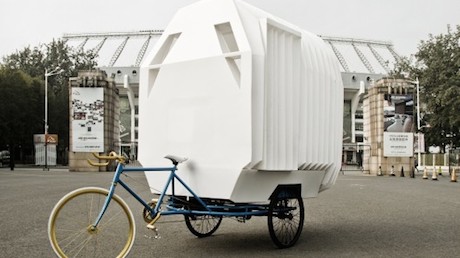
Resilient nomad housing would have to have minimal grid-dependence, which is why we dig the Taku Tanku concept by Japanese design firm Stereotank so much. It’s a trailer that’s minimal enough to be towed by foot or bicycle. If we were ever to face a Mad Max dystopian reality, we’d want this as our home way more than some 454 V8-powered behemoth.
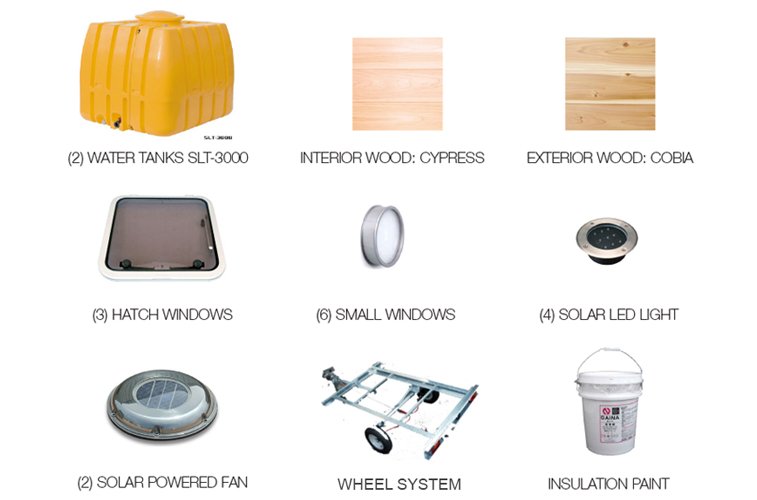
The Taku Tanku is designed to sleep 2-3 people and carry a bit of luggage. It can be made of lightweight, off-the-shelf materials; its main structure being two 3K liter water tanks. There’s really not that much more to it.
This is not the first time we’ve seen human-powered nomadic housing. The Tricycle House, was, as the name implies, a house affixed to a tricycle. Unlike Taku Tanku, a Tricycle House was built. Each house has its merits. We suspect the Tricycle House’s flexible folding, accordion structure, while lightweight, might not be as durable at Taku Tanku’s. The Tricycle House is smart because it’s designed to be used in tandem with a trike-powered garden, making sure you can tow your food source in case things get nasty. If S really did HTF, it’d be good to work through these important considerations ahead of time…just saying.
Days after Hurricane Katrina, Michael McDaniel was grabbing a cup of coffee. Pondering how to build a better shelter for the countless displaced citizens, he had an idea: why not make a shelter that could be stacked and assembled like a coffee cup? Several years later, the Exo shelter was born.
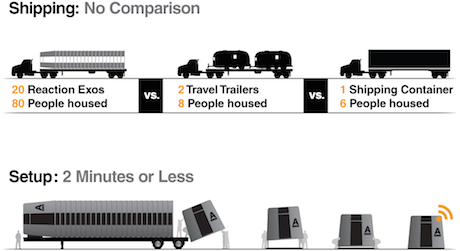
Exo is actually like an inverted coffee cup, where the “cup” is the roof and walls and the lid is the floor. The cups can stack super efficiently: 20 on a truck bed; compare that to two trailers or one shipping container home. The lightweight structure can be lifted by four people and set up in less than two minutes.
The only type of shelter that can match its portability is a tent. Unlike tents, the Exo is constructed with aircraft-grade aluminum and insulated composite panels, which gives it the durability and weather-resistance to make it both reusable and reasonably comfortable. The Exo is lockable, a critical feature where safety is an issue. And it is set up to accept electric, heat, air conditioning and online connectivity.
Perhaps most important for the NGOs who are the Exo’s most probable customer, the $5000 shelters are 1/4 the cost of a FEMA trailer and 1/3 the cost of modified shipping containers.
And please forgive us if this sounds a bit shallow, but we imagine the Exo could be a pretty cool vacation dwelling–like a tent you can climate control and leave up year round.
Exo’s is ramping up production through a crowdfunding campaign on Indiegogo. They have already surpassed a $50K goal by $20K, but we’re sure extra contributions are welcome. Find more info on their campaign page.
To borrow the catchphrase of politician Jimmy McMillan, New York City’s rents are too damn high. As of last November, the median rent for Manhattan was $3100. Want to slum it in Brooklyn? That number drops to a measly $2800. Living in the city for many who don’t work in finance (and some that do) means getting creative with housing. For New Yorker Steven Cintron and his pit bull Bruno, creativity came in the form of a 1996 Gulf Stream Ultra RV he picked up off Craigslist for $5000. He parks it on the streets of the Park Slope neighborhood he grew up in.
The LA Times reported on Cintron and fellow New York RVer Rick Hall last November. The two opted to go mobile rather than pay the city’s outrageous rents.
According to the article, this lifestyle is hardly Kerouacian good times. They report:
Getting electricity takes some effort. Heating during the winter can get costly. Mail may need to be delivered to relatives’ places or post office boxes. There’s also the issue of how to hook up sewage lines.
There are also social costs. Hall reports that “the ladies aren’t really kicking down the door” (though we imagine the flimsy RV doors would be easy to kick down if prospective partners wanted to).
We have mixed feelings about Cintron and Hall’s situation. On the one hand, it’s a bummer that an increasing large number of New Yorkers (not to mention residents of other major cities like San Fran and Boston) simply can’t afford to live in the city they choose. On the other hand, necessity is the mother of invention. We’ve looked at other ways of converting parking spaces to housing in the past. We also saw the Boneyard Studios, that brought trailer mounted tiny houses–structures that are often plopped in the middle of the woods–to the city of Washington DC. From this New Yorker’s perspective, assuming the city could provide/permit some sort of utility infrastructure for mobile homes, I would rather have our limited parking spaces used for housing people than cars.
What do you think? Is this a sad commentary or innovative, high-density housing?
We’ve covered a number of mobile homes here on LifeEdited, and we must confess a little judgment about this mode of living transport. While their interiors are always paragons of efficiency and clever design, their dependence on fossil fuels and association with the somewhat reviled car tend to diminish their edited cred.
This judgment is pretty misplaced. The fact is almost every home uses fossil fuel for electricity, heating, etc. And while we can’t say this for sure, we suspect the inefficiencies inherent in most stationary homes far outweigh the overall inefficiency of a chassis-mounted home. Mobile home dwellers don’t take long showers, leave lights on any longer than they are used or have any extraneous bit of stuff.
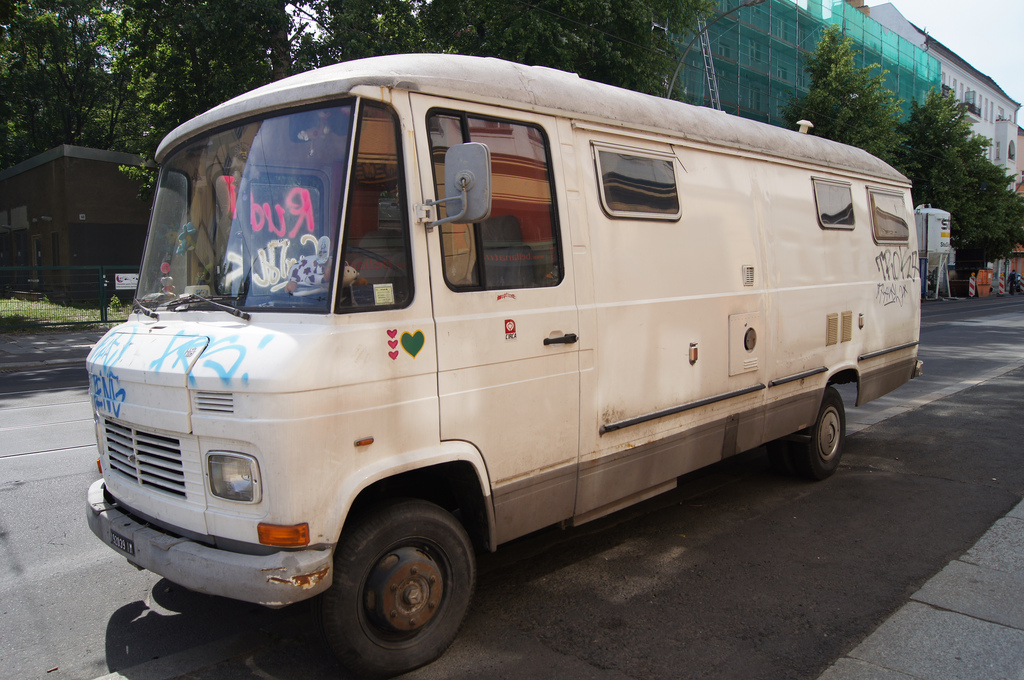
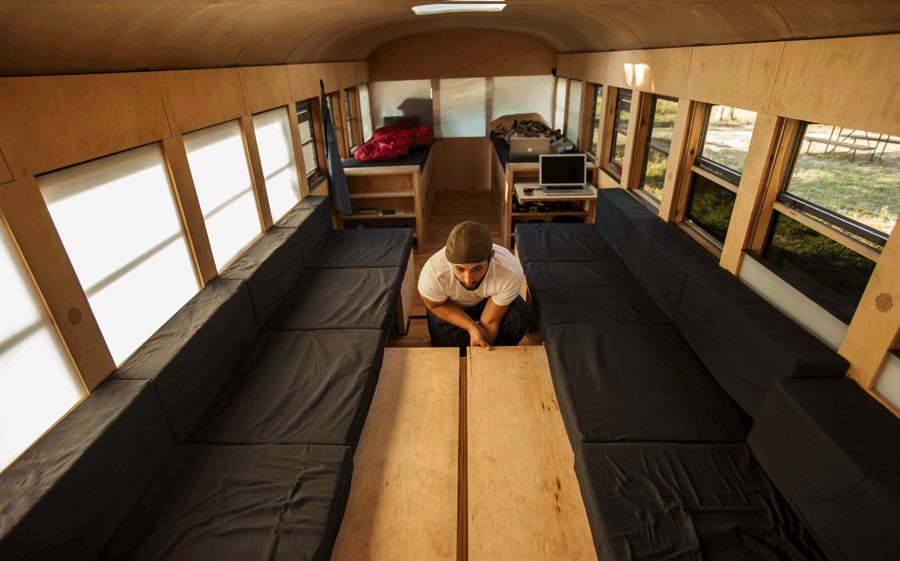
All this is a longwinded intro for one very cool bus-based home built by a guy named Hank. The bus was actually Hank’s Master’s project. Wanting a project that was more applied than theoretical, Hank bought the bus on Craigslist for $3000. Over the course of 15 weeks, he and his brother Vince constructed the bus’s interior. Material costs were $9000.
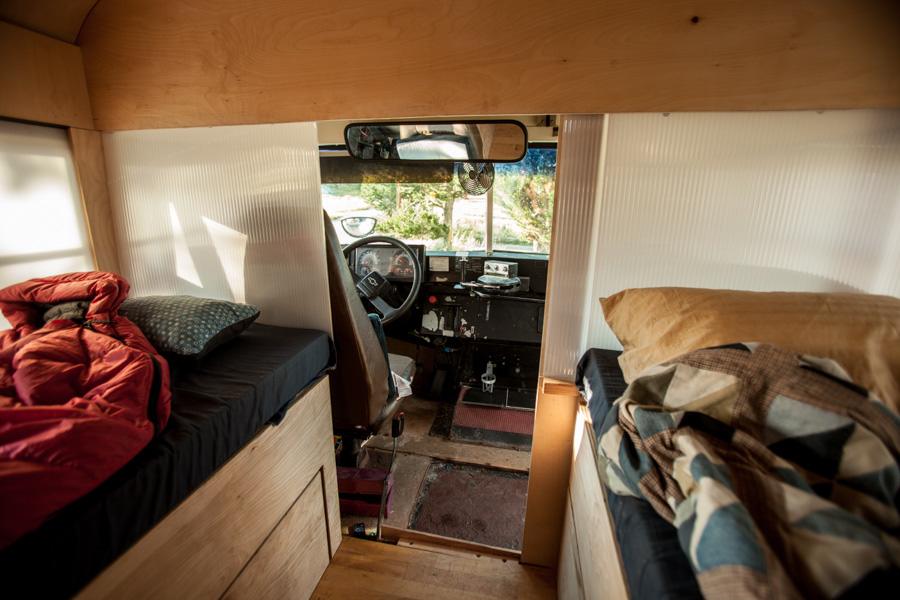
Unlike the other bus home we looked at a while back, Hank’s rig has an architectural feel. Its bent plywood ceiling and reclaimed gym flooring give it a cohesive look. Unlike the other home, Hank’s bus isn’t a fully functioning home, though he is living on the bus during a month long road trip that he chronicles on his blog.
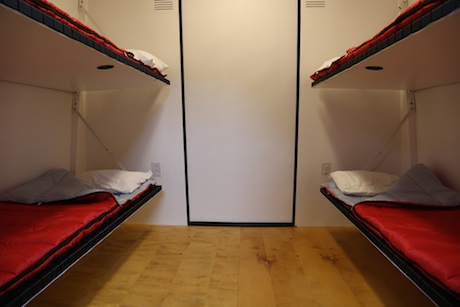
The bus has a kitchen, a non-plumbed bathroom, a couple work stations, a removable dining table and modular furniture with built-in storage that can sleep up to six depending on how pieces are arranged.
We applaud Hank’s design. Even though most of us might not need or want to live life on the road, the project demonstrates a level of DIY small space design innovation applicable to any home.
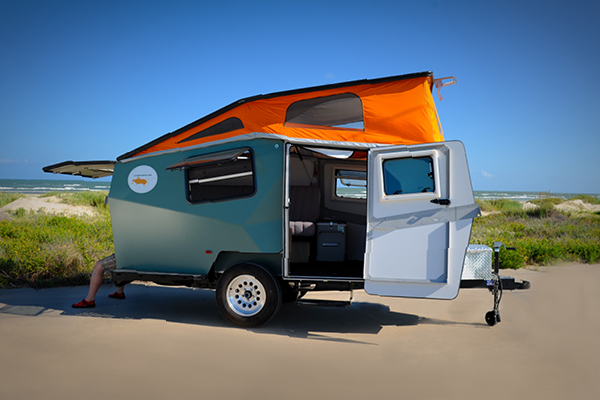
Shipbuilders might know a thing or two about optimizing tiny spaces, but their skills pale in comparison to those of spacecraft engineers. There isn’t any other type of mobile home where space is so important (pun intended). When your odometer registers in tens-of-thousands of miles, carrying even a square millimeter of extraneous volume makes a big difference in efficiency. It’s with that sense of lean design that Garrett Finney designed the Cricket Trailer.
Before designing the Cricket, Finney worked as an architect and designer for NASA, working on their habitation modules–the place where astronauts live, bathe, sleep and eat. In other words, he was a “space” architect. The Cricket’s stripped down interior, replete with lots of machined aluminum, shows vestiges of Finney’s aerospace roots.
The $17K Cricket has all the basic features of a traditional small trailer including a indoor/outdoor shower, toilet, queen size bed that doubles as banquette seating and a cooking area (custom options are available). The Cricket does not, however, include a HAL computer.
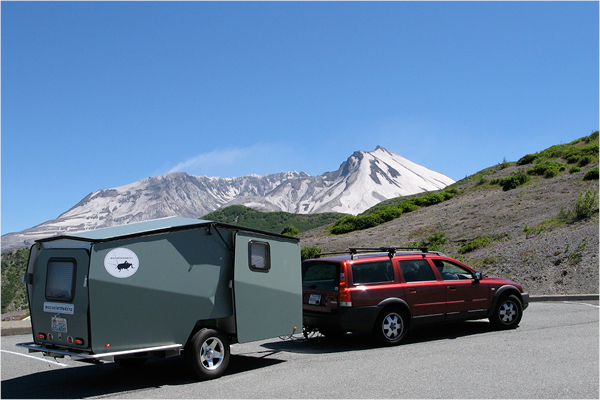
Where Finney’s aerospace background really shines through is the Cricket’s weight. At a mere 1300 lbs, it doesn’t require a special vehicle to tow it the way many trailers do.
Finney explains on his site that he was an avid backpacker, but having children made that endeavor much more difficult. The Cricket Trailer was his solution for creating family-friendly adventure without the logistical issues. And while having a trailer might seem like a big piece of stuff, consider it could effectively be a family’s vacation home. The fact that it uses a normal car and could be shared with another family could make it one worthwhile piece of stuff.
This video from Fair Companies takes an extensive tour of Richard and Rachel’s school bus home. Unlike René Agredano and Jim Nelson’s mobile living we looked at yesterday, this project is decidedly DIY; most evidenced by the decapitated VW Vanagon that makes up the top 2 stories. Just like the latter couple, Richard and Rachel tout the advantages of living mortgage-free as one of their principle motivations for living this way.
They also liken the project, which has taken them about 6 years so far, to the cardboard forts kids make. They fabricated most of their furniture and even included things like a projection “room” on the second floor. They claim there’s a level of connection and imagination that comes from a hand-built home not usually found when you buy something already built.
There seem to be some concessions to this hacker home, e.g. no plumbing; they use grey water to shower and wash their dishes every few days. They also don’t have RV status, which I suspect is why they didn’t specify their last names or location (though the bay they look upon looks suspiciously like San Francisco Bay).
The upsides they report are many. The have a minimal carbon footprint, using a composting toilet, solar power and even a solar-powered fridge. The bus only cost $12K to build, including a $1200 fridge. They live debt free with only $100/month living expenses. And they enjoy freedom that comes from not living to pay for their lifestyle. This is a common theme from yesterday’s couple and the Tiny House Family we looked at last week.
Do you think you could live on the road like either one of these couples? Have you? What was your experience? Is this something that can be done for longer than 6 years or is this more of a phase? Could a family live like this? Is a mortgage inherently a bad thing? We’d love to hear what you think in our comments section.
Last week, we showed a family living an edited rural life, showing that densely-packed, tiny-apartmented cities aren’t the only environments that support pared-down living. We ran across another version of this way of life that is neither urban, suburban, rural or any of the above: it’s mobile.
images via liveworkdream.com
In 2007, René Agredano and Jim Nelson, inspired by their dog’s diagnosis of bone cancer, quit their corporate jobs, sold their home and most of their possessions, bought a truck and an RV trailer and hit the road with Jerry, their sick doggy to evaluate their lives. After realizing they could support themselves from the road through a combination of online businesses, freelance work and some labor, the trip, meant as a sabbatical, became a lifestyle. They have been going at it for 5+ years with no plan to stop.
We shot René a few questions via email regarding their lifestyle–asking about things like the pros/cons of RV living, their carbon footprint and what landlubbers might learn from their perambulating lifestyle.
LE: What is the best part of your lifestyle?
René Agredano: We can sum up the best part of our lifestyle in one word: Freedom. We have the freedom to live as we wish, work where we want and when we want. Being location independent entrepreneurs gives us the flexibility to go where the weather’s nice and experience all that this great big world has to offer, without sacrificing our need to earn an income.
LE: What is the worst part?
RA: Dealing with the unexpected. When you’re stationery, life is broken up into a series of predictable routines that rarely vary. But when your scenery changes throughout the year, unexpected challenges are always around the corner and there’s a big learning curve in discovering how to cope with them.
Unexpected events ranging from mechanical failures with your rig, to severe weather situations you’ve never experienced before, to something as simple as navigating your way through a new grocery store layout. All of these things challenge your ability to think on your feet and be positive while encountering the unknown.
LE: Can you say something about rising gas prices?
RA: We’re glad we have a diesel pickup and a relatively small fifth wheel trailer (24′ feet), which helps to keep our fuel bill down. And as fuel prices go up, our lifestyle gives us the ability to choose how much or how little we want to drive, unlike people who are tied down by a daily commute or suburban lifestyle.
Rising prices used to scare us, and they really hurt at the pump when we have to swipe our debit card twice! But since we’ve carefully track all of our expenses over the last 5 years, we’ve discovered that on average, we spend less than $400 a month on fuel, which probably less than what the average commuter spends driving to and from work each month.
Also, while we might travel longer distances in one shot while getting from Point A to Point B, we still drive much less frequently than most people. Once we’re in one location, we do little driving other than to the grocery store or sightseeing because we work from our rig.
LE: How do you view the issue of sustainability and your lifestyle? We saw on your blog that something about using bio-diesel. Can you say more about that?
RA: We’re from Northern California, where being an environmentalist is the de facto way of life. Before we started traveling, we were avid backpackers. Whenever we saw a big RV hauling down Highway 101, we would scoff and think “gas hog!” But now that we became one of them, we’ve realized that’s not the case for fulltimers anyhow. If someone is full-timing in their RV, even the biggest 40′ rigs have a smaller carbon footprint than the traditional lifestyle of living in a house or even a small apartment.
For example, as RVers who choose to boondock (forego standard electric, water and sewer hookups) most of the time, we are living off-grid in remote areas with solar power and satellite internet service. By not staying in RV parks unless the weather is exceptionally cold or hot, we’re not consuming a whole lot of resources. Also, we don’t consume stuff on the same level as most people, because with less space we just can’t stock up or buy things on a regular basis. We live in about 100 square feet! Whenever anything new comes into the rig, something has to go to make it fit.
One of the reasons we bought our Dodge Ram diesel pickup, was so that we could make and run biodiesel in it (a mix of veggie & diesel), or eventually convert it to run on waste vegetable oil (WVO). But the practicalities of making our own fuel have eluded us, and these days, finding anyone selling biodiesel is like a needle in a haystack. The industry has just tanked because of the bad rap the palm oil industry has received (there is debate about the ethics of harvesting these trees for fuel instead of using that land for food) and it’s really sad to see. We’re still petroleum-slaves, I hate it.
LE: Do you have a storage unit or did you really get rid of everything that couldn’t fit in you trailer?
RA: When we first hit the road, the plan was to do it for one year, then settle down and get back to “the real world” again. We sold off most of what we owned but kept got a small storage unit for things we didn’t want to have to re-purchase, like basic furniture, as well as some sentimental things. Well, one year turned into two and when we finally returned to that storage unit, we saw that we didn’t get rid of as much stuff as we thought we did. It was scary to realize that our mindset about downsizing was so different when we first hit the road. After living in a tiny space for two consecutive years, now we realize how very little we need to be happy, and it comes down to less than 1/4 of what we left in that unit!
One of our lifetime goals was to own some property, so today we own a very nice paid-for RV site on 5 acres in the Colorado Rockies. It also happens to come with a guest cabin for our visiting friends! But the cabin is off-line and not using any resources for about 10 out of 12 months. We only go there occasionally, since we still love traveling too much.
LE: How long do you plan to continue?
RA: Indefinitely! We’re having too much fun to even think about hanging up our keys.
LE: Any living strategies you can lend the non-mobile?
RA: Yes! Whether you enjoy life on the road or in a stick house, the key to living simply and being happy is to remain debt free. Living unburdened by monthly payments allows you so much more freedom. You can enjoy life to the fullest, be prepared for unexpected expenses and not live in fear of losing your job because you have so many bills to pay. Ever since we became debt free, we aren’t working just to pay bills…we have more time to to pursue our hobbies and interests that may not pay a lot of money, but make us fulfilled, like the Tripawds.com community we founded for canine amputees and their humans!
But when it comes down to it, as Dave Ramsey says, debt is a symptom of insufficient income. We have learned that the best solution to staying financially solvent and able to pursue our passions is to diversify our revenue streams and focus on earning passive, ongoing income. Instead of relying one one business for all of our earnings, we have several different endeavors that each bring in revenue streams each month. Cumulatively they all add up and we’ll never go back to a traditional small business structure again. We believe this is one of the best ways to protect ourselves against economic catastrophe, so now our mission is to help others do the same, through our remote home-based business ebook (www.bit.ly/incomeanywhere) and free coaching at Agreda.com.