Lighten Up and Get Out of Town with this $150 DIY Bike Camper

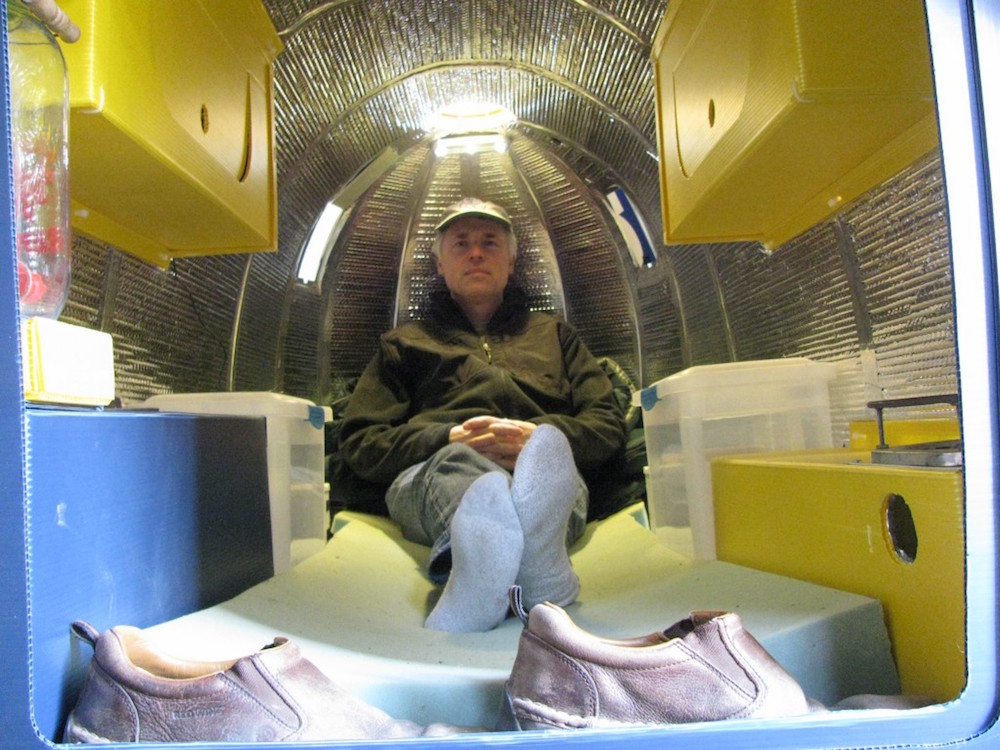
We’ve explored bicycle towed trailers in the past. In particular, the Wide Path Camper seemed like a nice execution of the idea. But as a number of readers noted, it had a couple big liabilities. First, was its weight of 100 lbs. While this is a reasonable weight for a camper, it’s a lot for a human to drag any considerable distance. The next was its high profile, which would catch the wind like nobody’s business. This Micro Airstream bike camper by maker extraordinaire Paul Elkins solves many of these problems, being lighter, sleeker and a lot cheaper than the WPC (or anything else we’ve come across for that matter).

paul-elkins-trailer paulelkins-interior

It has most everything a single tourers/nomad needs. At 45  lbs, it’s a bit heavier than a trailer, but has an insulated sleeping structure that adds a ton of functionality and removes the need for a tent. It has a low, curved profile, which will probably still catch the wind, but not so much as to prove unworkable. Best of all, Elkins offers plans to make the trailer for $150 out of materials such as zip ties and recycled campaign posters (a commodity that will abound in the coming months). Check out the above video by Fair Companies and be sure to visit Elkins other amazing DIY projects.

Sweden’s Nature Pill for City Dwellers

Last summer we looked at kolonistuga, the garden and vacation colonies that dot Sweden and are occupied with tiny cottages. Like most great ideas in compact living, you know that Kirsten Dirksen‘s camera is not too far behind to take a more intimate look. The particular kolonistuga in this Faircompanies video is located between a bunch of freeways in Gothenburg, Sweden’s second largest city. Rather than being littered with vacation homes, most of the tiny structures are more like garden sheds (though one of the interviewees confesses her family has crashed out there on numerous occasions). The colony is intended as a supplement to urban living, which sometimes has an alienating effect on one’s connection to nature. This colony also has an intent close to its roots (pun intended) of growing food.

The kolonistuga idea is so great because accepts the ills of urban living–cramped quarters, noise, harried living, too little access to greenery and fresh air, etc–and creates a right sized, no frills pill to remedy the condition.

Moving Up Maslow’s Pyramid with Kirsten Dirksen

Since 2006, Kirsten Dirksen and her husband have been producing *faircompanies, a web video series that has evolved to become the world’s most comprehensive archive of compact homes and the people who made and live in them (among other things). Virtually every significant small space–from our own LifeEdited apartment to Nakagin Capsule Tower to many, many others you never heard of, but should have–has been lovingly chronicled by Dirksen.

As her profession dictates, Dirksen’s focus has her looking at others, but we thought it was time to turn the focus on her, finding out more about her and *faircompanies..

David Friedlander: Tell us a little bit about yourself.

Kirsten Dirksen: I live in Fontainebleau, France (40 miles south of Paris). We just moved from Barcelona this fall.

I don’t really have a job title. I used to work in television, then I met my husband in Barcelona and started commuting there between freelance TV jobs in NYC. Once we had kids I began to do more freelance work from Spain, but now I just make videos for our website and youtube channel.

DF: How did *faircompanies begin?

KD: Back in 2006, my husband, Nicolás Boullosa, had the idea to start a website that was a type of 21st-century Whole Earth Catalog. While it has evolved into something a bit different, “access to tools” is still the logline for *faircompanies.

With my videos I try to focus on great stories: people who are building unique homes, creating new vehicles, reinventing gardening, etc. Again echoing Stewart Brand (founder of the Whole Earth Catalog), I believe in the power of basic tools and skills–and the technologies available to us today (e.g. 3D printing, aeroponics, Arduino)–to shape our environments in a way unthinkable a few generations ago. As Brand wrote back in 1968 “we are as gods and might as well get good at it”. (For a taste of all this, I put together a compilation video of some of my stories here).

DF: What is your intention behind making the videos?

KD: I want to explore stories in the way I wanted to film and edit them, but often couldn’t while working for broadcast media. I make videos to examine how other people live. The camera gives me an excuse to ask questions.

What attracts me most to people who have minimized their lives (their possessions, the size of their home, etc) is the shift in focus. Here are people who have decided not to focus on stuff and so that leaves the more interesting topics, namely, my personal favorite: anything related to philosophy of life.

DF: What is or are the favorite videos you’ve produced and why?

KD: I don’t have a favorite video. I feel that each video builds on the others and they’re all part of this trip I’m on of discovery. That journey involves:

DF: Anything else we should know?

KD: I want to be sure to point out that I’m very aware of how easy it is to oversimplify all this. I don’t think a tiny house, or a tiny wardrobe, makes anyone happier, but it might open up more paths toward fulfillment. If you think about it within the framework of Maslow’s hierarchy of needs, those who have chosen to make their physical needs small, and easier to achieve, can move on to working on self-actualization.

Returning to Stewart Brand’s ideas about the incredible access to information we all have at this moment in history, I try to tell stories to help remind people about the great power we all have at our fingertips. I think the Internet has also made it dangerously easy for us to identify with mass movements and, at times, to fall victim to victimhood. I hope my videos inspire people to recognize the great power we all have, even if it’s just to make small, but often significant, changes in our lives.

Hide Out in the Hills with this High Design Getaway

If DIY, salvaged material made, moss-covered Hobbit holes aren’t your thing, the VIPP Shelter might just be. VIPP is a Danish product design company best known for a pedal operated trash can (trust me, you’ve seen it). In their shelter they wanted to create a “plug-and-play getaway”–everything from the structure itself down to the linens has been designed by VIPP and is included in the purchase price. VIPP wants the owner to set up the, ahem, cabin and get relaxing ASAP without burden of choosing which door handle goes best with the moulding.

vipp-shelter-kitchen

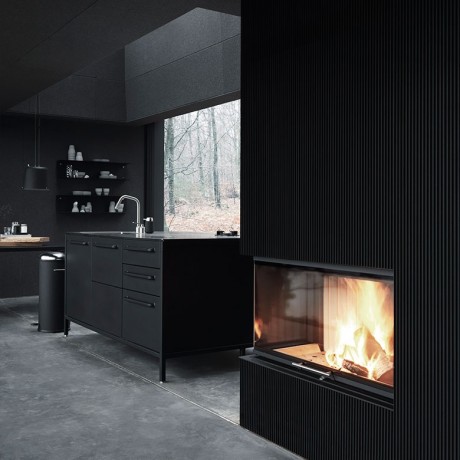
The first thing you’ll probably notice about the prefab, 55 sq m (592 sq ft) shelter is glass. It’s everywhere. On the two main walls. On the ceiling. The idea being to give the owner maximum exposure to nature. The next thing you might notice are dark colors: everything is swathed in some shade of black or grey. Again, the idea is to take focus away from the interior spaces and cast it outside. The whole thing sits on nine steel pillars to give the effect of levitating over the land it inhabits. 

vipp-shelter-bed

The place is a marvel of industrial design, with every inch of the structure made of the highest quality materials installed to the tightest tolerances. The 1000 lbs+ glass windows glide along roller bearings in a discrete floor track. The ladder to the sleeping loft looks like it could support a Sherman tank. The walls are sheathed in 3mm felt to create womb like silence.

For a more leisurely tour showing all of the space’s features as well as an explanation why those features exist, take a look at the above Fair Companies video of the space.

Unlike the Hobbit hole, the VIPP structure cannot be purchase with leftover halloween candy and bellybutton lint. VIPP is charging €485K/$585K for the unit and says it’ll take six months to deliver and 4-5 days to install onsite. For those with more money than time, a deep affection for high modern design and a longing for nature, this could be a great deal. For more information or to place an order visit VIPP’s website.

HT Daid M.

Video: Man Goes Beyond Off Grid, Going Under It

Happy Friday! Sit back, relax, grab a bowl of cereal and watch this Fair Companies video of Dan Price and his Hobbit hole home. Be prepared to feel like your life is a wasteful, complicated mess. It’s fairly tough to get much lower impact than Dan. He lives in a tiny subterranean Shire-like structure that is almost wholly constructed of reclaimed materials. He pays $200 a year for the land his house sits on (or, rather, under) and his annual expenses total $5K. He gets most of his water from a spring. His feces are composted in a toilet he made 25 years ago. He uses the tiniest bit of electricity. His diet consists mostly of raw fruits and veggies and cereal. He has very few possessions. Almost everything in his life has been edited–a word Price, once a professional photographer, uses liberally–down to the most essential. Despite his radical level of editing, Price sees himself as a pretty normal guy, albeit one who has and consumes very little stuff.

The video is really worth the full 34 minute viewing time. It’s the chronicle of a man who has consistently chosen to live according to his own rules (His lifestyle is no flash in the pan. Before the Hobbit hole, he lived in a tent, teepee and tiny house). And while he considers himself a normal guy, he alludes to how his lifestyle is partly the function of being a bit of a hermit–that more human contact would put him under more scrutiny, making it more difficult to do his own thing, which he seems to enjoy quite a bit.

Even if you don’t want to live like Price, to know this level of minimalism is not only possible, but being carried out, might help inspire whatever bit of modest editing you might be having difficulty incorporating into your life.

Tour Yesterday’s Future Architecture Right Now

I’ve long expressed my affection for the Nakagin Capsule Tower. The 1972-built residential tower, located in the Ginza district of Tokyo, was a daring expression of the Metabolism architectural movement. Each tiny, prefabricated unit was self-contained, fully furnished and affixed to a central spine. The units were meant to be easily attached and detached from the spine for upgrades and reconfigurations. Unfortunately, the building was fraught with design and engineering problems–constant leaks, poor circulation in the units and so forth. And today, the building lies semi-derelict, ever in danger of feeling the crush of a demolition ball.

Fortunate for us, Kirsten Dirksen from Fair Companies got into the tower before it’s gone forever. Guided by Masato Abe (who, incidentally, rents out capsule units on Airbnb. Dirksen actually stayed there with her husband and three girls), she gets an in depth look at the building and its amazing level of detail. Abe also gives a nice explanation of how its creators thought it would be used.

There’s been a recent resurgence of multi story, prefabricated urban skyscrapers (some micro), but their level of design daring pales in comparison to Nakagin (many, like Brooklyn’s B2, have been similarly fraught with engineering hiccups). And while the Capsule Tower was far from an unbridled success, I hope it will continue to inform the shape of urban architecture for years to come.

Via Fair Companies

Video: Tour Arcade Providence Micro-Apartment Complex

I’ve long expressed my affection for the Arcade Providence, America’s oldest indoor mall that was recently converted to house ground floor retail and two upper floors of micro-apartments. Fair Companies took a video tour of the building and interviewed the building’s developer Evan Granoff as well as a few of its tenants.

Besides getting a live action view of the spaces, the video goes into more detail about the building’s economic and social structures. Granoff touches on some of the economics, about how the micro-apartment structure, with its high cost per dwelling unit square foot offsets some of the expenses related to the building’s huge common areas. He also talks about the “micro-retail” shops on the ground floor that support independent businesses. The tenants talk about how the little spaces give them everything they need as well as some of the adaptations they’ve made to fit into the dinky spaces. Worth a look.

Video Tour of Brooklyn Studio to Two Bedroom Conversion

Something about Adam Finkelman’s Brooklyn transformation of an open-floor-planned studio into a two bedroom apartment really resonated with our readers. Perhaps it was his imaginative use of reclaimed materials or the one-month’s rent budget for the conversion or how relatable his situation was (i.e. how do you create a functional, affordable living situation in an expensive neighborhood?). Whatever the reason, people loved the apartment.

Our good friend Kirsten Dirksen from Fair Companies managed to catch up with Adam and his roommate for a video tour of the space. Besides seeing the space itself in living–and moving–color, the two roommates elaborate on the design creativity that went into the space as well as the lifestyle creativity that fuels their lives and pays their bills. The space is used as an popup restaurant, concert/jam session venue and, of course, carpentry lab. Between their various endeavors, they offset their living expenses while maximizing the space’s utility–not to mention living a pretty cool looking life. Check it out.

Très Petite Maison Parisienne

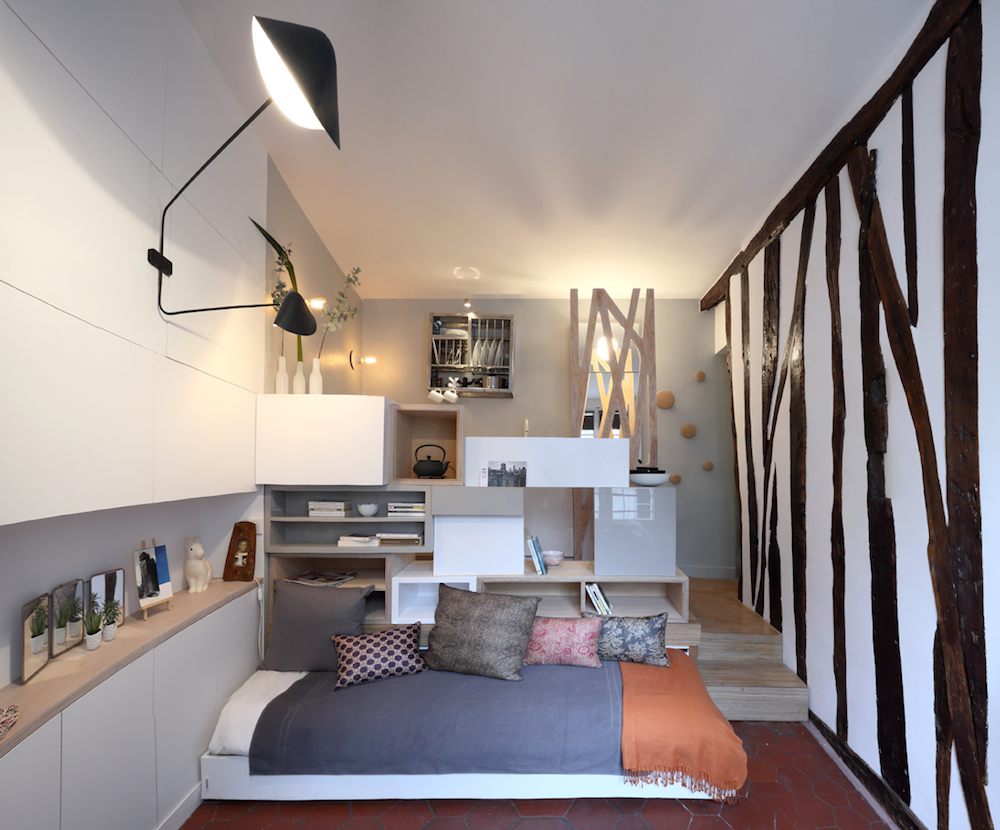
The stereotypical profile of someone living in a 129 sq ft apartment is a person who might have trouble putting together enough scratch to afford ramen noodles. Therefore the idea that he or she could pull off a tasteful and smart renovation is nearly unthinkable. We talk here a lot about this phenomenon: how small spaces tend to get marginalized because many of the people who live in them might not have the resources to give their spaces the design love they deserve. So we are quick to point out exceptions like this tiny (12 sq m/129 sq ft) Parisian flat designed by Julie Nabucet Architecture.

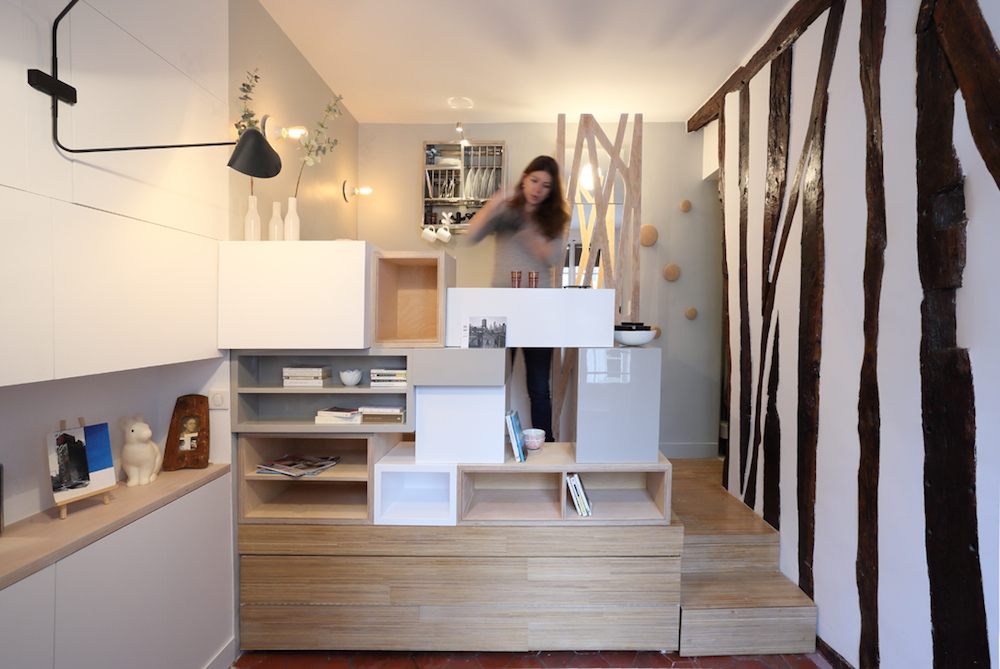
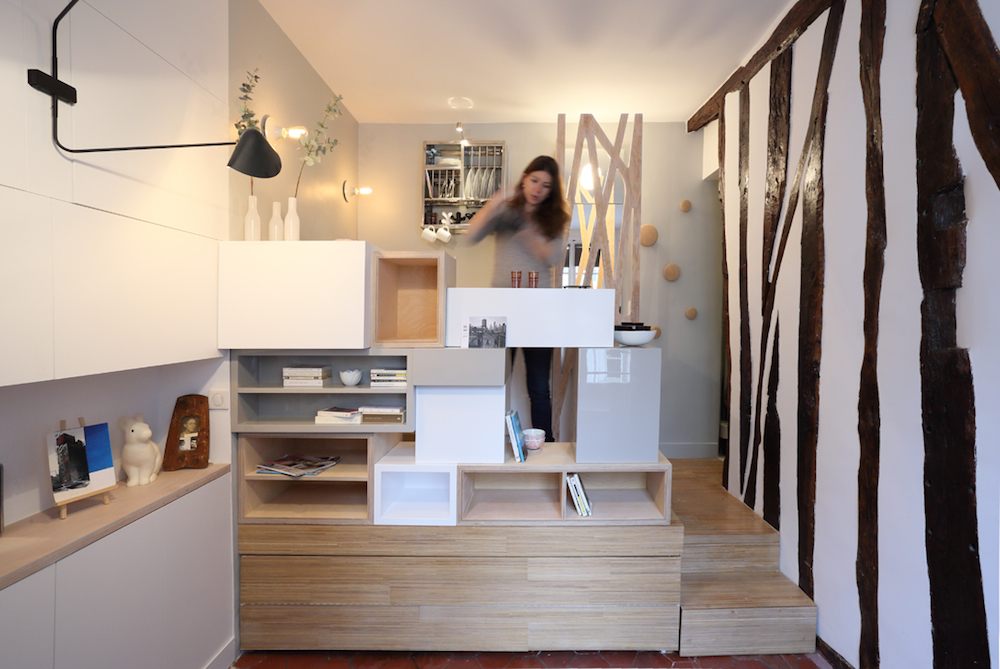
The main feature of the space is a raised platform that holds a trundle bed. When extended halfway, the bed also acts as a sofa. There is a clever drawer built into the platform stair that holds pillows (an oft-overlooked detail with many hiding beds).

Stacked wooden boxes separate the kitchen from the living room and act as storage–these make a lot of sense, though we suspect they’re not stable enough to use as a counter. There is a bunch of built-in storage along the room’s main wall.

The small kitchen has a two burner cooktop and a small convection/microwave oven (everything is kinda small actually). The bathroom sink is separated by a lattice plywood divider that creates some separation without closing off the space; the proximity of the bathroom sink to the kitchen keeps the two sinks on the same plumbing line.

Like many tiny spaces, this apartment’s main feature is its central location in the Montorgueil quarter. In her interview with Fair Companies, Nabucet talks about how Parisians tend to live outside, which makes big private spaces unnecessary. With a little bit of design, this apartment is a nice demonstration that your urban launchpad can be as attractive as it is functional.

Take a Tour of Steve Sauer’s 182 Sq ft Triplex

A while back, we looked at Steve Sauer’s 182 sq ft, self-built “pico-dwelling” in Seattle. The tiny triplex, built in a converted storage area, has the level of intricacy you’d expect from a Boeing engineer (Sauer’s day job). Though we have yet to check out Sauer’s digs in person, thanks to Fair Companies, we have a video tour providing the next best thing.

Beyond its outsized features–e.g. a soaking tub and ability to entertain 17–what shows through in Sauer’s space is quality. With butcher-block cabinets and stainless steel fixtures everywhere, the space looks like it could withstand a simultaneous hurricane and tornado. The space was designed and fabricated by Sauer and is a real feat of engineering. Definitely worth a watch.

Via Fair Companies