Helsinki Attempts to Create a Seamless Transit Web

Last year we looked at DriveNow, an innovative program set up by BMW that would connect you with whatever form of transit made sense given your location. The system, accessed via a smartphone app, could, for example, direct you from a shared bike to the train to a DriveNow BMW car parked at the train station. The system holds the promise of a swift and efficient connection of transit options, none of which requires personal ownership of any vehicle.

One issue with DriveNow program is that focuses on automobile travel (albeit BMW wants those automobiles to be their electric i-Series). It’s also possible that if the system were governed by BMW, there might be some conflict of interest between public and private interests. What if the most effective way of traveling has nothing to do with BMW? What if something like DriveNow was an open and neutral platform, almost like a public utility? That’s exactly what Helsinki Finland is trying to do. Their “mobility-on-demand” system would be a comprehensive transit system that would seamlessly (and neutrally) link you to the most efficient mode of transit available.

Helsinki’s program was devised by transportation engineer Sonja Heikkilä and would allow users to enter a pickup and drop off location. You could enter in preferences and the system would map out your journey, even factoring in things like weather in order to devise an optimal plan.

Another key part of the system would be how payment is given. Currently, people pay for their transit to whichever system they’re using. For example, they pay the Helsinki Region Transport when they take public transit. The “transit-on-demand” program would centralize payment, buying transit wholesale from the various providers. People could choose various payment options; they could pay by the kilometer or have unlimited use, with each having a different pricing structures depending on frequency of use.

The city is launching a test run with a small group of people at the end of this year. If all goes well, Helsinki hopes to have this program up and running by 2025.

Helsinki’s Kutsuplus system sets a precedent that this could work. Kutsuplus is a geo-locational minibus service that creates its routes based on realtime demand–sort of like a mix of a public bus and taxi cab, with a price that’s square in the middle of the two.

Heikkilä told the Helsinki Times that this program is not merely representative of innovation and efficiency, but the fact that “a car is no longer a status symbol for young people.” In other words, people, particularly young ones, are just as interested in pimping their planets as they are their rides.

Image credit: Slava2009 / Shutterstock.com

Via The Guardian
The Smarter, Simpler Smartphone

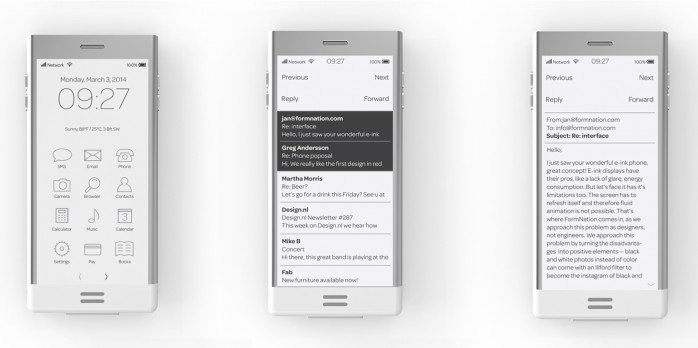
If you’re like me, you have a somewhat conflicted relationship with your smartphone. Features like GPS, email, basic web browsing and ebook reading have become indispensable. But I also find myself looking at screens filled with apps I’ll never use. And while I appreciate the Retina display on my iPhone, I don’t use it for watching movies or playing games–things that might justify its extreme energy sucking tendencies. In fact, I find myself constantly charging my phone with even the most moderate use. I would love a simple–but not too simple–smartphone that retains basic functionality but uses far less power than my iPhone. I want an E-PHONE by New York design consultancy FormNation.

The basic idea behind the concept phone is to retain most of the smartphone functionality, but use an e-ink display, which consumes a fraction of the power of LED models (the battery could last as long as a month on a single charge) as well as reducing the phone’s capabilities. It would still make calls, texts, have music, a GPS and web-browser–it would just do it in black and white and not have fluid motion graphics (video, games), which aren’t essential for many people anyway. Head designer Jan Habraken asks, “Do we really need angry birds or flying pigs?”

e-phone-camera

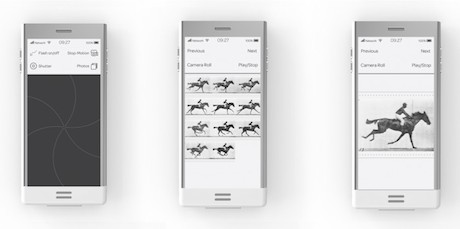
The phone would take pictures, but since the display is in black and white, it’s anyone’s guess how colors will appear in the shot when they’re downloaded. FormNation says users would enjoy “the suspense of waiting to see how their image develops,” akin to how we used to take pictures with 35mm cameras. And rather than taking videos, the E-PHONE will take stop-motion GIF’s.

To make the package even sweeter, FormNation says the E-Ink phone would only cost $175-200 dollars. Unfortunately, there are no immediate plans to manufacture the E-PHONE, but given its long battery life, nice styling and low price, we think it would have a lot of appeal.

Via PSFK

147 Tips to Avoid Wasting Time Online That’ll Blow Your Mind

There you are, doing something worthwhile online–researching, reading the news, connecting with people on Facebook. Then you see a link. “This kitten has a special trick that’ll leave you speechless.” You click through to a web page with a Youtube video of a kitten smoking a cigarette and doing shots of Jaegermeister. You chuckle. You try hard to return to what you were doing. You add four minutes to your life’s clock of time ill used.

We don’t want to suggest that recreational activity–online or otherwise–is intrinsically time misspent, but if we saw our lives as balance sheets divided between time spent on activity that enriches and activity that distracts, chances are much of the viral media that’s out there is basically a waste of time.

A study released last year reported that Americans aged 18-64 who use social networks spend an average of 3.2 hours per day on those networks. While there is surely a portion of that time used to good effect, there is surely another (very large) portion that is spent clicking through to sites that add almost no value to our lives. If you’re interested in having more time for the important stuff, we suggest to look out for and, whenever possible, avoid online media with these attributes:

  1. Titles that use the following adjectives: richest, hottest, best, worst. These are almost always the things that lead to a lot of head-scratching and asking, “where did the time go?” and “what did I gain from learning that?”
  2. Virtually any list exceeding 15 items. Sure, every now and again there’s a useful list that’s longer than 15 (e.g. 100 cities with highest quality of life), but more often than not, these lists are a complete waste of time. In fact, most are designed to generate pageviews. Oftentimes, each item on the list has its own discreet page. The more pages you click on, the more ads the site will expose you to, the more revenue they generate. By all means, get drawn into good content, but beware of endless, superfluous lists.
  3. Virtually anything about celebrities. Unless you’re Kanye West, there’s very little probability that the comings and goings of Kim Kardashian having any bearing on your life.
  4. Stuff about the decade you were born in. 20 Things you’ll appreciated if you were born in the…90s, 80s, 70s, etc.” Yes, like millions of others, I used to listen to Wham and cuff my jeans. This is not critical information to my wellbeing. It’s not even that interesting or funny upon reflection.
  5. Titles that say “Must see.” Think about it, does a respected and venerated journalistic outlet like the NY Times–a place that delivers impactful, high quality, dare we say “must see” content–use the words “must see”? Okay, maybe they would in today’s click-happy media landscape., but really important stuff rarely needs to convince you of its import.
  6. Titles that end with “what happens next will blow your mind.” Okay, maybe it will blow your mind, but it will not, in all probability enlarge it.
  7. Titles with “Your won’t believe…” Again, unbelievability and usefulness are not synonymous.
  8. Titles that start with “Things you didn’t know about…” You probably didn’t know about these things because they weren’t that important.

How would you increase this list? Let us know in our comments section.


Amazon Fire Phone and the Merits of Having Barriers

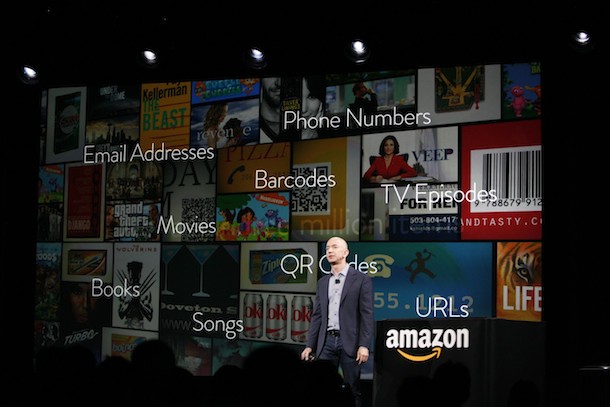
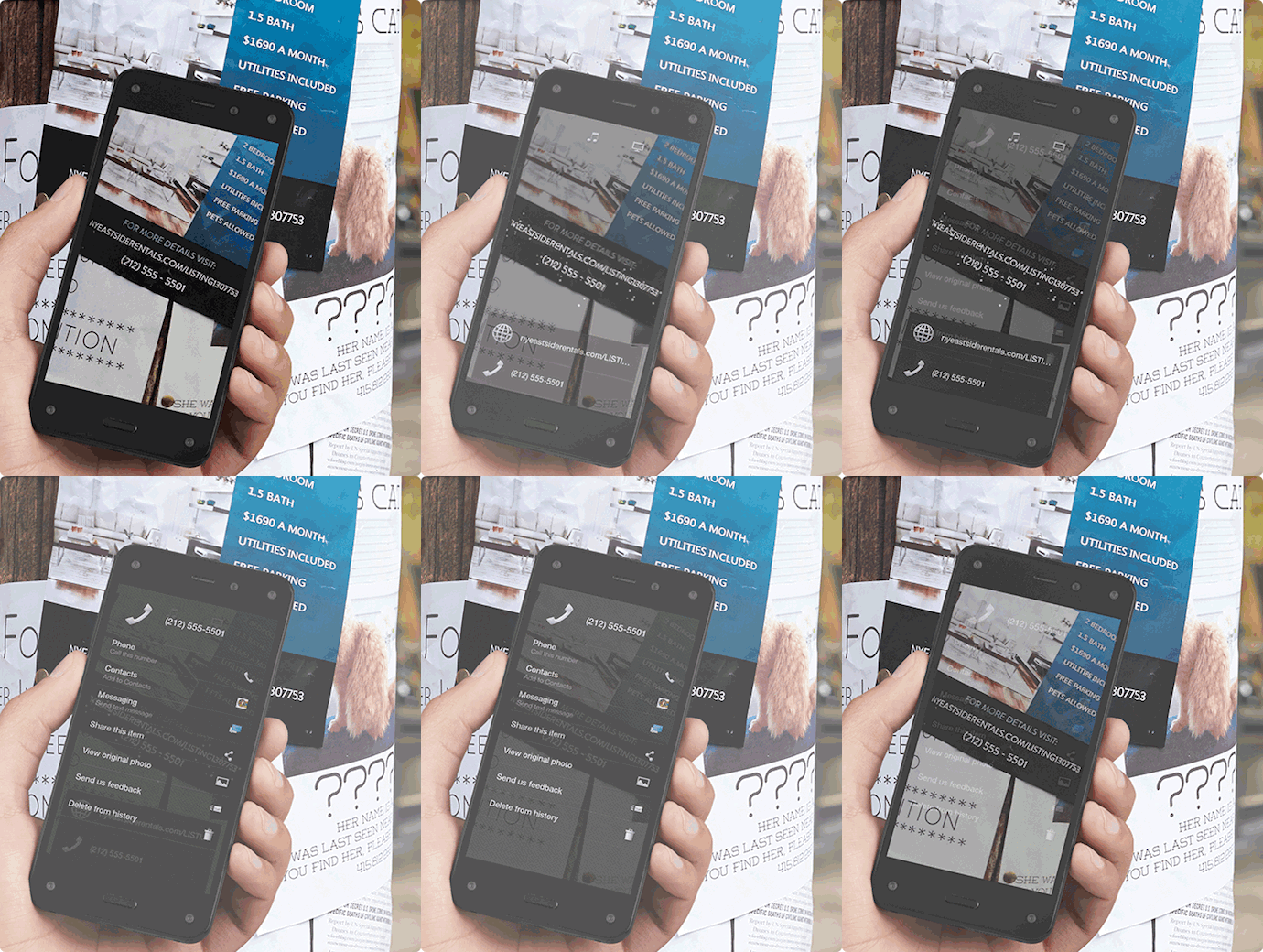
The Amazon Fire phone came out last week with great fanfare. Besides its nifty dynamic perspective capabilities, the Fire features the Firefly technology, which, depending on your perspective, is a great blessing or a major curse. Firefly has some beneficial or benign applications: you can take a snapshot of printed material with a phone number, email or web address; Firefly will allow you to call/email/visit or log the contact info into your phone with the press of a few buttons. You can take a picture of a famous piece of art and it’ll pull up its history. The technology holds the promise (or threat) of never having an unanswered question again.

firefly

But there are other things you can do with Firefly: via its various sensors (photographic, microphone, text) it’ll recognize movies, music and over 70 million products, all of which can be added to your Watchlist, Playlist, Wishlist or shopping cart. For example, take a picture of that copy of Ulysses by James Joyce at your friend’s place and you can buy it on the spot; let Firefly hear that snippet of James Brown’s “Living in America” and you can buy the MP3…and so on. We’d imagine some time in the not-too-distant future that the technology could advance far enough that you could take a pic of someone’s outfit and order everything he or she is wearing.

Of course, you’re not adding these things to just any watch or wish list, or just any shopping cart–you are adding it to your Amazon lists; you are, if Jeff Bezos has his way, buying stuff from Amazon. And there’s very little to stop you from walking into a Best Buy or any other retailer, snapping pics of all the stuff you want, then buying them for less on Amazon. We’re not lawyers here, so we won’t pretend to understand monopolies and antitrust laws, but it seems like Amazon is trying to lay the groundwork for a world where we can bypass all forms of non-Amazon shopping.

But leaving aside the Firefly’s benign applications and ethics, we wonder whether the removal of barriers to shopping is a good or bad thing? On the one hand, Firefly seems like an amazing way of streamlining our lives. No longer would we run out of toothpaste–just snap the barcode when we notice our tube running low and wait a couple days for a new one to arrive in the mail. This has a great appeal to this author who has an acute distaste for most forms of shopping. In fact, I buy most everything I can from Amazon as it is.

On the other hand, the opportunity for impulse buying would seem to increase dramatically. We could buy a pair of sneakers or Star Wars Darth Maul Fx Lightsaber with nary a thought of whether we need these things or not. And while I don’t like running out of toothpaste, sometimes going to the drug store and getting out of the house and running into a friend is not the worst thing I to do.

The other day, we reviewed the TINY documentary, which, as many pointed out in our comments, might not have been the most authoritative guide to small living. But the movie did, at least to my mind, show the benefits of developing a connection with out stuff. While shopping is a pretty superficial connection to the processes that bring stuff into our lives, it is some connection. Might the ability to buy stuff by taking a pic and pressing a button further erode that connection? It’s a world where humans don’t make stuff, they don’t even sell stuff–the world Firefly might presage is one where stuff comes from our phones and UPS.

Then again, maybe shopping in the physical space will one day be an archaic act–one that few of us will miss.

What do you think? Do you think the removal of barriers to purchasing a good or bad or neutral thing? Have you use Firefly? Let us know what you think in our comments section.

Image via Nextweb

How to Create a Healthy Relationship with Technology

Aside from publishing this site and our real estate arm, one of the chief things LifeEdited does is spread the less is more gospel at various conferences. This last weekend we–specifically Graham Hill with my assistance–presented at the Revitalize Conference organized by the good folks over at Mind, Body, Green. The name of our talk was “Signs You Have an Unhealthy Relationship With Technology.” While there’s undoubtably a crisis of excess affecting consumer goods and architecture, those things are well-matched by the attention crisis. We live in a world where people are glued to glowing LCD screens for many of their waking hours–some of those hours are used to good effect, many are not. The talk was an investigation into this relationship between humans and personal technology as well as a brainstorming session for possible ways through some of the more problematic aspects of that relationship.

We touched on the marvels technology has wrought (mostly portable and information tech–smartphones, tablets and to some extent computers). It has given us the ability to access vast amounts of information instantaneously; the ability to fit tens-of-millions of songs or books in our pockets; the ability for unprecedented levels of connectivity, which has changed the face of social activism a la Arab Spring, the Occupy movement and others.

But in line with the talk’s title, we spent a good deal of time elucidating some of the more problematic aspects of technology use. A bunch of this we covered a few weeks ago with the post “Distracted, Dangerous and Dumb: Why it Might Be Time to Check Our Cellphone Use,” which explained how our technophilia is making us bad students, thinkers, friends, lovers, community members and parents. Expanding on that, here are few more things we found about the deleterious effects of our overuse of technology:

  1. Portable tech is making us really, really, horrendously awful drivers. This can’t be overstated. According to the National Highway Traffic Safety Administration (NHTSA), sending or receiving a text takes a driver’s eyes from the road for an average of 4.6 seconds, the equivalent–when traveling at 55 mph–of driving the length of an entire football field while blindfolded. They say driving and texting is six times more dangerous than driving while intoxicated.
  2. It’s even making us bad walkers. Experts say distracted walking results in more injuries per mile than distracted driving. Reports of injuries to distracted walkers treated at ERs have more than quadrupled in the past seven years and are almost certainly underreported. There has been a spike in pedestrians killed and injured in traffic accidents in that time as well (though there is no reliable data on how many were distracted by electronics).
  3. It’s making us nervous nellies. Americans check their phones, on average, 150/day according to study conducted by Nokia.
  4. Our technophilia is crap for the environment. The average American generates 65 lbs of e-waste every year–a yellow labrador’s weight in electronic waste–much of which does not get recycled.
  5. It might be bad for our health. The International Agency for Research on Cancer (IARC), an agency of the World Health Organization, downgraded radiation from mobile phones from a category 3, which means “no conclusive evidence” of causing cancer, to category 2b–a “possible human carcinogen”–a designation shared with diesel exhaust, chloroform, jet fuel, lead and DDT.

When we got all the nasty stuff out of the way, we started seeking solutions. We explained that technology is not bad any more than a chef’s knife is bad–it can be wielded by Mario Batali or Norman Bates for very different purposes.

The thing that became evident is that in many ways technology use is in its infancy. For most of humankind, we have had incremental introductions of technology. In Europe, the lowly table fork took about 700 years between its first notable appearance and widespread adoption. Smartphones have been around for about ten years, yet 56% of Americans already have them–a number that’s only expected to increase. We haven’t had time as a culture to develop rules and etiquette around their usage. So we proposed a few strategies that might start fostering a happy, healthy, balanced relationship with technology:

  1. Regularly going tech free. This is an obvious, though seldom followed, suggestion. We suggested not only turning off your phone, but actually getting away from it–charge it away from your bed at night, keep it off the dining table, etc. Stay away from tech an hour before sleep and upon awakening. Also, we suggested taking a tech sabbath once a week or more. We also suggested going analog for certain things; sure, it’s pretty awesome that smartphones can do so much, but if checking the time on our phones sets us off on four hour Facebook binges, maybe it’s time to get a wristwatch. Likewise, we might play Scrabble rather than Angry Birds, talking to someone face to face instead of chatting online. Sometimes the old ways are the best ways.
  2. Build your defenses. All of us have moments of weakness. If we’re straight about that, we can effectively defend ourselves from common dangers technology poses to our wellbeing. We suggested batching emails, calls and texts, choosing a time or two a day when we knock out all of our correspondences, rather than having a distracting drip feed of correspondences throughout the day. We suggested disabling push notifications–those (generally) useless reminders that come up on our smartphones telling us that Joe thought the new episode of Orange is the New Black was interesting. We suggested using the Airplane mode on our phones liberally. Most of us non-surgeons have few true emergencies. It’s okay to be offline for a while.
  3. Honor yourself and others. When we check our phones incessantly, what we are communicating to the world, in the words of Renny Gleeson, is that “you are not as important as anything that could come to me through this device.” When he said “you,” he meant the people we spend time with, but this could also mean ourselves. By continually checking our phones, we are communicating that our phones and whatever bits of information they transmit take priority over the present moment–whether that present moment is spent alone or with others. If we value our lives, if we value our friendships, if we value our surroundings, we suggested that we might all start acting that way, honoring these things with our “payment” of attention and putting the damn phone down. We suggested getting reacquainted with the art of being “in-between”–those gaps between activities that used to be filled with no activity but are now filled with information. It’s been said that 75% of Americans report using their phones on the toilet. We suggested practicing going tech-free waiting in line, sitting in a cab or taking a poop. Lastly, we suggested leading by example. If we want our kids to be less tech-addicted, if we want our friends to pay better attention, we must do it first.

We also pointed out that these are not fantasitc goals. There are many people living with no or minimal technology, some notable like Jim Jarmusch, Warren Buffett, Louis CK and Alain de Bottom. The latter figure announced to his 443K Twitter followers that they should delete their Twitter accounts. Our closing thought was the reasoning de Botton gave to the Washington Post about his newfound relationship with Twitter. It’s a sentiment we think is applicable to most tech use. He said:

Twitter is of course a wonderful thing, but it is also the most appalling distraction ever invented. It sounds so harmless…[but] It denies us that precious non-specific time in which you can daydream, unpack your anxieties and have a conversation with your deeper self.

…We need long train journeys on which we have no wireless signal and nothing to read, where our carriage is mostly empty, where the views are expansive and where the only sounds are those made by the wheels as they click against the rails. We need plane journeys when we have a window seat and nothing else to focus on for two or three hours but the tops of clouds and our own thoughts.

We need relief from the Twitter-fueled impression that we are living in an age of unparalleled importance, with our wars, our debts, our riots, our missing children, our after-premiere parties, our IPOs and our rogue missiles. We need, on occasion, to be able to go to a quieter place, where that particular conference and this particular epidemic, that new phone and this shocking wildfire, will lose a little of their power to affect us – and where even the most intractable problems will seem to dissolve against a backdrop of the stars above us. FULL TEXT HERE

We couldn’t agree more.

George Orwell and Ray Kurzweil’s Architectural Lovechild

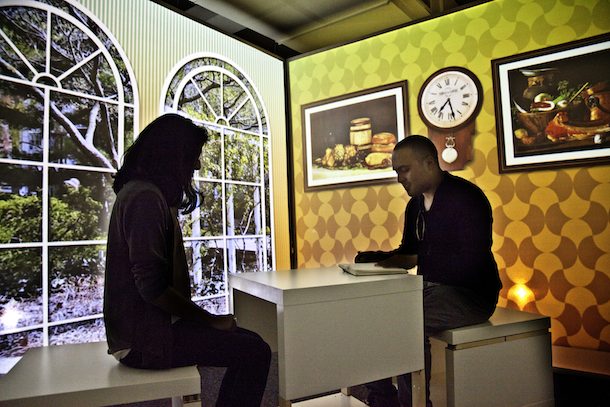
A few weeks ago, we looked at CoeLux, a sophisticated LED light that comes close to replicating a naturally sunlit window. The notion of giving advanced technology the duties historically given to mother nature is, for some, kinda weird. But once you get past the weirdness, you see that high technology could theoretically open up new worlds of possibilities in housing design. Many of those possibilities are being explored by technologist Bernardo Schorr’s Mixed Reality Living Space.

he 100 sq ft space consists of transforming furniture and walls where projections are cast onto. According to its website:

Each different arrangement [of the furniture] is recognized in real time by the environment, which sets the mood and decoration accordingly. The same room serves as bedroom, office, dining room, home theater and library.T, making the function and look of the space infinitely changeable.

mixed-reality-reading

The project has a somewhat dark application. Schorr speculates that the world may one day soon be so overcrowded that people must living in 100 sq ft windowless rooms. The Mixed Reality Living Space would make those little apartments livable. Schorr says it’s “an [sic] utopian solution for a dystopian scenario.”

Be sure to check out the video and let us know what you think in our comments section.

Week of Living Connectedly Wrap Up

I’m going to start this post with a big admission of failure in my #weekoflivingconnectedly. I could do an analysis of my metrics–i.e. number of postings, pics uploaded, etc–but I will say with relative confidence that I didn’t meet the quotas of tweets, Instagram pics and other goals I set out with last week. I could not keep on top of my existing social media sites, much less explore the new social networks I had planned. I am a big, fat social media loser.

As I reported, the experiment started great. I got a big social media endorphin rush after I dumped all of my gmail contacts into both Facebook and LinkedIn (the latter site, I still don’t quite know how to use). Years of various correspondences had trapped some pretty cool people’s email addresses; because of my contact dump, many of those people became my Facebook and LinkedIn contacts (there were also a bunch of people I had no recollection corresponding with…people I love of course). I was excited to be connected with these people, however loosely.

Having this larger network gave–and will give–me access to more ideas, resources and so forth. And when I choose to share my own ideas, resources and so forth, those things will have a larger audience. These are all good things.

But after a couple days of frenzied social media activity, I realized the level of technological connection I sought to achieve required a lot of work and attention. And I made the mistake of conducting my experiment on a holiday weekend–a time when I really didn’t want to work or give my attention to anything other than chilling out, friends and family. For three days I all but relinquished technology and my online presence went dark. And though I had ostensibly “connected” to 300 or so new people, as far as the weekend was concerned, I was really only interested in connecting with a half-dozen or so people–and none of that connection was to be done online. I could have forced myself to keep the experiment up during my precious weekend, but it felt like a major pain in the ass to do so.

My words should not by any stretch be construed as a condemnation of technology or social media. I took away a couple valuable things from the week that I might not have gleaned had I not started the experiment:

  1. I (and probably you) have a much bigger network of awesome people at my disposal than I thought. Who knew that so many cool people doing cool things were just lurking quietly in my contact list? But I never added them to my electronic network because I was shy or thought it presumptuous. But networks aren’t built if you don’t take actions to initiate and maintain connections with people. What I learned is that social media is really good way of doing that. And I also learned that people are waiting to connect with us. No, most of these people won’t become “friends” in the deep sense of the word, but some might. In the future, I will have no compunction about connecting with people online and expanding my network in turn.
  2. Ideas die when they aren’t shared. Years ago, my laptop’s hard-drive crashed. I lost countless things I had written–stuff I had poured a lot of time into and was quite proud of. After the initial shock of the loss, I realized that the only things not lost were those things that had been shared or published. Only the things I had given away were retained. It is easy to argue that the nearly ceaseless stream of information the internet dispenses creates an entropic tangle of information, too tangled to ever be digested and understood in a meaningful way. But I think the web also affords us the opportunity to share the things that are important. If those things are deemed unimportant, they get buried, being relegated to bits of unloved information burrowed deep in some lonely server. But if they’re good ideas–and, yes, often when they’re not good–they have the opportunity to flourish, grow and live. I think I will be quicker to share ideas after my week of living (semi) connectedly than I did before. This is a good thing.


MIT-Designed 200 Square Foot Architectural Gadget

Two years ago, we reported about MIT’s CityHome. The concept presented a technologically-enhanced way of mating residential interiors with resident needs. In the way someone enters personal preferences for an online dating site, a resident would list his or her needs in CityHome’s software and CityHome’s proprietary furniture–much of which was modular and moving–would configure itself to suit that need in any given moment. The concept, which to the best of our information was never build, was based on an 840 sq ft floorplan. MIT’s Changing Places Group, the team behind the project, said this “very small footprint” (their words, not ours) could function like a space three times as large.

We hadn’t heard anything from CityHome until the other day, when Fastco Design reported about the CityHome 200 sq ft. The newer, smaller version shows vestiges of the original concept, but takes space saving much further.

cityhome-wave

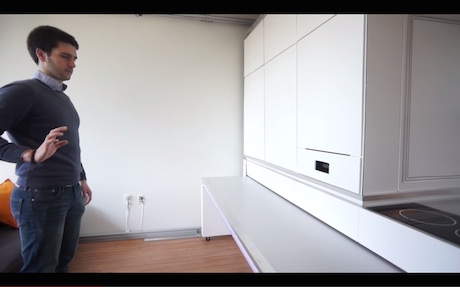
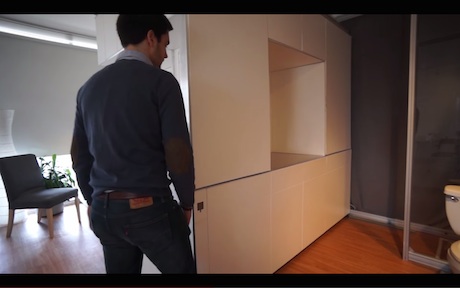
CityHome 200 sq ft centers around a central module that can be plopped (our word, not theirs) in the middle of a tiny apartment. The module contains a bed, dining table, desk, kitchen and storage. The unit contains numerous sensors where body and voice commands enable you to control various functions; you can pull the bed out with a wave of a hand or activate disco lighting if the sensors detect the smell of cheap cologne (the latter function is unverified).

cityhome-shower

The whole module easily slides back and forth. In one position, you can expand the size of the bathroom to reveal a shower; in the other position you can take the shower’s square footage and give it to the living area.

As with other spaces we’ve looked at in the past, we wonder about the longterm feasibility of a space that’s so tech-dependent. What if the bed’s motor breaks? Will you have to sleep on the floor? But the basic design would be super practical even in full-on manual mode.

According to Fast Company who spoke with project lead Kent Larson, the project is not just a far-flung concept, and there are plans of bringing it to market. Of the expense of such an elaborate architectural gadget, Larson says, “At $1,000 per square foot in Boston [roughly the same, or a little less than NYC and SF incidentally], the extra cost of technology is trivial compared to space saved for a furnished apartment.” Makes sense to us.

Via Fast Company Design

Week of Living Connectedly Field Report: Day 1

The first thing I did as part of my experiment was to be as indiscriminate as possible in terms of who I connected with online. Channelling my inner Ray Kurzweil, I figured why not have as many connections as possible, increasing my network and making my outbrain all the bigger. So I dumped my entire Gmail contact list into Facebook and Linkedin. I’d never took this step before because I thought it was weird or intrusive. But really, the beauty of social media is how unobtrusive it is. If you didn’t want to be my friend, you could just ignore me. I’d live.

Well, 200 people confirmed my Facebook friend request yesterday (a number that increases by the minute). My numbers skyrocketed on Linkedin as well.

Here are some of the things I observed about the experience:

  • It was pretty awkward at first to send the invites. I thought I might be perceived as being needy or self-promotional. It helped me having the experiment excuse, though I really shouldn’t have been too concerned. I will not be posting selfies and inane facts about my life. I actually want to see if this experiment might help the free interchange of ideas.
  • There’s a certain excitement that comes from “connecting” with people. I was stoked when a number of people I admired accepted my friendship. I was also happy to refresh connections with people I hadn’t connected with for some time. There were quite a few people I didn’t really know (many people who got added to my contact list because of one or two email exchanges); time will tell how those connections pan out.
  • Social media makes the line between work/personal life fuzzier. I read this quote recently: “A master in the art of living draws no sharp distinction between his work and his play; his labor and his leisure; his mind and his body; his education and his recreation.” While I’m not super revealing about my personal life online, people who check out my online identity–people who might have only had professional interactions with me–will get to know a little more about me. That’s okay.
  • Working full time and helping take care of my son makes my day-to-day stuff pretty dull. You can follow my migrations between home, coffee shop and park, but I wouldn’t take it personally if you didn’t.
  • Social media management can get a bit exhausting. After all of yesterdays thrills, I woke up today not really wanting to soldier on with experiment.

To do’s for today:

  • Focus on meaningfully interacting with other social media sites, in particular Twitter and Instagram.
  • Stick with the goals I set out to achieve yesterday, especially as the weekend approaches, a time when I historically ditch my social media life pretty completely.
  • Focus on sharing ideas. Social media, in my opinion, is pretty ridiculous if it’s just a tool for aggrandizing our lives. It can be pretty amazing if we use it as a place to disseminate and expand ideas.
  • Start thinking about forging new relationships through technology, not just reestablishing existing ones.

The Week of Living Connectedly

As regular LifeEdited readers know, I am no tech zealot. Sure, I use the stuff copiously. I have up-to-date gadgets: 15″ Macbook Pro with SSD, iPhone 5, iPad 2, etc. I am pretty facile with social media: Facebook, Twitter, Instagram. I know my way around apps, how pay bills online and troubleshoot my network printer when it goes offline. But I am no true believer. I certainly don’t believe in salvation through technology. I shudder when I see people glued to their phones. I find the concept of the Singularity frightening. Like many of us who were not fully immersed in technology from the womb, people who remember vinyl, landlines and bunny-ear antennae, I hold onto a certain degree of technological nostalgia. I often wonder whether we’d be better off if technological progress stopped right after humans figured out how to stop plagues.

In many ways, because of these beliefs and prejudices, I don’t give tech a chance. I don’t see how it can and does improve my life. I wonder what my relationship to tech would be if I were to let go of these beliefs and take on the idea my friend Jason Silva calls “radical openness”–a state abetted by technology, where the free-flowing exchanges of ideas initiates an unprecedented rate of growth for human evolution and consciousness? What if technology is here to help me grow and connect with something greater than myself?

So I am conducting an experiment. Rather than going on a tech and online media fast as many are wont to do nowadays, I’m going to pig out for the next seven days, I’m going to avail myself of as much technology as I can and be as connected and reachable as possible. I even took my first selfie (though it may be my last).

Here’s where I’ll start:

  • Turning on all of my chats: Facebook, Google +, G chat. (they’re all black right now. Skype is reserved for work).
  • At least 10 tweets/day.
  • At least three Instagram pics/day.
  • Share at least five things/day I’m reading across various social media channels.
  • Regularly checking in my location with Facebook and Four Square.
  • Experimenting with other social networking sites such as Nextdoor.com.
  • Most important, I will be proactive in reaching out to others–i.e. not just a passive observer of the others who do share (I think this is the big one).

You are personally invited to find me, engage me, introduce yourself, drop me a message, if you happen to see that I’m near you, say hi to me. Share your ideas for LifeEdited, your editing challenges and triumphs, you experiences with tech, whatever. Below is where you can find me online:

I’ll be reporting regularly on my experience and write up a summary on this site next week. I look forward to meeting you on the interwebs and exchanging ideas.